This is an Open Access article distributed under the terms of the Creative Commons Attribution Non-Commercial License (http: //creativecommons.org/licenses/by- nc/4.0/) which permits unrestricted non-commercial Copyright: © 2020 Korean Journal of Agrcultural Science
ENGINEERING
Design, manufacture and field test of a surface water storage tank providing irrigation water to upland crops
Hyung Jin Shin1, Young-Joon Kim2, Jae Young Lee3, Hwang-Hee Kim3, Sung Mun Jo2, Sang Sun Cha4, Seon-Ah Hwang5, Seung-Kee Lee6, Chan Gi Park2,*
1Rural Research Institute, Korea Rural Community Corporation, Ansan 15634, Korea
2Department of Rural Construction Engineering, Kongju National University, Yesan 32439, Korea
3Research Center, Contecheng Co., Ltd., Yongin 16942, Korea
4Industrial Development Institute, Kongju National University, Yesan 32439, Korea
5Soil and Fertilizer Division, Rural Development Administration, National Institute of Agricultural Science, Wanju 55635, Korea
6Department of Bio-Industry Mechanical Engineering, Kongju National University, Yesan 32439, Korea
*Corresponding author: [email protected]
Abstract
For most upland crops in Korea, underground water is used to ensure an adequate water supply.
Thus, surface water storage tanks are needed to supply surface water from reservoirs or streams.
This study discusses the design, manufacture and monitoring of a water storage tank capable of reliably supplying water to crops and preventing the inflow of floating debris. The study was conducted in an apple orchard in Yesan-gun, Chungcheongnam-do in Korea. Based on the water requirements of the crops and size of the orchard, a required flow volume of about 0.6 m3·h-1 was determined, along with a surface water storage tank capacity of 1.2 m3. Following a comparison with other materials, stainless steel (STS) was used to construct the water tank. The tank was designed to provide 14 hours of irrigation, enabling a small-capacity, cost-efficient tank design to be used. A surface water irrigation test was performed using the surface water storage tank. The average surface water irrigation flow rate was 0.00045 m3·m-2·h-1. The water quality test showed that the pH, suspended solids (SS), total nitrogen (TN), and total phosphorus (TP) values satisfied the reference values for agricultural water. The test results showed that the surface water storage tank evaluated in this study allows for crop irrigation when there is a lack of groundwater during droughts.
Keywords: irrigation water, surface water storage tank, underground water, upland crops
Introduction
South Korea is vulnerable to drought during the spring and summer, primarily due to low rainfall and OPEN ACCESS
Accepted: November 26, 2020 Revised: October 20, 2020 Received: July 13, 2020
Citation: Shin HJ, Kim YJ, Lee JY, Kim HH, Jo SM, Cha SS, Hwang SA, Lee SK, Park CG. 2020. Design, manufacture and field test of a surface water storage tank providing irrigation water to upland crops.
Korean Journal of Agricultural Science 47:1057-1069. https://doi.org/10.7744/
kjoas.20200089
spring. Therefore, facilities are urgently needed to supply agricultural water in response to these droughts.
Since the 1990s, various measures for dealing with this problem have been introduced, including new irrigation technologies and securing water facilities such as dams and reservoirs. However, due to a lack of awareness of drought, a regional imbalance in water resources, and insufficient drought policies, drought is still an issue (Choi et al., 2018). Due to recent changes in the utilization of farmland, the importance of upland crops has increased. A survey conducted by Statistics Korea (KOSTAT) in 2018 found that while the proportion of paddy fields in the total cultivated land area decreased by 5.2%
between 2009 (58.1%) and 2018 (52.9%), the proportion of upland fields increased by 5.2% (from 41.9% to 47.1%). In addition, an area of 1,890 million·m2 was converted from paddy fields to upland fields in 2018, which is around 4.4 times the size of the area (36 million·m2) converted from upland fields to paddy fields (Statistics Korea, 2018). According to the Agricultural and Forestry Production Index of the Korean Statistical Information Service (KOSIS), the value of upland crops in 2018 was about 21,600 billion won, approximately 2.5 times the 8,400 billion won value of rice. Based on these data, it can be assumed that upland farming is currently more profitable than paddy farming. The intensity, frequency and persistence of El Niño, which causes severe droughts and flooding, have been increasing since the mid-1970s (Lim and Park, 2017). Due to the El Niño phenomenon, natural disasters such as drought, torrential rains, and typhoons have appeared in rapid succession, resulting in remarkable damage (Shin et al., 2019). Furthermore, increasing frequency and intensity of droughts due to climate change has been documented: there were five major droughts in South Korea in the period 1980 - 2000, six in 2000 - 2010, and four in 2011 - 2015 (Lee et al., 2018). Despite the increasing frequency of drought events,
farmers and scientists remain focused on responding to, rather than preventing, droughts. According to the Water Resources Management Information System (WAMIS; www.wamis.go.kr), the area of irrigated upland fields in South Korea with water supply facilities covered 3,230 million·m2 in 2016, only about 43.3% of the country's total field area. This area is much smaller than that covered by irrigated paddy fields, which was 81.3% (Shin et al., 2019). To address this situation, an irrigation improvement project was launched and has had a major impact on agricultural production. To date, it has primarily focused on paddy fields to improve the self-sufficiency of rice. Due to changes in consumption patterns of agricultural products associated with economic growth and increasing incomes, areas of non-rice crops have been expanding. Recent changes to the Korea-China Free Trade Agreement (FTA) have emphasized the importance of upland farming, which in turn led to the promotion and expansion of upland field infrastructure, including improvement of upland irrigation (Kim, 2014).
As demand for high-quality agricultural crops has grown, farmers have been increasingly interested in water management and upland water irrigation systems. Measures to reduce losses associated with drought, such as reduced crop productivity and instability in supply and demand, are urgently needed. Thus, adequate water sources and irrigation systems are required.
Although domestic ground and surface water can be used for upland irrigation, ground water is typically obtained from wells. Surface water supplied by reservoirs, pumping stations and weirs is used only in certain areas. The water is transferred to storm water detention systems utilizing main irrigation canals and pipe channels. Since most of this water is supplied via unpressurized pipe channels, water storage tanks tend to be installed above the irrigation system. In mountainous areas, irrigation water is supplied to upland fields from an elevated storage tank. However, since surface water from reservoirs and rivers is supplied through concrete or earth canals, suspended solids (SS) can easily lead to contamination. Based on 2018 data from the Agricultural Water Comprehensive Information System managed by the Korea Rural Community Corporation, the Agricultural Water Quality Monitoring Network survey showed that the percentage of locations exceeding water quality standard IV was 11.2% (109/975 locations), the percentage of locations exceeding water quality standard IV was 9.5%
(82/866 locations), and the percentage of city/gun management lakes exceeding water quality standard IV was 24.8% (27/109
locations). Therefore, when using water from a reservoir, a storage tank with a water treatment facility is required. For other surface waters, the water temperature fluctuates, so it is necessary to measure the actual temperature of the water used in cultivation farms in winter. In the present study, the storage tank was designed to prevent inflow of floating matter and maintain a consistent water temperature.
Materials and Methods
Irrigation requirements
The irrigation requirements were calculated based on the method for determining water supply capacity described in
「Design standards of agricultural irrigation (MAFRA, 1998)」, and on 「Design Guide on Construction of Infrastructure for Controlled Agriculture (KRC, 2009)」. The irrigation requirements (Q) were calculated using Equation 1:
Q = 2.78 × A ×F TE × 10- 3 (m3·sec) (1)
Where A represents the irrigation area (ha), F is the number of days of irrigation (days), E is the water usage during a single irrigation (mm), and T is the irrigation time per day (h).
Determining irrigation requirements is important to determine the storage tank capacity requirements. The amount of irrigation water needed is calculated based on the type of crops, cultivation method, and water supply method. Water required for purposes other than irrigation should also be considered. Depending on the crop and soil types, upland crops are irrigated every 3 to 6 days for outdoor cultivation, and every 0.5 to 5 days for greenhouse cultivation. 「Design standards of agricultural irrigation (MAFRA, 1999)」 provided an equation for calculating the required frequency of irrigation (in days), wherein the total readily available moisture (TRAM) is divided by the projected evapotranspiration:
Frequency of irrigation =
Evapotranspiration
TRAM (2)
Water consumption estimation
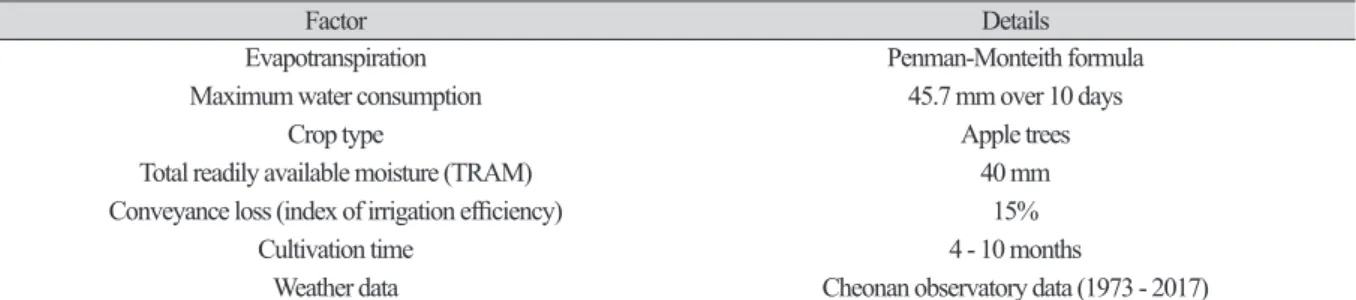
As shown in Table 1, water use requirements are estimated based on evapotranspiration, crop type, conveyance loss (irrigation efficiency), cropping period, and climatological data. For calculating evapotranspiration, the Penman-Monteith equation of the Food and Agriculture Organization (FAO) of the United Nations was used; the crop type was apple trees. The conveyance loss was estimated at 15% (i.e., 85% irrigation efficiency), and the cropping period was from April to October.
Meteorological data obtained over the past 45 years by the Cheonan Observatory, which is close to the study area, were used in the analysis. Crop coefficient data for apple trees are shown in Table 2.
Required storage tank capacity
The larger the capacity of the storage tank, the more capable it is of meeting water requirements. However, increasing the size of the tank reduces the economic efficiency. Our surface water storage tank was designed based on 「Design standards of agricultural irrigation (MAFRA, 1999)」of the Ministry of Agriculture, Food and Rural Affairs. Although the guidelines cover overall planning and methods for determining upland irrigation water requirements, methods for estimating storage tank capacity are not provided. A study aimed at improving paddy field irrigation systems for upland crops, conducted by the MAFRA (2004), introduced the following method for calculating storage tank capacity requirements for field irrigation:
If Q1 < Q2, select less of 4Q1 or 2 (Q2-Q1), and if Q1 > Q2, select 2Q2 or 2Q1.
Where Q1 represents the pump capacity of the tank (m3·h-1) and Q2 indicates the volume of irrigation water per hour (m3·h-1).
To achieve a stable supply of irrigation water, upper and lower water level sensors were installed in our storage tank. When activated, the upper and lower sensors stop and start the operation of the water pump motor. A conceptual diagram of the storage tank capacity is shown in Fig. 1.
Table 1. Factors involved in the calculation of irrigation water requirements.
Factor Details
Evapotranspiration Penman-Monteith formula
Maximum water consumption 45.7 mm over 10 days
Crop type Apple trees
Total readily available moisture (TRAM) 40 mm
Conveyance loss (index of irrigation efficiency) 15%
Cultivation time 4 - 10 months
Weather data Cheonan observatory data (1973 - 2017)
Table 2. Crop coefficient data for apple trees.
Period Jan. Feb. Mar. Apr. May Jun. Jul. Aug. Sept. Oct. Nov. Dec.
First 10 days - - - 0.50 0.72 0.95 1.05 1.05 1.02 0.80 - -
Middle 10 days - - - 0.50 0.72 0.95 1.05 1.05 1.02 0.80 - -
Final 10 days - - - 0.50 0.85 1.00 1.05 1.05 1.02 0.80 - -
Fig. 1. Conceptual diagram of the water storage tank capacity. FWL, full water level.
Test bed
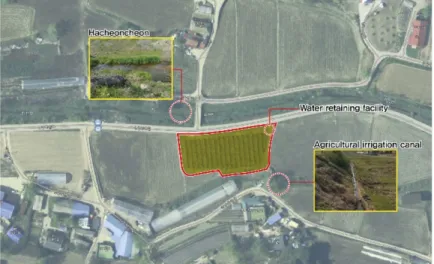
A surface water storage tank was tested in Hacheon-ri, Sinyang-myeon, Yesan-gun, Chungcheongnam-do, over an area of 1,600 m2 converted from paddy to upland fields to grow apples. Water for irrigation was sourced from ground water using a well and stored in a fiber-reinforced plastic (FRP) storage tank. A pump was used to provide drip irrigation as required.
However, due to a reduction in the ground water capacity caused by drought and various other factors, the irrigation water source was insufficient. Therefore, a field survey was undertaken, and a site that could utilize surface water from surrounding channels and rivers was identified. The study area is shown in Fig. 2.
Fig. 2. Location of the test bed.
Water quality test
A water quality analysis was conducted according to the water pollution standards, to evaluate the water purification performance with respect to substances suspended in the surface water storage tank. The analysis was conducted on the influent and the treated water, and the test evaluated SS, pH, and TN-TP.
Results and Discussion
Calculation of irrigation water requirements
To estimate the irrigation water requirements, the irrigation area, number of days of irrigation, water capacity, and irrigation time per day were input into Equation 1. The irrigation area was 1,600 m2, and irrigation was performed for 9 days. The maximum amount of water consumed over 10-day period was estimated at 45.7 mm. Based on these values, Equation 1 calculated the irrigation water requirement to be 0.58 m3·h-1. Table 3 lists the factors included in the irrigation water
requirement calculation.
Surface water storage tank capacity requirements
To calculate the required volume of the storage tank, the method suggested in the 2004 Ministry of Agriculture, Food and Rural Affairs study mentioned above was adopted. The pump capacity of the tank (Q1) exceeds the amount of water irrigated per hour (Q2), and the flow rate is 1.2 m3·h-1 (twice the amount of Q2). The necessary volume of the storage tank, determined by the amount of irrigation water required per hour, was estimated to be 1.2 m3.
Design and manufacture of the surface water storage tank
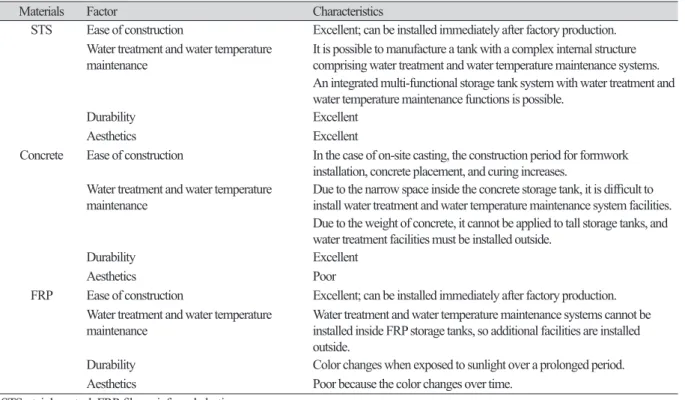
Storage tanks can be constructed from stainless steel (STS), reinforced concrete or FRP. The characteristics of various storage tanks are shown in Table 4.
Table 3. Factors used in the irrigation water requirement calculation.
Factor Data
Area irrigated (m2) 1,600
Days of irrigation
Frequency of irrigation = Evapotranspiration
TRAM = 9
Maximum water consumption over 10 days (mm) 45.7
Irrigation time per day (h) 14
Irrigation water flow rate (m3·h-1) About 0.6
Table 4. Characteristics of various storage tanks.
Materials Factor Characteristics
STS Ease of construction Excellent; can be installed immediately after factory production.
Water treatment and water temperature
maintenance It is possible to manufacture a tank with a complex internal structure comprising water treatment and water temperature maintenance systems.
An integrated multi-functional storage tank system with water treatment and water temperature maintenance functions is possible.
Durability Excellent
Aesthetics Excellent
Concrete Ease of construction In the case of on-site casting, the construction period for formwork installation, concrete placement, and curing increases.
Water treatment and water temperature
maintenance Due to the narrow space inside the concrete storage tank, it is difficult to install water treatment and water temperature maintenance system facilities.
Due to the weight of concrete, it cannot be applied to tall storage tanks, and water treatment facilities must be installed outside.
Durability Excellent
Aesthetics Poor
FRP Ease of construction Excellent; can be installed immediately after factory production.
Water treatment and water temperature
maintenance Water treatment and water temperature maintenance systems cannot be installed inside FRP storage tanks, so additional facilities are installed outside.
Durability Color changes when exposed to sunlight over a prolonged period.
Aesthetics Poor because the color changes over time.
STS, stainless steel; FRP, fiber reinforced plastics.
The study site had a small area of about 1,600 m2, and had been converted from rice paddies to upland field. Because of the small size of study area, as well as the construction requirements and water management facilities a needed for a concrete tank, concrete was not considered as a suitable material. Similarly, the water treatment and temperature maintenance system required for an FRP tank ruled out the use of that material. STS tanks can be built in a factory, and installed directly onsite with a water treatment and temperature maintenance system preinstalled. Therefore, STS was used for the storage tank, where such tanks are also suitable for small areas. As shown in Fig. 3, the main body of the storage tank was welded together following manufacture.
In addition to the storage tank, a mesh net was used to screen the water pump. To clean the filter of the water purification device located within the tank, a backwash pump and internal piping were installed. Also, a water purification filter was connected to the existing internal piping and an external valve and tank cover were connected to the main body. After assembly of the tank and ancillary devices, a control panel was installed on the outer wall to allow both automatic and manual pump control. Finally, the water management system and backwash pump were tested to ensure they were working properly.
Installation of the water pump
As shown in Fig. 4, after laying the influent water pipe (water conveyance line), the water pump was installed in the river to supply irrigation water. A drip hose (water supply line) was installed to complete the construction process.
Testing of the water supply
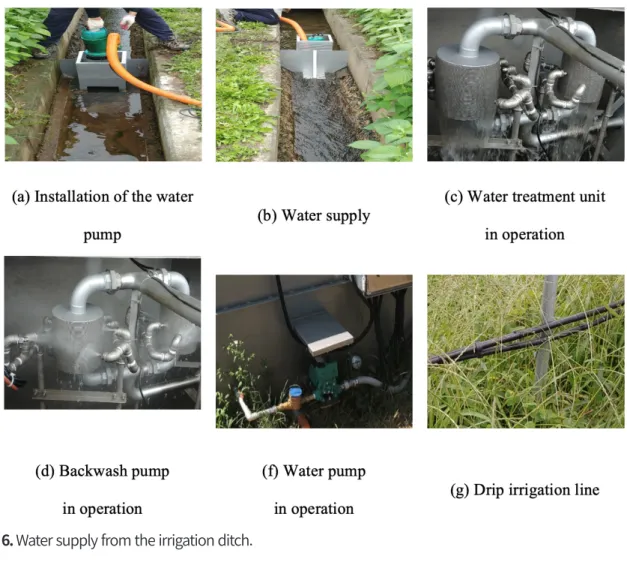
The water supply during non-watering periods can vary because water drain from the irrigation ditch may not be above the level of the water pump. To ensure that the water level remained above the pump, a barrier was installed in the water pump housing (Fig. 5). In addition, the water pump in the storage tank allowed water from the irrigation ditch to be used as irrigation water (Fig. 6).
Fig. 4. Installation of the storage tank.
Fig. 5. Barrier and housing for the water pump.
Fig. 6. Water supply from the irrigation ditch.
Storage tank monitoring results
After installing the system to allow irrigation water to be supplied to the test bed, performance monitoring was carried out.
A farming diary recorded the irrigation water flow rate in the study area from 2017, as shown in Table 5.
The water required for irrigation of the apple trees in 2017 (May-June) was calculated using the HOMWORS (Hydrological Operation Model for Water Resources System) program (Korea Rural Community Corporation, Naju, Korea). The results are presented in Table 6.
Table 5. Flow rates of underground irrigation water delivered to the study site in 2017.
Irrigation date Irrigation time
(h) Irrigation water flow rate
(m3·m-2) Total irrigation water amount (m3·m-2)
2017 May 21 5 0.0075 0.0135
May 27 4 0.0060
June 11 2 0.0030 0.0180
June 12 5 0.0075
June 14 5 0.0075
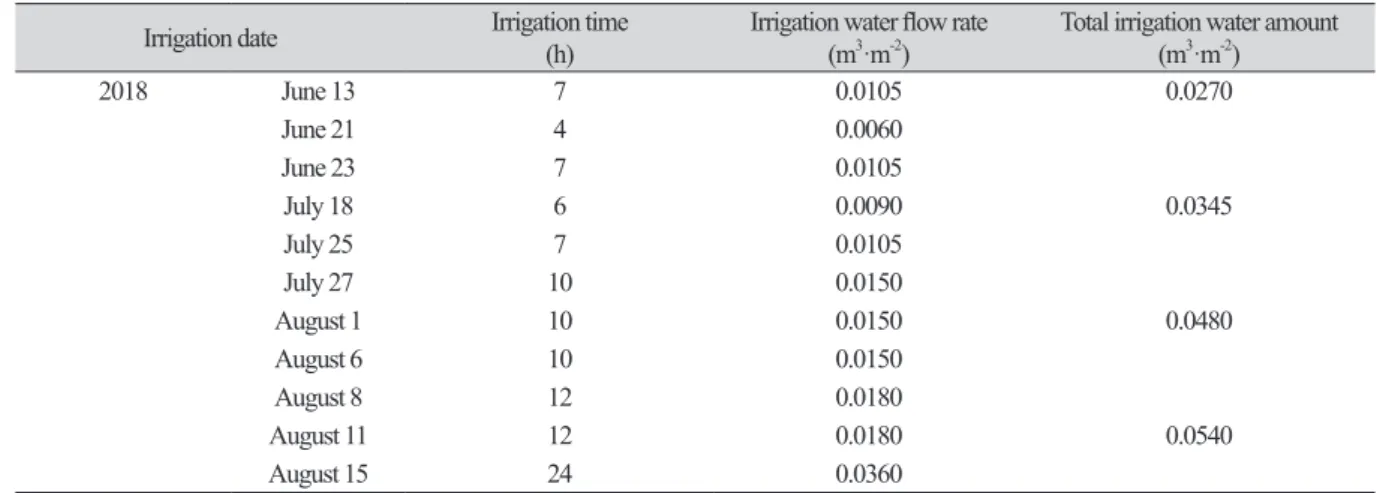
From May to June, an irrigation water flow rate of 0.0121 - 0.1442 m3·m-2 was required for the apple trees. In final-may, the flow rate required was 0.0419 m3·m-2; however the actual flow rate was only 0.0135 m3·m-2. In mid-June, the required flow rate was 0.0538 m3·m-2, but a flow rate of only 0.018 m3·m-2 was achieved. Thus, there was a difference between the required and actual irrigation water flow rates. The variation in flow rate is attributed to fluctuations in weather and soil conditions. As shown in Table 7, the volume of irrigation water supplied in 2018 was significantly higher than that in 2017. The highest flow rate required was 0.0538 m3·m-2 (in mid-June), and the highest rate actually achieved was 0.0540 m3·m-2 (in mid-August).
Table 6. Amount of water required for irrigation of the study site in 2017 (May-June).
Period Amount of water required for irrigation
(m3·m-2) (mm)
May First 10 days 0.0121 12.1
Middle 10 days 0.0321 32.1
Final 10 days 0.0419 41.9
Total 0.0861 86.1
June First 10 days 0.0469 46.9
Middle 10 days 0.0538 53.8
Final 10 days 0.0435 43.5
Total 0.1442 144.2
Table 7. Amount of underground irrigation water delivered to the study site in 2018.
Irrigation date Irrigation time
(h) Irrigation water flow rate
(m3·m-2) Total irrigation water amount (m3·m-2)
2018 June 13 7 0.0105 0.0270
June 21 4 0.0060
June 23 7 0.0105
July 18 6 0.0090 0.0345
July 25 7 0.0105
July 27 10 0.0150
August 1 10 0.0150 0.0480
August 6 10 0.0150
August 8 12 0.0180
August 11 12 0.0180 0.0540
August 15 24 0.0360
Surface water irrigation using the storage tank was performed three times. As shown in Table 8, surface water irrigation using a multifunctional storage tank was conducted three times. Water from the aqueduct was supplied using a submersible pump, and the irrigation time was 1 hour. The average ground water irrigation flow rate according to the farming diary was 0.0015 m3·m-2·h-1) per hour, and that with surface water was 0.00045 m3·m-2·h-1. The irrigation water quantity differed depending on whether surface or ground water was used, according to the farming diary. In this study, evapotranspiration was estimated using HOMWORS based on previous data. However, the water quantities in the farming diary were determined subjectively by farmers according to the prevailing weather conditions. We set the irrigation time to 14 hours in this study, which informed the tank design with respect to storage capacity. A small-capacity tank could be used, which rendered the study economically viable. For commercial storage tanks using surface water, the required tank capacity could be estimated more accurately based on HOMWORS analyses combined with the subjective reports of farmers.
Water quality test results
The mesh net used to screen the water purification device was 75 µm, which was smaller than the drop hose and sprinkler nozzle diameters (0.8 - 1.1 mm). Thus, it was possible to filter fine SS, so no clogging of the irrigation device occurred. Water quality analysis showed that the pH, TN, and TP, at the influent and in the treated water, satisfied the reference values for agricultural water (lake water). However, the amount of SS at the influent was 26.4 mg·L-1, which did not satisfy the standard value of 15 mg·L-1. This is because suspended matter accumulated at the bottom of the tank before treatment. However, after water treatment, a value of 5.6 mg·L-1 was achieved (Table 9).
Table 8. Amount of surface irrigation water delivered to the study site in 2018.
Irrigation day Irrigation flow rate
(m3·m-2·h-1) Total irrigation water amount for a 14-h period
2018 June 21 0.00045 0.0063
July 31 0.00044 0.0062
September 19 0.00045 0.0063
Table 9. Substances in irrigation water at the study site in 2018.
Type of irrigation water pH Suspended solids (mg·L-1) Total nitrogen (mg·L-1) Total phosphorus (mg·L-1)
Inflow water (irrigation channel) 6.7 26.4 1.2 0.010
Treated water (reservoir) 6.3 5.6 1.1 0
Agricultural standard for lake water 6.0 - 8.5 15 > 1.0 > 0.1 >
Conclusions
In this study, a surface water storage tank to supply surface water during farming was designed, manufactured, and tested within an agricultural site. The results are summarized as follows.
Water use requirements were estimated based on the crops cultivated, evapotranspiration, conveyance loss, cropping period and weather data. The maximum amount of water consumed over 10 days was estimated at 45.7 mm.
To determine the required storage tank capacity, the irrigation water flow volume was calculated (about 0.6 m3·h-1). The
The storage tank was manufactured from STS, and the water treatment system was preinstalled. The quantity of water required for irrigation of the apple trees was calculated using HOMWORS. The maximum flow rate required was 0.0538 m3·m-2 (in mid- June 2017), and the maximum flow rate actually achieved was similar, at 0.0540 m3·m-2 (in mid-August 2018).
The average surface water irrigation flow rate was 0.00045 m3·m-2·h-1. The storage capacity of the designed tank was in accordance with an irrigation time of 14 hours, to enable a small-capacity, cost-efficient tank to be used.
The SS, pH, TN, and TP in the treated water satisfied the reference values for agricultural water.
Therefore, the test results showed that the surface water storage tank evaluated in this study allows for irrigation of crops when there is a lack of groundwater during droughts.
The storage tank capacity was relatively small, to keep the manufacturing cost low according to the aim of the study. For commercial application of this storage tank design, the required capacity can be calculated using the HOMWRS program of the Korea Rural Community Corporation and actual farming log data.
Acknowledgements
This work was carried out with the support of "Cooperative Research Program for Agriculture Science & Technology Development (Project No.PJ014813032020)" Rural Development Administration, Republic of Korea and this work was supported by Korea Institute of Planning and Evaluation for Technology in Food, Agriculture, Forestry(IPET) through Agricultural Foundation and Disaster Response Technology Development Program, funded by Ministry of Agriculture, Food
and Rural Affairs(MAFRA)(320051-3).
Authors Information
Hyung Jin Shin, https://orcid.org/0000-0002-7271-6126 Young-Joon Kim, https://orcid.org/0000-0003-0781-7390 Jae Young Lee, https://orcid.org/0000-0002-0879-3100 Hwang-Hee Kim, https://orcid.org/0000-0002-1734-8199 Sung Mun Jo, https://orcid.org/0000-0001-8910-6802 Sang Sun Cha, https://orcid.org/0000-0002-1086-3614 Seon-Ah Hwang, https://orcid.org/0000-0003-1829-402x Seung-Kee Lee, https://orcid.org/0000-0002-0265-891x Chan Gi Park, https://orcid.org/0000-0002-2735-7734
References
Choi YH, Kim YJ, Kim MY, Jeon JG. 2018. On-site evaluation of rainwater harvesting device for securing irrigation water in small fields. Journal of the Korean Society of Agricultural Engineers 60:31-36. [in Korean]
Kim HS. 2014. We must build a field irrigation facility management system. 21 Nov. 2014. p. 15. Korean farmers' newspaper, Suwon, Korea. [in Korean]
KRC (Korea Rural Community Corporation). 2009. Design guide on construction of infrastructure for controlled agriculture. KRC, Naju, Korea. [in Korea]
Lee JY, Kim HH, Shin HJ, Kim HD, Kwon HJ, Jeon JC, Cha SS, Park CG. 2018. Evaluation of drought impact and function improvement effect of agricultural hydraulic structures. Journal of The Korean Society of Agricultural Engineers 60:1-13. [in Korean]
Lim KT, Park JH. 2017. Consumers’ awareness and behavior intention on meat consumption according to climate change. Korean Journal of Agricultural Science 44:296-307. [in Korean]
MAFRA (Ministry of Agriculture, Food and Rural Affairs). 1998. Design standards of agricultural irrigation. MAFRA, Sejong, Korea. [in Korean]
MAFRA (Ministry of Agriculture, Food and Rural Affairs). 1999. Design standards of agricultural irrigation. MAFRA, Sejong, Korea. [in Korean]
MAFRA (Ministry of Agriculture, Food and Rural Affairs). 2004. A study on improvement strategy of paddy field irrigation system for supplying upland crops. MAFRA, Sejong, Korea. [in Korean]
Shin HJ, Lee JY, Jo SM, Jeon SM, Kim MS, Cha SS, Park CG. 2019. Vulnerability evaluation of groundwater well efficiency and capacity in drought vulnerable areas. Journal of the Korean Society of Agricultural Engineers 61:41- 53. [in Korean]
Statistics Korea. 2018. Cultivation acreage survey results. Statistics Korea, Daejeon, Korea. [in Korean]