Journal of the Korean Crystal Growth and Crystal Technology Vol. 26, No. 2 (2016) 58-61
http://dx.doi.org/10.6111/JKCGCT.2016.26.2.058
p-ISSN 1225-1429 e-ISSN 2234-5078
Growth and characterization of bulk GaN single crystals by basic ammono- thermal method
Jang Bo Shim and Young Kuk Lee
†Thin Film Materials Research Center, Korea Research Institute of Chemical Technology, Daejeon 34114, Korea (Received April 1, 2016)
(Revised April 19, 2016) (Accepted April 20, 2016)
Abstract Bulk GaN crystals were grown by the basic ammonothermal method. The c-plane GaN templates grown by hydride vapor phase epitaxy were used as seed crystals and sodium metal, amide, and azide were added as a mineralizer.
The growth conditions are at temperatures from 500~600
oC and pressures from 2~3 kbar. The growth rate for the c-axis was increased with increasing the operating pressure. Average dislocation density was measured 1 × 10
5/cm
2by the cathodoluminescence measurement. The full-width at half-maximum of the X-ray diffraction rocking curve for (002) reflection was approximately 270 arcsec for Ga face and 80 arcsec for N face.
Key words GaN, Ammonothermal growth, Cathodoluminescence, X-ray diffraction rocking curve
Basic 암모노써멀 방법에 의한 벌크 GaN 단결정의 성장 및 특성
심장보, 이영국
†한국화학연구원 박막재료 연구센터, 대전, 34114 (2016 년 4월 1일 접수)
(2016년 4월 19일 심사완료) (2016년 4월 20일 게재확정)
요 약 Basic 암모노써멀 방법을 사용하여 벌크 GaN 단결정을 성장시켰다. 종자 결정은 Hydride vapor phase epitaxy법 으로 성장한 c면의 GaN 템플릿을 사용하고 광화제는 sodium metal, amide, azide를 사용하였다. 결정 성장 온도는 500~
600
oC, 성장 압력은 2~3 kabr에서 실시하였다. c 축의 결정 성장 속도는 운용 압력이 증가함에 따라 선형적으로 증가하였다.
Cathodoluminescence로 측정한 평균 전위 밀도는 1 × 10
5/cm
2였다. Double Crystals X-ray Diffraction로 측정한 (002)면의 반 치폭은 Ga 면에 대해서는 약 270 arcsec, N 면에 대해서는 약 80 arcsec이었다.
1. 서 론
고품질과 대형의 질화 갈륨 (GaN) 단결정 기판은 사 파이어, 실리콘 혹은 SiC 등과 같은 이종 기판 상에 제 작된 광전자 및 전자 디바이스의 개선을 위해 필요하다.
이종 기판의 사용은 높은 전위 밀도(> 10
9/cm
2) 의 생성 및 효율 저하를 나타낸다. 따라서, 상업화를 위한 고품질 의 대형 GaN 단결정 제조가 주요 연구 이슈이며 최근 에는 암모노써멀 성장 기술이 대형 GaN 단결정 성장을 위한 유망한 기술로 관심을 끌고 있다. Jacobs 등은 첫 번째로 전달 매개체를 사용하여 암모노써멀법으로 AlN
를 성장하였다[1]. Dwiliński 등은 1995년에 암모노써멀 법으로 GaN 성장을 시작하였고[2] 두께 10 mm 이상, 직경 2인치 이상의 고품질 GaN 성장까지 진전시켰다[3, 4]. Ehrentraut 등은 새로운 암모노써얼 장비를 고안하여 40 µm/h 이상의 결정 성장 속도를 가진 m면 방향의 결 정을 성장시켰고[5] Yoshida 등은 NH
4Cl 광화제를 사용 한 고온 Acidic 암모노써멀법으로 반치폭이 약 30 arcsec 인 GaN 단결정을 성장시켰다[6].
암모니아를 용매로 사용하는 암모노써멀 방법은 물을 용매로 사용하는 수열법과 유사하다. 초임계 암모니아 내에서 GaN 결정을 성장하는 방법은 다른 성장 방법에 비해 (1) 간단한 장치 구조, (2) 공정 확장성, (3) 다수의 종자 결정을 사용한 동시 성장, (4) 낮은 공정 온도 등 과 같은 장점이 있다[7]. 그러므로 암모노써멀 방법을
†
Corresponding author
†
E-mail: [email protected]
Growth and characterization of bulk GaN single crystals by basic ammonothermal method 59
사용한 벌크 GaN 단결정 성장은 비용 면에서 효과적인 방법이 될 수 있다[8].
암모노써멀 방법으로 결정 성장 시 할로겐(F, Cl, Br, I) 원소를 광화제로 첨가할 경우 Acidic 암모노써멀 방 법이라고 하고, 알칼리(Li, Na, K) 원소를 광화제로 첨가 할 경우는 Basic 암모노써멀 방법이라고 부른다. Acidic 암모노써멀은 온도 증가에 따라 GaN의 용해도가 증가 하는 정방향의 용해도 거동을 나타내고, Basic 암모노써 멀은 온도 증가에 따라 GaN의 용해도가 감소하는 역방 향의 용해도 거동을 나타낸다.
본 연구에서는 Basic 암모노써멀 방법을 사용하여 벌 크 GaN 단결정을 성장시키고 성장된 결정의 표면 morphology 및 구조적 특성에 대해 고찰하였다. 또한 운용 압력 변화에 따른 Ga-face와 N-face의 성장 속도 변화, sodium metal, amide, azide 광화제에 따른 c축 방향의 성장 속도 관계에 대해서도 조사하였다.
2. 실험 방법
150 cm
3압력 용기의 용해 영역에 Hydride Vapor Phase Epitaxy(HVPE) 방법에 의해 얻어진 웨이퍼 형태의 GaN 공급 원료를 15.0 g 충전하였고, HVPE 방법에 의해 얻 어진 0.8 g의 GaN 종자 결정도 동일한 압력 용기의 결정 화 영역에 고정시켰다. 그 후, 압력 용기 내에 Potassium amide(KNH
2), Sodium amide(NaNH
2) 및 Sodium azide (NaN
3), Potassium(K), Sodium(Na) 의 광화제를 각각 선 정하고 7 N의 NH
3와 같이 투입하였다. 압력 용기를 밀 폐시키고 로 상단의 용해 영역 온도는 400~500
oC 까지 증가시키고, 로 하단의 결정화 영역 온도는 500~600
oC 까지 증가시켰다. 또한 결정 성장 시 최고 압력이 2~3 kabr 가 유지되도록 내부 Filling ratio를 설정하였다.
성장된 결정의 표면 상태와 미세 구조는 Field Emission- Scanning Electron Microscopy(FE-SEM, Hitachi S- 4700) 로 관찰하였고 결정 품질 평가는 Double Crystals X-ray Diffraction(DCXRD, PANalytical) 의 Full width at half maximum(FWHM) 으로 실시하였다. 또한 전위 밀 도는 Cathodoluminescence(CL, GATAN)로 측정하였다.
3. 결과 및 고찰
Basic 암모노써멀 방법으로 성장된 벌크 GaN 단결정 의 사진을 Fig. 1에 나타내었다. 종자 결정 GaN의 모든 면에서 단결정 GaN 층의 성장이 관찰되었고 성장된 결 정은 약 50 mm의 길이와 약 2 mm의 두께를 나타내었 다. 또한 유관상 crack 및 내부의 pore 등의 결함은 관
찰되지 않았다.
사각형 형태의 GaN 종자 결정을 사용하여 성장한 as- grown GaN 단결정의 표면 morphology를 Fig. 2에 나 타내었다. 종자 결정의 4면이 두 개의 m면과 두 개의 a 면으로 구성되게 절단하였다. 일반적으로 GaN 결정의 equilibrium facet 은 r면과 m면이고 a면은 non-equilibrium facet 이다. Fig. 2의 SEM 이미지에서 보여지는 것과 같 이, 모든 면이 m면으로 된 육각형의 equilibrium 형태를 형성하기 위해 a축 방향의 결정 성장 속도가 m축 방향 보다 빠르다. 본 실험의 경우는 a축 방향의 결정 성장 속도가 m축 방향보다 약 2.4배 빨랐다.
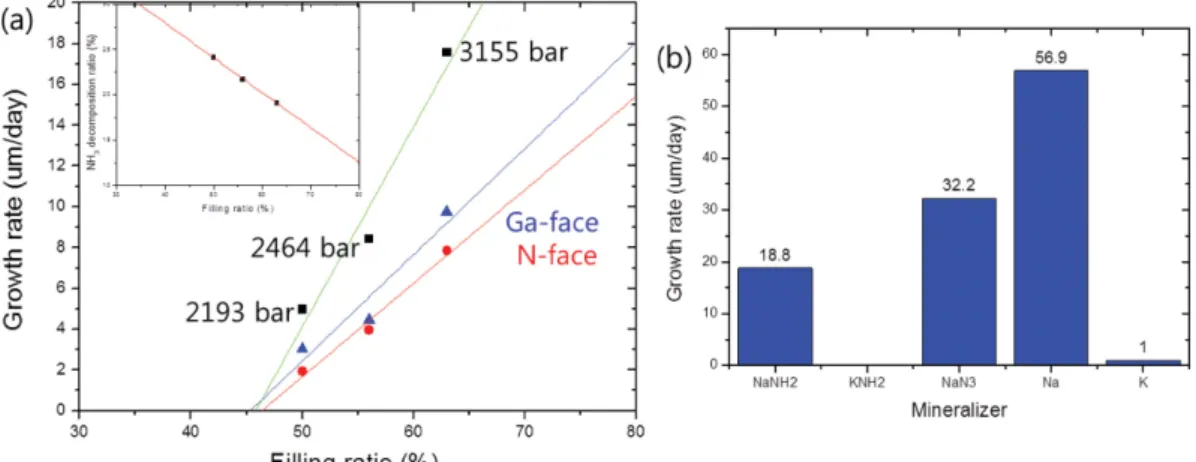
Filling ratio 에 따른 결정 성장 속도 의존성을 Fig.
3(a) 에 나타내었다. Filling ratio의 증가는 성장 운용 압 력의 증가를 야기하고 이것은 c축 방향으로의 결정 성장 속도를 증가하게 만들었다. 이것은 Filling ratio의 증가 에 따른 암모니아 분해의 감소에 기인한 것이다(Fig. 3(a) inset 참조)[9]. 암모노써멀 성장 시스템에서 암모니아의 양이 감소함에 따라, 암모니아에 용해된 GaN species의 농도 증가는 궁극적으로 낮은 품질의 결정 및 과도한 양 의 이종 핵생성을 형성하는 성장 조건을 야기한다. 성장 운용 압력을 증가시키면 암모니아의 분해를 감소시킬 수 있다. 이와 같은 방법 등으로 암모니아 분해를 제어하게 되면 결정의 품질 및 성장 속도를 향상시킬 수 있다 [10].
Fig. 3(b) 는 Basic 광화제 중 amide, azide, metal을 선택하여 실험한 것의 결정 성장 속도 측정 결과이다.
성장된 결정 내의 불순물은 주로 광화제로부터 발생된다.
Amide 광화제의 경우에는 산소와 수분에 매우 민감하기 때문에 그것으로 인한 불순물 생성으로 인해 성장 속도 에 영향을 주는 것으로 판단된다. Amide 광화제에 비해 비교적 산소와 수분에 덜 민감한 azide의 경우는 amide 광화제보다 결정 성장 속도가 약 1.7배 빠르다(NaNH
2vs. NaN
3). 또한 결정 성장 속도 측면에서는 K계열의
광화제보다 Na계열의 광화제가 더 유리함을 알 수 있었
다. 가장 최적의 광화제는 Sodium metal로 판명되었고
Fig. 1. Ammonothermal GaN crystal grown on HVPE seed.
60 Jang Bo Shim and Young Kuk Lee
이것은 amide, azide, metal에 따른 불순물의 농도가 가 장 큰 영향을 미치는 것으로 사료된다.
CL 기법을 사용하여 성장된 단결정의 전위 밀도를 측 정하였으며 Fig. 4에 이미지를 도시하였다. CL을 통해 측정된 전위 밀도 평균값은 1 × 10
5/cm
2이었다. CL 이미 지 상에 표기한 전위들은 SEM 측정 이미지와 표면 상 태를 비교하면서 구분하였다.
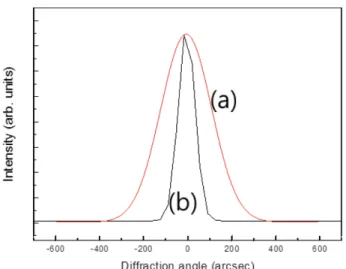
Fig. 5 는 (002)면의 DCXRD rocking curve를 보여 주 고 있다. Rocking curve의 FWHM으로 성장된 단결정 의 품질을 알 수 있는데, 결정의 완전성이 좋을수록 폭 이 좁고 피크 강도가 크게 된다. (002)면의 FWHM은 Ga 면에 대해서는 약 270 arcsec, N면에 대해서는 약 80 arcsec 이었다. 종자 결정으로 사용한 HVPE 샘플의 경우는 200 arcsec를 나타내었다.
Fig. 2. Surface SEM images of as-grown GaN crystal with rectangular HVPE GaN seed.
Fig. 3. (a) Filling ratio dependence on the growth rate and (b) growth rate at different mineralizers.
Fig. 4. CL image of ammonothermal grown GaN crystal.
Growth and characterization of bulk GaN single crystals by basic ammonothermal method 61
4. 결 론
Basic 암모노써멀 방법으로 약 50 mm의 길이와 약 2 mm 의 두께를 가진 벌크 GaN 단결정을 성장시켰다.
Filling ratio 가 증가함에 따라 c축 방향으로의 결정 성장 속도가 증가하였다. 결정 성장 속도 측면에서는 K계열 의 광화제 보다 Na계열의 광화제가 더 유리하였다. CL 을 통해 측정된 전위 밀도 평균값은 1 × 10
5/cm
2이었고 (002) 면의 DCXRD FWHM 은 270 arcsec(Ga면), 80 arcsec(N 면)으로 성장된 벌크 GaN 단결정의 품질이 우 수함을 알 수 있었다. 이와 같은 결과를 통하여 암모노 써멀 방법은 고품질의 대형 GaN 단결정 성장을 위한 적합한 성장 기술이라고 생각된다.
감사의 글
본 연구는 산업통상자원부 전략적 핵심소재 기술개발 사업(과제번호: 10043791)의 지원으로 인해 이루어졌습 니다.
References