229 This is an Open-Access article distributed under the terms of the Creative Commons Attribution Non-Commercial License (http://
creativecommons.org/licenses/by-nc/3.0) which permits unrestricted non-commercial use, distribution, and reproduction in any medium, provided the original work is properly cited.
J. Mushrooms 2017 December, 15(4):229-236 http://dx.doi.org/10.14480/JM.2017.15.4.229 Print ISSN 1738-0294, Online ISSN 2288-8853
© The Korean Society of Mushroom Science
*Corresponding author E-mail : [email protected] Tel : +82-61-862-8877, Fax : + Received September 4, 2017 Revised September 19, 2017 Accepted November 10, 2017
상황진흙버섯 균사배양 곡물의 성분변화
진성우1 · 임승빈1 · 김경제1 · 윤경원2 · 정상욱1 · 고영우1 · 제해신1 · 조인경3 · 장지연4 · 서경순1,*
1(재)장흥군버섯산업연구원
2순천대학교 한약자원개발학과
3남부대학교 식품영양학과
4한국생산기술연구원
Changes of chemical compositions of cereals by Phellinus linteus mycelial cultivation
Seong-Woo Jin1, Seung-Bin Im1, Kyung-Je Kim1, Kyeong-Won Yun2, Sang-Wook Jeong1, Young-Woo Koh1, Hae-Shin Je1, In-Kyung Cho3, Ji Yeon Jang4, and Kyoung-Sun Seo1,*
1Jangheung Research Institute for Mushroom Industry, Jangheung 529-851, Korea
2Department of Oriental Medicine Resources, Sunchon Nat'l University, 57922, Korea
3Department of Food and Nutrition, Nambu University, Gwangju 506-706, Korea
4Korea Institute of Industrial Technology, Cheonan 31056, Korea
ABSTRACT: This study was carried out to investigate the physicochemical characteristics of cultivated cereals by Phellinus linteus mycelium. Also, we investigated the content of free sugar, organic acid, free amino acid, mineral and fatty acid of cultivated cereals by P. linteus mycelium. The major free sugars were determined the glucose, maltose, and fucose by HPLC. The content of total free sugars was the highest in cultivated red rice by P. linteus mycelium at 36oC. The content of fucose was the highest in cultivated red rice by P. linteus mycelium at all cultivation temperatures. The organic acids were identified oxalic acid, malic acid, citric acid, and succinic acid, as in the case of free sugar, higher contents of organic acids were observed in the cultivated cereals by P. linteus mycelium than control. There was no significant difference in the mineral content between the control and cultivated cereals by P. linteus mycelium. Sixteen kind of free amino acid were detected in cultivated cereals by P. linteus mycelium. And the content of total free amino acids were higher in the cultivated cereals by P. linteus mycelium than the control. And essential amino acids showed significantly differences between control and cultivated cereals by P. linteus mycelium. Fatty acids were detected with seven kinds of fatty acids, and the major fatty acid was determined the linoleic acid by GC-MS. The content of linoleic acid was higher in the cultivated cereals by P. linteus mycelium than the control.
KEYWORDS: Amino acids, fatty acids, Free sugars, minerals, Organic acids, Phellinus linteus
서 론
버섯류는 세계적으로 약 20,000여 종이 알려져 있으며 그 중 식용으로 개발 가능한 것은 약 2,000여 종이다. 국 내 분포하는 버섯류는 약 992종이 기록되어 있으며, 이중 식용 버섯이 100여종으로 알려져 있다 (Lee, 1990). 약 20여종 이상의 버섯이 국내에서 재배가능하며 항암 (Han et al., 2006; Fujii et al., 1978), 콜레스테롤저하 (Suzuki and Ohshima, 1976), 혈당강하 (Hikino et al., 1985; Cho et al., 2007) 등이 입증된 바 있다.
상황진흙버섯은 소나무 비늘버섯과의 진흙버섯속 (Phellinus)에 속하며 주로 뽕나무와 활엽수의 줄기에 자 생하는 것으로 일반명칭은 목질진흙버섯 (Phellinus linteus)
이라고 하는데 초기에는 노란 진흙덩이가 뭉친 것 같은 형태로 유지된다 (Choi et al., 1996). 전 세계적으로 약 280여 종류가 존재하는 상황진흙버섯은 대부분 노란색을 띠며 나이테 무늬를 형성하며 성장하는데, 현재 가장 널 리 인공재배되는 버섯 품종 중의 하나이다 (Kim and Lee, 2010). 상황진흙버섯은 생리활성 및 항암력이 뛰어 난 버섯으로 소비자의 관심이 증대되면서 기능성 식품 및 식품, 의약소재로 활용하기 위한 연구가 활발히 이루어지 고 있다 (Kim et al., 1996; Lee et al., 2006).
한편 버섯균을 곡물에 접종하여 배양하는 고체배양기술 이 버섯 활용의 한 방법으로 이용되고 있는데 이는 유용 성분을 얻기 위한 별도의 추출, 정제공정이 필요없으며, 배양물 전체를 일반 곡물처럼 손쉽게 섭취할 수 있기 때 문에 소비자의 건강증진에 기여함은 물론 국내산 곡물의 부가가치를 증대시킬 수 있는 이점이 있다 (Choi et al., 2007).
이에 본 연구에서는 곡물과 상황진흙버섯 고유의 유용 성분을 갖는 버섯배양곡물을 개발하기 위하여 상황진흙버 섯 균사체를 다양한 곡물에 접종 후 온도별로 배양하였 고, 식품소재로 개발 가능성을 검토하기 위하여 유리당, 유기산, 무기성분, 유리아미노산, 및 지방산 분석을 수행 하였다.
재료 및 방법
재 료
본 실험에 사용한 배양미는 적미, 흑미, 백미를 수세한 후 4시간 동안 수침하고 30분간 물을 뺀 각 곡물을 배양 봉지에 600 g씩 넣은 후, 121oC에서 15분간 멸균하였다.
멸균된 곡물을 방냉한 후 (재)장흥군버섯산업연구원에서 보존중인 상황진흙버섯 (Phellinus linteus) 균사체를 곡물 의 표면에 접종하여 배양기의 온도를 24, 28, 30, 34, 36oC로 달리 조절하여 배양하였다. 배양이 완료된 상황진 흙버섯 균사체 배양미를 동결건조시킨 후 분쇄하여 시료 로 사용하였다.
시 약
실험에 사용한 추출 및 chromatography용 용매 및 시약 (Sigma-Aldrich Co., USA)은 일급 또는 특급시약을 구입 하여 사용하였다.
유리당 분석
유리당 성분은 Wilson 등의 방법에 따라 분석하였다.
시료 5 g에 증류수를 가하고 homogenizer로 마쇄하여 교 반 후 침출시켜 50 mL로 정용한 다음 원심분리 (3,000 rpm, 30 min)하여 Sep-pak C18으로 정제시킨 다음 0.45 µm membrane filter (Millipore Co., USA)로 여과한 여액을 high performance liquid chromatography (HPLC)를 이용
하여 분석 하였으며, 함량은 외부표준법으로 계산하였고, HPLC조건은 Table 1과 같다.
유기산 분석
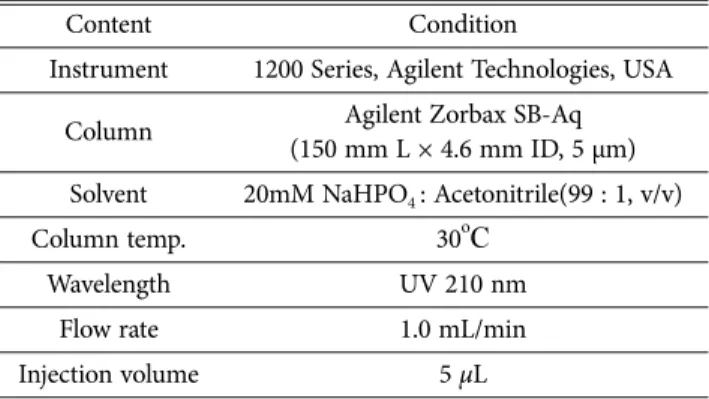
유기산은 시료 5 g에 증류수를 가하여 50 mL 정용하여 추출시킨 다음 원심분리 (3,000 rpm, 30 min)하여 상징액 을 취하여 여과 (Whatman No.2)하고, Sepak C18으로 정 제시킨 다음 0.45 µm membrane filter (Millipore Co., U.S.A)로 여과한 여액을 HPLC (High Performance Liquid Chromatography)를 이용하여 분석하였다. 분석조 건은 Table 2와 같으며, 함량은 외부표준법으로 계산한다.
무기성분 분석
무기성분은 건식분해법으로 전 처리하여 분석하고 분 석 조건은 Table 3과 같다. 즉 시료 1 g을 600oC에서 회 화시켜 백색회분을 얻었다. 회분을 2배 희석한 진한 염 산 10 mL를 가해 여과하여 수욕상에서 증발 건고시킨 후 4배 희석한 염산을 10 mL를 가하고 증류수를 가하여 100 mL로 정용한 다음 여액을 분석시료로 사용하였다.
각 무기성분의 정량은 원자흡광광도계 (Perkin Elmer, AAnalyst 400)로 각 원소의 표준 용액 농도를 0.1, 0.5 및 1.0 ppm으로 조제하여 표준 검량 곡선을 작성하여 분석하였다.
Table 1. HPLC conditions for free sugars analysis
Content Condition
Instrument 1200 Series, Agilent Technologies, USA ELSD detector
Column ZORBAX Carbohydrate
(150 mm L × 4.6 mm ID)
Solvent 85% Acetonitrile
Column temp. 30oC
Flow rate 1.4 mL/min
Injection volume 20 μL
Table 2. HPLC conditions for organic acids analysis
Content Condition
Instrument 1200 Series, Agilent Technologies, USA
Column Agilent Zorbax SB-Aq
(150 mm L × 4.6 mm ID, 5 μm) Solvent 20mM NaHPO4 : Acetonitrile(99 : 1, v/v)
Column temp. 30oC
Wavelength UV 210 nm
Flow rate 1.0 mL/min
Injection volume 5 μL
유리아미노산 분석
유리 아미노산 분석은 유리당 정량과 같은 방법으로 얻 은 여액을 Ohara와 Ariyosh의 방법으로 분석하였다. 여액 10 mL에 sulfosalicylic acid 25 mg을 첨가하여 4oC에서 4시간 동안 방치시킨 후 원심분리(50000 rpm, 30분)하여 단백질 등을 제거하고, 상등액을 0.45 µm membrane filter로 여과하여 얻은 여액을 일정량 취하여 AccQ-Tag 시약을 사용하여 유도체화시킨 후 HPLC로 분석하였다.
분석조건은 Table 4와 같다.
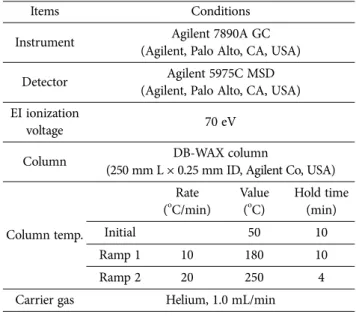
지방산 분석
시료의 지방산은 GC-MS를 이용하여 분석하였으며 그 조건은 Table 5와 같다. 시료 1 g을 100 ml의 ether를 가 하여 100oC의 Hot-plate 환류 추출한다. 추출물을 여과하 여 60oC 항온수조에서 증발건고시킨 후 0.5 N methanolic sodium hydroxide 2 ml를 넣고 5분간 환류 추출하였다.
추출 후 14% BF3-methanol 2 ml를 가해 30분간 환류 추 출한다. 위의 수기에 n-Hexane 4 ml를 넣고 2분간 환류 추출 후 포화 sodium chloride를 가하여 충이 분리되면 상층을 취하여 0.45 µm membrane filter로 여과하여 분석 시료로 사용하였다. 지방산은 GC-MS를 이용하여 분석하 며, 표준품으로는 SUPELCO사 EC10A-Kit를 사용하여 각 peak의 retention time을 확인하였고 GC-MS의 Wiley
library의 spectrum을 이용하여 동정하였다.
결과 및 고찰
유리당 분석
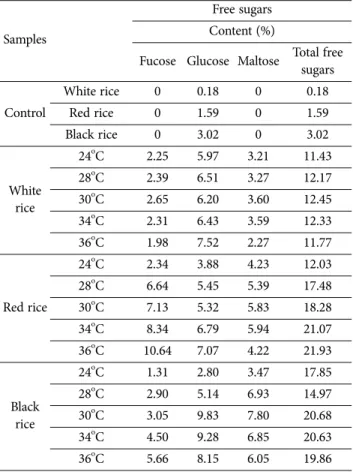
상황진흙버섯균사 배양미의 유리당 함량을 분석한 결과 는 Table 6과 같으며, 주요 당으로 fucose, glucose 및 maltose로 나타났다. 상황진흙버섯균사를 배양하지 않고 대조구로 사용한 백미, 적미 및 흑미의 유리당은 glucose 만 검출되었다. 상황진흙버섯균사를 접종한 시료구에서는 대조구에 비하여 높은 유리당의 함량과 glucose 외에 fucose 및 maltose가 검출되었다. 상황진흙버섯균사 배양 곡물별 유리당 함량은 상황진흙버섯균사 배양백미는 30oC에서 배양 한 시료가 총 유리당 함량이 12.45%로 높 게 나타났고, 상황진흙버섯균사 배양적미는 36oC에서 21.93%로 가장 높게 나타났으며, 상황진흙버섯균사 배양 흑미는 30oC와 34oC조건에서 가장 높은 총 유리당 함량 을 나타냈다. 검출된 유리당의 종류별로 살펴보면 상황진 흙버섯균사 배양 백미와 상황진흙버섯균사 배양 흑미는 glucose > maltose > fucose 순으로 높은 함량을 보였으 며, 상황진흙버섯균사 배양 적미의 유리당은 fucose >
glucose > maltose 순으로 높게 나타났다. 유리당 종류별 함량을 살펴보면 상황진흙버섯균사 배양 적미 시료구에서 나머지 두 시료구와 달리 fucose의 함량이 높음을 확인할 수 있었다. 상황진흙버섯균사 배양 백미는 24~36oC범위 에서 유리당 함량의 큰 차이가 없었으며, 상황진흙버섯균 사 배양 적미와 상황진흙버섯균사 배양 흑미에서는 30oC 이상에서 높은 함량을 나타내었다.
본 실험결과, 상황진흙버섯균사가 배양된 곡물에서 유 리당 함량이 증가하였는데, Lee 등의 보고에 의하면 균사 Table 3. Atomic absorption spectrophotometer conditions for
minerals analysis
Content Condition
Instrument Atomic Absorption Spectrophotometer (AAnalyst 400, Perkin Elmer, USA) Fuel flow C2H2, 2.0/min
Oxidant flow Air, 10.0 L/min Wavelength (nm) K: 766.49, Mg: 285.51, Na: 589.00
Ca: 422.67, Cu: 324.75, Cr: 357.87
Table 4. HPLC conditions for amino acids analysis
Content Condition
Instrument 1200 Series, Agilent Technologies, USA Detector FLD, 1200 Series, Agilent Technologies, USA
Column AccQ-TagTM
(Waters Co., 150 mm L × 3.9 mm ID)
Column temp 37oC
Buffer solution
A : AccQ-Tag Eluent A (acetate-phosphate buffer) B : AccQ-Tag Eluent B (60% acetonitrile)
Flow rate 1.0 mL/min
Injection volume 5 μL
Table 5. GC-MS conditions for fatty acids analysis
Items Conditions
Instrument Agilent 7890A GC
(Agilent, Palo Alto, CA, USA)
Detector Agilent 5975C MSD
(Agilent, Palo Alto, CA, USA) EI ionization
voltage 70 eV
Column DB-WAX column
(250 mm L × 0.25 mm ID, Agilent Co, USA)
Column temp.
Rate (oC/min)
Value (oC)
Hold time (min)
Initial 50 10
Ramp 1 10 180 10
Ramp 2 20 250 4
Carrier gas Helium, 1.0 mL/min
체가 가지고 있는 amylase 분해효소에 의해서 glucose 등 과 같은 환원당으로 분해되어 control과 비교하였을 때 다 량이 발견됨을 확인하였다.
유기산 함량
상황진흙버섯균사 배양곡물의 유기산 함량을 분석한 결 과는 Table 7과 같으며, 주요 유기산으로는 oxalic acid, malic acid, citric acid 및 succinic acid가 검출되었다.
대조구인 백미, 적미 및 흑미의 유기산 함량은 흑미가 270.76 mg%로 가장 높게 나타나고, 적미는 184.93 mg%, 백미는 27.11 mg%로 가장 낮게 나타났다. 백미에서는 검 출되지 않은 succinic acid가 적미와 흑미에서는 가장 높 은 함량을 나타내었다.
상황진흙버섯균사를 배양한 시료구에서는 대조구에 비 하여 높은 유기산 함량을 나타내었다. 시료구별로 살펴보 면 상황진흙버섯균사 배양백미는 30oC에서 배양한 시료 의 총 유기산 함량이 1,051.21 mg%로 가장 높은 함량을 나타냈지만, 28oC에서는 oxalic acid의 함량이 낮게 나타 났다. 상황진흙버섯균사 베양적미는 30oC에서 배양한 시 료의 총 유기산 함량이 1,054.15 mg%로 가장 높은 함량 을 나타내었지만, 검출된 유기산 중에서는 succinic acid 의 함량이 615.18 mg%로 가장 높게 나타났다. 상황진흙 버섯균사 배양흑미는 28oC에서 배양한 시료의 총 유기산 함량이 1203.06 mg% 가장 높게 나타났으며, 상황진흙버 Table 6. The content of free sugars in rices cultivated with
Phellinus linteus mycelial
Samples
Free sugars Content (%)
Fucose Glucose Maltose Total free sugars
Control
White rice 0 0.18 0 0.18
Red rice 0 1.59 0 1.59
Black rice 0 3.02 0 3.02
White rice
24oC 2.25 5.97 3.21 11.43
28oC 2.39 6.51 3.27 12.17
30oC 2.65 6.20 3.60 12.45
34oC 2.31 6.43 3.59 12.33
36oC 1.98 7.52 2.27 11.77
Red rice
24oC 2.34 3.88 4.23 12.03
28oC 6.64 5.45 5.39 17.48
30oC 7.13 5.32 5.83 18.28
34oC 8.34 6.79 5.94 21.07
36oC 10.64 7.07 4.22 21.93
Black rice
24oC 1.31 2.80 3.47 17.85
28oC 2.90 5.14 6.93 14.97
30oC 3.05 9.83 7.80 20.68
34oC 4.50 9.28 6.85 20.63
36oC 5.66 8.15 6.05 19.86
Table 7. The content of organic acids in rices cultivated with Phellinus linteus mycelial Samples
Organic acids Content (mg%)
Oxalic acid Malic acid Citric acid Succinic acid Total organic acids
White rice 2.61 14.41 10.09 0.00 27.11
Red rice 16.17 70.82 20.90 77.05 184.94
Black rice 18.31 101.30 29.41 121.73 270.76
White rice
24oC 16.96 499.69 119.82 224.42 860.89
28oC 138.31 143.97 127.76 508.56 918.60
30oC 37.11 591.52 129.94 292.63 1051.21
34oC 36.95 164.35 119.86 133.15 454.32
36oC 46.39 227.05 175.22 248.85 697.51
Red rice
24oC 128.27 149.15 111.77 398.93 788.12
28oC 19.64 562.27 119.53 237.80 939.24
30oC 137.63 168.83 132.52 615.18 1054.15
34oC 138.28 134.00 136.30 310.56 719.14
36oC 197.28 170.80 158.06 496.60 1022.73
Black rice
24oC 103.63 143.45 149.21 443.49 839.78
28oC 124.58 353.38 137.60 587.50 1203.06
30oC 141.57 173.79 150.92 432.17 898.44
34oC 156.19 180.07 163.32 356.62 856.19
36oC 191.10 165.42 140.67 403.85 901.05
섯균사 배양적미와 같이 succinic acid의 함량이 가장 높 게 나타났다.
유기산 분석결과 상황진흙버섯균사 배양흑미가 상황진 흙버섯균사 배양백미와 상황진흙버섯균사 배양적미에 비 하여 유기산 함량이 높게 나타났는데, 흑미의 주요 유기 산이 다른 쌀품종에 비하여 다소 높게 나타난 보고 (Rhee et al., 2000)가 있어, 배양 원료로 사용한 흑미의 유기산 함량이 상황진흙버섯균사 배양 흑미의 높은 유기산 함량 과 직접적으로 연관되는 것으로 생각된다.
무기성분 함량
상황진흙버섯 배양미의 무기성분 함량을 분석한 결과는 Table 8과 같으며, 주요 무기성분으로는 potassium, magnesium 으로 나타났으며, calcium 및 sodium이 소량 검출되다.
무기성분 함량의 경우 상황진흙버섯의 배양 온도 차이 에 의해서는 큰 차이를 나타내지 않았으며, 주요 무기성 분인 magnesium의 함량이 상황진흙버섯균사 배양흑미 및 상황진흙버섯균사 배양적미가 상황진흙버섯균사 배양 백미에 비하여 10배 이상 높은 함량을 나타내었다. 이는 백미의 도정과정 중에 버려지는 부산물인 미강에 의한 것 으로 판단된다. 쌀의 외피를 구성하는 미강은 지방, 단백 질, 식이섬유가 영양소의 많은 부분을 차지하고 있고, vitamin A와 thiamine, pyridoxyine, niacine 등의 vitamin
B군 및 칼륨, 칼슘, 아연, 철분 등의 미네랄이 주성분을 이루고 있으며 혈중 콜레스테롤 저하효과, 항산화 효과, 혈압상승 억제 효과가 우수하다 (Nicolsi et al., 1993;
Capro et al., 1977).
유리 아미노산 함량
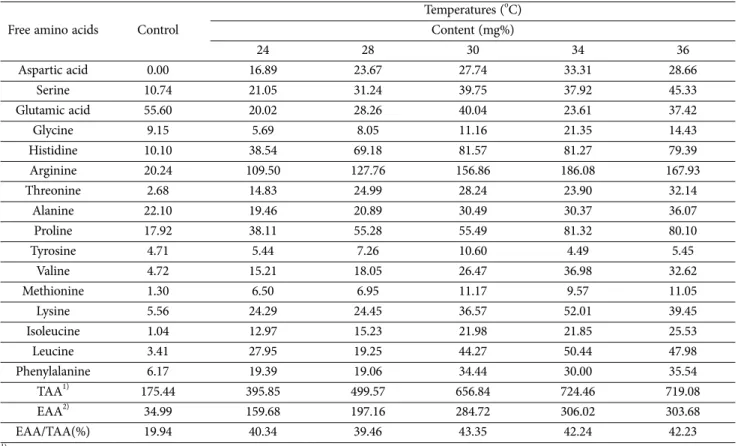
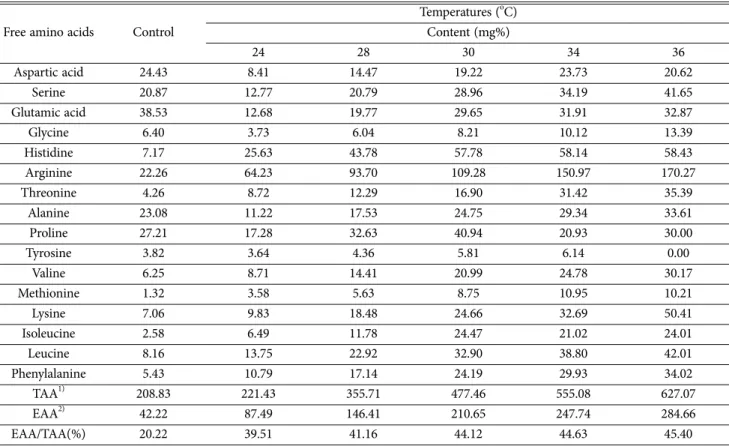
상황진흙버섯균사 배양곡물의 유리아미노산 함량을 분 석한 결과는 Table 9~11과 같다. 상황진흙버섯균사를 배 양한 곡물들에서는 총 16종의 아미노산이 검출되었다. 총 유리아미노산의 함량을 살펴보면 상황진흙버섯균사 배양 적미 및 상황진흙버섯균사 배양흑미에서 백미보다 약 3배 가량 높은 함량을 나타냈다.
Koh 등(1996)의 일반벼, 적색 및 자색 현미의 아미노산 조성을 조사한 결과 유색미들의 주요 아미노산은 aspartic acid와 glutamic acid였으며, 가장 높은 함량을 보인 아미 노산은 glutamic acid라고 보고한 바 있는데, 본 연구에서 대조구로 사용한 백미, 적미 및 흑미의 아미노산 조성과 유사하였다. 배양 온도별 함량을 살펴보면 상황진흙버섯 균사 배양백미의 총 유리아미노산은 28, 30oC에서 395.85 mg%로 높은 함량을 나타냈고, 주요 아미노산으로는 arginine, histidine 및 proline으로 나타났다. 상황진흙버섯 균사 배양 적미의 총 유리아미노산 함량은 34oC에서 724.46 mg%로 가장 높게 나타났으며, 주요 아미노산으로 Table 8. The content of minerals in rices cultivated with Phellinus linteus mycelial
Samples
Minerals Content (mg%)
K Ca Mg Na Cr Cu
White rice 31.15 2.69 12.66 4.11 0.62 0.30
Red rice 369.07 1.65 127.94 4.23 0.64 0.19
Black rice 354.02 1.81 117.18 4.40 0.65 0.31
White rice
24oC 47.35 1.49 5.00 3.24 1.11 0.37
28oC 31.41 1.66 5.33 4.62 1.00 0.22
30oC 32.27 1.52 5.63 3.34 1.03 0.29
34oC 31.37 1.76 4.81 3.87 1.13 0.24
36oC 28.87 1.50 5.99 3.28 1.08 0.27
Red rice
24oC 188.54 0.94 103.29 4.07 0.94 0.17
28oC 245.36 1.11 148.18 4.88 1.12 0.17
30oC 332.88 1.18 150.09 4.89 1.16 0.18
34oC 301.74 1.10 204.79 4.94 1.30 0.18
36oC 316.80 1.14 225.14 5.45 1.24 0.18
Black rice
24oC 305.84 1.39 268.35 4.30 1.30 0.29
28oC 377.88 1.51 379.86 4.79 1.37 0.33
30oC 391.40 1.50 334.92 4.40 1.32 0.34
34oC 358.97 1.54 254.44 4.48 1.29 0.32
36oC 323.85 1.52 132.89 4.33 1.35 0.35
Table 9. The content of free amino acids in white rice cultivated with Phellinus linteus mycelial Free amino acids Control
Temperatures (oC) Content (mg%)
24 28 30 34 36
Aspartic acid 0.00 5.34 26.44 8.02 5.13 5.48
Serine 0.00 15.26 38.03 27.52 13.22 10.34
Glutamic acid 7.67 10.89 39.68 17.60 9.13 6.12
Glycine 0.00 3.92 10.14 7.44 4.08 4.26
Histidine 0.00 52.11 67.22 75.81 21.58 8.57
Arginine 0.00 37.32 116.77 59.49 28.88 14.30
Threonine 0.00 10.66 24.36 14.20 8.13 5.67
Alanine 2.79 17.25 32.94 25.31 15.11 11.58
Proline 4.23 29.81 50.44 51.69 31.16 28.94
Tyrosine 0.00 2.37 7.20 4.47 5.36 6.57
Valine 0.00 8.94 27.13 19.42 10.09 8.30
Methionine 0.00 6.32 9.38 13.20 11.56 12.36
Lysine 0.00 6.51 33.22 14.91 5.22 2.70
Isoleucine 0.00 5.91 21.83 12.87 7.33 5.78
Leucine 1.43 10.64 41.66 20.93 11.20 8.12
Phenylalanine 0.96 10.21 30.95 17.83 11.28 7.99
TAA1) 17.06 224.77 395.85 380.72 188.45 134.72
EAA2) 2.38 104.96 159.68 179.18 76.39 47.13
EAA/TAA(%) 13.96 46.70 44.29 47.06 40.54 34.99
1)Total free amino acid.
2)Total essential amino acid (Thr+Val+Met+Ile+Leu+Phe+His+Lys).
Table 10. The content of free amino acids in red rice cultivated with Phellinus linteus mycelial Free amino acids Control
Temperatures (oC) Content (mg%)
24 28 30 34 36
Aspartic acid 0.00 16.89 23.67 27.74 33.31 28.66
Serine 10.74 21.05 31.24 39.75 37.92 45.33
Glutamic acid 55.60 20.02 28.26 40.04 23.61 37.42
Glycine 9.15 5.69 8.05 11.16 21.35 14.43
Histidine 10.10 38.54 69.18 81.57 81.27 79.39
Arginine 20.24 109.50 127.76 156.86 186.08 167.93
Threonine 2.68 14.83 24.99 28.24 23.90 32.14
Alanine 22.10 19.46 20.89 30.49 30.37 36.07
Proline 17.92 38.11 55.28 55.49 81.32 80.10
Tyrosine 4.71 5.44 7.26 10.60 4.49 5.45
Valine 4.72 15.21 18.05 26.47 36.98 32.62
Methionine 1.30 6.50 6.95 11.17 9.57 11.05
Lysine 5.56 24.29 24.45 36.57 52.01 39.45
Isoleucine 1.04 12.97 15.23 21.98 21.85 25.53
Leucine 3.41 27.95 19.25 44.27 50.44 47.98
Phenylalanine 6.17 19.39 19.06 34.44 30.00 35.54
TAA1) 175.44 395.85 499.57 656.84 724.46 719.08
EAA2) 34.99 159.68 197.16 284.72 306.02 303.68
EAA/TAA(%) 19.94 40.34 39.46 43.35 42.24 42.23
1)Total free amino acid.
2)Total essential amino acid (Thr+Val+Met+Ile+Leu+Phe+His+Lys).
는 arginine, proline 및 histidine으로 나타났다. 상황진흙 버섯균사 배양 흑미는 36oC에서 627.07 mg%로 가장 높 은 함량을 나타냈으며, 주요 아미노산으로는 arginine, histidine 및 proline으로 나타났다. 상황진흙버섯균사 배 양곡물들의 주요 아미노산의 구성을 살펴보면, 대조구에 비하여 필수아미노산인 arginine의 함량이 높아지는 특이 점이 나타났다.
지방산 함량
상황진흙버섯 균사 배양미의 지방산을 분석한 결과는 Table 12에서 보는 바와 같다. 필수지방산으로 분류되는
linoleic acid, linolenic acid를 비롯하여 palmitic acid, stearic aicd 등 총 7종의 지방산이 검출되었다. linoleic acid가 대조구인 적미와 흑미의 지방산 함량에서 차지하 는 양은 38.53 area% 및 36.64 area%로 나타났으며, 상황 진흙버섯 균사를 배양한 곡물들에서는 47.36 area%과 38.67 area%로 크게 증가하였다. 상황진흙버섯균사 배양 백미와 대조구로 사용한 백미에서는 유색미와 달리 palmitic acid가 매우 높은 비율을 차지하고 있는 것을 확 인 할 수 있었다. 쌀을 도정하는 과정에서 제거되는 미강 의 지방산은 70% 이상이 oleic acid, linoleic acid, linolenic acid로 보고(Lee et al., 2002)된 바 있어, 미강의 Table 11. The content of free amino acids in black rice cultivated with Phellinus linteus mycelial
Free amino acids Control
Temperatures (oC) Content (mg%)
24 28 30 34 36
Aspartic acid 24.43 8.41 14.47 19.22 23.73 20.62
Serine 20.87 12.77 20.79 28.96 34.19 41.65
Glutamic acid 38.53 12.68 19.77 29.65 31.91 32.87
Glycine 6.40 3.73 6.04 8.21 10.12 13.39
Histidine 7.17 25.63 43.78 57.78 58.14 58.43
Arginine 22.26 64.23 93.70 109.28 150.97 170.27
Threonine 4.26 8.72 12.29 16.90 31.42 35.39
Alanine 23.08 11.22 17.53 24.75 29.34 33.61
Proline 27.21 17.28 32.63 40.94 20.93 30.00
Tyrosine 3.82 3.64 4.36 5.81 6.14 0.00
Valine 6.25 8.71 14.41 20.99 24.78 30.17
Methionine 1.32 3.58 5.63 8.75 10.95 10.21
Lysine 7.06 9.83 18.48 24.66 32.69 50.41
Isoleucine 2.58 6.49 11.78 24.47 21.02 24.01
Leucine 8.16 13.75 22.92 32.90 38.80 42.01
Phenylalanine 5.43 10.79 17.14 24.19 29.93 34.02
TAA1) 208.83 221.43 355.71 477.46 555.08 627.07
EAA2) 42.22 87.49 146.41 210.65 247.74 284.66
EAA/TAA(%) 20.22 39.51 41.16 44.12 44.63 45.40
1)Total free amino acid.
2)Total essential amino acid (Thr+Val+Met+Ile+Leu+Phe+His+Lys).
Table 12. The content of fatty acids in rices cultivated with Phellinus linteus mycelial
Fatty acids
Samples Content (area %)
White rice Red rice Black rice White rice with P.
linteus mycelial
Red rice with P.
linteus mycelial
Black rice with P.
linteus mycelial
Myristic acid - - 0.15 - - -
Palmitic acid 76.19 16.30 19.55 73.80 13.16 16.23
Palmitoleic acid - - - - 0.30 -
Stearic acid 7.49 0.82 1.57 6.68 0.61 0.53
Oleic acid 16.32 43.76 41.51 19.52 38.57 44.57
Linoleic acid - 38.53 36.64 - 47.36 38.67
Linolenic acid - 0.59 0.58 - - -
첨가여부가 지방산 조성에 영향주는 것으로 생각된다. 따 라서 상황진흙버섯 균사를 배양에 따라 지방산 중 linoleic acid의 함량이 높아짐을 확인하였다.
적 요
본 연구는 곡물(백미, 적미, 흑미)에 상황진흙버섯 균사 를 배양하여 곡물과 상황진흙버섯의 유용성분 시너지 효 과를 탐색하고자 수행하였으며, 배양조건에 따른 상황진 흙버섯 균사 배양곡물의 유리당, 유기산, 유리아미노산, 무기성분, 지방산을 분석하였다. 유리당의 함량을 분석한 결과 fucose, glucose, maltose 총 3종의 유리당이 검출되 었으며, 대조구에서는 glucose에서만 검출되었다. 상황진 흙버섯을 배양한 곡물들에서 대조구에 비해 높은 유리당 함량이 검출되었다. 상황진흙버섯을 배양한 곡물들의 유 기산 함량을 분석한 결과, 4종의 유기산이 검출되었으며 유리당과 마찬가지로 상황진흙버섯을 접종한 시료구에서 대조구에 비해 높은 함량의 유기산이 확인되었다. 상황진 흙버섯을 배양한 곡물들과 대조구간의 무기성분 함량 차 이는 유의적이지 않았다. 16종의 아미노산이 검출되었으 며, 상황진흙버섯을 배양한 곡물들에서 유리아미노산의 함량이 다량 증가함을 확인하였다. 지방산의 결과는 총 7 종의 지방산이 검출되었으며 각 대조구와 상황진흙버섯을 배양한 곡물들간에 유의적인 차이는 나타나지 않았지만, 배양 원료로 사용한 백미와 유색미와의 조성에서 많은 차 이가 있었다.
감사의 글
본 연구는 산업통상자원부와 한국산업기술진흥원이 지 원하는 경제협력권산업 육성사업으로 수행된 연구결과입 니다 (R0005473).
References
Lee TS, 1990. The full list of recoded mushroom in Korea. Kor J Mycol. 18:233-259.
Han SB, Lee CW, Kang JS, Yoon YD, Lee KH, Lee K, Park SK, Kim HM. 2006. Acidic polysaccharide from Phellinus linteus inhibits melanoma cell metastasis by blocking cekk adhesion and invasion. Int Immunopharmacol, 6:697-702
Fujii T, Maeda H, Suzuki F, Ishida N. 1978. Isolation and
characterization of a new antitumor polysaccharide, KS-2, extracted from culture mycelia of Lentinus edodes. J Antiniot.
31:1079-1090.
Suzuki S and Ohshima S. 1976. Influence of shiitake (Lentinus edodes) on human serum cholesterol. Mushroom Sci. 9:463- 647.
Hikino H, Konno C, Mirin Y, Hayashi T. 1985. Isolation and hypoglycemic activity of ganoderans A and B, glycans of Ganoderma lucidum fruit bodies1. Plant Med. 51:339-340.
Cho EJ, Hwang HJ, Kim SW, Oh JY, Baek YM, Choi JW, Bae SH, Yun JW, 2007. Hypoglycemic effects of exopolysaccharides produced by mycelial cultures of two different mushrooms Tremella fuciformis and Phellinus baumii in ob/ob mice. Appl Microbiol Biotechnol. 75:1257-1265.
Choi JH, Ha TH, Rho YD, 1996. Studied on the main factors affecting the mycelial growth of Phellinus linteus. Kor J Mycol.
24:214-222.
Kim HM, Lee DH. 2010. Characterization of anti-inflammation effect of aqueous extracts from Phellinus baumii. Kor J Mycol.
38:179-183.
Kim DH, Han SB, Oh GT, Kim YH, Hong DH, Hong ND, Yoo ID. 1996. Stimulation of humoral and cell mediated immunity by polysaccharide from mushroom Phellinus linteus. Int J Immunophamacol. 18:295-303.
Lee KH, Kwon HJ, Chun SS, Kim JH, Cho YJ, Cha WS. 2006.
Biological activities if extracts from Phellinus linteus. J.
Korean Soc Appl Biol Chem. 49:298-303.
Choi HD, Seog HM, Park YK, Park YD, Kim JA, 2007 Hypoglycemic effects of Basidiomycetes mycelia and cereals fermented with Basidiomycetes. J Korean Soc Food Sci Nutr.
36:1257-1262.
Lee H, Kim YS, Kim DY, Kim SY, Lee WK, Lee SM, Park JD, Shon MY. 2015. A study on manufacturing of red ginseng Makgeolli using the red ginseng starch and changes of physicochemical components of red ginseng Makgeolli during storage periods. Korean J Food Preserv. 22:369-376 Nicolsi RJ, Rogers EJ, Ausman LM, Orthefer FT. 1993. Rice bran
oil and its health benefits. In: Rice Science and Technology.
Boca Raton, FL, USA pp. 421-437.
Capro PA, Reaven G, Olefsky J. 1977. Postgrandial plasma- glucose and insulin responses to different complex carbohydrate. Diabetes. 26:1178-1183.
Rhee CO. Song, Lee YS. 2000. Volatile flavor components in cooking black rice. Korea J Food Sci Technol. 32:1015-1021.
Koh HJ, Won YJ, Cha GW, Heu MH. 1996. Amino acids, vitamins and mineral contents of some colored rices. Annual Report of Agriculture and Life Science, p.88-89.
Lee JT, Jeong YS, An BJ. 2002. Physiological activity of Salicornia herbacea and its application for cosmetic materials. Kor J Herbology. 17:51-60.