• 검색 결과가 없습니다.

Characteristics of Organic Acid Contents and Fermentation Solution of Prunus mume in South Korea

N/A
N/A
Protected

Academic year: 2021

Share "Characteristics of Organic Acid Contents and Fermentation Solution of Prunus mume in South Korea"

Copied!
6
0
0

로드 중.... (전체 텍스트 보기)

전체 글

(1)

Introduction

Plum tree (P. mume) is a deciduous subtree belongs to the Prunus, Rosaceae of China origin, which grows currently wild or cultivated in the warm regions of northeast Asia (Song, 1998). Plum tree in Korean peninsula was planted for processing in the Koryo period following the ornamental of the Three Kingdoms period, and now trees with older age and historical properties are being cultivated rarely.

Plum tree fruit (plum) has a number of bioactive substances, exhibiting antibacterial activity, appetite improvement, sterilization, insecticidal action with the prevention of various adult diseases (Yun, 2011).

In addition, plums are mainly used for processing plum wine, drink, concentrate, vinegar, pickle, tea (Lim and Eun, 2012; Yaegaki et al., 2006), so researches on food properties and efficacy have been variously conducted. The main studies of plum are useful components (Cha et al., 1999b;

Kim et al., 2006), and pharmacological effects (Kim et al., 2002; Seo et al., 2008), organic acids (Cha et al., 1999a; Paik et al., 2010) and plum fermentation solution (Seon et al., 2017; Yun, 2011).

Although most of these studies were conducted on improved varieties, resource characteristics of the historical old plum were extremely rare. In particular, the usefulness study for the plum resources in the distribution of all regions in Korea is expected to provide lots of information about the availability of plum.

This study was analyzed on the characteristics of organic acids and plum fermentation solution for the plum fruit of 192 germplasms in order to provide useful information of the plum trees use collected in all regions of South Korea.

Materials and Methods

Experimental materials

The study was conducted on 192 germplasms of P. mume (plum trees) planted on Kongju university farm (Fig. 1). Plum

Characteristics of Organic Acid Contents and Fermentation Solution of Prunus mume in South Korea

Hee-Kyoung Kang 1 , Hye-Rin Kang 2 , Young-Sang Lee 3 and Hong-Seon Song 4 *

1 Professor and 2 Graduate Student, Department of Horticulture, Kongju National University, Yesan 32439, Korea

3 Professor, Department of Medical Biotechnology, Soonchunhyang University, Asan 31538, Korea

4 Adjunct Professor, Department of Plant Resource, Kongju National University, Yesan 32439, Korea

Abstract - This study was carried out to get the information of Plum tree (192 germplasm) collected in Korea, and to evaluate the organic acid contents and fermentation solution. The organic acid content of fruit was 50.9 ± 6.0 ㎎/g, and which was composed of 55.5% of citric acid, 43.4% of malic acid and 1.1% of oxalic acid, and showed large difference among germplasms. Oxalic acid and malic acid made no differences in organic acid content according to flesh color, whereas citric acid and total organic acid contents were highest in orange color and lowest in whitish green. Malic acid, citric acid and total organic acid contents did not show differences among fruit weight groups, but oxalic acid content was highest at fruit weight of 5.1 ~ 10.0 g and lowest at more than 20.1 g. The sugar content of fermentation solution of fruit was 55.7 ± 1.6 °Brix and the harvest rate was 116.7 ± 8.7%. The correlation coefficients among fruit weight, the sugar content (°Brix) and harvest rate of fermentation solution were very low, and there were correlations of r=–0.551** between fruit weight and oxalic acid, r=–

0.767** between malic acid and citric acid, and r=0.834** between citric acid and total organic acid content.

Key words – Fermentation solution, Germplasm, Organic acid, Plum tree, Prunus mume

*Corresponding author. E-mail : [email protected] Tel. +82-2-716-8373

Original Research Article

(2)

trees are collected and grafted in South Korea and then grown for more than 10 years. Identification of the plum tree was utilized in the literature of Lee (2003). Experimental materials are plum tree fruits (plums) harvested from 2018 to 2019.

Organic acid contents of plums were analyzed by selecting 43 germplasm according to the distribution ratio of fruit flesh

color and weight.

Organic acid analysis

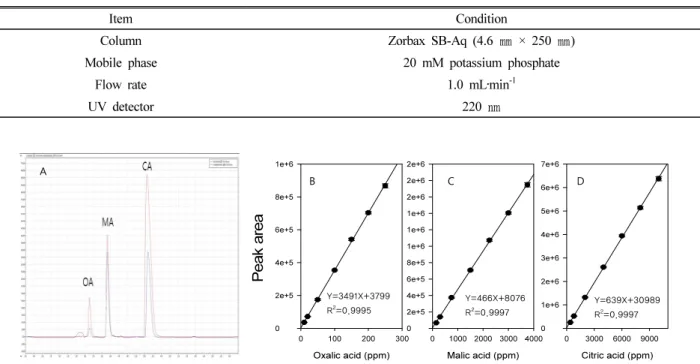
The plum samples were collected in June 2018 and stored at -70℃ up to 3 months prior to experimental use. After thawing, plum seeds were removed and remaining fleshes were cut into small pieces. One gram of sample was placed in a 50 mL centrifuge tube, and 30 mL of 20 mM potassium phosphate were added and homogenized with a polytron (PT 2500 E, Kinematica AG, Switzerland) at a speed of 1,000 rpm. After centrifugation (Combi-514 R, Hanil, Republic of Korea) at 3,000 x g for 10 min, supernatants were filtered through a syringe filter (nylon, 0.45 ㎛, ADVANTEC, Japan) and injected into an HPLC system (S2100, Sykam, Germany). Table 1 shows HPLC instrumental conditions for organic acid analysis and resultant chromatograms for a plum sample and authentic standards of oxalic (OA), malic (MA), and citric (CA) acids are provided in Fig. 2A. Under our experimental conditions OA, MA, and CA showed retention times of 2.92 min, 3.87 min, and 5.75 min, respectively (Fig.

2A). Authentic standards for OA, MA, and CA were Fig. 1. Germplasms of plum trees planted on Kongju university

farm. (A) field appearance, (B) fruitful state, (C) marker board, (D) resource management.

Table 1. Operation conditions of HPLC for organic acid analysis

Item Condition

Column Zorbax SB-Aq (4.6 ㎜ × 250 ㎜)

Mobile phase 20 mM potassium phosphate

Flow rate 1.0 mL‧min -1

UV detector 220 ㎚

Oxalic acid (ppm)

0 100 200 300

Pe ak a re a

0 2e+5 4e+5 6e+5 8e+5 1e+6

Malic acid (ppm)

0 1000 2000 3000 4000 0

2e+5 4e+5 6e+5 8e+5 1e+6 1e+6 1e+6 2e+6 2e+6 2e+6

Citric acid (ppm)

0 3000 6000 9000 0

1e+6 2e+6 3e+6 4e+6 5e+6 6e+6

A

7e+6

B C D

Y=3491X+3799 R

2

=0.9995

Y=466X+8076 R

2

=0.9997

Y=639X+30989 R

2

=0.9997

Fig. 2. Chromatograms for sample (blue) and authentic standards (red) (A) and their calibration curves for oxalic (B), malic (C), and

citric (D) acids. The retention times for OA, MA, and CA were 2.92 min, 3.87 min, and 5.75 min, respectively. Data in calibration

curves represent mean values ± standard deviation of 6 independent replications.

(3)

purchased from Sigma-Aldrich (USA) and standard mixture solutions ranging 10 to 250 ppm, 150 to 3,750 ppm, and 400 to 10,000 ppm, respectively, were prepared to evaluate plum germplasm samples with diverse range of organic acid contents. Validations for organic acid analysis methods were performed prior to sample analyses. The recovery rates for OA, MA, and CA tested at 3 different levels with 6 replications for each level were 91.3%-98.9%, 90.8%-97.6%, and 84.0-89.1%, respectively. Limit of detection (LOD) and limit of quantitation (LOQ) were 2.88 and 8.74 ppm for OA, 36.8 and 111.5 ppm for MA, while CA showed 81.4 and 246.7 ppm, respectively. Relative standard deviations (RSD, in %) for repeatability tests based upon 6 replicated injections of 7 levels of authentic standards and reproducibility tests based upon 6 inter-date injections of 7 levels of standards were 1.1-3.2% and 1.5-4.8% for OA, 1.0-2.9% and 2.0-4.7%

for MA, and 1.0-3.4% and 1.9-4.3% for CA, respectively.

Fermentation solution analysis

The plums of experimental materials were used through the process of washing and drying after harvesting in June 2019.

The plums of 200 to 300 g were stored at normal temperature by sealing up in a plastic airtight container with the same amount of white sugar. Sugar content of fermentation solution was measured three times by opening a closed container in October 2019 with a fruit sugar index meter (Giwon high- tech GMK-706R). Sugar content was analyzed by selecting a

uniform 148 germplasms of fermentation solution, the total harvest rate of 192 germplasms is shown in fermentation solution (mL)/weight (g) of plum.

Statistical analysis

Statistics analyzed the correlation and average difference between characteristics using the SPSS 23.

Results and Discussion

Organic acids content

The content of organic acids by fruit flesh color is the same as Table 2. The total organic acid content was 50.9 ± 6.0 ㎎/g. In the contents by fruit flesh colors, orange color was the highest as the 54.3 ± 8.5 ㎎/g, the next, light orange (52.3 ± 4.2 ㎎/g) and whitish green (48.1 ± 4.7 ㎎/g) was followed. In the contents by organic acids, citric acid was the highest as the 28.3 ± 9.0 ㎎/g, 55.5%, the next, malic acid (22.1 ± 5.2 ㎎/g, 43.4%) and oxalic acid (0.55 ± 0.32 ㎎/g, 1.1%) was followed.

It was similar to the report of So (2013) that the citric acid was contained the highest as 2.0∼3.3 ㎎/mL in the plums.

Content of oxalic acid and malic acid was a few in difference by fruit flesh color, but the citric acid content showed a difference, which the orange color was the highest and whitish green was the lowest. The organic acids content in fruit flesh color was different; whitish green did show little difference in the content of malic acid and citric acid, but

Table 2. Comparison of organic acid contents by fruit flesh colors of P. mume germplasms

Color Organic acid (㎎/g)

Total (㎎/g) n

Oxalic acid Malic acid Citric acid

Whitish green 0.66 ± 0.39 ns z

(1.4%) 24.0 ± 5.3 ns

(49.9%) 23.5 ± 8.4 a y

(48.7%) 48.1 ± 4.7 a

(100.0%) 19

Light orange 0.49 ± 0.25

(0.9%) 20.7 ± 5.5

(39.5%) 31.1 ± 7.5 ab

(59.5%) 52 .3 ± 4.2 ab

(100.0%) 15

Orange 0.39 ± 0.17

(0.7%) 23.5 ± 8.4

(43.2%) 33.6 ± 8.1 b

(61.8%) 54.3 ± 8.5 b

(100.0%) 9

Total 0.55 ± 0.32

(1.1%) 2 2 .1 ± 5.2

(43.4%) 28.3 ± 9.0

(55.5%) 50.9 ± 6.0

(100.0%) 43

Range 0.06 ~ 1.25 8.1 ~ 34.1 2.7 ~ 51.0 36.9 ~ 70.7

C.V(%) 58.6 23.4 31.9 11.7

z not significant.

y Mean separation within columns by Duncan’s multiple range test at p = 0.05.

(4)

citric acid is higher 20.0%, 18.6%, respectively than the malic acid in the light orange and orange.

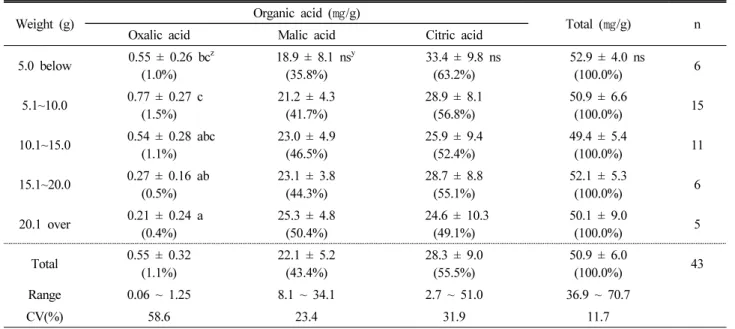
The content of organic acids by plum weight is the same as Table 3. The content of malic acid, citric acid with total organic acid did not show a difference by weight, and oxalic acid showed a difference by weight. In oxalic acid, the weight 5.1∼10.0 g (0.77 ± 0.27 ㎎/g) was the highest, and the more than 20.1 g (0.21 ± 0.24 ㎎/g) was the lowest.

In more than 20.1 g weight, the difference between citric acid and malic acid is very little, but other weight groups were 5.7 to 27.4% higher than citric acid.

In citric acid content, the lower plum weight grew, the higher tendency was. The citric acid content contained the most commonly in the plum showed a certain tendency in other studies; malic acid and oxalic acid content is reduced by plum maturation and showed annual variations, but citric acid was increased by plum maturation and no showed annual variations (Gwak et al., 2018; Kim, 2017).

Sugar content and harvest rate of fermentation solution The sugar content of the fermentation solution was an average of 55.7 ± 1.6 °Brix, range 48.8 to 59.7 °Brix (Table 4). Sugar content distribution was the highest in 54.1 to 56.0

°Brix (37.0%), followed by 56.1 to 58.0 °Brix (29.2%), 52.1 to 54.0 °Brix (12.5%).

The sugar content of the fermentation solution showed a variety of individuals, in spite of the same ratio and the same fermentation period of the plum and sugar, but did not show a significant difference in the individuals because variation coefficient is lowered to 2.9. Therefore, the sugar content of the fermentation solution is believed to affect more difference of the sugar ratio and fermentation period than the same conditions. So (2013) reported that the longer the fermentation period became, the less sugar of the plum fermentation solution grew.

The harvest rate of the fermentation broth was wide as an average of 116.7 ± 8.7%, range 91.3 to 134.1%, as table 5, the Table 3. Comparison of organic acid contents by fruit weight of P. mume germplasms

Weight (g) Organic acid (㎎/g)

Total (㎎/g) n

Oxalic acid Malic acid Citric acid

5.0 below 0.55 ± 0.26 bc z

(1.0%) 18.9 ± 8.1 ns y

(35.8%) 33.4 ± 9.8 ns

(63.2%) 52 .9 ± 4.0 ns

(100.0%) 6

5.1~10.0 0.77 ± 0.2 7 c

(1.5%) 21.2 ± 4.3

(41.7%) 28.9 ± 8.1

(56.8%) 50.9 ± 6.6

(100.0%) 15

10.1~15.0 0.54 ± 0.2 8 abc

(1.1%) 23.0 ± 4.9

(46.5%) 25.9 ± 9.4

(52.4%) 49.4 ± 5.4

(100.0%) 11

15.1~20.0 0.2 7 ± 0.16 ab

(0.5%) 23.1 ± 3.8

(44.3%) 28.7 ± 8.8

(55.1%) 52.1 ± 5.3

(100.0%) 6

20.1 over 0.21 ± 0.24 a

(0.4%) 25.3 ± 4.8

(50.4%) 24.6 ± 10.3

(49.1%) 50.1 ± 9.0

(100.0%) 5

Total 0.55 ± 0.32

(1.1%) 22.1 ± 5.2

(43.4%) 28.3 ± 9.0

(55.5%) 50.9 ± 6.0

(100.0%) 43

Range 0.06 ~ 1.25 8.1 ~ 34.1 2.7 ~ 51.0 36.9 ~ 70.7

CV(%) 58.6 23.4 31.9 11.7

z Mean separation within columns by Duncan’s multiple range test at p = 0.05.

y not significant.

Table 4. Distribution of sugar content (°Brix) of fermentation solution of P. mume germplasms

D\ivision Sugar content (°Brix)

Range Mean ± S.D C.V (%) 50.0 below 50.1 ~ 52.0 52.1 ~ 54.0 54.1 ~ 56.0 56.1 ~ 58.0 58.1over

rate (%) 1.6 6.5 12.5 37.0 29.2 2.6 48.8 ~ 59.7 55.7 ± 1.6 2.9

(5)

coefficient of variation was higher than the sugar content indicating 7.4. The distribution of yield sped up from 110.1 to 115.0% to 23.4%, followed by 120.1 to 125.0% (20.8%), 115.1 to 120.0% (20.3%) it was followed by:

Correlation

Correlation coefficients between sugar content and weight of the plum, correlation coefficients between the sugar content of fermentation solution and harvest rate were very low. The relationship harvest rate between the fermentation solution sugar content and weight of the plum was the correlation coefficient of r=0.180*, r=0.150*, respectively, they marked the relevance between the two characteristics because showed significance by 5% (Table 6).

The relationship between the plum weight and the organic acid content had a tendency of lowing the content of oxalic acid when the plum weight was heavier, because the oxalic acid and plum weight was recognized as r=-0.551** correl-

ation. Correlation by organic acid showed a correlation of r=-0.767** between the malic acid and citric acid, and r=0.834** between citric acid and the total organic acid (Table 7).

In the above results, the main organic acid of the plum was citric acid, malic acid, oxalic acid as reported by Kim (2017).

The total organic acid content of the plums was lots of changes in high and low contents by the individual and organic acids, and the ratio of the content was also different by the individual. The diversity of this organic acid content is inferred to be related to the taste and aroma and harvest rate of the plum fermentation solution, there it needs the relevance of these elements by various analytical methods in the future.

In the fermentation solution of the plum, because of variety of individuals in sugar content and harvest rate, the possibility of developing a variety of products utilizing these resources will be greatly increased, if the additional researches are performed on this project.

Table 5. Distribution of the harvest rate of fermentation solution of P. mume germplasms Division

Harvest rate (%) z

Range Mean ± S.D C.V (%) 105.0 below 105.1 ~

110.0 110.1 ~

115.0 115.1 ~

120.0 120.1 ~

125.0 125.1 over

rate (%) 9.3 9.9 23.4 20.3 20.8 16.2 91.3 ~ 134.1 116.7 ± 8.7 7.4

z [fermentation solution (mL) / fruit weight (g)] × 100.

Table 6. Correlation coefficients for soluble solid content (°Brix), fruit weight, the sugar content (°Brix) and harvest rate of fermentation solution of P. mume germplasms

Division Fruit weight Sugar content (°Brix) Harvest rate

Soluble solid content (°Brix) 0.055 0.125 -0.052

Fruit weight - -0.086 0.150*

Sugar content (°Brix) - - 0.180*

*Significance at p < 0.05.

Table 7. Correlation coefficients for fruit weight and organic acid contents of P. mume germplasms

Division Oxalic acid Malic acid Citric acid Total organic acid

Fruit weight -0.551** 0.270 -0.203 -0.103

Oxalic acid - 0.039 -0.142-0.12 6

Malic acid - - -0.767** -0.288

Citric acid - - - 0.834**

**Significance at p < 0.01.

(6)

Acknowledgements

This study was supported by Kongju National University Research Year Fund in 2018.

References

Cha, H.S., J.B. Hwang, J.S. Park, Y.K. Park and J.S. Jo. 1999a.

Changes in chemical composition of mune (Prunus mume Sieb. et Zucc) fruits during maturation. Korean J. Food Preserv. 6(4):481-487 (in Korean).

Cha, H.S., Y.K. Park, J.S. Park, M.W. Park and J.S. Jo. 1999b.

Changes in firmness, mineral composition and pectic sub- stances of mune (Prunus mume Sieb. et Zucc) fruits during maturation. Korean J. Food Preserv. 6(4):488-494 (in Korean).

Gwak, B.K., S.Y. Eom, W. Kanphassorn, H.K. Kang and Y.S.

Lee. 2018. Year-dependent variations of organic acid contents in pre-matured fruits of 175 Korean Prunus mume landlaces. Proceedings of Symposium. October 2018. Korean J. Plant Res. p. 115 (in Korean).

Kim, S.M. 2017. Studies on the physiological activities in grade of maturity and parts of Prunus mume. Department of Food Science and Technology, Ph.D. Thesis, Sunchon National University, Korea. pp. 1-154 (in Korean).

Kim, Y.D., M.H. Jeong, I.R. Koo, I.K. Cho, S.H. Kwak, B.E.

Kim and K.M. Kim. 2006. Chemical composition of Prumus mume flower varieties and drying method. Korean J. Food Preserv. 13(2):186-191 (in Korean).

Kim, Y.D., S.K. Kang and K.H. Hyun. 2002. Contents of cyanogenic glucosides in processed foods and during ripening of Ume according to varieties and picking date. Korean J.

Food Preserv. 9(1):42-45 (in Korean).

Lee, T.B. 2003. Coloured Flora of Korea. Vol. I. Hyangmunsa Publishing Co., Seoul, Korea. p. 914 (in Korean).

Lim, S.J. and J.B. Eun. 2012. Processing and distribution of Maesil, Japanese apricot in Korea. Food Sci. Ind. 45(2):2-9 (in Korean).

Paik, I.Y., W.R. Chang, Y.S. Kwak, S.Y. Cho and H.E. Jin.

2010. Effect of Prumus mume supplementation on energy substrata levels and fatigue induction factors. J. of Life Science 20(1):49-54 (in Korean).

Seo, K.S., C.K. Huh and Y.D. Kim. 2008. Comparison of antimicrobial and antioxidant activities of Prunus mume fruit in different cultivars. Korean J. Food Preserv. 15(2):

288-292 (in Korean).

Seon, S.J., Y.J. Jeong, S.Y. Kim, J.H. Choi, N.Y. Kim, H.S.

Lee, J.M. Bae, S.I. Kim, H.S. Lee, J.S. Shin and J.S. Han.

2017. Analysis of amygdalin of content Prunus mume by variety, harvest time, and fermentation conditions. J. Korean Soc. Food Sci. Nutr. 46(6):721-729 (in Korean).

So, D.Y. 2013. Study on components by cultivar and character- istics of fermentation solution by maturation condition in Prunus mume. Department of Molecular Biotechnology, Ph.D. Thesis, Konkuk University, Korea. pp. 1-117 (in Korean ).

Song, H.S. 1998. Korea Crop Encyclopedia. Polggotnamu.

Seoul, Korea. pp. 192-195 (in Korean).

Yaegaki, H., H. Iwata, T. Haji, Y. suesada and M. Yamaguchi.

2006. Classification and identification of cultivars in Japanese apricot (Prunus mume Sieb. et Zucc.) based on quantitative evaluation of morphological features of stone. Bull. Natl.

Inst. Fruit Tree Sci. 5:29-37.

Yun, J.R. 2011. Component composition of fermented plum extracts with the variety and different sugar contents.

Department of Traditional Korean Food Culture, MS.

Thesis, Myongji University, Korea. pp. 1-58 (in Korean).

(Received 6 April 2020 ; Revised 8 May 2020 ; Accepted 12 May 2020)

수치

Fig. 2. Chromatograms for sample (blue) and authentic standards (red) (A) and their calibration curves for oxalic (B), malic (C), and  citric (D) acids
Table 2. Comparison of organic acid contents by fruit flesh colors of P. mume germplasms
Table 4. Distribution of sugar content (°Brix) of fermentation solution of P. mume germplasms
Table 7. Correlation coefficients for fruit weight and organic acid contents of P. mume germplasms

참조

관련 문서

Anaerobic acidogenic reactor (0.5 m 3 ) for organic acid production from effluent of semi-anaerobic hydrolysis/acidogenic reactor

- A novel lactic acid bacterium for the production of high purity l-lactic acid, Lactobacillus paracasei subspL. helveticus - Production of Lactic Acid from Water Hyacinth

High level of nitrogen fertilizer application increased the nitrogen contents in all the parts of citrus trees.. But there was no change in sugar and

In this study, a titanium surface was modified with acrylic acid (AA) using a plasma treatment and immobilized with bioactive arginine- glycine-aspartic acid (RGD) peptide,

Chitosan/Carbopol ® 971NF (poly acrylic acid) interpolymer complexes were prepared in pH 3.0, 4.0 and 5.0 medium to control the ratio of chitosan and Carbopol ® 971NF in

Currently, the method of radioactive strontium( 90 Sr) analysis uses the nitric acid method and resin method.. The act of nitric acid method and

phenylalanine, carnosine, ornitine contents were significantly higher in carrot than in parsnip, while α-aminoadipic acid, leucine, tyrosine, γ-amino-n-butyric

이 스케일억 제제들로는 Acrylic acid-hydroxypropyl acrylate copolymer, Styrene sulfonic acid-maleic acid copolymer, Acrylic acid-sulfonic acid copolymer