양파초 발효과정 중의 정미성분 변화
⁃연구노트⁃
정은정1․차용준2
1창신대학교 식품영양학과
2창원대학교 식품영양학과
Changes in Taste Compounds during Onion Vinegar Fermentation
Eun-Jeong Jeong1 and Yong-Jun Cha2
1Department of Food and Nutrition, Changshin University
2Department of Food and Nutrition, Changwon National University
ABSTRACT Prior research has attempted to develop a method for fermentation of onion vinegar to satisfy customer quality standard. Onion wine (OW) and onion vinegar (OV) were produced by alcoholic and acetic fermentation of onion extracts (OE) using Saccharomyces cerevisiae and Acetobacter pasteurianus, and their taste compounds (non-vola- tile organic acids, non-protein N compounds, and free sugars) were determined. Main components of non-volatile organic acids were malic acid (50.1%) and citric acid (26.9%) in OE, whereas malic acid (28.1%), acetic acid (20.8%), lactic acid (20.1%), citric acid (13.3%), and succinic acid (12.0%) were detected in OW. Total concentrations of non-vol- atile organic acids in OV were 4,612.0 mg/100 g, which was 3.9 and 2.3 times higher than those of OE and OW, respectively. Non-volatile organic acids except malonic acid and acetic acid were reduced during acetic fermentation.
Non-protein N compounds increased 4.23-fold (41,526.8 μg/100 g) during alcohol fermentation, and urea content was the highest of non-protein N compounds at 33,816 μg/100 g. The reduced values in OV might be used as a nutritious element of Acetobacter pasteurianus. Free sugars (glucose, fructose, and sucrose) were detected in OE, whereas only fructose was absent in OW and OV.
Key words: onion, onion wine, onion vinegar, taste compounds
Received 14 December 2015; Accepted 12 February 2016 Corresponding author: Yong-Jun Cha, Department of Food and Nutrition, Changwon National University, Gyeongnam 51140, Korea E-mail: [email protected], Phone: +82-55-213-3513
서 론
식품의 맛과 향을 증강하는 향신료나 약재로 이용되고 있 는 양파는 단맛과 매운맛을 동시에 갖고 있으며 동・서양 요 리에서 중요한 식품으로 당 성분(포도당, 설탕, 맥아당), 무 기원소(칼슘, 철분) 및 각종 비타민(A, B, B2, C)이 풍부하여 (1,2) 식품가공용 소재로서 활용 가능성이 큰 작물이다. 양 파는 수확시기인 4~6월에 낮은 가격을 형성하다가 단경기 인 11월 이후부터 저온 저장된 양파 양에 따라 가격 등락이 거듭되나 현재는 수입양파의 유입으로 가격경쟁력이 떨어 져 양파 재배 농가의 기반이 흔들리고 있다. 타 농산물보다 소득의 비율이 높은 양파는 재배면적이 늘어나고 있는 실정 으로 공급과잉 현상에 의한 농산물의 가격 폭락이 연쇄적으 로 일어날 것으로 예측된다. 또한 양파는 저장성이 낮아 저 장 유통 시 변색, 연부병, 동해 등에 의한 폐기율이 30% 이상 (3)이 되고 있어 양파 출하시기에 대량 소비가 일어날 수 있는 양파가공품 개발 등 실효성이 있는 대안들이 요구된다.
양파 가공품으로는 양파를 주원료로 하여 제품 개발을 한 양 파장아찌(4,5), 양파김치(6), 양파조미액(7), 양파스낵(8,9), 양파즙(10,11) 및 양파음료(12-16) 등이 있다. 양파를 부재 료로 첨가한 제품으로는 양파의 영양학적인 측면(플라보노 이드, 식이섬유 등)을 고려한 빵반죽(17), 식빵(18), 스펀지 케이크(19) 및 피자(20,21) 등이 있다. 양파가공제품은 앞서 언급한 것과 같이 다양하게 시도되고 있으나 양파가공품에 대한 소비량이 한정적이므로 새로운 소비층을 형성할 수 있 는 제품 개발이 이뤄져야 한다. 양파초 음료는 발효 중 생성 되는 천연의 향미 및 기능성 발현과 관련 있는 양파 특유의 관능을 조화롭게 배합할 수 있는 기술이므로 고부가가치의 양파음료 개발을 통해 다양한 소비자의 소비를 창출하여 양 파의 소비 활성화를 통한 재배농가의 수익 안정화를 꾀할 수 있을 것이다. 또한 발효기술을 통한 기능성 양파음료 개 발은 양파를 이용하여 알코올 발효 및 초산 발효를 통한 고 품질의 식초음료로 건강기능성 제품 개발의 저변을 확대할 수 있으며 세계적인 전통발효식품인 식초의 산업화에 기여 할 수 있을 것이다. 따라서 본 연구는 양파초 발효과정 중에 식초의 품질에 크게 기여하는 유기산 및 유리아미노산 등 정미성분의 변화를 분석 비교함으로써 양파식초의 산업화 를 위한 기초자료로 제시하고자 한다.
Table 1. The analytical conditions of HPLC for organic acids
Items Conditions
Instrument Column
Mobil phase
Flow rate Detector range Injection
HPLC (HP 1100 series, Hewlett-Packard Co., Palo Alto, CA, USA)
HP ZORBAX Eclipse column (4.6×150 mm, 5 µm, XDB-C18, Hewlett Packard, Co.)
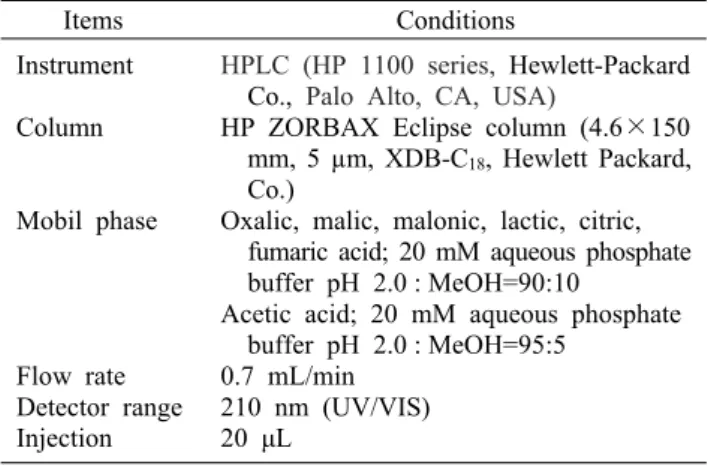
Oxalic, malic, malonic, lactic, citric, fumaric acid; 20 mM aqueous phosphate buffer pH 2.0 : MeOH=90:10
Acetic acid; 20 mM aqueous phosphate buffer pH 2.0 : MeOH=95:5
0.7 mL/min 210 nm (UV/VIS) 20 μL
재료 및 방법
실험재료
본 실험에 사용한 양파(Allium cepa L.)는 창녕군 소재 모곡농산(2006. 9. 18)에서 구입하여 사용하였다. 알코올 발효에 사용한 효모(Saccharomyces cerevisiae, ATCC 9763) 및 초산 발효에 사용된 초산균(Acetobacter pas- teurianus, ATCC 9432)을 Korean Collection for Type Cultures(KCTC) 생물자원센터(Jeongeup, Korea)에서 분 양받아 사용하였다.
양파즙 제조
본 실험에 사용한 양파의 외형적 특성은 품질기준상 무게 360.9 g, 높이 8.2 cm, 직경 8.8 cm, 구형지수 93.1%로 원형 에 가까운 양파를 사용하였다. 협잡물을 제거한 후 수세・세 절한 양파를 착즙기(Philips HR1861, Royal Philips Elec- tronics, Amsterdam, Netherlands)로 착즙하여 여과(Ad- vantec, No. 2, Toyo Roshi, Tokyo, Japan)한 다음 65°C 에서 25분간 살균하여 0.9 L polyethylene terephthalate (P.E.T) 통에 나누어 -20°C에 보관하여 사용하였다.
주모 제조 및 알코올 발효
양파의 세포 내에 다량 존재하는 alliin은 양파 세포가 파 괴될 때 alliinase에 의하여 항균성 물질인 allicin으로 변환 된다. 단계적인 양파 착즙액에 효모를 적응시켜 효율적인 알코올 발효를 위하여 3단계의 전 배양 단계를 거쳐 주모를 제조하였다. 즉 Saccharomyces cerevisiae 균을 YM 배지 (0.3% yeast extract, 0.3% malt extract, 0.5% peptone, 1.0% dextrose)에 배양[(pH 6.2, 30°C, 100 rpm, 24시간), 1단계 배양]한 후, 배양액과 고압멸균기(121°C, 15분, 15 lbs)로 처리한 양파 착즙액(pH 6.2 조절)을 동비율로 섞어 24시간 배양하였다(2단계 배양). 2단계 배양액과 멸균된 양 파 착즙액(pH 6.2 조절)을 1:4 배율로 혼합하여 24시간 배 양한 액을 주모로 사용하였다. 본 연구의 본 배양조건은 자 당 첨가량(10~15oBrix)에 따른 총당, 알코올 함량 예비실험 을 통하여 결정하였다. 즉 본 배양의 알코올 발효는 양파 착즙액에 자당으로 보당(13oBrix)하여 pH 6.2로 조절하고 고압멸균기(SW00AV, Sangwoo Scientific Corp., Bu- cheon, Korea)에서 멸균시킨 후 냉각한 액에 주모를 5%
(v/v) 접종하여 배양기(DS-310FL, Dasol Scientific Co., Ltd., Gyeonggi, Korea)에서 배양(30°C, 100 rpm, 5일)하 였다.
종초 제조 및 초산 발효
초산균 Acetobacter pasteurianus는 YPM 배지(0.5%
yeast extract, 0.3% peptone, 2.5% mannitol)에서 배양 (30°C, 100 rpm, 24시간)하였다. 알코올 원료인 양파 알코 올 발효액은 원심분리(10,000 rpm, 20 min, 5°C) 한 후 여
과(0.45 μm)한 여액(알코올 농도 7.5%)으로 1단계에서 배 양된 초산균 배양액을 10%(v/v, 알코올 여액 부피비) 첨가 하여 배양(30°C, 200 rpm, air 0.5 NL/min, 10일)하였다.
상기 배양액 20%(v/v)를 양파 알코올 발효 여액에 첨가하여 배양한 액을 종초(30°C, 200 rpm, air 0.5 NL/min, 10일)로 사용하였다(종초 총산 2.4%, pH 4.3). 본 배양의 배양조건 은 본 연구의 예비실험 결과 발효 10일 이후 총산 함량이 4.1~4.2%를 나타내었고 10일 이후 알코올 함량이 검출되 지 않아서 다음과 같은 조건으로 선정하였다. 본 배양의 초 산 발효는 종초 35%(v/v)를 양파 알코올 발효 여액(알코올 함량 7.5%)에 접종하여 발효조(5 L, KF-5, KFC, Incheon, Korea)에서 10일간 발효시켰다(총산 함량 4.1%, pH 3.3).
불휘발성 유기산 분석
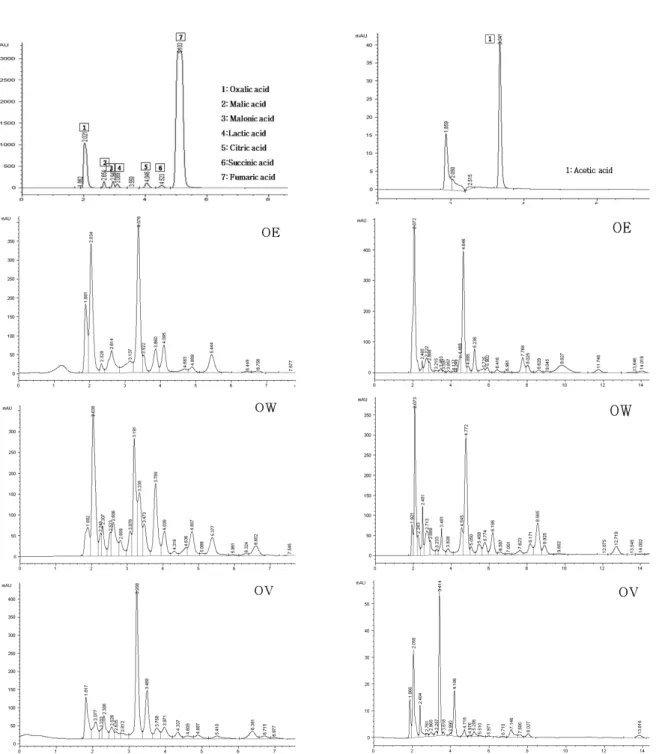
양파 착즙액, 양파 알코올 발효액 및 양파 초산 발효액을 각 시료 10 g씩 취한 후 원심분리(10,000 rpm, 20 min, Beckman J2-HC refrigerated centrifuge, Coulter Inc., Palo Alto, CA, USA) 하여 상층액을 취한 후 0.45 μm mem- brane filter(Puradisc NYL 25 Filter, Whatman® Schleich- er & Schuell Ltd., Florham Park, NJ, USA)로 여과하여 시료를 준비하고 HPLC(Hewlett-Packard HPLC 1100 Series, Hewlett-Packard Co., Palo Alto, CA, USA)로 분 석하였다. 분석조건은 Agilent Technologies(22)의 방법을 변형한 방법으로 Table 1에 제시한 조건에 따라 분석하였 다. 표준 유기산(oxalic acid, malic acid, malonic acid, lac- tic acid, citric acid, succinic acid, fumaric acid 및 acetic acid)과 시료의 유기산 chromatogram을 Fig. 1에 나타내었 다.
비단백태 질소화합물 분석
양파 착즙액 및 각 발효 여과 여액의 시료 10 mL를 ro- tary evaporator(BUCHI V-805, BUCHI, Flawil, Switz- erland)로 농축한 시료에 20 mL ethanol을 가하였다. 3,000 rpm에서 30분간 원심분리 하여 상층액과 침전물에 75%
ethanol 10 mL를 가하여 원심분리 한 후 분리한 상층액을
Fig. 1. Chromatogram of a standard solution (oxalic, malic, malonic, lactic, citric, fumaric, succinic, and acetic acid), onion extracts (OE), onion wine (OW), and onion vinegar (OV).
rotary evaporator로 ethanol을 휘발시켰다. 8 mL 초순수 증류수를 넣고 0.2 g의 sulfosalicylic acid를 가하여 녹인 후 1시간 동안 4°C에 두었다. 3,000 rpm에서 30분간 원심 분리 한 후 상층액을 취하여 10 mL로 정용하고 이 중 1 mL를 취하여 membrane filter(0.2 μL)로 여과한 다음 아미 노산분석기(Amino acid analyzer, S433-H, Sykam GmbH, Eresing, Germany)로 정량분석 하였다.
유리당 분석
양파 착즙액, 양파 알코올 발효액 및 초산 알코올 발효액
을 0.45 μm syringe filter(Minisart RC 15, Sartorius AG, Goettingen, Germany)로 여과한 다음, 여액 20 μL를 HPLC (Waters Alliance 2695, Waters Co., Milford, MA, USA) 로 분석하였다. 분석조건은 Table 2에 제시한 조건에 따라 분석하였다.
통계 처리 및 결과 분석
분석 결과는 SPSS 통계프로그램(Statistical Package for the Social Science, Ver. 16.0, Statistical Package Inc., Chicago, IL, USA)을 이용하여 분산분석(ANOVA)을
Table 2. The analytical conditions of HPLC for free sugars
Items Conditions
Instrument Column Mobil phase Flow rate Detector range Injection
HPLC (Waters Alliance 2695, Waters Co., Milford, MA, USA)
Asahipak NH2P 50 column (4.6 mm×
250 mm, Shodex, Tokyo, Japan) 75% acetonitrile (in water) 1.0 mL/min
RI (Water 410, Waters Co.) 20 μL
Table 3. Changes in non-volatile organic acids during onion vin- egar fermentation (mg/100 g)
Organic acids OE1) OW OV
Oxalic acid Malic acid Malonic acid Lactic acid Citric acid Succinic acid Fumaric acid Acetic acids
109.0±0.9b2)3) 591.9±5.0c 21.2±0.2a 33.9±0.3a 317.7±2.7c
ND 1.2±<0.1b 105.9±0.9a
109.5±0.5b 562.4±2.8b ND4) 402.3±2.0b 265.9±1.3b 239.7±1.2 3.8±<0.1c 417.1±2.1b
27.3±0.1a 121.4±0.3a 122.3±0.3b ND 200.5±0.4a ND 0.9±<0.1a 4,139.6±9.0c Total 1,180.8 2,000.8 4,612.0
1)OE: onion extracts, OW: onion wine, OV: onion vinegar.
2)Values are the mean±SD (n=3).
3)Different letters (a-c) within a row indicate significant differ- ences (P<0.05).
4)ND: not detected.
실시하고 통계적 유의성(P<0.05)은 Duncan's multiple range test로 검증하였다.
결과 및 고찰
양파 알코올 발효 및 양파 초산 발효를 통한 유기산 함량 변화
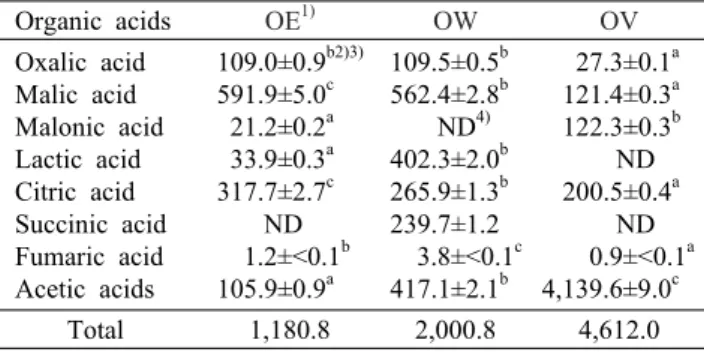
2단 발효를 통한 8종의 유기산 변화(oxalic acid, malic acid, malonic acid, lactic acid, citric acid, succinic acid, fumaric acid 및 acetic acid)는 Table 3에 나타내었다. 원 료인 양파 착즙액의 총유기산 함량은 1,180.8 mg/100 g으 로 국내산 양파의 유기산 함량보다 5~9배 정도 높은 함량이 검출되었다(23). 양파 착즙액의 유기산 조성은 malic acid (50.1%) 및 citric acid(26.9%)가 대부분의 함량을 차지하 였고, 다음으로는 oxalic acid(9.2%)> acetic acid(9.0%)>
lactic acid(2.9%)> malonic acid(1.8%)> fumaric acid(1.2
%) 순으로 나타났다. 이러한 유기산의 조성 비율은 국내산 양파(23)의 유기산 조성[7종 검출, malic acid(86~96%)>
citric acid(1.9~18%)> lactic acid(0~3.4%), succinic acid (0~2.3%)> oxalic acid(0.2~1.1%), malonic acid(0.1~1.1
%)> fumaric acid(0.2 ~0.7%)]과 유사하였고, Benkeblia 와 Varoquaux(24)가 보고한 유기산 조성[5종 검출, malic acid(64%)> oxalic acid(37%)> citric acid(12%)]과도 유
사하였다.
양파 알코올 발효액은 총 7종의 유기산이 검출되었고 양 파즙에 비해 1.7배 증가한 2,000.8 mg/100 g 함량을 나타 내었다. 유기산의 조성을 본다면 malic acid(28.1%)> acetic acid(20.8%)> lactic acid(20.1%)> citric acid(13.3%)>
succinic acid(12.0%)> oxalic acid(5.5%)> fumaric acid (0.2%) 순으로 나타났다. 알코올 발효를 통해 주된 유기산인 malic acid는 유사하였지만 다른 유기산의 함량 및 조성비 가 크게 증가한 것을 볼 수 있다. 이러한 경향은 혐기적 알코 올 발효에서 EMP 경로 및 TCA 회로와 관련한 유기산 발효 가 일어난 것으로 사료된다. 즉 효모의 활성으로 EMP 경로 를 통해 생성된 pyruvic acid가 탈수소 반응 후 lactic acid 및 acetic acid의 생성이 초래되고, 또한 succinic acid는 효모의 알코올 발효과정 중에 증가한다는 Jayaram 등(25) 의 보고에서와 같이 PEP carboxylation pathway와 같은 경로를 통해서 succinic acid의 증가가 일어난 것으로 본다.
양파 초산 발효액의 총유기산 함량은 4,612.0 mg/100 g으 로 양파 착즙액이나 알코올 발효액에 비해 약 3.9배 및 2.3 배로 증가하였으나 acetic acid 및 malonic acid 이외의 유 기산의 함량은 감소하였다. 양파 초산 발효액의 유기산 조성 (6종 검출)은 acetic acid(89.8%), citric acid(4.3%), ma- lonic acid(2.7%), malic acid(2.6%), oxalic acid(0.6%), fumaric acid(0.02%) 순으로 나타났다. 이러한 경향은 호기 적 발효조건에 따른 알코올 발효액에서 생성된 ethanol의 산화로 acetic acid의 함량이 급격히 증가한 반면에 다른 유기산들은 초산균의 생육에 있어서 탄소원으로서의 역할 로 감소가 일어난 것으로 사료된다.
Shin 등(26)은 양파를 농축하여 제조한 양파식초 및 양파 에 보당(15oBrix)을 하여 제조한 양파식초에서 acetic acid, succinic acid, malic acid 순으로 유기산이 높게 검출되었 으며 succinic acid(298.0~452.1 mg%) 및 malic acid(76.8
~293.4 mg%)의 풍미 향상에 대한 역할을 보고하였으나, 본 연구에서는 acetic acid를 제외하고는 citric acid(200.5 mg/100 g), malonic acid(122.3 mg/100 g) 및 malic acid (121.4 mg/100 g)가 주된 유기산으로 차이를 나타내었다.
과실식초(27,28) 중 사과는 malic(427.1 mg%) 및 citric acid(89.9 mg%), 매실식초는 citric acid(580.17 mg%), 포 도식초는 tartaric acid(340.0 mg%), 감식초는 galactur- onic acid(446.32 mg%)로 나타났고 야채식초 중 오이식초 (29)에서는 succinic acid(842.09 mg%), 마늘식초(30)에서 는 citric acid가 주된 유기산으로 검출되었다. 야콘(31)에 서는 초산 발효과정 중에 succinic acid(787.14 mg%)의 변 화가 주된 유기산의 변화로 나타났다. 이와 같이 식초 원료 에 따라 특이적인 유기산의 조성이 발표되었다. 또한 Jeong 등(27)의 보고에 따르면 사과식초의 경우 malic acid 및 citric acid를 품질지표로 제시하여 사과식초의 품질을 예시 하였는데 양파식초 또한 산업화를 위한 과정에서 품질지표 가 될 수 있는 유기산에 대한 고찰이 더욱 필요하다고 본다.
Table 4. Changes in non-protein N compounds during onion vinegar fermentation (μg/100 g)
Non-protein N compounds OE1) OW OV
Phosphoserine Taurine
Phosphoethanolamine Urea
Aspartic acid Threonine serine Asparagine Glutamic acid Sarcosine
α-Aminoadipic acid Proline
Glycine Alanine Citrulline Valine Cystine Methionine Isoleucine Leucine Tyrosine Phenylalanine β-Alanine
β-Aminoisobutyric acid γ-Amino-n-butyric acid Histidine
3-Methylhistidine 1-Methylhistidine Carnosine Anserine Ornitine Lysine Ammonia Ethanolamine Arginine
11.23±3.972)3) 0.37±0.04a 24.18±14.15a 6,432.54±184.12b 71.05±0.69b 68.89±0.43b 60.04±2.79b 515.64±33.53c 46.19±0.11b 14.34±3.35ab ND4) 37.37±1.39a 8.32±0.35a 53.58±0.95a ND 135.61±4.31a ND 1.46±0.25a 37.19±0.50b 102.91±0.37b 72.03±1.62b 60.85±5.02a ND ND 20.20±0.19a 23.08±0.62a ND 71.39±0.24b 80.97±4.56b ND 8.12±0.22a 154.80±3.53b 149.03±18.09a 0.05±0.03a 1,541.67±402.37b
9.83±1.98 20.95±0.46b 83.06±7.96b 33,816.02±614.88c 135.48±8.79c 133.41±1.67c 167.19±8.81c 185.74±18.96b 258.49±6.57c 19.17±4.33b ND 2,065.79±22.08c 152.69±4.21b 347.69±8.82c 2.71±2.29 556.04±9.70c 94.35±2.89b 44.16±7.83b 153.61±3.58c 332.15±6.60c 155.33±4.95c 242.44±18.16b 0.56±0.05b 7.77±0.17b 390.27±6.73c 55.61±2.81b 0.71±0.27 3.47±1.15a 195.20±13.39c 0.92±0.31a 193.88±2.80c 209.31±4.42c 212.52±12.56b 1.72±0.70b 1,278.54±30.87b
15.88±4.07 20.15±0.57b 33.24±0.48a 731.48±28.44a 1.44±0.38a 9.83±1.17a 7.87±0.17a 9.26±1.82a 34.89±1.61a 9.22±2.12a 2.07±0.41 278.22±3.78b 6.92±0.11a 73.54±1.75b 0.61±0.86 164.52±3.44b 34.00±1.51a 1.06±0.43a 12.93±1.05a 20.93±9.83a 25.42±2.46a 97.78±9.15a 0.39±0.06a 3.74±0.70a 42.34±0.97b 51.79±2.15b ND 63.26±3.37b 3.44±0.21a 13.89±0.72b 97.17±2.69b 96.61±3.55a 240.72±13.40b 7.79±0.57c 446.50±5.02a
Total 9,803.09 41,526.76 2,658.87
1)OE: onion extracts, OW: onion wine, OV: onion vinegar.
2)Values are the mean±SD (n=3).
3)Different letters (a-c) within a row indicate significant differences (P<0.05).
4)ND: not detected.
양파 알코올 발효 및 양파 초산 발효를 통한 비단백태 질 소화합물 함량 분석
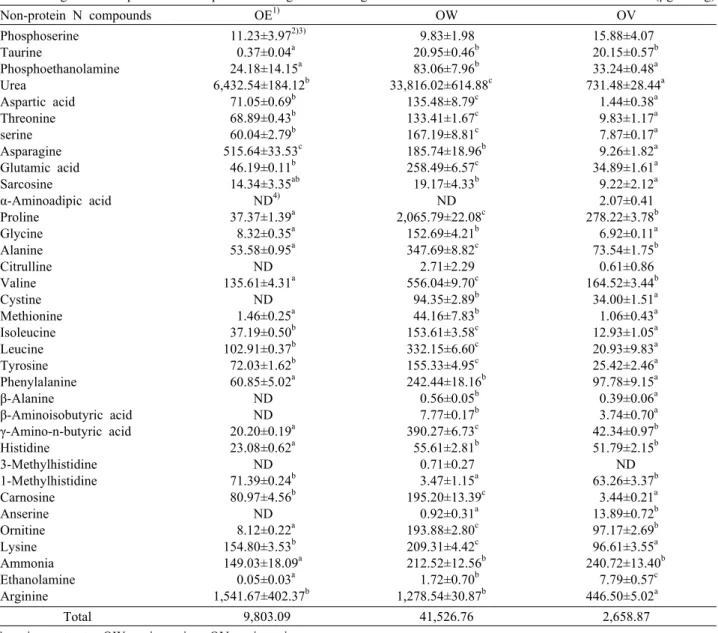
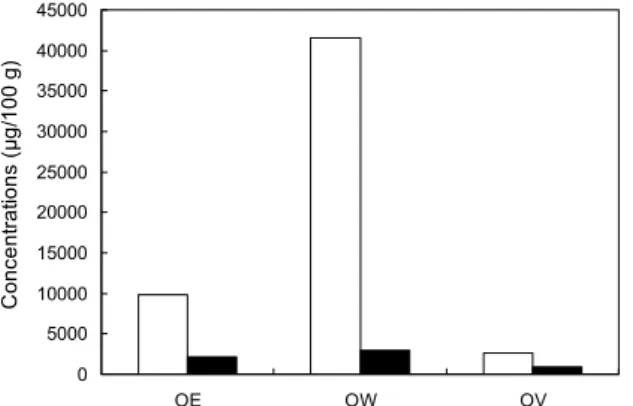
알코올 발효 및 초산 발효에 따른 비단백태 질소화합물의 함량 변화는 Table 4와 같다. 총 35종의 비단백태 질소화합 물이 검출되었다. 양파 착즙액의 총비단백태 질소화합물의 함량은 9,803.09 μg/100 g이었고 주된 성분은 urea(65.62
%), arginine(15.73%), asparagine(5.26%), lysine(1.58%), ammonia(1.52%), valine(1.38%) 및 leucine(1.05%)으로 나타났다. 알코올 발효 후 비단백태 질소화합물 함량은 4.23 배(41,526.76 μg/100 g)로 증가하였고, 특히 총비단백태 질소화합물의 대부분을 차지하는 urea(81.43%)가 두드러 지는 증가를 보였다. 양파 알코올 발효액의 주요 성분은 urea (81.43%), proline(4.97%) 및 arginine(3.08%)이었다. 양
파 초산 발효액의 총비단백태 질소 함량은 2,658.87 μg/
100 g이었고 이는 양파 알코올 발효액의 6%에 해당되는 양으로 초산균의 생육과 관련하여 소비가 이루어진 것으로 사료된다. 양파 초산 발효액의 주된 성분은 urea(27.51%), arginine(16.79%), proline(10.46%), ammonia(9.05%) 및 valine(6.19%)으로 양파 알코올 발효액의 주된 비단백태 질 소화합물과 유사하였지만, 대부분의 비단백태 질소화합물 의 함량이 감소하였다. 식초의 아미노산 조성은 함초현미식 초에서 제시된 바와 같이 주된 성분(glycine, alanine)이 원 료에서 기인할 수도 있고(32), 양조발효공정으로 제조된 식 초의 경우는 재료 배합비, 발효법 등에 따라 유리아미노산 함량이 다양해진다고 보고되었다(33). 또한 Koizumi 등(34) 은 초산 발효 과정 중 glutamic acid, aspartic acid 및 pro-
0 5000 10000 15000 20000 25000 30000 35000 40000 45000
OE OW OV
Concentrations (µg/100 g) .
Fig. 2. Concentration in total non-protein N compounds (□) and essential amino acids (■) during onion vinegar fermentation.
OE, onion extracts; OW, onion wine; OV, onion vinegar.
Table 5. Changes in total umami, sweet, and bitter taste of free amino acids during onion vinegar fermentation (μg/100 g)
OE1) OW OV
Umami2) Sweet3) Bitter4) Others
117.2 (1.2%) 383.0 (3.9%) 1,902.8 (19.4%) 7,400.1 (75.5%)
394.0 (0.9%) 3,076.1 (7.4%) 2,662.6 (6.4%) 35,394.2 (85.2%)
36.3 (1.4%) 473.0 (17.8%) 795.5 (1.2%) 1,354.1 (50.9%) Total 9,803.1 (100%) 41,526.8 (100%) 2,658.9 (100%)
1)OE: onion extracts, OW: onion wine, OV: onion vinegar.
2)Umami: aspartic acid+glutamic acid.
3)Sweet: threonine+serine+glutamine+proline+glycine+alanine+
lysine.
4)Bitter: valine+methionine+isoleucine+leucine+phenylalanine+
histidine+arginine.
Amino acids were classified according to Fuke with modification (35).
Table 6. Changes in free sugars during onion vinegar fermenta- tion (mg/100 g)
Free sugars OE1) OW OV
Fructose Sucrose Glucose Maltose
2,141.6 649.3 2,682.3 ND
17.9 ND1)
ND ND
23.5 ND ND ND
1)OE: onion extracts, OW: onion wine, OV: onion vinegar.
2)ND: not detected.
line과 같은 유리아미노산의 감소를 보고하였는데 이러한 경향은 본 양파식초 초산 발효 과정에서도 유사한 경향으로 나타났다. 비단백태 질소화합물과 필수아마노산의 함량을 Fig. 2에 나타내었다. Tryptophan을 제외한 필수아미노산 (leucine, isoleucine, lysine, valine, threonine, phenylal- anine, methionine, histidine, arginine)의 함량은 양파 착 즙액 2,216.5 μg/100 g(21.7%), 알코올 발효액 3,005.3 μg/
100 g(7.2%), 초산 발효액 901.9 μg/100 g(33.9%)으로 비 단백태 질소화합물의 변화와 유사한 경향을 나타내었으나 전체 분석성분 중 urea를 제외한 유리아미노산에서 필수아 미노산의 비율이 높게 나타났다. 이는 초산균의 생육에 있어 서 urea와 같은 질소원이 우선적으로 사용되어 다른 아미노 산의 소비가 상대적으로 적게 나타난 것으로 사료된다.
유리아미노산 조성이 맛에 미치는 영향을 검토하기 위하 여 유리아미노산을 감칠맛계(aspartic acid, glutamic acid) 와 단맛계(threonine, serine, proline, glycine, alanine, lysine), 그리고 쓴맛계(valine, methionine, isoleucine, leucine, phenylalanine, histidine, arginine) 아미노산(35) 으로 나누어 그 결과를 Table 5에 나타내었다. 양파 착즙액 의 감칠맛계, 단맛계 및 쓴맛계 아미노산이 차지하는 비율은
1.2, 3.9, 19.4%였다. 알코올 발효 및 초산 발효 후 단맛계 아미노산의 비율이 증가하였다. 그러나 본 연구의 시료는 Kato 등(36)이 보고한 유리아미노산의 맛에 대한 역치 (threshold: aspartic acid 3 mg/100 mL, glutamic acid 5 mg/100 mL, glycine 130 mg/100 mL, proline 300 mg/
100 mL, alanine 60 mg/100 mL, arginine 50 mg/100 mL, lysine 50 mg/100 mL, methionine 30 mg/100 mL, leucine 190 mg/100 mL, phenylalanine 90 mg/100 mL, threonine 260 mg/100 mL, serine 150 mg/100 mL, va- line 140 mg/100 mL, isoleucine 90 mg/100 mL)에 비하 여 낮은 농도를 나타내므로 아미노산의 정미에 대한 영향을 거의 없을 것으로 사료된다.
양파 알코올 발효 및 양파 초산 발효를 통한 유리당 함량 변화
유리당의 함량 변화는 Table 6에 나타내었다. 양파 착즙 액에 포함된 유리당 중 포도당(2,682.3 mg/100 g)> 과당 (2,141.6 mg/100 g)> 자당(649.3 mg/100 g) 순으로 함량 이 나타났고 맥아당은 검출되지 않았다. Jeong 등(37)이 발 표한 황색양파에서 나타난 함량과 비교하여 본다면 포도당 (744.2 mg/100 g), 과당(705.9 mg/100 g) 및 자당(335.4 mg/100 g) 등의 순으로 양파 착즙액에서 검출된 조성율과 유사하였다. 유리당의 양적인 차이는 품종이나 재배지에 따 른 화학적인 요인에 기인한 차이로 볼 수 있으나 착즙과정을 통한 많은 수용성 성분의 유출로 인해 양파와 비교하여 높은 함량이 검출된 것으로 사료된다. Terry 등(38)은 양파의 유 리당, 특히 포도당과 과당은 양파의 단맛과 상관성이 높고 그중 포도당은 쓴맛과 음의 상관성을 제시하여 본 연구의 양파 착즙액이 단맛이 강하고 쓴맛이 약한 양파 착즙액일 것으로 판단되었다. 한편 알코올 발효 및 초산 발효과정을 통해 과당은 양파 착즙액에 비해 1% 이내로 감소하였고 자 당 및 포도당은 검출되지 않았다. 이러한 경향은 알코올 발 효에 있어서 효모균의 탄소원으로 이용되어 나타난 결과로 사료된다. 감식초의 발효과정 중 유리당(포도당, 과당, 자당) 의 함량이 감소하는 결과를 보고(39)하였는데 본 연구에서 도 알코올 발효 후기에 미량의 과당을 제외하고는 유리당이 거의 존재하지 않아 초산 발효에 있어서 유리당의 역할을 기대할 수 없을 것으로 사료된다.
요 약
발효과정(양파 알코올 발효 및 양파 초산 발효) 중의 정미성 분을 분석하였다. 유기산의 분석 결과 양파 착즙액(유기산 함량 1,180.8 mg/100 g)에서 malic acid(50.1%)와 citric acid(26.9%)가 대부분의 함량을 차지하였다. 양파 알코올 발효액(유기산 함량 2,008.8 mg/100 g)은 malic acid(28.1
%), acetic acid(20.8%), lactic acid(20.1%), citric acid (13.3%) 및 succinic acid(12.0%) 순으로 높은 함량을 차지 하였다. 양파 초산 발효액의 총유기산 함량은 4,612.0 mg/
100 g으로 양파 착즙액이나 알코올 발효액에 비해 각각 약 3.9배와 2.3배 증가하였으나 acetic acid 이외 유기산의 함 량은 감소하였다. 비단백태 질소화합물은 양파 착즙액(총비 단백태 질소 함량 9,803.1 μg/100 g)에 비하여 알코올 발효 후 4.23배(41,526.8 μg/100 g)로 증가하였고, 특히 urea (81.43%)가 두드러지는 증가를 보였다. 양파 초산 발효액은 2,658.9 μg/100 g으로 초산균의 생육과 관련하여 소비가 이루어진 것으로 사료된다. 양파 착즙액에 검출된 유리당 (포도당, 과당, 자당)은 발효과정 중 과당을 제외하고는 검출 되지 않았다.
감사의 글
본 연구는 2008~2009년 산학 공동기술개발지원사업으로 수행하였으며, 이에 감사드립니다.
REFERENCES
1. Park YK. 1995. Source and processing techniques and study trends of vegetable juice. Bull Food Technol 8: 59-68.
2. Jin SK, Kim IS, Hah KH, Lyou HJ, Park KH, Lee JI. 2005.
Changes of quality characteristics of spicy fermented pork with atmosphere packaging during storage. J Anim Sci &
Technol 47: 813-824.
3. Industry-Academia-Research Institute of Ajou University.
2006. Identification of onion components having beneficial effects on cardiovascular diseases. Ministry of Agriculture and Forestry, Gwacheon, Korea. p 20.
4. Kang NS, Kim JH, Kim JK. 2008. Quality characteristics of onion Jangaji during aging. Korean J Food Preserv 15:
796-803.
5. Kim JH, Kim JK. 2008. Effect of maturation solution com- position on the physicochemical properties of onion Jangaji.
Korean J Food Preserv 15: 816-823.
6. Lee JI, Cho YS, Shon MY, Kang KS, Seo KI. 2000. Changes in physicochemical components and bacterial count during the fermentation of onion Kimchi. J East Asian Soc Dietary Life 10: 419-424.
7. Cho WD, Yoo KW. 1997. Preparation of onion hydrolysate for usage of sauce. J Korean Soc Food Sci Nutr 26: 1147- 1151.
8. Kee HJ, Ryu GH, Park YK. 2001. Physical properties of extruded snack made of dried onion and onion pomace. J Korean Soc Food Sci Nutr 30: 64-69.
9. Kee HJ, Park YK. 2000. Preparation and quality properties
of extruded snack using onion pomace and onion. Korean J Food Sci Technol 32: 578-583.
10. Suh HJ, Chung SH, Son JY, Son HS, Cho WD, Ma SJ. 1996.
Preparation of onion hydrolysates with enzyme. J Korean Soc Food Sci Nutr 25: 786-790.
11. Kee HJ, Park YK. 1999. Effect of seaweeds and adsorbents on volatile flavor components of onion juice. Korean J Food Sci Technol 31: 1447-1483.
12. Kim SW, Park JH, Jun HK. 2008. Analysis of optimum con- dition for production of an onionic vinegar by two-step fer- mentations. J Life Sci 18: 1410-1414.
13. Kim SW, Oh EH, Jun HK. 2008. Analysis of optimum con- dition for alcoholic drink production using onion extract.
J Life Sci 18: 871-877.
14. Kim SW, Oh EH, Jun HK. 2008. Development of an alco- holic drink using onion extract. J Life Sci 18: 980-985.
15. Hou WN, Go EK. 2004. Extractive optimization of func- tional components for processing of onion health promotion drink. Korean J Food Sci Technol 36: 403-409.
16. Choi YJ, Kim SW, Jang JK, Choi YJ, Park YS, Park H, Shim KS, Lee HS, Chung MS. 2009. Development of fer- mented functional onion juice using lactic acid bacteria.
Food Eng Prog 13: 1-7.
17. Bae JH, Woo HS, Choi HJ, Choi C. 2003. Physicochemical properties of onion powder added wheat flour dough. Kore- an J Food Sci Technol 35: 436-441.
18. Bae JH, Woo HS, Choi HJ, Choi C. 2003. Quality character- istics of the white bread added with onion powder. Korean J Food Sci Technol 35: 1124-1128.
19. Chun SS. 2003. Development of functional sponge cakes with onion powder. J Korean Soc Food Sci Nutr 32: 62-66.
20. Sung CR, Kim CS. 2007. The development of pizza with Chungkukjang and onion: Optimization of pizza crust prepa- ration using response surface methodology. Korean J Food Cookery Sci 23: 481-491.
21. Sung CR, Kim CS. 2007. The development of pizza with Chungkukjang and onion: Formulation and assessments of nutrients and sensory quality for Chungkukjang・onion pizza.
Korean J Food Cookery Sci 23: 492-501.
22. Agilent Technologies, Inc. 2009. Analysis of organic acids in aqueous samples. Available from https://www.agilent.com/
cs/library/applications/5989-1265EN_low.pdf (accessed Jun 2009).
23. Lee HY. 2006. Comparison of quality and functional prop- erties of domestic onions during storage. MS Thesis. Chang- won National University, Changwon, Korea. p 16-18.
24. Benkeblia N, Varoquaux P. 2003. Effect of nitrous oxide (N2O) on respiration rate, soluble sugars and quality attrib- utes of onion bulbs Allium cepa cv. Rouge Amposta during storage. Postharvest Biol Technol 30: 161-168.
25. Jayaram VB, Cuyvers S, Verstrepen KJ, Delcour JA, Courtin CM. 2014. Succinic acid in levels produced by yeast (Sac- charomyces cerevisiae) during fermentation strongly impacts wheat bread dough properties. Food Chem 151: 421-428.
26. Shin JS, Lee OS, Jeong YJ. 2002. Changes in the compo- nents of onion vinegars by two stages fermentation. Korean J Food Sci Technol 34: 1079-1084.
27. Jeong YJ, Seo JH, Lee GD, Park NY, Choi TH. 1999. The quality comparison of apple vinegar by two stages fermenta- tion with commercial apple vinegar. J Korean Soc Food Sci Nutr 28: 353-358.
28. Seo JH, Kim YJ, Lee KS. 2003. Comparison of physico- chemical characteristics of fruit vinegars produced from two- stage fermentation. Food Industry and Nutrition 8(3): 40-44.
29. Moon HS. 2011. Development of vinegar using cucumber and its functional activity. MS Thesis. Sunchon National University, Sunchon, Korea. p 18.
30. Ko EJ, Hur SS, Choi YH. 1998. The establishment of opti- mum cultural conditions for manufacturing garlic vinegar.
J Korean Soc Food Sci Nutr 27: 102-108.
31. Lee MK, Choi SR, Lee J, Choi YH, Lee JH, Park KU, Kwon SH, Seo KI. 2012. Quality characteristics and anti-diabetic effect of yacon vinegar. J Korean Soc Food Sci Nutr 41:
79-86.
32. Kim HS. 2011. Development of vinegar using saltwort (Sal- icornia heracea L.) and its antioxidant effect. MS Thesis.
Sunchon National University, Suncheon, Korea. p 22.
33. Na HS, Choi GC, Yang SI, Lee JH, Cho JY, Ma SJ, Kim JY. 2013. Comparison of characteristics in commercial fer- mented vinegars made with different ingredients. Korean J Food Preserv 20: 482-487.
34. Koizumi Y, Uehara Y, Yanagida F. 1987. The general com- position, inorganic cations, free amino acids and organic acids
of special vinegars. Nippon Shokuhin Korgyo Gakkaishi 34:
592-598.
35. Fuke S. 1994. Taste. In Science of Taste. Yamano Y, Yama- guchi S, eds. Asakura-Shoten, Tokyo, Japan. p 46-61.
36. Kato H, Rhue MR, Nishimura T. 1989. Role of acids and peptides in food taste. In Flavor Chemistry. American Chem- ical Society, Washington, DC, USA. p 158-174.
37. Jeong CH, Kim JH, Shim KH. 2006. Chemical components of yellow and red onion. J Korean Soc Food Sci Nutr 35:
708-712.
38. Terry LA, Law KA, Hipwood KJ, Bellamy PH. 2005. Non- structural carbohydrate profiles in onion bulbs influence taste preference. In Frutic 05: Information and Technology for Sustainable Fruit and Vegetable Production. 12-16 Sep- tember 2005, Montpellier, France.
39. Jeong YJ, Seo JH, Park NY, Shin SR, Kim KS. 1999. Changes in the components of persimmon vinegars by two stages fermentation. Korean J Postharvest Sci Technol 6: 228-232.