Energy-Efficient Base Station Operation in Heterogeneous Cellular Networks
Hoang-Hiep Nguyen
†, Won-Joo Hwang
††ABSTRACT
In this paper, we study the ON/OFF control policy of base stations in two-tier heterogeneous cellular networks to minimize the total power consumption of the system. Using heterogeneous cellular networks is a potential approach of providing higher throughput and coverage compared to conventional networks with only macrocell deployment, but in fact heterogeneous cellular networks often operates regardless of total power consumption, which is a very important issue of modern cellular networks. We propose a policy that controls the activation/deactivation of base stations in heterogeneous cellular networks to minimize total power consumption. Under this policy, the total power consumed can be significantly reduced when the traffic is low while the QoS requirement is satisfied.
Key words: Energy-efficient, optimal control, cellular networks, heterogeneous cellular networks, dynamic programming.
※ Corresponding Author : Won-Joo Hwang, Address : 621-749, Obangdong, Gimhae, Gyeongnam, Korea, TEL : +82-55-320-3847, FAX : +82-55-322-6275, E-mail : [email protected]
Receipt date : July 11, 2012, Revision date : Aug. 20, 2012 Approval date : Aug. 30, 2012
††
Department of Information and Communication Engin- eering, HSV-TRC, Inje University
(E-mail: [email protected])
††
Department of Information and Communication Engin- eering, HSV-TRC, Inje University
※ This work was supported by the Inje Research and Scholarship Foundation in 2009.
1. INTRODUCTION
Nowadays, energy efficiency in wireless cellular networks has become a very important aspect in addition to improving the total throughput of the system. This is because of the huge amount of en- ergy consumed and the
emissions caused by the operation of the networks. It is reported that the information and communication technology in- dustries accounts for 2% and 3% of global
emissions and energy consumption respectively, [1], this consumption is expected to grow by three times by 2030. In particular, nearly 60% of this use
belongs to users and devices in mobile networks and this is still increasing explosively. Much atten- tion has focuses on reducing the energy con- sumption of mobile cellular networks, and solutions range from backhaul networks to radio access net- works [2].
In this paper, we focus on increasing the energy efficiency of base station (BS) operation since they account for nearly 60% of the total energy consumed. We study the dynamic on/off operation of BSs in two-tier heterogeneous networks. we specifically consider networks that consist of a macrocell as the first tier and picocells overlaid on the coverage area of the macrocell as the second tier. Our work can also expand to a network of mi- crocells or femtocells as the second layer, the latter only has effects on energy efficiency in case of dense femtocell deployed because the power con- sumption of a femto BS is quite small, e.g., 5 W.
Our goal is to reduce the total power consumption
of the system. For this purpose, we propose a poli-
cy that chooses the optimal actions which are acti-
vation, deactivation or doing nothing on picocells
and radio resources of the macrocell that lead to
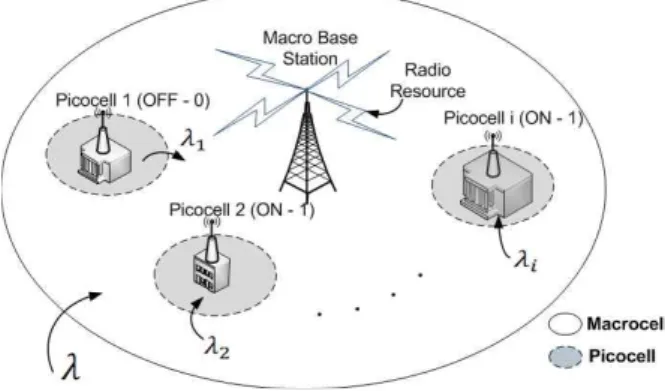
minimum power consumed with acceptable users QoS perceived. For example, in the scenario in Fig.
1, users are leaving picocell 1, when traffic in pico- cell 1 decreases to a level in which the macro BS can handle the current traffic of this picocell while keeping an acceptable level of QoS. Then we can turn it off to save power, and ongoing calls in pico- cell 1 will be handed over to the macro BS.
However, there may be the case that when we put picocell 1 off, the macro BS has to serve additional traffic that leads to degradation of the QoS require- ment, e.g., the blocking rate exceeds a certain threshold or the macro BS has to activate addi- tional radio resources to serve that traffic with ac- ceptable QoS which causes more power con- sumption, then doing nothing is the optimal action.
We formulate this problem as a dynamic program- ming problem, the optimal action is deduced based on the traffic profile that results in the minimum total power consumption and satisfies the QoS requirements. Our main contributions can be sum- marized as follows:
• We model the system and formulate the problem of choosing the optimal policy as a dynamic pro- gramming problem. (Section III.A and III.B).
• We propose an algorithm that minimizes the power consumption of the system and satisfies the QoS requirement. (Section III.C).
• In section IV, we evaluate the proposed algo- rithm with numerical analysis.
The remainder of this paper is organized as follows. We present related works in section II. In section III, we describe our system model, the problem formulation and the solution. Section IV gives the evaluation of the proposed algorithm and section V eventually concludes the paper.
2. RELATED WORKS
There are various ways to improve the energy efficiency of cellular networks. An approach that can significantly reduces the amount of energy
consumed is the dynamic load aware on/off oper- ation of BSs [3,4] (this idea can be found in [5]
for home networks). Since BSs usually operate re- gardless of traffic load, they are often underutilized.
In [6], it was observed that real traffic patterns are highly periodic and there are long periods in which traffic is below 10% of the peak hour, however, the energy consumption of the BSs is nearly un- changed even when traffic is very low. Real data measurements show that the power consumption of BSs varies about 2%-3% over the time when traffic varies between no load to peak load level [7]. This is due to the presence of pilot channels and the fixed power consumed of BSs is very large, therefore it is essential to entirely or partly turn off BSs in the period of low loads to save energy.
In [3] they proposed a scheme that allows BSs to turn on/off their radio resources based on the traf- fic information and users perceived QoS, but in networks with hierarchy cell structure, the authors considered that the smaller cells or relays were the radio resources of macro BS. This assumption does not capture the impacts of switching on/off smaller cells on macro BS. Another mechanism was pro- posed in [8] that femto BSs activate or deactivate their radio transmissions according to the presence or absence of users within its coverage. This re- quired modification of femto BSs so they were able to detect active calls from users to the overlaid macrocell.
Another approach was using hierarchy cell
structures by deploying low-cost, low-power,
small-range coverage micro/pico base stations
that covered dense traffic areas, e.g., shopping
malls, office buildings or cell-edge areas to im-
prove users performance instead of increasing
macro BSs. Networks with such heterogeneous
cell structures improves not only network capacity
and coverage but also energy efficiency such as
improvement in term of the total throughput over
the total power consumption [9]. However, this
work only analyzed the inherent energy efficiency
Fig. 1. Macrocell with overlaid picocells.
of heterogeneous cellular networks. To further re- duce the power consumption of heterogeneous cel- lular networks, we consider the dynamic on/off op- eration of heterogeneous cellular networks accord- ing to real traffic patterns, we also investigate the impacts of switching off smallers cell on the macrocell.
3. SYSTEM MODEL AND PROBLEM FORMULATION
3.1 A. System model
In this paper, we consider a system consists of traditional macrocell, which is the first tier equip- ped with R radio resources such as the number of transmitters for GSM, carriers for 3G, HSDPA or LTE, and N picocells forming the second tier with- in the macrocell coverage area (Fig. 1). Users within the coverage area of picocells can commu- nicate with both the macro and pico BSs, we as- sume in this case they will be automatically con- nected to the pico BSs because of the short dis- tance to pico BSs. When users leave a picocell, on going calls of users will be transferred to the macro BS by hand over. We also assume that cross-tier and inter-tier interference are mitigated by the in- terference coordination and cancellation techniques [10].
Next, let’s consider the scenario in Fig. 1 in which the traffic in picocell 1 is decreasing, traffic in macro and picocell 2 are increasing. The macro
BS knows about the traffic information of system and will decide: if the traffic in picocell 1 decreases to a level that macro BS can handle that traffic with acceptable users perceived QoS, it will turn off picocell to save energy. In this case, ongoing calls of users in picocell 1 will be handed over to the macrocell. If the macro BS can serve the hand- ed over traffic from picocell 1 but has to activate additional radio resources to serve that traffic, which in turn requires more power or the QoS de- grades due to the increasing of users in the macro- cell, then clearly doing nothing is the optimal action.
To calculate the power consumption of BSs, we use a power consumption model of macro and pico BSs that consists of two parts, the static part which is consumed even if there is no user in the system and the dynamic part that depends on the load (BS’s utilization), the energy consumption function of macro BS is given by [3]
m ax
where
is the power consumed due to transport and processing units,
is the fixed power of the transceiver and
m axis the maximum output signal of the power amplifier, is the direct current to radio frequency conversion factor,
is the uti- lization (load) of radio resource . We assume that each pico BS is equipped with one radio resource and the energy consumption is given by [4]
(1)
Similar to macro BS,
here is the fixed power consumption and
is the power con- sumption that is proportional to the utilization (load) of pico BSs,
m axwhere
m axis the maximum power consumption of pico
BSs (when operating with full load).
3.2 B. Problem formulation
To choose the optimal actions on radio resources
of macro BS and picocells to serve current traffic
with minimum consumed energy and acceptable QoS, we formulate the problem as a Dynamic Programming Problem with components as fol- lows:
(i) Time: In this paper, we consider time is div- ided into equal periods in which the traffic is con- sidered as constant. It is clear that the traffic pat- tern varies over time and space, but it can be con- sidered unchanged for a certain period of time (e.g., one hour as in [4]).
(ii) System state: Let
⊂ be the vector that represents system state at period
, is the state space, is defined as
where
is the number of active radio resources
and
represents the state of pico BSs, i.e.,
t,i
.
1 if pico BS i is activated l = 0 if pico BS i is deactivated
ì í î
(iii) Decision variable: At the beginning of each period, we define the control variable
⊂ associated with state
, is the action space,
is defined as
where
and
are actions corresponding to the radio resources of macro BS and pico BSs re- spectively, the values of
and
are as follows:
or i f
or i f
The value “ ” means activation, “ ” means deactivation and “0” means do nothing.
(iv) Transition function: The system evolu- tion is described as
(v) Traffic information: Due to the dynamic on/off operation of BSs, it is very hard to obtain completely and exactly traffic information of the system, but based on the real traffic profile, the controller can obtain the traffic distribution of the
system in each period.
(vi) Cost per stage: We define the cost per stage
is the power consumption of the system in state
knowing the distribution of traf- fic load in period
, i.e.,
where
and
are the total power con- sumption of macro BS and pico BSs knowing state
and traffic information in period
respectively.
When system state is
, the macro BS is using
radio resources, thus
is given by (1), re- placing by
radio resources
m ax (2)
The total power consumption of all pico BSs de- pends on the state of those pico BSs and can be calculated as
(3)
Here
and
are the state and the energy consumption of pico BS
, respectively and
is given by (2). Our aim is to find the actions that minimize the total power consumption of the sys- tem over a period T and satisfy QoS requirement, i.e.,
min
(4)
s.t. requirements,
Here we just consider the QoS of macrocell as picocells are designed to serve users with accept- able QoS even in peak traffic.
3.3 C. Optimal policy
The pure problem (4) (without QoS require-
ments) is a dynamic programming problem over
a finite horizon with finite, discrete states and ac-
tion space, solving this problem is equivalent to
solving the following equation [10]
Step 1: Initiating the termination cost
. Set .
Step 2: For all
⊂ ,
⊂ calculate:
2a:
min
. Set
arg
. 2b: Calculating the corresponding QoS.
2c: If QoS meets requirement then go to step 3.
Else Set ╲
and return to 2a.
Step 3: If , decrement and return to step 1. Else stop.
Table 1. The algorithm
Fig. 2. Traffic pattern.
min
(5) where
is the cost-to-go starting from state
, this problem can be solved by the “backward induction” algorithm in [11] by setting the termi- nation cost
and calculating (5) recursively backward in time for . Problem (4) with the QoS requirement can be solved by this algorithm with a little modification as shown in Table. 1.
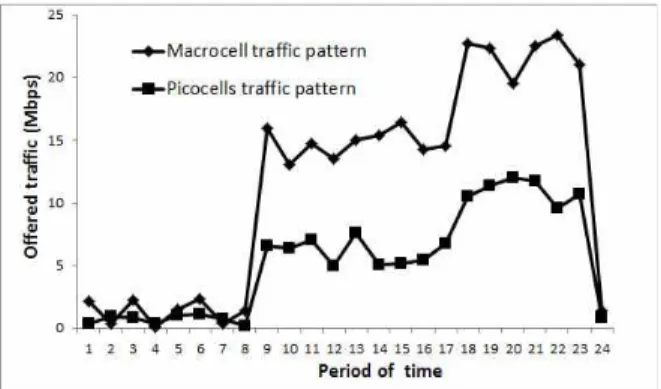
This framework can be applied, for example in a typical day, time is divided into 24 periods (each lasts one hour), the load of base station for each period is calculated as
Where
and
are the arrival rate and average file size in period
(note that
is the average offered traffic in period
) and R is the total transmission rate. Substituting this into (1), (2) and (3), calculating the cost according (5) and following
“backward induction” algorithm to obtain the opti- mal actions, QoS here can be considered in case of a network with admission control as the block- ing probability that new call requests will be blocked when there are the maximum M active users in the system to achieve a required through- put and is given by (Erlang B formula)