위성 시스템에서의 시공간 부호 기술과 결합된 계층적 터보 부호
김 영 민*, 김 수 영* 정회원
Layered Turbo codes combined with space time codes for satellite systems
Youngmin Kim*, Sooyoung Kim* Regular Member
요 약
계층적 부호화 방식은 멀티미디어 방송 및 멀티캐스팅 서비스(multimedia broadcasting and multicasting services; MBMS)등과 같이 단방향의 서비스에서 신호 품질에 대한 피드백 정보의 활용이 어려울 경우 사용할 수 있는 적응형 수신 기법 중의 하나이다.
이 기술은 계층적 변조 방식과 결합하여 사용함으로써, 부호화율과 변조 방식을 적절하게 결합하여 사용할 수 있는 방식이다. 또한, 터보부호와 결합된 시공간부호를 이용하여 멀티미디어 방송 서비스 제공에 있어서 위성-지상 통합망에서 효과적으로 다이버시티 이 득을 얻을 수 있음이 보여왔다. 본 논문에서는 계층적 터보 부호와 결합된 시공간 부호화 방식을 위성-지상 통합 망에 적용하는 방 안을 제시한다. 먼저, 시스템 구조 및 동작 원리를 설명하고, 실제 적용 예제들을 제시한다.
Key Words : 위성통신, 터보 부호, 시공간 부호, 이동위성통신, 계층적 변조 방식
ABSTRACT
A layered coding scheme is one of the adaptive receiving techniques for unidirectional services such as multimedia broadcasting and multicasting services (MBMS), where we cannot utilize feedback information. The layered coding scheme can be used with hierarchical modulations by combining suitable code rates and modulation orders of each. In addition, it has been reported that hybrid and/or integrated satellite systems can effectively achieve transmit diversity gains by appropriate utilization of space time coding combined with turbo codes. This paper proposes a layered turbo coding schemes for hybrid and/or integrated satellite systems. We first introduce the system architecture and operational principle of the proposed scheme, and discuss the applicability.
*전북대학교 전자정보공학부 디지털통신시스템연구실 ([email protected], [email protected])
※ 이 논문은 2009 년도 정부(교육과학기술부)의 재원으로 한국연구재단의 지원을 받아 수행된 기초연구사업임(No. 2009-0088286).
접수일자 : 2010년 8월 26일, 수정완료일자 : 2010년 9월 15일, 최종게재확정일자 : 2010년 10월 6일
I. Introduction
Multimedia broadcast and multicast services (MBMS) are expected to be prevailed in future, and we can expect an integrated scenario where the satellite cooperates with the terrestrial segment to provide mobile users with MBMS service. Due to the unidirectional nature of MBMS, downlink strategies should be focused on improving the performance.
Recently, various cooperative transmit diversity techniques have been proposed for these
integrated/hybrid networks, using repeaters as the ground components with appropriate signal processing capabilities [1-3]. In these schemes, the user terminal with multi-path signals from the satellite and terrestrial components can achieve spatial and time diversity gains. As the name
“transmit diversity” indicates, these techniques are basically driven at the transmitter.
On the other hand, there are some techniques driven at the receiver, and these are hierarchical modulation and layered coding techniques. In these methods, the receiver operates adaptively by itself
without any control commands. The hierarchical modulation scheme is one of the most popular adaptive schemes that can be applied to MBMS applications [4], and the purpose of this adaptability is to allow the service quality to be upgraded for a new terminal while maintaining backward compatibility. On the other hand, the layered coding scheme is used to compensate channel impairments adaptively at the receiver [5]. In this scheme, a receiver selects a suitable demodulation/decoding scheme for the channel condition without any knowledge of the channel quality information (CQI) from the return link.
This paper provides applicability of the above hierarchical modulation and layered coding techniques for hybrid/integrated satellite and terrestrial systems. We first introduce the related previous works in the literature. Next, we extend this idea into hierarchical modulation and layered coding technique and investigate the applicability.
This paper is organized as follows. Section 2 describes an architecture of integrated/hybrid satellite and terrestrial network where cost-effective MBMS can be provided. In addition, brief summary of the previous related works is given. Section 3 presents application examples of hierarchical modulation and layered coding techniques for integrated/hybrid satellite and terrestrial network, and investigates the applicability. Finally we draw conclusions in section 4.
Ⅱ. System Model and Review of Previous Works
1. Hybrid/integrated system for MBMS
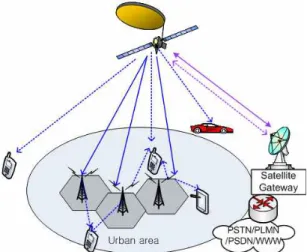
Figure 1 shows the system model of the integrated/hybrid satellite-terrestrial network which designed to provide MBMS in a cooperative way. In this network, a satellite in the geostationary orbit (GEO) and an ensemble of ground components (GCs) are deployed. These kinds of GCs are referred to as ancillary terrestrial component (ATC) in the United States and Canada, and complementary ground component (CGC) in Europe. The main purpose of these GCs is to relay the satellite signal to the users who are not in prevailed line of sight (LOS) condition, such as in urban areas.
Figure 1. An architecture of integrated/hybrid system providing MBMS.
2. Previous Works
A transmit diversity techniques using space-time coding (STC) for an integrated Mobile Satellite Service (MSS) system was proposed in [1]. This transmit diversity technique is well-suited for the MBMS service, since it does not require any CQI from the return link. In this scenario, the satellite and GCs cooperate so that the diversity gain is achieved at the user terminal. The user terminal with multi-path signals from the satellite and GCs achieves spatial and time diversity gain from the STC encoded signals.
Later, a coded cooperative diversity technique was presented for integrated/hybrid satellite systems [2][6]. In this scheme, the satellite and GCs transmit different parity symbols in a rate-compatible punctured turbo codes, so that the user terminal can combine a received codeword for the mother code. Moreover, reference [3] presented cooperative diversity techniques for integrated satellite systems using various STC schemes for two to four transmit antennas, and evaluated the Bit Error Rate (BER) performance for these diversity schemes.
The layered coding scheme consists of several concatenated codes that can be separated and operate in different ways. The user terminal can choose to operate either with the symbols encoded using the high rate code, or with the symbols encoded using the low rate code, according to the required BER and the received SNR. The penalty associated with the latter choice is increased decoding complexity and delay.
As an example of the layered coding applied to
hybrid/integrated satellite system to provide MBMS, the previous research in [7] proposed a layered coding scheme with serially concatenated turbo codes, and demonstrated performance improvement.
Later, with a similar concept, a layered coding scheme with block turbo codes (BTC) was introduced [5]. In this scheme, the BTC consists of multidimensional product codes that can be separated into lower dimensional codes and operate in different ways. The user terminal can choose to operate either with the symbols encoded using the high code rate BTC (lower dimensional code), or with the symbols encoded using the low code rate BTC code (higher dimensional code) according to the required BER and the received SNR.
Ⅲ. Layered Coding for Hybrid /Integrated Satellite systems
1. The Basic Concept
Hierarchical modulation scheme was originally designed to provide high quality service to a new terminal while maintaining backward compatibility [4]. A modulation symbol in a hierarchical modulation scheme is consisted of information bits in a basic layer and an enhancement layer, so that the receiver can select demodulation scheme either for only basic layer or both basic and enhancement layers. Therefore, if the user terminal is in a good channel condition, then the receiver can demodulate with higher order modulation symbol to recover information in both basic and enhancement layers.
On the other hand, if it is a bad channel condition, then the receiver demodulates with lower order modulation symbol to recover information only in the basic layer.
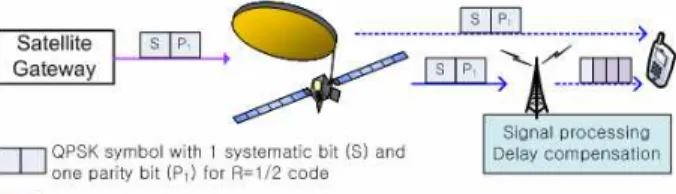
Layered coding concept can be viewed as hierarchical modulation applied to channel coding schemes. In this scheme, additional parity information is added in order to form a higher order modulation symbol. Figure 2 shows an example of layered coding scheme applied to integrated/hybrid satellite and terrestrial system.
In the example shown in Fig. 2, we first assume the mother code of rate 1/4 code is used. The satellite transfers QPSK modulation symbol which is consisted of two bits, i.e., a systematic bit and a parity bit. With this, a punctured code with rate 1/2
is formed. After receiving the QPSK symbols at the GCs, the other two parity bits are added and form 16-QAM symbol with a code rate of 1/4.
Figure 2. An example of layered coding scheme.
A user terminal classifies the channel condition into different categories, and uses a suitable demodulation/decoding scheme. Depending on the situation, users can detect the received symbol with QPSK and extract two bits consisting of one systematic bit and one parity bit. Then, a decoder for the rate 1/2 code is employed. On the other hand, users can detect the received symbol with 16-QAM and extract four bits consisting of one systematic bit and three parity bits. Then, a decoder for the rate 1/4 code, with possibly a more complex decoding algorithm to further improve the performance, is employed.
With this approach, a lower order modulation symbol is transmitted through the satellite, and thus the signal transmitted to the satellite will not have serious nonlinearity problem caused by traveling wave tube amplifier (TWTA) at the satellite transponder. In addition, the system can combine cooperative diversity schemes with space-time coding in order to increase the performance [1-3].
In the situation, where both QPSK and 16-QAM modulated signals received, we can still detect, at least QPSK symbol with the higher rate code.
2. Applicability
In order to take advantage of the layered coding schemes, the higher order modulation scheme with lower rate code should provide better performance.
Otherwise, there is no reason to add additional parity information at GCs. For this reason, in the previous works on the layered coding schemes, the higher order modulation scheme employs a much more complex decoder in order to compensate the performance degradation compared to the lower order modulation scheme [5][7]. For example, reference [5] evaluated the performance of the layered coding scheme employing BTC. Table 1
shows the layered coding scheme using an 3D BTC.
There are 4 modes i.e. M0, M1, M2, and M3 in the layered coding scheme. M0 is uncoded BPSK. In this case the code rate is 1. In M1, a QPSK symbol with an information bit and a parity bit is transmitted, and thus the code rate is 1/2. In M2 and M3, a 8-PSK symbol with an information bit and 2 parity bits is transmitted, and the code rate is 1/3.
Table 1. Layered coding scheme employing four operating modes
Mode Mod.
scheme
Coding scheme
Code rate
Eb/N0 @ BER =
10-6
M0 BPSK Uncoded 1 10 dB
M1 QPSK 2D BTC 1/2 5.2 dB M2 8-PSK Punctured
3D BTC 1/3 4.2 dB M3 8-PSK Full 3D
BTC 1/3 3.2 dB
Figure 3 shows the BER performance of each mode by assuming the same component code of the (15, 10) expurgated BCH code in each axis of the BTC. The rightmost column of Table 1 shows bit energy to noise spectral density (Eb/N0) value when the required BER performance is 10-6. A user terminal can select its own operating mode at the receiver by the channel condition. For example , a user with comparatively good channel condition, detects a QPSK symbol and employs less complex decoder for the 1/2 rate code. On the other hand a user with comparatively bad channel condition detects an 8PSK symbol and employs more complex decoder for the 1/3 rate code.
In order to investigate applicability of the layered coding scheme with another coding scheme, we apply a duo-binary turbo code. We assume that the codeword length is 192 symbols, i.e., 384 bits, and the code rate of the mother code is 1/3 [8]. We can design two possible layered coding schemes as follows.
(A) scheme A
A. layer 1 : QPSK with code rate of 1/2 B. layer 2 : 8-PSK with code rate of 1/3 (B) scheme B
A. layer 1 : QPSK with code rate of 3/4 B. layer 2 : 8-PSK with code rate of 1/2
Figure 3. BER performance of the various modes in the layered coding scheme.
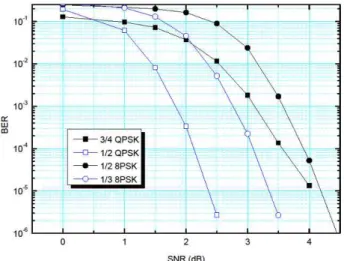
Figure 4 shows BER performance each scheme of the above layered coding scheme. When simulating the performance, we used the Max-log-MAP algorithm as an iterative decoding scheme, and the maximum iteration number was set to eight.
However, in the simulation results we investigated in this example, we cannot see the advantages of using layered coding scheme, because the higher order modulation schemes with lower rate codes could not provide better performance. One of the major reasons is that, in this example, there is no difference in the decoding complexity across the layers. Therefore, in order to design a good layered coding scheme, layer design is a very important issue.
Figure 4. BER performance of duo binary turbo code with the various combinations.
A layered coding scheme needs to be targeted to
a special group which can be a certain part of service area or a certain group of users. Enhanced service can be provided to the special group by increasing the order of the modulation with increased parity information, and thus there is no bandwidth expansion. Instead, there should be increase in the decoder complexity in order to compensate the performance degradation.
Ⅳ. Conclusion
In this paper, we investigated applicability of the layered turbo coding scheme for integrated/hybrid satellite and terrestrial system to provide efficient MBMS. A layered coding scheme can be viewed as an application of hierarchical modulation to coding scheme. In the layered coding scheme, enhanced service can be provided a special group without any bandwidth expansion, but at the expense of decoder complexity.
참 고 문 헌
[1] S. Kim, H. W. Kim, K. Kang, D. S. Ahn,
“Performance Enhancement in Future Mobile Satellite Broadcasting Services”, IEEE Communication Magazine, Vol. 46,No. 7,pp.
118-124, July 2008.
[2] S. Kim, H. Kim, D. S. Ahn, “A Cooperative Transmit Diversity Scheme for Mobile Satellite Broadcasting Systems”, Proceedings of the 4th Advanced Satellite Mobile Systems, 2008, pp.
72-75, 26-28 Aug. 2008.
[3] S. Kim, U. Park, H. Kim, D. S. Ahn, “Evaluation of Cooperative Diversity Techniques Using STC for Future S-DMB Services”, IEICE Transactions on Communications, Vol. EB92-B, No. 11,pp .3345-3353, Nov. 2009.
[4] H. Jiang and P. A. Wilford, ”A hierarchical modulation for upgrading digital broadcast systems,” IEEE Transactions on Broadcasting, vol. 51, no. 2, pp. 223 - 229, June 2005.
[5] S. Ryoo, S. Kim, and D. S. Ahn, “Layered coding with block turbo codes for broadcasting and multicasting services,” Proceedings of IEEE Vehicular Technology Conference, fall, 2006.
[6] D. S. Ahn, S. Kim, H. W. Kim, and D-C. Park,
“A cooperative transmit diversity scheme for
mobile satellite broadcasting systems” Int. J.
Satell. Commun. Network, vol. 28, pp.352-368, 2010.
[7] A. Levissianos, G. Metaxas, N. Dimitriou, A.
Polydoros, “Layered coding for satellite-plus- terrestrial multipath correlated fading channels,”
Int. J. Satell. Commun. Network, vol. 22, pp.
485-502, 2004.
[8] IEEE 802.16 Standard-Local and Metropolitan Area Networks-Part 16, IEEE Std 802. 163-2005.
저 자 김 영 민 (Youngmin Kim) 정회원
2009년:전북대학교 전자정보공학부 학사.
2009년~현재:전북대학교 전자공학 석사 과정 중.
<관심분야> 시공간블록부호, 이동/위성통신
김 수 영 (Sooyoung Kim) 정회원 1990년 2월:한국과학기술원 전기 및 전자공학과 학사 1990년 2월~1991년 9월:
ETRI 연구원
1992년 10월:Univ. of Surrey, U.K 공학석사
1995년 2월:Univ. of Surrey, U.K 공학박사
1994년 11월~1996년 6월:Research Fellow, Univ. of Surrey, U.K
1996년 8월~2004년 2월:ETRI 광대역무선전송연구팀장 2004년 3월~현재:전북대학교 전자정보공학부 부교수
<관심분야> 오류정정부호화방식, 이동/위성통신