Factors influencing Preferences for Care near the End-of-life among Undergraduate Nursing Students
Jooyoung Cheon
Assistant Professor, Department of Nursing Science, Sungshin Women’s University
간호대학생 임종치료선호도에 영향을 미치는 요인
성신여자대학교 간호학과 조교수 천주영
Abstract This study aimed to identify factors influencing the preferences for end-of-life (EOL) care among undergraduate nursing students. In this cross-sectional study, data were collected from December 2017 to February 2018. This study included 217 undergraduate nursing students. Factors influencing the preference for ‘autonomous physiological decision-making’ were the following:
education level(by grade), having biomedical education, attitude towards death, and attitude towards life-sustaining treatments (LSTs). Preference for ‘decision-making by healthcare professionals’ was related to having a religion. Factors influencing the preference for ‘spirituality’ were education level, having a religion, and academic major satisfaction. Preference for ‘pain control’ was associated with education level, experience with dying patients, bad self-rated health, attitude towards death, and attitude towards LSTs. The study findings suggest that education regarding LSTs, EOL care, and EOL decision-making in nursing curricula is essential.
Key Words : Nursing students, Terminal care, Death, Life support care, Decision making
요 약 본 연구는 간호대학생들의 임종치료선호도에 영향을 미치는 요인을 확인하기 위해 수행되었다. 이 조사 연구는 2017년 12월부터 2018년 2월까지 수행되었으며, 최종 217명의 간호대학생의 자료가 수집되었다. '자율적 의사결정' 선호도에 영향을 미치는 요인은 교육수준(학년), 생명의료윤리 교육 수강, 죽음에 대한 태도, 연명치료에 대한 태도였 다. '의료인의 의사결정'에 대한 선호도는 종교를 가지는 것과 관련이 있었다. '영성'에 대한 선호도에 영향을 미치는 요인은 교육수준(학년), 종교를 가짐, 전공만족도였다. '통증 조절'에 대한 선호도는 교육수준(학년), 사망한 환자 관찰 경험, 나쁜 주관적 건강상태, 죽음에 대한 태도, 연명치료에 대한 태도와 관련이 있었다. 본 연구 결과는 간호학 전공 커리큘럼에서 연명치료, 생애말기간호 및 생애말기 의사결정에 관한 교육이 필수적임을 시사한다.
주제어 : 간호대학생, 임종기치료, 죽음, 연명치료, 의사결정
*This work was supported by the National Research Foundation of Korea (NRF) grant funded by the Korea government (MSIT) (No. 2017R1C1B5076398).
*Corresponding Author : Jooyoung Cheon([email protected]) Received November 3, 2020
Accepted December 20, 2020 Revised November 27, 2020
Published December 28, 2020
1. Introduction
In Korea, the Boramae Hospital case in 1997 and the “Grandma Kim” case in 2009 have sparked debate regarding the withdrawal of life-sustaining treatments, the responsibility of health care professionals in end-of-life care, and the need for laws that prevent futile care and support death with dignity [1]. The Korean National Assembly passed the “Law on Hospice and Palliative Care and Determination of Life-Sustaining Treatment for Terminally Ill Patients” in January 2016; this law allowed incurable terminally ill patients to withdraw from life-sustaining treatments. This law came into effect on February 4, 2018; this stimulated an interest in advance directives, which are legal documents giving instruction regarding life-sustaining treatments and other preferences for end-of-life care of terminally-ill patients in South Korea [2]. In addition, there has been growing scrutiny concerning the role of health care professionals, especially the role of nurses, in end-of-life care [3-5].
Nurses are in a crucial position to assess patients’ preferences for end-of-life care and play an important role facilitating shared decision-making among patients, families, and health care professionals [3,4]. Nurses also provide information to patients and their family members about the patient's diagnosis, prognosis, types of life-sustaining treatments, the expected outcomes of life-sustaining treatments, and the completion of advance directives [3,5].
Therefore, nurses’ attitudes and preferences for end-of-life care have a significant influence on end-of-life care discussion and decision-making among patients and family members [3]. Nursing students are aware of the necessity for advance directives and withdrawal of life-sustaining treatments, but they also have to consider human dignity and bioethics in decisions regarding withdrawal of life-sustaining treatments [3,6-8].
However, as diverse and complex ethical conflicts are common in the field of nursing practice, many nurses and nursing students do not have sufficient knowledge and confidence regarding advance directives, withdrawal of life-sustaining treatments, and end-of-life care as advocates of patients and family members, even if they have solid ethical values [3,4,8-10].
Even though most nurses will care for end-of-life patients at some point in their careers, to our knowledge, no previous study has examined nursing students’ end-of-life care preferences and the factors that influence them. A previous study found that students’ comfort while caring for dying patients was related to less positive attitudes towards end-of-life care, and that their knowledge about symptom management and spiritual care at the end-of-life was insufficient [9]. In a recent study in Korea, more than half of the nursing students reported that their ethical values adapted to the situation, and one third answered that they sometimes felt confused about their ethical values regarding end-of-life care [7].
Since the enforcement of the law, previous definition and process of end-of-life care should be revised, and the education regarding advance directives, withdrawal of life-sustaining treatments, and new ethical values should be provided to nursing students [7-9]. Therefore, the identification of nursing students’ preferences for end-of-life care is important for developing the necessary educational programs and bioethics curricula that may help them engage in end-of-life care with confidence. Therefore, this study examined nursing students’ preferences within end-of-life care and identified factors associated with said preferences among undergraduate nursing students in South Korea.
2. Methods
2.1 Study Design and Sample
This cross-sectional study aimed to identify factors influencing the preferences for end-of-life care among undergraduate nursing students. The subjects of this study were undergraduate nursing students enrolled in a women’s university located in Seoul. Those who understood the purpose of this study gave their consent to participate. This study excluded from the final data analysis those questionnaires that showed insufficient literacy or incomplete responses. The sample size was calculated using the G*power 3.1 program. When the linear multiple regression statistics of the F-test test were selected and the effect size .15, power .95, significance level .05, and a maximum of 10 predictors were selected, the minimum number of subjects required was 172; the dropout rate was considered when collecting data. Thus, 230 questionnaires were distributed and 220 were collected. This study included 217 questionnaires in our final analysis, having excluded three due to insufficient data.
2.2 Measures
This study included the following participants’
characteristics: education level (by grade), religion, perceived economic status, academic major satisfaction, clinical practice experience, end-of-life patient observation experience, whether they had biomedical ethics education, and self-rated health.
For our analysis, we established the following four research measures: 1) knowledge regarding end-of-life care, life-sustaining treatments, and advance directives, 2) attitude towards death, 3) attitude towards withdrawal of life-sustaining treatments, and 4) end-of-life preferences.
Knowledge regarding end-of-life care, knowledge regarding life-sustaining treatments, and knowledge regarding advance directives were measured using tools developed by Hong and
Kim [11]. Knowledge was scored from 0 to 26 based on the following items: 11 questions regarding end-of-life care, 6 questions regarding life-sustaining treatments, and 9 questions regarding advance directives. The answer options were ‘yes, ‘no, or ‘I don’t know. The total knowledge score was obtained by adding up the scores from each subsection: 0-11 points for knowledge regarding end-of-life care, 0-6 points for knowledge regarding life-sustaining treatments, and 0-9 points for knowledge regarding advance directives. The higher the score was, so too was the participants’
knowledge. Cronhach’s α was .92 in previous study [11], while it was .85 in this study.
Moreover, participants’ attitude towards death was measured using tools developed by Thorson and Powell [12] and adapted by Park [13] with tools modified by Kim [14]. With 20 questions rated on a 4-point scale, the score ranged from 20 to 80. Higher scores indicated a more positive attitude towards death. Cronhach’s α was .76-.83 in previous studies [12,14], while it was .88 in this study.
Attitude towards withdrawal of life-sustaining treatments was measured using a tool developed by Park [15] which was modified by Byun et al.
[16]. With 19 questions rated on a 5-point scale, the score ranged from 19 to 95. A higher score indicated a more positive attitude towards withdrawal of life-sustaining treatments.
Cronhach’s α was .88 in previous study [16], while it was .73 in this study.
Preferences for end-of-life care were
measured using the Korean version of Preference
for Care near the End of Life Scale-Korean
Version (PCEOL-K). The PCEOL-K was translated
by Lee and Kim [17] from the tool developed by
Gauthier and Froman [18], and consists of 26
questions rated on a 5-point scale. This tool
includes five subscales: 8 items for ‘autonomous
physiological decision-making’ that represent
life-sustaining treatments preferences; 4 items
for ‘decision-making by a health care professional’; 6 items for ‘spirituality,’ which refers to the religious (spiritual) needs or beliefs;
5 items for ‘family,’ which represent preference for family participation during end-of-life decision-making; and 3 items for ‘pain control.’
Since preferences may differ by subscale, it was necessary to analyze each subscale rather than the total score [6]. In the case of five items that consisted of negative sentences, these were reverse-coded and summed to facilitate comparison with other questions and for easier interpretation of the results. A high score on any subscale indicated the participants’ preference for it in an end-of-life situation. Cronhach’s α was .42-.89 in previous study [17], while it was .46-.87 in this study.
2.3 Data Collection
Data were collected from December 2017 to February 2018. The subjects were recruited using two methods. In the first method, the research assistant recruited students who voluntarily remained after class to be informed about the study’s purpose and methods. The research assistant then obtained signed consent from the interested students. Afterwards, a questionnaire survey was conducted, lasting about 15 minutes.
In the second method, interested students voluntarily contacted the research assistant after seeing a recruitment announcement on the department bulletin board. Then, the research assistant explained the study’s purpose and methods to the interested students. After obtaining informed consent, a survey was conducted, lasting for about 15 minutes.
2.4 Ethical Considerations
This study was approved by the institutional review board of the university (SSWUIRB 2017-075). The author explained the purpose of the study to the professor in the nursing
department and obtained approval for the survey. The author did not participate in the explanation of the study and distribution of the questionnaire, and the research assistant was in charge of the questionnaire survey, to ensure that students who were vulnerable subjects could voluntarily participate in the study without coercion.
The research assistant fully explained to the students that they had the freedom to withdraw immediately from participation without any negative consequences if they no longer wished to respond to the questionnaire. The consent obtained after explaining that there were no disadvantages to refusing or discontinuing participation in this study, and that confidentiality and anonymity were guaranteed.
When the students filled out and submitted the structured questionnaire, the consent form and the questionnaire were immediately kept separate and securely stored to prevent leakage of personal information.
2.5 Data Analysis
The collected data were analyzed using SPSS/Win 22.0 software. The characteristics of the students were analyzed using numbers and percentages, mean, and standard deviation.
Additionally, differences in the participants’
preference for end-of-life care were analyzed
using an independent t-test and an analysis of
variance (ANOVA), and the post-test was
analyzed using Scheffe's multiple comparison
test. Further, knowledge regarding end-of-life
care, knowledge regarding life-sustaining
treatments, knowledge regarding advance
directives, attitude towards death, attitude
towards withdrawal of life-sustaining treatments,
and preference for end-of-life care were
analyzed using mean and standard deviation; the
reliability of the measures was reported using
Cronbach's α. Moreover, the correlation between
the main variables was analyzed using the
Characteristics Categories N(%) Autonomous physiological decision-making
Decision-making by healthcare
professionals Spirituality Family Pain control
M(SD) t/F p-valu
e M(SD) t/F p-value M(SD) t/F p-value M(SD) t/F p-value M(SD) t/F p-value Grade Freshman a 66(30.4) 3.0±0.8 2.502 .060 2.4±0.7 3.430 .018a>b 3.2±0.712.619 <.001
a<c,d b<d
3.4±0.8 .413 .744 3.6±0.7 6.259 <.001a<b,d
Sophomore b 47(21.7) 3.4±0.6 2.0±0.7 3.6±0.8 3.4±0.7 4.0±0.6
Junior c 44(20.3) 3.4±0.7 2.1±0.7 3.7±0.7 3.6±0.8 3.8±0.5
Senior d 60(27.6) 3.3±0.8 2.3±0.8 4.0±0.6 3.5±0.8 4.1±0.6
Having a religion Yes 97(44.7) 3.2±0.8 1.603 .110 2.3±0.8 -2.202 .029 3.9±0.7 -5.081 <.001 3.5±0.8 -.668 .505 3.8±0.6 0.961 .338
No 120(55.3) 3.3±0.7 2.1±0.7 3.4±0.8 3.4±0.8 3.9±0.6
Perceived economic status High 59(27.3) 3.2±0.8 0.412 .663 2.4±0.8 1.357 .260 3.6±0.8 0.434 .648 3.5±0.9 0.135 .874 3.8±0.7 0.173 .841
Middle 128(59.3) 3.3±0.8 2.2±0.7 3.6±0.8 3.4±0.7 3.9±0.6
Low 29(13.4) 3.3±0.5 2.2±0.7 3.7±0.9 3.4±0.7 3.9±0.7
Nursing major satisfaction Very satisfied a 38(17.5) 3.4±0.7 1.242 .291 2.2±0.8 0.465 .629 3.9±0.7 5.408 .005a>c 3.5±0.90.277 .758 3.9±0.8 1.450 .237
Satisfied b 116(53.4) 3.3±0.8 2.30.7 3.6±0.7 3.5±0.7 3.9±0.6
Neither satisfied nor
dissatisfied c 61(28.1) 3.1±0.7 2.1±0.8 3.4±0.8 3.4±0.8 3.7±0.6
Experience of clinical
practicum Yes 104(47.9) 3.3±0.8 -1.419 .157 2.2±0.8 0.141 .888 3.9±0.7 -4.890 <.001 3.5±0.8 -1.180 .240 3.9±0.6 -1.897 .059
No 113(52.1) 3.2±0.7 2.2±0.7 3.4±0.8 3.4±0.7 3.8±0.7
Experience observing patients
at end-of-life Yes 120(55.3) 3.2±0.8 .053 .958 2.3±0.8 -.899 .370 3.8±0.6 -3.915 <.001 3.5±0.8 -0.699 .485 4.0±0.6 -2.898 .004
No 97(44.7) 3.3±0.7 2.2±0.7 3.4±0.8 3.4±0.8 3.7±0.7
Have received biomedical
ethics education Yes 160(73.7) 3.4±0.7 -3.614 <.001 2.2±0.8 -0.074 .941 3.6±0.7 -1.163 .246 3.5±0.8 -2.085 .038 3.9±0.6 -0.261 .794
No 57(26.3) 3.0±0.8 2.2±0.7 3.5±0.8 3.3±0.8 3.8±0.7
Self-rated health Good 147(67.7) 3.3±0.8 .034 .973 2.2±0.7 -.508 .612 3.7±0.7 1.818 .072 3.5±0.8 1.340 .182 3.9±0.6 2.052 .041
Fair or Poor 70(32.3) 3.2±0.7 2.2±0.8 3.5±0.9 3.3±0.8 3.7±0.7
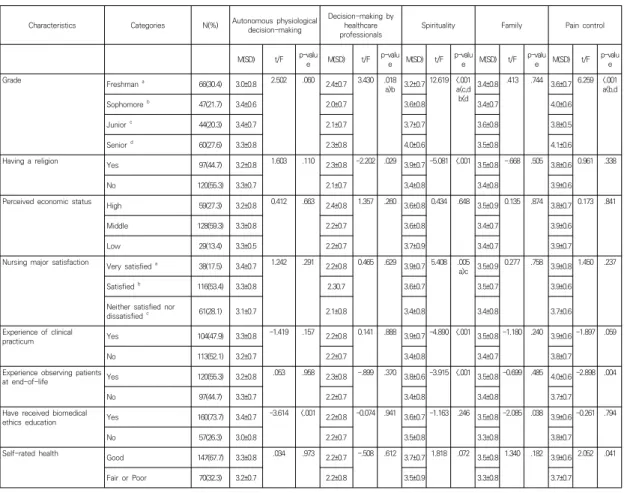
Table 1. Differences in the Preferences for Care near the End-of-life according to Characteristics of Undergraduate Nursing Students
(N=217)Pearson correlation coefficient. Finally, multiple regression analysis was conducted to analyze the factors influencing end-of-life care preferences among nursing students.
3. Results
3.1 End-of-life Care Preference according to the Characteristics of the Subjects All participants were female nursing students (N=217), and their average age was 21.0±1.6 years. Table 1 shows differences in end-of-life preferences according to participants’
characteristics. The preference score for
‘autonomous physiological decision-making’ was
higher among students with biomedical ethics education (t=-3.614, p<.001). The preference score for ‘decision-making by health care professionals’ was significantly higher among freshmen than among sophomores (F=3.430, p=.018) and it was higher among students who have a religion than among those who have not (t=-2.202, p=.029).
The preference score for ‘spirituality’ was
significantly higher in the upper academic levels
than in the lower levels (F=12.619, p<.001) and
among participants who have a religion than for
those who have not (t=-5.081, p<.001). In
addition, students with high academic major
satisfaction (F=5.408, p=.005), with clinical
practice experience (t=-4.890, p<.001), and with
Measures M±SD Range 1) Knowledge about
- End-of-life care 7.82±2.34 0-11
- Life-sustaining treatments 4.59±1.36 0-6
- Advance directives 6.97±1.92 0-9
2) Attitude toward death 51.00±9.97 20-80
3) Attitude toward withdrawal
life-sustaining treatment 65.07±6.94 19-95
4) Preferences for Care near the End-of-life
- Autonomous physiological
decision-making 3.25±0.74 1-5
- Decision-making by
healthcare professionals 2.22±0.74 1-5
- Spirituality 3.60±0.75 1-5
- Family 3.45±0.77 1-5
- Pain Control 3.86±0.62 1-5
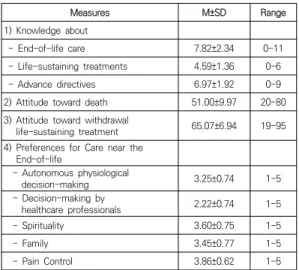
Table 2. Main Variables and Preferences for Care near the End-of-life
end-of-life patient observation experience (t=-3.915, p<.001) had higher preference scores for ‘spirituality’. The preference score for ‘family’
was higher for students with biomedical ethics education than for those without it (t=-2.085, p=.038).
The preference score for ‘pain control’ was significantly higher among sophomores and seniors than among freshmen (F=6.259, p<.001), among students with end-of-life patient observation experience (t=-2.898, p=.004), and among students with fair or poor self-rated health than those with good self-rated health (t=2.052, p=.041).
3.2 Main Variables and End-of-life Care Preference
The mean scores of knowledge regarding end-of-life care, knowledge regarding life-sustaining treatments, and knowledge regarding advance directives were 7.82±2.34, 4.59±1.36, and 6.97±1.92, respectively. The attitude towards death score was 51.00±9.97 out of a possible 80, and the attitude towards withdrawal of life-sustaining treatments score was 65.07±6.94 out of a possible 95 points. The
mean scores of preferences for care near the end-of-life were shown in Table 2.
The higher the knowledge regarding end-of-life care, life-sustaining treatments, and advance directives was, the lower the preference score for ‘decision-making by health care professional’ (r=-.137, p=.046; r=-.227, p=.001;
r=-.166, p=.015, respectively), the higher the preference score for ‘spirituality’ (r=.144, p=.034;
r=.175, p=.010; r=.160, p=.019), and the higher the preference score for ‘pain control’ were (r=.219, p=.001; r=.244, p<.001; r=.202, p=.003).
Moreover, the more positive the attitude towards death was, the lower were the preference scores for ‘autonomous physiological decision-making’
(r=-.238, p=.004) and ‘pain control’ (r=-.142, p=.043). The positive attitude toward withdrawal of life-sustaining treatments was negatively correlated with the preference for ‘autonomous physiological decision-making’ (r=-.194, p=.006), but was positively correlated with the preference score for ‘pain control’ (r=.285, p<.001).
3.3 Factors influencing End-of-life Care Preference
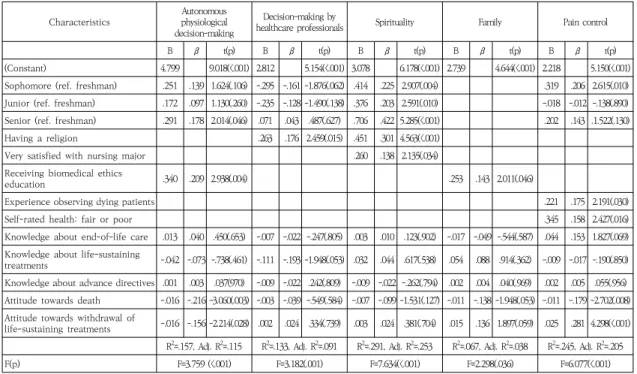
In order to identify the factors influencing end-of-life care preference among nursing students, variables with significant differences in scores for each end-of-life care preference subscale and variables with significant correlation with each subscale were selected for the final analysis (Table 3).
The Durbin-Watson statistics was close to the reference value of 2 (1.73-2.15), and the variance inflation factor (VIF) was lower than 10 (1.05-2.20), the tolerance was more than 0.1 (0.46-0.98). Therefore, the basic hypotheses for the regression formula were all satisfied.
The factors influencing the preference for
‘autonomous physiological decision-making’
were the following: being a college senior (β
=.178, p=.046), having biomedical ethics
Characteristics Autonomous physiological decision-making
Decision-making by
healthcare professionals Spirituality Family Pain control
B β t(p) B β t(p) B β t(p) B β t(p) B β t(p)
(Constant) 4.799 9.018(<.001) 2.812 5.154(<.001) 3.078 6.178(<.001) 2.739 4.644(<.001) 2.218 5.150(<.001) Sophomore (ref. freshman) .251 .139 1.624(.106) -.295 -.161 -1.876(.062) .414 .225 2.907(.004) .319 .206 2.615(.010) Junior (ref. freshman) .172 .097 1.130(.260) -.235 -.128 -1.490(.138) .376 .203 2.591(.010) -.018 -.012 -.138(.890) Senior (ref. freshman) .291 .178 2.014(.046) .071 .043 .487(.627) .706 .422 5.285(<.001) .202 .143 .1.522(.130)
Having a religion .263 .176 2.459(.015) .451 .301 4.563(<.001)
Very satisfied with nursing major .260 .138 2.135(.034)
Receiving biomedical ethics
education .340 .209 2.938(.004) .253 .143 2.011(.046)
Experience observing dying patients .221 .175 2.191(.030)
Self-rated health: fair or poor .345 .158 2.427(.016)
Knowledge about end-of-life care .013 .040 .450(.653) -.007 -.022 -.247(.805) .003 .010 .123(.902) -.017 -.049 -.544(.587) .044 .153 1.827(.069) Knowledge about life-sustaining
treatments -.042 -.073 -.738(.461) -.111 -.193 -1.948(.053) .032 .044 .617(.538) .054 .088 .914(.362) -.009 -.017 -.190(.850) Knowledge about advance directives .001 .003 .037(970) -.009 -.022 .242(.809) -.009 -.022 -.262(.794) .002 .004 .040(.969) .002 .005 .055(.956) Attitude towards death -.016 -.216 -3.060(.003) -.003 -.039 -.549(.584) -.007 -.099 -1.531(.127) -.011 -.138 -1.948(.053) -.011 -.179 -2.702(.008) Attitude towards withdrawal of
life-sustaining treatments -.016 -.156 -2.214(.028) .002 .024 .334(.739) .003 .024 .381(.704) .015 .136 1.897(.059) .025 .281 4.298(<.001) R2=.157, Adj. R2=.115 R2=.133, Adj. R2=.091 R2=.291, Adj. R2=.253 R2=.067, Adj. R2=.038 R2=.245, Adj. R2=.205
F(p) F=3.759 (<.001) F=3.182(.001) F=7.634(<.001) F=2.298(.036) F=6.077(<.001)