• 검색 결과가 없습니다.

Meteorological Determinants of Forest Fire Occurrence in the Fall, South Korea

N/A
N/A
Protected

Academic year: 2021

Share "Meteorological Determinants of Forest Fire Occurrence in the Fall, South Korea"

Copied!
9
0
0

로드 중.... (전체 텍스트 보기)

전체 글

(1)

163

F OREST S OCIETY

Meteorological Determinants of Forest Fire Occurrence in the Fall, South Korea

Myoung Soo Won

1

, Danesh Miah

2

, Kyo Sang Koo

1

, Myung Bo Lee

1

and Man Yong Shin

3

*

1

Division of Forest Disaster Management, Korea Forest Research Institute, 57, Hoegiro, Dongdaemun-gu, Seoul 130-712 Korea

2

Institute of Forestry and Environmental Sciences, University of Chittagong, Chittagong 4331 Bangladesh

3

Department of Forest Resources, Kookmin University, Seoul 136-702 South Korea

Abstract : Forest fires have potentials to change the structure and function of forest ecosystems and significantly influence on atmosphere and biogeochemical cycles. Forest fire also affects the quality of public benefits such as carbon sequestration, soil fertility, grazing value, biodiversity, or tourism. The prediction of fire occurrence and its spread is critical to the forest managers for allocating resources and developing the forest fire danger rating system. Most of fires were human-caused fires in Korea, but meteorological factors are also big contributors to fire behaviors and its spread. Thus, meteorological factors as well as social factors were considered in the fire danger rating systems. A total of 298 forest fires occurred during the fall season from 2002 to 2006 in South Korea were considered for developing a logistic model of forest fire occurrence. The results of statistical analysis show that only effective humidity and temperature significantly affected the logistic models (p<0.05). The results of ROC curve analysis showed that the probability of randomly selected fires ranges from 0.739 to 0.876, which represent a relatively high accuracy of the developed model. These findings would be necessary for the policy makers in South Korea for the prevention of forest fires.

Key words : forest fire danger rating, logistic regression, temperature, effective humidity

Introduction

Fire ignition, spread, and impacts were influenced by the interactions between weather conditions, vegetation structure and land use, on various temporal or spatial scales (Flannigan, 2006; Martín et al., 1997). It was proved that forest fires are potential to change the struc- ture and functioning of ecosystems posing a significant impact on atmosphere and biogeochemical cycles. It also modifies the provision of ecosystem services notably carbon sequestration, soil fertility, grazing value, biodi- versity and tourism (Schimel and Baker, 2002). A report drawn from the satellite data showed that 350 million hectares of land area was affected by vegetation fires worldwide in the year 2000, much of which was forest and woodland (FAO, 2007). It has also been reported that in the Northeast Asia including the South Korea, about 1 million hectare of forests in average were burned each year between 1990 and 2004. A huge prop- erty loss of US $83 million was recorded in April 2000,

with severe impacts on the forests as well. It is also evi- dent that the number of catastrophic fires burning across large areas is being increased. Fire risk could be influ- enced climate change, ignition sources, length of the fire season, vegetation structure, land-use changes and insti- tutional constraints for sustainable forest or fire manage- ment (FAO, 2007; Flannigan et al ., 2000). Understanding of forest fire ignition and its spread is critical to prevent catastrophic forest fires and provide the forest fire risk alert at a specific region and a season.

Prediction of fire occurrence and its spread in a certain season for a given area is necessary for the forest man- agers to help them to allocate resources and to develop the forest fire danger rating system (Andrews and Queen, 2001). Based on the fire danger risk and the fire environment (e.g. meteorological factors), it is able to systematically evaluate and integrate the factors easing the forest fire ignition and its spread (Countryman, 1966). In South Korea, forest fires are not the natural events, but rather anthropogenic accidents depending on human activities, such as carelessness, weed burning, fireworks, and other activities inside the forests (Lee et al ., 2006). FAO (2007) reports that 79% of the forest

*Corresponding author

E-mail: [email protected]

(2)

fires occurred in South Korea were overwhelmingly originated from human activities. In South Korea, conif- erous trees covers about 42% of forest lands and Pinus

densiflora covers about 58% of the coniferous forest.

Coniferous species in South Korea are considered to be vulnerable to fire. In fall, the seasonal wind blowing from the continent creates dry seasons in Korea and poses to the fire hazards. Even though forest fires in South Korea were caused by human activities, fire behaviors and its spread were mainly influenced by meteorological factors, such as temperature, effective humidity, precipitation (Flannigan, 2006; Chandler et al ., 1983).

Lee et al . (2004) developed a probability model of for- est fire occurrence for the spring season, a severe fire season in South Korea, by using the meteorological data.

Lee et al . (2005) also developed forest fire occurrence danger index using fuel and topographical conditions of ignition points in South Korea. Lee et al . (2006) ana- lyzed the temporal and spatial characteristics of forest fires in South Korea between 1970 and 2003. Shin and Lee (2004) described the restoration strategies for forest ecosystems degraded by forest fire in Gangwon province in South Korea. From 2003, Korea Forest Research Institute has predicted national fire danger rating by using probability model of forest fire occurrence for the severe season (from January to May). However, there is a problem to use the model for the fall season because weather conditions are quietly different between the spring and the fall. There was no probability model available to predict forest fire occurrence and its spread for the fall in South Korea. This study aimed at devel- oping a probability model to predict forest fire occur- rence for the fall in eight different provinces of the South Korea based on the meteorological data of forest fires occurred from 2002 to 2006.

Materials and Methods

1. General forest fire environments in South Korea South Korea is a temperate country located at the heart of the North Western Pacific region. The Korean peninsula encompasses 221,000 km

2

, 45% of which (99,600 km

2

) makes up the South Korea ranging between 125

o

04' and 131

o

52' E longitude and between 36

o

06' and 38

o

27' N latitude. South Korea has a tem- perate climate with four distinct seasons. It is dry and cold during the winter due to the northwesterly wind sweeping down from Siberia. South Korea has hotter summers and colder winters compared to the other coun- tries located in the same latitude zone of the continent.

The most severe fire season is spring that has a dry and warm weather. Annual average temperature is 12-14

o

C

in the central region and 3-10

o

C in the northern region.

Annual mean precipitation ranges from 600 mm to 1,600 mm with seasonal variation (KFS, 2006). In 2005 South Korea has 6.39 million ha of forests covering about 64.2% of the total land area, of which nearly 42.3%

(2.70 million ha) is coniferous forest. The broadleaved and mixed forests cover 25.9% (1.66 million ha) and 29.3% (1.87 million ha), respectively, with the remaining 2.5% (0.16 million ha) being classified as miscellaneous types. Nearly 60% of forests are young stands less than 40 years (KFS, 2006). With the increase in the forest age, woody fuel, ground litter and forest visitors, the for- est fire risk has been significantly increasing. Therefore, forest managers are in a high pressure to prevent and control forest fires. In April 2000, a catastrophic forest fire encompassing 23,794 ha occurred in mountainous areas near the East Coast Gangwon province. This fire was recorded as the most disastrous forest fire since 1945, causing massive property damage. On average, from 1999 to 2008, 497 fires burned 3,637 ha of forest lands each year in South Korea. All fires were occurred due to human activities, especially agricultural burning in rural areas adjacent to forests.

2. Method

To develop a probability model of forest fire occurrence, a total of 298 forest fires occurred during the fall (Sep- tember to December) from 2002 to 2006 were selected.

Meteorological data such as temperature, relative humidity, wind speed at the ignition time, and daily precipitation of the nearest date before the ignition, were collected from the Korea Meteorological Administration (KMA, 2007).

The effective humidity was calculated by weighing the rel- ative humidity of a given ignition day and the previous four days using the following equation (1):

(1) Here, H

e

is the effective humidity, H

0

is the relative humidity of the given ignition day, is the relative humidity of n previous days, and r is the coefficient of effective humidity. In this study, the value of r was fixed at 0.7.

The forest fire occurrence observation encompasses the eight provinces of the Republic of Korea, i.e., Chun- gbuk, Chungnam, Chunbuk, Chunnam, Gangwon, Gyunggi, Gyungbuk and Gyungnam. The ignition locations of fires were demarcated by the nearest weather stations. A total of 55 weather stations were encountered for this study.

With the specific day of ignition and the corresponding weather stations, the data were collected. This study includes the forest fires occurred from September, 2002 to December, 2006.

H

e

H r H + ( ) r

1

+

2

( ) r H

2

+

3

( ) r H

3

+

4

( ) H

4

1 r r + + + +

2

r

3

r

4

---

=

H

n

(3)

3. Probabilistic risk assessment

To understand meteorological characteristics in the study regions it needs to make an analysis of statistical methods like canonical correlations analysis (CCA). CCA is used when multivariate measurements are portioned into two sets. CCA finds linear combinations in the two sets that have the largest possible correlation (Ramsey and Schafer, 1997). That is canonical discriminant analysis is a dimension-reduction technique related to principal component analysis and canonical correlation. Given a nominal classification variable and several interval vari- ables, canonical discriminant analysis derives canonical variables (linear combinations of the interval variables) that summarize between-class variation in much the same way that principal components summarize total variation.

Dayananda (1977), Poulin-Costello (1993), Mandallaz and Ye (1997) employed Poisson model to explain the number of forest fires. Preisler et al . (2004), Chou et al . (1993) and Martell et al . (1987) used the logistic model to assess the fire occurrence probability. Also, Lofts- gaarden and Andrews (1992) used the logistic regression to develop the forest fire danger rating system, and Gar- cia et al . (1995) used it to predict the number of fire- days. In addition, Vasconcelos et al . (2001) used the logistic regression for prediction of fire ignition location.

Martell (1999) used Markov chain models for estimating occurrence probability of relationship between wildfire and weather variables. Wildfire incidences were related with temperature, precipitation, fuel moisture and fire history for Los Angeles County (Peng and Schoenberg, 2001; Schoenberg et al ., 2000).

Probabilistic risk assessment was used to estimate the probabilities of hazardous events which took place within a specified time period and in a specified context (Brillinger et al ., 2003). It proceeded by reducing a com- plex situation to its simpler components, followed by the fitting and validation of stochastic models associated with the components. The probability framework is nec- essary to assess the utility of explanatory variables, such as weather condition at the ignition time. A non-para- metric logistic regression with stratified data for each province was employed to model the probability of fire occurrence. Brillinger et al . (2003) state that fire occur- rence depends on local conditions such as location, ele- vation, wind speed, precipitation, temperature, humidity, topography, litter type, level of suppression and so on.

The explanatory variables in this study are temperature (

o

C), effective humidity (%) (calculated from the relative humidity), wind speed (m/sec) at the ignition time; and daily precipitation (mm) at the nearest date of the igni- tion day and the duration (day) between rainfall and ignition day. These factors were considered as explana-

tory variables in our model with an assumption that a fire spread out after ignition when the variables at a given location exceed a threshold level.

4. Logistic regression

In this study, logistic regression was used to predict fire occurrence probability with meteorological factors and fire history. The logistic function determining the fire occurrence probability is the ‘ Logit ’ function. In fact the logistic model determined the actual percentages of an event as a function of a number of explanatory vari- ables with a constant and coefficients. Logit(P) is the log (to base e ) of the odds or likelihood ratio that the depen- dent variable is 1. It can be defined as:

(2) Here, p has a value ranging from 0 to 1, while Logit(P) has a value from negative infinity to positive infinity.

The logistic regression equation was resulted as below:

(3) To make a more general equation, we reversed the Logit equation as followings:

(4) Here, p is the probability of the fire occurrence, exp is the exponential function, X

1…j

are the explanatory vari- ables, β

0

is the intercept, and β

1…j

is the coefficients for explanatory variables.

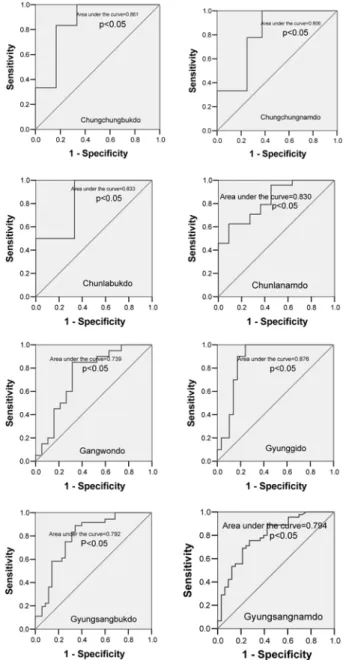
Receiver operating characteristic (ROC) curve was used for verifying the probability of the fire occurrence in the fall. The ROC curve is a plot of test sensitivity as the y coordinate versus its 1-specificity or false positive rate as the × coordinate. It is an effective method of evaluating the performance of diagnostic tests.

5. Fire danger rating

Chandler et al . (1983) defined the forest fire danger as an index based on fuel types, topography and weather conditions which affect the fire ignition, its spread and behaviors. The National Fire Danger Rating System (NFDRS) of the United State was developed the basis on the research of mathematics and physics of fuel moisture and heat exchange (Rothermel, 1972). The U.S. and Canadian models were also developed from the statisti- cal analysis of large field data (Van Wagner, 1974; Lee

et al., 2002). The statistical models applied in this study was also used optimistically in the NFDRS. The litera- ture reviews of the forest fire danger rating showed that Canada and U.S. NFDRS can be a good example for developing NFDRS of South Korea (Wybo et al., 1995).

In a ROC curve the true positive rate (Sensitivity) is

Logit p ( ) = log ( p ⁄ ( 1 – p ) )

ln ( p ⁄ 1 – p ) β =

0

+ β

1

X

1

+ + … β

1

X

1

p exp ( β

0

+ β

1

X

1

+ + … β

j

X

j

) 1 exp + ( β

0

+ β

1

X

1

+ + … β

j

X

j

)

---

=

(4)

plotted in function of the false positive rate (1-Specific- ity) for different cut-off points. Each point on the ROC plot represents a sensitivity/specificity pair correspond- ing to a particular decision threshold. A test with perfect discrimination (no overlap in the two distributions) has a ROC plot that passes through the upper left corner (100% sensitivity, 100% specificity). Therefore the closer

the ROC plot is to the upper left corner, the higher the overall accuracy of the test (Zweig and Campbell, 1993).

Results and Discussion

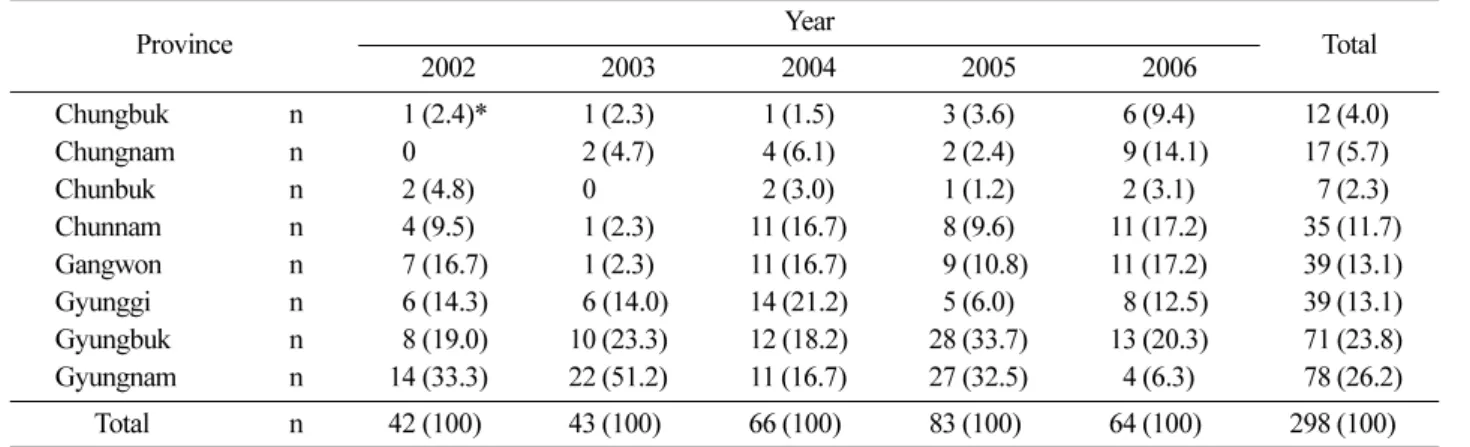
Maximum number of fires in the fall from 2002 to 2006 was found in Gyungnam (78, 26.2%) and the min- Table 1. Fire occurrence and the corresponding meteorological factors in the eight provinces.

Province Temperature

(

o

C) Effective humidity

(%) Wind speed

(m/sec) Duration between rainfall and ignition day (day)

Daily precipitation

(mm) Chungbuk

n 120. 1200. 12000. 12.00 12.00

Mean 11.90 5300. 2.900 8.00 3.4z

Std. Error of Mean 2.45 1.61 .418 1.91 .76

Minimum -2.50 42.00 .600 0.00 .2z

Maximum 24.80 61.00 5.400 17.00 9.5z

Chungnam

n 170. 170.0 17000. 17.00 17.00

Mean 19.4 5100. 2.200 9.00 1.40

Std. Error of Mean 1.92 1.15 .230 1.51 .44

Minimum .20 40.00 .40.. 0.00 .50

Maximum 27.20 61.00 4.100 19.00 6.00

Chunbuk

n 70. 70.0 7000. 7.00 7.00

Mean 12.50 530.0 2.500 11.71 3.50

Std. Error of Mean 4.49 2.78 .290 3.02 1.88

Minimum .30 43.00 1.200 0.00 .20

Maximum 27.20 63.00 3.500 25.00 13.50

Chunnam

n 350. 350.0 3500.0 35.00 35.00

Mean 16.00 5400. 3.700 6.60 4.90

Std. Error of Mean 1.20 1.35 .470 .90 1.81

Minimum 1.20 39.00 .000 0.00 .10

Maximum 28.60 75.00 10.200 27.00 56.00

Gangwon

n 390. 3900. 39000. 39.00 39.00

Mean 10.60 4900. 3.000 7.36 5.60

Std. Error of Mean 1.13 1.66 .350 1.15 1.33

Minimum -4.40 23.00 .600 0.00 .10

Maximum 22.30 69.00 10.600 24.00 35.50

Gyunggi

n 390. 3900. 39000. 39.00 39.00

Mean 10.10 4900. 2.370 7.64 5.20

Std. Error of Mean 1.16 1.08 .220 1.11 1.29

Minimum -5.40 32.00 .000 0.00 .10

Maximum 26.10 66.00 5.800 27.00 32.50

Gyungbuk

n 710. 7100. 71000. 71.00 71.00

Mean 9.00 4500. 2.900 9.27 4.30

Std. Error of Mean 1.12 1.25 .210 .90 .81

Minimum -11.60 22.00 .000 0.00 .10

Maximum 26.6 63.00 7.700 31.00 36.50

Gyungnam

n 780. 7800. 78000. 78.00 78.00

Mean 8.90 3900. 2.960 10.67 4.50

Std. Error of Mean .92 1.12 .180 .76 .73

Minimum -8.60 18.00 .400 0.00 .10

Maximum 28.70 61.00 6.300 26.00 30.00

(5)

Table 2. Annual forest fire occurrence from 2002 to 2006 in the eight provinces.

Province 2002 2003 2004 Year 2005 2006 Total

Chungbuk n 01 (2.4)* 01 (2.3) 01 (1.5) 03 (3.6) 06 (9.4) 012 (4.0)

Chungnam n 00 02 (4.7) 04 (6.1) 02 (2.4) 09 (14.1) 017 (5.7)

Chunbuk n 02 (4.8) 00 02 (3.0) 01 (1.2) 02 (3.1) 007 (2.3)

Chunnam n 04 (9.5) 01 (2.3) 11 (16.7) 08 (9.6) 11 (17.2) 035 (11.7)

Gangwon n 07 (16.7) 01 (2.3) 11 (16.7) 09 (10.8) 11 (17.2) 039 (13.1)

Gyunggi n 06 (14.3) 06 (14.0) 14 (21.2) 05 (6.0) 08 (12.5) 039 (13.1)

Gyungbuk n 08 (19.0) 10 (23.3) 12 (18.2) 28 (33.7) 13 (20.3) 071 (23.8)

Gyungnam n 14 (33.3) 22 (51.2) 11 (16.7) 27 (32.5) 04 (6.3) 078 (26.2)

Total n 42 (100) 43 (100) 66 (100) 83 (100) 64 (100) 298 (100)

*Number in the parenthesis means the percentage value

Figure 1. Classification tree for discriminating the regions for predicting fire occurrence in South Korea.

(6)

imum was found in Chungbuk (12, 4%) (Table 1 and Table 2). Mean temperature, effective humidity, wind speed, duration between rainfall and ignition day and daily precipitation at the nearest date of the ignition day were 8.9

o

C, 39%, 3.0 m/sec, 10.67 days and 4.5 mm in Gyungnam. The same meteorological data for Chungbuk were 11.9

o

C, 53%, 2.9 m/sec, 8 days and 3.4 mm, respectively. Maximum number of fires was observed in 2005 (83) and the minimum was recorded in 2002 (42) (Table 2).

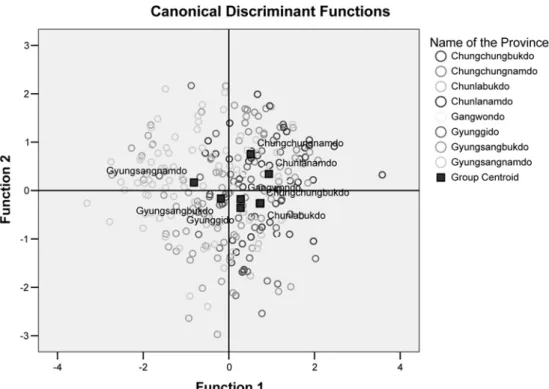
1. Meteorological characteristics in the study regions The results showed that the eight provinces were sig- nificantly discriminated by the effective humidity and temperature (p<0.05 and p<0.01, x

2

=89.038 and 25.681) (Figure 1). Effective humidity was appeared as the most effective weather factors. Discriminating the eight regions to three levels, i.e., 36%, 36-46% and >46%. Temperature

was another important factor discriminating the regions to two levels, i.e., 19.2ºC and >19.2ºC. The centroids of the eight regions depicted in the Figure 2 also indicate that the eight regions were discriminated by the two weather factors.

2. Probability model for forest fire occurrence

For the eight different regions, forest fire probability was predicted with the given meteorological factors.

Effective humidity and temperature were the significant factors in the logistic regression as well (p<0.05 and p<0.01). The coefficients and constants resulted from the logistic regression are shown in the table 3. The prob- ability models of equation (4) for the eight different regions are shown in the table 4.

Wind speed was reported as an important factor for predicting fire risk and development (Martín et al., 1997).

Preisler et al . (2004) also reported a similar result in Figure 2. Canonical discriminant functions showing the eight provinces for predicting fire occurrence in South Korea.

Table 3. Parameter estimates for the probability of forest fire occurrence in the eight provinces.

Name of the region/province

Chungbuk Chungnam Chunbuk Chunnam Gangwon Gyunggi Gyungbuk Gyungnam Effective humidity 0-0.720** 0-0.636** 0-0.721** 0-0.703** 0-0.665** 0-0.678** 0-0.615** 0-0.526**

Temperature 0-0.210** 0-0.054** 0-0.202** 0-0.140** 0-0.201** 0-0.214** 0-0.197** 0-0.152**

Constant -20.971 -18.704 -21.708 -20.003 -17.158 -17.613 -14.239 -10.869

Nagelkerke R

2

0-0.749 0-0.35 0-0.721 0-0.43 0-0.28 0-0.28 0-0.93 0-0.26

Hosmer and Limeshow

goodness-of-fit statistics 0-0.715 0-0.993 0-0.823 0-0.595 0-0.651 0-0.489 0-0.466 00-.337

Predicted accuracy (%) 083.3 058.8 -57.1 -68.6 -59 -71.8 -64.8 -60.3

(7)

their study. However, wind speed was not an effective weather factor to the fire occurrence probability (p>0.05) in this study. The distance between the weather station and the fire initiation points could be a confounding fac- tor to examine the effects of wind speed on the model.

The duration between ignition day and the latest rainfall, daily precipitation at the latest day, were not significant factors (p>0.05) on the model either. The distance between the ignition point and the reference weather station could be a confounding factor in this case as well.

In the probability models of forest fire occurrence in spring, a severe fire season in South Korea, effective humidity, wind speed and temperature were the impor- tant determinants (Lee et al., 2004). However, wind speed was not an important determinant in the probabil- ity model of the fall season. It can be due to the seasonal variation of wind speed. The constants for the logistic functions used in the models of Lee et al . (2004) ranged from 2.216 to 7.405 for all the provinces, while in this study they ranged from -20.971 to -10.869 for all the provinces. It also can be explained by the seasonal vari- ation of temperature and relative humidity. The ROC curve and area under the curve reveal that using the models developed in this study provided better predic- tion of fire occurrence (p<0.05). The area under the curve ranges from 0.739 to 0.876 (Figure 3). The prob- ability model for Gangwon showed the least adequate probability (0.739) whereas that for Gyunggi showed the most adequate probability (0.876).

Conclusions and Recommendations

In this study, we found that effective humidity and temperature were major meteorological factors determin- ing the probability of forest fires in fall for all the eight regions in South Korea. The ROC curve estimation for the prediction model also showed the adequacy of the prediction in the eight regions. For the better prediction

of forest fire occurrence, it is necessary to consider some more variables along with the fire weather. Fire man- agement information systems for the non-sever fire sea- son in South Korea could be beneficial for fire management during the season. Recently Korea Forest Research Insti- tute developed databases for fire weather and fire occur- rence. The probability models of the fall for eight provinces can be useful to the policy makers of forest fire preven- tion in Korea. The fire data warehouse could facilitate the collaborative research or management among the wide range of research field including forest policy, for- est management, forest fire science, forest health, forest inventory, global change, forest economics and remote sensing (Lee et al., 2002).

Table 4. Forest fire occurrence probability model resulted from the logistic regression analysis.

Regions Probability model

Chungbuk [1+{exp(-20.971+(0.720×EF*)-(0.210×Tmean**))}]

−1

Chungnam[1+{exp(-18.704+(0.636×EF)-(0.054×Tmean))}]

−1

Chunbuk [1+{exp(-21.708+(0.721×EF)-(0.202×Tmean))}]

−1

Chunnam [1+{exp(-20.003+(0.703×EF)-(0.140×Tmean))}]

−1

Gangwon [1+{exp(-17.158+(0.665×EF)-(0.201×Tmean))}]

−1

Gyunggi [1+{exp(-17.613+(0.678×EF)-(0.214×Tmean))}]

−1

Gyungbuk [1+{exp(-14.239-(0.197×EF)+(0.615×Tmean))}]

−1

Gyungnam[1+{exp(-10.869+(0.526×EF)-(0.152×Tmean))}]

−1

*EF : effective humidity

**Tmean : mean temperature.

Figure 3. ROC curve estimation for the eight provinces

for the probability of forest fire occurrence in the fall season

in South Korea.

(8)

Literature Cited

1. Andrews, P.L. and Queen, L.P. 2001. Fire modeling and information system technology. International Journal of Wildland Fire 10: 343-352.

2. Brillinger, D.R., Preisler, H.K. and Benoit, J.W. 2003.

Risk assessment: a forest fire example. In Science and statistics: A Festschrift for Terry Speed. (Ed. Dr. Gold- stein). Institute of Mathematical Statistics: Beachwood.

pp. 177-196.

3. Chandler, C., Cheney, P., Thomas, P., Trabaud, L. and Williams, D. 1983. Fire in Forestry. Wiley: New York.

4. Chou, Y.H., Minnich, R.A. and Chase, R.A. 1993.

Mapping probability of fire occurrence in San Jacinto Mountains. Environmental Management 17: 129-140.

5. Countryman, C.M. 1966. Rating fire danger by the multiple basic index system. Journal of Forestry 64:

531-536.

6. Dayananda, P.W.A. 1977. Stochastic models for forest fires. Ecological Modelling 3: 309-313.

7. FAO. 2007. Fire management-global assessment 2006.

Food and Agriculture Organization of the United Nations:

Rome.

8. Flannigan, M.D. 2006. Fire Research: where we are and where are we going? Forest Ecology and Manage- ment 234: 8-9.

9. Flannigan, M.D., Stocks, B.J. and Wotton, B.M. 2000.

Climate change and forest fires. The Science of The Total Environment 262: 221-229.

10. Garcia, C.V., Woodard, P.M., Titus, S.J., Adamowicz, W.L. and Lee, B.S. 1995. A logit model for predicting the daily occurrence of human caused forest-fires.

International Journal of Wildland Fire 5: 101-111.

11. Korea Forest Service. Forest distribution: Republic of Korea. www.forest.go.kr. 11-14-2006. Korea Forest Ser- vice (KFS). 11-14-2006.

12. Korea Meteorological Administration. 2007. Climate.

Internet at http://metsky.kma.go.kr/index.html. 6-15-2007.

13. Lee, B., Park, P.S. and Chung, J. 2006. Temporal and spatial characteristics of forest fires in South Korea between 1970 and 2003. International Journal of Wild- land Fire 15: 389-396.

14. Lee, B.S., Alexander, M.E., Hawkes, B.C., Lynham, T.J., Stocks, B.J. and Englefield, P. 2002 Information systems in support of wildland fire management deci- sion making in Canada. Computers and Electronics in Agriculture 37: 185-198.

15. Lee, S.Y., Han, S.Y., Won, M.S., An S.H. and Lee, M.B. 2004. Developing of forest fire occurrence prob- ability model by using the meteorological characteris- tics in Korea. Korean Journal of Agricultural and Forest Meteorology 6: 242-249.

16. Lee, S.Y., Won, M.S. and Han, S.Y. 2005. Developing of forest fire occurrence danger index using fuel and

topographical characteristics on the condition of igni- tion point in Korea. Technology of Korean Institute of Fire Science & Engineering 19: 75-79.

17. Loftsgaarden, D.O. and Andrews, P.L. 1992. Construct- ing and testing logistic regression models for binary data: applications to the national fire danger rating sys- tem. USDA Forest Service, No. INT-286, Intermoun- tain Research Station.

18. Mandallaz, D. and Ye, R. 1997. Prediction of forest fires with Poisson models. Canadian Journal of Forest Research 27: 1685-1694.

19. Martell, D.L. 1999. A Markov chain model of daily changes in the Canadian forest fire weather index.

International Journal of Wildland Fire 9: 265-274.

20. Martell, D.L., Otukol, S. and Stocks, B.J. 1987. A logis- tic model for predicting daily people-caused forest fire occurrence in Ontario. Canadian Journal of Forest Research 17: 394-401.

21. Martín, L.D., Diez, A.G., Soriano, L.R. and Diez, E.L.G.

1997. Meteorology and forest fires: conditions for igni- tion and conditions for development. Journal of Applied Meteorology 36: 705-710.

22. Peng, R. and Schoenberg, F. 2001. Estimation of wild- fire hazard using spatial-temporal fire history data. Sta- tistics Department, UCLA.

23. Poulin-Costello, M. 1993. People-caused forest fire pre- diction using poisson and logistic regression. Depart- ment of Mathematics and Statistics, University of Victoria.

24. Preisler, H.K., Brillinger, D.R., Burgan, R.E. and Benoit, J.W. 2004. Probability based models for estimation of wildfire risk. International Journal of Wildland Fire 13:

133-142.

25. Ramsey, F.L. and Schafer, D.W. 1997. The Statistical Sleuth: a course in methods of data analysis. Duxbury Press. pp. 742.

26. Rothermel, R.C. 1972. A mathematical model for pre- dicting fire spread in wildland fuels. General Technical Report INT-115. Intermountain Forest and Range Experiment Station, USDA Forest Service.

27. Schimel, D. and Baker, D. 2002. The wildfire factor.

Nature 420: 29-30.

28. Schoenberg, F., Peng, R., Huang, Z. and Rundel, P.

2000. Exploratory analysis of Los Angeles County wildfire data. Statistics department, UCLA.

29. Shin, J.H. and Lee, D.K. 2004. Strategies for restoration of forest ecosystems degraded by forest fire in Kang- won Ecoregion of Korea. Forest Ecology and Manage- ment 201: 43-56.

30. Van Wagner, C.E. 1974. Structure of the Canadian for- est fire weather index. Canadian Forest Service, Cana- dian Department of Environment.

31. Vasconcelos, M.J.P., Silva, S., Tome, M., Alvim, M.

and Pereira, J.M.C. 2001. Spatial prediction of fire

ignition probabilities: comparing logistic regression and

(9)

neural networks. Photogrammetric Engineering & Remote Sensing 67: 73-81.

32. Wybo, J.L., Guarnieri, F. and Richard, B. 1995. Forest fire danger assessment methods and decision support.

Safety Science 20: 61-70.

33. Zweig, M.H. and Campbell, G. 1993. Receiver-operat-

ing characteristic (ROC) plots: a fundamental evalua- tion tool in clinical medicine. Clinical Chemistry 39:

561-577.

(Received September 30, 2009; Accepted January 25, 2010)

수치

Table 2. Annual forest fire occurrence from 2002 to 2006 in the eight provinces.
Table 3. Parameter estimates for the probability of forest fire occurrence in the eight provinces.
Table 4. Forest fire occurrence probability model resulted from the logistic regression analysis.

참조

관련 문서

DGCA General Director Yousef Al-Fouzan said in statement that the first flight of Kuwait Airways to London has departed in the presence of the British Ambassador

In a statement to Kuwait News Agency (KUNA) on the sidelines of a meeting of the Arab Parliament's Foreign Affairs Political and National Security

The meeting was attended by Assistant Foreign Minister for GCC Affairs, Ambassador, Nasser Al-Muzayyen, and Deputy Assistant Foreign Minister for the Office of the

“ Sheikh Nasser has a written message from HH the Amir, Sheikh Sabah Al-Ahmad Al-Jaber Al-Sabah to the Chinese President, Chi Gen Beng related to enhancing mutual

On his part, CEO of Express Roads Authority, Saud Al-Naqqi said that the heavy rains of the previous day led to clogging parts of the express

Kuwait will celebrate on Sunday the fourth anniversary of the UN honoring and proclamation of His Highness the Amir, Sheikh Sabah Al-Ahmad Al-Jaber Al-Sabah as

• 이명의 치료에 대한 매커니즘과 디지털 음향 기술에 대한 상업적으로의 급속한 발전으로 인해 치료 옵션은 증가했 지만, 선택 가이드 라인은 거의 없음.. •

In the current context, where the interconnectedness of the global economy has intensified greatly and the importance of a collective response to