• 검색 결과가 없습니다.

Characterization and Stability of Silver Nanoparticles in Aqueous Solutions

N/A
N/A
Protected

Academic year: 2021

Share "Characterization and Stability of Silver Nanoparticles in Aqueous Solutions"

Copied!
5
0
0

로드 중.... (전체 텍스트 보기)

전체 글

(1)

Characterization and Stability of Silver Nanoparticles in Aqueous Solutions

L. H. Bac

a,b

, W. H. Gu

a

, J. C. Kim

a,

* , B. K. Kim

a

, and J. S. Kim

a

a

School of Materials Science Engineering, University of Ulsan, Daehak-ro 102, Nam-gu, Ulsan, 680-749Korea

b

School of Engineering Physics, Hanoi University of Science and Technology, No. 1 Dai Co Viet Road, Hanoi, Vietnam

(Received January 13, 2012; Revised January 30, 2012; Accepted February 8, 2012)

···

Abstract In this work, the silver nanoparticles have been synthesized by electrical explosion of wire in three liquid mediums: deionized water (DIW), polyvinylpyrrolidone (PVP) and sodium dodecyl benzene sulfonate (SDBS) solutions.

Absorption in the UV-visible region of these suspensions was measured in the range of 300-800 nm. A surface plasmon peak was observed at ~400 nm in all suspensions in measured wavelength range. Particle size was analyzed by trans- mission electron microscope. It showed that the particles had nearly spherical shape in all samples. The average particle sizes prepared in DIW, PVP and SDBS solution were 37, 31 and 27 nm, respectively. Stability of the suspensions was estimated by multiple light scattering method. The presence of PVP and SDBS surfactants in the exploding medium resulted in enhanced stability of the silver suspensions.

Keywords: Silver nanoparticles, Electrical explosion of wire (EEW), multiple light scattering, Stability

···

1. Introduction

Noble metal nanocolloids have been attracted much attention in recent years due to their specific chemical and physical behaviors. They have widely investigated for applications in many fields: electronics, catalysis, sensing, drug delivery system and biological labeling [1-5].

Many methods are available to synthesize the noble metal nanocolloids including physical and chemical approaches such as chemical reduction [6], electrochemistry [7], laser ablation [8], gamma irradiation [9], and electrical arc dis- charge [10]. Among physical methods, electrical explosion of wire (EEW) in liquid is an attractive method because of simplicity, low impurity introduction, and low cost [11].

Vacuum apparatus is no need in this process. Moreover, it is easy to scale up for mass production. The products of wire explosion process depend on the current density, the wire dimension and the medium in which explosion is carried out. The ambient environment is one of the important parameters of this method. Non-noble metals

exploded can react with the molecules of liquid to form a new phase [12, 13]. Noble metals do not react with the ambient medium but surface modification of nanoparticles and quality of products are much dependent on the envi- ronment. Ambient liquid properties affect on the explo- sion and particles formation and therefore they can be used to control the properties of colloids. The stability of gold colloids obtained by EEW in water increased at higher liquid temperature although mean size of particles became bigger [14]. In contrast, silver colloids at lower syn- thetic temperature have better dispersion properties than those at higher temperatures [15]. The size of nanoparticles and their properties significantly changed when surfac- tant presented in the working liquid [14]. Evidently, sur- factant plays an important role in stability of suspension and properties of the nanoparticles. Particle size is smaller and size distribution is narrower when exploding in surfactant medium. Stability of colloids is much better with higher zeta potential value and lower sedimentation rate [16].

*Corresponding Author : J. C. Kim, TEL: +82-52-259-2231, FAX: +82-52-259-1688, E-mail: [email protected]

(2)

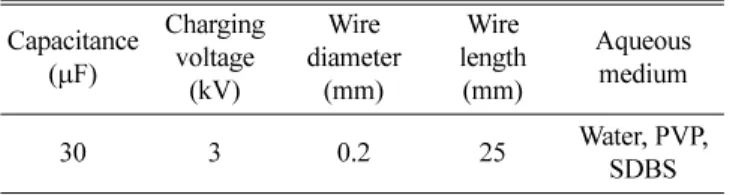
Silver colloid was prepared by EEW in liquid from wire with 2 mm in diameter. Experimental setup has been described elsewhere [17]. PVP and SDBS surfactants were dissolved in the deionized water with concentration of 0.01M. These solutions were used as working liquid for explosion process. The 400 ml liquid was filled in a teflon beaker with 73 mm in diameter and 124 mm in height. A section of silver wire (25 mm) was installed between two electrodes and submersed in liquid. A pulsed high-density current from a 3 kV charged capacitor was injected through the wire by closing the spark gap switch. Because the resistance of liquid is much smaller than that of silver, the electrical energy only deposited on the wire. Silver wire is rapidly heated to form vapor and plasma due to a high rate of the energy injection and an expansion lag of the heated material. Consequently, a bright light flashes and a shockwave scatters to the ambient atmosphere. The silver vapor was rapidly cooled down when colliding with the liquid molecules and condensed into solid particles dispersed directly in the liquid. The experimental parameters of explosion process were shown in Table 1. After 25 times of explosion, the suspension was collected for analysis.

The morphology and the size of the prepared silver nanoparticles were observed by transmission electron microscopy (TEM). A drop of silver suspension was dropped on a carbon coated copper grid then dried under vac- uum. The absorption spectrum of silver colloids was investi-

ing signal as a function of the sample height in a step of 40 mm every 2 h for 3 days. Zeta potential property of sil- ver nanocolloids was measured by zeta potential analyser (ELS-Z, Japan). At least ten different runs were carried out to take the average zeta potential value.

3. Results and Discussion

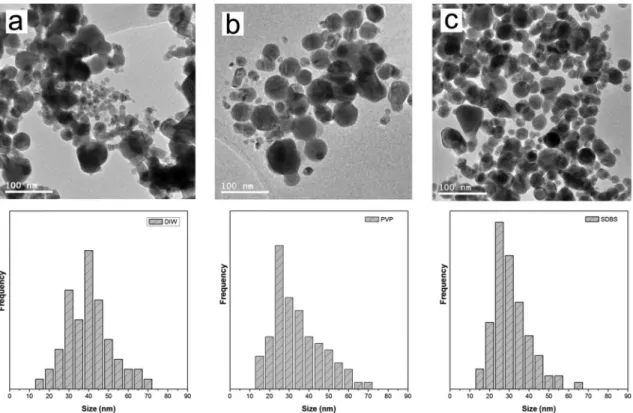
Fig. 1 illustrates the TEM images and corresponding size distributions of silver nanoparticles produced by EEW in DIW, PVP and SDBS solutions. The results show that the particle shape in all cases is nearly spherical.

These results are in agreement with one absorption peak in optical spectrum (Fig. 2). The average particles sizes were calculated from TEM images to be 28, 31 and 37 nm in the SDBS, PVP and DIW, respectively. Particle size in DIW is biggest and particles are more aggregated. The aver- age diameter of nanoparticles decreases when nanoparti- cles were prepared in surfactant solutions. Moreover, the size distribution also become narrower with presence of surfactant. In SDBS solution, the particle size is smallest and size distribution is narrowest in three samples.

Fig. 2 shows absorption spectra of silver colloid prepared by EEW in different aqueous media. All spectra exhibit a peak at around 400 nm, which is related to the surface plasmon resonance of silver nanoparticles and a tail of a broad band extending toward the UV wavelength. It is noted that number of peaks in absorption spectrum indicates the shape of particles; one plasmon absorption band is char- acteristic of a spherical nanoparticle and two plasmon absorption bands is characteristic of an ellipsoidal/nanorod particle [18]. The single surface plasmon peak of these spectra implies that the silver nanoparticles fabricated by EEW are spherical. The detail characteristics of silver absorption spectra in DIW, PVP and SDBS were listed in Table 1. Experimental details of EEW in liquid

Capacitance ( µ F)

Charging voltage

(kV)

diameter Wire (mm)

length Wire (mm)

Aqueous medium

30 3 0.2 25 Water, PVP,

SDBS

(3)

the Table 2. Position of peak shifts a small value with changing the liquid but the width of surface plasmon peak dramatically varies. According to the Mie theory, the peak shift and the change of peak width are observed when the particle size and size distribution change [19].

The absorption peaks of silver nanoparticles in SDBS and PVP are similar while it is red shift in the DIW. The peak width of silver nanoparticles in PVP is broader than

that of silver particles in SDBS. The broader peak in PVP than in SDBS indicates that the silver particles have larger range size. Although the peak position of silver particles in PVP is little smaller, the average size is still bigger due to larger size distribution. In case of DIW, the significantly broader bandwidth and red-shift of absorption peak surely confirm the biggest particles size and the widest size distribution.

To investigate the stability of silver nanocolloids, we measured their zeta potential and multi light scattering.

The high value of zeta potential makes a repulsion force and keeps the nanoparticles away from each other, which results in a high stability of colloid. Table 2 shows the zeta potential of silver nanocolloids prepared by EEW in different aqueous media. The all silver nanoparticles are negatively charged with zeta potential value in the range of -15 mV to -35 mV. It is found that the absolute zeta Fig. 1. TEM images and corresponding size distributions of nanoparticles prepared in different media: (a) DIW, (b) PVP and (c) SDBS.

Table 2. Characteristics of silver nanoparticles prepared by EEW in various aqueous solutions

Sample Peak position (nm) FWHM Particle size (nm) Z-potential

(mV) Dispersion state SDBS 403 71 28 -34.83 Stable colloid

PVP 402 82 31 -29.16 Stable colloid

DIW 406 108 37 -15.21 Unstable colloid

Fig. 2. UV-vis absorption spectra of silver colloidal solution

prepared at different media: (a) DIW, (b) PVP, and (c)

SDBS.

(4)

by the absorption of surfactant molecules on the surface of particles. Therefore, colliding among particles and agglom- eration of particles can be more difficult and the dispersion stability of silver nanoparticles in surfactant is the better than that of particles in water.

Fig. 3 presents transmission (T) profiles as a function of sample height and time measured in three days. The transmitted light flux in percentage (%) related to the density of suspension in the liquid. The change of nano- particle concentration affects on the transmitted light flux. The less particles cause the more transmission light going across the sample. The initial transmission scan was used for reference and set to be 0% transmission sig- nal throughout the length of the measured cell.

It can be seen clearly that the transmission profile of silver suspension in water shows clarification of sample with increasing T level on the right of profile. This phe- nomenon occurs due to the particle migration. Silver par- ticles migrating from the top to the bottom induce particle volume fraction change on the extremities of sample. As characterizing in zeta potential measurement,

means that the volume fraction is the same in all area of sample at the scanning time. The transmission increases slightly with time because the suspension settling takes place. However, the settling speed is very slow and no clarification can be found in the each scan after 3 days.

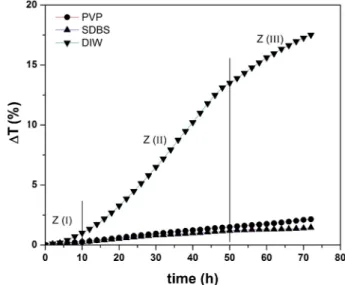
Fig. 4 compared the variation of the T signal as a func- tion of time for silver suspensions prepared in DIW, SDBS and PVP. From this figure, it indicates that the variation of T signal is much depends on working liquid of EEW. In other words, the stability of silver suspen- sion is influence by the working liquid. In all cases, T variation increases as a function of time but the speed of variation is different. It shows clearly that the silver col- loid in surfactant solution is much more stable than that in DIW due to the much smaller variation of transmis- sion signal. The T variation of suspension in water can be divided into three zones. The first zone less than 10 h, the particles migrated slowly corresponding small slope of T variation. In zone II, the variation of T signal

Fig. 3. Transmission profile of silver colloids prepared in

different exploding media. Fig. 4. Variation of transmission signal (DT) vs. time for silver

colloids produced by EEW in different aqueous media.

(5)

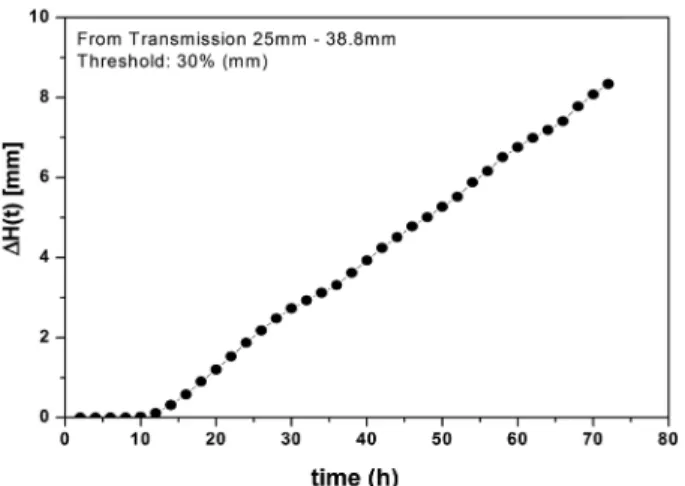
increases faster with higher slope of curve. Slope of clari- fication kinetics are significant due to the high velocity of particle movement and this means that the sedimenta- tion rate is rapid in this period. In zone III, the slope and the sedimentation rate decreases. It is easy to observe that the transmission flux increases at the top of the sample from the T profile of silver particles in DIW. The thick- ness (delta H) of the clarification layer taken out from the transmission in the 25-38 mm with threshold of 30% trans- mission flux is shown in Fig. 5. It was small change less than 10 h and became considerably afterward. It changed linearly following the time and was about 8 mm after 72 h. The variation of silver suspension in surfactant is very different in DIW. No clarification is observed in transmis- sion scan. The transmission flux slightly increased with time through the total height of the sample. The change of T level of silver colloids with presence of surfactant is much smaller than that in DIW. It is about 1.5% and 2.2% corresponding to particles in SDBS and PVP, while it is 17.5% in DIW. The small change of transmission flux deduces that the stability of suspension in surfactant is much better than that in water.

4. Conclusion

Electrical explosion of wire in liquid was employed to prepare silver colloids in DIW, PVP and SDBS solu- tions. The working liquid of EEW much affects on the prop- erties of the colloids. Particles in DIW, PVP and SDBS all are in nearly spherical shape. The nanoparticle size is smaller and size distribution is narrower when SDBS and PVP surfactant were used. Optical analysis in the range of 300-800 nm exhibited an absorption peak at ~400 nm. The

peak position of silver nanoparticles in water was red-shifted and the peak width in water was broader than that in surfac- tant. The stability of suspension was investigated by multi light scattering. The results showed that the stability of silver particles strongly depends on the exploding medium. Disper- sion property is instable in the DIW and is much better in PVP and SDBS solutions. The best stability among three samples is SDBS sample with the highest zeta potential value and the lowest speed of transmission variation.

References

[1] Y. N. Li, Y. L. Wu and B. S. Ong: J. Am. Chem. Soc.,

127 (2005) 3266.

[2] Y. C. Kim, N. C. Park, J. S. Shin, S. R. Lee, Y. J. Lee and D. J. Moon: Catal. Today, 87 (2003) 153.

[3] D. V. Talapin, J. S. Lee, M. V. Kovalenko and E. V.

Shevchenko: Chem. Rev., 110 (2010) 389.

[4] D. P. O’Neal, L. R. Hirsch, N. J. Halas, J. D. Payne and J.

L. West: Cancer Lett., 209 (2004) 171.

[5] D. M. K. Lam and B. W. Rossiter: Sci. Am., 245 (1991) 48.

[6] P. V. Kamat: J. Phys. Chem. B, 106 (2002) 7729.

[7] J. Zhu, S. Liu, O. Palchik, Y. Koltypin and A. Gedanken:

Langmuir, 16 (2000) 6396.

[8] F. Mafune, J. Y. Kohno, Y. Takeda, T. Kondow and H.

Sawabe: J. Phys. Chem. B, 104 (2000) 8333.

[9] W. T. Wu, Y. Wang, L. Shi, Q. Zhu, W. Pang, G. Xu and F. Lu: Nanotechnology, 16 (2005) 3017.

[10] J. K. Lung, J. C. Huang, D. C. Tien, C. Y. Liao, K. H. Tseng, T. T. Tsung, W. S. Kao, T. H. Tsai, C. S. Jwo, H. M. Lin and L. Stobinski: J. Alloys Compd., 434/435 (2007) 655.

[11] Y. A. Kotov: J. Nanopart. Res., 5 (2003) 539.

[12] A. P. Ilyin and O. B. Nazarenko: J. Optoelectron Adv. M.,

9 (2007) 1521.

[13] N. Goswami and P. Sen: J. Nanopart. Res., 9 (2007) 513.

[14] L. H. Bac, G. S. Yun, J. S. Kim, H. S. Choi and J. C. Kim:

J. Nanosci. Nanotechno., 11 (2011) 1730.

[15] G. S. Yun, L. H. Bac, J. S. Kim, Y. S. Kwon, H. S. Choi, J. C. Kim: J. Alloys Compd., 509 (2011) S348.

[16] L. H. Bac, K. S. Kim, J. S. Kim, J. C. Kim and C. K.

Rhee: J. Kor. Powd. Met. Inst., 17 (2010) 464 ( Korean ).

[17] L. H. Bac, J. S. Kim and J. C. Kim: Res. Chem. Intermed., 36

(2010) 795.

[18] S. Link and M. A. E. Sayed: J. Phys. Chem. B, 103 (1999) 8410.

[19] U. Kreibig and M. Vollmer: Optical properties of metal clusters, Springer, Berlin, (1995).

Fig. 5. Thickness of clarification layer of silver colloid prepared in DIW.

이 논문을 지난 30여 년간 한국분말야금학회 발전 및

기술개발에 큰 업적을 남기신 울산대학교 권영순 교수님의

정년을 기념하여 헌정합니다.

수치

Fig. 1 illustrates the TEM images and corresponding size distributions of silver nanoparticles produced by EEW in DIW, PVP and SDBS solutions
Table 2. Characteristics of silver nanoparticles prepared by EEW in various aqueous solutions
Fig. 3 presents transmission (T) profiles as a function of sample height and time measured in three days
Fig. 5. Thickness of clarification layer of silver colloid prepared in DIW.

참조

관련 문서

The purpose of this research was to suggest the water quality improvement in streams by evaluating the distribution characteristics of organics and ammonia nitrogen

In this regard, this study analyzes the effect of the job characteristics and work environment of workers with physical disabilities on job satisfaction

The proposed BMS in this thesis aimed to secure stability and increase the speed of balancing by minimizing the heat problem occurring in the cell

Various studies have been performed to improve properties of material, electrical and mechanical properties of railway train according to the increase of the speed in the

• Theory can extent to molten polymers and concentrated solutions.. The single-molecule bead spring models.. a)

This Study was conducted on privatizing the Water Supply Industry in Korea. Water supply service has been operated by local autonomous and public entities. But in

Crosslinked network polysiloxanes containing oligo ethylene oxide and phenol units, as internal free chains have been synthesized by hydrosilylation of

1 John Owen, Justification by Faith Alone, in The Works of John Owen, ed. John Bolt, trans. Scott Clark, "Do This and Live: Christ's Active Obedience as the