• 검색 결과가 없습니다.

Measurement of Thermal Load in the Tip-Clearance Region of a Rotor Surface

N/A
N/A
Protected

Academic year: 2021

Share "Measurement of Thermal Load in the Tip-Clearance Region of a Rotor Surface"

Copied!
6
0
0

로드 중.... (전체 텍스트 보기)

전체 글

(1)

1.

(rotor blade) (casing)

(stator vane)

, (tip clearance)

.

(pressure surface) (suction surface)

2 ,

(tip-leakage flow) .

Mayle

Metzger

(1)

.

(cascade) .

(2-5)

Jin Goldstein

(6)

.

(turning angle) 107 ,

(span-to-chord ratio) 2.5

.

.

. 1

Measurement of Thermal Load in the Tip-Clearance Region of a Rotor Surface

Sang Woo Lee, Hyun Goo Kwon, and Jin Jae Park

Key Words: Tip-Leakage Flow ( ), Tip Clearance ( ), Heat (Mass) Transfer Coefficient ( ( ) )

Abstract

The heat (mass) transfer characteristics in the tip-leakage flow region of a high-turning first-stage turbine rotor blade has been investigated by employing the naphthalene sublimation technique. The heat transfer data in the tip-leakage flow area for the tip clearance-to-span ratio, h/s, of 2.0% are compared with those in endwall three-dimensional flow region without tip clearance (h/s = 0.0 %). The result shows that the thermal load in the tip-leakage flow region for h/s = 2.0% is more severe than that in the endwall flow region for h/s = 0.0%. The thermal loads even at the leading and trailing edges for h/s = 2.0% are found larger than those for h/s = 0.0%. The tip-leakage flow results in heat transfer augmentations near the tip on both pressure and suction sides in comparison with the mid-span results.

,

E-mail : [email protected]

TEL : (054)467-4209 FAX : (054)467-4050

* ,

** ,

(2)

Fig. 1 Turbine rotor cascade with tip clearance

, ( )

.

2.

,

, .

9.0 ,

40 m/s .

(Fig. 1).

420 mm × 320 mm ,

1.2 m .

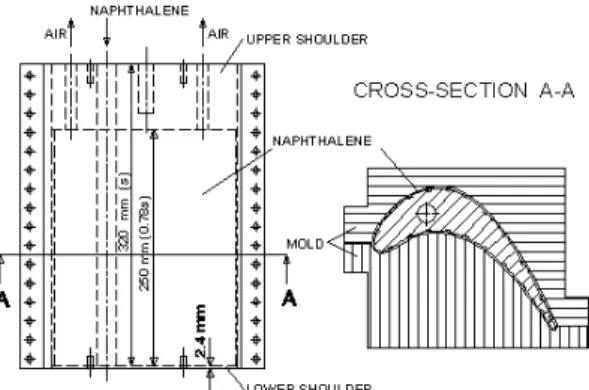
6

. 1

(mid-span)

large-scale . Fig. 2

, (c),

(p), (s) 217.8 mm, 151.6 mm,

320.0mm .

119 Goldstein

(6)

107 12 .

(7)
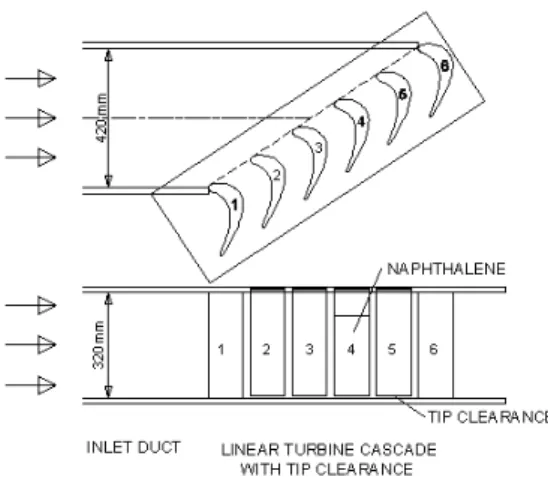
. 6 #1 #6

, 4

(Fig. 1). Fig. 2

. xyz

Fig. 2 Arrangement of turbine blade cascade

x- , ( ) y- ,

( ) z- .

z

. Fig. 2 s

p

s

s

.

.

(8)

,

.

C

10

H

8

, 80.2 . Fig. 3

.

.

Fig. 3 ,

. ,

. ,

.

LVDT(Linear Variable Differential

Transformer) . LVDT (Sensotec,

model 060-3590-02) ±1.0 mm

1 .

T- ,

(Keithley, 2001) GPIB (National Instruments,

AT-GPIB) .

(3)

Fig. 3 Casting mold for naphthalene coated blade

(Fisher Scientific, 9010) .

,

LVDT .

LVDT 3 .

Fig. 4 4-

.

15 m/s .

Reynolds (Re = ) 2.09×10

5

.

1.5c

0.3% , ,

, 44.7 mm, 5.16 mm, 4.04

mm .

(h/s) 2%

.

3.

3.1 Sherwood

Fig. 5(a)

Sherwood (Sh = h

m

c/D)

. ,

(z/s = 0) Sh .

Sh

Fig. 4 Schematic diagram of 4-axis profile measurement system

. (leading edge)

Sh

. s

p

/c 1.1

(trailing edge) Sh

.

(vortex shedding) Sh

.

(mid-chord) Sh

. Sh

.

z/s 0.5 Sh ,

.

Sh , s

p

/c = 0.1

(inflection point)

Sh 400 .

(re-attachment)

s

p

/c 0.2 1400

, . s

p

/c 0.5

1.0 Sh 800

. ,

Sh

, .

Fig. 5(b) Sh

.

Sh , Sh

(4)

(a) Pressure surface

(b) Suction surface Fig. 5 Contours of Sh for h/s = 2.0 %

. Sh

,

. Sh ,

Sh .

Sh Sh

.

.

,

. s

s

/c 0.9

0.2s ,

. , Sh

. 0.35 < s

s

/c < 0.5

. Sh 1800

Sh ,

Sh .

0.7 < s

s

/c < 1.4

(a) z/s = 0.02

(b) z/s = 0.06

(c) z/s = 0.12

(d) z/s = 0.20

Fig. 6 Chord-wise profiles of Sh for h/s = 0.0 and 2.0 %

z/s = 0.2 ,

Sh 2000 .

Sh 600

3.2 Sherwood

Fig. 6 z/s 0.02, 0.06, 0.12, 0.2 , Sh .

(h/s = 0%)

(h/s = 2%)

(5)

Sh z/s

.

.

. z/s = 0.02

Sh .

. z/s 0.02

,

Sh .

Sh , z/s 0.12

3 Sh

. z/s = 0.02

Sh

. s

s

/c 0.15 0.55

, s

s

/c 0.45 0.75 .

3 s

s

/c 0.7

, Sh (s

s

/c = 0.45)

. z/s = 0.06 Sh

. s

s

/c

0.3 0.4 Sh

. s

s

/c 0.55

,

Sh 50%

.

z/s = 0.12 .

(Fig. 6(d)), . 3

3

.

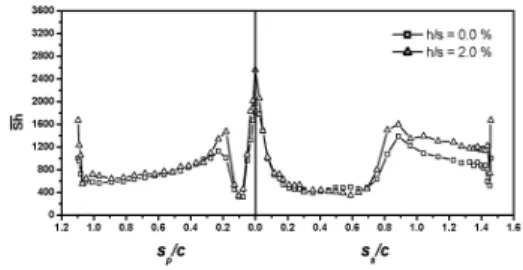
Fig. 7 Chord-wise profile of mean Sh averaged in the span-wise direction from z/s = 0.0 to 0.5 for h/s = 0.0 and 2.0 %

3.3 Sherwood

Fig. 7 Sh z/s = 0 0.5 Sherwood

. 2%

,

.

30% ,

. s

s

/c 0.7

, .

4.

1

( ) .

. (1)

.

. (2)

.

.

(3) ,

.

(6)

(4)

. (5)

3 , .

(1) Mayle, R. E., and Metzger, D. E., 1982, "Heat Transfer at the Tip of an Unshrouded Turbine Blade," Proceedings of 7th International Heat Transfer Conference, Vol. 3, pp. 87 92.

(2) Chyu, M. K., Moon, H. K., and Metzger, D.

E., 1989, "Heat Transfer in the Tip Region og Grooved Turbine Blades," ASME Journal of Turbomachinery, Vol. 111, pp. 131 138.

(3) Metzger, D. E., Dunn, M. G., and Hah, C., 1992, "Turbine Tip and Shroud Heat Transfer,"

ASME Journal of Turbomachinery, Vol. 113, pp.

502 507.

(4) Metzger, D. E., and Rued, K., 1989, "The influ

ence of Turbine Clearance Gap Leakage on Passage Velocity and Heat Transfer Near Blade Tips, Part I - Sink Flow Effects on Blade Pressure sides," ASME Journal of Turbomachinery, Vol. 111, pp. 284 292.

(5) Rued, K., and Metzger, D. E., 1989, "The influence of Turbine Clearance Gap Leakage on Passage Velocity and Heat Transfer Near Blade Tips, Part II - Source Flow Effects on Blade Suction sides," ASME Journal of Turbomachinery, Vol. 111, pp. 293 300.

(6) Jin, P., and Goldstein, R. J., 2002, "Local Mass/Heat Transfer on Turbine Blade Near-Tip Surfaces," ASME Paper No. GT-2002-30556.

(7) , , , 2001, "

( )

," , 25 , 3 ,

pp. 356 365.

(8) Goldstein, R. J. and Cho, H. H., 1995, "A

Review of Mass Transfer Measurements Using

Naphthalene Sublimation," Experimental Thermal

and Fluid Science, Vol. 10, pp. 416 434.

수치

Fig. 1 Turbine rotor cascade with tip clearance , ( ) . 2. , , . 9.0 , 40 m/s . (Fig. 1)
Fig. 4 Schematic diagram of 4-axis profile measurement system . (leading edge) Sh . s p /c 1.1 (trailing edge) Sh
Fig. 6 Chord-wise profiles of Sh for h/s = 0.0 and 2.0 % z/s = 0.2 , Sh 2000 . Sh 600 3.2 Sherwood Fig
Fig. 7 Chord-wise profile of mean Sh averaged in the span-wise direction from z/s = 0.0 to 0.5 for h/s = 0.0 and 2.0 % 3.3 Sherwood Fig

참조

관련 문서

Others: waste heat in distillation tower, waste heat recovery, natural gas pressure turbine, by-product gas Source: The monthly report on major electric power statistics,

The purpose of this study is to evaluate the effects of heat treatment on the load-deflection properties and transitional temperature range(TTR) of

9 Designed aerodynamic shape of 500W class wind

Also, the design of an optimal heat sink requires a complete knowledge of all heat transfer characteristics between the heat source and the ambient air

G.(1988), &#34;Theoretical Determanation of the Sizes of Standard Model and Effect of Changes in Heat Input and kind of Steel on Inherent Strain - A Predicting Method

Martonosi, &#34;Dynamic thermal management for high- performance microprocessors,&#34; Proceedings of International Symposium on High-Performance Computer

• For dry or semi-dry concrete exposed to water, capillary suction pressure has the same effect on flow as a pressure head of 2.4 MPa in saturated concrete.. •

Reference 7 contains a derivation (also by the Newtonian method) of a system of nonlinear equations for the elastic bending and rigid pitching motion of a cantilever rotor