2009년도 춘계 학술발표회 논문집 대한방사선방어학회
250 _ http://www.karp.or.kr
X-ray Shield for High Energy Gamma Spectrometry using a n-type HPGe Detector
Jong In Byun
1․ Jeong Hwan Row
2․ Ji Yun Lee
2․ Ju Yong Yun
1,21
University of Science & Technology ․
2Korea Institute of Nuclear Safety
E-mail: [email protected]
keyword : Cascade coincidence summing, X-ray, HPGe
Introduction
In the last several decades HPGe detectors have been used popularly because of good energy resolution and high efficiency. And HPGe detectors to measure low energy gamma rays also have been developed by several companies. The detectors are generally called as a n-type HPGe detector or LEGe. The commercial n-type HPGe detectors have the front window made from carbonate or beryllium to increase the detection efficiency for low energy photons. For that reason, cascade coincidence summing effects by X- and Gamma rays can be produced. In order to use the n-type HPGe detector for high energy gamma rays, therefore, we should eliminate incidence of X-rays or correct the effects. The correction for X- and Gamma rays might be so complicate and difficult. On the other hand, the summing effects can be terminated by additional X-ray shields at the end cap.
In this study, we optimized the thickness of shielding material selected for the purpose. This paper demonstrates the optimization process and the shield's applicability for detection efficiency calibration and radioactivity analysis.
Materials and Methods
When determining the detection efficiency for HPGe detector, we usually use commercial standard radioactive source. In general, the source contains
241Am,
109Cd,
57Co,
139Ce,
113Sn,
203Hg,
85Sr,
137
Cs,
60Co and
88Y. Of them,
113Sn,
85Sr and
88Y can produce the X- and gamma rays summing effects[1]. Therefore, the material and its thickness should be selected considering the maximum X-ray energy to produce the effects.
The maximum energy line of X-ray is about 40 keV in
139Ce. Firstly, we compared interaction characteristics with X-rays of Cu and Al. The interests of X-ray energy in Cu are dominantly absorbed by photoelectric effects. That is, the cascade summing effects by multiple scattered X- and Gamma rays can be terminated in Cu. The coefficients were calculated by using XCom software[2]. Cu was determined as shielding material because of the interaction characteristics with X-rays and good workability. Secondly, we optimized the thickness of Cu considering X-ray energy and detection efficiency for Gamma rays.
The thickness was determined as 0.2 cm by
linear attenuation coefficients in Cu. In fact, the
thickness is conservative because the integration
of actual path length of photons to detector is
2009년도 춘계 학술발표회 논문집 대한방사선방어학회
대한방사선방어학회_ 251 longer than the calculation.
Fig. 2. Total linear attenuation rate excluding coherent scattering, for Cu with varied thickness from 0.05 to 1 cm, calculated with XCOM.
In addition, the probability to produce the cascade summing after penetrating Cu is nearly zero. As shown in Fig. 2, the attenuation rate for about 40 keV is nearly 100 %. Finally, in order to test the detection efficiency with Cu shield, we made efficiency curve and analyzed radioactivity of radioisotopes contained in reference materials.
For the purpose, we used cylindrical types of radioactive sources. The commercial standard radioactive source was diluted in U8 vial ( ∅ 2.4 × 6 cm
3) with 2 M HCl. And we used a n-type coaxial HPGe detector with a relative efficiency of 30 %. All radioactive sources were measured on the detector window. The gamma ray peaks were measured within relative counting uncertainty of 2
%. To show the applicability of the copper shield, the IAEA reference materials also were filled in U8 vial and the radioactivity analysis results were compared with recommended values.
Results and Discussion
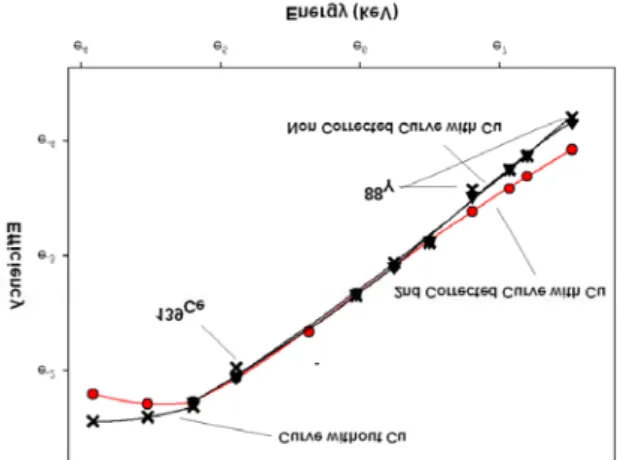
The Fig. 3 shows the characteristics of efficiency curves with cascade coincidence summing effects by X- and Gamma rays. We can
Fig. 3. The efficiency curves with and without cascade summing effects for U8-10mm.
find that detection efficiencies for the
139Ce and
88