한방소아과학회지에 출판된 임상연구논문에 대한 분석
양두화1․박장경2․성현경3․성수현4
1대구한의대학교 한의과대학 한방재활의학과교실, 2상지대학교 한의과대학 부인과학교실,
3세명대학교 한의과대학 소아과학교실, 4한약진흥재단 정책본부 미래정책팀
Received: October 26, 2018 ∙ Revised: November 16, 2018 ∙ Accepted: November 17, 2018 Corresponding Author: Sung Soo Hyun, KMD (DKM), PhD
Future Policy Team, Department of Korean Medicine Policy, National Development Institute of Korean Medicine, Republic of Korea
Tel: +82-2-3393-4531, Fax: +82-2-3393-0000 E-mail: [email protected]
ⓒ The Association of Pediatrics of Korean Medicine. All rights reserved. This is an open-access article distributed under the tenus of the Creative Commons Attribution Non-Commercial License (http://creativecommons.org/licenses/by-nc/3.0/), which permits unrestricted non-commercial use, distribution, and reproduction in any medium, provided the original work is properly cited.
Abstract
Trend Analysis of Clinical Studies Published in the Journal of Pediatrics of Korean Medicine
Yang Doo Hwa1․Park Jang Kyung2․Sung Hyun Kyung3․Sung Soo Hyun4
1Department of Rehabilitation Medicine, College of Korean Medicine, Daegu Haany University,
2Department of Obstetrics and Gynecology, College of Korean Medicine, Sangji University,
3Department of Korean Pediatrics, College of Korean Medicine, Semyung University,
4Future Policy Team, Department of Korean Medicine Policy, National Development Institute of Korean Medicine
Objectives
The purpose of this study is to provide evidence of traditional Korean medicine treatment in children and adolescents by reviewing previous studies published in the journal of pediatrics of Korean medicine.
Methods
We have reviewed clinical studies of children and adolescents in the journal of pediatrics of Korean medicine from 2008 to 2017.
Results
Eighty-seven clinical studies of children and adolescents were reviewed. Total number of patients were 1644 in the studies. Among these, top 5 most commonly reported diseases in children and adolescents were atopic dermatitis, growth, autism, juvenile idiopathic arthritis and obesity. The most common intervention to treat those was taking herbal medicine. Most of the clinical studies showed effectiveness of this approach in treating children and adolescents.
Conclusions
More double-blinded randomized controlled clinical trials of Korean medicine interventions treating children and adolescents are needed to establish evidence-based treatment.
Key words: Clinical studies, Journal of pediatrics of Korean medicine, EBM
대한한방소아과학회지 제32권 제4호(2018년 11월) J Pediatr Korean Med. November, 2018;32(4):141-162 ISSN 1226-8038(Print), 2287-9463(Online), https://doi.org/10.7778/jpkm.2018.32.4.141
142 Trend Analysis of Clinical Studies Published in the Journal of Pediatrics of Korean Medicine
Ⅰ. Introduction
한의학은 축적된 역사적 근거를 바탕으로 건강유지, 질병예방, 질병치료에 있어 국가 보건의료체계의 한 축을 담당해오고 있다1,2). 근래 근거중심의학의 대두에 따라 한의계는 근거에 기반한 환자 치료 표준화와 보 편화에 대한 요구를 지속적으로 받고 있으며, 이와 같 은 시대적 요구에 순응하여 한의학계에서도 양질의 근 거를 축적하기 위한 임상연구가 활발히 이루어지고 있 다3,4). 2016년부터 추진 중인 3차 한의약 육성발전 종 합계획에서도 한의 보장성 강화와 한의 의료 표준화를 목표로 30개 질병에 대한 한의표준임상진료지침서 개 발을 진행 중이다5).
소아는 태생기부터 성인에 이르기 전까지의 시기로, 성인과 다른 소아 특유의 생리와 병리 소견을 보인다6). 한의학은 인체를 전일체로 보며, 治未病하는 사상에 기반하여7), 자발적이고 능동적인 예방과 섭생을 중시 한다. 이러한 특징은 학령기 아동과 청소년을 포함한 소아 질환의 예방과 치료에 부합한다.
기존에 발표된 임상연구를 분석한 연구들은 소아의 특정 질환에 대한 동향을 보고한 연구가 주로 이루어
졌으며8-10), 한방소아과학회지에 보고된 임상논문을 고
찰한 1건의 연구가 보고된 바 있다11). 그러나 보고된 시일이 10년 이상 경과하였고, 임상연구 연도별 연구 디자인, 질환명, 연구기관 정도의 정보만을 제시하여 소아의 한방치료 동향을 파악하기에는 부족하였다.
이에 한방소아과학회지에 게재된 임상연구 중 질병 에 대해 한의치료가 이루어진 연구논문을 조사하여, 소아의 한방치료와 관련된 임상연구 동향을 파악하여 향후 연구수행을 위한 기초자료로 활용되는데 기여하 고자 한다.
Ⅱ. Materials and Methods
1. 연구대상
본 연구는 2008년부터 2017년까지, 10년간 한방 소아과학회지에 게재된 335편의 논문을 대상으로 하였다.
2. 포함기준
본 연구에서는 질환을 막론하고, 소아 환자를 대상 으로 포함한 임상연구 중에서 한의학 관련 치료법을 사용한 경우를 대상으로 하였다. 한의학 관련 치료법 은 침, 전침, 약침, 한약, 뜸, 부항, 상담 등 한의의료기 관에서 사용하고 있는 모든 치료법으로 간주하였다.
3. 제외기준
검색된 문헌의 제외기준은 다음과 같다.
① 단행본, 학술대회 발표 자료 등 논문 형식 (서론, 연구방법, 결과, 고찰, 결론)을 갖추지 않은 논문
② 문헌연구, 실험연구 등 사람을 대상으로 하지 않 은 논문
③ 설문조사 및 질적연구 방법으로 수행된 논문
④ 임상연구이지만 치료를 적용하지 않은 논문
4. 데이터 추출
2명의 저자 (Yang DH, Park JK)가 독립적으로 사전 에 정의한 기준에 따라 335편의 논문을 분류하였다. 논 문 분류는 제목과 초록을 확인하여 분류하였으며, 필 요한 경우 논문 원문을 확인하였다. 이후 2명의 저자 (Yang DH, Sung HK)가 최종 연구대상으로 선정된 논 문의 저자, 임상연구 디자인, 나이, 환자 수, 질병명, 중 재법, 평가도구, 평가결과 데이터를 추출하였다. 논문 분류 및 데이터 추출에 대한 의견이 다른 경우 다른 저자 (Sung SH)와 논의하여 해결하였다.
Ⅲ. Results
1. 검색과정 및 결과
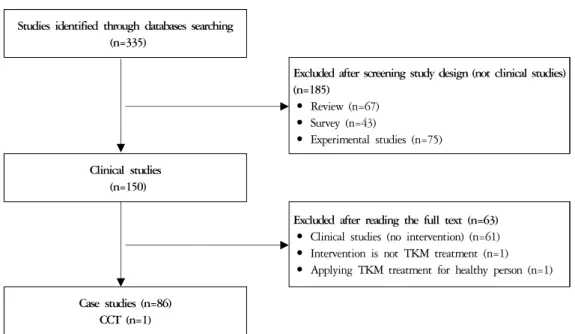
2008년부터 2017년까지 한방소아과학회지에 게재 된 335편의 논문 중 임상연구는 150편, 문헌연구는 67 편, 설문연구는 43편, 실험연구는 75편으로 나타났다.
임상연구 150편 중 중재법을 사용하지 않은 임상연구 61편, 한방치료를 사용하지 않은 임상연구 1편, 건강한 소아에게 한방치료를 적용한 임상연구 1편을 제외하 고 총 87편의 임상연구가 본 연구에 포함되었다 (Fig.
1). 소아의 한방치료 임상연구에 대한 분석결과는 Table 4와 같다.
한방소아과학회지에 출판된 임상연구논문에 대한 분석 143
2. 문헌형태, 연도별 분류
지난 10년간 발간된 소아 관련 임상연구는 총 87편 으로 그 중 86편은 증례연구 (98.9%), 1편은 대조군연구 (1.1%)로 대부분이 증례연구였으며, 2011년에 가장 많 은 12편이 발간되었다. 임상논문의 총 소아환자 수는 1644명으로, 2014년이 405명으로 가장 많았다 (Fig. 2).
단일 증례가 보고된 경우가 42편으로 가장 많았고, 다음으로 2건의 증례를 보고한 경우가 9편으로 약
72.4%에서 10건 이하의 증례를 후향적으로 보고하였 다. 가장 많은 대상자를 포함한 연구는 284명의 환자를 포함한 1건의 연구가 있었다 (Fig. 3).
3. 질환에 따른 분류
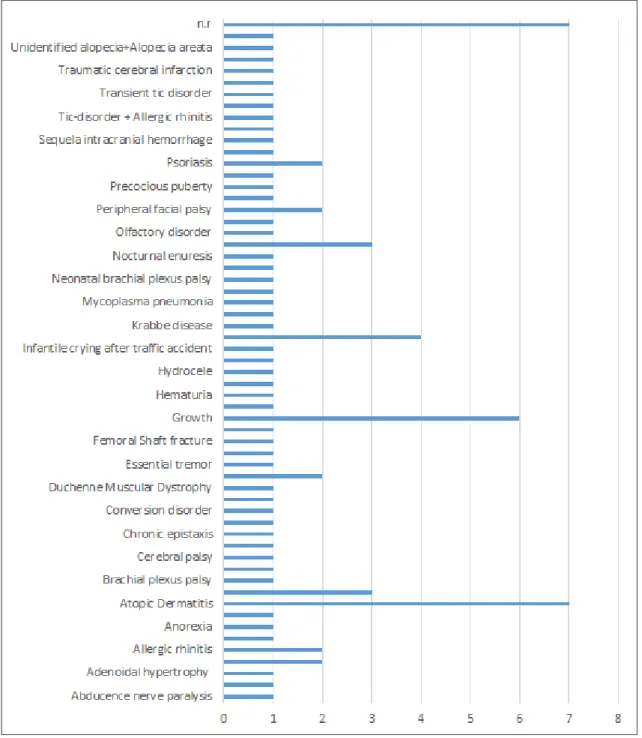
총 87편의 보고된 증례 중 다빈도 질환은 아토피성 피부염, 성장, 자폐스펙트럼장애, 소아 특발성 관절염, 비만 순이었다 (Table 1).
Studies identified through databases searching (n=335)
Excluded after screening study design (not clinical studies) (n=185)
• Review (n=67)
• Survey (n=43)
• Experimental studies (n=75) Clinical studies
(n=150)
Excluded after reading the full text (n=63)
• Clinical studies (no intervention) (n=61)
• Intervention is not TKM treatment (n=1)
• Applying TKM treatment for healthy person (n=1)
Case studies (n=86) CCT (n=1)
CCT: Controlled Clinical Trial, TKM: Traditional Korean Medicine Fig. 1. Flowchart of study selection process
Fig. 2. Study trend of clinical studies and cases by year
144 Trend Analysis of Clinical Studies Published in the Journal of Pediatrics of Korean Medicine
Fig. 3. Patient number distribution
Table 1. Top-five Diseaseʼs Intervention of Clinical Studies in the Journal of Pediatrics of Korean Medicine
Disease Intervention n (%)
Atopic dermatitis (n=192)
Herbal medicine (n=192) 100%
Acupuncture (n=43) 22.4%
Counseling (n=23) 12.0%
LLLT (n=19) 9.9%
Atopy care program (n=17) 8.9%
External wet therapy (n=6) 3.1%
Lotion (n=6) 3.1%
Art therapy (n=6) 3.1%
Relaxation therapy (n=6) 3.1%
Lifestyle education (n=6) 3.1%
Food education (n=6) 3.1%
Wind bathing (n=6) 3.1%
Horminis placenta external therapy (n=1) 3.1%
Growth (n=504) Herbal medicine (n=504) 100%
Autism (n=9)
Herbal medicine (n=7) 77.8%
Acupuncture (n=2) 22.2%
Herbal medicine extract (n=1) 11.1%
Electric moxibustion (n=1) 11.1%
Juvenile idiopathic arthritis (n=3) Herbal medicine (n=3) 100%
Obesity (n=60)
Herbal medicine (n=40) 66.7%
Balneotherapy (n=20) 33.3%
Acupuncture (n=1) 1.7%
Moxibustion (n=1) 1.7%
Auricular acupuncture (n=1) 1.7%
Behavior modification (n=1) 1.7%
LLLT: Low level laser therapy
한방소아과학회지에 출판된 임상연구논문에 대한 분석 145
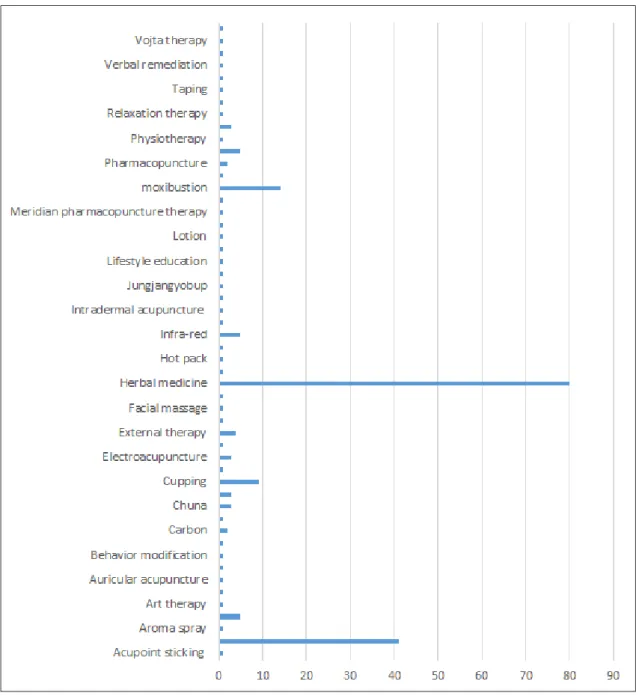
4. 중재방법에 따른 분류
대상 논문에 다용된 중재방법은 한약치료, 뜸치료, 경혈첩부요법 등이었다. 상위 5개 질환에 따른 중재방 법은, 아토피성 피부염에는 한약치료, 침치료, 상담, 저 출력 레이저 요법 (Low level laser therapy, LLLT), 아토 피 관리 프로그램, 습포 요법, 자하거 습포 요법, 로션, 미술 치료, 이완 요법, 생활습관 교육, 식이 교육, 풍욕 이 사용되었다. 성장에는 한약치료, 자폐스펙트럼장애
에는 한약치료, 침치료, 전자침, 한약추출물 전기식 온 구기가 사용되었다. 소아 특발성 관절염에는 한약치료 가 사용되었고, 비만에는 한약치료, 침치료, 뜸치료, 이 침치료, 행동교정요법, 광천요법이 사용되었다.
5. 유효성 평가 방법에 따른 분류
대상 논문 87편 중 58.6%에서는 객관적인 평가도구 를 활용하여 유효성을 평가하였고, 41.4% (36편)에서
n.r: not reported
Fig. 4. Chief complaints for clinical studies
146 Trend Analysis of Clinical Studies Published in the Journal of Pediatrics of Korean Medicine
는 평가도구 없이 환자의 주관적인 증상의 변화만으로 효과를 평가하였다.
질환의 치료 경과를 평가하기 위해 다음과 같은 도 구들이 활용되었다. 아토피성 피부염에는 SCORAD (Scoring atopic dermatitis), 설문조사, EASI (Eczema area and severity index), 증상 변화, 피부 PH 값이 활용되었 고, 성장에는 키, 몸무게, 체질량지수 (Body mass index, BMI), 골연령 (Bone age), Osteoporosis index, 체성분, 비 만지수, Growth velocity가 평가도구로 활용되었다. 자 폐스펙트럼장애에는 한국영유아발달검사, 아동기 자 폐증 평정척도, 자폐아동 행동발달 평가도구가 활용되
었다. 소아 특발성 관절염에는 증상 변화, 혈액검사, 체 온, 소아건강설문 (Childhood health assesment ques- tionnaire, CHAQ), 관절가동범위, VAS가 활용되었다.
비만에는 체질량지수, 비만지수, 체중, 키, 체성분. 체 지방 비율, Röhler index (RI)가 평가 목적으로 활용되 었다 (Table 2).
6. 부작용 보고 여부
포함된 연구 중 한의치료에 의해 부작용이 보고된 예는 5건이었다. 자세한 부작용 증상 및 환자수는 Table 3에 기록하였다.
Fig 5. Interventions for clinical studies
한방소아과학회지에 출판된 임상연구논문에 대한 분석 147
Disease Outcome measure n (%)
Atopic dermatitis (n=192)
SCORAD (n=121) 63.0%
Survey (pre-reported in paper) (n=71) 40.0%
EASI (n=17) 8.9%
Symptom change (n=7) 3.6%
Skin PH value (n=6) 3.1%
Growth (n=504)
Height (n=504) 100%
Weight (n=253) 50.2%
BMI (n=136) 27.0%
Bone age (n=118) 23.4%
Osteoporosis index (n=67) 13.3%
Body composition (n=51) 10.1%
OI (n=51) 10.1%
Growth velocity (n=18) 3.6%
Autism (n=9)
K-ASQ (n=7) 77.8%
K-CARS (n=2) 22.2%
E-CLAC (n=1) 11.1%
Juvenile idiopathic arthritis (n=3)
Symptom change (n=3) 100%
Blood test (n=1) 33.3%
Body temperature (n=1) 33.3%
CHAQ (n=1) 33.3%
ROM (n=1) 33.3%
VAS (n=1) 33.3%
Obesity (n=60)
BMI (n=60) 100%
OI (n=59) 98.3%
Weight (n=40) 66.7%
Height (n=39) 65%
Body composition (n=20) 33.3%
RI (n=20) 33.3%
Fat percents (n=1) 1.7%
BMI: Body mass index; CHAQ: Childhood health assesment questionnaire; E-CLAC: EWHA-checklist for autistic children; EASI: Eczema area and severity index; K-ASQ: Korean ages & stages questionnaires; K-CARS: Korean-childhood autism rating scale; OI: Obesity index; RI: Röhler index;
ROM: Range of motion; SCORAD: Scoring atopic dermatitis; VAS: Visual analog scale
Table 2. Top-five Diseaseʼs Outcome Measure of Clinical Studies in the Journal of Pediatrics of Korean Medicine
148 Trend Analysis of Clinical Studies Published in the Journal of Pediatrics of Korean Medicine
Table 3. Characteristics of Published Clinical Studies in the Journal of Pediatrics of Korean Medicine First author (year)Study designAge, number of patientsPatient's diseaseInterventionOutcome measureResultAdverse events (1)Choi (2008)Case studies12Y, n=2Fatty liver 1. Herbal medicine 2. Acupuncture 3. Therapeutic exercise 4. Consultation
1. GOT 2. GPT 3. GGT 4. TG 5. BMI 6. Symptom change
1. Improved 2. Improved 3. Improved 4. Improved 5. Improved 6. Improved
N (2)Jeong (2008)Case studies10.30Y, n=18Growth1. Herbal medicine1. Height 2. BMI 3. Growth velocity
1. Improved 2. Improved 3. ImprovedN (3)Jung (2008)Case studies9Y, n=1Mesenteric lymphadenitis1. Herbal medicine 2. Acupuncture 3. Moxibustion1. Symptom change1. ImprovedN (4)Kim (2008)Case studies18Y, n=1Conversion disorder
1. Herbal medicine 2. Acupuncture 3. Moxibustion 4. Consultation
1. Symptom change1. ImprovedN (5)Lee (2008)Case studies16M, n=1Traumatic cerebral infarction
1. Herbal medicine 2. Acupuncture 3. Aromatherapy 4. Rehabilitation 5. Physical therapy
1. Activity index1. ImprovedN (6)Park (2008)Case studies15Y, n=1Ramsay hunt syndrome
1. Herbal medicine 2. Acupuncture 3. Electroacupuncture 4. Moxibustion 5. Vesiculation therapy 6. Massage 7. Cupping boil 8. Taping
1. Yanagihara's scale 2. H-B Scale1. Improved 2. NDN (7)Song (2008)Case studies8Y, n=1Aphasia
1. Herbal medicine 2. Acupuncture 3. Verbal remediation 4. Intelligence-learning treatment 1. Symptom change 2. PRES1. Improved 2. ImprovedN (8)Yu (2008)Case studies8M-9Y n=9Atopic dermatitis1. Herbal medicine1. SCORAD1. ImprovedN
149
First author (year)Study designAge, number of patientsPatient's diseaseInterventionOutcome measureResultAdverse events (9)Choi (2009)Case studies9Y, n=1Sequela intracranial hemorrhage1. Herbal medicine 2. Acupuncture 3. Rehabilitation 1. ROM 2. MMT 3. Symptom change
1. Improved 2. Improved 3. ImprovedN (10)Hong (2009)Case studies7Y, n=1Autism1. Acupuncture1. K-CARS 2. E-CLAC1. Improved 2. ImprovedN (11)Jung (2009)Case studies4Y, n=1Urolithiasis1. Herbal medicine1. Symptom change1. ImprovedN (12)Kim (2009)Case studies12Y, n=1Epilepsy1. Herbal medicine 2. Acupuncture1. Symptom change1. ImprovedN (13)Kim (2009)Case studies6Y, n=1Functional dyspepsia1. Herbal medicine 2. Acupuncture1. Symptom change1. ImprovedN (14)Lee (2009)Case studies12-16Y, n=3Psoriasis1. Herbal medicine1. PASI1. ImprovedN (15)Sung (2009)Case studies2Y, n=1Traumatic brain injury
1. Herbal medicine 2. Acupuncture 3. Moxibustion 4. Cupping therapy
1. Symptom change1. ImprovedN (16)Yoo (2009)Case studies4Y, n=1Juvenile rheumatoid arthritis1. Herbal medicine1. ESR 2. CRP 3. Symptom change
1. Improved 2. Improved 3. ImprovedN (17)Yoon (2009)Case studies24.29Y, n=19Atopic dermatitis1. Herbal medicine 2. Acupuncture 3. LLLT1. SCORAD1. P<0.05 2. P<0.05N (18)Yu (2009)Case studies6-14Y, n=121Growth1. Herbal medicine1. Height1. UnclearN (19)Cheon (2010)Case studies13Y, n=1Abducence nerve paralysis
1. Herbal medicine 2. Acupuncture 3. Carbon-ray 4. Moxibustion 5. Aroma therapy 6. Infra-red 1. Symptom change1. ImprovedN (20)Choi (2010)Case studies18Y, n=1Post traumatic stress disorder1. Herbal medicine 2. Acupuncture1. Symptom change1. ImprovedN
150 Trend Analysis of Clinical Studies Published in the Journal of Pediatrics of Korean Medicine
First author (year)Study designAge, number of patientsPatient's diseaseInterventionOutcome measureResultAdverse events (21)Gok (2010)Case studies6.44Y, n=27n.r.1. Herbal medicine1. Symptom change1. ImprovedY Urinary frequency and hives in 2 cases (22)Hong (2010)Case studies13-14Y, n=2Structural scoliosis1. Chuna 2. Acupuncture1. Cobb's angle 2. VAS1. Improved 2. ImprovedN (23)Kim (2010)Case studies5-11Y, n=5Nocturnal enuresis 1. Moxa bucket moxibustion (5 patients) 2. Herbal medicine (5 patients) 3. Acupuncture (5 patients) 4. Moxibustion (3 patients)
1. Symptom change 2. ICCS1. Improved 2. ImprovedN (24)Park (2010)Case studies23Y, n=1Atopic dermatitis1. Herbal medicine 2. Acupuncture 3. Horminis placenta external therapy 1. Kunz type 2. SCORAD 3. Symptom change 1. Improved 2. Improved 3. ImprovedN (25)Ryu (2010)Case studies10Y, n=1Acute appendicitis1. Herbal medicine 2. Acupuncture
1. Symptom change 2. VAS 2. Abdominal ultrasonography
1. Improved 2. Improved 3. ImprovedN (26)Son (2010)Case studies1-10Y, n=2Case 1. Epilepsy Case 2. n.r.
1. Herbal medicine (2 patients) 2. Acupuncture (2 patients) 3. Moxibustion (2 patients) 4. Cupping (1 patient) 5. Aromatherapy (1 patient) 6. Infra-red (1 patient)
1. Symptom change1. ImprovedN (27)Yoo (2010)Case studies6Y, n=1Juvenile idiopathic arthritis1. Herbal medicine 1. CHAQ 2. VAS 3. ROM 4. Symptom change 1. Improved 2. Improved 3. Improved 4. Improved
N (28)Yoo (2010)Case studies5Y, n=1Juvenile idiopathic arthritis1. Herbal medicine1. Blood test 2. Body temperature 3. Symptom change
1. Improved 2. Improved 3. ImprovedN (29)Hong (2011)Case studies1-19Y, n=42Allergic rhinitis1. Intranasal acupuncture1. TNSS 2. QLQKR1. P<0.05 2. P<0.05N (30)Hong (2011)Case studies7Y, n=7Hemophilic arthropathy
1. Herbal medicine 2. Acupuncture 3. Moxibustion 4. Cupping 1. ROM 2. LFI 3. WOMAC osteoarthritis index 4. VAS 1. Improved 2. Improved 3. Improved 4. Improved
N
151
First author (year)Study designAge, number of patientsPatient's diseaseInterventionOutcome measureResultAdverse events (31)Jo (2011)Case studies7-15 (10.8)Y, n=30n.r.1. Hot spring therapy 1. Weight 2. BMI 3. Body composition 4. HRV 1. P<0.05 2. ND 3. P<0.05 4. ND
N (32)Jung (2011)Case studies9Y, n=1Obesity
1. Herbal medicine 2. Acupuncture 3. Moxibustion 4. Auricular acupuncture 5. Behavior modification 1. Weight 2. BMI 3. Fat percents
1. Improved 2. Improved 3. ImprovedN (33)Ko (2011)Case studies2-20Y, n=69Allergic rhinitis1. Herbal medicine 2. Acupuncture1. TNSS1. P<0.01N (34)Lee (2011)Case studies19-78 (52.64)M, n=56n.r.1. Acupoint sticking in Dog-days1. Symptom change1. ImprovedY Pruritus in 2 cases (35)Lee (2011)Case studies3-16 (9.17)Y, n=67Growth1. Herbal medicine
1. Bone age 2. Osteoporosis index 3. Height 4. Weight 5. BMI 1. P<0.01 2. P<0.01 3. P<0.01 4. P<0.01 5. P<0.01
N (36)Park (2011)Case studies5Y, n=1Krabbe disease1. Herbal medicine 2. Acupuncture1. Symptom change1. ImprovedN (37)Ryu (2011)Case studies2Y, n=1Mycoplasma pneumonia1. Herbal medicine 2. Aroma therapy1. Symptom change1. ImprovedN (38)Suk (2011)Case studiesn.r., n=5Constipation1. Herbal medicine extract (1 patient) 2. Herbal medicine (1 patient) 3. Jungjangyobup (2 patients)1. Symptom change
Case1-3,5 1. Improved Case4 1. ND
N (39)Sung (2011)Case studies10Y, n=1Femoral Shaft fracture1. Herbal medicine 2. Herbal medicine extract1. X-ray1. ImprovedN (40)Yu (2011)Case studies13M-3Y, n=2Developmental disorder1. Herbal medicine1. GMFM 2. PEDI1. Improved 2. ImprovedN (41)Hong (2012)Case studies3-15 (10.01)Y, n=112Growth1. Herbal medicine1. Height1. P<0.01N (42)Hwangbo (2012)Case studies5Y, n=1Alopecia areata1. Herbal medicine1. Symptom change1. ImprovedN