Vol. 25, No. 3 (2015)
132
Effects of the Mixing of an Active Material and a Conductive Additive on the Electric Double Layer Capacitor
Performance in Organic Electrolyte
Inchan Yang 1 , Soon Hyung Kwon 1 , Bum-Soo Kim 2 , Sang-Gil Kim 2 , Byung-Jun Lee 2 , Myung-Soo Kim 1 and Ji Chul Jung 1†
1Department of Chemical Engineering, Myongji University, Yongin 449-728, Korea
2R&D Center, Vitzrocell Co. Ltd., Chungnam 340-861, Korea
(Received January 13, 2015 : Received in revised form February 13, 2015 : Accepted February 16, 2015)
Abstract
The effects of the mixing of an active material and a conductive additive on the electrochemical performance of an electric double layer capacitor (EDLC) electrode were investigated. Coin-type EDLC cells with an organic electrolyte were fabricated using the electrode samples with different ball-milling times for the mixing of an active material and a conductive additive. The ball-milling time had a strong influence on the electrochemical performance of the EDLC electrode. The homogeneous mixing of the active material and the conductive additive by ball-milling was very important to obtain an efficient EDLC electrode. However, an EDLC electrode with an excessive ball-milling time displayed low electrical conductivity due to the characteristic change of a conductive additive, leading to poor electrochemical performance. The mixing of an active material and a conductive additive played a crucial role in determining the electrochemical performance of EDLC electrode.The optimal ball-milling time contributed to a homogeneous mixing of an active material and a conductive additive, leading to good electrochemical performance of the EDLC electrode.
Key words
active material, conductive additive, effect of mixing, ball-milling, electric double layer capacitor.1. Introduction
In contrast with secondary battery, electric double layer capacitor(EDLC) utilizes the electrostatic storage of electrical energy which can be obtained from the charge separation in a Helmholtz double layer at the interface between the surface of an electrode and an electrolyte.
1-5)For this reason, EDLC has been considered as a pro- mising high-power devices in energy-storage system. Ac- cordingly, major applications of EDLC have also been focused on the high-power electrical devices such as memory back up and hybrid electric vehicles.
6-7)There- fore, high conductivity of EDLC electrode is one of the many researchers’ main concerns, and EDLC electrode is generally required to retain a good conductivity as well as a high surface area for ion sorption.
4,8)Various carbon materials with a high specific surface area have been extensively examined as EDLC elec-
trodes.
7-17)In particular, activated carbon was mainly employed as electrode material for commercial EDLC due to its high specific surface area. However, the low conductivity of activated carbon is a great drawback, leading to the limited specific capacitance of activated carbon at a high current density. To overcome this pro- blem, highly conductive carbon materials such as carbon aerogel,
9-10)graphene,
11-13)and carbon nanotube(CNT)
13-14)were investigated as electrode materials for EDLC.
Although many efforts to increase the conductivity of carbon electrode have been made up to now,
18-23)conduc- tive additives are compelled to use for increasing the relative low conductivity of carbon electrode for com- mercial EDLC. Prior to the casting the electrode materials onto current collectors, active material and conductive additive are generally premixed. Therefore, it can be inferred that homogeneous mixing of active material and conductive additive can be one of the crucial factors to
†
Corresponding author
E-Mail : [email protected] (J. C. Jung, Myongji Univ.)
© Materials Research Society of Korea, All rights reserved.
This is an Open-Access article distributed under the terms of the Creative Commons Attribution Non-Commercial License (http://creative-
commons.org/licenses/by-nc/3.0) which permits unrestricted non-commercial use, distribution, and reproduction in any medium, provided the
original work is properly cited.
determine the electrochemical performance of EDLC. To the best of our knowledge, however, any systematic in- vestigation to see the effect of mixing of active material and conductive additive has not been attempted yet.
In this work, active material and conductive additive were mixed using a ball mill with a variation of mixing time. Coin-type EDLC cells with organic electrolyte were assembled to examine their electrochemical performance of EDLC. Cyclic voltammetry, galvanostatic charge/dis- charge, and electrochemical impedance spectroscopy were also employed to characterize the electrochemical pro- perties of electrode. Finally, we attempted to clarify the effect of mixing of active material and conductive additive on the electrochemical performance of EDLC electrode.
2. Experimental Procedure
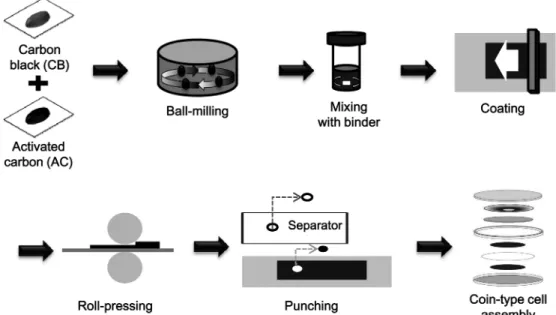
Activated carbon(MSP-20) for an active electrode material was provided from Kansai Coke & Chemicals Co.. Super-P(M.M.M. Carbon Co., Belgium) and poly- vinylidene fluoride(Sigma-Aldrich) were employed as a conductive additive and a binder, respectively. The pre- paration procedure for a coin-type EDLC cell was briefly presented in Fig. 1. Active material(activated carbon) and conductive additive were thoroughly mixed using a ball mill with different ball-milling times. The ball-milling time was varied from 0 to 60 min with an interval of 10 min, in order to investigate the effect of mixing of active material and conductive additive on the electrochemical performance of EDLC electrode in organic electrolyte.
Known amount of binder(polyvinylidene fluoride. 10 wt.%) in 1-methyl-2-pyrrolidone(NMP) was added to the mixed powder to form slurry, and subsequently, the
resulting solution was vigorously stirred for 30 min. The mass ratio of active material:conductive additive:binder was fixed at 80:10:10. The slurry was coated onto the aluminum foil(current collector) by a doctor-blade appar- atus with a gap of 22 μm, and then, the coated electrode was dried at 70
oC in vacuo. Finally, the dried foil was pressed using a double-roll press at 80
oC to yield the electrode sheet. The prepared electrode were denoted as AC_X(X = 0, 10, 20, 30, 40, 50, and 60), where X re- presents ball-milling time(min).
Coin-type EDLC cell(CR2032) is composed of two symmetrical carbon electrodes, separator, organic electro- lyte, SUS cap, spacer and so on(Fig. 1). Prior to the coin cell packaging, the punched electrode was soaked in organic electrolyte(1M tetraethylammonium tetrafluoro- borate in acetonitrile, TEABF
4/AN) for 1 day in a glove box filled with argon. The carbon electrodes with a diameter of 18 mm were opposed to each other and the cellulose separator with a diameter of 19 mm was placed between the electrodes. Finally, coin-type cell was sealed using a coin cell crimper.
The prepared electrodes were characterized by SEM (JSM-6700F, Jeol) analysis. Electrochemical performance of the fabricated coin-type EDLC cells was evaluated by cyclic voltammetry(CV), galvanostatic charge/discharge(C/
D), and electrochemical impedance spectroscopy(EIS) measurements. CV and C/D measurements were perform- ed with the Potentiostat/Galvanostat(WB3300, Anatec).
CV measurements were conducted at a scan rate of 100 mV/s in the voltage range 0-2.7 V. C/D measurements were performed at a constant current load(5 A/g) in the same voltage range of CV measurements. Nyquist plots for evaluating the cell resistance were obtained from EIS
Fig. 1. Schematic preparation procedure for a coin-type EDLC cell.
analysis(PGSTAT302N, AUTOLAB), which was operated within the frequency range of 100 kHz to 0.01 Hz at open circuit potential with an AC 5 mV.
3. Results and Discussion
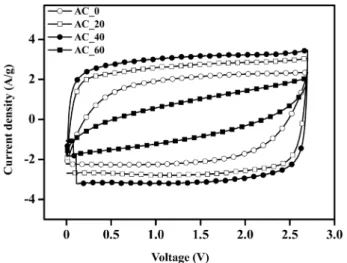
Electrochemical performance of AC_X electrodes with different ball-milling time(X) was evaluated by cyclic voltammetry(CV) and charge/discharge(C/D) measure- ments, with an aim of investigating the effect of mixing of active material and conductive additive. Fig. 2 shows the cyclic voltammograms of selected AC_X(X = 0, 20, 40, and 60) at a scan rate of 100 mV/s. The larger integrated area and the more rectangular shape of CV curve correspond to the better electrochemical perfor- mance of EDLC electrode. Interestingly, AC_20 and AC_40 showed a better electrochemical performance than AC_0, which was prepared without ball-milling process.
However, a narrow and rugby ball-shaped CV curve was obtained over AC_60. Therefore, it can be inferred that optimal ball-milling time is required to improve the elec- trochemical performance of EDLC electrode in organic electrolyte. Among the samples tested in this work, AC_40 retained the most rectangular, symmetric, and reversible shape in the voltage range of 0-2.7 V, indicative of excellent electrochemical properties of AC_40 for EDLC electrode.
The specific capacitance of samples was also calculated from their CV curves as follows.
Here, I
ais the anodic current and I
cis the cathodic current. dV/dt means the scan rate and m is total weight of electrode materials. Accordingly, the specific capacitance of sample is proportional to its integrated area of CV
curve. As shown in Fig. 2, specific capacitance of AC_X exhibited a tendency to increase with increasing ball- milling time(X) to 40 min. However, a drastic decrease of specific capacitance was observed as ball-milling time was increased further. Consequently, the largest specific capacitance was obtained over AC_40 electrode in this work(Table 1).
Specific capacitances of AC_X obtained from charge/
discharge(C/D) measurements at a current density of 5 A/
g showed a similar trend with the cyclic voltammetry results. In the C/D measurements, specific capacitances of AC_X were calculated using the following equation for discharge curves, where I is discharge current, Δt is the discharge time, m is the total weight of electrode material, and ΔV is the operation voltage range during discharging. The calculated results were summarized in Table 1.
C Ia+ Ic 2m dV dt⋅( ⁄ ) ---
=
C I Δt⋅ m ΔV⋅ ---
=
Fig. 2. Cyclic voltammograms of AC_X(X = 0, 20, 40, and 60) electrodes at a scan rate of 100 mV/s.
Table 1. Specific capacitance of AC_X electrodes with different ball-milling time (X).
Electrode (AC_X) Specific Capacitance (F/g)
CV
aC/D
bAC_0 17.1 16.7
AC_10 20.6 17.6
AC_20 25.1 24.6
AC_30 26.7 26.9
AC_40 29.1 22.8
AC_50 11.6 4.17
AC_60 7.60 2.32
a
Determined from cyclic voltammetry measurement at 100 mV/s.
b
Determined from charge/discharge measurement at 5 A/g
Fig. 3. Discharge profiles of AC_ X(X = 0, 20, 40, and 60) elec-
trodes measured at 5 A/g.
As expected, AC_40 showed a relatively long dis- charge time, that is, a high specific capacitance(Fig. 3).
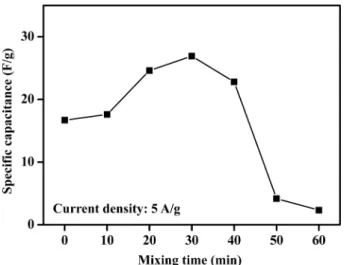
This result was well consistent with the CV result. In order to see the effect of mixing of active material and conductive additive, we plotted the specific capacitance of AC_X as a function of ball-milling time(X). Specific capacitance of AC_X showed a volcano-shaped curve with
respect to ball-milling time. As show in Fig. 4, AC_20, AC_30, and AC_40 with the ball-milling times of 20-40 min retained relatively high specific capacitances when compared with the others. It is thought that the proper ball-milling time could contribute to a homogeneous mixing of active material and conductive additive, leading to a good electrochemical performance of EDLC electrode.
However, the excessive mixing of active material and Fig. 4. Specific capacitance of AC_X electrode with respect to ball-
milling time(X).
Fig. 5. Nyquist plots of AC_ X(X = 0, 20, 40, and 60) electrodes.
Fig. 6. SEM images of (a) AC_0, (b) AC_20, (c) AC_40, and (d) AC_60 electrodes.
conductive additive could have an adverse effect on the electrochemical properties of EDLC electrode. Once again, we confirmed that ball-milling time strongly affected the electrochemical performance of EDLC electrode in organic electrolyte.
From the CV and C/D measurements, it can be easily deduced that the excessive ball-milling time resulted in a low electrical conductivity, and thus, a poor electro- chemical performance of EDLC electrode. In order to confirm the equivalent series resistance(ESR) of samples, Nyquist plots of coin-type cells were obtained using electrochemical impedance spectroscopy(EIS) analysis.
What is interesting is that the charge transfer resistance (R
ct) of AC_X, which is determined from the radius of semi-circle loop, was much different depending on the ball-milling time(X). R
ctincludes the electronic resistance (the intrinsic resistance of electrode material and the contact resistance between the active layer and the current collector) and the ionic resistance(the electrolyte ionic conductivity inside the pores of electrode). As shown in Fig. 5, AC_40 retained the smallest radius of semi-circle loop, that is, the lowest charge transfer resistance. There- fore, it is believed that the enhanced electrochemical performance of AC_40 was attributed to its low electrical resistance resulted from the homogeneous mixing of active material and conductive additive. In addition, it seems that the excessive mixing with a ball mill resulted in a high electrical resistance, which may be due to the change in characteristics of active material and conductive additive.
SEM was conducted with an aim of elucidating the different electrochemical performance of AC_X with respect to ball-milling time(X), and the obtained figures are shown in Fig. 6. Surface morphology of AC_X was not greatly changed until the ball-milling time of 40 min, while AC_60 exhibited a remarkably different surface morphology. Especially, an obvious morphology change was observed in the conductive additive(Super-P) rather than the active material(activated carbon). This indicates that the excessive ball-milling time led to a characteristic change of conductive additive, leading to a low electrical conductivity of EDLC electrode. Another point to note is that the active material and the conductive additive were more uniformly mixed with increasing ball-milling time up to 40 min. Therefore, it is thought that the homo- geneous mixing of active material and conductive additive in AC_40 electrode played a key role in increasing its electrical conductivity, and thus, its electrochemical per- formance of EDLC electrode.
Through the electrochemical evaluation and character- ization of EDLC electrode, the mixing of active material and conductive additive was found to be a crucial factor to determine the electrochemical performance of EDLC
electrode in organic electrolyte. The homogeneous mixing of active material and conductive additive by a ball mill was important in the preparation of EDLC electrode.
However, the excessive ball-milling time resulted in a characteristic change of conductive additive, leading to a low electrical conductivity of EDLC electrode. Therefore, it can be concluded that optimal mixing of active material and conductive additive is needed to prepare an efficient EDLC electrode in organic electrolyte.
4. Conclusion
Coin-type EDLC cells with organic electrolyte were assembled using electrode materials(AC_X) with different ball-milling time(X) of active material and conductive additive. Electrochemical properties of the prepared EDLC cells were determined by cyclic voltammetry, galvanostatic charge/discharge, and electrochemical impedance spectros- copy. Specific capacitance of AC_X showed a volcano- shaped curve with respect to ball-milling time. Inter- estingly, the drastic decrease in specific capacitance was observed after a ball-milling time of 40 min. The ex- cessive mixing of active material and conductive additive could have an adverse effect on the electrochemical properties of EDLC electrode. The poor electrochemical performance of EDLC electrode with an excessive ball- milling time was due to its low electrical conductivity, which was resulted from the characteristic change of conductive additive during the ball-milling. Consequently, ball-milling time played a key role in determining the electrochemical performance of EDLC electrode, and optimal mixing time was required to prepare an efficient EDLC electrode in organic electrolyte.
Acknowledgements
This work was supported by the World-Class 300 Project funded by the Small and Medium Business Administration of Korea(SMBA).
References
1. V. Khomenko, E. Raymundo-Pinero and F. Béguin, J.
Power Sources, 177, 643 (2008).
2. Andrew Burke, J. Power Sources, 91, 37 (2000).
3. Pawan Sharma and T S. Bhatti, Energy Convers.
Manage., 51, 2901 (2010).
4. F. Béguin, V. Presser, A. Balducci and E. Frackowiak, Adv. Mater., 26(14), 2219 (2014).
5. E. Frackowiak, Q. Abbas and F. Béguin, J. Energy Chem., 22, 226 (2013).
6. L. Wei and G. Yushin, Nano Energy, 1, 552 (2012).
7. S. L. Candelaria, Y. Shao, W. Zhou, X. Li and J. Xiao,
Nano Energy, 1, 195 (2012).
8. E. Franckowiak and F. Béguin, Carbon, 39, 937 (2001).
9. S. H. Kwon, E. Lee, B. kim, S. kim, B. Lee, M. Kim and J. C. Kim, Curr. Appl. Phys., 14, 603 (2014).
10. Y. J. Lee, J. C. Jung, J. Yi, S. Baeck, J. R. Yoon and I.
K. Song, Curr. Appl. Phys., 10, 682 (2010).
11. J. R. Miller, R. A Outlaw and B. C. Holloway, Electrochim.
Acta, 56, 10443 (2011).
12. W. Lee, S. Suzuki and M. Miyayama, Electrochim. Acta, 142, 240 (2014).
13. Z. Yan, L. Ma, Y. Zhu, I. Lahiri, M.G. Hahm, Z. Liu, S.
Yang, C. Xiang, W. Lu and Z. Peng, Nano Lett., 7, 58 (2013).
14. Y. Yamada, O. Kimizuka, K. Machida, S. Suematsu and K. Tamamitsu, Energy Fuels, 24, 3373 (2010).
15. B. Xu, F. Wu, R. Chen, G. Cao, S. Chen, G. Wang and
Y. Yang, J. Power Sources, 158, 773 (2006).
16. A. Thambidurai, J. K. Lourdusamy, J. V. John and S.
Ganesan, Korean J. Chem. Eng., 31, 268 (2014).
17. C. Kim, J. Lee, J. Kim and K. Yang, Korean J. Chem.
Eng., 23, 592 (2006).
18. A. B. Fuertes, Micropor. Mesopor. Mater., 67, 273 (2004).
19. T. Ma, L. Liu and Z. Yuan, Chem. Soc. Rev., 42, 3977 (2013).
20. J. Wei, D. Zhou, Z. Sun, Y. Deng, Y. Xia and D. Zhao, Adv. Funct. Mater., 23(18), 2322 (2013).
21. Z. Zapata-Benabithe, F. Carrasco-Marin and C. Moreno- Castilla, J. Power Sources, 219, 80 (2012).
22. H. Lee, H. Kim, K. An and B. Kim, Carbon Lett., 1. 15, 71 (2014).
23. K. Xia, X. Tian, S. Fei and K. You, Int. J. Hydrogen Energy, 39, 11047 (2014).