- 840 -
포도씨 추출물의 총 카테킨 함량과 전자공여능에 대한 마이크로웨이브 추출조건 최적화
이은진1․김정숙2․권중호†
경북대학교 식품공학과, 1대구지방식품의약품안전청, 2계명문화대학 식품영양조리과
Optimization of Microwave-assisted Extraction Conditions for Total Catechin and Electron Donating Ability of Grape Seed Extracts
Eun-Jin Lee1, Jeong-Sook Kim2 and Joong-Ho Kwon
Department of Food Science and Technology, Kyungpook National University, Daegu 701-702, Korea
1
Korea Food & Drug Administration, Daegu 704-940, Korea
2
Department of Food Nutrition & Culinary, Keimyung College, Daegu 704-703, Korea
Abstract
Microwave-assisted extraction (MAE) of grape seeds was performed under the different conditions based on a central composite design for independent variables of microwave power (0~120 W), ethanol concentration (0~100%) and extraction time (1~5 min). Response surface methodology (RSM) was used to predict the optimum extraction conditions for three dependent variables in grape seed extracts: total yield, total catechin and electron donating ability. Determination coefficients (R
2) of regression equations for the three dependent variables were higher than 0.9 (p < 0.01). The optimal MAE conditions to yield the maximum value of total catechin (434.16 mg%) were 122.76 W microwave power, 42.88% ethanol and 4.67 min extraction time. The superimposed contour maps for maximizing the three dependent variables indicated that the MAE condition ranges were 75150 W, 4060% ethanol and 3.55.0 min. The predicted values at the optimized conditions (6.72% total yield, 408.65 mg% total catechin, and 83.33% electron donation ability) were similar to the experimental values. The optimized MAE (112.5 W, 50% EtOH, 4.2 min) was more efficient than the conventional solvent extraction using 80% EtOH, 60℃ for 3 h and 150 rpm.
Key words:Grape seed, microwave-assisted extraction, catechin, electron donating ability
서 론
1)
포도(grape, Vitis vinifera)는 세계 과일생산량의 약 30%
를 차지하며 국내에서도 연간 생산량이 약 40만 톤에 이르 고 있다. 세계적으로 포도는 포도주 생산에 가장 많이 이용 되고 있으며, 국내에서는 주로 생과로 이용되고 있으나 부 가가치를 높이기 위한 가공제품의 개발을 위한 시도가 다양 하게 이루어지고 있다. 이에 따라 가공부산물로 얻어지는 포도씨(포도 중량의 3~5%)의 활용에 대한 필요성이 높아
†Corresponding author. E-mail:[email protected], Phone:82-53-950-5775, Fax:82-53-950-6772
지고 있다(1).
포도씨에 함유된 proanthocyanidin 등 폴리페놀 화합물은 항산화작용(2-4), 순환기계 질환(5,6)을 예방할 뿐 아니라 항암작용(7,8), 항균작용(9,10) 등 다양한 생리활성을 지니 는 것으로 알려져 있다. 니와 같이 포도씨의 기능성분들이 알려지면서 국내에서는 포도종자추출물을 천연첨가물(11) 로 하여 proanthocyanidin 함량 기준을 정하고 있으며, 포도 씨유제품는 고시형 건강기능식품으로 등재되어 기능성 지 방산 및 cathechin 함량(30 mg/100 g)을 기준규격으로 정하 고 있다(12).
포도씨의 기능성 성분의 추출 연구로는 용매 및 열수추 출법(3,4,10,13), 초임계 유체 추출(14) 등이 연구되고 있으
나 추출효율, 경제성 등에서 개선되어야 할 점들이 있다.
이에 마이크로웨이브 추출(microwave-assisted extraction, MAE)이 소개되면서 마이크로웨이브 투과성 용기와 용매 를 사용하여 식물의 기능성 성분을 신속하게 추출하는 방안 이 소개되고 있다(15-18).
따라서 본 연구는 마이크로웨이브 에너지와 에탄올을 추출용매로 하여 포도씨로부터 총 추출수율, 총 카테킨 함 량 및 추출물의 전자공여능을 극대화 할 수 있는 추출 예측 모델을 설정하고 추출조건을 최적화하였다.
재료 및 방법
실험재료
본 실험에 사용된 포도(Vitis vinifera)는 2004년 8월 경북 영천에서 수확된 Campbell Early였으며, 포도씨를 분리하 여 깨끗이 세척한 후 35~45℃에서 열풍건조하고 4℃에 냉장 보관하면서 필요시 분쇄하여(20 mesh) 냉동보관하면 서 시료로 사용하였다. 시료의 일반성분(18)은 수분 14.3%, 조단백질 7.6%, 조지방 6.4%, 조회분 1.1%, 조섬유 65.8%, 가용성 무질소물 4.8% 등이었다.
마이크로웨이브 추출장치 및 추출방법(MAE)
마이크로웨이브 추출은 2,450 MHz 주파수의 실험실용 상압형 추출장치(Microdigest unit, Prolabo, Fontenay-sous- Bois cedex, France)를 이용하여 programmable power(max.
250 W)와 time control이 가능하고 환류냉각관이 장착된 추출장치를 사용하였다. 추출방법은 extraction vessel에 일 정량의 시료와 에탄올 용매(1:10, g/mL)를 가한 후 추출공정 변수를 조절하여 추출하고, 두 겹의 여과지(Whatman No.
1)를 사용하여 흡입 여과한 후 일정량의 부피로 하여 분석 용 시료로 사용하였다.
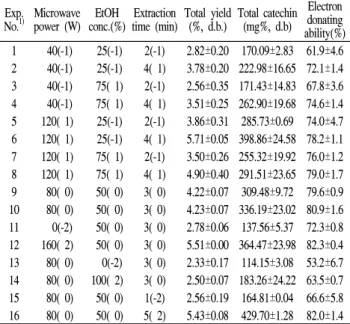
추출조건 최적화를 위한 중심합성 실험계획 및 결과 분석 마이크로웨이브 추출의 중요한 공정인자는 추출시간 및 추출에 사용된 용매의 농도, microwave power 등으로 추출 물의 효율이 달라지므로(19,20), 본 실험에서는 마이크로웨 이브 추출조건을 최적화하기 위하여 반응표면분석법 (response surface methodology, RSM)(21-23)을 사용하여 중 심합성계획(central composite design)을 실시하였다. 즉, 추 출공정의 독립변수(Xi)로서 microwave power(X1), 에탄올 농도(X2) 및 추출시간(X3)에 대해 5단계로 부호화하였고 중심합성계획에 따라 16구간으로 설정하였다(Table 1). 이 때 얻어진 추출물의 카테킨류 함량을 3회 반복 측정하여 그 평균값을 종속변수(Yn)로 하여 회귀 분석을 실시하였다.
회귀분석에 의한 모델식의 예측은 SAS(statistical analysis system) program(24)을 이용하였으며 회귀분석 결과 임계
점이 최대점이거나 최소점이 아니고 안장점일 경우에는 능선분석을 하여 최적점을 구하였다. 또한 각 독립변수가 종속변수에 미치는 영향은 예측된 모델식을 바탕으로 Mathematica program(25)을 이용하여 4차원 반응표면 분석 으로 해석하였다.
총 추출수율 측정
각 조건에서 얻어진 추출물의 총 추출수율은 추출물 일 정량을 항량을 구한 수기에 취하여 회전증발농축기 (Heidolph VV2011, Schwabach, Germany)로 농축하고, 10 5℃에서 항량이 될 때까지 건조하여 사용된 원료량(건물 량)에 대한 백분율로써 총 추출수율(total extract yield, %)로 나타내었다(19).
총 카테킨 정량
포도씨 추출물의 catechin 분석은 Ricardo da Silva 등(26) 의 방법을 변형하여 Choi(27)의 방법에 따라 HPLC에 의해 정량하였다. 각 추출물을 농축하여 80% methanol에 용해하 고 1 mL를 0.45 μm membrane filter에 통과시켜 10 μL를 HPLC 분석에 사용하였다. 여기에 내부표준물질로서 catechol(catechol 0.2 mg을 methanol 1 mL에 녹인 용액) 1 mL를 시험용액 1 mL에 가하여 0.45 μm membrane filter에 통과시킨 후 HPLC용 시료용액으로 하였다. 이때의 분석조 건은 170 UV-vis detector와 231XL autosampler가 부착된 Gilson 506B HPLC system, column은 YMC-Pack Pro C18 (5 μm, 4.6 I.D. × 250 mm, YMC Inc., USA), mobile phase는 solvent A (4.5% formic acid in H2O)와 solvent B (90%
CH3CN containing 10% solvent A)를 사용하였다. Detector 는 UV280 nm, flow rate는 1.0 mL/min, sensitivity는0.01 AUFS 등이었다. 또한 추출물의 카테킨류를 확인하기 위하 여 표준물질로는 (+)-catechin, procyanidin B2, (-)-epicatechin, (-)-epicatechin gallate를 각각 methanol에 용해시켜 mg/mL 의 용액으로 조제하였다. 내부표준물질로는 catechol 10 mg 을 취하여 methanol에 용해시켜 이 두 용액을 일정량씩 취 하고 methanol을 가하여 4~100 μg/mL가 되게 조제하여 표준검량선을 작성하였다. 총 카테킨 함량은 상기 4종의 카테킨류를 합하여 산출하였다.
전자공여능 측정
포도씨 추출물의 전자공여능(electron donating ability, EDA) 측정은 α, α-diphenyl-β-picrylhydazyl(DPPH)를 사용 한 방법(28)으로 측정하였다. 즉, DPPH 시약을 사용하여 50% ethanol을 blank로 하여 517 nm에서 DPPH 용액의 흡광 도를 약 1.0으로 조정하였다. 그리고 이 용액 5 mL에 시료용 액 0.5 mL를 혼합한 후 상온에서 30초간 방치한 다음 517 nm에서 흡광도를 측정하여 시료 첨가구와 무첨가구의 흡 광도 차이를 백분율(%)로 표시하여 전자공여능으로 나타 내었다.
EDA(%)= ( 1 -시료 첨가시의 흡광도 ) ×100 공시험의 흡광도
현행 추출법과 MAE의 추출효율 비교
현행 추출법은 Peng 등(29)의 방법 및 상업적 추출법(30) 을 절충하여, 포도씨 분말(g)에 80% 에탄올(mL)을 1:50의 비율로 가하여 60℃에서 3시간 동안 진탕(150 rpm) 추출하 였다. 이같이 추출된 현행 추출물은 앞서 검증된 최적의 마이크로웨이브 추출물과 추출수율과 추출물의 특성을 비 교하였다.
결과분석
포도씨 추출물의 총 카테킨 함량 및 전자공여능 측정은 각 조건 별로 3회 반복 측정하여 건물량 기준으로 나타내었 으며, 실험결과는 SAS program(24)을 이용하여 분석하였다.
결과 및 고찰
총 추출수율
포도씨 추출물의 microwave-assisted extraction (MAE) 조 건별 총 추출수율은 Table 1에 나타내었고, 그 결과에 대한 회귀식은 다음과 같다.
Y = - 0.993750 + 0.010250X1 + 0.082300X2 + 0.806250X3
- 0.000080000X1X2 + 0.004188X1X3 - 0.002300X2X3
- 0.000012500X12 - 0.000724X22 - 0.057500X32
Table 1. Total extract yield, total catechin, and electron donating ability of grape seed extracts by MAE under different conditions based on central composite design for RSM
Exp.
No.1) Microwave power (W) EtOH
conc.(%) Extraction
time (min) Total yield
(%, d.b.) Total catechin (mg%, d.b)
Electron donating ability(%) 1 40(-1) 25(-1) 2(-1) 2.82±0.20 170.09±2.83 61.9±4.6 2 40(-1) 25(-1) 4( 1) 3.78±0.20 222.98±16.65 72.1±1.4 3 40(-1) 75( 1) 2(-1) 2.56±0.35 171.43±14.83 67.8±3.6 4 40(-1) 75( 1) 4( 1) 3.51±0.25 262.90±19.68 74.6±1.4 5 120( 1) 25(-1) 2(-1) 3.86±0.31 285.73±0.69 74.0±4.7 6 120( 1) 25(-1) 4( 1) 5.71±0.05 398.86±24.58 78.2±1.1 7 120( 1) 75( 1) 2(-1) 3.50±0.26 255.32±19.92 76.0±1.2 8 120( 1) 75( 1) 4( 1) 4.90±0.40 291.51±23.65 79.0±1.7 9 80( 0) 50( 0) 3( 0) 4.22±0.07 309.48±9.72 79.6±0.9 10 80( 0) 50( 0) 3( 0) 4.23±0.07 336.19±23.02 80.9±1.6 11 0(-2) 50( 0) 3( 0) 2.78±0.06 137.56±5.37 72.3±0.8 12 160( 2) 50( 0) 3( 0) 5.51±0.00 364.47±23.98 82.3±0.4 13 80( 0) 0(-2) 3( 0) 2.33±0.17 114.15±3.08 53.2±6.7 14 80( 0) 100( 2) 3( 0) 2.50±0.07 183.26±24.22 63.5±0.7 15 80( 0) 50( 0) 1(-2) 2.56±0.19 164.81±0.04 66.6±5.8 16 80( 0) 50( 0) 5( 2) 5.43±0.08 429.70±1.28 82.0±1.4
1)
The number of experimental condition by central composite design.
총 추출수율에 대한 회귀식의 R2는 0.9809이었고 1% 이 내에서 유의성이 인정되었다. 예측된 정상점은 안장점 (saddle point)이므로 능선분석(ridge analysis)을 실시하여 본 결과, microwave power 138.71 W, 에탄올 농도 45.30%
및 추출시간 4.35 min에서 최대의 추출수율 6.42%로 예측 되었다(Table 2). 총 추출수율에 대한 반응표면(Fig. 1)을 보면 microwave power가 높고 추출시간이 길수록 추출수율 이 증가하는 것으로 나타났으며, 에탄올 농도의 경우 거의 영향을 받지 않는 것으로 나타났다. 또한 microwave power 100 W 이상에서는 extraction time 3.4 min 이상의 범위에서 가장 높은 수율을 나타내었다. 그러므로 microwave power 가 높고 추출시간이 길수록 포도씨의 여러 가용성 물질들이 용출됨으로 인해 추출수율이 높아진 것으로 사료된다. 즉, Table 3에서와 같이 추출수율은 에탄올 농도보다 microwave power 및 추출시간에서 더 많은 영향을 받는 것으로 나타났 다. 이상의 총 추출수율에 대한 결과는 인삼(19), 섬백리향 (31) 등의 총 수율에 대한 마이크로웨이브 추출특성과 유사 한 경향을 나타내었다.
Fig. 1. Four-dimensional response surface for total yield of grape seed extracts at constant values (3.0-4.5-6.0%) as functions of microwave power, ethanol concentration and extraction time in microwave-assisted extraction.
총 카테킨 함량
중심합성계획에 따라 계획된 조건으로 추출한 추출물을 대상으로 총 카테킨 함량을 분석하였으며(Table 1), 이를 분석한 결과 회귀식은 아래와 같다.
Y = - 366.998750 + 4.219188X1 + 9.452600X2 + 102.123750X3 - 0.021503X1X2 - 0.006375X1X3 - 0.226800X2X3 - 0.011222X12 - 0.069652X22 - 6.395000X32
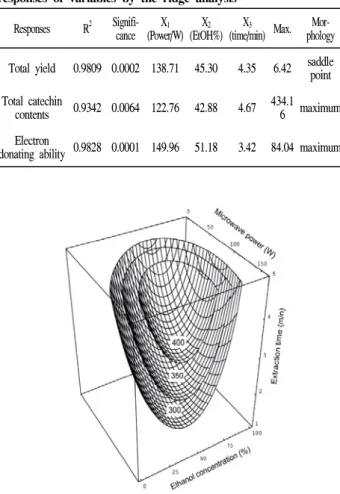
이때 회귀식의 R2는 0.9342이고 1% 이내의 수준에서 유 의성이 인정되었다. 예측된 정상점은 최대점으로 최대값은 434.16 mg%로 예측되었고 최대 예측 값을 추출할 수 있는 조건은 microwave power 122.76 W, 에탄올 농도 42.88%, 추출시간 4.67 min으로 각각 나타났다(Table 2). 그리고 Fig.
2는 총 카테킨 함량의 4차원 반응표면을 나타내었으며, microwave power 80 W 이상, 에탄올 농도 10~63%, 추출시 간 3.7 min 이상의 범위에서 가장 높은 것으로 확인되었다.
전반적인 추출특성은 microwave power, 에탄올 농도, 추출 시간 등 3가지 독립변수에 유사하게 영향을 받는 것으로 나타났으며(Table 3), 따라서 포도씨의 유용성분 카테킨류 를 효과적으로 추출하기 위해서는 3가지 변수를 모두 고려 해야 할 것으로 사료된다. Lee와 Kwon(18)은 포도씨 성분 의 마이크로웨이브 추출실험에서 100 W에서 에탄올을 용 매로 사용하였을 경우 물이나 아세톤에 비해 카테킨의 추출 효율이 높았으며, 추출시간에도 유의적 영향이 확인되었다 고 하여 본 실험의 결과를 잘 뒷받침하였다.
Table 2. Predicted levels of extraction conditions for the maximum responses of variables by the ridge analysis
Responses R2 Signifi- cance X1
(Power/W) X2
(EtOH%) X3
(time/min) Max. Mor- phology Total yield 0.9809 0.0002 138.71 45.30 4.35 6.42 saddle point Total catechin
contents 0.9342 0.0064 122.76 42.88 4.67 434.1 6 maximum Electron
donating ability 0.9828 0.0001 149.96 51.18 3.42 84.04 maximum
Fig. 2. Four-dimensional response surface for total catechin contents of grape seed extracts at constant values (300-350-400 mg%) as functions of microwave power, ethanol concentration and extraction time by microwave-assisted extraction.
추출물의 전자공여능
항산화 물질은 지질의 산화 과정 중 생성되는 유리 라디 칼(R․, ROO․ 등)에 전자를 주어 산화의 진행을 방지하게 된다(32). 각 추출물에 DPPH 라디칼을 이용한 전자공여능 을 측정한 다음 (Table 1) 그 결과를 분석하여 아래와 같이 회귀식을 얻었다.
Y = 7.975000 + 0.280000X1 + 1.080500X2 + 15.962500X3
- 0.000700X1X2 - 0.030625X1X3 - 0.023000X2X3 - 0.000461X12 - 0.008760X22 - 1.487500X32
추출물의 전자공여능에 대한 회귀식의 R2는 0.9828이었 고 1% 수준에서 유의성이 인정되었다. 예측된 정상점은 최대점으로 최대 값은 84.04 %(10배 희석)로 예측되었고, 이때 추출조건은 microwave power 149.96 W, 에탄올 농도 51.18% 및 추출시간 3.42 min이었다(Table 2). 이 같은 마이 크로웨이브 추출조건은 포도씨의 페놀성 화합물 추출조건 과 유사하여 페놀성 화합물과 항산화성과의 상관성을 잘 뒷받침 해 주었다(33-35). 그리고 추출물의 전자공여능은 추출공정 중 에탄올 농도에 가장 큰 영향을 받았으며(Table 3), Fig. 3의 반응표면에서 알 수 있듯이 에탄올 농도 35~
67%의 범위에서 가장 높은 전자공여능을 보여 주었다. 이 와 같은 결과는 포도씨에서 에탄올 농도가 높을수록 기능성 성분의 추출률이 높았다는 보고(2,4)와는 다소 상이한 결과 로써, 마이크로웨이브 추출은 용매 사용량은 물론, 추출시 간을 크게 단축시킬 수 있는 효과적 추출방법(15-17,31,33) 으로 사료되어 천연물의 기능성분 추출연구에 다양한 응용 연구가 기대된다.
Table 3. Regression analysis for regression model of variables in extraction condition
Extraction condition
F-Ratio Microwave
power (W)
Ethanol
conc. (%) Extraction time (min) Total yield 29.69*** 13.70** 30.52***
Total catechin contents 9.01** 5.72** 7.33**
Electron donating ability 15.82*** 46.76*** 20.35***
*
p<0.1,
**p<0.05,
***p<0.01.
최적 추출조건의 예측 및 실증
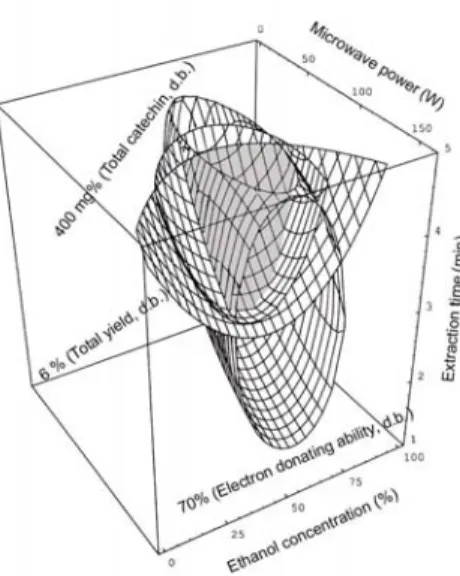
폐자원인 포도씨로부터 카테킨을 보다 효율적으로 추출 하고자 마이크로웨이브를 이용하여 추출된 각 추출물의 총 추출수율 6% 이상, 총 카테킨 함량 400 mg% 이상, DPPH 에 의한 전자공여능 70% 이상에 대한 4차원 반응표면을 superimposing하였다(Fig. 4). 그 결과 최적 추출조건 범위는
Fig. 3. Four-dimensional response surface for electron donating ability of grape seed extracts at constant values (60-70-80%) as functions of microwave power, ethanol concentration and extraction time in microwave-assisted extraction.
Table 4와 같이 microwave power 75~150 W, 에탄올 농도 40~60%, 추출시간 3.5~5.0 min이었다. 이로부터 최적점 이라고 예상되는 112.5 W, 50%, 4.2 min을 임의의 최적추출 조건으로 예측하였다. Table 5는 최적 추출조건에서 얻어진 예측치와 그 조건에서 실제 실험에 의해 얻은 실험치를 추출효율의 관점에서 비교하였다. 즉, 최적 추출조건에서 의 예측된 값은 총 추출수율 6.72%, 총 카테킨 함량 408.65 mg%, 전자공여능 83.33%이었다. 그리고, 이에 대한 실측치 는 추출수율 6.70%, 총 카테킨 함량 403.29 mg%, 전자공여 능 82.3% 등으로 예측치보다 조금 낮은 값을 보였으나 유의 적 차이는 없이 예측회귀식의 신뢰성을 뒷받침하였다.
Table 4. Optimum extraction condition for optimum responses of total yield, total catechin contents and electron donating ability of grape seed extracts by superimposing their 4-dimensional response surfaces
Extraction condition Range of optimum
condition Optimum condition Microwave power (W) 75 ~ 150 112.5 Ethanol concentration (%) 40 ~ 60 50
Extraction time (min) 3.5 ~ 5.0 4.2
현행 추출법과 MAE의 추출효율 비교
현행 추출법(80% 에탄올, 60℃, 3시간, 150 rpm)과 최적 화된 마이크로웨이브 추출법(MAE, 112.5 W, 50% 에탄올, 4.2분)의 추출효율을 비교해 본 결과, Table 6과 같이 MAE 은 현행 추출법보다 추출시간이 훨씬 짧음에도 불구하고 4.2분 1회 추출에서도 현행 추출법과 추출수율은 유사하나
Fig. 4. Superimposed four-dimensional response surfaces for maximized levels of total yield, total catechin content and electron donating ability in grape seed extracts as functions of microwave power, ethanol concentration and extraction time in microwave- assisted extraction.
Table 5. Comparison between predicted and experimental values of response variable of grape seed extracts at the given condition
1)within the range of optimum conditions
Response variable Predicted value Experimental value Total yield(%, d.b.) 6.72 6.70±0.022)
(0.30%)3) Total catechin contents
(mg%, d.b.) 408.65 403.29±8.83
(2.19%) Electron donating ability(%) 83.3 82.3±0.3 (0.36%)
1)
Microwave power 112.5 W, ethanol conc. 50%, extraction time 4.2 min.
2)
Mean of triplicates ± s.d.
3)
Relative s.d. = s.d./mean × 100.
Table 6. Comparison between MAE and conventional extraction of response variable at the given condition
1)within the range of optimum conditions
Response variables Microwave-assisted
extraction Conventional extraction2) Total yield (%, d.b.) 6.70±0.023)
(0.30%)4) 6.78±0.01 (0.15%) Total catechin contents
(mg%, d.b.) 403.29±8.83
(2.19%) 367.21±12.62 (3.44%) Electron donating ability (%) 82.3±0.3
(0.36%) 76.3±0.0
(0.00%)
1)
Microwave power 112.5 W, ethanol conc. 50%, extraction time 4.2 min.
2)
Extraction temperature 60℃, ethanol conc. 80% , extraction time 3 hr.
3)
Mean of triplicates ± s.d.
4)
Relative s.d. = s.d./mean × 100.
총 카테킨 함량과 추출물의 전자공여능은 상당히 높은 것으로 확인되었다. 이는 인삼근 유효성분에 대한 보고와 유사한 경향으로써 마이크로파 에너지는 천연물 시료의 기능성 성분의 신속한 추출(36-38)에 매우 효과적인 방법임 이 확인되고 있다.
요 약
포도씨의 총 카테킨 함량과 추출물의 항산화성을 극대화 하기 위한 마이크로웨이브 추출조건의 최적화를 시도하였 다. 중심합성계획에 따라 추출조건(microwave power 0~
120 W, 에탄올 농도 0~100%, 추출시간 1~5 min)을 설계 하고, 종속변수로서 추출물의 수율, 카테킨 함량 및 전자공 여능을 회귀 분석함으로써 최적 추출조건을 예측하였다.
모든 회귀식의 R2는 0.9 이상으로 1% 수준에서 유의성이 인정되었다. 총 카테킨 함량의 최대 추출 값은 434.16 mg%
로 예측되었으며, 추출조건은 microwave power 122.76 W, 에탄올 농도 42.88%, 추출시간 4.67 min으로 나타났다. 추 출물에 대한 세 가지 종속변수의 극대 값을 얻기 위한 추출 조건 범위는 75~150 W, 40~60% 및 3.5~5.0 min이었다.
이상의 예측 값(총 추출수율 6.72%, 총 카테킨 함량 408.65 mg%, 전자공여능 83.33%)은 실제 값과 유의적인 차이가 없었으며, 최적화된 마이크로웨이브 추출법(112.5 W, 50%
에탄올, 4.2분)은 현행추출법 (80% 에탄올, 60℃, 3시간, 150 rpm)에 비해 추출효율이 우수하였다.
참고문헌
1. Gabetta, B., Fuzzati, N., Griffini, A., Lolla, E., Pace, R., Ruffilli, T. and Peterlongo, F. (2000) Characterization of proanthocyanidins from grape seeds. Fitoterapia, 71, 162-175
2. Pack, S.J., Lee, H.Y. and Oh, D.H. (2003) Free radical scavenging effect of seed and skin extracts from Campbell early grape(Vitis labruscana B.). J. Korean Soc. Food Sci. Nutr., 32, 115-118
3. Jang, J.K. and Han, J.Y. (2002) The antioxidant ability of grape seed extracts. Korean J. Food Sci. Technol., 34, 524-528
4. Chung, H.Y. and Yoon, S.J. (2002) Antioxidant activity of grape seed extract. J. Korean Soc. Food Sci. Nutr., 31, 893-898
5. Tabib, K., Bitri, L., Besancon, P. and Rouanet, J. (1994) Polymeric grape seed tannins prevent plasma-cholesterol changes in high-cholesterol-fed rats. Food Chem., 49,
403-406
6. Yamakoshi, J., Kataoka, S., Koga, T. and Ariga, T. (1999) Proanthocyanidin-rich extract from grape seeds attenuates the development of aortic atherosclerosis in cholesterol- fed rabbits. Atherosclerosis, 142, 139-149
7. Bagchi, D., Bagchi, M., Stohs, S.J., Das, D.K., Ray, S.D., Kuszynski, C.A., Joshi, S.S. and Pruess, H.G. (2000) Free radicals and grape seed proanthocyanidin extract:
importance in human health and disease prevention.
Toxicology, 148, 187-197
8. Pack, S.J., Lee, H.Y., Pack, B.K. and Oh, D.H. (2002) Screening biological activities of grape seed and skin extracts of Campbell Early (Vitis labruscana B.).
Nutraceuticals Food, 7, 231-237
9. Jayaprakasha, G.K., Selvi, T. and Sakariah, K.K. (2003) Antibacterial and antioxidant activities of grape (Vitis
vinifera) seed extracts, Food Res. Int., 36, 117-122
10. Chung, H.Y. and Pack, D.K. (2003) Antimicrobialactivity of grape seed extract. J. Korean Soc. Food Sci.
Nutr., 32, 109-114
11. KFDA. (2008) Food Additives Code, Korea Food & Drug Administration (http://kfda.go.kr), Seoul, Korea 12. KFDA. (2006) Health Functional Food Code, Korea Food
& Drug Administration (http://kfda.go.kr), Seoul, Korea 13. Pekić, B., Kovač, V., Alonso, E. and Revilla, E. (1998) Study of the extraction of proanthocyanidins from grape seeds. Food Chem., 61, 201-206
14. Lee, W.Y., Chang, K.S. and Choi, Y.H. (2000) Extraction of phenolic compounds from grape seed using supercritical CO2 and ethanol as a co-solvent. Korean J. Postharvest Sci. Technol., 7, 177-183
15. Paré, J.R.J., Sigouin, M., and Lapointe, J. (1991) Microwave-assisted natural products extraction. US Patent 5, 002, 784, 26 March
16. Lopez-Avila, V., Young, R. and Teplitsky, N. (1996) Microwave-assisted extraction as an alternative to soxhlet, sonication, and supercritical fluid extraction. J.
AOAC Int., 79, 142-156
17. Kwon, J.H. (1998) High speed extraction of phytochemicals from food and natural products using microwave-assisted process. Food Sci. Ind., 31, 43-55 18. Lee, E.J. and Kwon, J.H. (2006) Characteristics of microwave-assisted extraction for grape seed components with different solvents. Korean J. Food Preserv., 13, 216-222
19. Kwon, J.H., Bélanger, J.M.R. and Paré J.R.J. (2003) Optimization of microwave- assisted extraction (MAP)
for ginseng components by response surface methodology. J. Agric. Food Chem., 51, 1807-1810 20. Kwon, J.H., Lee, G.D., Bélanger, J.M.R. and Paré, J.R.J.
(2003) Effect of ethanol concentration on the efficiency of extraction of ginseng saponins when using a microwave-assisted process (MAP). Int. J. Food Sci.
Technol., 38, 615-622
21. Lee, G.D., Lee, J.E. and Kwon, J.H. (2000) Application of response surface methodology in food industry. Food Sci. Ind., 33, 33-45
22. Myers, R.H. (1971) Response Surface Methodology.
Allyn and Bacon Inc. Boston, USA., pp. 61-218 23. Gontard, N., Guilbert, S. and Cuq JL. (1992) Edible wheat
gluten films: Influence of the main process variables on film properties using response surface methodology. J.
Food Sci., 57, 190-196
24. SAS Institute Inc. (2002) SAS User's Guide. Statistical Analysis Systems Institute, Cary, NC, USA
25. Matha, L.A. and James P.B. (1992) The Mathematica Handbook, compatible with Mathematica Version 2.0.
Academic Press, Inc. Harcourt Brace & Co., Massachusetts, USA
26. Ricardo da Silva, J.M., Rigaud, J., Cheynier, V., Cheminat, A. and Moutounet M. (2002) Procyanidin dimers and trimers from grape seeds. Phytochemistry, 30, 1259-1264
27. Moon, S.O., Lee, J.Y., Kim, E.J. and Choi, S.W. (2003) An improved method for determination of catechin and its derivatives in extract and oil of grape seeds. Korean J Food Sci. Technol., 35, 576-585
28. Blois, M.S. (1958) Antioxidant determination by the use of a stable free radical. Nature, 4617, 1198-1199 29. Peng, Z., Hayasaka, Y., Iland, P.G., Sefton, M., Hoj,
P. and Waters, E.J. (2001) Quantitative analysis of polymeric procyanidins (tannins) from grape (Vitis
venifera) seeds by reverse phase high-performance liquid
chromatograpy, J. Agric. Food Chem., 49, 26-3130. Anonymous (2003) Commercial Extraction Manuals on Grape Seed Extract. MSC, Yang San, Korea
31. Kwon, Y.J., Noh, J.E., Lee, J.E., Lee, S.H., Choi, Y.H.
and Kwon, J.H. (2005) Prediction of optimal extraction conditions in microwave-assisted process for antioxidant- related components from Thymus quinquecostatus.
Korean J. Food Preserv., 12, 344-349
32. Jayaprakasha, G.K., Singh, R.P. and Sakariah, K.K.
(2001) Antioxidant activity of grape seed (Vitis vinifera) extracts on peroxidation models in vitro, Food Chem., 73, 285-290
33. Lee, E.J. (2004) Optimization of microwave-assisted extraction conditions for grape seed components. MS Thesis, Kyungpook National University, Daegu, Korea 34. Zielinski, H. and Kozlowska, H. (2000) Antioxidant
activity and total phenolics in selected cereal grains and their different morphological fractions. J. Agric. Food Chem., 48, 2008-2016
35. Kwak, C.S., Kim, S.A. and Lee, M.S. (2005) The correlation of antioxidant effects of 5 Korean common edible seaweeds and total phenol content. J. Korean Soc.
Food Sci. Nutr., 34, 1143-1150
36. Kwon, J.H. and Kim, K. E. (1999) Comparative effects of microwave-assisted process under atmospheric pressure condition and conventional process on extraction efficiencies ginseng components. J. Korean Soc. Food Sci. Nutr., 28, 586-592
37. Kwon, J.H., Bélanger, J.M.R., Paré, J.R.J. and Yaylayan VA. (2003) Application of microwave-assisted process (MAP) to the fast extraction of ginseng saponins. Food Res. Int.., 36, 491-498
38. Kwon, J.H., Lee, G.D., Kim, K.E., Bélanger, J.M.R. and Paré, J.R.J. (2004) Monitoring and optimization of microwave-assisted extraction for total solid, crude saponin, and ginsenosides from ginseng roots. Food Sci.
Biotechnol., 13, 309-314
(접수 2008년 8월 6일, 채택 2008년 10월 31일)