Original Article
716
Kor J Fish Aquat Sci 45(6),716-722,2012 한수지 45(6), 716-722, 2012
The larval occurrence of the red snow crab Chionoecetes japonicus was investigated near Dokdo in the East Sea of Korea, and the larval timing of the genus Chionoecetes in world oceans was reviewed. C. japonicus larvae were collected seasonally at 12 stations in February, May, August, and November in 2011. A Bongo net with a 303 mesh was deployed with a double oblique tow. Larvae appeared from February to August, but no larvae were found in November. Zoea I occurred at nine stations with a few zoea II in February, and were found until August. The larval densities in February were high near the northern. In May, megalopa were found at eight stations with a few zoea II. No larvae were caught in November. The larval abundance in the research area peaked in February. Overall, the larval duration of the genus Chionoecetes in the world’s oceans persisted for a long time, and Chionoecetes larvae occurred during the warm season in each area. The cold temperature at the sea bottom, where gravid females are found, may prolong larval production along the distribution range of the genus Chionoecetes.
Key words: Dokdo, Chionoecetes, Larvae, East Sea of Korea, Larval timing
Article history;
Received 17 October 2012; Revised 9 November 2012; Accepted 21 November2012
*Corresponding author: Tel: +82. 51. 629. 5928 Fax: +82. 51. 629. 5931 E-mail address: [email protected]
Kor J Fish Aquat Sci 45(6) 716-722, December 2012 http://dx.doi.org/10.5657/KFAS.2012.0716 pISSN:0374-8111, eISSN:2287-8815
ⓒ The Korean Society of Fishereis and Aquatic Science. All rights reserved
Hae-Won Lee and Won-Gyu Park
1*Larval Timing and Distribution of the Red Snow Crab Chionoecetes japonicus near Dokdo
Dokdo Fisheries Research Center, National Fisheries Research & Development Institute, Pohang, 791-110, Korea
1Department of Marine Biology, Pukyong National University, Busan, 608-737, Korea
독도 근해 홍게( Chionoecetes japonicus) 유생의 출현시기와 분포
국립수산과학원 독도수산연구센터, 부경대학교 자원생물학과1
이해원·박원규1*
서 론
대게(Chionoecetes) 속(Genus)에속한종(Species)들은분 포해역에서모두 산업적으로중요한위치를차지하고있다 (Squires, 1969; Kon, 1996). 대게속에는대게(C. opilio), 홍 게(C. japonicus), C. bairdi, C. tanneri 그리고 C. angulatus 등 총 5종이전세계바다에분포하는것으로알려져있으며, 분포 해역이접하는대게와홍게그리고 C. tanneri 와C. angulatus
사이에각각잡종(hybrid)이존재하는것으로보고되어왔다
(Jadamec et al., 1999; Hur et al., 2001; Park et al., 2007). 이 들중 C. bairdi와대게는다른종들에비해비교적얕은대륙 붕에살며, C. tanneri, 홍게그리고 C. angulatus는다른두종 보다더깊은바다에살고있다(Jadamec et al., 1999). 우리나
라동해연안에는대게와홍게그리고이들의잡종인너도대게 (Chionoecetes sp.)가분포하는것으로알려져있다(Hur et al., 2001; Park et al., 2007). 대게는우리나라동해를비롯하여, 오 호츠크해, 베링해그리고북서대서양에분포하며, 너도대게와 홍게보다상대적으로얕은수심에분포하고있다(Hur et al.,
2001). 홍게는우리나라동해와오호츠크해에만분포하며 700
m이하의깊은수심에분포하고 1000 m수심에서분포밀도가
가장높다(Yosho and Hayashi, 1994).
대게속에속한종들은이속이속한물맞이게과(Family Ma- jidae)의다른게들처럼두단계의 Zoea와한단계의 Megalopa 유생기를갖는다. 산란시기에어미게는유생을생산하기위해 수심이낮은지역으로이동한다(Taylor et al., 1985; Ennis et al. 1990; Lovrich et al., 1995). 알이성숙해지면어미게의복
부에서 Prezoea로나오며, 대략한시간이내에 Zoea I기로발 달한다. Zoea I기에서 Zoea II기그리고 Megalopa기로발달할 때는각유생단계당약한달의시간이소요된다(Incze, 1983;
Hong et al., 2009).
산란시기는동일종이더라고위도에따라다르며, 분포범위 가넓을수록유생생산시기가다양할수있다. 북미의서부 해역에분포하는은행게류인 Metacarcinus magister (이전에 Cancer magister)의경우저위도지역에서는유생의출현시기 가그지역에서상대적으로수온이낮은계절에유생이생산되 며, 고위도의수온이낮은지역에서는수온이높은시기에유 생이출현한다(Park et al., 2007; Park and Shirley, 2008).
해양에분포하는무척추동물들은거의대부분부유유생기를
갖는다(Thorson, 1950). 해양무척추동물들에서부유유생의
생존은개체군의변동을야기시키는중요한요인중의하나로
간주되고있다. 수온과염분그리고식물플랑크톤등의먹이 는해양무척추동물들의유생의생존에크게영향을주는것으 로알려져있으며(Chelton et al., 1982; Navarrete et al., 2002).
특히수온은해양무척추동물의생식과성장에가장밀접한관 계가있으며(Reed, 1969; Ebert et al., 1983), 궁극적으로는무 척추동물의생활사전반에영향을준다(Hartnoll, 1982; Arm- strong, 1983; Shirley et al., 1987). 하지만염분은해양무척추 동물의유생의성장과생존에직접적인영향을미치지는않지 만대사에영향을미친다(Kinne, 1971).
수중에살고있는해양생물들에게먹이는생활사전반에걸 쳐영향을준다. 식물플랑크톤의일차대번무와동시에시작 되는유생의생산은생산된유생의생존율을증가시키는데도 움을주는것으로알려져있다(Somerton, 1982). 대게속에속 한종들은유생시기에소형동물플랑크톤과규조류등의식물
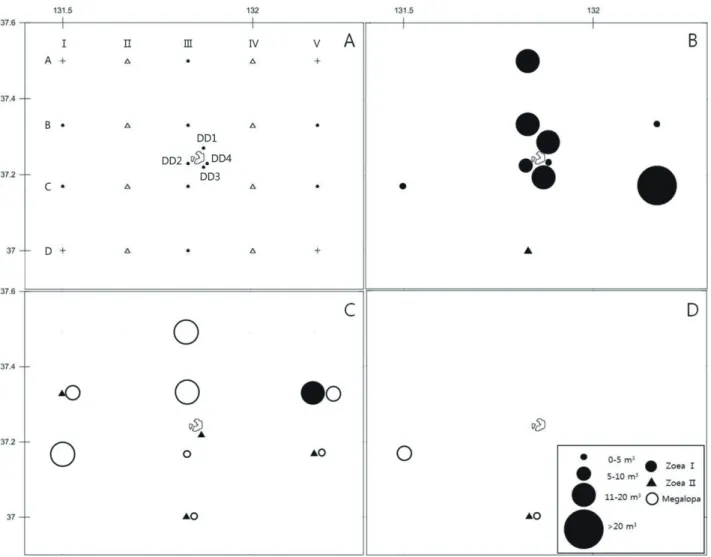
Fig. 1. Sampling stations and larval occurrence of Chinoecetes japonicus near Dokdo in the East Sea of Korea in 2011. In A, solid circles indicate CTD and zooplankton sampling stations while open triangles show only CTD casting stations. B, C and D indicate sampling months, February, May and August, respectively.
Fig. 1. Sampling stations and larval occurrence of Chinoecetes japonicus near Dokdo in the East Sea of Korea in 2011. In A, solid circles indicate CTD and zooplankton sampling stations while open triangles show only CTD casting stations. B, C and D indicate sampling months, February, May and August, respectively.
이해원·박원규 718
플랑크톤을섭이한다(Incze, 1983; Incze et al., 1987). 동일속
(Genus)에속한다른종들이각기종들유생의생존율을극대
화시키기위해유생의생산시기를조절하는것으로보고되었 다(Park and Shirley, 2005).
우리나라동해에서대게속에속한종들은수산업적으로중 요한역할을하고있고, 어민들의소득에지대한영향을미치 는것으로알려져있다. 하지만어획량의변동폭이심하며, 어 획량변동의원인중의하나의유생의생존에관한체계적인연 구가부족한실정이다. 본연구는우리나라동해독도근해에서 출현한홍게유생의시·공간적분포를분석하여, 전세계해양 에출현하는대게속유생들의출현시기를비교함으로이속에 속한종들의유생의출현특징을파악함을목적으로한다. 또한 독도근해홍게유생출현의특징을연구함으로독도근해홍게 자원관리의기초자료로제공함을목적으로한다.
재료 및 방법
우리나라동해독도근해에서 2011년 2월, 5월, 8월, 그리고 11월에 12개정점에서동물플랑크톤을채집하였다(Fig. 1). 동 물플랑크톤은 303 µm 크기망목의네트가부착된봉고네트를 사용하여반복경사채집(Double oblique tow)으로표층부터
200 m 수심가까이까지채집하였다. 채집된동물플랑크톤은
선상에서중성포르말린으로즉시고정한후실험실로옮긴다
음현미경(Wild M-5) 하에서홍게유생을동정하여선별한후
계수하였으며, 계수된개체수는단위체적당 10 m3개체수로 환산하였다. 동물플랑크톤채집시 CTD (Sea-Bird SBE 21)를 이용하여표층수온과염분을측정하였다.
결 과
유생 출현전조사기간동안 ZoeaⅠ기 519개체, Zoea Ⅱ기 6개체, 그리 고 Megalopa 기 163개체등총 748 개체가채집되었다. 2011
년 2월에는 495개체가출현하여가장많았고, 5월에는 176개 체 그리고 8월에가장적은 17개체가출현하였으며 11월에 는유생이출현하지않았다. 2011년 2월에는 12 정점중 BI과 CIII를제외한 10개정점에서출현하였다(Fig. 1). 출현밀도 는 10 m3당 0.3개체부터 94.5개체까지정점에따라매우다양 하였다. 정점 CV에서가장많은 94.5개체 (10 m-3)가출현하였 고, DIII에서는 Zoea II기만 0.3 개체 (10 m-3)출현하였다. 5월 에는 3개의유생기가모두출현하였다. Megalopa기(1.5-20.0 inds. 10 m-3)가가장많이출현하였고, Zoea II기의출현밀도가 가장낮았다(0.3-1.2 inds.10 m-3). Zoea I기는정점 BV (11.3 inds.10 m-3) 에서만출현하였다. 독도와가까운정점 (DD1-4) 군에서는 Zoea I기나 Megalopa 기가전혀출현하지않았고, 정점 DD3에서 Zoea II기(0.4 inds.10 m-3) 만소수출현하였 다. 8월에는 2개의정점에서만유생이출현하였다. 정점 CI에 서는 Megalopa 기만 7.1 inds.10 m-3출현하였고, DIII에서는 Megalopa와 Zoea II가모두 0.004 inds. 10 m-3출현하였다. 수온과 염분 분포
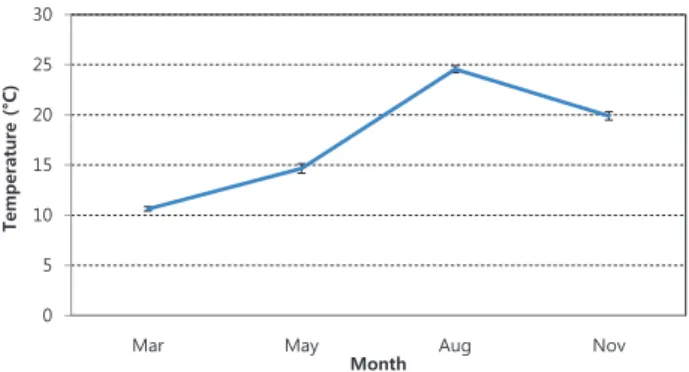
2011년에관측된표층수온은 2월에 9.7-11.3℃ (10.6±0.45) 로가장낮았으며, 5월12.3-16.8℃ (14.6±0.95) 부터증가하 기시작하여, 8월에 23.2-25.6℃ (24.5±0.68)의범위로가장 높았으며, 11월에 19.1-21.4℃ (19.9±0.83)로다시낮아졌다 (Fig. 2). 5월에정점간의표층수온의차이가가장컸으며, 2월 에정점간표층수온의차이가가장작았다(Fig. 2). 2월에는정 점 CI에서 9.7℃로가장낮았으며정점 CIV에서 11.3℃로가 장낮았다. 5월에는정점 DD3 (12.3℃)와정점 BI (13.4℃)에 서다른정점들에비해표층수온이낮았으며, 정점 DIV (16.8
℃)에서표층수온이가장높았다. 8월에는정점 BII과 BV 그 리고정점 CV에서 25℃이상의높은표층수온을기록했으며, 정점 DII, DIII 그리고 DIV에서 23℃로다른정점들에비해낮 았다. 11월에는정점 CII과 CIII에서 21℃이상으로표층수온 이가장높았고, 독도주변해역에서 19℃로가장낮았다.
2011년에관측된표층염분은 2월에 34.0-34.7 psu (34.3±
0.30), 5월에 34.0-34.7 psu (34.3±0.23), 8월에 31.9-34.3 psu Fig. 2. Seasonal variations of sea surface temperature near Dokdo
in 2011.
Fig. 2. Seasonal variations of sea surface temperature near Dokdo in 2011.
0 5 10 15 20 25 30
Mar May Aug Nov
Temperature (°C)
Month
Fig. 3. Seasonal variations of sea surface salinity near Dokdo in 2011.
Fig. 3. Seasonal variations of sea surface salinity near Dokdo in 2011.
30 31 32 33 34 35
Mar May Aug Nov
Salinity (PSU)
Month
(32.7±0.51) 그리고 11월에 33.4-34 psu (33.6±0.24)의범위 를보였다(Fig. 3). 2, 5 그리고 11월에정점간염분차이는크 지않았지만 8월에는전체적으로염분이가장낮고, 정점간염 분차이도가장컸다(Fig. 3).
고 찰
해양생태계는생산자(식물플랑크톤)와 1차소비자(동물플랑 크톤) 그리고고차소비자(소형및대형어류)로이어지는구조 를가지고있다. 일차생산자인식물플랑크톤은전체해양생 태계를지탱하는중요한역할을하며, 많은해양생물들이일 차대번무시생산된식물플랑크톤을이용한다. 요각류나난바 다곤쟁이와같은종생플랑크톤도식물플랑크톤의일차대번 무의시기에맞추어유생을생산하며(Coyle and Paul, 1990;
Paul et al., 1990a,b; Starr et al., 1994), 따개비와십각류유 생등의일시플랑크톤들도이시기에유생을생산한다(Kon, 1982; Park, 2007). 유생의출현시기는먹이를포함하는환경
과유생과의 match-mismatch 문제로유생의생산시기는유
생의생존그리고개체군변동과직결되는것으로알려져있다 (Cushing, 1990).
대게속에속한종들도예외는아니어서이들종들이속한분 포해역에서일차대번무시기에유생을생산한다. 남동베링 해에서 C. bairdi와대게(C. opilio)의 Zoea 1기유생이 4월과 5월에최대밀도로출현하였고(Incze et al., 1987; Incze and Armstrong, 1987), 알라스카코디악(Kodiak)섬인근에서는 4 월중순경부터유생이생산되기시작하여 5월까지계속되었 다(Stevens, 2003). 남동부알라스카의그래시어만(Glacier Bay)에서도 C. bairdi유생이 5월에가장밀도가높았다(Fisher, 2006; unpubl. data). C. tanneri 의경우북미지역의 Oregon과
British Columbia연안에서이른봄에유생을생산한다고보
고되었다(Pereyra, 1966; Hong et al., 2009). 베링해는해빙이 녹는시기에따라식물플랑크톤의일차대번무의시기가다르 지만대체로 3월과 5월사이에식물플랑크톤의일차대번무가 일어난다(Hunt and Stabeno, 2002). 알라스카만과남동부알
Chionoecetes larvae in the areas.
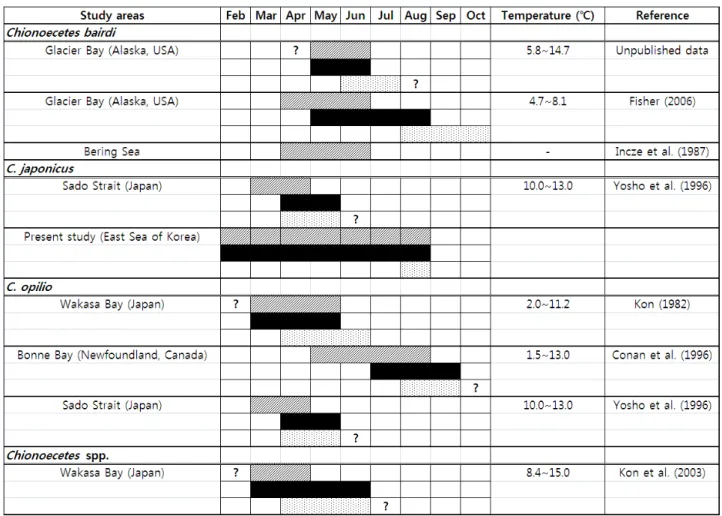
Table 1. Larval duration of the Chionoecetes larvae in the world oceans. indicate zoea I, zoea II and megalopa, respectively. Question marks (?) indicate the possible occurrence of Chionoecetes larvae in the areas.
이해원·박원규 720
라스카의경우도겨울바람이약해져수괴가잠잠해지기시작 하는시기에식물플랑크톤의일차대번무가시작된다(Fisher, 2006).
대서양연안에위치한뉴펀드랜드(Newfoundland) 의본느 만(Bonne Bay)에서식하는대게도 4월과 5월에유생을생산 한다(Taylor et al., 1985). 같은대서양연안의센트로렌스만의 대게도 3월과 5월사이에 Zoea I기유생을생산하는것으로알 려져있다(Starr et al., 1994). 알라스카연안과베링해의경우 와같이이시기도식물플랑크톤의일차대번무시기와일치된 다.
우리나라동해에서도대게속에속한종들은식물플랑크톤의
일차대번무시기에유생을생산한다. Chl a 의농도는우리나
라동해에서는계절성이매우강한것으로보고되어왔다(Kim et al., 2000; Yamada et al., 2004). 3월부터증가하기시작하여 6월까지 Chl a 의농도가높으며여름동안그농도가낮다. 가 을동안 Chl a 의농도가다시증가하고 12월부터 2월까지의
겨울동안다시감소하는것으로알려져있다. Chl a 의농도는
동해의북쪽부터높아지기시작하여점차남쪽으로높아지는 경향이보고되어왔다(Kim et al., 2000). 현연구의해역이독 도근해로제한되어있어실제로유생의출현시기가 Chl a 의 농도의변화를따라북쪽부터남쪽으로이동해왔는지는알수 없지만, 유생의출현시기가식물플랑크톤의대번무와밀접한 연관이있는것으로판단된다.
동해에서대게속유생들의출현시기에대한여러연구들이 진행되었다. Kon (1967)은우리나라동해에서 대게와홍게 의유생이 1월부터 4월까지출현한다고하였다. Kon (1996) 과 Kon and Honma (1970)는일본의와카사만(Wakasa Bay) 에서유사한시기에출현한다고보고하였다. 대게와홍게유생 모두일본의사도해협(Sado Strait) 3월부터출현하기시작하 였다(Yosho et al., 1996). 비록연구가 3월에시작되어연구가 진행되지전인 1월이나 2월에출현했었을수도있다. 하지만 본연구결과와유사한것으로보아동해를둘러싸고있는한국 과일본연안에서대게속유생의출현시기는거의유사한것 으로나타났다.
대게속에속한종들의유생은수괴에서긴시간을보내는것 으로알려져있다. 미국남동부알라스카에분포하는C. bairdi 는 4월부터 유생이생산되기 시작하여 10월까지출현한다 (Table 1; Fisher, 2006; Unpubl. Data). 대게의경우일본의와 카사만에서 2월부터 6월까지출현하는것으로보이며(Table 1; Kon, 1982). 홍게의유생도일본의사도해협에서 3월부터 6월까지출현하는것으로조사되었다(Table 1; Yosho et al.,
1996). 대게와홍게의유생을분리하지않은대게속유생들은
일본의와카사만에서 2월부터 7월까지출현하는것으로추정 된다(Table 1; Kon et al., 2003). 본연구에서도유생은 2월부 터 8월까지출현하여유사한연구결과를보였다. 본연구와다 른연구들을종합해볼때홍게를포함하는대게속유생들은
긴유생기를가지며, 이것은유생이발달할수록수온이낮은 깊은물로들어가기때문에긴유생기를갖는것으로간주된다 (Kon, 1982; Kon et al., 2003).
사 사
시료채집을도와주신국립수산과학원조사선탐구20호의 선장과선원여러분께감사드립니다. 본연구는국립수산과학 원(RP-2012-FR-048)의연구지원에의해수행되었습니다.
참고문헌
Armstrong DA. 1983. Cyclic crab abundance and relationship to environmental causes. In: Wooster W ed. From year to year: interannual variability of the environment and f isheries of the Gulf of Alaska. University of Washington, Sea Grant Report. WST-WO 83-3. Seattle, Washington, U.S.A., 102- Chelton DB, Bernal PA and McGowan JA. 1982. Large-scale 110.
interannual physical and biological interaction in the Cali- fornia current. J Mar Res 40, 1095-1125.
Conan GY, Starr M, Comeau M, Therriault JC, Hernandez FXM, and Robichaud G. 1996. Life history strategies, re- cruitment f luctuations, and management of the Bonne bay fjord Atlantic snow crab. In: High Latitude Crabs: Biology, Management and Economics. Alaska Sea Grant College Program AK-SG-96-02,199-208.
Coyle KO and Paul AJ. 1990. Abundance and biomass of mero- plankton during the spring bloom in an Alaskan Bay. Oph- elia 32, 199-210.
Cushing DH. 1990. Plankton production and year-class strength in f ish populations: an update of the match-mismatch hy- pothesis. Adv Mar Biol 26, 249-293.
Ebert EE, Hazeltine AW, Houk JL and Kelly RO. 1983. Labora- tory cultivation of the Dungeness crab, Cancer magister. In:
Wild PW and Tasto RN eds. Life history, environment, and mariculture studies of the Dungeness crab.
Ennis GP, Hooper RG and Taylor DM. 1990. Changes in the Composition of Snow Crab (Chionoecetes opilio) Par- ticipating in the Annual Breeding Migration in Bonne Bay, Newfoundland. Can J Fish Aquat Sci 47, 2242-2249.
Fisher JL. 2006. Seasonal timing and duration of brachyuran lar- vae in a high-latitude fjord. Mar Ecol Prog Ser 323, 213-222 Hartnoll RG. 1982. Growth. In: Abele, L.G. ed. The Biology
of Crustacea. Vol. 2 Embryology, morphology, and genetics.
Academic press, New York, U.S.A., 111-196.
Hong SY, Park W, Perry I and Boutillier J. 2009. Larval devel- opment of the grooved Tanner crab, Chionoecetes tanneri Rathbun, 1893 (Decapoda: Brachyura: Majidae) described from laboratory-reared specimens. ACS 13, 59-69.
Hunt GL and Stabeno PJ. 2002. Climate change and the control of energy f low in the southeastern Bering Sea. Prog Ocean- ogr 55, 5-22.
Hur YH, Jeon YY, Whang SJ, Hong BG and Kim YS. 2001.
Research on f ishery resources in the coastal area of the East Sea of Korea. 2000 NFRDI Res Rep, 3-29.
Incze L. 1983. Larval life history of Tanner crabs, Chionoecetes bairdi and C. opilio, in the southeastern Bering Sea and re- lationships to regional oceanography. PhD dissertation Uni- versity of Washington, Seattle, U.S.A., 191.
Incze LS and Armstrong DA. 1987. Abundance of larval Tanner crabs (Chionoecetes spp.) in relation to adult females and regional oceanography of the southeastern Bering Sea. Can J Fish Aquat Sci 44, 1143-1156.
Incze LS, Armstrong DA and Wencker DL. 1987 Rates of devel- opment and growth of larvae of Chionoecetes bairdi and C.
opilio in the Southeastern Bering Sea. In: Proceedings of the International Symposium on the Genus Chionoecetes. May 1982. Alaska Sea Grant Report 82-10. 219-232.
Jadamec LS, Donaldson WE and Cullenberg P. 1999. Biological field techniques for Chionoecetes crabs. Alaska Sea Grant College Program Report. AK-SG-99-02.
Kim SW, Saitoh S, Ishizaka J, Isoda Y and Kishino M. 2000.
Temporal and spatial variability of phytoplankton pigment concentration in the Japan Sea derived from CZCS images.
J Oceanogr. 56, 527-538.
Kinne O. 1971. Salinity. In: Kinne O. ed. Marine Biology 3.
Willey-Interscience, London, U.K., 683-1244.
Kon T. 1967. Fisheries biology of the tanner crab-I. On the prezoeal larva. Bull Jap Soc Sci Fish 35, 219-224.
Kon T. 1982. On the planktonic larval life of the zuwai crab, Chionoecetes opilio, occurring along coasts of the central Japan sea. In: Proceedings of the International Symposium on the Genus Chionoecetes. Alaska Sea Grant Report 82-10.
137-156.
Kon T. 1996. Overview of Tanner crab fisheries around the Japa- nese Archipelago. In: high latitude crabs: Biology, manage- ment, and economics. University of Alaska Sea Grant, AK- SG 96-02, Fairbanks, 13-24.
Kon T and Honma Y. 1970. Studies on the maturity of the gonad in some marine invertebrates- III. Seasonal changes in the ovary of the tanner crab. 36, 1021-1027.
Kon T Adachi T and Suzuki Y. 2003. Distribution of snow crab, Chionoecetes spp., larvae off Wakasa Bay in the Sea of Ja- pan. Fish Sci 69, 1109-1115.
Lovrich GA, Sainte-Marie B and Smith BD. 1995. Depth dis- tribution and seasonal movements of Chionoecetes opilio (Brachyura: Majidae) in Baie Sainte-Marguerite, Gulf of Saint Lawrence. Can J Zool 73, 1712-1726.
Navarrete SA, Broitman B, Wieters EA, Finke GR, Venegas RM and Sotomayor A. 2002. Recruitment of intertidal in- vertebrates in the southeast Pacif ic: Interannual variability
and the 1997-1998 El Nino. Limnol Oceanogr 47, 791-802.
Paul AJ, Coyle KO and Ziemann DA. 1990a. Variation in egg production rates by Pseudocalanus spp. in a subarctic Alas- kan bay during the onset of feeding by larval f ish. J Crust Biol 10, 648-658.
Paul AJ, Coyle KO and Ziemann DA. 1990b. Timing of spawn- ing of Thysanoessa raschii (Euphausiacea) and occurrence of their feeding-stage larvae in an Alaskan bay. J Crust Biol 10, 69-78.
Park H, Jeong E, Bae B, Yang Y, Hwang S, Park J, Kim Y, Lee S and Choi S. 2007. Fishing investigation and species com- position of the catches caught by a bottom trawl in the deep East Sea. J Kor Soc Fish Tech 43, 183-191.
Park W. 2007. Spatial and monthly changes of sea surface tem- perature, sea surface salinity, chlorophyll a, and zooplankton biomass in southeastern Alaska: Implications for suitable conditions of survival and growth of Dungeness crab zoeae.
J Fish Sci Technol 10, 133-142.
Park W and Shirley TC. 2005. Diel vertical migration and sea- sonal timing of the larvae of three sympatric cancrid crabs, Cancer spp., in Southeastern Alaska. Estuaries, 28, 266-273.
Park W and Shirley TC. 2008. Variations of abundance and hatch timing of Dungeness crab larvae in southeastern Alas- ka: implications for climate effect. ACS 12, 287-295.
Park W, Douglas DC and Shirley TC. 2007. North to Alaska:
Evidence for conveyor belt transport of Dungeness crab lar- vae along the west coast of the United States and Canada.
Limnol Oceanogr 52, 248-256.
Pereyra WT. 1966. The bathymetric and seasonal distribution, and reproduction of adult tanner crabs, Chionoecetes tan- neri Rathbun (Brachyura: Majidae), off the northern Oregon coast. Deep Sea Res 16, 1185–1205.
Reed PH. 1969. Culture methods and effects of temperature and salinity on survival and growth of Dungeness crab (Cancer magister) larvae in the laboratory. J Fish Res Board Can 26, 389-397.
Shirley SM, Shirley TC and Rice SD. 1987. Latitudinal varia- tion in the Dungeness crab, Cancer magister. Zoeal mor- phology explained by incubation temperature. Mar Biol 95, 371-376.
Somerton DA. 1982. Bipartite breeding: A hypothesis of the re- productive pattern in Tanner crabs. In: Proceedings of the In- ternational Symposium on the Genus Chionoecetes. Alaska Sea Grant Report 82-10, 283-288.
Starr M, Therriault JC, Conan GY, Comeau M and Robichaucd G. 1994. Larval release in a sub-euphotic zone invertebrate triggered by sinking phytoplankton particles. J Plankton Res 16, 1137-1147.
Stevens BG. 2003. Timing of aggregation and larval release by Tanner crabs, Chionoecetes bairdi, in relation to tidal current patterns. Fish Res 65, 201-216.
Squires HJ. 1969. Decapoda Crustacea of the Beaufort Sea and
이해원·박원규 722
arctic waters eastward to Cambridge Bay, 1960-65. J Fish Res Board Can 26, 1899-1918.
Taylor DM, Hooper RG and Ennis GP. 1985. Biological aspects of the spring breeding migration of snow crabs, Chionoece- tes opilio, in Bonne Bay, Newfoundland (Canada). Fish Bull 83, 707-710.
Thorson G. 1950. Reproductive and larval ecology of marine bottom invertebrates. Biol Rev 25, 1–45.
Yamada K, Ishizawa J, Yoo S, Kim H and Chiba S. 2004. Sea- sonal and interannual variability of sea surface chlorophyll a concentration in the Japan/East Sea(JES). Prog Oceanogr 61, 193-211.
Yosho I and Hayashi I. 1994. The bathymetric distribution of Chionoecetes opilio and C. japonicus (Majidae: Brachyura)
in the western and northern areas of the Sea of Japan. Bull Japan Sea Nat Res Inst 44, 59-71.
Yosho I, Nagasawa T and Konishi K. 1996. Larval distribution of Chionoecetes (Majidae, Brachyura) in the Sado Strait, Sea of Japan. In: High Latitude Crabs: Biology, Manage- ment and Economics. Alaska Sea Grant College Program AK-SG-96-02, 199-208.