• 검색 결과가 없습니다.

The Significance of Clinical Examination for Brain Lesion Differentiation of Patients with Head Trauma after Alcohol Intoxication

N/A
N/A
Protected

Academic year: 2021

Share "The Significance of Clinical Examination for Brain Lesion Differentiation of Patients with Head Trauma after Alcohol Intoxication"

Copied!
6
0
0

로드 중.... (전체 텍스트 보기)

전체 글

(1)

� Address for Correspondence : Dong Kil Jeong, M.D.

Department of Emergency Medicine, College of Medicine, Soonchunhyang University, 31, Suncheonhyang 6-gil, Dongnam-gu, Cheonan-si, Chungcheongnam-do 31151, Korea Tel : 82-41-570-2891, Fax : 82-41-592-3806, E-mail : [email protected]

Submitted : August 14, 2016 Revised : September 2, 2016 Accepted : December 30, 2016

The Significance of Clinical Examination for Brain Lesion Differentiation of Patients with

Head Trauma after Alcohol Intoxication

Yoon Hyun Jung, M.D., Dong Kil Jeong, M.D., Jung Won Lee, M.D., Hyung Jun Moon, M.D., Jae Hyung Choi, M.D., Jun Hwan Song, M.D.

1

Department of Emergency Medicine, College of Medicine, Soonchunhyang University, Cheonan, Korea

1

Department of Pediatrics, College of Medicine, Soonchunhyang University, Cheonan, Korea

Purpose: There are many patients visited to ED in an alcohol intoxicated state. For these patients, it is difficult to pre- dict by only clinical examination whether he/she would have brain lesion. The purpose of this study is to research whether it is possible to predict brain lesion by only clinical examination findings, with comparing patients with/with- out actual brain lesions.

Methods: A retrospective study was performed at a university hospital for the period 11 months with the medical records. As for the inclusion group, head trauma patients with objectively proved drunk, judging by their blood ethanol concentration, and performed the brain CT were selected. In terms of medical record, Glasgow coma scale (GCS), the presence of neurologic abnormalities, the presence of lesion on brain CT of the patients, were examined. From labora- tory results, blood ethanol concentration, platelet count, prothrombin time (PT), activated partial thromboplastin time (aPTT) and glucose concentration were identified.

Results: For this study, there were total 80 patients of inclusion group. There was no statistically significant differ- ence in terms of GCS score and neurological examination abnormalities, between the group with brain lesion and the group without brain lesion on brain CT.

Conclusion: Alcohol intoxicated patient with head trauma visits the ED, it is not possible to distinguish or determine whether brain lesion exists or not by only clinical findings. In order to check the lesion existence, the image examina- tion, therefore, should be considered and performed. [ J Trauma Inj 2016; 29: 99-104 ]

Key Words: Alcoholic intoxication, Craniocerebral trauma, Neurologic examination

(2)
(3)

Table 1. Demographic characteristics

Brain CT normal Brain CT abnormal Total

(N=66) (N=14) (N=80)

Sex Male 54 (81.8%) 13 (92.9%) 67 (83.8%)

Female 12 (18.2%) 01 (07.1%) 13 (16.2%)

Mean age 44.6 14.2 49.9 17.9 45.5 14.9

(4)

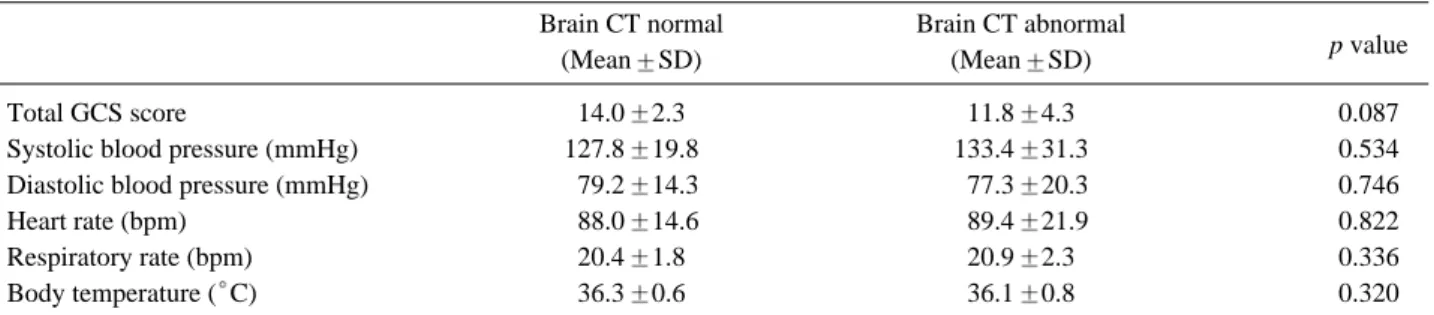
Table 3. Glasgow Coma Scale (GCS) & Vital sign

Brain CT normal Brain CT abnormal

p value

(Mean SD) (Mean SD)

Total GCS score 14.0 2.3 11.8 4.3 0.087

Systolic blood pressure (mmHg) 127.8 19.8 133.4 31.3 0.534

Diastolic blood pressure (mmHg) 079.2 14.3 077.3 20.3 0.746

Heart rate (bpm) 088.0 14.6 089.4 21.9 0.822

Respiratory rate (bpm) 20.4 1.8 20.9 2.3 0.336

Body temperature ( C) 36.3 0.6 36.1 0.8 0.320

SD: standard deviation

Table 4-1. Neurologic examination

Brain CT abnormal Brain CT normal Total

Neurologic exam. abnormal 02 09 11

Neurologic exam. normal 12 57 69

Total 14 66 80

Table 4-2. Statistic analysis of neurologic examination

PPV NPV Sensitivity Specificity Odd ratio p value*

18.2% 82.6% 14.3% 86.4% 1.056 0.616

PPV: positive predictive value NPV: negative predictive value Table 2. Brain CT abnormal group

SDH SAH EDH ICH IVH Contusional

Pneumocephalus Skull

hemorrhage fracture

01 √ √ √ √

02 √

03 √ √ √

04 √ √

05 √ √ √

06 √ √ √ √

07 √ √ √

08 √

09 √ √

10 √ √ √

11 √ √ √

12 √ √ √

13 √

14 √

SDH: subdural hemorrhage, SAH: subarachnoid hemorrhage, EDH: epidural hemorrhage, ICH: intracranial hemorrhage, IVH: intra-

ventricular hemorrhage

(5)

Fig. 2. Correlation analysis between blood ethanol concentra- tion and total GCS.

Fig. 2. Pearson’s correlation coefficient: -0.17, p=0.13

Ethanol (mg/dl) 240.5 77.6 216.5 91.5 0.310

Platelet (103/ l) 218.4 73.6 0.212 51.7 0.781

PT (sec) 11.7 1.3 12.1 1.5 0.309

aPTT (sec) 28.0 4.7 27.8 7.0 0.939

Glucose (mg/dl) 134.3 56.5 156.4 74.1 0.246

(6)

REFERENCES

01) SH Choi, CK Moon, JD Mun, SW Lee, YS Hong. Alcohol Related Trauma Patients. J Korean Soc Emerg Med 1999; 10:

266-75.

02) H Noh, YH Choi, EK Eo, KY Jung. The Adequacy of Self- reporting and Physician’s Diagnoses for Assessing Alcohol Ingestion in Trauma Patients. J Korean Soc Emerg Med 2007;

18: 307-12.

03) Judith E. Tintinalli JSS, O. John Ma, Donald M. Yealy, Garth D. Meckler, David M. Cline. Tintinalli’s Emergency Medicine. 8th ed. New York: McGraw-Hill Medicine; 2016.

p1243.

04) Teasdale G, Jennett B. Assessment and prognosis of coma after head injury. Acta neurochirurgica 1976; 34: 45-55.

05) Sporer KA, Solares M, Durant EJ, Wang W, Wu AH, Rodriguez RM. Accuracy of the initial diagnosis among patients with an acutely altered mental status. Emergency medicine journal: EMJ 2013; 30: 243-6.

06) Starke RM, Komotar RJ, Otten ML, Schmidt JM, Fernandez LD, Rincon F, et al. Predicting long-term outcome in poor grade aneurysmal subarachnoid haemorrhage patients utilising the Glasgow Coma Scale. Journal of Clinical Neuroscience 2009; 16: 26-31.

07) SH Choi, JD Moon, SJ Kim, CK Moon, SW Lee, YS Hong.

Prognostic Factors in Head Trauma Patients. J Korean Soc Emerg Med 2001; 12: 105-18.

08) KH Kim, KH Lee, WY Kim, YC Yoon, HY Kim. Computed Tomography (CT) in Head Trauma Patients with Alert Mental Status: How Important are the Clinical Symptoms. J Korean Soc Emerg Med 1997; 8: 564-70.

09) Ashkenazi I, Schecter WP, Peleg K, Givon A, Olsha O, Turegano-Fuentes F, et al. Glasgow Coma Scale Score in Survivors of Explosion With Possible Traumatic Brain Injury in Need of Neurosurgical Intervention. JAMA 2016.

10) Sullivan SJ, Hammond-Tooke GD, Schneiders AG, Gray AR,

McCrory P. The diagnostic accuracy of selected neurological

tests. Journal of clinical neuroscience: official journal of the

Neurosurgical Society of Australasia 2012; 19: 423-7.

수치

Table 1. Demographic characteristics
Table 4-1. Neurologic examination
Fig. 2. Correlation analysis between blood ethanol concentra- concentra-tion and total GCS.

참조

관련 문서

The purpose of this study is to examine whether internet addiction is related with ADHD (Attention Deficit Hyperactivity Disorder) that is characterized

The purpose of this study is to find out the factors to be considered to allow people with disabilities to work stably and propose the direction of

As the results from this study, it proved the usefulness of color psychological counseling through the effect of color stimuli on brain waves to

Conclusion: Aromatherapy with neroli essential oil had a difference in brain wave and brain utilization ability according to the MBTI personality type

The purpose of this study was to identify the frequency and related factors of advanced airway management for patients with cardiac arrest by the

With some 300 thousand youths preparing for civil service examinations, it is necessary to improve the civil service examination system with consideration

 Although van der Waals equation is still less accurate at high

Purpose: The purpose of this study is to evaluate the usability of the video lecture commentary solution to guarantee the learning rights of students with visual