1. Introduction
1.1. Research objectives
The government is preparing systematic basis for distribution and expansion of Hankok which is high quality and eco-firnedly housing based on new hanok plan for national status improvement confirmed by the third national architect policy planning committee(’10.05.03). Especially to accomplish '2020 hanok Renaissance, hanok popularization era' which is the propulsion goal of new hanok plan, development, expansion and distribution of various architectural space through utilization and close relation with modern and traditional architect are needed.
This research pursues popularization through opportunity expansion of new space experience to locals and future residents by developing public building models in new hanok type utilizing, connecting various planning factors of traditional and modern architect with service facilities1) within apartment housing mutually.
But succession problem of traditional architect can be said to be the factor that should be considered the first in the process of developing service facilities to new hanok. This research intends to extract
pISSN 2288-968X, eISSN 2288-9698 http://dx.doi.org/10.12813/kieae.2015.15.3.029
genetic factors of Korean traditional architect as a decisive factor that enables utilization based on plan for traditional succession upon model development of service facilities of new hanok Type. 1)
1.2. Research method
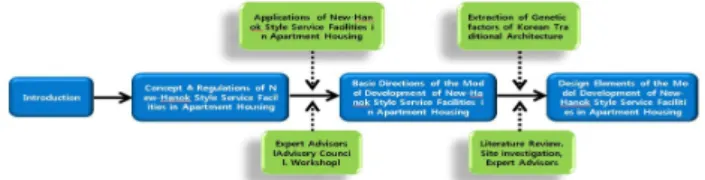
We set the category and basic concept of service facilities of new hanok Type examining system and current relevant regulations and extracted genetic factors of Korean traditional architect as planning factors for tradition succession and developmental direction of model based on analysis result such as literature study, field survey and expert consultation as well as investigation on application status of new hanok Type service facilities.2)
Fig. 1. Research Progress Pictures
1) In the future this study indicated only 'Service Facilities' to omit 'within apartment housing' of the 'Service Facilities within Apartment housing'
2) Among planning factors for model development of new-hanok service facilities, research result in hanok technology development in 1st stage and planning factors that will be drawn in modern building techniques were excluded in this research.
KIEAE Journal
Korea Institute of Ecological Architecture and Environment
73
1)
The Design Elements for the Model Development of New-Hanok Type Service Facilities in Apartment Housing
- Focused on the Genetic factors of Korean Traditional Architecture- Park, Joon-Young*⋅Kwon, Hyuck-Sam**⋅Bae, Kang-Won***
* Dept. of Public-Housing Research, Land & Housing Institute, South Korea ([email protected]) ** Coauthor, Dept. of Research Planning, Land &housing Institute, South Korea
*** Corresponding author, Dept. of Public-Housing Research, Land&Housing Institute, South Korea ([email protected])
A B S T R A C T K E Y W O R D
Purpose: This study is as only basic research for the model Development of the New-Hanok Type Service Facilities in Apartment Housing, which is as a decisive factor used as a planning element for developing the model inherited tradition, There aimed at extracting the genetic factor of Korea's traditional architecture. Method: For this purpose, Consider the concept and regulations of the New-Hanok Type Service Facilities in Apartment Housing and examined the Domestic Application Status of the New-Hanok Type Service Facilities in Apartment Housing. It sets direction of the New-Hanok Type models development based on Expert advice and the literature, and was reviewed a primal reason system of Korea as an extraction base of genetic factors. Result: Then Through the framework of the vertical axis (the form), the horizontal axis (space), It extracted the genetic factors of the Korea Traditional Architecture, classified the genetic factors extracted as the structure(layout, construction, space), features, traditional beauty, investigated the content of the form representation and spatial meaning, and were characterized. Based on the result, It were comprehensive the genetic factors extracted as plan Elements for inheriting of the traditions.
ⓒ 2015 KIEAE Journal
New-Hanok Type, Service Facilities,
Genetic factors of Korean Traditional Architecture
A C C E P TA N C E IN F O Received May 14, 2015
Final revision received June 8, 2015 Accepted June 10, 2015
2. Analysis of related regulations and concept of new hanok service facilities
2.1. Concept and category
(1) Scope and definition of hanok clarified in legal system National regulations3) and ordinance of local governments define hanok4) commonly mentioning 'Korean roof tile' and 'wooden structure' and 'traditional beauty' is stipulated as the following important standard. ‘Natural material’ is partly mentioned as well and in case of ordinance in Jeonju(’02), it stipulates not only the gate which is the landscape element but also walls. Currently, it was shown that only buildings with unified structure, material, traditional beauty are set as the scope of hanok in national regulation and ordinance.
Fig. 2. The Definition of Hanok In the National Legislation & Bylaw
(2) Concept and category of new hanok Type buildings The scope of new hanok Type building defined in this research is the wider concept differentiated from ‘new hanok’5) that is gaining its importance and is the flexible one that can expand 'new hanok' with main objective on house securing to various buildings such as public buildings and can be said to belong to ‘building asset’6)and
‘hanok building form’7) stipulated in current regulations.
3) National regulations that defines hanok are stipulated in hanok experience business(’10.02.24), article 2 in enforcement ordinance of tourism promotion act and article 2 of building act enforcement ordinance. (’10.02.18)
4) "Hanok" refers to the structure with Korean roof frame and is a wooden structure in its pillars and buildings that reflect Korean traditional forms finished with natural materials such as Korean roof tile, chaff, wood, soil and its annex. Article 2 of enforcement ordinance of building act, Ministry of Land, Infrastructure and Transportation, [Enforced on 2010.02.18.]
5) The concept of ‘new hanok’ is established through old law grafted with new technology succeeding traditionality and is the one that commonly calls Korean buildings improved or built currently with internal spae accpeting modern people's lives. ‘Plan research on supply of Korean style public buildings’, AURI, 2011
6) “Building asset” has social, economic, scenic value valid in present and future or refers to the buildings that contributes to formation of identity of region and welfare of building cultures of the nation or possessing historical and cultural value that is unique such as hanok. Law on promotion of building asset such as hanok(Law no. 12729, enacted on 2014.6.3. ) [enforced in 2015.6.4], Ministry of Land, Infrastructure and Transportation 7) “Korean Building Style" is built using modern material and technology or has forms and
structure of hanok. Same legislation with footnote 4).
Fig. 3. The Category of New Hanok Type Architecture
Fig. 4. The configuration concept of New-hanok type building
The concept of ‘new hanok Type building’ is based on structure, function and beauty as well as possible transformation and recreation of planning factors drawn in modern building techniques and research result of 1st step hanok technology development along with genetic factors drawn from traditional architect responding to new environment that pursues continuous change and sets the direction that actively accepts modern conveniency, efficiency as standards based on the structure, function, traditional beauty of hanok8).
(3) The concept and scope of service facilities of new hanok Type
New-hanok service facilities are buildings with structural, technological, design features of new hanok9) and limited to annex (management office), welfare facilities (senior citizen center, kindergarten, resident's common space) within apartment housing.
8) Hanok used in this research not only refers to traditional house building (house) but structure with wooden structure with pillars defined in Article 2 of enforcement act of building law」 and the whole annex and building that reflect Korean traditional style finished with natural materials such as Korean roof tile, chaff, wood and soil.
9) New hanok style building in this research not only refers to buildings but also includes every space at outside, transfer space, inside.
Division Small scale Medium Size Large scale 50Generation 100Generation 300Generation 500Generation 1000Generation 2000Generation
FacilitiesManagement Office ◯ ◯ ◯ ◯ ◯ ◯
Rest facilities ◯ ◯ ◯ ◯
Welfare facilities
Children's
playground ◯ ◯ ◯ ◯ ◯ ◯
Resident sports
facilities ◯ ◯ ◯
Homes for the
elderly ◯ ◯ ◯ ◯ ◯
Nurseries ◯ ◯ ◯ ◯
Residents communal
facilities ◯ ◯ ◯ ◯
Small library ◯ ◯ ◯ ◯
Kindergarten ◯
Neighborhood
Facilities Households✕6㎡
Table 1. Service Facilities Installation Standards According to the Current Number of Households of Housing Construction Standard
2.2. Investigation on application status
In recent new house complex, differentiated marketing strategy as design grafted with Hanok is gaining importance as a new trend.
But the case where welfare service facilities are created as hanok style is very scarce. But the case applied to the country recently includes 'Raemian Mapo Riverwell' complex in Seoul that started a sale since Junly of 2014 and it was understood that planning factors of traditional hanok such as living room and yard were introduced in residential common place in 'Kyunghui palace Xai' in Jong-no, Seoul and 'Woopyung Labien' in Andong of Kyungbuk which are for sale now. Application status of Table 2 is the survey result through experts consultation on field visit and related organization and phone survey of local governments office, internal search.
Classification Instance
Service Facilities
Seoul 'Raemian Ma-po River
-well '
Start moving in July 2014 (563menage)
creating the Hanok type park and children's playground, guest house, tea house in
Hanok
An-dong 'woo-pyeong
Ravi-yen'
Starting pre-sale from the end of February 2015
(230menage)
introducing the Hanok traditional beauty in the Facade, roof garden, yard,
rest area
Jong-no 'Gyeonghuigun
g Xi'
Pre-sale December 2014
(2533menage)
Introducing Korean "yard"
and "floor" in the apartment doorway
Planar structure
Mok-po 'Umi Fahrenheit'
The end of 2011 pre-sale (548menage)
Introducing Sarang-chae and veranda followed from the
entrance immediately Gyeong-gi,
'Pyeongtaek vision Prugio '
Pre-sale schedule in 2015
(761menage)
Introducing Sarang-chae to the plane Table 2. Application of Hanok in Apartment Housing
2.3. Review on related regulations
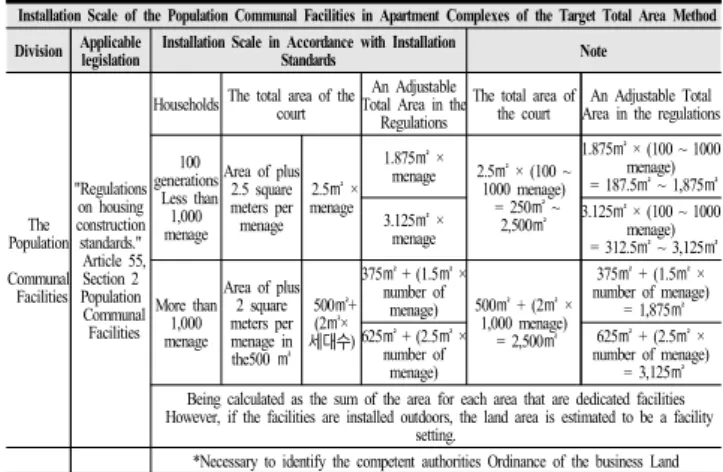
Followings are summary of examined, limited range of welfare facilities that are senior citizen center, kindergarten, residential common space (playground for children, small library, gymnasium, kindergarten) and annex that is management office.
Installation Scale of the Population Communal Facilities in Apartment Complexes of the Target Total Area Method Division Applicable legislation Installation Scale in Accordance with Installation
Standards Note
PopulationThe
Communal Facilities
"Regulations on housing construction standards."
Article 55, Section 2 Population Communal Facilities
Households The total area of the court
An Adjustable Total Area in the
Regulations
The total area of
the court An Adjustable Total Area in the regulations 100
generations Less than
1,000 menage
Area of plus 2.5 square meters per menage
2.5㎡ × menage
1.875㎡ ×
menage 2.5㎡ × (100 ~ 1000 menage)
= 250㎡ ~ 2,500㎡
1.875㎡ × (100 ~ 1000 menage) = 187.5㎡ ~ 1,875㎡
3.125㎡ × menage
3.125㎡ × (100 ~ 1000 menage) = 312.5㎡ ~ 3,125㎡
More than 1,000 menage
Area of plus 2 square meters per menage in the500 ㎡
500㎡+
세대수)(2㎡×
375㎡ + (1.5㎡ × number of
menage) 500㎡ + (2㎡ × 1,000 menage)
= 2,500㎡
375㎡ + (1.5㎡ × number of menage) = 1,875㎡
625㎡ + (2.5㎡ × number of
menage)
625㎡ + (2.5㎡ × number of menage) = 3,125㎡
Being calculated as the sum of the area for each area that are dedicated facilities However, if the facilities are installed outdoors, the land area is estimated to be a facility
setting.
*Necessary to identify the competent authorities Ordinance of the business Land Table 3. Installation Scale of the Population Communal Facilities in Apartment Complexes of the Target Total Area Method
The minimum area under the facility Division Applicable
legislation Minimum Area Criteria Note
Management Office
"Regulations on housing construction
standards."
Article 28
More than 50 menage
More than 10 ㎡ plus 500㎠ Every menage over 50 menage in the
area
10㎡ + (menage-50 menage) x0.05㎡
However, if The sum of the area exceeds 100㎡ It may be to 100㎠ the area of the
installation Located on the basis of efficiency of administration
and accessibility of the residents
Homes for the elderly
"Regulation on residential construction
standards."
Chapter 2, Article 55 Article
5 and Article 6
More than 150
menage Area plus 0.1㎡ to 50㎡ per menage
50㎡ + (0.1㎡ × number of
menage)
Sunshine, natural lightings/
entertainment, hobbies, multi-purpose room / gender space available/water, cooking, and toilet and garden
accessory installation
"Elderly Welfare Law" Article 36
"Old man welfare Enforcement Rules" Article 26
More than 150 menage
More than 20 people using personnel (in the case of Eup and
Myeon , the 10 or more)
Elderly are autonomously Friendship, hobbies, co-workshop operation and various information exchange,
the purpose of providing a place to allow the other
recreational facilities Facilities Criteria 1 toilet, 1 living room or foyer, electrical facilities 1
Equipment
standards Living room or foyer: more than 20
㎡
Nurseries
"Regulation on residential construction
standards."
Chapter 2, Article 55 Article
5 and Article 6
300 to less than
600 menage 0.1 persons per menage people Less than 600 to
1,000 menage Persons of 30 + 0.05 persons per menage More than 1,000
menage Area to care for 80 or more people
"Infant Care Act"
Facilities area
include nursery More than 4.29 ㎡per 1 Infants
(excluding playground area) Installing the kitchen, bathroom, toilet, playground
equipment Nursery area More than 2.64 square meters per 1
infants including Living room, crawling room and game room
Children's playground
"Regulation on residential construction
standards."
Chapter 2, Article 55 Article
5 and Article 6
Less than 150 to 300 menage
Install the appropriate area be harmonized with landscaping, greenery Taking into account the
local conditions, the apartment complex features
* Note: Residential complex of installing to integrate The sports facilities, landscaping, and greenery, recognizing children's playground footprint
in accordance with the business plan approver is
recognition Less than
300-1000 menage
Area plus the per menage 1㎡ to 200㎡
More than 1,000
menage Area plus the per menage 0.7㎡ to 500㎡
"Infant Care Act Enforcement
Rules"
Nurseries Nursery garden
more than 50 people
principles of 3.5 square meters or more (outdoor playground) per
Infants
However, the Minister of Health and Welfare can be installed in accordance with the criteria a playground to determine the basis of the area and maximum number of infants to participate in fun activities in the same time zone as daycare centers, depending on size (people),
Small library
"Regulation on residential construction
standards."
Chapter 2, Article 55 Article
5 and Article 6
"Libraries Act command" area
in accordance with the criteria
of Annex 1
Note: Ministry of Culture and Tourism recommends an area of
around 100㎡ to the proper
functioning of a small library -Note: the building area of the entrance, foyer, hallways, restrooms and dining room area shall be included
"Library Law Decree"
Building area of over 33 square meters, view seats of 6 seats or more, more than 1,000 book library
materials
Table 4. Minimum Area Criteria of the Population Communal Facilities in Apartment Complexes of the Target Total Area Method
3. Induction of planning factors and basic direction of model development
3.1. Basic direction
The basic principle of model development of new hanok style welfare facilities is improvement of improper parts to modern architect environment and succession of advantages of traditional architect. Thus as it is organically connected to sustainable settlement environment of past, present and future, it pursues a high fusibility as potential capacity that can create new demand actively dealing with changes in demand regarding various housing life of demanders.
Fig. 5. Basic Directions of the Model Development of New-Hanok Style Architecture
3.2. Planning factors deduction: Genetic factors of Korean traditional architect10)
(1) Deduction basis
Analysis regarding genetic factors starts in the aspect that ideological reason of Korea tradition is the basis that forms the distinction of Korean traditional architect. Although there is a difference between ages and implementation method as a space modeling principle hid in the backside of factors that do not change in Korean space culture, 'Heaven unity' thought that means sky (天), land (地) and people (人) unite can be considered as the root idea of our people. 11)
Our ancestors stipulated land(人, buildings) as ‘man's world’, and heaven(天) and underground(地) that cannot be explained with daily experience of human as ‘god's world’ and recognized buildings(+) as 'vertical(|) ∙ horizontal(ᅳ) axis' that connects heaven(風) and land(水)12) Likewise, Korean traditional architect seriated the nature connecting internal and outer space efficiently using natural energy through its ‘風流(wind road)’ in empty space between buildings. This leads to taste(風流)→flow of wind, water.
light→geometric geography(風水地理)→natural providence.
Korean traditional architect involves ideological concept of
‘Natural(天地人) unity’ forming basic frame of space creation method thanks to ‘aesthetics of nature’.
Fig. 6. Korea Unique spirit As an Organizing Principle of Korean Traditional Architecture
10) For methods for genetic factor extraction, this research is based on empirical experience, theoretical contemplation as well as independent decision of research faculty and opinion acceptance. Thus genetic factors possess their meanings and values as planning factors with variable features rather than fixed ones.
11) Heaven unity ideology is the main point of ⌜Chunbukyung(天符經)⌟ which is the history of ideology that becomes the root of Korean people, and Chiwon Choi who translated ⌜Chunbukyung⌟ into Chinese characters clarifies that his is the ‘taste(風 流)’ which is the religion or our people root in ⌜Nanrangbisu(鸞郞碑序)⌟.
12) Bae, Kang-won and others, A Study on the Korean Archetype Space of the Mythology Based on the Eliade's Mythic Geography, Journal of 25 No. 4, 2012, pp.101-113 The minimum area under the facility
Division Applicable
legislation Minimum Area Criteria Note
Resident sports facilities
"Decree of the Act on the installation and use of athletic facilities."
To determine the physical facilities, the area in accordance with the standards of the stadium
each event group game
Kindergarten
"Regulations on Housing construction
standards."
Article 52
2000 generations
Section 2 For facilities with a composite construction of kindergarten for any purpose other
-> it can be installed with only than (limited to facilities that can be installed on the school environment
hygienic cleansing areas of the
"School Act"), Medical facilities, resident sports facilities, child care
facilities, religious venue, neighborhood living facility.
The total area of the bottom of the case to be less than K-use one-half
of that building floor area.
<Amended 30/06/2005, 08/12/2011>
Construct To installation who wish of the facility to pre-sale by securing the land for housing development or supply to those who want to
operate it by building a kindergarten (except
exclusions) The complex architecture by the
provisions of paragraph 2 should be in a separate structure with facilities of other purposes(excluding the day care center and social welfare)
entrance, stairs, hallway and bathroom of Kindergarten to protect
the environment of child care.
<Amended 08/12/2011>
(2) Scope and method of genetic factors extraction13)
Since there is a close relation between outer and inner space in Korean traditional architect, the scope of genetic factors extraction included overall features such as internal space, transfer space, outer space. The target of genetic factors extraction was limited to Korean traditional architect in Chosun era.14) Representative instance of extracted genetic factors utilized field image data collected in direct survey in most cases along with literature investigation.
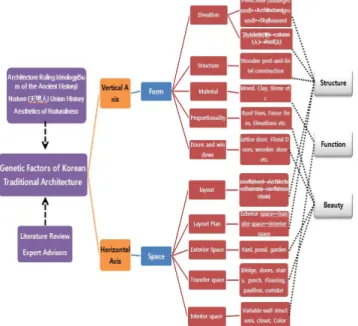
Based on primitive idea of Korea, following figure shows the composition organized after examining genetic factors extracted through vertical (form), horizontal (space) analysis with structure, function and beauty.
Fig. 7. Configuration of Extraction Method of Genetic Factors
The procedure and method of genetic factor extraction contemplates Korean primitive speculation system regarding nature(heaven) unity ideology through first, literature review.
Second, genetic factors were extracted through vertical (form), horizontal (space) analysis regarding various cases of traditional architect space and reviewed objectively through domestic experts consultation and independent decision of research faculty. Third, extracted genetic factors were classified into structure (allocation, design, space, function and traditional beauty to help analysis of features and contemplation of contents in accordance with spatial meaning and formative expression. Fourth, deduced genetic factors were combined as planning factors for tradition succession.
13) The genetic factors extracted in this research have their meanings in basic work for excavation of traditional factors that can be utilized upon model development of new-hanok styled public buildings in the future. Thus other traditional factors not utilized in this research as well can be utilized upon future model development.
14) Although buildings were created prior to Chosun era, most of them were recreated in late Chosun era so we included every traditional buildings that exist now in targets.
Fig. 8. Extraction Methods and Procedures of Genetic Factors
(3) Genetic factors extraction
Following shows the summary of extraction result of genetic factors classifying them into inner, outer, transfer spae based on structure, function and traditional beauty.
Division Genetic Factors of Korean Traditional Architecture
Genetic Factors Representative examples Contents
ctureStru (Exterior
space) Layout
Building placed in the center of the vertical and horizontal axis
(baesanimsu)
River (地) ↔ building (人)
↔ heaven (天) South (水) ↔ building (人)
↔ North (山) Baekje Gongsanseong
Oond SeonAmSa Map
Architect ure
Vertical axis:
Stylobate(地)↔column (人)↔Roof(天)
Stylobate is hell, the roof symbolizing wing, of the Bird, column symbolizing
the cosmic tree Gaesimsa SimGeonDang Hwaeomsa 9th-floor
Hermitage
Wooden post-and-lintel construction
combination Technique put together to create a space facing each other Wood and wood without the use of
nails Yunjeung old houses jong
Institute Buseoksa Beomjongru
Space
Horizontal Axis:
Exterior space↔transfer space↔Interior space
Hanok were developed transfer space Yunjeung old houses jong
Institute Damyang myeongokheon
Function(interior space)
Natural Heating System: Goodle
(ondol)
Goodle is Our nation's unique heating techniques Chilbulsa ahjja room Chilbulsa ahjja room
Natural cooling system Natural convection system
according to a built-in lattice in different sizes Haeinsa Beopbojeon Hahoe Village
chunghyodang
Natural Ventilation Systems
Natural ventilation system through up and down with
winds Seonamsa toilet Seonamsa toilet
Variable partition system: variable wall
structure
Hanok is characteristic that can produce a variable-space consolidation and detachable SoonJeonghyo Empress
Yoon-parent home Yunjeung old houses Sarangchae
Built-in storage space:
Hair closet, alcove Must be empty space can be
converted into various places Haeinsa Buddhist monks
room
Changdeokgung yeongyeongdang main
house
Table 5. Genetic Factors Extraction of Korean Traditional Architecture
autyBe Transfer space
Entry area: bridges 1
When the initial entry Symbolize to get into 聖 (interior) from 俗 (exterior) by going across the bridge to install the pond Gaesimsa wooden bridge Songgwangsa stepping
stones
Entry area bridges 2
The bridge is ambiguous boundary role to connect the
interior space and exterior space Songgwangsa paradise
bridge ChongRyangGak Songgwangsa NeungHeogyo woohwagak
Entry area door 1
Door yard is connected to interior and exterior paradoxically and Cose areas
of Door are experiencing with the inside Yeongju Sudori ManjukJae Songso old houses inside and outside the fence
Beauty Transfer space
Entry area: door2
Architectural Space with a Directional Along the North-South Axis By superimposing the door Changdeokgung
yeongyeongdang Middle door
Haeinsa phoenix door - Ilju door
Entry area door3
In the Case of Bottom Entry pavilion, The upper is used as pavilion, the lower is the
role of entrance Youngsanam Woo-Hwa
pavilion pavilion lower door
Haeinsa SudaraZang JongDoor
Entry area: Stairs
Taking Advantage of the Difference in height of the terrain with an elevation of continuity and dimension
through stairs Beomeosa Temple Buseoksa Temple
Central area: Yard
Korea's yard by emptying completely, recognized as an
extension of the interior space depending on the
application Yangdong Village
gwangajeong Changdeokgung yeongyeongdang
Central area: Stylobate
Adjusting the height and width of the Stylobate, depending on the size of the
building Yangdong Village
SeobaekDang Yangdong Village HyangDan
Central area: Veranda Ondol placed in front of the
most veranda Changdeokgung
yeongyeongdang Bongjeongsa Daeungjeon
Central area: Hall
By emptying the hall, it can be utilized depending on the
application This being the cleanest place in the home and center
as a place dedicated to the trails Yangdong Village
gwangajeong Hamyang jeongyeochang old houses
Central area: Numaru
Numaru is the space to attract the magnificent scenery of outside on the house by open of three sides Yangdong Village
simsujeong Yangdong Village gwangajeong
Central area: pavilion
Pavilion Type Building stands the two sides to extend indefinitely the interior to the outside while attracting the outside to the
inside Byeongsan seowon Byeongsan seowon
Central area: Railings
Railing at the Hanok is absolutely for molding a hanok gorgeous curves,
sculpture, etc.
Yangdong Village
simsujeong Hamyang jeongyeochang old houses
Beauty Transfer
space
Subarea:
summerhouse1
The house of builting to play or rest in a great scenery place .Without walls, only pillars and a roof, but it recognized interior space Soswaewon gwangpunggak Damyang myeonangjeong
Subarea:
summerhouse2
There are many summer house of different all shapes
and sizes. What are melt, The characteris tics of Korean people reluctant to
repeat Changdeokgung
gwanramjeong Changdeokgung aeryeonjeong
Subarea: corridor
Long Corridor with a roof over the main part of the Religious building or palaces
building Changdeokgung
yeongyeongdang Gyeongju Bulguksa
Interior exterior and space
Natural Materials1-Wood,
Clay, Stone
Hanok is that the principle of using natural Materials intact where appropriate Gaesimsa SimgeonDang Ssanggyesa flower fence
Natural Materials2- Clay, ganghoe
compaction
Hot air rises and Cool Air of the Backyard through the hall Causes convection HaePoong buwongun
yuntaekyoung house Yangdong Village HyangDan
Natural Materials3- Granite, brick
The courtyard of Korea does not have a cloth-clad case.
However, the solemn and sacred space paved with brick or Stone Tiles JongMyo JungJun JongMyo JungJun
Natural Materials4- Korean tile, thatch,
wood plates
Neowa house: House From the roof of wood or stone plate Gulpi house: House followed roof by a thick
bark Byeongsan seowon Samcheok Kim Jin Ho
houses
Proportionality1
Elevation of the hanok is to show the essence of warm human abstract immaculate
and refreshing Sudeoksa Daeungjeon Baekdamsa meditation
room
Proportionality2 Designed for the operation
with the human body scale SoSouSeoWon HackGuJae SoSouSeoWon JiRackJae
windows and Doors1:Variably open
the door
lattice is revealed the configuration of the line in
the exterior ,and interior being perceived as a continuous surface with the
interior walls Yangdong Village
gwangajeong Asan maengssi haengdan
windows and Doors2:Wooden plate
Wooden plate door is divided into the Cage-Wooden plate door in
the Framework and boards door without the Framework Yangdong Village
gwangajeong Sunheung Hyanggyo younggwiLou
windows and Doors3:
lattice
Lattice are a collectively that windows and doors made of thin rib weave in the Framework. The Names are subdivided according to the appearance to create intersect of lines and lines of bars Songgwangsa HaSadang
lattice Gangjingun muwisa lattice
windows and Doors4:
Flower lattice
Flower lattice door of the temple is Simple, crude and
the Cultural heritage that warm emotion permeated Jeungsimsa Daeungjeon
flowers lattice Jeungsimsa Daeungjeon flowers lattice
Colors1
Simple and Neat, Do not flashy and contrary to the whole harmony, rather than
being pronounced Buseoksa Temple
ZoSaJeon Sudeoksa Daeungjeon
Beauty Interior exterior and space
Colors2 Korea is often to keep the
same color tone as a whole Daeheungsa cheonbuljeon Yongmunsa yunjangdae
Colors3 Light transmitted through the
ever-shoji paper Beomeosa AnSimLyo Beomeosa AnSimLyo
Colors4 Wide range of uses so that
you have a primordial tendency of white worship Changdeokgung
yeongyeongdang Andong uiseong Kim jongtaek
Line1: Roof
Roof line characteristic of Korea, A ridge line and
eaves line would form flexible curve side-by-side Damyang Seohadang Damyang sikyoungjeong
Line2: Fences
Korea's fence low into a human scale, and composition in compliance with the terrain topography Haeinsa fence Hahoe Village fence
Humorous1
Korea's space is lurking everywhere the humorous elements makes you smile to
see people Andong Poongsan Kim
jongtaek around fence Wanju Songgwangsa chimney
Humorous2
Wickets which is directly connected to the main house-door, Man went to dwelling in the outer house
privately Yangdong Village
gwangajeong wickets Hahoe Village yangjindang wickets
Humorous3
Intended to create a hole in the wall so you can see people stepping up to the gate in the outer house Songso gotaek fence Yangdong ganghakdang
bulbalgi door
Tasteful1(Wind Road) Hanok is open to allow to
pass through the wind road without being interrupted Nanping Moon bonri
segeoji Bumadowi bakyounghyo houses
Tasteful2(Waterway) Waterway as a factor that
binds each of the buildings that are continuously
Soswaewon Seonamsa
Garden: Naturalness Minimize artificial trail and
a natural garden as it was originally Jindo unrim Sanbang Damyang myeongokheon
(4) Synthesis of genetic factors extraction
Following is the summary of extracted genetic factors according to spatial features of Korean traditional architect by structure, function, beauty.
First, it can be classified into planning principle part according to horizontal and vertical axis such as location, allocation structure, design structure(stylobate-column-roof, construction method), spatial structure(inner, outer, transfer space), second, functional part regarding scientific principle of hanok such as natural heating
(Goodle), natural cooling(convection), natural ventilation system.
This would act as a factor that determines eco-friendly energy technology of model development (plan) of annex of public buildings in new hanok Type that will be developed in the future.
Additionally, built-in storage, variable partition system through windows and doors that open can be considered as functional parts regarding internal space utilization of hanok, and these features will act as a factor that determines planning standard of internal space in new hanok Type with application of modern architect technique that will be deduced afterwards. Third, traditional beauty of internal space such as windows and doors, color will act as a traditional planning factor of new hanok Type service facilities.
Finally, for overall appearance plan of service facilities in new hanok Type, planning standard that considers traditional beauty of outer space such as natural material, line, proportion, humor, wind current (wind way, water way) is needed to be presented. Natural material belongs to the development of new material that will be applied to new hanok Type service facilities and it will act as a planning standard that can be utilized upon model development of new hanok Type service facilities.
Division Genetic Factors Extraction of Korean Traditional Architecture
Vertical Axis Horizontal Axis
Structure (Exterior space)
Layout River (地) ↔ building (人) ↔ heaven
(天) South (水) ↔ building (人) ↔ North (山) Architecture Stylobate(地)↔column(人)↔Roof(天) -
Wooden post-and-lintel construction -
Space - Exterior space↔transfer space↔Interior
space
Function (Interior space)
Natural Heating
System - Goodle (Ondol)
Natural cooling
(ventilation) system -
In summer the cool hall, different size windows of around the walls (ventilation, ventilation and humidity
control) Variable partition
system - Variable wall structure
Built-in storage
space - Cupboard, alcove, attic
Traditional Beauty
Interior and exterior finishes and
patterns
Doors and windows - Sabunhapdoor, bulbalgidoor, panmun,
salmun, kkotsalmun
Colors
Color of Korea is not flashy, simple and neat, and should be careful not to violate than being the prominent for full harmonization
Light transmitted through the shoji paper White worship
Exterior space/Transfer
space
Transfer space - Bridge, Doors, Stairs, Stylobate,
Veranda, Hall, Numaru, Pavilion, Railing, summerhouse, Corridor Natural materials Buildings, fences Yard Stone flooring Roof
Wood, Clay, Stone Clay, compaction ganghoe Granite, brick Korean tile, thatch, wood plates
Line
Roof fences
Flexible curvaceous Low composition in compliance with the terrain topography
Proportion
Building Exterior Space
Elevation of the hanok is to show the essence of abstract of warm human
immaculate and refreshing
human scale: Hanok is designed to meet the body scale and behavior to
suit human proportion
Humorous
Korea's space is lurking everywhere the humorous elements makes you smile to see people . The feeling of someone more important than the representation
of the object itself
Wickets which is directly connected to the main house- door, Man went to dwelling in the outer house privately
Hole in the fence - the intended allow the homeowner to see the man stepping on Main
Tasteful Wind road, Waterway
Garden Characteristic of Korea Garden Culture is 'Naturalness'. This minimizes the artificial signs and natural gardens, as it did from the original Table 6. Synthesis of Genetic Factors Extraction
4. Conclusion
This research sets developmental direction of model as a basic research for model development of new hanok Type service facilities and extracted genetic factors of Korean traditional architect through vertical (form), horizontal (space) analysis based on structure, function, beauty then examined possibility as a planning factor for tradition succession. This research extracted planning factors as a primitive standard regarding genetic factors of Korean traditional architect as a basic research. However in order to apply it to actual service facilities in the future specific target selection and field applicability review are necessary and there is a need for follow-up research related to development of design manual and planning standard that can be utilized widely based on the result. Especially in follow-up research, there is also a need for a study on standard and system of objective type classification that can reflect variability of public buildings in new hanok style that will be developed in this research.
This research is meaningful as a basic research that extracts, proposes genetic factors of Korean traditional architect as a planning factor for tradition succession suitable for public buildings in new hanok Type so that it can be referred to by people, local governments and public organizations affiliated with expansion, distribution policy of hanok in recent years. The practical planning standard using genetic factors proposed in this research can be said to have its meaning and value as a common standard for distribution and expansion of new hanok Type public buildings.
Acknowledgements
This research utilized the part of result with financial aid in research cost from city arthictect research business of Ministry of Lan, Infrastructure and Transportation task no : 14AUDP-B070934-02
Reference
[1] 국토교통부, 한옥기술개발 2단계, 신한옥형 공공건축물 모델 개발 및 구축, 2014.09 // Ministry Transportation, Hanok Technology Development Phase 2, New Hanok Type Public Buildings Model Development and Deployment, 2014.09
[2] 박준영 외, 신한옥형 공공건축물 모델 개발 방향에 관한 연구, 대한건 축학회 추계학술발표대회논문집, 2014.10 // Park, Joon-Young et al., A Study on the Model Development Direction for New Hanok Style Public Building, Architectural Institute Journal of Fall Conference, 2014.10
[3] LH 토지주택연구원, 한옥기술개발 2단계 1, 2차 통합자체평가보고서, 2015 // LH Land Housing Institute, Hanok Technology Development Phase 2 1st and 2nd Integrated Self-Assessment Report, 2015
[4] 배강원 외, 신한옥형 공공건축물 단지형 모델개발 구상에 관한 연구,
한국생태환경건축학회 춘계학술발표대회논문집, 2015.05 // Bae.
Kang-Won et al., A Study on the Model Development Conception for New Hanok Style Public Facilities in the Housing Complex, Korea Institute of Ecological Architectue and Environment Journal of Spring Conference, 2015.05
[5]배강원 외, 엘리아데의 신화적 공간론에 입각한 한국적 신화원형공간 에 관한 연구, 디자인학연구 25권 4호, 2012 // Bae. Kang-Won et al., A Study on the Korean Archetype Space of the Mythology Based on the Eliade's Mythic Geography, Journal of 25 No. 4, 2012
[6]윤장섭, 한국의 건축, 서울대학교 출판부, 2008 // Yoon Jang-seop, Korea's Architecture, Seoul National University Press, 2008
[7]안영배, 한국건축의 외부공간, 보진재, 1980 // An young-Bae, Exterior Space of Korean Architecture, Bo-JinJae, 1980
[8]이상우, 동양미학론, 시공사, 2002 // Lee Sang-Woo, Oriental Aesthetic Theory, Si-Gong Publishers, 2002
[9]이영진, 공간과 문화, 민속원, 2007 // Lee Young-Jin, Space and Culture, MinSoKwon, 2007
[10]최동환, 천부경, 지혜의 나무, 2000 // Choe Dong-Hwan, The Chun Bu Kyung, Wisdom Tree, 2000
[11] Amos Rapoport, 주택의 형태와 문화, 송보영역, 태림문화사, 1990 //
Amos Rapoport, type and culture of housing, Song Bo-Young Translation, TaeRim Culture Publishers, 1990