ABSTRACT
Background: There is currently a lack of evidence-based postresuscitation or postmortem guidelines for patients with out-of-hospital cardiac arrest (OHCA) in the setting of an emerging infectious disease. This study aimed to develop and validate a multimodal screening tool that aids in predicting the disease confirmation in emergency situations and patients with OHCA during a coronavirus disease 2019 (COVID-19) outbreak.
Materials and Methods: We conducted a retrospective, multicenter observational study of adult patients with OHCA in Daegu, Korea. To identify the potential predictors that could be used in screening tools in the emergency department, we applied logistic regression to data collected from March 1 to March 14. The prediction performance of the screening variables was then assessed and validated on the data of patients with OHCA who were treated between February 19 and March 31, 2020. General patient characteristics and hematological findings of the COVID-19-negative and COVID-19-positive groups were compared. We also evaluated confirmation test criteria as predictors for COVID-19 positivity in patients with OHCA.
Results: Advanced age, body temperature, and abnormal chest X-ray (CXR) revealed significant predictive ability in the derivation cohort. Of the 184 adult patients with OHCA identified in the validation cohort, 80 patients were included in the analysis. Notably, 9 patients were positive and 71 were negative on the COVID-19 reverse transcription polymerase chain reaction test. Five patients (55.6%) in the COVID-19-positive group had a fever before OHCA, and 12 (16.9%) of the COVID-19-negative group had a fever before OHCA (P = 0.018).
Eight patients (88.9%) in the COVID-19-positive group had a CXR indicating pneumonic infiltration. Of the criteria for predicting COVID-19, fever or an abnormal CXR had a
sensitivity of 100% (95% confidence interval [CI]: 65.4 – 100) and a specificity of 22.5% (95%
CI: 13.5 – 34.0).
Conclusion: The screening tools that combined fever or abnormal CXR had a good
Original Article
Changho Kim 1, In Hwan Yeo 1, Jong Kun Kim 1, Yeonjoo Cho 1,
Mi Jin Lee 1, Haewon Jung 1, Jae Wan Cho 1, Ji Yeon Ham 2, Suk Hee Lee 3, Han Sol Chung 4, You Ho Mun 4, Sang Hun Lee 5, and Yang Hun Kim 6; on behalf of the WinCOVID-19 consortium
1Department of Emergency Medicine, School of Medicine, Kyungpook National University, Daegu, Korea
2Department of Clinical Pathology, School of Medicine, Kyungpook National University, Daegu, Korea
3Department of Emergency Medicine, Daegu Catholic University, Daegu, Korea
4Department of Emergency Medicine, College of Medicine, Yeungnam University, Daegu, Korea
5Department of Emergency Medicine, Keimyung University Dongsan Hospital, Daegu, Korea
6Department of Emergency Medicine, Daegu Fatima Hospital, Daegu, Korea
Confirmation of COVID-19 in Out- of-Hospital Cardiac Arrest Patients and Postmortem Management in the Emergency Department during the COVID-19 Outbreak
Received: Jul 28, 2020 Accepted: Nov 11, 2020 Corresponding Author:
In Hwan Yeo, MD
Department of Emergency Medicine, School of Medicine, Kyungpook National University, 680 Gukchaebosang-ro, Jung-gu, Daegu 41944, Korea.
Tel: +82-53-420-6400 Fax: +82-53-428-2820 E-mail: [email protected]
Copyright © 2020 by The Korean Society of Infectious Diseases, Korean Society for Antimicrobial Therapy, and The Korean Society for AIDS
This is an Open Access article distributed under the terms of the Creative Commons Attribution Non-Commercial License (https://
creativecommons.org/licenses/by-nc/4.0/) which permits unrestricted non-commercial use, distribution, and reproduction in any medium, provided the original work is properly cited.
ORCID iDs Changho Kim
https://orcid.org/0000-0002-7552-8200 In Hwan Yeo
https://orcid.org/0000-0002-6380-9443 Jong Kun Kim
https://orcid.org/0000-0002-0583-4368 Yeonjoo Cho
https://orcid.org/0000-0001-5209-844X Mi Jin Lee
https://orcid.org/0000-0002-3773-8047 Haewon Jung
https://orcid.org/0000-0002-2303-3142 Jae Wan Cho
https://orcid.org/0000-0002-5342-155X
Ji Yeon Ham
https://orcid.org/0000-0002-7638-0658 Suk Hee Lee
https://orcid.org/0000-0001-5685-5049 Han Sol Chung
https://orcid.org/0000-0003-2193-9060 You Ho Mun
https://orcid.org/0000-0003-0585-8674 Sang Hun Lee
https://orcid.org/0000-0003-4303-7375 Yang Hun Kim
https://orcid.org/0000-0002-9581-4562 Conflict of Interest
No conflicts of interest.
Author Contributions
Conceptualization: CK, IHY. Project administration: JKK, JWC, SHL, YHM, SHL, YHK. Data curation: JKK, HSC, HJ, JWC, SHL, YHM, SHL, YHK. Formal analysis: IHY, JYH, MJL. Methodology: JYH, MJL. Validation: YC, MJL. Visualization: IHY. Writing-original draft:
CK, IHY, YC. Writing-review & editing: CK, IHY, MJL.
discriminatory ability for COVID-19 infection in adult patients with OHCA. Therefore, during the COVID-19 outbreak period, it is recommended to suspect COVID-19 infection and perform COVID-19 test if patients present with a history of fever or show abnormal findings in postmortem CXR.
Keywords: COVID-19; Heart arrest; Fever; Chest X-ray; Screening
INTRODUCTION
In November 2019, atypical pneumonia caused by coronavirus disease 2019 (COVID-19) was reported in Wuhan, China. A large COVID-19 outbreak caused by local transmission and community spread started in Daegu and North Gyeongsang province shortly after the confirmation of the first community-acquired infection in Daegu on February 18, 2020.
On March 31, 7 weeks after the outbreak started, the Korea Centers for Disease Control and Prevention (KCDC) announced 9,786 confirmed cases and 162 deaths from COVID-19 nationwide and 7,984 confirmed cases (81.6%) and 152 deaths (93.8%) from COVID-19 in Daegu and the North Gyeongsang province, respectively [1-4]. In addition, patients with out- of-hospital cardiac arrest (OHCA) with confirmed COVID-19 infection after cardiopulmonary resuscitation (CPR) during the COVID-19 outbreak began to appear. Subsequent COVID-19 confirmed cases had led to repeated emergency department (ED) closures and medical staff quarantine [5].
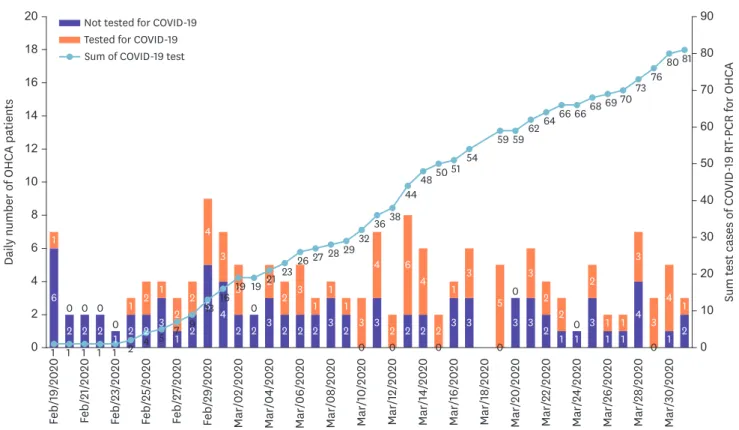
However, at the time of this unprecedented outbreak, treatment guidelines or studies for patients with OHCA had not been established. Moreover, there were no studies that can predict whether patients with OHCA were infected with COVID-19. Therefore, COVID-19 test was decided at the discretion of the ED doctor (Fig. 1).
When COVID-19 was the primary reason for the cardiac arrest, patients may have high viral loads, suggesting a high risk of transmission [6]. Therefore, it was essential to protect healthcare workers who participated in CPR from infection to perform epidemiologic investigations for contact tracing and to ensure the implementation of procedures to prevent the spread of infection during the funeral. This study aimed to develop and validate a simple multimodal screening tool that aids in predicting the disease confirmation in emergency situations.
MATERIALS AND METHODS
1. Study setting and data collection
Daegu is a city with a population of 2.43 million, with 2,897 reported cases of emergency medical service (EMS)–treated adult OHCA in 2018. Daegu has 2 regional and 4 local emergency medical centers with 19 emergency rooms. Because advanced cardiac life support, postcardiac arrest care, and cardiovascular interventions are available in all these centers, these 6 emergency medical centers treat most patients with cardiac arrest.
Data of all patients who visited all 6 emergency centers in Daegu during the outbreak period from February 19 to March 31, 2020, were managed in a registration system, and primary data were analyzed. We established community research groups under the name WinCOVID-19
in Daegu. The target patients were registered using a prepared uniform dataset based on the emergency center census and EMS sheet, and the medical records of the subjects were retrospectively reviewed.
2. Derivation cohort
The derivation cohort was used to develop the early warning characteristics of suspected COVID-19 infection during the early outbreak phase. We evaluated all emergency patients (over 18 years) who had undergone COVID-19 reverse transcription polymerase chain reaction (RT-PCR) tests in a regional emergency medical center from March 1 to March 21. To evaluate COVID-related variables, we obtained data, such as clinical symptoms or signs (sore throat and cough), initial vital signs (systolic pressure, heart rate, respiratory rate, oxygen saturation, and body temperature), epidemiologic risk factors (high-risk cluster, contact with patients with confirmed COVID-19, exposure history), chest X-ray (CXR) findings (pneumonic infiltration, parapneumonic pleural effusion), and clinical outcomes at ED discharge or during hospitalization.
From March 1 to March 21, 262 eligible patients who visited in a regional emergency center were identified, 20 of whom were excluded because vital signs were absent on arrival (n = 3) or there was data duplication (revisit of >2 times; n = 17). The remaining 242 patients were used as the derivation cohort. The criteria for screening COVID-19-positive patients were then determined using univariate and multivariable logistic analysis. We analyzed the data to identify the associations between the epidemiologic and clinical characteristics and positive COVID-19 tests of the patients. The adjusted odds ratios (ORs) were calculated after adjusting for sex, age, initial vital signs, exposure history, clinical features (hypoxia, tachypnea),
Daily number of OHCA patients Feb/19/2020 Feb/21/2020 Feb/23/2020 Feb/25/2020 Feb/27/2020 Feb/29/2020 Mar/02/2020 Mar/04/2020 Mar/06/2020 Mar/08/2020 Mar/10/2020 Mar/12/2020 Mar/14/2020 Mar/16/2020 Mar/18/2020 Mar/20/2020 Mar/22/2020 Mar/24/2020 Mar/26/2020 Mar/28/2020 Mar/30/2020
0 2 4 6 8 10 12 14 16 18 20
0 10 20 30 40 50 60 70 80 90
Sum test cases of COVID-19 RT-PCR for OHCA
6 1
2 2 2 1 2 1
2 2
3 1
1 2
2 2 5
4
4 3
2 3
3 2
2 2
2 1
2 1
3 4
2 6
2 0 2
3
3 1
0
3 2
0 2 4
3 1
3 3
0 5
3 3
3 0
2 2
01 1
2 3
2
1 1 1
1 4
3
0 3
1 4
2 1 2
0 0 0 0
0
1 1 1 1 1 2 4 5 7 9
13 16 19 1921 23
26 2728 293236 38
444850 5154
59 596264 66 6668 69 70
737680 81 Not tested for COVID-19
Tested for COVID-19 Sum of COVID-19 test
Figure 1. Sum test cases of COVID-19 RT-PCR for OHCA during the COVID-19 outbreak in Daegu.
COVID-19, coronavirus disease 2019; RT-PCR, reverse transcription polymerase chain reaction; OHCA, out of hospital cardiac arrest.
presence or absence of fever (defined as a temperature of ≥37.5°C), and abnormal CXR findings. The characteristics of the adjusted ORs are presented using forest plots, and the ORs with 95% confidence intervals (CIs) were estimated.
3. Validation cohort
The WinCOVID-19 citywide OHCA registry data were used to conduct a multicenter registry- based observational study. Validation cohort was used to develop a tool to screen for patients with COVID-19 among patients with OHCA using this uniform dataset. There were 184 EMS- treated OHCA cases in Daegu during the study observation period from February 19 to March 31, 2020. We excluded children below the age of 18 years, those with trauma, dead on arrival cases, a previously COVID-19 confirmed case before cardiac arrest, and 85 cases that were not tested for COVID-19 (Fig. 2). Of the remaining OHCA cases, 80 cases who underwent an RT- PCR test were included in this study.
The study investigated patient data on gender, age, the conduct of CPR, and epidemiologic risk factors, such as exposure to infection (Shincheonji church members — members of a specific religious group in which a large outbreak occurred, a recent history of visiting a COVID-19 — affected country, contact with confirmed and suspected patients, and
categorized in high-risk groups, such as patients from Daenam Hospital in Cheongdo–cohort quarantined hospital because of outbreaks, nursing homes with confirmed cases or from areas with cluster outbreaks, etc.). The following characteristics were also investigated:
the presence or absence of fever, laboratory findings during the hospital visit, RT-PCR test results after CPR, the presence or absence of abnormal findings in postmortem CXRs (lung consolidation, pleural effusion, etc.).
Undergone COVID-19 RT-PCR test (n = 80, 48.2%) Risk evaluation of COVID-19
Fever before cardiac arrest (n = 17, 21.3%) Presence of epidemiologic risk factors (n = 2, 2.5%) Abnormal chest PA findings (n = 60, 75.0%)
Enrolled non-traumatic, EMS-treated OHCA patients in Daegu, Korea during the COVID-19 outbreak (n = 166)
Adult, EMS-treated OHCA (n = 184) (From 2020.02.19 to 2020.03.31)
Under 18 years of age (n = 4), DOA (n = 5) Traumatic cardiac arrest (n = 8) Data missing variables (n = 1)
No COVID-19 RT-PCR test (n = 85, 51.2%) COVID-19 confirm before arrest (n = 1, 0.6%)
Positive COVID-19 RT-PCR test
(n = 9, 11.3%) Negative COVID-19 RT-PCR test (n = 71, 88.2%)
Figure 2. OHCA patient enrollment during the COVID-19 outbreak in Daegu and patient characteristics.
OHCA, out of hospital cardiac arrest; COVID-19, coronavirus disease 2019; DOA, death on arrival; EMS, emergency medical service; RT-PCR, reverse transcription-polymerase chain reaction.
For the validation cohort, patients were classified into COVID-19-positive and COVID- 19-negative groups. Medical history, epidemiologic risk factors, presence or absence of fever, CXR results, and hematologic findings were compared. The criteria for screening COVID-19-positive patients were then determined using a validation analysis. We studied 7 types of combined predictive criteria which were created by the combination with fever, epidemiologic risk factors, and abnormal CXR. In evaluating the combination prediction models for COVID-19 in OHCAs, we extracted patients with OHCA who met the criteria for each dominating model of COVID-19 confirmation. To identify patients with OHCA with a risk of COVID-19, we calculated the sensitivities, specificities, positive predictive values (PPVs), negative predictive values (NPVs), and false-negative rate (FNR) and their respective 95% CIs. The predictive performance of these models was measured by the FNR for the rule (the probability that the model will suggest a negative case or misclassify a patient as not having the disease when the patient was confirmed with COVID-19) and the PPV of the model (the confirmation of COVID-19 when the model suggests the disease). The screening tool used to confirm or suspect the disease must be reliable with a high sensitivity and an FNR close to 0% with a narrow 95% CI.
4. Diagnostic tool of COVID-19
For the diagnosis of COVID-19, we used severe acute respiratory syndrome coronavirus 2 nucleic acid testing (2019-nCoV real-time PCR kit [KogeneBiotech, Seoul, Korea] and Allplex 2019- nCoV Assay [Seegene, Seoul, Korea]–approved emergency diagnostic kits in Korea in February).
Specimens were collected by doctors or nurses using nasopharyngeal swabs after CPR.
5. Statistical analysis
IBM SPSS Statistics version 25 (IBM Corp., Armonk, NY, USA) and MedCalc version 17 (MedCalc Software, Mariakerke, Belgium) were used for data analysis. Categorical variables are presented as frequency and percentage, whereas continuous variables are presented as the median and interquartile range (25th to 75th percentile). The chi-square or Fisher's exact test was used to compare categorical variables. The Shapiro–Wilk test was used to determine the normality of the variables. A t-test or one-way analysis of variance and the Mann–Whitney U test were used to compare continuous variables. All tests were 2 tailed, and P <0.05 was considered statistically significant.
6. Ethics statement
The Institutional Review Boards of Kyungpook National University Hospital (no. 2020- 04032) and Kyungpook National University Chilgok Hospital (no. 2020-06040) approved this retrospective study, and participant informed consent was waived.
RESULTS
1. Derivation cohort
The validation cohort included 242 patients with OHCA during the early COVID-19 outbreak. The univariable analysis for the ED general population is presented in Table 1.
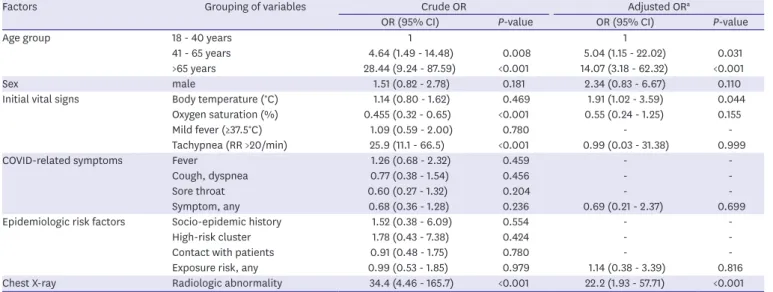
Patient demographics and predicting factors were analyzed using multivariable logistic regression, and the results are presented in Table 2 and Figure 3. Advanced age, raised body temperature, and abnormal CXR indicated a significant predictive power for a positive COVID-19 test result. The ORs from the derivation model were as follows: 14.1 (95% CI, 3.2 - 62.7) for age above 65 years, 22.2 (95% CI, 1.93 - 57.71) for abnormal CXR, and 1.91 (95% CI,
1.02 - 3.59) for initial body temperature. The P-value of Hosmer–Lemeshow goodness-of-fit test was 0.633.
2. General characteristics of the validation cohort
A total of 80 patients with OHCA were included in the validation cohort; their general characteristics are presented in Table 3. Moreover, 9 cases were included in the COVID-19- positive group and 71 in the COVID-19-negative group, based on the COVID-19 RT-PCR test.
There were 46 males (57.5%) and 34 females (42.5%). Notably, 20 patients (25.0%) were aged below 65 years and 60 (75.0%) were aged above 65 years. Gender, age, and prevalence of underlying diseases were not significantly different between the 2 groups. Clinical laboratory data of patients with OHCA are presented in Supplementary Table 1.
Two patients (2.8%) in the COVID-19-negative group had epidemiologic risk factors for COVID-19 infection, but none (0%) in the COVID-19-positive group had epidemiologic risk Table 1. General characteristics of the ED patients with screening RT-PCR test in COVID-19 outbreak (derivation cohort)
Characteristics Overall
(n = 242) Result of COVID-19 RT-PCR P-value
COVID-19 (+)
(n = 54, 22.3%) COVID-19 (−) (n = 188, 77.7%)
Sex, n (%) 0.180
Male 115 (47.5) 30 (55.6) 85 (45.2)
Female 127 (52.5) 24 (44.4) 103 (54.8)
Age, median (IQR) 50.0 (34.0 - 65.5) 70.0 (59.0 - 79.0) 43.5 (32.0 - 58.0) <0.001
18 - 40 years 91 (37.6) 4 (7.4) 87 (46.3) <0.001
41 - 65 years 91 (37.6) 16 (29.6) 75 (39.9)
>65 years 60 (24.8) 34 (63.0) 26 (13.8)
Initial vital signs, median (IQR)
Systolic pressure (mmHg) 149 (133 - 165) 146 (118 - 158) 149 (135 - 166) 0.024 Diastolic pressure (mmHg) 85 (77 - 95) 80 (71 - 87) 87 (79 - 97) 0.001 Pulse rate (per minute) 93 (80 - 108) 92 (81 - 110) 93 (80 - 107) 0.818 Respiratory rate (per minute) 20 (20 - 20) 20 (20 - 24) 20 (20 - 20) <0.001 Body temperature (°C) 37.3 (36.8 - 37.8) 37.3 (36.8 - 37.8) 37.3 (36.8 - 37.8) 0.889
Oxygen saturation (%) 99 (99 - 99) 98 (96 - 99) 99 (99 - 99) <0.001
Respiratory screening signs
Mild fever ≥37.5°C 108 (44.6) 25 (46.3) 83 (44.1) 0.780
Tachypnea (RR >20) 18 (7.4) 17 (31.5) 1 (0.5) <0.001
Oxygen saturation ≤94% 9 (3.7) 9 (16.7) 0 <0.001
COVID-related symptoms
Fever 97 (40.1) 24 (44.4) 73 (38.8) 0.458
Cough, dyspnea 68 (28.1) 13 (24.1) 55 (29.3) 0.455
Sore throat 56 (23.1) 9 (16.7) 47 (25.0) 0.201
Related symptom, any 164 (67.8) 33 (61.1) 131 (69.7) 0.235
Risk factors
Socio-epidemic contact 10 (4.1) 3 (5.6) 7 (3.7) 0.551
Travel history 0 0 0 -
High-risk cluster 9 (3.7) 3 (5.6) 6 (3.2) 0.418
Contact with patients 80 (33.1) 17 (31.5) 63 (33.5) 0.780
Exposure risk, any 90 (37.2) 20 (37.0) 70 (37.2) 0.979
Radiologic finding <0.001
Normal finding 206 (85.1) 19 (35.2) 187 (99.5)
Abnormality on chest X-ray 36 (14.9) 35 (64.8) 1 (0.5)
Clinical outcomes <0.001
Admission, ward 26 (10.7) 26 (48.1) 0
Admission, ICU 6 (2.5) 6 (11.5) 0
In-hospital death 11 (4.5) 11 (20.4) 0
ED, emergency department; RT-PCR, reverse transcription-polymerase chain reaction; COVID-19, coronavirus disease 2019; IQR, interquartile range; RR, respiratory rate; ICU, intensive care unit.
factors. Five patients (55.6%) in the COVID-19-positive group had a fever before OHCA, and 12 (16.9%) of the COVID-19-negative group had a fever before OHCA, which was significantly different between the 2 groups (P = 0.018). Eight patients (88.9%) of the COVID-19-positive group had a CXR indicating pneumonic infiltration. In the COVID-19-negative group, 52 patients (73.2%) had a CXR indicating pneumonic infiltration. Survival admissions were 11 (13.8%) and 10 (14.1%) in the COVID-19-negative group and 1 (11.1%) in the COVID-19- positive group. Furthermore, 6 (8.5%) in the COVID-19-negative group were discharged alive (survival), but none in the COVID-19-positive group.
Table 2. Potential predictive factors for confirmation of COVID-19 in the derivation cohort
Factors Grouping of variables Crude OR Adjusted ORa
OR (95% CI) P-value OR (95% CI) P-value
Age group 18 - 40 years 1 1
41 - 65 years 4.64 (1.49 - 14.48) 0.008 5.04 (1.15 - 22.02) 0.031
>65 years 28.44 (9.24 - 87.59) <0.001 14.07 (3.18 - 62.32) <0.001
Sex male 1.51 (0.82 - 2.78) 0.181 2.34 (0.83 - 6.67) 0.110
Initial vital signs Body temperature (°C) 1.14 (0.80 - 1.62) 0.469 1.91 (1.02 - 3.59) 0.044
Oxygen saturation (%) 0.455 (0.32 - 0.65) <0.001 0.55 (0.24 - 1.25) 0.155
Mild fever (≥37.5°C) 1.09 (0.59 - 2.00) 0.780 - -
Tachypnea (RR >20/min) 25.9 (11.1 - 66.5) <0.001 0.99 (0.03 - 31.38) 0.999
COVID-related symptoms Fever 1.26 (0.68 - 2.32) 0.459 - -
Cough, dyspnea 0.77 (0.38 - 1.54) 0.456 - -
Sore throat 0.60 (0.27 - 1.32) 0.204 - -
Symptom, any 0.68 (0.36 - 1.28) 0.236 0.69 (0.21 - 2.37) 0.699
Epidemiologic risk factors Socio-epidemic history 1.52 (0.38 - 6.09) 0.554 - -
High-risk cluster 1.78 (0.43 - 7.38) 0.424 - -
Contact with patients 0.91 (0.48 - 1.75) 0.780 - -
Exposure risk, any 0.99 (0.53 - 1.85) 0.979 1.14 (0.38 - 3.39) 0.816
Chest X-ray Radiologic abnormality 34.4 (4.46 - 165.7) <0.001 22.2 (1.93 - 57.71) <0.001
aAdjusted by age group, sex (male), body temperature, oxygen saturation detected by pulse oximetry, clinical features (hypoxia, tachypnea, mild fever), any exposure history, and abnormal radiologic finding on chest X-ray. To determine the logistic model calibration, we calculated the Hosmer-Lemeshow goodness of fit (P value = 0.633).
COVID-19, coronavirus disease 2019; OR, odds ratio; CI, confidence interval; RR, respiratory rate.
Age 18 – 40 (reference)
Abnormal chest X-ray findings Epidemiologic risk factor, any COVID-19 related symptom, fever Tachypnea (RR >20/min) Oxygen saturation Body temperature Sex, male Age >65 Age 41 – 65
0.01 0.1 1 10 100
Odds ratio
Figure 3. Forest plot for predicting potential factors for confirmation of COVID-19 in the derivation cohort.
COVID-19, coronavirus disease 2019; RR, respiratory rate.
3. Ability of the confirmation test criteria to predict COVID-19 in patients with OHCA
The validation of the confirmation test criteria is presented in Table 4. The overall combined criteria of fever or abnormal CXR were superior, with a sensitivity of 100% (95% CI, 65.4 - 100), a specificity of 22.5% (95% CI, 13.5 - 34.0), a false-negative ratio of 0% (95% CI, 0 - 33.6), a PPV of 14.1% (95% CI, 7.0 - 25.5), and an NPV of 100% (95% CI, 75.9 - 100). After adding the epidemiologic risk factor, sensitivity and FNR were similar to the combined criteria of fever or abnormal CXR criteria (Table 4).
DISCUSSION
We reviewed patients who developed OHCA during the outbreak and investigated the characteristics of patients with confirmed COVID-19. According to other studies, fever was the most common COVID-19 symptom and was present in 80% to 90% of confirmed patients Table 3. General characteristics of OHCA patients who had a COVID-19 RT-PCR test
Variables All patients COVID-19 RT-PCR test P-value
Negative Positive
N 80 (100.0) 71 (88.2) 9 (11.3)
Gender, n (%) 0.159
Male 46 (57.5) 43 (60.6) 3 (33.3)
Female 34 (42.5) 28 (39.4) 6 (66.7)
Age, median (IQR) 75.5 (64.5 - 80.8) 75.0 (65.0 - 81.0) 77.0 (63.0 - 79.5) 0.921
Age group, n (%) 0.684
<65 years 20 (25.0) 17 (23.9) 3 (33.3)
≥65 years 60 (75.0) 54 (76.1) 6 (66.7)
Underlying disease, n (%)
Hypertension 34 (42.5) 29 (40.8) 5 (55.6) 0.484
Diabetes mellitus 26 (32.5) 22 (31.0) 4 (44.4) 0.462
CKD 4 (5.0) 3 (4.2) 1 (11.1) 0.386
Cancer 16 (20.0) 13 (18.3) 3 (33.3) 0.373
COPD 4 (5.0) 4 (5.6) 0 (0.0) 1.000
HF, MI, Angina 10 (12.5) 9 (12.7) 1 (11.1) 1.000
Dementia, Parkinson 12 (15.0) 12 (16.9) 0 (0.0) 0.342
ICH, Stroke 7 (8.8) 6 (8.5) 1 (11.1) 0.581
LC, others 5 (6.3) 3 (4.2) 2 (22.2) 0.095
Epidemiologic risk factorsa 0.786
Absence 78 (97.5) 69 (97.2) 9 (100)
Presencea 2 (2.5) 2 (2.8) 0 (0.0)
Fever before OHCAb 0.018
No 63 (78.8) 59 (83.1) 4 (44.4)
Yes 17 (21.3) 12 (16.9) 5 (55.6)
Chest X-ray 0.284
Unremarkable 20 (25.0) 19 (26.8) 1 (11.1)
Abnormal consolidation 60 (75.0) 52 (73.2) 8 (88.9)
ROSC 22 (27.5) 19 (26.8) 3 (33.3) 0.700
Survival Admission 11 (13.8) 10 (14.1) 1 (11.1) 1.000
Survival Discharge 6 (7.5) 6 (8.5) 0 (0.0) 1.000
aEpidemiologic risk factors for COVID-19: (Sincheonji church members, hospital staff, or patients from community infection areas like Cheongdodaenam hospital), history of recent visit to high-risk country, contact with a COVID-19 patient or COVID-19 suspected person.
binitial fever ≥37.5.
OHCA, out of hospital cardiac arrest; COVID-19, coronavirus disease 2019; RT-PCR, reverse transcription- polymerase chain reaction; IQR, interquartile range; CKD, chronic kidney disease; COPD, chronic obstructive pulmonary disease; HF, heart failure; MI, myocardial infarction; ICH, intracranial hemorrhage; LC, liver cirrhosis;
ROSC, return of spontaneous circulation.
[7]. In this study, 5 patients (55.6%) who had an infection confirmed postmortem had developed fever before cardiac arrest. Eight patients (88.9%) in the COVID-19-positive group had a radiological pneumonic infiltration on CXR.
To determine factors that could predict COVID-19 infection in patients with OHCA, this study compared the sensitivities and specificities of the 7 OHCA screening criteria. The fever or abnormal CXR group showed a sensitivity of 100% and a specificity of 22.5%, respectively (Table 4). Although low specificity is a limitation, a test with high sensitivity is generally used for screening, whereas a test with a high specificity is used as a confirmatory test. As the performances of the confirmation test criteria to predict COVID-19 in patients with OHCA in the outbreak area, new criteria consisting of 2 variables (fever and abnormal CXR findings) would be reliable with a high sensitivity focus on subjects and an FNR close to 0% with narrow 95% CI in this study. Therefore, in an outbreak, it is appropriate to suspect possible positive cases when patients meet the fever or abnormal CXR criteria and to conduct an RT- PCR test in all patients with OHCA during emergency visits.
However, in the early phase of emerging infectious disease, because clear guidelines or studies for managing patients with OHCA had not been established, there has been confusion on the frontline of emergency services in the COVID-19 epidemic areas. Leading public health organizations such as the World Health Organization, the KCDC, and the American Heart Association issued temporary recommendations or updates that provided treatment guidelines that based on the evidence from previous outbreaks, such as severe acute respiratory syndrome and the Middle East respiratory syndrome [8]. In those recent resuscitation guidelines related to COVID-19, it is recommended that all patients are Table 4. Validation of the confirmation test criteria for predicting COVID-19 in OHCA patients
Criteria COVID (+) COVID (−) Sensitivity Specificity FNR PPV NPV
Fevera
Met criteria 5 12 55.6% 83.1% 44.4% 29.4% 93.7%
Did not all fulfill criteria 4 59 (21.2 - 86.3) (72.3 - 90.9) (13.7 - 78.8) (16.0 - 47.6) (87.6 - 96.9) Epidemiologic risk factorsb
Met criteria 0 2 0% 97.2% 100% 0% 88.5%
Did not all fulfill criteria 9 69 (0 - 33.6) (90.2 - 99.6) (66.4 - 100) (0 - 80.2) (78.7 - 94.2)
Abnormal CXRc
Met criteria 8 52 88.9% 26.8% 11.1% 13.3% 95.0%
Did not all fulfill criteria 1 19 (51.8 - 99.7) (16.9 - 38.6) (0.3 - 48.2) (10.5 - 16.8) (74.2 - 99.2) Fever or Epidemiologic risk factors
Met any criteria 5 14 55.6% 80.3% 44.4% 26.3% 93.4%
Did not all fulfill criteria 4 57 (21.2 - 86.3) (69.1 - 88.8) (13.7 - 78.8) (14.4 - 43.0) (87.2 - 96.8) Fever or Abnormal CXR
Met any criteria 9 55 100% 22.5% 0% 14.1% 100%
Did not all fulfill criteria 0 16 (66.4 - 100) (13.5 - 34.0) (0 - 33.6) (7.0 - 25.5) (75.9 - 100)
Epidemiologic risk factors or Abnormal CXR
Met any criteria 8 53 88.9% 25.4% 11.1% 13.1% 94.7%
Did not all fulfill criteria 1 18 (51.8 - 97.7) (15.8 - 37.1) (2.3 - 48.2) (10.4 - 16.5) (73.1 - 99.2) Fever or Epidemiologic risk factors or Abnormal CXR
Met any criteria 9 56 100% 21.1% 0% 13.8% 100%
Did not all fulfill criteria 0 15 (66.4 - 100) (12.3 - 32.4) (0 - 33.6) (6.9 - 25.2) (74.7 - 100)
Values are presented as statistical value (95% Confidence Interval).
aInitial fever ≥37.5.
bPresence of epidemiologic risk factors: (Sincheonji church members, hospital members, or patients from community infection areas like Cheongdodaenam hospital), recent history of visiting high-risk country, contact with a COVID-19 patient or COVID-19 suspected person.
cAbnormal chest X-ray image defined a suggestive of pneumonic infiltration or a parapneumonic effusion.
COVID-19, coronavirus disease 19; OHCA, out of hospital cardiac arrest; FNR, false negative rate; PPV, positive predictive value; NPV, negative predictive value;
CXR, chest X-ray.
screened for COVID-19 symptoms (e.g., fever, cough, shortness of breath) or any recent contact history with COVID-19-infected people before hospital arrival. However, as shown in the results of this study, screening using 2 variables (fever and/or epidemiologic risk factors) is not adequate for performing in emergency situations (FNR = 44.4%).
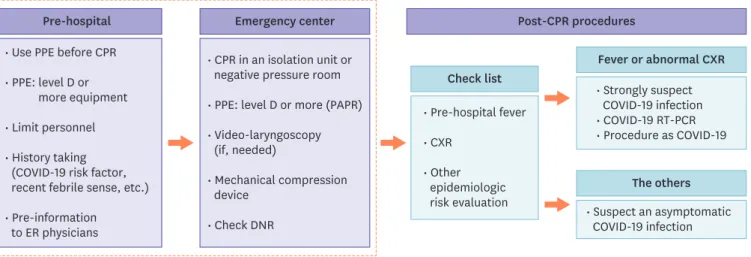
According to the results of this study, it is recommended that the patient's medical history is obtained for screening and to perform CXR. If there are abnormal findings on the CXR or the patient presented with a fever before the visit, COVID-19 infection should be strongly suspected; hence, performing RT-PCR tests is strongly encouraged. However, asymptomatic infections in patients with COVID-19 have been confirmed in the literature and this study [9, 10]. Therefore, COVID-19 testing in all patients with OHCA is recommended, if possible, because COVID-19 screening with test results or symptoms may not be feasible when COVID-19 is not the main cause of cardiac arrest (Fig. 4).
This study has some limitations. First, the number of study subjects was limited because the study was conducted over a short period. The sample size was inadequate for statistical analysis and generalization. To overcome the sample size, a derivation cohort that was used targeting general COVID-19-infected patients, not patients with OHCA, also remains a limitation. Second, because of the retrospective nature of this study, the same approaches and examinations were not performed in all patients. Some OHCA may not have had a COVID-19 test despite the presence of related symptoms and an abnormal CXR. In Daegu, 85 patients with OHCA did not have an RT-PCR test because of the absence of guidelines for testing. Of the 85 patients, 2 patients presented with fever and 38 patients had abnormal CXR findings; some of these patients may have been infected.
In conclusion, screening for COVID-19 infection in patients with OHCA during outbreaks using screening tool with abnormal findings on the CXR or those who present with fever before hospital arrival is helpful. Moreover, further study should be continued to make adequate screening tool and guidelines for treatment.
Pre-hospital
• Use PPE before CPR
• PPE: level D or more equipment
• Limit personnel
• History taking (COVID-19 risk factor, recent febrile sense, etc.)
• Pre-information to ER physicians
Post-CPR procedures Emergency center
• CPR in an isolation unit or negative pressure room
• PPE: level D or more (PAPR)
• Video-laryngoscopy (if, needed)
• Mechanical compression device
• Check DNR
Check list
• Pre-hospital fever
• CXR
• Other epidemiologic risk evaluation
Fever or abnormal CXR
• Strongly suspect COVID-19 infection
• COVID-19 RT-PCR
• Procedure as COVID-19
The others
• Suspect an asymptomatic COVID-19 infection
Figure 4. Guidelines for management in OHCA patients and the confirmation test during the COVID-19 outbreak.
OHCA, out of hospital cardiac arrest; COVID-19, coronavirus disease 19; CPR, cardiopulmonary resuscitation; PPE, personal protective equipment; ER, emergency room; PAPR, powered air purifying respirator; DNR, do not resuscitate; CXR, chest X-ray; RT-PCR, reverse transcription-polymerase chain reaction.
SUPPLEMENTARY MATERIAL
Supplementary Table 1
Clinical laboratory data of OHCA patients in COVID-19 outbreak Click here to view
REFERENCES
1. Korea Centers for Disease Control and Prevention (KCDC). Press release. Available at: https://www.cdc.
go.kr/board/board.es?mid=a30402000000&bid=0030. Accessed 15 April 2020.
2. Korean Society of Infectious Diseases, Korea Centers for Disease Control and Prevention. Analysis on 54 mortality cases of coronavirus disease 2019 in the Republic of Korea from January 19 to March 10, 2020. J Korean Med Sci 2020;35:e132.
PUBMED | CROSSREF
3. Korean Society of Infectious Diseases, Korean Society of Pediatric Infectious DiseasesKorean Society of Epidemiology, Korean Society for Antimicrobial Therapy, Korean Society for Healthcare-associated Infection Control and Prevention, Korea Centers for Disease Control and Prevention. Report on the epidemiological features of coronavirus disease 2019 (COVID-19) outbreak in the Republic of Korea from January 19 to March 2, 2020. J Korean Med Sci 2020;35:e112.
PUBMED | CROSSREF
4. Korean Statistical Information Service (KOSIS). Population by administrative region. Available at: http://
kosis.kr/statHtml/statHtml.do?orgId=101&tblId=DT_1B040A3&checkFlag=N. Accessed 15 April 2020.
5. Chung HS, Lee DE, Kim JK, Yeo IH, Kim C, Park J, Seo KS, Park SY, Kim JH, Kim G, Lee SH, Cheon JJ, Kim YH. Revised triage and surveillance protocols for temporary emergency department closures in tertiary hospitals as a response to COVID-19 Crisis in Daegu Metropolitan city. J Korean Med Sci 2020;35:e189.
PUBMED | CROSSREF
6. Liu Y, Yan LM, Wan L, Xiang TX, Le A, Liu JM, Peiris M, Poon LLM, Zhang W. Viral dynamics in mild and severe cases of COVID-19. Lancet Infect Dis 2020;20:656-7.
PUBMED | CROSSREF
7. Huang C, Wang Y, Li X, Ren L, Zhao J, Hu Y, Zhang L, Fan G, Xu J, Gu X, Cheng Z, Yu T, Xia J, Wei Y, Wu W, Xie X, Yin W, Li H, Liu M, Xiao Y, Gao H, Guo L, Xie J, Wang G, Jiang R, Gao Z, Jin Q, Wang J, Cao B. Clinical features of patients infected with 2019 novel coronavirus in Wuhan, China. Lancet 2020;395:497-506.
PUBMED | CROSSREF
8. Advanced Cardiovascular Life Support (ACLS). Cardiac arrest algorithm for suspected or confirmed COVID-19 patients. Available at: https://cpr.heart.org/-/media/cpr-files/resources/covid-19-resources-for- cpr-training/english/algorithmacls_cacovid_200406.pdf ?la=en. Accessed 1 May 2020.
9. Tan C, Xiao Y, Meng X, Huang X, Li C, Wu A. Asymptomatic SARS-CoV-2 infections: what do we need to know? Infect Control Hosp Epidemiol 2020:1-2. [Epub ahead of print].
PUBMED | CROSSREF
10. Qiu J. Covert coronavirus infections could be seeding new outbreaks. Nature 2020. [Epub ahead of print].
PUBMED | CROSSREF