Time Perspective in Individuals with Sluggish Cognitive Tempo
Yelin Park Kiho Kim Jang-Han Lee
†Department of Psychology, Chung-Ang University, Seoul, Korea
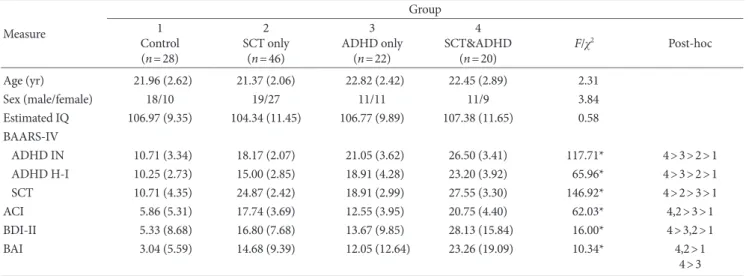
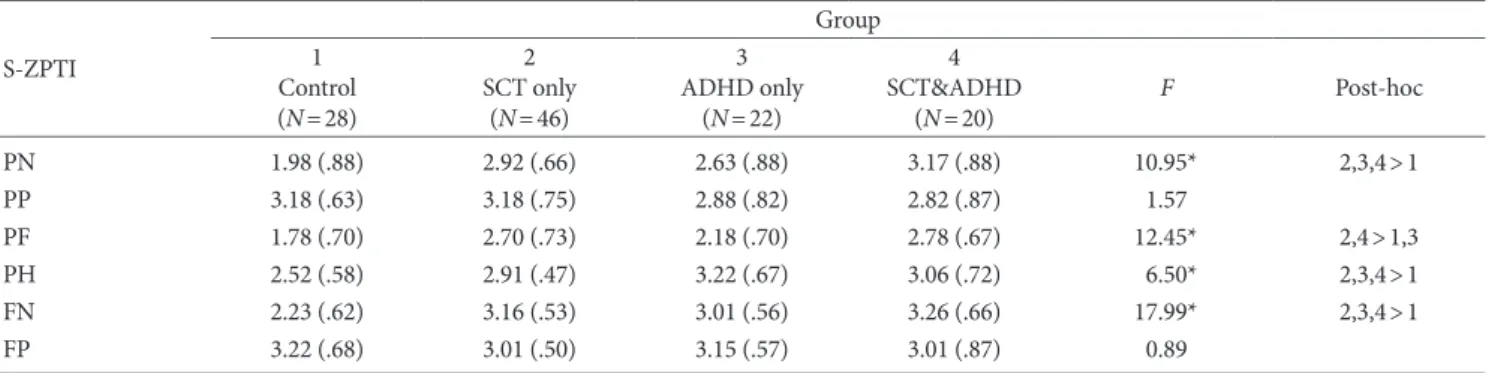
Individuals with sluggish cognitive tempo (SCT) experience difficulties in achieving goal-directed behaviors. As time per- spective (TP) helps elaborate problems in goal pursuit, this study aimed to identify the TP of individuals with SCT and com- pare it to individuals with attention-deficit/hyperactivity disorder (ADHD). The screening was performed using the Barkley Adult ADHD Rating Scale-IV, and participants were divided into the following groups: SCT & ADHD (n=20), SCT only (n=46), ADHD only (n=22), and healthy controls (n=28). To assess TP, participants also completed the Swedish Zimbardo Time Perspective Inventory. After controlling for depression and anxiety, the SCT only group showed higher present-fatalistic and future-negative TP compared to healthy controls. The ADHD only group showed higher present-hedonistic and future- negative TP when compared to healthy controls. These results indicate that individuals with SCT have a generally fatalistic at- titude and an aversive view of the future, possibly associated with low engagement in social and academic activities. On the other hand, individuals with ADHD have a present-oriented view and an aversive view of the future, possibly related to im- pulsivity.
Keywords: sluggish cognitive tempo, attention-deficit/hyperactivity disorder, time perspective, present-fatalistic, present-he- donistic, future-negative
Introduction
Sluggish cognitive tempo (SCT) is a cluster of symptoms charac- terized by sluggishness, daydreaming, slow movement, hypoactiv- ity, and mentally foggy (Barkley, 2012, 2013). Initially, SCT was considered to be a specifier of attention-deficit/hyperactivity dis- order (ADHD); now, it has become clear that SCT should be stud- ied as a psychiatric disorder in its own right (Garner et al., 2017).
More specifically, factor analysis studies have repeatedly shown that SCT is strongly related to but distinct from ADHD inatten- tion, internalizing symptoms of depression and anxiety, and day- time sleepiness (Garner, Mrug, Hodgens, & Patterson, 2013; Lei- kauf & Solanto, 2017; Smith, Eadeh, Breaux, & Langberg, 2018). In
terms of comorbidity patterns, ADHD symptoms are positively associated with externalizing symptoms, as in oppositional defi- ant disorder, conduct disorder, substance use disorder, while SCT symptoms are more positively correlated with internalizing symp- toms including depression, anxiety, social withdrawal (Barkley, 2013, 2014; Becker, Garner, Tamm, Antonini, & Epstein, 2017;
Fenollar Cortés et al., 2017; Jarrett, Rapport, Rondon, & Becker, 2017). In terms of executive functions, individuals with SCT had difficulties in self-organization/problem-solving, time-manage- ment, and emotion regulation. Individuals with ADHD had diffi- culties with time management and self-restraint (Barkley, 2012).
In daily life, both SCT and ADHD symptoms are related to de- creased psychological well-being. SCT is also negatively related to the physical quality of life, whereas ADHD is negatively related to the environmental quality of life (Combs, Canu, Broman Fulks, &
Nieman, 2014). It is revealed that SCT is associated with difficul- ties in various functioning domains and turned out SCT to be
© 2020 Korean Clinical Psychology Association
2020. Vol. 39, No. 1, 53-63
eISSN 2733-4538
†
Correspondence to Jang-Han Lee, Department of Psychology, Chung-Ang University, 84 Heukseok-ro, Dongjak-gu, Seoul, Korea; E-mail: clipsy@cau.
ac.kr
Received Oct 8, 2019; Revised Jan 17, 2020; Accepted Jan 27, 2020
https://doi.org/10.15842/kjcp.2020.39.1.006