RESEARCH ARTICLE
Smoking, development of or recovery from metabolic syndrome, and major adverse cardiovascular events: A nationwide
population-based cohort study including 6 million people
Sehoon Park1,2☯, Kyungdo Han3☯, Soojin Lee4,5, Yaerim KimID6, Yeonhee Lee4,5, Min Woo Kang4,5, Sanghyun Park7, Yong Chul Kim4, Seung Seok Han4,8, Hajeong Lee4, Jung Pyo Lee4,8,9, Kwon Wook Joo4,5,8, Chun Soo Lim4,8,9, Yon Su Kim1,4,5,8, Dong Ki KimID4,5,8*
1 Department of Biomedical Sciences, Seoul National University College of Medicine, Seoul, Korea, 2 Department of Internal Medicine, Armed Forces Capital Hospital, Gyeonggi-do, Korea, 3 Department of Statistics and Actuarial Science, Soongsil University, Seoul, Korea, 4 Department of Internal Medicine, Seoul National University Hospital, Seoul, Korea, 5 Department of Internal Medicine, Seoul National University College of Medicine, Seoul, Korea, 6 Department of Internal Medicine, Keimyung University School of Medicine, Daegu, Korea, 7 Department of Medical Statistics, College of Medicine, Catholic University of Korea, Seoul, Korea, 8 Kidney Research Institute, Seoul National University, Seoul, Korea, 9 Department of Internal Medicine, Seoul National University Boramae Medical Center, Seoul, Korea
☯These authors contributed equally to this work.
Abstract
Smoking, metabolic syndrome (MetS), and major adverse cardiovascular events (MACEs) are important global health problems. We aimed to investigate the association between smoking, alteration in MetS status, and the consequent risk of MACE. We performed a nationwide observational cohort study based on the claims database of Korea. We included people with�3 national health screenings from 2009 to 2013. Total 6,099,717 people, including 3,576,236 nonsmokers, 862,210 ex-smokers, 949,586 light-to-moderate smokers, and 711,685 heavy smokers, at the first health screening, were investigated. First, we per- formed a logistic regression analysis using smoking status at the first screening as the expo- sure variable and MetS development or recovery as the outcome variable. Second, we performed a Poisson regression using smoking status at the third screening as the exposure variable and the outcome was risk of incident MACEs. Among those previously free from MetS (N = 4,889,493), 347,678 people developed MetS, and among those who had previ- ous MetS (N = 1,210,224), 347,627 people recovered from MetS. Smoking was related to a higher risk of MetS development [for heavy smokers: adjusted OR 1.71 (1.69 to 1.73)] and a lower probability of MetS recovery [for heavy smokers: adjusted OR 0.68 (0.67 to 0.69)].
Elevated triglycerides was the MetS component with the most prominent association with smoking. The risk for incident MACEs (78,640 events during a median follow-up of 4.28 years) was the highest for heavy smokers, followed in order by light-to-moderate, ex-smok- ers and nonsmokers, for every MetS status. Therefore, smoking may promote MetS or even a1111111111
a1111111111 a1111111111 a1111111111 a1111111111
OPEN ACCESS
Citation: Park S, Han K, Lee S, Kim Y, Lee Y, Kang MW, et al. (2021) Smoking, development of or recovery from metabolic syndrome, and major adverse cardiovascular events: A nationwide population-based cohort study including 6 million people. PLoS ONE 16(1): e0241623.https://doi.
org/10.1371/journal.pone.0241623
Editor: Gianluigi Savarese, Karolinska Institutet, SWEDEN
Received: July 11, 2020 Accepted: October 19, 2020 Published: January 12, 2021
Copyright:© 2021 Park et al. This is an open access article distributed under the terms of the Creative Commons Attribution License, which permits unrestricted use, distribution, and reproduction in any medium, provided the original author and source are credited.
Data Availability Statement: The datasets generated and/or analysed during the current study are available in the National Health Insurance Sharing Service (URL:https://nhiss.nhis.or.kr/bd/
ay/bdaya001iv.do, lastaccessed January, 5, 2021), under data number NHIS-2019-1-651, after acquiring approval from the organization.
Funding: This work was supported by a grant from the Korea Healthcare Technology R&D Project, Ministry of Health and Welfare, Republic of Korea
hinder recovery from MetS. Smoking cessation should be emphasized to reduce MACE risk even for those without MetS.
Introduction
Tobacco smoking is related to various health risks, including cancer, lung disease, fractures, and many others [1,2]. In particular, smoking causes major adverse cardiovascular events
(MACEs), which are a leading cause of death globally [3,4]. Nevertheless, the smoking rates remain high in certain nations, and approximately a billion people currently smoke globally [5].
Metabolic syndrome (MetS) represents a cluster of conventional metabolic risk factors (e.g., central obesity, glucose intolerance, elevated blood pressure, and dyslipidemia) [6] that is another major contributor to the risk of MACEs in the general population, and its prevalence is rising globally [7,8]. Previous studies focused on the synergistic harm of smoking and MetS on cardiovascular health [9], and it has been suggested that smoking itself may trigger MetS [10–13]. Therefore, controlling metabolic risk factors by reducing smoking and encouraging a healthy diet and exercise is a common lifestyle modification strategy to reduce the risk of MACEs [14–18]. Few large cohort studies that have investigated the association between MetS and MACEs have considered smoking history [9]. Nevertheless, as a patient’s MetS status can change dynamically [19], population-scale evidence obtained in quantitative assessments of the relationship between the risk of MACEs and smoking in people with various dynamic MetS states would be useful information for guiding public policy. In addition, whether smok- ing is associated with hindrance of recovery from MetS or facilitating its development could be further investigated longitudinally at a large-scale in a nationwide cohort study in which MetS status is assessed sequentially [20]. In particular, determining which MetS component is more prominently related to smoking or whether MetS recovery is inhibited by smoking would be essential to further evaluating the adverse effects of smoking on metabolic health.
In this nationwide study, we assessed one of the largest nationwide cohorts to investigate whether prior smoking status was related to a higher risk of MetS development or to hindrance during recovery from previous MetS. We further analyzed the MACE prognosis of people with various dynamic MetS statuses according to their smoking status. We hypothesized that smok- ing would be associated with the facilitation of MetS and a higher MACE risk in the general population.
Materials and methods Ethics considerations
The institutional review board of Seoul National University Hospital (no. E-1801-027-913) approved this study. The institutional review board waived the requirement for informed con- sent as anonymous data from the National Health Insurance Service of Republic of Korea. The data was provided by the National Health Insurance Service after approval (no. NHIS-2019-1- 651). The study was conducted in accordance with the Declaration of Helsinki.
Study setting
The study environment was described in our previous study [19]. The National Health Insur- ance Service of the Republic of Korea provides general nationwide health insurance services for all Korean people, and the related claims information and health screening results are accu- mulated in a public database [21,22]. General health screening includes a free-of-charge
(HI17C0530). he funders had no role in study design, data collection and analysis, decision to publish, or preparation of the manuscript.
Competing interests: The authors have declared that no competing interests exist.
nationwide exam provided to subscribers. We used the self-reported questionnaire results included in the health screening to evaluate smoking exposure, the lab data obtained in health screenings and claims information to evaluate MetS status, and claims information to identify MACE outcomes.
Study population
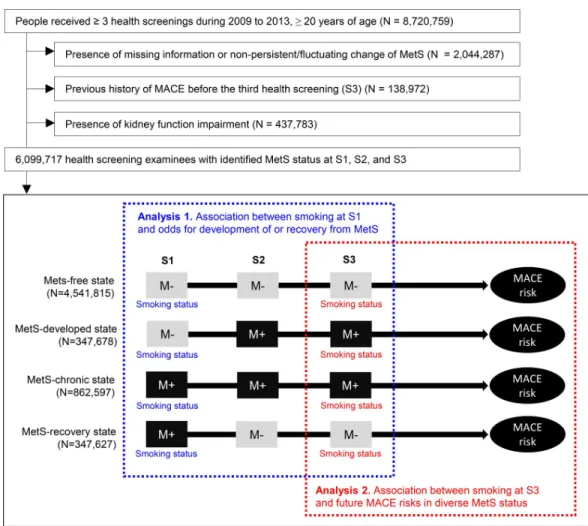
We included adults (� 20 years old) who received � 3 national health screenings from 2009 to 2013 (Fig 1), and the information from the first three health screenings (S1, S2, and S3) and the associated claims data were investigated to obtain the study population. As we could not include persons with insufficient information related to lifestyle variables, clinical characteris- tics, or MetS profiles, those with missing information in the analyzed variables were excluded.
In addition, we excluded persons with transient changes in MetS status as we aimed to study subjects who showed stable changes in or the maintenance of their MetS state. In addition, we also excluded those showing changes in MetS status at the third health screening (S3) to ensure that the identified changes in MetS status were consistent. Finally, as we intended to study a population with no history of MACEs or significant kidney function impairment before the completion of the first 3 health screenings (S1, S2, and S3), we excluded persons with a history of MACE or indicators of kidney diseases (baseline estimated glomerular filtration rate < 60 mL/min/1.73 m2calculated using the Modification of Diet in Renal Disease equation, a chronic kidney disease diagnostic code, or a history of renal replacement therapy) before S3.
Exclusion of those with kidney function impairment was because the clinical significance of metabolic parameters may be different in the people with chronic kidney disease [23,24].
Data collection
The main exposure variable was smoking status, which was collected from self-reported ques- tionnaires included in the general health screening, which can be found in S1 Fig inS1 File.
Non-smokers were those who had not smoked a total of � 100 cigarettes in their lifetime and were not smoking at the time, ex-smokers as those who smoked � 100 cigarettes in their life- time but were not smoking at the time, and current-smokers as those who were smoking at the time of the survey [25]. We additionally stratified the current-smokers as “light-to-moderate”
and “heavy” smokers, and those who smoked � 20 cigarettes per day were defined as heavy smokers). Other details related to demographics, lifestyle variables, and variables that reflect the severity of MetS are presented in S2 Method inS1 File. All characteristics, including smok- ing status, were collected at both S1 and S3.
Identification of MetS status
MetS status was determined using the harmonized criteria, as previously described [6]. People with � 3 of the 5 following criteria were considered to have MetS at the corresponding health screening: central obesity (waist circumference � 90 cm for males and � 80 cm for females among Asian individuals); high triglycerides (� 150 mg/dL or the use of a relevant drug); low high-density lipoprotein cholesterol (< 40 mg/dL for males, 50 mg/dL for females or the use of a relevant drug); high blood pressure (systolic � 130 and/or diastolic � 80 mmHg or the use of an anti-hypertensives); and high fasting plasma glucose (fasting glucose � 100 mg/dL or the use of an anti-diabetics). A free state of a metabolic component was defined when a relevant medi- cation was not prescribed and the lab or anthropometric value was not in the abnormal ranges.
Based on the absence/presence state of Mets in the first three health screenings (S1, S2, and S3), we defined four dynamic MetS statuses (Fig 1): MetS-free, when no MetS (< 3 MetS com- ponents) was found during S1, S2, and S3; MetS-chronic, when MetS was present for all of S1,
S2, and S3; MetS-recovery, when stable recovery from preexisting MetS was observed (MetS present at S1 but not at S2 and S3); and MetS-developed, when MetS was newly developed and persistent for one more health screening (no MetS at S1 but MetS present at S2 and S3) [19].
These 4 MetS statuses were used as the outcome variable in the analysis of the association between smoking status at S1 and the probability of the MetS status changing during the S2 and S3 follow-up screenings. In addition, MetS status was used to define subgroups in the anal- ysis of the associations between smoking status at S3 and future MACE risks in people with various MetS statuses.
Assessment of the association between smoking and metabolic syndrome In the first part of this study, we used smoking status at S1 as the exposure variable and change in MetS status as the outcome variable (Fig 1). In this investigation, the first outcome was
“development of MetS”, which was studied in patients free from MetS at S1 (the “MetS-devel- oped” and “MetS-free” status groups described above). Those with a MetS-developed state
Fig 1. Study population. The flow diagram for the study population. The first three health screenings are indicated as S1, S2, and S3. The gray squares with “M–” indicate a health screening without identified metabolic syndrome MetS. Black squares with “M+” indicate a health screening with identified MetS. The first part of the study was performed with the smoking status at S1 used as the exposure variable and change in MetS status between S2 and S3 compared to S1 as the outcome variable. The second part of the study was performed with smoking status at S3 used as the exposure variable and future risk of MACE used as the outcome variable. MetS = metabolic syndrome, MACE = major adverse cardiovascular event.
https://doi.org/10.1371/journal.pone.0241623.g001
were considered to have the outcome occurrence. The second outcome was “recovery from MetS”, which included people with MetS at S1 (those with a “MetS-recovered” or “MetS- chronic” status). People with a MetS-recovery state included those with the recovery outcome.
We additionally performed analyses regarding the association between smoking status and the probability of each MetS component (central obesity, elevated blood pressure, high fasting plasma glucose, high triglycerides, and low high-density lipoprotein cholesterol). In these anal- yses, we defined the dynamic status of each MetS component following the same method described above, and the odds for development of or recovery from each MetS component were investigated according to smoking status at S1.
Assessment of the association between smoking and MACEs in various MetS statuses
In the second part of the study, smoking status at S3 was used as the exposure variable, and future risk of MACEs after completion of the three health screenings (S1, S2, and S3) was the outcome variable. In this analysis, we investigated these associations by dividing each sub- group according to dynamic MetS status (Fig 1). The prognostic study outcome, MACE, was a composite of acute myocardial infarction, coronary revascularization and acute ischemic stroke events, which were defined according the claims database, as described in S2 Method in S1 File. The follow-up was initiated from a day after S3. We censored death events or follow- up ended on December 31, 2016, as no additional claims information was available for this study after that date.
Statistical analysis
Continuous variables are presented as mean values (standard deviations), and categorical vari- ables are presented as numbers (percentages). For the associations between prior smoking sta- tus and MetS development or recovery, odds ratios for the outcomes were calculated with logistic regression analyses. For the associations between smoking status and MACE risk in the people with various MetS statuses, the incidence rate ratios of MACEs were calculated with Poisson regression. The age- and sex-adjusted results are presented as smoking exposure was substantially different according to these two important clinical variables. The details regard- ing the constructions and statistical analysis of the multivariable regression model are described in S2 Method inS1 File. All statistical analyses were performed using SAS, and two- sided P values <0.05 were considered significant.
Results
Study population and their characteristics
Among the 8,720,759 people who had � 3 health screenings, we excluded those with missing information or nonstable MetS status (N = 2,044,287), those with a history of MACEs before the third health screening (S3) (N = 138,972), and those with indicators of kidney function impairment (N = 437,782). We finally included 6,099,717 people in this study (Fig 1).
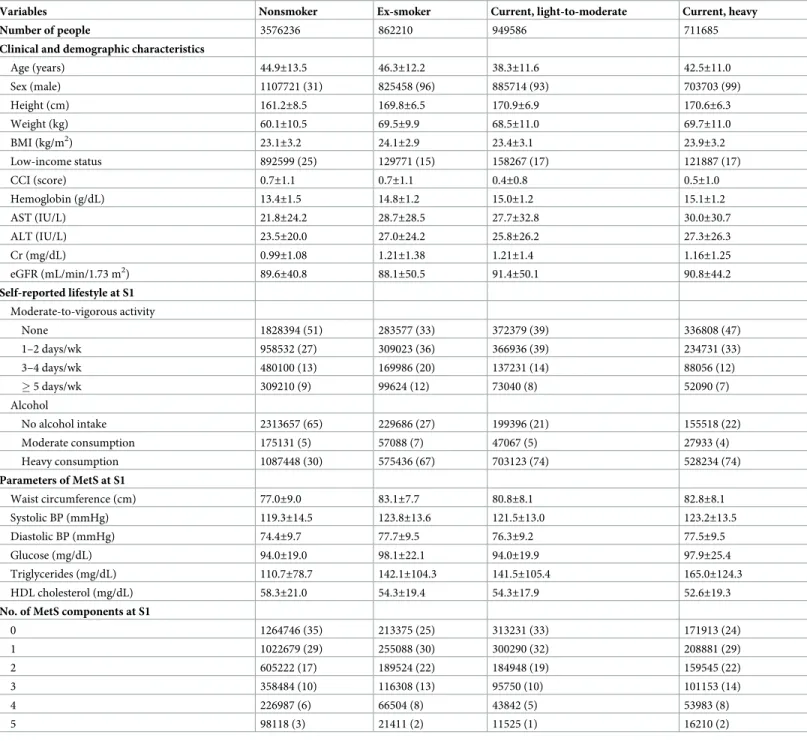
The characteristics of the study population were collected at S1 and S3. At the first health screening (S1), 3,576,236 non-smokers, 862,210 ex-smokers, 949,586 current light-to-moder- ate smokers, and 711,685 current heavy smokers were identified (Table 1). The current smok- ers were predominantly male and relatively younger than ex-smokers or nonsmokers. Among nonsmokers, a relatively large portion of them was female, and the proportion not engaged in moderate-to-vigorous physical activity or alcohol consumption was higher than the propor- tion that was engaged in these activities. Regarding the MetS components present at S1, the
proportions of nonsmokers and light-to-moderate current smokers who were free from any MetS component were relatively higher than the corresponding proportion of heavy or ex- smokers. The overall trend was similar when the characteristics were collected at the third health screening (S3) (S3 Table inS1 File).
Prior smoking status and development of or recovery from MetS The numbers of people with dynamic or stable MetS status were as follows: MetS-free [N = 4,541,815 (74.3%)], MetS-chronic [N = 862,597 (13.5%)], MetS-developed [N = 347,627 (5.7%)], and MetS-recovery [N = 347,678 (5.7%)]. Although the odds ratios were heteroge- neous in the unadjusted model, people with a smoking history at the first screening had a sig- nificantly higher risk of MetS development and a lower probability of recovering from MetS in the age- and sex-adjusted models (Table 2). In the multivariable model adjusted for variables including body mass index, severity of MetS, physical activity and alcohol consumption behav- ior, being an ex-smoker was related to approximately 10% higher odds of developing MetS and 10% lower odds of MetS recovery than was found in nonsmokers. Current smokers at S1 had higher probabilities of having MetS at S2 and S3 than was found in ex-smokers. In particu- lar, heavy smoking was associated with a more than 70% higher odds of developing MetS and a more than 30% lower odds of recovering from MetS than was found in nonsmokers.
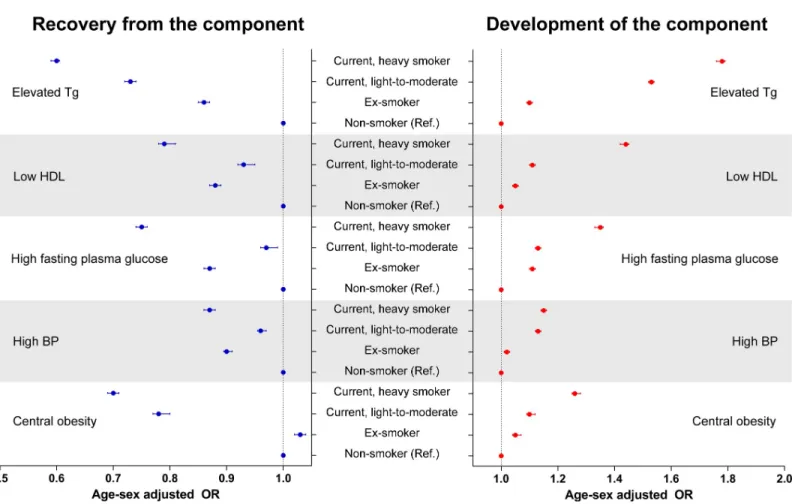
Regarding individual components, we found that elevated triglycerides was most strongly associated with smoking status after considering the association sizes with regard for both the development of and recovery from the component (Fig 2). This finding remained similar when other characteristics, including self-reported frequencies of moderate-to-vigorous physi- cal activity or alcohol consumption, were also adjusted (S4 and S5 Tables inS1 File). The development of or recovery from other MetS components were also significantly associated with prior smoking status, and current smoking was associated with higher odds of future MetS, particularly in heavy smokers, in the multivariable analysis.
MACE risks according to smoking status in MetS subgroups
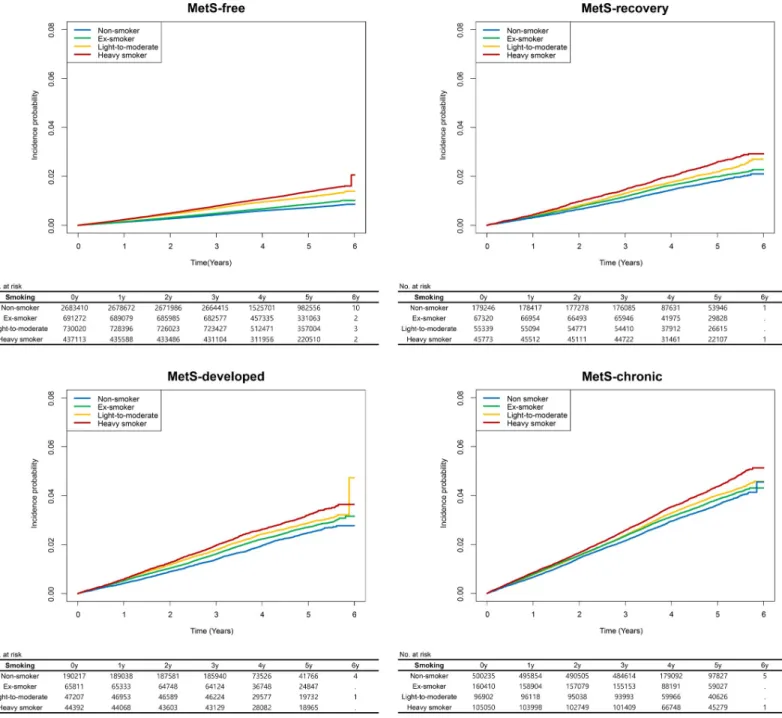
The study population was followed-up for a median of 4.28 (3.50–5.25) years after the three health screenings. The incidence rate ratios for MACEs in each MetS subgroup are shown according to smoking status at S3 inTable 3and differed significantly among the groups, plot- ted inFig 3. Heavy smokers in the MetS-chronic state had the highest (8.94/1,000 person- years), while nonsmokers in the MetS-free state had the lowest (1.46/1,000 person-years) inci- dence rate of MACEs. The age- and sex-adjusted risks of MACEs were found, in increasing order, in non-smokers, ex-smokers, light-to-moderate current smokers, and heavy smokers, with heavy smokers having a nearly 2-fold higher risk than was found in nonsmokers.
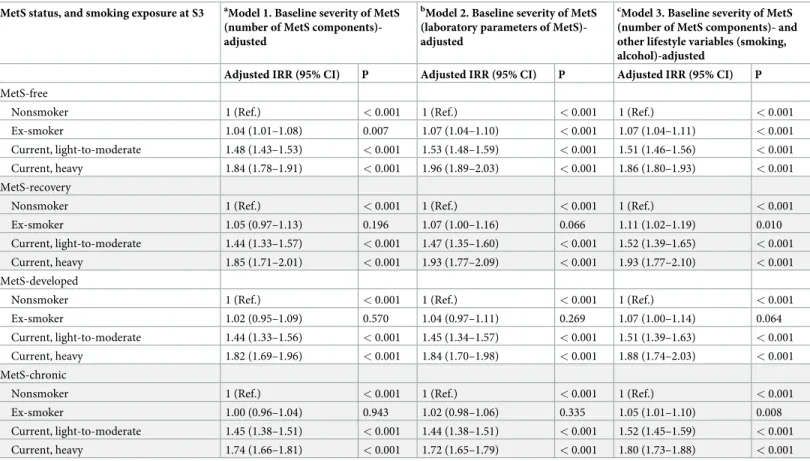
Although those with MetS at S3 had a higher risk of a MACE than was found in those without, those who were smoking but in a MetS-free or MetS-recovery state had a comparable or even higher adjusted risk of MACEs than was found in those who were not smoking and in a MetS- developed or MetS-chronic state. Similar results were found for acute myocardial infarction, revascularization, and acute ischemic stroke outcomes when analyzed individually (S6, S7, and S8 Tables inS1 File). When additional adjustments for other clinicodemographic characteris- tics and baseline severity of MetS were performed, an ex-smoker history was related to an approximately 5–10% higher risk of MACEs in each MetS status subgroup (Table 4). In addi- tion, the light-to-moderate current smokers and heavy smokers had an approximately 50%
and 90% higher risk of MACEs, respectively, than was found in nonsmokers, regardless of MetS status.
Discussion
In this nationwide study, smoking was significantly associated with the development or hin- drance of recovery from MetS. Elevated triglycerides was the MetS criterion for which the development or hindrance of recovery was most prominently associated with smoking status.
Table 1. Characteristics of the study population at the first health screening (S1).
Variables Nonsmoker Ex-smoker Current, light-to-moderate Current, heavy
Number of people 3576236 862210 949586 711685
Clinical and demographic characteristics
Age (years) 44.9±13.5 46.3±12.2 38.3±11.6 42.5±11.0
Sex (male) 1107721 (31) 825458 (96) 885714 (93) 703703 (99)
Height (cm) 161.2±8.5 169.8±6.5 170.9±6.9 170.6±6.3
Weight (kg) 60.1±10.5 69.5±9.9 68.5±11.0 69.7±11.0
BMI (kg/m2) 23.1±3.2 24.1±2.9 23.4±3.1 23.9±3.2
Low-income status 892599 (25) 129771 (15) 158267 (17) 121887 (17)
CCI (score) 0.7±1.1 0.7±1.1 0.4±0.8 0.5±1.0
Hemoglobin (g/dL) 13.4±1.5 14.8±1.2 15.0±1.2 15.1±1.2
AST (IU/L) 21.8±24.2 28.7±28.5 27.7±32.8 30.0±30.7
ALT (IU/L) 23.5±20.0 27.0±24.2 25.8±26.2 27.3±26.3
Cr (mg/dL) 0.99±1.08 1.21±1.38 1.21±1.4 1.16±1.25
eGFR (mL/min/1.73 m2) 89.6±40.8 88.1±50.5 91.4±50.1 90.8±44.2
Self-reported lifestyle at S1 Moderate-to-vigorous activity
None 1828394 (51) 283577 (33) 372379 (39) 336808 (47)
1–2 days/wk 958532 (27) 309023 (36) 366936 (39) 234731 (33)
3–4 days/wk 480100 (13) 169986 (20) 137231 (14) 88056 (12)
� 5 days/wk 309210 (9) 99624 (12) 73040 (8) 52090 (7)
Alcohol
No alcohol intake 2313657 (65) 229686 (27) 199396 (21) 155518 (22)
Moderate consumption 175131 (5) 57088 (7) 47067 (5) 27933 (4)
Heavy consumption 1087448 (30) 575436 (67) 703123 (74) 528234 (74)
Parameters of MetS at S1
Waist circumference (cm) 77.0±9.0 83.1±7.7 80.8±8.1 82.8±8.1
Systolic BP (mmHg) 119.3±14.5 123.8±13.6 121.5±13.0 123.2±13.5
Diastolic BP (mmHg) 74.4±9.7 77.7±9.5 76.3±9.2 77.5±9.5
Glucose (mg/dL) 94.0±19.0 98.1±22.1 94.0±19.9 97.9±25.4
Triglycerides (mg/dL) 110.7±78.7 142.1±104.3 141.5±105.4 165.0±124.3
HDL cholesterol (mg/dL) 58.3±21.0 54.3±19.4 54.3±17.9 52.6±19.3
No. of MetS components at S1
0 1264746 (35) 213375 (25) 313231 (33) 171913 (24)
1 1022679 (29) 255088 (30) 300290 (32) 208881 (29)
2 605222 (17) 189524 (22) 184948 (19) 159545 (22)
3 358484 (10) 116308 (13) 95750 (10) 101153 (14)
4 226987 (6) 66504 (8) 43842 (5) 53983 (8)
5 98118 (3) 21411 (2) 11525 (1) 16210 (2)
MetS = metabolic syndrome, BMI = body mass index, CCI = Charlson Comorbidity Index, AST = aspartate aminotransferase, ALT = alanine aminotransferase, Cr = creatinine, eGFR = estimated glomerular filtration rate, BP = blood pressure, HDL = high-density lipoprotein.
There were no missing values in the table.
https://doi.org/10.1371/journal.pone.0241623.t001
In addition, regardless of which MetS status group was analyzed, a smoking history was related to a higher MACE risk, and current smokers, especially heavy smokers, had an even higher risk of MACE. Our study provides large-scale evidence showing that smoking may cause harm during all stages of cardiovascular disease development, from the facilitation of MetS to a higher risk of MACEs.
A population-scale study investigating whether smoking promotes MetS including sequen- tial health screening results is scarce. Moreover, a description of the sizes of the associations between smoking and MACE risks in the general population with diverse MetS statuses would be helpful as MACE risks vary substantially according to the population’s dynamic MetS status [19]. Our study has strengths, including that we found 1) that smoking may promote or hinder recovery from MetS in a large-scale general population cohort including repetitive assessments for MetS; 2) that the sizes of association with smoking varied among the MetS components, with elevated triglycerides having the strongest association; 3) and that the association between smoking and MACE risks was significant regardless of MetS status. Our study results addition- ally alert the medical community to the harm caused by smoking at overall stages from MetS to MACE development and further emphasize the importance of smoking cessation.
Table 2. Smoking status and its association with recovery from or development of metabolic syndrome.
Prior MetS status and outcome
Smoking status at S1
Number of subjects
Number of outcomes and percent
Unadjusted model Model 1. Age-/sex- adjusted
aModel 2. Clinical factors, including the values of adjusted MetS parameters
bModel 3. Clinical factors, including the number of MetS components and other adjusted lifestyle variables OR (95%
CI)
p Adjusted
OR (95%
CI)
p Adjusted
OR (95%
CI)
p Adjusted
OR (95%
CI)
p
MetS development as the outcome in persons without underlying MetS (MetS-free or MetS-developed state)
Nonsmoker 2892647 191211 (6.6%) Reference Reference Reference Reference
Ex-smoker 657987 54702 (8.3%) 1.28 (1.27–
1.29)
<
0.001
1.20 (1.18–
1.21)
<
0.001
1.08 (1.07–
1.10)
<
0.001
1.10 (1.08–
1.11)
<
0.001 Current, light-
to-moderate
798469 48887 (6.1%) 0.92 (0.91–
0.93)
<
0.001
1.32 (1.30–
1.34)
<
0.001
1.33 (1.31–
1.34)
<
0.001
1.37 (1.35–
1.38)
<
0.001 Current,
heavy
540339 52827 (9.8%) 1.53 (1.52–
1.55)
<
0.001
1.80 (1.78–
1.82)
<
0.001
1.61 (1.59–
1.63)
<
0.001
1.71 (1.69–
1.73)
<
0.001 MetS-recovery as the outcome
in persons with underlying MetS (MetS-chronic or MetS- recovery state)
Nonsmoker 683589 181169
(26.5%)
Reference Reference Reference Reference
Ex-smoker 204223 61372 (30.0%) 1.19 (1.18–
1.20)
<
0.001
0.88 (0.87–
0.89)
<
0.001
0.89 (0.88–
0.90)
<
0.001
0.90 (0.89–
0.92)
<
0.001 Current, light-
to-moderate
151117 54630 (36.2%) 1.57 (1.55–
1.59)
<
0.001
0.86 (0.85–
0.88)
<
0.001
0.84 (0.83–
0.86)
0.001 0.82 (0.81–
0.84)
<
0.001 Current,
heavy
171346 50507 (29.5%) 1.16 (1.15–
1.17)
<
0.001
0.68 (0.67–
0.69)
<
0.001
0.72 (0.71–
0.74)
<
0.001
0.68 (0.67–
0.69)
<
0.001
MetS = metabolic syndrome, OR = odds ratio, CI = confidence interval.
Heavy smoking was defined as smoking � 20 cigarettes per day.
aModel 2 was adjusted for age, sex, baseline eGFR (continuous, mL/min/1.73 m2), alanine aminotransferase (continuous, IU/mL aspartate aminotransferase (continuous, IU/mL), hemoglobin (continuous, g/dL), low income status (the lowest quartile in the nation), body mass index (continuous, kg/m2), the Charlson Comorbidity Index, and the values of MetS components at the first health screening (S1).
bModel 3 was adjusted for the same variables as Model 2, but the number of MetS components at the first screening (S1) was adjusted for instead the values of MetS components and other lifestyle variables [self-reported frequencies of moderate-to-vigorous exercise (categorical: none/week, 1–2 days/week, 3–4 days/week, and � 5 days/week) and drinking status (categorical: none, moderate consumption of � 2 standard drinks for males and � 1 standard drink for females per single drinking session, and more than moderate)] were additionally adjusted for the model.
https://doi.org/10.1371/journal.pone.0241623.t002
Few studies have explored cross-sectional associations between smoking and MetS preva- lence [11–13], and some studies have shown that smoking is related to higher risks of incident MetS components, providing important insights into the adverse effects of smoking on meta- bolic health [20,26–31]. The previous studies firstly focused on the impact of smoking on the development of diabetes, and a previous meta-analysis investigated 1.2 million individuals and reported that the risk of diabetes associated with active smoking [20]. In Korea, a prospective cohort study including 1.2 million individuals also reported a significant association between smoking and diabetes [28]. There were other studies demonstrating that smoking is associated with the risk of hypertension [29,30], obesity [31], and dyslipidemia [12]. Our study results additionally confirm previous reports that showed that smoking may worsen metabolic pro- files; in this study, our large-scale repetitive assessment of various MetS profiles including 6 million people emphasizes the finding. In addition, our finding that smoking may suppress MetS recovery, which commonly occurs in persons with relatively nonsevere MetS [19], is important because few population-based cohort studies have explored this issue. In our study results, current smokers had higher adjusted probabilities of MetS than was found in ex- or nonsmokers, and heavy smokers had the highest risks of MetS development and the lowest probability of recovery from MetS. Therefore, people with metabolic risk factors and smoking
Fig 2. Association between smoking status and development of or recovery from individual MetS components. The blue dots and error bars indicate the age- and sex-adjusted odds ratios and 95% confidence intervals for recovery from the component. The red dots and error bars indicate the age- and sex-adjusted odds ratios and 95% confidence intervals for the development of the component. The recovery from individual MetS components was assessed within between individuals with the component at the first health screening (S1) and those who no longer fulfilled the criterion in the second (S2) and third (S3) health screenings were considered to be recovered from the MetS component. The development of individual MetS components was assessed between individuals without the component at S1 and those who fulfilled the criterion at S2 and S3 were considered to have developed the MetS component. All odds ratios are presented with nonsmokers used as the reference group.
https://doi.org/10.1371/journal.pone.0241623.g002
histories should be made aware of these risks and encouraged to try to quit or at least reduce smoking to ameliorate the critical burden of MetS.
Our study shows that all individual MetS components were associated with smoking, addi- tionally emphasizing the harm caused by smoking on metabolic health. Additionally, we com- pared the sizes of the associations between smoking and individual MetS components and found that elevated triglycerides or low high-density lipoprotein cholesterol, the dyslipidemia, had relatively large association sizes [12,32]. These results suggest that further studies focused on the mechanisms of dyslipidemia in smokers are warranted.
The age- and sex-adjusted effect sizes of the associations between smoking and MACE risks are noteworthy. Heavy smokers consistently free of MetS had even higher risks of MACE than were found in those who developed MetS but were not smoking, further supporting the notion that smoking alone exerts adverse effects. Also, the finding suggests the possibility that quitting smoking may overcome the adverse impact of MetS in certain people, emphasizing the
Table 3. Risks of major adverse cardiovascular events according to smoking status at S3 and dynamic metabolic syndrome status.
MetS status Smoking status at S3
Number of subjects
Number of MACEs
Follow-up (person-years)
Incidence rate (/1000 person-years)
Unadjusted model Age-/sex-adjusted IRR (95%
CI)
p Adjusted IRR (95% CI)
p
MetS-free Nonsmoker 2683410 16892 11587438 1.46 1 (Ref.) <
0.001
1 (Ref.) <
0.001
Ex-smoker 691272 7328 3119304 2.35 1.61 (1.57–
1.66)
<
0.001
1.08 (1.05–1.11) <
0.001 Current, light-to-
moderate
730020 5705 3324731 1.72 1.18 (1.14–
1.21)
<
0.001
1.43 (1.38–1.47) <
0.001
Current, heavy 437113 5474 1994115 2.75 1.88 (1.83–
1.94)
<
0.001
1.86 (1.80–1.92) <
0.001 MetS-
recovery
Nonsmoker 179246 3020 749040 4.03 2.77 (2.66–
2.87)
<
0.001
1.47 (1.41–1.53) <
0.001
Ex-smoker 67320 1337 298000 4.49 3.08 (2.91–
3.25)
<
0.001
1.57 (1.48–1.66) <
0.001 Current, light-to-
moderate
55339 905 249434 3.63 2.49 (2.33–
2.66)
<
0.001
2.11 (1.98–2.26) <
0.001
Current, heavy 45773 1060 205848 5.15 3.53 (3.32–
3.76)
<
0.001
2.86 (2.68–3.04) <
0.001 MetS-
developed
Nonsmoker 190217 4213 761886 5.53 3.79 (3.67–
3.92)
<
0.001
1.67 (1.62–1.73) <
0.001
Ex-smoker 65811 1671 281987 5.93 4.06 (3.87–
4.27)
<
0.001
1.80 (1.71–1.90) <
0.001 Current, light-to-
moderate
47207 1019 206241 4.94 3.39 (3.18–
3.61)
<
0.001
2.61 (2.45–2.79) <
0.001
Current, heavy 44392 1273 193887 6.57 4.50 (4.25–
4.77)
<
0.001
3.43 (3.24–3.64) <
0.001 MetS-
chronic
Nonsmoker 500235 16170 1977354 8.18 5.61 (5.49–
5.73)
<
0.001
2.03 (1.98–2.07) <
0.001
Ex-smoker 160410 5362 683130 7.85 5.38 (5.22–
5.55)
<
0.001
2.08 (2.01–2.15) <
0.001 Current, light-to-
moderate
96902 3110 421703 7.37 5.06 (4.87–
5.26)
<
0.001
3.18 (3.05–3.30) <
0.001
Current, heavy 105050 4101 458713 8.94 6.13 (5.93–
6.35)
<
0.001
4.05 (3.91–4.20) <
0.001
MetS = metabolic syndrome, MACE = major adverse cardiovascular events, IRR = incidence rate ratio, CI = confidence interval Heavy smoking was defined as smoking � 20 cigarettes per day.
https://doi.org/10.1371/journal.pone.0241623.t003
necessity of smoke cessation. As the age- and sex-adjusted incidence rate of MACE was approximately 90% higher in heavy smokers than in nonsmokers, this dangerous behavior should be particularly discouraged. In addition, even people with a MetS-free or MetS-recov- ery state had significantly higher risks of MACEs if they were smokers, so these metabolically healthy smokers should not be considered assured due to their absence of MetS and smoking should be similarly discouraged regardless of absence of MetS [33].
Fig 3. The survival curves were plotted in each MetS subgroup. The y-axes indicate the incidence probability of MACEs, including acute myocardial infarction, revascularization, and acute ischemic stroke. The x-axes indicate the time (years). The blue, green, orange and red curves indicate the incidences of MACEs in nonsmokers, ex-smokers, light-to-moderate smokers, and heavy smokers, respectively. The tables below the survival curves show the numbers of persons at risk.
MetS = metabolic syndrome.
https://doi.org/10.1371/journal.pone.0241623.g003
The current study which reported both the association between smoking and MetS, and smoking and MACE in various MetS status provides an integrative view for the adverse associ- ation between smoking, MetS, and MACE. Our findings suggest that smoking may have a harmful effect on the longitudinal spectrum of MACE development, from the initial develop- ment of MetS. In addition, the results demonstrated that smoking and MetS might have syner- gistic harm on MACE. Although the causality should be proven in further studies, policy to reduce the smoking rate would be one of the fundamental approaches to decrease the crucial burden of MetS and MACE in the current medicine.
There are several limitations in this study. First, as this is a retrospective study, there may be hidden confounders or unincluded events. In particular, consideration of nutrition may have provided additional insights; however, as this variable is not collected in general health screen- ings. Second, the accuracy of the implemented questionnaire has not been validated. However, as the questions included in the survey are relatively simple and the method used to quantify smoking history followed general consensus, limitations related to the questionnaire form may
Table 4. Risk of major adverse cardiovascular events according to smoking status at the third health screening (S3) in each study group.
MetS status, and smoking exposure at S3 aModel 1. Baseline severity of MetS (number of MetS components)- adjusted
bModel 2. Baseline severity of MetS (laboratory parameters of MetS)- adjusted
cModel 3. Baseline severity of MetS (number of MetS components)- and other lifestyle variables (smoking, alcohol)-adjusted
Adjusted IRR (95% CI) P Adjusted IRR (95% CI) P Adjusted IRR (95% CI) P MetS-free
Nonsmoker 1 (Ref.) < 0.001 1 (Ref.) < 0.001 1 (Ref.) < 0.001
Ex-smoker 1.04 (1.01–1.08) 0.007 1.07 (1.04–1.10) < 0.001 1.07 (1.04–1.11) < 0.001
Current, light-to-moderate 1.48 (1.43–1.53) < 0.001 1.53 (1.48–1.59) < 0.001 1.51 (1.46–1.56) < 0.001
Current, heavy 1.84 (1.78–1.91) < 0.001 1.96 (1.89–2.03) < 0.001 1.86 (1.80–1.93) < 0.001
MetS-recovery
Nonsmoker 1 (Ref.) < 0.001 1 (Ref.) < 0.001 1 (Ref.) < 0.001
Ex-smoker 1.05 (0.97–1.13) 0.196 1.07 (1.00–1.16) 0.066 1.11 (1.02–1.19) 0.010
Current, light-to-moderate 1.44 (1.33–1.57) < 0.001 1.47 (1.35–1.60) < 0.001 1.52 (1.39–1.65) < 0.001
Current, heavy 1.85 (1.71–2.01) < 0.001 1.93 (1.77–2.09) < 0.001 1.93 (1.77–2.10) < 0.001
MetS-developed
Nonsmoker 1 (Ref.) < 0.001 1 (Ref.) < 0.001 1 (Ref.) < 0.001
Ex-smoker 1.02 (0.95–1.09) 0.570 1.04 (0.97–1.11) 0.269 1.07 (1.00–1.14) 0.064
Current, light-to-moderate 1.44 (1.33–1.56) < 0.001 1.45 (1.34–1.57) < 0.001 1.51 (1.39–1.63) < 0.001
Current, heavy 1.82 (1.69–1.96) < 0.001 1.84 (1.70–1.98) < 0.001 1.88 (1.74–2.03) < 0.001
MetS-chronic
Nonsmoker 1 (Ref.) < 0.001 1 (Ref.) < 0.001 1 (Ref.) < 0.001
Ex-smoker 1.00 (0.96–1.04) 0.943 1.02 (0.98–1.06) 0.335 1.05 (1.01–1.10) 0.008
Current, light-to-moderate 1.45 (1.38–1.51) < 0.001 1.44 (1.38–1.51) < 0.001 1.52 (1.45–1.59) < 0.001
Current, heavy 1.74 (1.66–1.81) < 0.001 1.72 (1.65–1.79) < 0.001 1.80 (1.73–1.88) < 0.001
MetS = metabolic syndrome, IRR = incidence rate ratio, CI = confidence interval.
aModel 1 was adjusted for age, sex, baseline eGFR (continuous, mL/min/1.73 m2), alanine aminotransferase levels (continuous, IU/mL), aspartate aminotransferase levels (continuous, IU/mL), hemoglobin levels (continuous, g/dL), low income status (the lowest quartile in the nation), body mass index, the Charlson Comorbidity Index, and the number of MetS components at the third health screening (S3).
bModel 2 was adjusted for the same variables as those used in Model 1, but the exact values obtained for waist circumference, systolic BP, diastolic BP, fasting glucose levels, triglyceride levels, and high-density lipoprotein cholesterol levels were included in the multivariable model instead of the number of MetS components.
cModel 3 was adjusted for the same variables as those used in Model 1, but the other lifestyle variables (smoking: none, previous, or current; and alcohol consumption:
none, moderate, or heavy) at S3 were additionally included in the adjustment variable.
https://doi.org/10.1371/journal.pone.0241623.t004
be not critical. Third, the study population included individuals residing in a single nation, and their ethnic backgrounds were mostly Asian. Although this is a rare large-scale Asian cohort that assessed important health variables, whether the study results can be applied to populations in other nations is not secured. Finally, the smokers were predominantly male, similar to the actual smoking proportions reported from 2009 to 2013 in Korea, where more than 40% of male subjects and fewer than 10% of female subjects are smokers. As the main age- and sex-adjusted results and further multivariable models showed consistent trends, we believe this limitation is not critical, but it may be necessary to perform additional investiga- tions in nations with higher female smoking rates.
In conclusion, smoking may facilitate MetS development or inhibit recovery from MetS, further emphasizing that reducing the smoking rate is essential to alleviating the critical bur- den of MetS in general population. In addition, smoking was associated with higher MACE risks in general people with different MetS statuses, even those free from MetS. Cessation of smoking should be emphasized in general population to decrease the future burden of MetS and the risks of MACEs.
Supporting information S1 File.
(DOCX)
Acknowledgments
This study used the National Health Insurance Database managed by the National Health Insurance Service of Korea and an approach approved by this organization (no. NHIS-2019-1- 651).
Author Contributions
Conceptualization: Sehoon Park, Kyungdo Han, Soojin Lee, Yaerim Kim, Yeonhee Lee, Min Woo Kang, Yong Chul Kim, Dong Ki Kim.
Data curation: Sehoon Park, Kyungdo Han, Soojin Lee, Yeonhee Lee, Min Woo Kang, San- ghyun Park, Yong Chul Kim, Seung Seok Han, Hajeong Lee, Jung Pyo Lee, Kwon Wook Joo, Yon Su Kim, Dong Ki Kim.
Formal analysis: Sehoon Park, Kyungdo Han, Soojin Lee, Yaerim Kim, Yeonhee Lee, San- ghyun Park, Seung Seok Han, Hajeong Lee, Jung Pyo Lee, Kwon Wook Joo, Chun Soo Lim, Yon Su Kim, Dong Ki Kim.
Funding acquisition: Sehoon Park, Yaerim Kim, Min Woo Kang, Yon Su Kim, Dong Ki Kim.
Investigation: Sehoon Park, Kyungdo Han, Yaerim Kim, Sanghyun Park, Yong Chul Kim, Hajeong Lee, Jung Pyo Lee, Chun Soo Lim, Yon Su Kim, Dong Ki Kim.
Methodology: Kyungdo Han, Soojin Lee, Min Woo Kang, Sanghyun Park, Yong Chul Kim, Seung Seok Han, Hajeong Lee, Jung Pyo Lee, Kwon Wook Joo, Chun Soo Lim, Yon Su Kim, Dong Ki Kim.
Project administration: Sehoon Park, Soojin Lee, Min Woo Kang, Hajeong Lee, Kwon Wook Joo, Chun Soo Lim, Yon Su Kim, Dong Ki Kim.
Resources: Sehoon Park, Kyungdo Han, Yaerim Kim, Yeonhee Lee, Sanghyun Park, Seung Seok Han, Kwon Wook Joo, Chun Soo Lim, Yon Su Kim, Dong Ki Kim.
Software: Sehoon Park, Kyungdo Han, Yaerim Kim, Yeonhee Lee, Sanghyun Park, Yong Chul Kim, Seung Seok Han, Kwon Wook Joo, Yon Su Kim, Dong Ki Kim.
Supervision: Yong Chul Kim, Seung Seok Han, Hajeong Lee, Jung Pyo Lee, Kwon Wook Joo, Chun Soo Lim, Dong Ki Kim.
Validation: Soojin Lee, Seung Seok Han, Hajeong Lee, Jung Pyo Lee, Kwon Wook Joo, Yon Su Kim, Dong Ki Kim.
Visualization: Sehoon Park, Sanghyun Park, Dong Ki Kim.
Writing – original draft: Sehoon Park, Kyungdo Han, Soojin Lee, Yaerim Kim, Yeonhee Lee, Min Woo Kang, Sanghyun Park, Yong Chul Kim, Dong Ki Kim.
Writing – review & editing: Sehoon Park, Kyungdo Han, Seung Seok Han, Hajeong Lee, Jung Pyo Lee, Kwon Wook Joo, Chun Soo Lim, Yon Su Kim, Dong Ki Kim.
References
1. Iribarren C, Tekawa IS, Sidney S, Friedman GD. Effect of cigar smoking on the risk of cardiovascular disease, chronic obstructive pulmonary disease, and cancer in men. N Engl J Med. 1999; 340 (23):1773–80. Epub 1999/06/11.https://doi.org/10.1056/NEJM199906103402301PMID:10362820 2. Kamimura D, Cain LR, Mentz RJ, White WB, Blaha MJ, DeFilippis AP, et al. Cigarette Smoking and Inci-
dent Heart Failure: Insights From the Jackson Heart Study. Circulation. 2018; 137(24):2572–82. Epub 2018/04/18.https://doi.org/10.1161/CIRCULATIONAHA.117.031912PMID:29661945
3. Global, regional, and national age-sex specific mortality for 264 causes of death, 1980–2016: a system- atic analysis for the Global Burden of Disease Study 2016. Lancet. 2017; 390(10100):1151–210. Epub 2017/09/19.https://doi.org/10.1016/S0140-6736(17)32152-9PMID:28919116
4. Doll R, Peto R, Wheatley K, Gray R, Sutherland I. Mortality in relation to smoking: 40 years’ observa- tions on male British doctors. Bmj. 1994; 309(6959):901–11. Epub 1994/10/08.https://doi.org/10.1136/
bmj.309.6959.901PMID:7755693
5. Ng M, Freeman MK, Fleming TD, Robinson M, Dwyer-Lindgren L, Thomson B, et al. Smoking preva- lence and cigarette consumption in 187 countries, 1980–2012. JAMA. 2014; 311(2):183–92. Epub 2014/01/09.https://doi.org/10.1001/jama.2013.284692PMID:24399557
6. Alberti KG, Eckel RH, Grundy SM, Zimmet PZ, Cleeman JI, Donato KA, et al. Harmonizing the meta- bolic syndrome: a joint interim statement of the International Diabetes Federation Task Force on Epide- miology and Prevention; National Heart, Lung, and Blood Institute; American Heart Association; World Heart Federation; International Atherosclerosis Society; and International Association for the Study of Obesity. Circulation. 2009; 120(16):1640–5. Epub 2009/10/07.https://doi.org/10.1161/
CIRCULATIONAHA.109.192644PMID:19805654
7. Gami AS, Witt BJ, Howard DE, Erwin PJ, Gami LA, Somers VK, et al. Metabolic syndrome and risk of incident cardiovascular events and death: a systematic review and meta-analysis of longitudinal stud- ies. J Am Coll Cardiol. 2007; 49(4):403–14. Epub 2007/01/30.https://doi.org/10.1016/j.jacc.2006.09.
032PMID:17258085
8. Lakka HM, Laaksonen DE, Lakka TA, Niskanen LK, Kumpusalo E, Tuomilehto J, et al. The metabolic syndrome and total and cardiovascular disease mortality in middle-aged men. Jama. 2002; 288 (21):2709–16. Epub 2002/12/04.https://doi.org/10.1001/jama.288.21.2709PMID:12460094 9. Zhang L, Guo Z, Wu M, Hu X, Xu Y, Zhou Z. Interaction of smoking and metabolic syndrome on cardio-
vascular risk in a Chinese cohort. Int J Cardiol. 2013; 167(1):250–3. Epub 2012/01/17.https://doi.org/
10.1016/j.ijcard.2011.12.079PMID:22245477
10. Chiolero A, Faeh D, Paccaud F, Cornuz J. Consequences of smoking for body weight, body fat distribu- tion, and insulin resistance. Am J Clin Nutr. 2008; 87(4):801–9. Epub 2008/04/11.https://doi.org/10.
1093/ajcn/87.4.801PMID:18400700
11. Chen CC, Li TC, Chang PC, Liu CS, Lin WY, Wu MT, et al. Association among cigarette smoking, meta- bolic syndrome, and its individual components: the metabolic syndrome study in Taiwan. Metabolism.
2008; 57(4):544–8. Epub 2008/03/11.https://doi.org/10.1016/j.metabol.2007.11.018PMID:18328358 12. Oh SW, Yoon YS, Lee ES, Kim WK, Park C, Lee S, et al. Association between cigarette smoking and
metabolic syndrome: the Korea National Health and Nutrition Examination Survey. Diabetes Care.
2005; 28(8):2064–6. Epub 2005/07/27.https://doi.org/10.2337/diacare.28.8.2064PMID:16043763
13. Weitzman M, Cook S, Auinger P, Florin TA, Daniels S, Nguyen M, et al. Tobacco smoke exposure is associated with the metabolic syndrome in adolescents. Circulation. 2005; 112(6):862–9. Epub 2005/
08/03.https://doi.org/10.1161/CIRCULATIONAHA.104.520650PMID:16061737
14. Ockene IS, Miller NH. Cigarette smoking, cardiovascular disease, and stroke: a statement for health- care professionals from the American Heart Association. American Heart Association Task Force on Risk Reduction. Circulation. 1997; 96(9):3243–7. Epub 1997/12/31.https://doi.org/10.1161/01.cir.96.9.
3243PMID:9386200
15. Akesson A, Larsson SC, Discacciati A, Wolk A. Low-risk diet and lifestyle habits in the primary preven- tion of myocardial infarction in men: a population-based prospective cohort study. J Am Coll Cardiol.
2014; 64(13):1299–306. Epub 2014/09/27.https://doi.org/10.1016/j.jacc.2014.06.1190PMID:
25257629
16. Stampfer MJ, Hu FB, Manson JE, Rimm EB, Willett WC. Primary prevention of coronary heart disease in women through diet and lifestyle. N Engl J Med. 2000; 343(1):16–22. Epub 2000/07/07.https://doi.
org/10.1056/NEJM200007063430103PMID:10882764
17. Thompson PD, Buchner D, Pina IL, Balady GJ, Williams MA, Marcus BH, et al. Exercise and physical activity in the prevention and treatment of atherosclerotic cardiovascular disease: a statement from the Council on Clinical Cardiology (Subcommittee on Exercise, Rehabilitation, and Prevention) and the Council on Nutrition, Physical Activity, and Metabolism (Subcommittee on Physical Activity). Circulation.
2003; 107(24):3109–16. Epub 2003/06/25.https://doi.org/10.1161/01.CIR.0000075572.40158.77 PMID:12821592
18. Duncan MS, Freiberg MS, Greevy RA Jr., Kundu S, Vasan RS, Tindle HA. Association of Smoking Ces- sation With Subsequent Risk of Cardiovascular Disease. JAMA. 2019; 322(7):642–50. Epub 2019/08/
21.https://doi.org/10.1001/jama.2019.10298PMID:31429895
19. Park S, Lee S, Kim Y, Lee Y, Kang MW, Han K, et al. Altered Risk for Cardiovascular Events With Changes in the Metabolic Syndrome Status: A Nationwide Population-Based Study of Approximately 10 Million Persons. Ann Intern Med. 2019. Epub 2019/11/26.https://doi.org/10.7326/M19-0563PMID:
31766057
20. Willi C, Bodenmann P, Ghali WA, Faris PD, Cornuz J. Active smoking and the risk of type 2 diabetes: a systematic review and meta-analysis. JAMA. 2007; 298(22):2654–64. Epub 2007/12/13.https://doi.org/
10.1001/jama.298.22.2654PMID:18073361
21. Seong SC, Kim YY, Park SK, Khang YH, Kim HC, Park JH, et al. Cohort profile: the National Health Insurance Service-National Health Screening Cohort (NHIS-HEALS) in Korea. BMJ Open. 2017; 7(9):
e016640. Epub 2017/09/28.https://doi.org/10.1136/bmjopen-2017-016640PMID:28947447 22. Cheol Seong S, Kim YY, Khang YH, Heon Park J, Kang HJ, Lee H, et al. Data Resource Profile: The
National Health Information Database of the National Health Insurance Service in South Korea. Int J Epidemiol. 2017; 46(3):799–800. Epub 2016/10/31.https://doi.org/10.1093/ije/dyw253PMID:
27794523
23. Soohoo M, Moradi H, Obi Y, Kovesdy CP, Kalantar-Zadeh K, Streja E. Serum triglycerides and mortality risk across stages of chronic kidney disease in 2 million U.S. veterans. J Clin Lipidol. 2019; 13(5):744–
53.e15. Epub 2019/09/29.https://doi.org/10.1016/j.jacl.2019.08.001PMID:31562050
24. Madero M, Sarnak MJ, Wang X, Sceppa CC, Greene T, Beck GJ, et al. Body mass index and mortality in CKD. Am J Kidney Dis. 2007; 50(3):404–11. Epub 2007/08/28.https://doi.org/10.1053/j.ajkd.2007.
06.004PMID:17720519
25. Bondy SJ, Victor JC, Diemert LM. Origin and use of the 100 cigarette criterion in tobacco surveys. Tob Control. 2009; 18(4):317–23. Epub 2009/06/06.https://doi.org/10.1136/tc.2008.027276PMID:
19491091
26. Foy CG, Bell RA, Farmer DF, Goff DC Jr., Wagenknecht LE. Smoking and incidence of diabetes among U.S. adults: findings from the Insulin Resistance Atherosclerosis Study. Diabetes Care. 2005; 28 (10):2501–7. Epub 2005/09/28.https://doi.org/10.2337/diacare.28.10.2501PMID:16186287 27. Houston TK, Person SD, Pletcher MJ, Liu K, Iribarren C, Kiefe CI. Active and passive smoking and
development of glucose intolerance among young adults in a prospective cohort: CARDIA study. BMJ.
2006; 332(7549):1064–9. Epub 2006/04/11.https://doi.org/10.1136/bmj.38779.584028.55PMID:
16603565
28. Jee SH, Foong AW, Hur NW, Samet JM. Smoking and risk for diabetes incidence and mortality in Korean men and women. Diabetes Care. 2010; 33(12):2567–72. Epub 2010/09/09.https://doi.org/10.
2337/dc10-0261PMID:20823342
29. Bowman TS, Gaziano JM, Buring JE, Sesso HD. A prospective study of cigarette smoking and risk of incident hypertension in women. J Am Coll Cardiol. 2007; 50(21):2085–92. Epub 2007/11/21.https://
doi.org/10.1016/j.jacc.2007.08.017PMID:18021879
30. Halperin RO, Gaziano JM, Sesso HD. Smoking and the risk of incident hypertension in middle-aged and older men. Am J Hypertens. 2008; 21(2):148–52. Epub 2008/01/05.https://doi.org/10.1038/ajh.
2007.36PMID:18174885
31. Watanabe T, Tsujino I, Konno S, Ito YM, Takashina C, Sato T, et al. Association between Smoking Sta- tus and Obesity in a Nationwide Survey of Japanese Adults. PLoS One. 2016; 11(3):e0148926. Epub 2016/03/24.https://doi.org/10.1371/journal.pone.0148926PMID:27007232
32. Masulli M, Vaccaro O. Association between cigarette smoking and metabolic syndrome. Diabetes Care. 2006; 29(2):482; author reply -3. Epub 2006/02/18.https://doi.org/10.2337/diacare.29.02.06.
dc05-2077PMID:16482708
33. Hackshaw A, Morris JK, Boniface S, Tang JL, Milenkovic D. Low cigarette consumption and risk of coro- nary heart disease and stroke: meta-analysis of 141 cohort studies in 55 study reports. BMJ. 2018; 360:
j5855. Epub 2018/01/26.https://doi.org/10.1136/bmj.j5855PMID:29367388