Received: August 9, 2017 Revised: October 17, 2017 Accepted: October 25, 2017 TRAUMA AND INJURY
Correspondence to Won Jung Jeong, M.D.
Department of Emergency Medicine, St.
Vincent’s Hospital, College of Medicine, The Catholic University of Korea, 93 Jung- bu-daero, Paldal-gu, Suwon 16247, Korea Tel: +82-31-249-7363
Fax: +82-31-253-4126 E-mail: [email protected]
Analysis of Factors Related to Length of Stay Time in Patients with Back Pain at Emergency Department
Kwang Yong Choi, M.D., Byung Hak So, M.D., Ph.D., Hyung Min Kim, M.D., Kyung Man Cha, M.D., Won Jung Jeong, M.D.
Department of Emergency Medicine, St. Vincent’s Hospital, College of Medicine, The Catholic University of Korea, Suwon, Korea
Purpose: Most patients with acute low back pain visit emergency room (ER). They mostly need beds, and if their length of stay is longer, it can become difficult to ac- commodate new patients at the ER. We analyzed the treatment process of patients with back pain and tried to find method for shortening of the length of stay at the ER.
Methods: We retrospectively analyzed the medical records of patients with back pain who visited at our ER for one year. Patients were divided into two groups according to their length of stay at ER and were compared the charateristcs of between two groups.
Results: A total of 274 patients were included in the study. Eigthy-nine patients (32.5%) were in the group with less than 3 hours and 185 patients (67.5%) were in the other group. In the comparison of the two groups according to the medical departments, the number of patients who were in group with more than 3 hours were 25 (14.0%) in the emergency department, 94 (50.5%) in neurosurgery, 66 (35.5%) in orthopedic surgery. Length of stay was significantly increased in orthopedic surgery and neuro- surgery (p=0.014). In addition, the length of stay was longer when computed tomog- raphy and magnetic resonance imaging examinations were performed (p=0.000).
Regardless of the type of analgesic agent, the median time to the analgesic treatment was shorter in the group with less than 3 hours (p=0.034).
Conclusions: In patients with back pain who visit the ER, the emergency medicine doctor will early control the pain and do not unnecessary image examination to re- duce a length of stay at the ER.
Keywords: Back pain; Length of stay; Emergency departments
INTRODUCTION
Several studies have sought to find causes and solutions of the overcrowding for the right function of emergency room (ER), but they have not been able to provide clear methods and have reported that efforts at the national lev- el are necessary for the issue to be solved [1]. As a solution to the overcrowding, there is also a report that the short- ening of patients’ stay time has been achieved through the analysis of the treatment process [2]. However, because there are many factors that affect the stay time [3], the medical treatment system for the shortening of stay time should be changed according to the characteristics of the patients. Most patients with acute back pain will visit the ER. They are mostly need a bed, and if their length of stay is longer, it can become difficult to accommodate new pa- tients at the ER. In this study, we analyzed the factors re- lated to the length of stay time of patients with back pain, who are likely to occupy beds in the ER, and seek to find a way to improve the medical care system that can shorten the stay time of these patients in the future for maintain- ing the essential function of the ER.
METHODS
Population
Regardless of trauma, this study was conducted with all the back pain patients over 18 years of age who visited the emergency room of a particular our hospital from January 1 to December 31, 2015. We analyzed the medical records retrospectively, patients with other associated injuries, patients with pain due to cancer metastasis, and patients with a medical diagnosis other than musculoskeletal dis- orders were excluded from the study. The study was con- ducted after the approval of the St. Vincent’s Hospital In- stitute’s Clinical Research Ethics Committee. Because the study was a retrospective analysis of the medical records, consent for each patient was not needed, we didn’t used the patient information for any other purposes. Patients were divided into two groups, those with less than 3 hours of stay time, and those with more than 3 hours of stay time. The length of stay time was defined as from the time the patient visited and registered at the ER, their hospital
admission, through to the time the patient was discharged from the hospital or moved to a different hospital. The general characteristics of all subjects were examined, and the two patient groups were examined for general char- acteristics, injury mechanism, the time of arrival, the sort of imaging test, the type of painkiller used and the time taken for its administration. Comparative analysis was conducted on the final treatment, whether the patient was hospitalized and discharged, whether there was surgery, and the number of consulting departments.
Data collection
Patients’ age, gender, channel of visit, injury mechanism, time and day of the week of visit, were studied through the medical records. In addition, we collected the clinical information necessary including the type of painkiller and the timing of its administration, the final diagnosis, the hospitalization and surgery status, and the number of consulting departments.
Statistical analysis
Statistical analysis was performed using SPSS version 18.0 for Windows (SPSS Inc., Chicago, IL, USA). Nominal variables were expressed as counts and percentages of to- tal numbers. Continuous variables were expressed using mean and standard deviation. Chi-square test or Fisher exact test was used for comparison of the two groups. In- dependent sample t-test was used for continuous data and Mann-Whitney U test for non-normal distribution. Kru- skal Wallis was used for comparison of the three groups, and the statistical significance was judged to be the case when the p-value was less than 0.05.
RESULTS
Of the total 746 patients, 274 patients were selected after applying the exclusion criteria. Their general char- acteristics such as age, sex, visit time, visit method, and injury mechanism were analyzed. Also, we studied the results of imaging tests, treatments, and final decisions after their visit. The subjects were divided into two groups: stay time of less than 3 hours and stay time ex- ceeding 3 hours. The mean age of the two groups was
42.81±14.84 and 57.22±18.37, respectively, showing a meaningful difference, and in particular, the elderly patients showed a high rate in the group exceeding 3 hours. In examining the channel of visit, the number of patients who visited by ambulance in the exceeding group 3 hours was 104 (56.2%), which was significant compared to the number of patients who visited by walking in the less than 3 hours group (64 patients, 72.7%) (p=0.000) (Table 1).
In the comparison of the patients’ visit time and day of the week, there was a high proportion of 32 patients (36.4%) in the less than 3 hours group that visited the ER between 8 pm and 2 am, in comparison to the group exceeding 3 hours, where the highest proportion of patients visited the hospital between 8 am and 2 pm (69.1%), and the difference was statistically significant (p=0.009) (Table 1).
A median of 7 minutes (quartile of 5 to 12.7 minutes) was found in the time taken for the administration of a painkiller in the less than 3 hours group, which was meaningfully fast (p=0.034). 86 patients (97.7%) in the
less than 3 hours group only received general imaging tests, while 84 patients (45.2%) in the group exceeding 3 hours underwent additional computed tomography (CT) and magnetic resonance imaging (MRI) testing, showing that the sorts of imaging tests have a meaningful effect on the delay of staying time (p=0.000). In the final diagnosis of the patients, it was found that there was a significantly longer stay time in the case of disc herniation.
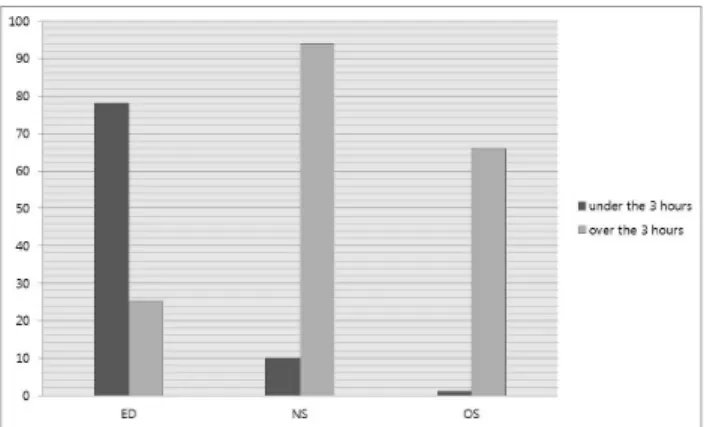
In the less than 3 hours group, none of the patients con- sulted with other departments. In the group exceeding 3 hours, 18 patients (9.7%) had more than one department consulting, and this was found to have a significant effect on the stay time (p=0.010) (Table 2). In the less than 3 hours group, 78 patients (75.7%) were treated by emer- gency medicine, 10 by neurosurgery (9.6%) and 1 patient by orthopedic (1.5%), and in the group exceeding 3 hours, 25 patients (13.5%) were treated by emergency medicine, 94 patients (90.4%) by neurosurgery, and 66 (98.5%) by orthopedics. In the case treated by orthopaedic surgeons and neurosurgeons, stay time was increased (p=0.014).
Although there may be differences in the examination, hospitalization and discharge criteria according to the department, it is noteworthy that only one patient (1.1%) showed a stay time within 3 hours in the orthopedics (Ta- ble 2 and Fig. 1).
DISCUSSION
Back pain is one of the most common symptoms at ER throughout the world. One study reported that the world- wide prevalence of low back pain was 12% [4]. Although our emergency room does not meet the above rates, pa- tients who are visited with back pain account for roughly 4% to 5%. Also most of them generally occupy the beds long-term, contributing to the overcrowding.
In a study reported in the Canada, patients with back pain were referred to a nearby primary physician after simple pain treatment in the emergency room, regardless of the degree of pain [5]. Although the results of our study did not investigate the degree of pain in patients, but all patients were given analgesic treatment and discharged, or referred to orthopaedic surgeons and neurosurgeons for additional care. It was a somewhat expected result, most Table 1. Comparison of the exam and treatment between
two groups
Under the 3 hours (n=88)
Over the 3 hours (n=186)
p-value
Age Years
Under the 65 years Over the 65 years
42.81±14.84 80 (90.9)
8 (9.1)
57.22±18.37 116 (62.4)
70 (37.6)
0.000
Man 42 (47.7) 81 (43.5) 0.516
Method of visit By walking By ambulance
64 (72.7) 24 (27.3)
81 (43.8) 104 (56.2)
0.000
Injury mechanism Indirect injury Direct injury
44 (50.0) 44 (50.0)
131 (70.4) 55 (29.6)
0.001
Time to visit 08:00-13:59 14:00-19:59 20:00-01:59 02:00-07:59
16 (18.2) 25 (28.4) 32 (36.4) 15 (17.0)
69 (37.1) 48 (25.8) 42 (22.6) 27 (14.5)
0.009
Weekdays 48 (54,5) 118 (63.4) 0.159
Values are presented as mean±standard deviation or number (%).
of the patients who were referred to orthopaedic and neurosurgeons showed long stay time. Generally, in our hospital, if there is no improvement within 30 minutes after the pain medication administration, we will refer to orthopedic surgeons or neurosurgery for further evalua- tion. And, most hospitals do, but orthopedic surgeons or
neurosurgery prescribe additional CT or MRI scans. But, because they do not reside in the emergency room, it takes time to prescribe imaging study, if the image shows that the patient does not require surgical treatment, they dis- charged the patients from the emergency room after the analgesic treatment for long time. Therefore, if the patient does not require hospitalization or surgical treatment after the initial treatment by the emergency medicine de- partment, we should recommend outpatient treatment or transfer of the other hospital without additional referral will be needed to shorten the stay time.
In addition, as shown the our study result, all patients underwent a form of imaging test, and the type of im- aging test influenced the stay time. In one study, only 30% of patients underwent imaging tests and most were performed in the elderly patients over 70 years of age, one-third of the patients who were admitted to the hos- pital reported that the imaging test they received did not have a direct relationship with their symptoms or the necessity of hospitalization, and reported that we should reduce the number of imaging tests in the future [6]. Our study also showed that patients over 65 years of age had a higher proportion in the group exceeding 3 hours, and more imaging tests were performed on them. Although it is thought that in the case of elderly patients, a simple imaging test can be an evaluation process to see whether a lesion has newly developed, but it was difficult to say that it played a major role in determining the treatment direc- tion in the future.
Moreover, Andersen [7] analyzed previously published research and literature and reported that in the case of Table 2. Comparison of the exam and treatment between
two groups
Under the 3 hours (n=88)
Over the 3
hours (n=186) p-value Pain control
Tridol Demerol Diclofenac Ketoracin
28 (41.8) 21 (31.3) 9 (13.4) 9 (13.4)
76 (44.4) 84 (49.1)
7 (4.1) 4 (1.7)
0.000
Time to pain control (minutes)
7.0 (5.0-12.7) 10.0 (6.0-16.2) 0.034
Radiologic study Only X-ray X-ray, CT X-ray and MRI X-ray, CT, and MRI
86 (97.7) 1 (1.1) 1 (1.1) 0 (0.0)
102 (54.8) 13 (7.0) 36 (19.4) 35 (18.8)
0.000
Diagnosis Sprain & strain Compression fx HNP
Spinal stenosis
60 (68.2) 3 (3.4) 24 (27.3)
1 (1.1)
24 (12.9) 64 (34.4) 83 (44.6) 15 (8.1)
0.000
Disposition Admission Discharge Transfer
2 (2.3) 85 (96.6)
1 (1.1)
59 (41.4) 121 (65.1) 6 (3.2)
0.000
Operation Yes No
1 (1.1) 87 (98.9)
38 (20.4) 148 (79.6)
0.000
Consultation Yes No
0 (0.0) 88 (100)
18 (9.7) 168 (90.3)
0.010
The department of treat- ment
ED NS OS
77 (87.5) 10 (11.4) 1 (1.1)
26 (14.0) 94 (50.5) 66 (35.5)
0.014
Values are presented as median (inter-quartile range) or number (%).
CT: computerized tomography, MRI: magnectic resonance image, HNP:
herniated nucleus pulposus, ED: emergency department, NS: neurosur- gery, OS: orthopedic surgery.
Fig. 1. Comparison of according to the treatment department. ED:
emergency department, NS: neurosurgery, OS: orthopedics.
back pain patients treated with clinical symptoms with- out imaging tests, there was no significant difference in short term and long term prognosis compared with the patients with back pain who were treated with imaging tests. In other studies, most of the back pain patients in the emergency room had a good prognosis, and only pa- tients with a high risk symptom (red flag sign), such as a tumor, infection, or neurological abnormalities, needs a CT or MRI, and even in the case of disc herniation, symp- tomatic treatment showed positive results [8,9]. Although we could not compare the results of our study since we excluded patients with back pain due to medical factors such as tumor invasion or infection, patients who only had simple imaging tests showed significant differences in the less than 3 hours group. In addition, there is no additional abnormality on CT and MRI unless special findings are seen on simple imaging tests in the case of non-traumatic patients. Also, in orthopaedics and neuro- surgery, there was no need for hospitalization or surgical treatment other than pain control, and positive prognosis was shown before discharge.
We thought that proper pain control early on was important. Barksdale et al. [10] reported that the nurses of the emergency department were trained in pain clas- sification and applied it to reduce the starting time of pain control for the patients who were visiting because of various pains. In addition, in the study comparing the results of various combinations of painkillers to acute non-traumatic back pain patients, the combination of painkillers and the prognosis of the patient was not re- lated, however, regardless of the degree of pain, the early administration of painkillers helps the patient to control pain quickly, it was reported that even gel-type rub- on painkillers were effective [11,12]. In the our study, painkillers were administered to all back pain patients, and the time required to administer the painkillers was significantly shorter in patients in the less than 3 hours group. The results of the our study showed that a high proportion of non-steroidal anti-inflammatory painkill- ers were administered in the less than 3 hours group, but because it was likely that the preference of painkillers in each department would have an effect, so it was consid- ered to compare the results after randomization in future analyzes. Based on these results, it is thought that to start
the pain control quickly will ultimately help to reduce the patients’ stay time.
In addition, in the case of back pain patients who did not require surgical treatment after simple imaging tests, there were no differentiated treatments other than referral to the neurosurgery or orthopaedic surgery and subse- quent CT and MRI. It is important to determine whether the patient is hospitalized or discharged on the basis of the initial simple imaging test, and to determine their transfer to another hospital in the absence of the hospital room. It is also thought it would be most effective if this decision was made by the emergency medical department.
As shown in the results of the study, it was thought that the unnecessary co-consultation with other depart- ments in the emergency room should be avoided, be- cause there was no patient in the less than 3 hours group that received consultation. On the other hand, the stay time of patients who require hospitalization or surgery due to injury or fracture at the time of the research plan were thought to be shorter than non-trauma patients and discharge patients, but in most cases they are not emer- gency operations, hence their stay time was lengthened.
We believe that this problem should be solved at hospital level.
The limitations of this study were that, due to it being a retrospective medical record study, the time for referral to other departments would have been slightly different de- pending on the physician on the day, and would have af- fected the results. It is also considered that hospitals have their respective consulting policies or testing guideline, so there is a limit to apply this study to other hospitals. The delay in stay time due to hospitalization delay is not an issue of the ER, but the overall hospital, so we are consid- ering to compare and analysis only discharged patients in further research.
CONCLUSION
In the case of patients visiting the emergency department with back pain, active pain control at the beginning of the visit would help to reduce their length of stay. An unnec- essary imaging tests were avoided except in the presence of risk factors, and the emergency physician should ac-
tively intervened to determine early on, whether or not the patient should be hospitalized.
ACKNOWLEDGEMENTS
The authors acknowledge Dr. Seoung Wook Kim for his technical support in providing data for the analyses.
REFERENCES
1. Alavi-Moghaddam M, Forouzanfar R, Alamdari S, Shahrami A, Kariman H, Amini A, et al. Application of queuing analytic the- ory to decrease waiting times in emergency department: does it make sense? Arch Trauma Res 2012;1:101-7.
2. Baig MA, Mian A, Najeed F, Shahzad H. Overcrowding in the emergency departments: challenges and opportunities for im- provement. J Pak Med Assoc 2015;65:1344-5.
3. Kreindler SA, Cui Y, Metge CJ, Raynard M. Patient characteris- tics associated with longer emergency department stay: a rapid review. Emerg Med J 2016;33:194-9.
4. Manchikanti L, Singh V, Falco FJ, Benyamin RM, Hirsch JA.
Epidemiology of low back pain in adults. Neuromodulation 2014;17 Suppl 2:3-10.
5. Nunn ML, Hayden JA, Magee K. Current management practices
for patients presenting with low back pain to a large emergency department in Canada. BMC Musculoskelet Disord 2017;18:92.
6. McCaughey EJ, Li L, Georgiou A, Golding MH, Westbrook JI.
Imaging for patients presenting to an emergency department with back pain: impact on patient pathway. Emerg Med Aus- tralas 2016;28:412-8.
7. Andersen JC. Is immediate imaging important in managing low back pain? J Athl Train 2011;46:99-102.
8. Della-Giustina D. Evaluation and treatment of acute back pain in the emergency department. Emerg Med Clin North Am 2015;33:311-26.
9. Singleton J, Edlow JA. Acute nontraumatic back pain: risk strat- ification, emergency department management, and review of serious pathologies. Emerg Med Clin North Am 2016;34:743- 57.
10. Barksdale AN, Hackman JL, Williams K, Gratton MC. ED triage pain protocol reduces time to receiving analgesics in patients with painful conditions. Am J Emerg Med 2016;34:2362-6.
11. Friedman BW, Dym AA, Davitt M, Holden L, Solorzano C, Esses D, et al. Naproxen With cyclobenzaprine, oxycodone/
acetaminophen, or placebo for treating acute low back pain: a randomized clinical trial. JAMA 2015;314:1572-80.
12. Serinken M, Eken C, Tunay K, Golcuk Y. Ketoprofen gel improves low back pain in addition to IV dexketoprofen:
a randomized placebo-controlled trial. Am J Emerg Med 2016;34:1458-61.