Clinical Characteristics of False-Positive Lymph Node on Chest CT or PET-CT
Confirmed by Endobronchial Ultrasound–
Guided Transbronchial Needle Aspiration in Lung Cancer
Jongmin Lee, M.B.
1, Young Kyoon Kim, M.D.
1, Ye Young Seo, M.B.
2, Eun Kyoung Choi, M.B.
3, Dong Soo Lee, M.D.
4, Yeon Sil Kim, M.D.
4, Sook Hee Hong, M.D.
5,6, Jin Hyoung Kang, M.D.
5,6, Kyo Young Lee, M.D.
7, Jae Kil Park, M.D.
8, Sook Whan Sung, M.D.
8, Hyun Bin Kim, M.P.H.
9,10, Mi Sun Park, M.S.
9,10, Hyeon Woo Yim, M.D.
9,10and Seung Joon Kim, M.D., Ph.D.
1,61
Division of Pulmonary, Department of Internal Medicine, Seoul St. Mary's Hospital, College of Medicine, The Catholic University of Korea, Seoul,
2Department of Nuclear Medicine, Inje University Sanggye Paik Hospital, Seoul, Departments of
3Radiology and
4
Radiation Oncology,
5Division of Medical Oncology,
6The Cancer Research Institute, Departments of
7Hospital Pathology,
8Thoracic Surgery, and
9Biostatistics,
10Clinical Research Coordinating Center, College of Medicine, The Catholic University of Korea, Seoul, Korea
Background: Endobronchial ultrasound-guided transbronchial needle aspiration (EBUS-TBNA) is a standard procedure to evaluate suspicious lymph node involvement of lung cancer because computed tomography (CT) and
18
F-fluorodeoxyglucose positron emission tomography-CT (PET-CT) have limitations in their sensitivity and specificity.
There are a number of benign causes of false positive lymph node such as anthracosis or anthracofibrosis, pneumoconiosis, old or active tuberculosis, interstitial lung disease, and other infectious conditions including pneumonia. The purpose of this study was to evaluate possible causes of false positive lymph node detected in chest CT or PET-CT.
Methods: Two hundred forty-seven patients who were initially diagnosed with lung cancer between May 2009 and December 2012, and underwent EBUS-TBNA to confirm suspicious lymph node involvement by chest CT or PET-CT were analyzed for the study.
Results: Of 247 cases, EBUS-TBNA confirmed malignancy in at least one lymph node in 189. The remaining 58 patients whose EBUS-TBNA results were negative were analyzed. Age ≥65, squamous cell carcinoma as the histologic type, and pneumoconiosis were related with false-positive lymph node involvement on imaging studies such as chest CT and PET-CT.
Conclusion: These findings suggest that lung cancer staging should be done more carefully when a patient has clinically benign lymph node characteristics including older age, squamous cell carcinoma, and benign lung conditions.
Keywords: Lymph Node; Chest; Tomography, X-Ray Computed; Positron Emission Tomography Computed Tomography;
Lung Neoplasms
Copyright © 2018
The Korean Academy of Tuberculosis and Respiratory Diseases.
Address for correspondence: Seung Joon Kim, M.D., Ph.D.
Division of Pulmonology, Department of Internal Medicine, Seoul St. Mary’s Hospital, The Cancer Research Institute, College of Medicine, The Catholic University of Korea, 222 Banpo-daero, Seocho-gu, Seoul 06591, Korea
Phone: 82-2-2258-6063, Fax: 82-2-599-3589, E-mail: [email protected]
Received: Nov. 17, 2017, Revised: Feb. 20, 2018, Accepted: Feb. 28, 2018, Published online: Jun. 19, 2018
cc
It is identical to the Creative Commons Attribution Non-Commercial License (http://creativecommons.org/licenses/by-nc/4.0/).
Introduction
Lung cancer is the leading cause of cancer deaths world- wide for both men and women
1. To determine optimal thera- peutic strategy for lung cancer patients, accurate staging is essential.
Mediastinoscopy is often considered as gold standard pro- cedure for the mediastinal staging of lung cancer
2. However, a prospective cohort study with 190 lung cancer patients found that diagnostic performance of endobronchial ultrasound- guided transbronchial needle aspiration (EBUS-TBNA) was comparable with that of mediastinoscopy
3. A meta-analysis of 11 observational studies which compared EBUS-TBNA with mediastinoscopy also showed similar sensitivity and specific- ity
4.
Computed tomography (CT) and
18F-fluorodeoxyglucose (FDG) positron emission tomography–CT (PET-CT) are stan- dard imaging modalities for staging of lung cancer. However, chest CT or PET-CT have limited reliability for the sensitivity or specificity of lymph node staging
5-9. Previous studies report- ed that the sensitivity and specificity of chest CT in identifying lymph node metastases were 55% and 81%, respectively
10. In comparison to CT imaging, PET-CT had shown to have better sensitivity and specificity, 77% and 86% respectively
10. How- ever, in patients with granulomatous disease such as sarcoid- osis, concurrent infectious and inflammatory disease such as tuberculosis, pneumonia and interstitial lung disease (ILD), PET-CT has been shown to increase the rates of false-positive malignancy in mediastinal lymph nodes
11,12.
Therefore, in the present study, we investigated various benign causes of false-positive lymph node including an- thracosis or anthracofibrosis, pneumoconiosis, old or active tuberculosis, ILD and other infectious conditions including pneumonia on chest CT or PET-CT using EBUS-TBNA.
Materials and Methods
1. Patients
Data were collected from lung cancer patients who under- went EBUS-TBNA for suspicious lymph node involvement by chest CT or PET-CT from May 2009 to December 2012 in Seoul St. Mary’s Hospital. The diagnosis of lymph node involvement was determined by EBUS-TBNA. True-positive was defined as a diagnosis of lymph node metastasis from lung cancer. True-negative was defined as a diagnosis of be- nign lymphoid tissue. We also defined false-positive group as patients with negative result of malignancy from EBUS-TBNA although chest CT or PET-CT were positive.
Anthracosis or anthracofibrosis were defined by broncho- scopic findings demonstrating black-brown pigment lining the endobronchial mucosa with or without fibrotic distortion/
narrowing of the bronchus. Diagnosis of pneumoconiosis includes chest imaging consistent with pneumoconiosis plus occupational inhalation exposure history of sufficient amount and latency to coal or silica dust. Previous history of tuber- culosis was defined as old tuberculosis. If lung cancer was concomitantly diagnosed with tuberculosis, it was defined as active tuberculosis. ILD was defined by typical radiological findings with symptoms and signs of ILD.
All subjects provided written informed consent for the pro- cedure, and the study protocol was approved by the Institu- tional Review Board of Seoul St. Mary’s Hospital, The Catholic University of Korea (IRB approval number: KC16RISI0733).
2. EBUS-TBNA
The EBUS-TBNA was done by two experts using a flexible linear (convex) ultrasound bronchoscopy system (Olympus, Tokyo, Japan). The procedure was performed with the patient under conscious sedation by midazolam, and local anesthesia (lidocaine) was applied. After scanning the mediastinal lymph node, each target lymph node was aspirated at least 3 times with a 22-gauge needle. Lymph node location was classified according to the International Association for the Study of Lung Cancer (IASLC) lymph node map
13. The aspirated tissue was fixed promptly with 95% alcohol, and stained using Papa- nicolaou. An expert lung pathologist (K.Y. Lee) performed the cytopathological examinations.
3. Chest CT
Multi-detector computed tomography (SOMATOM Defini- tion; Siemens, Erlangen, Germany and Discovery CT750 HD;
GE Healthcare, Waukesha, WI, USA) was performed using a slice thickness of 1 mm reconstructed at 0.75-mm intervals with contrast injection by a mechanical injector at a rate of 3 mL/sec, for a total dose of 100 mL. Axial, sagittal and coronal images were reconstructed at 3-mm interval and were trans- ferred to a PACS workstation (Maroview; Marotech, Seoul, Korea). All abnormal findings on chest CT were reviewed in lymph node stations according to the guidelines of the IASLC
13. On chest CT, positive lymph node was defined as short diameter longer than 1 cm
14.
4. PET-CT
Patients were fasted for at least 6 hours before PET-CT scan-
ning. Scanning was done 60 minutes later after FDG injection
(5.5–7.4 MBq/kg). None of the patients had a blood glucose
level higher than 130 mg/dL before injection. No intravenous
contrast agent was administered. Studies were acquired on
combined PET-CT in-line systems, either Biograph Duo or
Biograph Truepoint (Siemens Medical Solutions, Knoxville,
TN, USA). The maximum standardized uptake value (SUV)
was used to define positive lymph node on PET-CT, and the SUV was obtained by locating a region of interest on a lesion.
A maximum SUV >2.5 on a lymph node was interpreted as positive
15.
5. Statistical analysis
The descriptive statistics were calculated and are presented as number (percentage) for categorical variables, and the mean±SD and median (range) for continuous variables. Dif- ferences between the false-positive and true-positive group were compared using the Wilcoxon rank-sum test for con- tinuous variables and the chi-square or Fisher exact test for categorical variables. Sensitivity, specificity, positive predictive value (PPV), negative predictive value (NPV), and diagnostic accuracy of chest CT and PET-CT were measured for the de- tection of mediastinal lymph node metastases. The receiver operating characteristic (ROC) curve and the Youden index identified an optimal age cut-off value for mediastinal lymph node metastases. Univariate and multivariable logistic regres- sions analyses were performed to determine odds ratios (ORs) for identify independent predictors of false-positive. Analyses were conducted using the SAS statistical software version 9.4 (SAS Institute Inc., Cary, NC, USA). The significance level for statistical tests were set at a=0.05 (two-tailed).
Results
1. Patients’ characteristics
Among the 247 patients who underwent EBUS-TBNA, male patients were 199 (80.6%), and mean and median age was 64.9 and 66.0, respectively (Table 1). Predominant histologic type was adenocarcinoma (116 cases, 47.0%). The number of nodes sampled per patients was one in 123 (49.8%), two in 107 (43.3%) and three in 17 (6.9%). Staging workup indicated that 95 patients (49.0%) were classified as stage IV in non- small cell lung cancer, and 39 (73.6%) were extensive disease in small cell lung cancer. Mediastinal lymph node metastases
were confirmed by EBUS-TBNA in 258 nodal stations from total 388 lymph nodes.
Table 1. Baseline characteristics of the 247 lung cancer patients
Variable No. (%) (n=247)
Sex
Male 199 (80.6)
Female 48 (19.4)
Age, yr
Mean±SD 64.9±10.0
Median (range) 66.0 (33.0–87.0)
Histology
Adenocarcinoma 116 (47.0)
Squamous cell carcinoma 67 (27.1) Large cell carcinoma 5 (2.0) Small cell carcinoma 53 (21.5)
Others 6 (2.4)
Stage
NSCLC (n=194)
IA 6 (3.1)
IB 3 (1.5)
IIA 9 (4.6)
IIB 2 (1.0)
IIIA 47 (24.2)
IIIB 32 (16.5)
IV 95 (49.0)
SCLC (n=53)
Limited disease 14 (26.4) Extensive disease 39 (73.6) NSCLC: non-small cell lung cancer; SCLC: small cell lung cancer.
Table 2. Diagnostic performance of chest CT, PET-CT, chest CT and/or PET-CT according to lymph node positivity by EBUS- TBNA
Sensitivity (95% CI, %)
Specificity (95% CI, %)
PPV (95% CI, %)
NPV (95% CI, %)
Accuracy (95% CI, %)
AUC
(95% CI)
Chest CT 88.8 (84.3–92.3) 44.6 (35.9–53.6) 76.1 (70.9–80.8) 66.7 (55.8–76.4) 74.0 (69.3–78.3) 0.667 (0.618–0.714)
PET-CT 99.2 (97.1–99.9) 13.0 (7.6–20.3) 69.9 (64.8–74.6) 88.9 (65.3–98.6) 70.8 (65.9–75.3) 0.561 (0.509–0.612)
Chest CT and PET-CT 85.7 (80.8–89.7) 54.6 (45.7–63.4) 78.9 (73.7–83.6) 65.7 (56.0–74.6) 75.3 (70.7–79.5) 0.701 (0.653–0.747)
Chest CT or PET-CT 100.0 (98.5–100.0) 6.5 (2.8–12.4) 68.5 (63.5–73.2) 100.0 (63.1–100.0) 69.2 (64.2–73.8) 0.533 (0.480–0.584)
CT: computed tomography; PET-CT: positron emission tomography–CT; EBUS-TBNA: endobronchial ultrasound-guided transbronchial
needle aspiration; CI: confidence interval; PPV: positive predictive value; NPV: negative predictive value; AUC: area under the curve.
2. Diagnostic performance of chest CT and/or PET-CT according to lymph node
Table 2 presents sensitivity, specificity, PPV, NPV, accuracy, and area under the curve (AUC) of chest CT and/or PET-CT.
Sensitivity was the highest in chest CT or PET-CT group, but this group presented the lowest specificity. Chest CT and PET- CT group showed the highest specificity, but the specificity was only 54.6%. The false-positive rate according to lymph nodes was 55.4% in chest CT, 87% in PET-CT, 45.4% in chest CT and PET-CT, and 93.5% in chest CT or PET-CT group (Figure 1).
3. Factors associated with false-positive lymph node according to patients
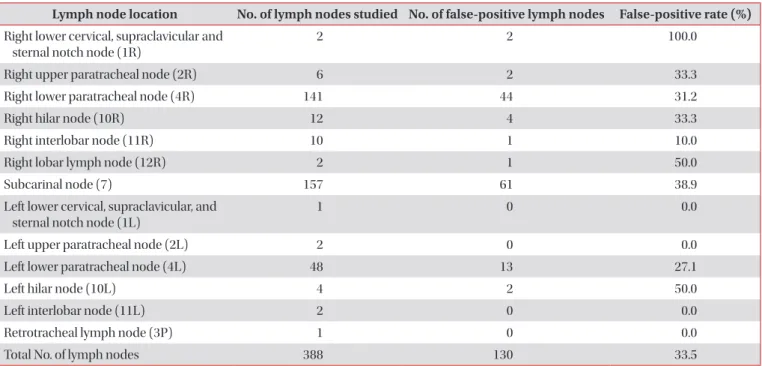
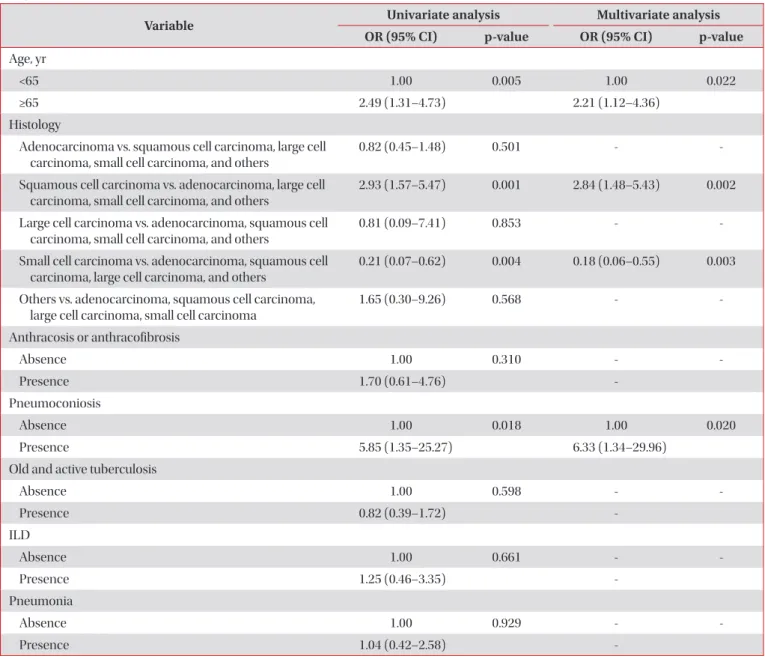
False-positive lymph nodes depending on the lymph node location was shown according to IASLC (Table 3) and the demographic differences between the false-positive group and the true-positive group are presented in Table 4. The false-positive patients had significantly higher mean and me- dian age than the true-positive patients (mean age, 68.2±9.5 vs. 63.9±10.0, p=0.004; median age, 69.5 [45.0–87.0] vs. 65.0 [33.0–85.0], p=0.004). According to the histologic type, false- positive rate was the highest in patients with squamous cell carcinoma, and the lowest in small cell carcinoma. Except old or active tuberculosis, other benign conditions such as an- thracosis or anthracofibrosis, ILD and pneumonia showed a higher tendency of false-positive rate, but were not statistically significant. Patients with pneumoconiosis had higher false- positive rate than those without pneumoconiosis.
4. Univariate and multivariate analyses of false-positive patients
Logistic regression analysis of clinicopathological param- eters for the prediction of false-positive patients with lung cancer is shown in Table 5. As mentioned above, older age was associated with increased risk of having a false-positive result on chest CT or PET-CT. We determined the optimal dis- criminator value for age using ROC curve analysis (Figure 2).
AUC was the highest (0.624) when patients were divided into
Table 3. False-positive lymph nodes depending on the lymph node location according to IASLC
Lymph node location No. of lymph nodes studied No. of false-positive lymph nodes False-positive rate (%) Right lower cervical, supraclavicular and
sternal notch node (1R)
2 2 100.0
Right upper paratracheal node (2R) 6 2 33.3
Right lower paratracheal node (4R) 141 44 31.2
Right hilar node (10R) 12 4 33.3
Right interlobar node (11R) 10 1 10.0
Right lobar lymph node (12R) 2 1 50.0
Subcarinal node (7) 157 61 38.9
Left lower cervical, supraclavicular, and sternal notch node (1L)
1 0 0.0
Left upper paratracheal node (2L) 2 0 0.0
Left lower paratracheal node (4L) 48 13 27.1
Left hilar node (10L) 4 2 50.0
Left interlobar node (11L) 2 0 0.0
Retrotracheal lymph node (3P) 1 0 0.0
Total No. of lymph nodes 388 130 33.5
IASLC: International Association for the Study of Lung Cancer.
Chest CT 100
80
60
40
20
PET-CT
False-positiverate(%)
0
Chest CT and PET-CT
Chest CT or PET-CT