• 검색 결과가 없습니다.

Adherence to Varenicline and Abstinence Rates for Quitting Smoking in a Private Health Promotion Center-Based Smoking Cessation Clinic

N/A
N/A
Protected

Academic year: 2021

Share "Adherence to Varenicline and Abstinence Rates for Quitting Smoking in a Private Health Promotion Center-Based Smoking Cessation Clinic"

Copied!
7
0
0

로드 중.... (전체 텍스트 보기)

전체 글

(1)

Tuberc Respir Dis 2012;72:426-432

CopyrightⒸ2012. The Korean Academy of Tuberculosis and Respiratory Diseases. All rights reserved.

Adherence to Varenicline and Abstinence Rates for Quitting Smoking in a Private Health Promotion Center-Based Smoking Cessation Clinic

Jin-Young Lee, M.D.

1

, Min Ji Kim

2

, Hee-Jung Jun, M.D.

1

, Mira Kang, M.D., Ph.D.

1

, Ah Rham Park

1

, Dae Eun Oh

1

, Yoon-Ho Choi, M.D., Ph.D.

1

, Jung Hye Hwang, M.D., Ph.D.

1

1

Center for Health Promotion,

2

Biostatistics Unit, Samsung Biomedical Research Institute, Samsung Medical Center, Seoul, Korea

Background: Varenicline is an effective smoking cessation aid. However, smokers prescribed with varenicline do not always receive varenicline for 12 weeks, as recommended. This study analyzed the subjects who received varenicline and investigated the effect of varenicline treatment duration on the success rate of 6-month smoking cessation.

Methods: This study retrospectively analyzed 78 subjects, who received varenicline, out of the 105 smokers that had visited the smoking cessation clinic after medical examination from September 2007 to December 2009.

Results: The subjects were all males. Twenty-two subjects (28.2%) had varenicline treatment for 12 weeks or longer;

18 subjects (23.1%) for 8∼12 weeks; 22 subjects (28.2%) for 4∼8 weeks; and 16 subjects (20.5%) for less than 4 weeks. The total success rate of the 6-month smoking cessation was 47.4%. The success rate of the 6-month smoking cessation was 63.6% in the group that received varenicline for 12 weeks or longer, which was higher than 41.1% of the group that early terminated the varenicline treatment (p=0.074). The period of varenicline treatment was extended for one more week, the odds ratio of the 6-month smoking cessation success increased to 1.172-folds (p=0.004; 95% confidence interval, 1.052∼1.305). Adverse events occurred in 30.8% of the subjects who received varenicline, but no serious adverse events were found.

Conclusion: If varenicline treatment period is extended, the odds ratio of the success rate for the 6-month smoking cessation increases. Therefore, an effort to improve drug compliance for varenicline in clinical practices could be helpful for the long-term success of smoking cessation.

Key Words: Smoking Cessation; Varenicline; Medication Adherence

Address for correspondence: Jung Hye Hwang, M.D., Ph.D.

Department of Medicine, Center for Health Promotion, Samsung Medical Center, 50, Irwon-dong, Gangnam-gu, Seoul 135-710, Korea

Phone: 82-2-3410-3882, Fax: 82-2-3410-0054 E-mail: [email protected] Received: Nov. 2, 2011

Revised: Nov. 18, 2011 Accepted: Mar. 26, 2012

Introduction

Smoking causes cancer, cardiovascular diseases, and pulmonary diseases. It is the most important causative factor of the aforementioned diseases and can be prevented. In advanced countries, smoking has been known to account for 35% of the total death caused by cancers and for 90% of death caused by lung cancer

1

. In particular, the risk of lung cancer has been known

to increase in proportion to the duration and amount

of smoking

2

. According to 2008 Korea National Health

and Nutrition Survey, the smoking rate of Koreans was

reported to be 47.7%, 7.4%, and 27.7% for men, wom-

en, and both men and women, respectively, which is

relatively higher than that of US (smoking rate of adult

males 19%, smoking rate of adult females 15%, total

smoking rate 17%) or France (smoking rate of adult

males 28%, smoking rate of adult females 19%, total

smoking rate 23%)

3

. The reason for high smoking rate

despite the well-known harmfulness of smoking is at-

tributable to addiction caused by nicotine contained in

cigarette. Nicotine acts on the compensation circuit of

the brain, causing addiction and resistance by physical

and psychological dependence. Thus, it is difficult to

initiate and maintain smoking cessation for oneself

4,5

.

(2)

Thus, it is necessary to perceive smoking as a disease which should be managed and treated such as drug ad- diction or chronic diseases rather than as a personal habit or hobby, or to rely on personal decision or will to quit smoking.

Varenicline, which is a smoking cessation aid that has been developed for smoking cessation, is a partial ago- nist of α4β2 nicotine receptor

6

. Varenicline stimulates nicotine receptors, making the receptors release a small amount of dopamine, thereby reducing smoking desire and withdrawal symptoms. In addition, as varenicline inhibits the binding of nicotine to nicotine receptors, dopamine releasing effect caused by nicotine is sup- pressed despite smoking, which results in no sat- isfaction by smoking

7,8

. Varenicline is recommended to be treated for minimum 12 weeks. A randomized study, which was conducted during 12-week non-treatment period after 12-week varenicline treatment, reported that the success rate of 6-month smoking cessation was 46.8%, which was significantly better than 21.8% ob- served in the placebo group

9

. However, smoking cessa- tion aids such as varenicline are not covered by medical insurance in Korea. Thus, smokers are financially bur- dened, and the drug compliance of smokers is low as shown in a situation where smokers would rather quit smoking by themselves than believe the efficacy of drug even if smoking cessation aids are prescribed. Thus, in many cases, varenicline is not treated for 12 weeks.

Accordingly, this study was conducted on smokers who received varenicline in the smoking cessation clinic of a general hospital health care center to analyze the char- acteristics of the subjects and to investigate the effect of varenicline treatment period on the success rate of 6-month smoking cessation.

Materials and Methods

This study was conducted on 87 subjects who re- ceived varenicline of 105 smokers who visited the smoking cessation clinic of Samsung Medical Center from September, 2007 to December, 2009. Among the 87 subjects, 9 subjects who failed follow-up 6 months

after study initiation were excluded. At the first visit, the

subjects were asked to complete a self-reported ques-

tionnaire for items such as educational background, in-

come level, stress severity at home and in a working

place (the Korean Psychological Well-being Index

[SF-PWI; 18 items])

10

, presence of underlying diseases

including psychiatric diseases, number of drinking, mo-

tives for smoking cessation, age of smoking commence-

ment, smoking duration, mean daily smoking amount,

reasons for smoking, previous history of smoking cessa-

tion and methods, reasons for the failure of smoking

cessation, reasons for current smoking cessation trial,

presence of smokers in the family, and nicotine depend-

ence, followed by an interview with a specialist. The

subjects were educated to know that smoking is a dis-

ease caused by nicotine addiction via multimedia to

provide smoking cessation motivation. Exhaled CO con-

centration was measured using a device measuring ex-

haled CO concentration, and a consultation about de-

termining anticipated smoking cessation date, writing

smoking cessation diary, measures to withdrawal symp-

toms, and smoking cessation methods was conducted

on the subjects. The subjects were asked to visit the

clinic every 2 weeks for the first month after their enroll-

ment to the smoking cessation clinic, and thereafter

once a month to undergo measurements of physical fac-

tors and exhaled CO concentration, and medical and

nutritional consultations. They were asked to receive

varenicline at a dose of 0.5 mg from day 1 to day 3

once a day, and at a dose of 0.5 mg from day 4 to

day 7 twice a day, and at a dose of 1 mg starting from

the second week twice a day according to the recom-

mendation of drug use. Non-smoker was defined as a

subject who orally reported that he/she did not smoke

at all and who showed that the result of measuring ex-

haled CO level was within the normal range. Smoking

cessation success was defined as a subject who main-

tained smoking cessation for 6 months or longer. This

study was conducted after approved by the clinical

study center of Samsung Medical Center.

(3)

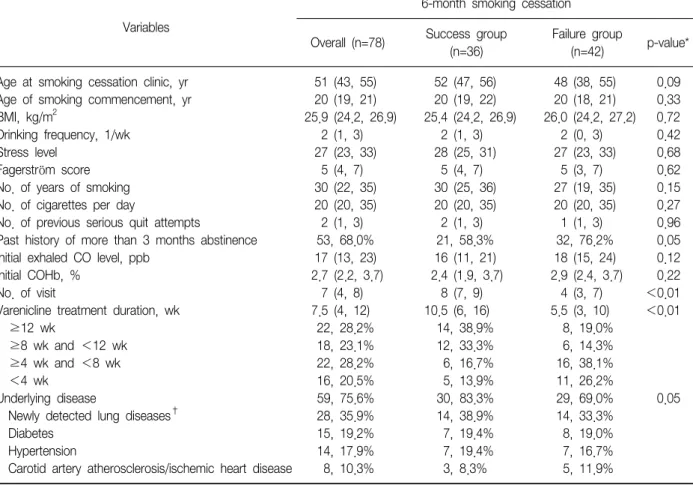
Table 1. Baseline characteristics

Variables

6-month smoking cessation

Overall (n=78) Success group (n=36)

Failure group

(n=42) p-value*

Age at smoking cessation clinic, yr 51 (43, 55) 52 (47, 56) 48 (38, 55) 0.09 Age of smoking commencement, yr 20 (19, 21) 20 (19, 22) 20 (18, 21) 0.33

BMI, kg/m

2

25.9 (24.2, 26.9) 25.4 (24.2, 26.9) 26.0 (24.2, 27.2) 0.72

Drinking frequency, 1/wk 2 (1, 3) 2 (1, 3) 2 (0, 3) 0.42

Stress level 27 (23, 33) 28 (25, 31) 27 (23, 33) 0.68

Fagerström score 5 (4, 7) 5 (4, 7) 5 (3, 7) 0.62

No. of years of smoking 30 (22, 35) 30 (25, 36) 27 (19, 35) 0.15

No. of cigarettes per day 20 (20, 35) 20 (20, 35) 20 (20, 35) 0.27

No. of previous serious quit attempts 2 (1, 3) 2 (1, 3) 1 (1, 3) 0.96 Past history of more than 3 months abstinence 53, 68.0% 21, 58.3% 32, 76.2% 0.05

Initial exhaled CO level, ppb 17 (13, 23) 16 (11, 21) 18 (15, 24) 0.12

Initial COHb, % 2.7 (2.2, 3.7) 2.4 (1.9, 3.7) 2.9 (2.4, 3.7) 0.22

No. of visit 7 (4, 8) 8 (7, 9) 4 (3, 7) <0.01

Varenicline treatment duration, wk 7.5 (4, 12) 10.5 (6, 16) 5.5 (3, 10) <0.01

≥12 wk 22, 28.2% 14, 38.9% 8, 19.0%

≥8 wk and <12 wk 18, 23.1% 12, 33.3% 6, 14.3%

≥4 wk and <8 wk 22, 28.2% 6, 16.7% 16, 38.1%

<4 wk 16, 20.5% 5, 13.9% 11, 26.2%

Underlying disease 59, 75.6% 30, 83.3% 29, 69.0% 0.05

Newly detected lung diseases

28, 35.9% 14, 38.9% 14, 33.3%

Diabetes 15, 19.2% 7, 19.4% 8, 19.0%

Hypertension 14, 17.9% 7, 19.4% 7, 16.7%

Carotid artery atherosclerosis/ischemic heart disease 8, 10.3% 3, 8.3% 5, 11.9%

Quantitative variables were summarized as medians with interquartile ranges. Frequency was summarized as number with percentage.

*The Wilcoxon two-sample test was used to compare categorical variables and the t-test or Mann-whitney test was employed to compare continuous variables comparing a difference between the two groups.

Newly detected lung diseases; lung nodule(s), em- physema, tuberculosis sequelae.

BMI: body mass index; CO: carbon monoxide; COHb: carboxyhaemoglobin.

1. Statistical methods

A statistical analysis was conducted using SPSS ver- sion 18.0 (SPSS Inc., Chicago, IL, USA) and SAS (SAS Institute Inc., Cary, NC, USA). Median (quartiles) was used for the expression of statistics. A logistic regres- sional model was used for the analysis of factors affect- ing the success of 6-month smoking cessation and ef- fects of varenicline treatment on the success of 6-month smoking cessation.

Results 1. Characteristics of the subjects

A total of 78 subjects were all males with a mean

age of 48 years (range, 23∼64 years) (Table 1). They

consisted of 13 subjects with an age of 39 years or low-

er, 25 subjects with an age of 40∼49 years, 33 subjects

with an age of 50∼59 years, and 7 subjects with an

age of 60 years or higher. Subjects in their 40∼50s ac-

counted for 74%, which was the highest. The mean age

of smoking commencement was 20 years. Sixty-four

percent of the subjects commenced smoking before an

age of 29 years, and smoked averagely 26 cigarettes a

day, and had a smoking history of 28 years. Eighty-

(4)

Table 2. Variables influencing 6-month smoking cessation

Variables

6-month smoking cessation

Odds ratio 95% CI p-value

Univariate analysis

Age at smoking cessation clinic (per 1 year) 1.058 1.004∼1.115 0.036

Age of smoking commencement (per 1 year) 1.136 0.966∼1.336 0.122

No. of years of smoking (per 1 year) 1.046 0.996∼1.098 0.073

No. of cigarettes per day (per 1 cigarette) 0.998 0.933∼1.068 0.954

Past history of more than 3 months abstinence (no=1, yes) 2.619 0.972∼7.056 0.057

Initial exhaled CO level (per 1 ppb of exhaled CO) 0.988 0.896∼1.089 0.755

Initial COHb (%) (per 1% of initial COHb) 1.005 0.549∼1.839 0.982

No. of visit (per 1 visit of clinic) 2.001 1.478∼2.709 <0.001

Underlying disease (no=1, yes) 3.100 0.990∼9.711 0.052

Duration of varenicline treatment (per 1 week of treatment) 1.123 1.032∼1.222 0.007 Multivariate analysis

Age at smoking cessation clinic (per 1 year) 1.343 1.090∼1.656 0.006

No. of years of smoking (per 1 year) 1.043 0.982∼1.107 0.173

Past history of more than 3 months abstinence (no=1, yes) 2.242 0.590∼8.525 0.236

No. of visit (per 1 visit of clinic) 2.217 1.504∼3.269 <0.001

Underlying disease (no=1, yes) 4.547 1.005∼20.563 0.049

Duration of varenicline treatment (per 1 week of treatment) 1.172 1.052∼1.305 0.004 Univariate logistic regression analysis was used to evaluate factors associated with successful smoking cessation. Multivariate logistic regression analysis was done to analyze the contributions of variables with p-values less than 0.25.

CI: confidence interval; CO: carbon monoxide; COHb: carboxyhaemoglobin.

three point six percent of the subjects had educational background of university or higher and 85.2% of the subjects had a monthly income of 4 million won or higher. Varenicline was treated to 22 subjects (28.2%) for 12 weeks or longer, 18 subjects (23.1%) for 8∼12 weeks, 22 subjects (28.2%) for 4∼8 weeks, and 16 sub- jects for less than 4 weeks among the total 78 subjects.

2. Analysis of the success rate of 6-month smoking cessation and factors affecting the success rate of smoking cessation

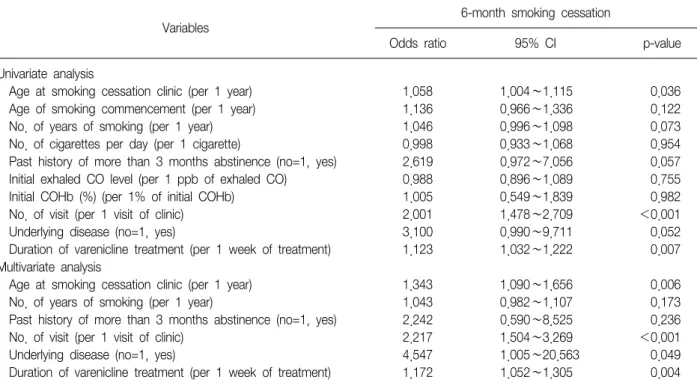
The success rate of 6-month smoking cessation of the 78 subjects was shown to be 47.4%. Based on the 12-week varenicline treatment, the success rate of 6-month smoking cessation was shown to be 63.6% in the group that received varenicline for 12 weeks or lon- ger, which was higher than 41.1% of the group that ear- ly terminated varenicline treatment (less than 12 weeks) (p=0.074). As a result of univariate analysis, factors af- fecting the success rate of 6-month smoking cessation

were shown to be age at the time of visiting the smok- ing cessation clinic, total number of visiting the smoking cessation clinic, presence of underlying diseases, and varenicline treatment duration (Table 2). A multivariate analysis showed that the odds ratio of 6-month smoking cessation success increased to approximately 1.34-folds and 2.22-folds in the cases of higher age at the visit of the smoking cessation clinic and an increase in the number of visiting the smoking cessation clinic, re- spectively, if other factors were constant. In addition, the odds ratio of 6-month smoking cessation success was approximately 4.55-folds higher in the case of un- derlying diseases compared to that of no underlying disease. However, when the underlying diseases were classified into pulmonary nodules, hypertension, dia- betes, and carotid artery atherosclerosis/ischemic heart disease, and then analyzed again, no significant differ- ence was found.

When the period of varenicline treatment was ex-

tended one more week, the odds ratio of 6-month

(5)

smoking cessation success was shown to have increased to approximately 1.17-folds (p=0.004; 95% confidence interval [CI], 1.052∼1.305). Compared to the group with varenicline treatment less than 4 weeks, when the varenicline treatment period was classified into less than 4 weeks, 4∼8 weeks, and 8 weeks or higher, and ana- lyzed, the odds ratio of 6-month smoking cessation suc- cess significantly increased to approximately 5.08-folds in the group with varenicline treatment for 8 weeks or higher (p=0.011; 95% CI, 1.362∼18.925), but insignif- icantly increased to approximately 2.18-folds in the group with varenicline treatment for 4∼8 weeks (p=

0.477; 95% CI, 0.495∼9.619).

3. Adverse events caused by varenicline

Twenty-eight cases of adverse events were observed in 24 subjects (30.8%) among 78 subjects who received varenicline. They included nausea (14.1%, 11/78), ab- normal dreaming (5.1%), weakness (2.6%), headache (2.6%), insomnia (2.6%), unknown loss of conscious- ness, abnormal blood pressure elevation, abdominal pain, itching, and psychological dependence to var- enicline. However, no serious adverse event was found.

When the subjects were classified into the groups with varenicline treatment for less than 4 weeks, 4∼8 weeks, and 8 weeks or longer, and were analyzed, the frequency of adverse events was shown to be 5.1% (4 cases), 12.8% (10 cases), and 12.8% (10 cases), re- spectively, which showed no significant difference among the three groups (p=0.211).

Discussion

Smoking causes cancer, cardiovascular diseases, and pulmonary diseases. However, the onset of these dis- eases or early death caused by them can be reduced via smoking cessation

11-14

. Many smokers decide to quit smoking due to reasons such as new year goal or health, but the success rate of smoking cessation by will alone has been reported to be only 3∼5%, which is very low

15,16

. The reasons for that is because of nicotine dependence, a major causative factor of smoking

17

.

Varenicline is a partial agonist of nicotine receptors, and

is currently used as the most effective smoking cessation

aid that reduces smoking desire and withdrawal symp-

toms

9,18-22

. However, due to drug cost, adverse events,

and drug incompliance in Korea, 12-week varenicline

treatment is rarely conducted

23

. Song et al.

23

reported

that smoking cessation subjects who completed 12-week

varenicline treatment accounted for 7.7%, and their suc-

cess rate of 6-month smoking cessation was 35.4%. A

univariate analysis showed that factors related to

6-month smoking cessation success were nicotine de-

pendence, mean daily smoking amount, weekly drink-

ing amount, varenicline treatment duration, number of

outpatient visit, and reasons for visiting, whereas a mul-

tivariate analysis showed that factors related to 6-month

smoking cessation success were mean daily smoking

amount, varenicline treatment duration, and reasons for

visiting the clinic. When the aforementioned results

were compared with the results this study, they were

similar in that the success rate of smoking cessation in-

creased in the cases of older age at the time of visiting

the smoking cessation clinic, more frequent outpatient

visit, longer varenicline treatment duration, and under-

lying diseases. However, in this study, the success rate

of 6-month smoking cessation was 47.4%, which was

irrelevant to the mean daily smoking amount, number

of drinking, and nicotine dependency. Twenty-eight

percent of the subjects who received varenicline com-

pleted 12-week varenicline treatment, and their success

rate of 6-month smoking cessation was 64%, which was

higher than 41% of the group that early terminated vare-

nicline treatment. Considering that the subjects of this

study were males in their 40∼50s (74%) with high edu-

cation (84%) and high income (85%) from a socio-

economic point of view, it is likely that compared to

smokers in their 20∼30s who have relatively lower fi-

nancial security and less interest in health, the success

rate of 6-month smoking cessation was higher in the

subjects of this study due to more experiences in abnor-

mal symptoms and signs, increased interest in health,

and stronger motivation for smoking cessation as a re-

quired behavior. In addition, although the presence of

(6)

underlying diseases was a factor related to 6-month smoking cessation success, no significant difference was found when the subjects were classified into the sub- groups by disease, and then analyzed. Thus, a further study is required to be conducted on a larger number of subjects.

A further systematic study is required for reasons for the early termination of varenicline treatment. One thing that should be noted in this study is that the odds ratio of 6-month smoking cessation success increased as var- enicline was treated one more week although the treat- ment period did not reach 12 weeks, the recommended period of varenicline treatment. Thus, it is important to increase drug compliance for varenicline treatment un- less a particular contraindication is commented in a smoking cessation consultation. Adverse events were observed in approximately 30% of the subjects who re- ceived varenicline, but most of them were mild gastro- intestinal symptoms. In the case of nausea, the symp- tom was improved as time passed by even if varenicline dose was constantly maintained, and it was resolved if varenicline dose decreased. Thus, this symptom can be controlled if an education on the efficacy and adverse events of varenicline is provided to smokers upon treatment. If varenicline is covered by medical in- surance, thereby saving the cost of varenicline treat- ment, patient's drug compliance could be improved.

This is a retrospective observatory study that was con- ducted on middle-aged male subjects with relatively high educational background and high income, who underwent a medical examination in a single institution.

Although the result of this study is hard to be general- ized and applied to the Korean male smoker pop- ulation, an effort to improve drug compliance for vare- nicline in clinical practices could be helpful for the long-term success of smoking cessation.

References

1. Action on Smoking and Health. Smoking statistics: ill- ness and death [Internet]. London: Action on Smoking and Health; 2011 [cited 2011 Oct 23]. Available from:

http://www.ash.org.uk/files/documents/ASH_

107.pdf.

2. Kim IS, Jee SH, Ohrr H, Yi SW. Effects of smoking on the mortality of lung cancer in Korean men. Yonsei Med J 2001;42:155-60.

3. Ministry of Health and Welfare, Korea Centers for Disease Control and Prevention. The Forth Korea National Health and Nutrition Examination Survey (KNHANES IV), 2008. Seoul: Ministry of Health and Welfare, Korea Centers for Disease Control and Prevention; 2009 [cited 2011 Oct 23]. Available from:

http://knhanes.cdc.go.kr/.

4. Watkins SS, Koob GF, Markou A. Neural mechanisms underlying nicotine addiction: acute positive reinforce- ment and withdrawal. Nicotine Tob Res 2000;2:19-37.

5. Zbikowski SM, Swan GE, McClure JB. Cigarette smok- ing and nicotine dependence. Med Clin North Am 2004;88:1453-65, x.

6. Tonstad S. Smoking cessation efficacy and safety of varenicline, an alpha4beta2 nicotinic receptor partial agonist. J Cardiovasc Nurs 2006;21:433-6.

7. Nides M, Oncken C, Gonzales D, Rennard S, Watsky EJ, Anziano R, et al. Smoking cessation with vareni- cline, a selective alpha4beta2 nicotinic receptor partial agonist: results from a 7-week, randomized, placebo- and bupropion-controlled trial with 1-year follow-up.

Arch Intern Med 2006;166:1561-8.

8. Tonstad S. Varenicline for smoking cessation. Expert Rev Neurother 2007;7:121-7.

9. Tsai ST, Cho HJ, Cheng HS, Kim CH, Hsueh KC, Billing CB Jr, et al. A randomized, placebo-controlled trial of varenicline, a selective alpha4beta2 nicotinic acetylcho- line receptor partial agonist, as a new therapy for smoking cessation in Asian smokers. Clin Ther 2007;

29:1027-39.

10. Kang YS, Choi SY, Ryu E. The effectiveness of a stress coping program based on mindfulness meditation on the stress, anxiety, and depression experienced by nursing students in Korea. Nurse Educ Today 2009;29:

538-43.

11. Ockene IS, Miller NH. Cigarette smoking, cardiovas- cular disease, and stroke: a statement for healthcare professionals from the American Heart Association.

American Heart Association Task Force on Risk Reduc- tion. Circulation 1997;96:3243-7.

12. Shinton R, Beevers G. Meta-analysis of relation be- tween cigarette smoking and stroke. BMJ 1989;298:789- 94.

13. Critchley JA, Capewell S. Mortality risk reduction asso-

(7)

ciated with smoking cessation in patients with coronary heart disease: a systematic review. JAMA 2003;290:86- 97.

14. Enstrom JE, Heath CW Jr. Smoking cessation and mor- tality trends among 118,000 Californians, 1960-1997.

Epidemiology 1999;10:500-12.

15. Molyneux A. Nicotine replacement therapy. BMJ 2004;

328:454-6.

16. Fiore MC, Novotny TE, Pierce JP, Giovino GA, Hatziandreu EJ, Newcomb PA, et al. Methods used to quit smoking in the United States. Do cessation pro- grams help? JAMA 1990;263:2760-5.

17. Laviolette SR, van der Kooy D. The neurobiology of nicotine addiction: bridging the gap from molecules to behaviour. Nat Rev Neurosci 2004;5:55-65.

18. Garrison GD, Dugan SE. Varenicline: a first-line treat- ment option for smoking cessation. Clin Ther 2009;31:

463-91.

19. Gonzales D, Rennard SI, Nides M, Oncken C, Azoulay S, Billing CB, et al. Varenicline, an alpha4beta2 nic- otinic acetylcholine receptor partial agonist, vs sus-

tained-release bupropion and placebo for smoking ces- sation: a randomized controlled trial. JAMA 2006;296:

47-55.

20. Jorenby DE, Hays JT, Rigotti NA, Azoulay S, Watsky EJ, Williams KE, et al. Efficacy of varenicline, an al- pha4beta2 nicotinic acetylcholine receptor partial ago- nist, vs placebo or sustained-release bupropion for smoking cessation: a randomized controlled trial.

JAMA 2006;296:56-63.

21. Tonstad S, Tønnesen P, Hajek P, Williams KE, Billing CB, Reeves KR, et al. Effect of maintenance therapy with varenicline on smoking cessation: a randomized controlled trial. JAMA 2006;296:64-71.

22. Wang C, Xiao D, Chan KP, Pothirat C, Garza D, Davies S. Varenicline for smoking cessation: a placebo-con- trolled, randomized study. Respirology 2009;14:384-92.

23. Song B, Yun WS, Choi EY, Cheong YS, Park EW.

Smoking cessation rate and related factors of vareni- cline in clinical practice. Korean J Fam Med 2011;32:

112-9.

수치

Table  1.  Baseline  characteristics
Table  2.  Variables  influencing  6-month  smoking  cessation

참조

관련 문서

this study analysed cast speed and solidification in thermal and flow perspectives and based on the results, conducted a confidence test on the high-speed general purpose

Subjects with a smoking period of 1 to 3 years had a high smoking cessation success rate (p=0.024), and the lower the average daily smoking amount, the higher the

Objectives : The purpose of this study was to investigate the effects of general characteristics, health characteristics, mental health characteristics, suicidal

Objectives: The aim of this study was to study the relationship between smoking, alcohol drinking and vitamin D level among Korean adults using data from the

Objective: The purpose of this study is to use it as a basis for the health care guidelines for the muscle mass and cardiovascular disease of Korean population by

This study analyzed the characteristics of smokers in term of structure of household, socioeconomic status and smoking behavior and investigated whether

And this Program was verified it's effect as applied to smoking adolescents showing significant differences in smoking knowledge, non-smoking behavior

The purpose of this study was to investigate the effects of 8 weeks trampoline exercise on health promotion (health related fitness, blood lipid) in