The Construction of a Chinese Cabbage Marker-assisted Backcrossing System Using High-throughput Genotyping Technology
Jinhee Kim
1*, Do-Sun Kim
1, Eun Su Lee
1, Yul-Kyun Ahn
1, Won Byoung Chae
1, and Soo-Seong Lee
21
Vegetable Research Division, National Institute of Horticultural and Herbal Science, RDA, 100, Nongsaengmyeong-ro, Iseo-myeon, Wanju-gun, Jeollabuk-do, Korea
2
BioBreeding Institute, Business Incubation, Chung-Ang University, Ansung, Korea
*Corresponding author: [email protected]
The goal of marker-assisted backcrossing (MAB) is to significantly reduce the number of breeding generations required by using genome-based molecular markers to select for a particular trait; however, MAB systems have only been developed for a few vegetable crops to date. Among the types of molecular markers, SNPs (single-nucleotide polymorphisms) are primarily used in the analysis of genetic diversity due to their abundance throughout most genomes. To develop a MAB system in Chinese cabbage, a high-throughput (HT) marker system was used, based on a previously developed set of 468 SNP probes (BraMAB1, Brassica Marker Assisted Backcrossing SNP 1). We selected a broad-spectrum TuMV ( Turnip mosaic virus ) resistance ( trs ) Chinese cabbage line (SB22) as a donor plant, constructing a BC
1F
1population by crossing it with the TuMV-susceptible 12mo-682-1 elite line. Foreground selection was performed using the previously developed trs SCAR marker. Background selection was performed using 119 SNP markers that showed clear polymorphism between donor and recipient plants. The background genome recovery rate (% recurrent parent genome recovery;
RPG) was good, with three of 75 BC
1F
1plants showing a high RPG rate of over 80%. The background genotyping result and the phenotypic similarity between the recurrent parent and BC
1F
1showed a correlation. The plant with the highest RPG recovery rate was backcrossed to construct the BC
2F
1population. Foreground selection and background selection were performed using 169 BC
2F
1plants. This study shows that, using MAB, we can recover over 90% of the background genome in only two generations, highlighting the MAB system using HT markers as a highly efficient Brassica rapa backcross breeding system. This is the first report of the application of a SNP marker set to the background selection of Chinese cabbage using HT SNP genotyping technology.
This study was supported by the National Institute of Horticultural and Herbal Science, the Rural Development Administration, Republic of Korea (Project No. PJ011854).
HORTICULTURAL SCIENCE and TECHNOLOGY 35(2):232-242, 2017
URL: http://www.kjhst.org pISSN : 1226-8763 eISSN : 2465-8588
This is an Open-Access article distributed under the terms of the Creative Commons Attribution NonCommercial License which permits unrestricted non-commercial use, distribution, and reproduction in any medium, provided the original work is properly cited.
Copyrightⓒ2017 Korean Society for Horticultural Science.
OPEN ACCESS Received:
Revised:
Accepted:
August 30. 2016 December 3. 2016 December 16. 2016
Abstract
Additional key words: background selection, Brassica rapa , high-throughput marker, SNP genotyping, TuMV resistance
Introduction
Turnip mosaic virus ( TuMV ; genus : Potyvirus) infects a wide range of cultivated plants , commonly
causing a distinct mosaic of light - and dark - green coloration in the leaves . Other symptoms such as necrotic streaks , flecks , or ring spots may also appear , depending on the virus strain and the crop species . The major hosts of TuMV are the brassicaceous species , in which it causes severe economic losses in terms of crop production in Asia , North America , and Europe ( Edwardson and Christie 1991 ; Shattuck et al ., 1992 ). TuMV is transmitted by aphids in a non - persistent manner ( Shattuck et al ., 1992 ). One of its target species , Chinese cabbage ( Brassica rapa subsp . pekinensis) is cultivated worldwide , but it most commonly grown in Asia and Europe . The serious loss of yield caused by TuMV means that the development of broad - spectrum resistance to this virus is still an important target for Chinese cabbage breeders .
Dominant TuMV resistance genes have been identified in the Brassicaceae , including TuMV Resistance in Brassica 01 (TuRB01), TuRB03, TuRB04, TuRB05, TuRB07, TuRB01b, Conditional TuMV resistance 01 (ConTR01), and TuRBCS01 ( Robbins et al ., 1994 ; Walsh et al ., 1999 ; Jenner et al ., 2002 ; Hughes et al ., 2003 ; Rusholme et al ., 2007 ; Qian et al ., 2013 ; Jin et al ., 2014 ; Liz et al ., 2015 ). Recessive resistance genes , Recessive TuMV resistance 01 ( retr01), retr02 and trs ( TuMV resistance discovered at Seoul National University ), have also been identified in Brassica rapa ( Walsh et al ., 2002 ; Kim et al ., 2013 ). Among these resistance genes , trs was found to provide broad - spectrum resistance against several TuMV strains ( Kim et al ., 2013 ).
The purpose of backcross breeding is to transfer a specific allele at the target locus from a donor line to a recipient line . The fundamental theory of the traditional backcrossing system is that the proportion of the recurrent parent genome ( RPG ) is recovered at a rate of 1 – ( 1 / 2 )
t+1for each backcrossing generation ( Babu et al ., 2004 ); thus , the time taken to achieve the appropriate number of generations and the linkage drag observed are the two major issues to resolve in the traditional backcrossing system ( Semagn et al ., 2006 ). Marker - assisted backcrossing ( MAB ) is considered an innovative tool for the effective introgression of a single targeted locus in plant breeding , while retaining the important characteristics of the recurrent parent ( Hospital and Charcosset 1997 ; Hospital 2001 ; Collard and Mackill 2008 ). MAB can remarkably accelerate the recovery speed of the recurrent parent genome . The use of molecular markers that permit the genetic dissection of the progeny at each generation increases the speed of the selection process , thus increasing the genetic gain per unit time ( Tanksley et al ., 1989 ; Hospital 2003 ).
The MAB system enables the recovery of the recurrent parent genotype in only two or three backcrosses . The efficiency of MAB is known to be dependent on the experimental design , most notably on the marker density and position , population size , and selection strategy ( Frisch et al ., 2000 ; Frisch et al ., 2005 ). MAB is available only when there is a reference genome from which useful markers can be developed , however , meaning few vegetable crop breeders have attempted to use this method to date . Many of the studies introducing MAB systems have been those examining field crops , such as rice ( Oryza sartiva), wheat (Triticum aestivum), barley (Hordeum vulgare), peanut (Arachis hypogaea), and millet (Pennisetum glaucum; Liu et al ., 2000 ; Jefferies et al ., 2003 ; Neeraja et al ., 2007 ; Koilkonda et al ., 2012 ; Soto - Cerda et al ., 2013 ; Vishwakarma et al ., 2014 ; Lee et al ., 2015 ). Simple sequence repeat ( SSR ) markers were used in most of these cases . MAB systems for multiple gene introgressions and QTL introgressions have also been used in several crops as maize , sweet corn , bean , rice , wheat and chickpea ( Frisch et al ., 2001 ; Yousef et al ., 2002 ; Miklas et al ., 2007 ; Iftekharuddaula et al ., 2011 ; Salameh et al ., 2011 ; Cuc et al ., 2012 ; Khanh et al ., 2013 ; Taran et al ., 2013 ; Hao et al ., 2014 ; Varshney et al ., 2014 ; Mallick et al ., 2015 ).
In this study , a high - throughput ( HT ) marker system was used to develop a MAB system in Chinese cabbage . The 468
previously developed single - nucleotide polymorphism ( SNP ) probes (Brassica Marker Assisted Backcrossing SNP 1
[ BraMAB1 ]), designed for the Fluidigm system , were applied in this study . We selected the broad - spectrum TuMV - resistant
Chinese cabbage line SB22 as a donor plant and crossed it with the TuMV - susceptible 12mo - 682 - 1 elite line , determining that the HT marker system is highly efficient in the B. rapa backcross breeding system . This is the first report of the application of a SNP marker set in the background selection of Chinese cabbages using HT SNP genotyping technology .
Materials and Methods
Plant Materials and MAB Population Construction
The Chinese cabbage (B. rapa subsp . pekinensis) backcross population BC
1F
1was constructed by crossing the SB22 TuMV - resistant donor line ( Kim et al ., 2013 ) with the recurrent parent , 12mo - 682 - 1 , an elite cultivar provided by the Biobreeding Research Center , Ansung , Korea ( Table 1 ). The 12mo - 682 - 1 line produces a closed head with yellow inner leaves , and displays strong heterosis , late flowering , and early maturity , which are all suitable characteristics for kimchi production . This accession is susceptible to TuMV . The SB22 produces half - opened heads . The BC
1F
1plant with the highest RPG recovery rate was backcrossed to 12mo - 682 - 1 to construct the BC
2F
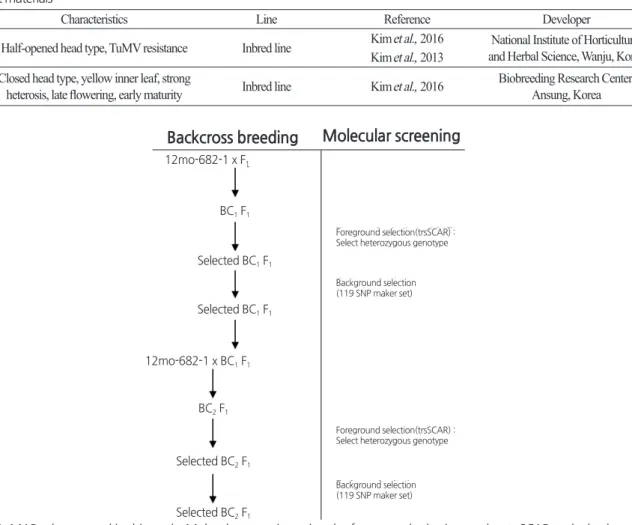
1population . The MAB scheme is described in Figure 1 .
Plant ID Characteristics Line Reference Developer
SB22 Half-opened head type, TuMV resistance Inbred line Kim et al., 2016 National Institute of Horticultural and Herbal Science, Wanju, Korea Kim et al., 2013
12mo-682-1 Closed head type, yellow inner leaf, strong
heterosis, late flowering, early maturity Inbred line Kim et al., 2016 Biobreeding Research Center, Ansung, Korea Table 1. Parent plant materials
Fig. 1. MAB scheme used in this study. Molecular screening using the foreground selection marker trsSCAR and a background selection marker set of 119 SNP markers polymorphic between the donor and recipient parents was performed in each backcross generation.
Backcross breeding
12mo-682-1 x F
1Molecular screening
BC
1F
1Selected BC
1F
1Selected BC
1F
1BC
2F
1Selected BC
2F
1Selected BC
2F
112mo-682-1 x BC
1F
1Foreground selection(trsSCAR) : Select heterozygous genotype
Background selection (119 SNP maker set)
Foreground selection(trsSCAR) : Select heterozygous genotype
Background selection (119 SNP maker set)
Selection of the SNP Background Marker Set
To develop the SNP marker set for the background selection of the BC
1and BC
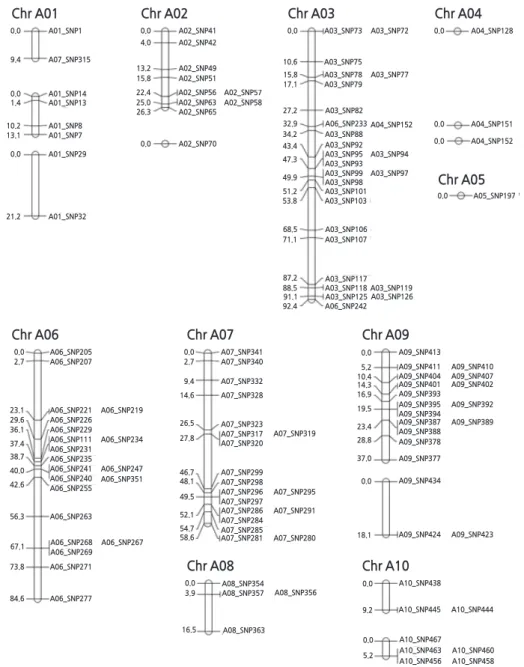
2populations , previously developed SNP markers , BraBSM (Brassica Background Selection Markers ), were used to screen for polymorphisms between the donor and the recipient plant ( Kim et al ., 2016 ). The 468 BraBSM SNP markers are evenly distributed throughout all ten chromosomes ( Kim et al ., 2016 ). Among these markers , 119 SNPs which showed polymorphism between the donor and the recipient plant were selected for further analysis ( Suppl . Table 1s ). The markers showing no polymorphism or an inconclusive result were eliminated . Linkage maps of SNPs used in the backcross selection of this study were constructed using the results of the BC
1F
1genotyping ( Figure 3 ) using Carthagene software ( de Givry et al ., 2005 ).
Fig. 3. Linkage map of SNPs constructed using the BC
1F
1genotyping result. The SNP probes are named on the right side of the map. The genetic distance (cM) is shown on the left. The ten chromosome numbers shown in this map are based on the physical position (kb) in the Brassica rapa reference genome sequence. The linkage map was generated using Carthagene software (de Givry et al ., 2005).
Chr A01 Chr A02 Chr A03 Chr A04
Chr A05
Chr A06 Chr A07 Chr A09
Chr A08 Chr A10
0.0
9.4
0.0 1.4
10.2 13.1
0.0
21.2
A01_SNP1
A07_SNP315
A01_SNP14 A01_SNP13
A01_SNP8 A01_SNP7
A01_SNP29
A01_SNP32
0.0 4.0
13.2 15.8
26.3
0.0
A02_SNP41 A02_SNP42
A02_SNP49 A02_SNP51
A02_SNP65
A02_SNP70 22.4
25.0
A02_SNP56 A02_SNP63
A02_SNP57 A02_SNP58
0.0
10.6 15.8 17.1
A03_SNP73
A03_SNP75 A03_SNP78 A03_SNP79
27.2 A03_SNP82 A03_SNP72
A03_SNP77
32.9 A06_SNP233 A04_SNP152 34.2 A03_SNP88 43.4 A03_SNP92 47.3 A03_SNP95 A03_SNP94
A03_SNP93 A03_SNP99 A03_SNP97 49.9 A03_SNP98 51.2 A03_SNP101 53.8 A03_SNP103
68.5 A03_SNP106 71.1 A03_SNP107
87.2 A03_SNP117 88.5 A03_SNP118 91.1 A03_SNP125 92.4 A06_SNP242
A03_SNP119 A03_SNP126
0.0 A04_SNP128
0.0 A04_SNP151
0.0 A04_SNP152
0.0 A05_SNP197
0.0 A06_SNP205 2.7 A06_SNP207
23.1 A06_SNP221 29.6 A06_SNP226 36.1 A06_SNP229 37.4 A06_SNP111 A06_SNP231 A06_SNP235 A06_SNP241 A06_SNP240 A06_SNP255 38.7
40.0 42.6
A06_SNP219
A06_SNP234
A06_SNP247 A06_SNP351
56.3 A06_SNP263
67.1 A06_SNP268 A06_SNP269
A06_SNP267
73.8 A06_SNP271
84.6 A06_SNP277
0.0 A07_SNP341 2.7 A07_SNP340
9.4 A07_SNP332 14.6 A07_SNP328
26.5 A07_SNP323 27.8 A07_SNP317 A07_SNP320
A07_SNP319
46.7 A07_SNP299 A07_SNP298 48.1
A07_SNP296 A07_SNP297
A07_SNP295
A07_SNP286 A07_SNP284
A07_SNP291
A07_SNP285
A07_SNP281 A07_SNP280 54.7
58.6 49.5
52.1
A08_SNP354
A08_SNP357 A08_SNP356 0.0
3.9
A08_SNP363 16.5
A09_SNP413 0.0
A09_SNP411 5.2
A09_SNP404 10.4
A09_SNP401 14.3
A09_SNP393 16.9
A09_SNP395 A09_SNP394 A09_SNP387 A09_SNP388 A09_SNP378 19.5
23.4 28.8
37.0 A09_SNP377
A09_SNP410 A09_SNP407 A09_SNP402
A09_SNP392
A09_SNP389
A09_SNP434 0.0
A09_SNP424
18.1 A09_SNP423
A10_SNP438 0.0
A10_SNP445
9.2 A10_SNP444
A10_SNP467 0.0
A10_SNP463 A10_SNP460 A10_SNP456 A10_SNP458 5.2
trsSCAR Marker Screening and Foreground Selection
The total genomic DNA was isolated from the young green leaves of Chinese cabbage using the cetyl trimethylammonium bromide ( CTAB ) method described by Hwang et al . ( 2009 ), and its quality was estimated using a NanoDrop spectrophotometer ( Thermo Fisher Scientific , Waltham , MA , USA ). To screen for TuMV resistance in the backcross population , the trs SCAR (trs sequence characterized amplified region ) marker ( three marker primers ) was used based on the modified protocol of Kim et al . ( 2013 ). A PCR analysis was performed using a total reaction volume of 25 µL , containing 100 ng of template genomic DNA , 2 . 5 µL 10 × rTaq Buffer , ( Mg
2+plus , Takara Shuzo Co ., Ltd ., Shiga , Japan ), 2 . 5 mM dNTP , 2 . 5 U of Takara rTaq ( Takara Shuzo Co ., Ltd .), 4 pmol of primer F1 , 3 pmol of primer F2 , and 5 pmol of primer R ( Kim et al ., 2013 ). The PCR conditions comprised 37 cycles at 94°C for 30 s , 63 . 5°C for 30 s , and 72°C for 1 min 40 s .
SNP Genotyping and Background Selection
The total genomic DNA of 75 BC
1F
1plants and 169 BC
2F
1plants was extracted and checked as described above . Genotyping analysis using the Fluidigm system ( IFC controller MX and EP1 system ; Fluidigm Corp ., San Francisco , CA , USA ) was performed by the Foundation of Agriculture Technology Commercialization and Transfer ( FACT ) in Korea .
Background selection was performed using the 119 SNP markers that showed a clear polymorphism between donor and recipient plants ( Table 2 ). The background genome recovery rate ( % RPG recovery ) was calculated as the percentage of recurrent parent ( 12mo - 682 - 1 ) alleles in the backcrossed plants . The number of plants showing the recurrent parent genotype was added to the number of plants showing the heterozygous genotype . The sum was divided by the total number of the population . The RPG rate was calculated by scoring the SNP genotype of each individual as either 0 ( homozygous , donor parent allele ), 0 . 5 ( heterozygous ), or 1 ( homozygous , recurrent parent allele ). The sum of the scores was converted to a percentage value .
Phenotyping Analysis of the Chinese Cabbage Backcross Population
The BC
1F
1population was phenotyped 60 days after transplant . The total weight , head weight , head height , and maximum head width were quantified , while the head type , outer leaf color , and internal leaf color were visually estimated . These seven
Brassica rapa chromosome Polymorphic SNP markers Chromosome size (Mb) SNP density
aA1 7 100 0.07
A2 10 120 0.08
A3 25 130 0.19
A4 3 150 0.02
A5 1 80 0.01
A6 21 230 0.09
A7 20 100 0.20
A8 5 150 0.03
A9 19 220 0.09
A10 8 180 0.04
Total 119
Average 0.08
a
SNP density = number of SNPs/Chromosome size (Mb)
Table 2. Distribution of SNP markers used in this MAB system across the Brassica rapa genome.
traits are typically bred for in Chinese cabbage crops produced in Korea . Photographs of the vertical aspect of each plant were taken during the phenotyping process .
Results
The Selection of Polymorphic SNP Markers and the Genotyping Result of the MAB Population
A total of 119 SNPs were identified from the BraBSM SNP markers between the donor and recurrent parents , and were used for the background selection of the BC
1and BC
2populations . The numbers of polymorphic SNPs per Chinese cabbage chromosome are shown in Table 2 . The range of SNP densities was between 0 . 01 and 0 . 20 SNPs · Mbp
-1, with an average SNP density of 0 . 08 SNPs · Mbp
-1. The SNP density of chromosome A07 was the highest , and that of chromosome A05 was the lowest .
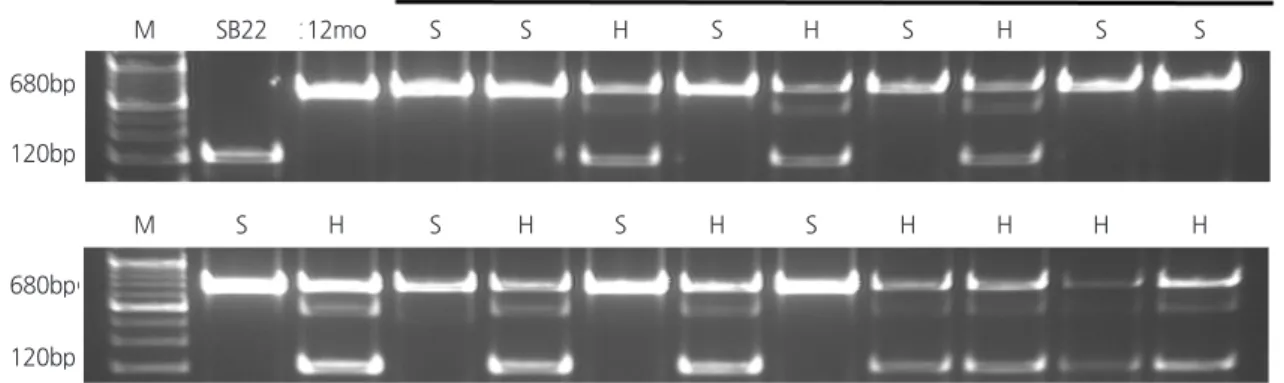
To preserve the TuMV resistance allele in the backcrossing procedure , foreground selection was performed using the trs SCAR marker , which was previously developed as an indicator of TuMV recessive resistance ( Kim et al ., 2013 ). The polymorphisms of the TuMV - resistant donor parent ( SB22 ) and the TuMV - susceptible recurrent parent ( 12mo - 682 - 1 ) plants were first confirmed using the trs SCAR marker . The 75 BC
1plants were then screened for their genotypic segregation of this trait ( Figure 2 ), resulting in the identification of 33 plants with a heterozygote genotype and 42 plants with a homozygote genotype ( Table 3 ). Because of the recessive inheritance pattern of TuMV resistance , heterozygous plants were selected for the background selection .
The RPG rates in the BC
1population ranged from 54 . 6% to 90 . 3% ( Table 3 ). A total of 18 . 2% of the 75 BC
1F
1plants showed an RPG rate above 80% , 68 . 8% had an RPG rate above 70% , and only one plant had an RPG rate above 90% . The BC
1F
1plant with the highest recovery rate ( 90 . 3% ) and with the heterozygous trs genotype was chosen to backcross to the recurrent parent to generate the next generation , BC
2F
1.
A total of 169 BC
2F
1plants were screened for the genotypic segregation analysis . A foreground selection was also performed using the trs SCAR marker . Of these , 108 plants had a heterozygous genotype , and 61 plants were homozygotes ( Table 3 ).
According to the screening data , the result was slightly biased to the heterozygote genotype . Of the 169 BC
1F
1plants , 39 . 1%
Fig. 2. Example of BC
1foreground selection using the trsSCAR marker. A total of 75 individuals were genotypically screened using the trsSCAR marker. ‘SB22’ and ‘12mo’ refer to the SB22 (donor parent) and 12mo-682-1 (recurrent parents) lines of Chinese cabbage, respectively. M: DNA marker; H: Heterotype genotype; S: susceptible genotype.
BC
1population
M SB22 12mo S S H S H S H S S
M S H S H S H S H H H H
680bp
120bp
680bp
120bp
had an RPG rate above 80% , and 85 . 2% had an RPG rate above 70% . The percentage of the genome - recovered plants (≥ 70% RPG rate ) in BC
2F
1was clearly increased compared with the BC
1F
1population .
These results show that the selected SNP marker set is useful for the efficient backcross breeding of Chinese cabbage. The RPG rates in the BC
2population ranged from 58 . 4% to 93 . 3% . Among the BC
2F
1plants , four plants had an RPG rate above 90% . This study shows that using MAB breeding , over 90% of the background genome can be recovered in only two generations .
The Selection Efficiency of Backcrossing Using the MAB Marker Set
To analyze the efficiency of the MAB background marker set , the genotype data of BC
1F
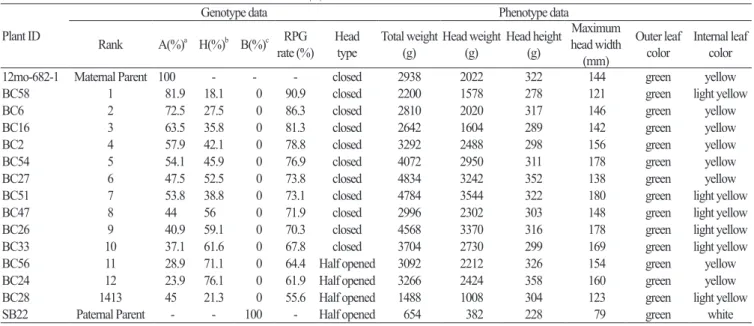
1plants were compared with their phenotypic data . A total of 13 plants were selected , representing RPG rates ranging from 55 . 6% ( plant BC28 ) to 90 . 9% ( plant BC58 ). The change in RPG rate between any two individuals was 0 . 7 - 6 . 3% ( Table 4 ).
The phenotype data of the selected BC
1F
1plants are shown in Table 5 and Figure 4 . Seven traits ( head type , total weight , head weight , head height , maximum head width , outer leaf color and internal leaf color ) were determined . According to the phenotype data , the head type trait showed a clear difference as the RPG rate changed , with the half - opened head type of the donor plant SB22 observed in the plants with an RPG rate < 65% . The density of the leaves , an indicator of maturity , also decreased in the plants with a lower RPG rate , similar to the SB22 donor . The quantitative analysis of total weight , head weight and width indicate that the plant ( BC58 ) with the highest RPG rate has a strong phenotypic similarity to the recurrent parent 12mo - 682 - 1 . There was no difference in the head height and the outer leaf colors among the BC
1F
1plants .
Discussion
Although background selection has become a standard tool in plant breeding , the high cost of marker analysis still limits its use in practice and restricts the experimental design of gene introgression programs ( Collard and Mackill , 2008 ). Here , we developed a Chinese cabbage MAB system using a HT genotyping method , the first time that this technique has been reported in this crop . We constructed the BC
1and BC
2Chinese cabbage populations to introduce TuMV broad - spectrum recessive resistance into the elite line , 12mo - 682 - 1 . The 119 polymorphic SNPs between the donor and recurrent parents identified from the previously developed BraMAB1 SNP probes were applied for the background selection , with foreground selection
FGS marker
aBC
1F
1BC
2F
1trs Total Heterozygotes Homozygotes χ
2p value Total Heterozygotes Homozygotes χ
2p value
75 33 42 1.096 0.295 169 108 61 14.341 p <0.1
Number of selected plants
after BGS
b(RPG
crate) 1(90.3) 1(93.3)
RPG recovered plant rate
(≥80%) 18.2 39.1
RPGc recovered plant rate
(≥70%) 68.8 85.2
Number of SNP markers
used for BGS 119 119
a
FGS marker: Foreground selection marker
b
BGS: Background selection
c
RPG rate: Recurrent parent genome (%)
Table 3. Genotyping of the BC
1F
1and BC
2F
1populations
Plant ID
Genotype data Phenotype data
Rank A(%)
aH(%)
bB(%)
cRPG
rate (%) Head
type Total weight
(g) Head weight
(g) Head height (g)
Maximum head width
(mm)
Outer leaf
color Internal leaf color
12mo-682-1 Maternal Parent 100 - - - closed 2938 2022 322 144 green yellow
BC58 1 81.9 18.1 0 90.9 closed 2200 1578 278 121 green light yellow
BC6 2 72.5 27.5 0 86.3 closed 2810 2020 317 146 green yellow
BC16 3 63.5 35.8 0 81.3 closed 2642 1604 289 142 green yellow
BC2 4 57.9 42.1 0 78.8 closed 3292 2488 298 156 green yellow
BC54 5 54.1 45.9 0 76.9 closed 4072 2950 311 178 green yellow
BC27 6 47.5 52.5 0 73.8 closed 4834 3242 352 138 green yellow
BC51 7 53.8 38.8 0 73.1 closed 4784 3544 322 180 green light yellow
BC47 8 44 56 0 71.9 closed 2996 2302 303 148 green light yellow
BC26 9 40.9 59.1 0 70.3 closed 4568 3370 316 178 green light yellow
BC33 10 37.1 61.6 0 67.8 closed 3704 2730 299 169 green light yellow
BC56 11 28.9 71.1 0 64.4 Half opened 3092 2212 326 154 green yellow
BC24 12 23.9 76.1 0 61.9 Half opened 3266 2424 358 160 green yellow
BC28 1413 45 21.3 0 55.6 Half opened 1488 1008 304 123 green light yellow
SB22 Paternal Parent - - 100 - Half opened 654 382 228 79 green white
a
A The maternal plant (12mo-682-1) genotype percentage
b
H The heterotype plant genotype percentage
c