Original article KOREAN JOURNAL OF APPLIED ENTOMOLOGY
한국응용곤충학회지 ⓒ The Korean Society of Applied Entomology
Korean J. Appl. Entomol. 54(2): 63-71 (2015) pISSN 1225-0171, eISSN 2287-545X
DOI: http://dx.doi.org/10.5656/KSAE.2015.03.1.069
A Taxonomic Review of the Genus Laccophilus Leach (Coleoptera: Dytiscidae: Laccophilinae) in Korea
Dae-Hyun LEE and Kee-Jeong AHN*
Department of Biology, Chungnam National University, Daejeon 305-764, Korea
한국산 깨알물방개속(딱정벌레목 : 물방개과 : 깨알물방개아과)의 분류학적 재검토
이대현ㆍ안기정*
충남대학교 생물과학과
ABSTRACT: A taxonomic review of Korean Laccophilus Leach is presented. Five species are recognized, three of which [L. hyalinus (De Geer), L. lewisius Sharp and L. minutus (Linné)] previously recorded in Korea are incorrect identification of L. vagelineatus Zimmermann, L. lewisioides Brancucci and L. difficilis Sharp, respectively. Habitus and SEM photographs, key and diagnoses of the species are provided.
Key words: Taxonomy, Laccophilus, Dytiscidae, Coleoptera, Korea
초 록: 한국산 깨알물방개속(Laccophilus Leach)의 분류학적 재검토를 수행하였다. 한국에서 기록된 5종 중에서 L. hyalinus (De Geer), L. lewisius Sharp (줄깨알물방개), L. minutus (Linné) (대륙깨알물방개)는 각각 L. vagelineatus Zimmermann (얼룩깨알물방개), L. lewisioides Brancucci (줄무늬깨알물방개)(신칭) and L. difficilis Sharp (깨알물방개)의 오동정이다. 각 종에 대한 외형 사진, 주사전자현미경 사진, 검색표 및 식별형질을 제시한다.
검색어: 분류, 깨알물방개속, 물방개과, 딱정벌레목, 한국
*Corresponding author: [email protected]
Received December 10 2014; Revised March 23 2015 Accepted April 9 2015
Laccophilus Leach is undoubtedly one of the most species-rich and widely distributed dytiscid genus. It contains 263 described species worldwide (Nilsson, 2014) and 37 species in the Palaearctic region (Nilsson and Hájek, 2014). In East Asia, eight species have been recorded in Korea, 21 species in China, 10 species in Japan and three species in the Far East of Russia (Nilsson and Hájek, 2014).
They are characterized by the combination of the following characters: head short and broad; median part of prosternum and prosternal process on same plane; prosternal process very
small, slender and apex acute; metatibial spines bifid apically;
pro- and mesotarsi with 5 tarsomeres; postero-lateral angle of metatarsomere strongly lobed (Kamiya, 1938a; Roughley and Larson, 2001).
In this paper we recognized five species, three of which [L.
hyalinus (DeGeer), L. lewisius Sharp, and L. minutus (Linné)]
previously recorded in the Korean fauna were incorrect identification of L. vagelineatus Zimmermann, L. lewisioides Brancucci, and L. difficilis Sharp, respectively. Habitus and SEM photographs, key and diagnoses of the species are provided.
Figs. 1. Habitus. A: Laccophilus difficilis, 5.2 mm; B: L. kobensis, 3.8 mm; C: L. lewisioides, 4.2 mm; D: L. vagelneatus, 3.6 mm.
Materials and Methods
To identify Korean Laccophilus Leach more reliably, we compared them with type series and voucher specimens in the National History Museum (NHM, London, United Kingdom).
The specimens used in this study are deposited in Chungnam National University Insect Collection (CNUIC), Daejeon, Korea and Ehime University Museum (EUMJ), Matsuyama, Japan. Habitus photographs were prepared from single or multi-layered shots taken with Olympus DP71 camera with several images amalgamated using Helicon Focus 5.3 (Helicon Soft, Kharkov, Ukraine) and edited by Adobe Photoshop CS4 (Adobe, San Jose, USA). Dry specimens for scanning electron microscope (SEM) photographs were sputter coated with platinum (SPUTTER COATER: CRESSINGTON 208 AUTO) and examined under SEM (S-4800, HITACHI). The terminology of taxonomic characters and measurements of specimens mainly followed Brancucci (1983) and Balke (2005).
Taxonomic accounts
Family Dytiscidae Leach, 1815
Subfamily Laccophilinae Gistel, 1856
Genus Laccophilus Leach, 1815 깨알물방개속
Laccophilus Leach, 1815: 84 (type species Dytiscus minutes Linné, 1758)
Key to the species of genus Laccophilus in Korea
1. Body length more than 4.0 mm ··· 2 - Body length less than 4.0 mm ··· 3 2. Elytra with distinct brown to black vitta ··· L. lewisioides - Elytra with indistinct brown vitta ··· L. difficilis 3. Ventral surface yellowish brown ··· 4 - Ventral surface dark brown ··· L. vagelineatus 4. Maxillary palpomere 4 with black marking on apical part
··· L. kobensis - Maxillary palpomere 4 without black marking on apical part
··· L. sharpi
Laccophilus difficilis Sharp 깨알물방개 (Figs. 1A, 2, 6A)
Laccophilus difficilis Sharp, 1873: 53; Kamite et al., 2005:
618.
Laccophilus minutus: Kim et al. 1994: 132; Cho and Park, 2010: 95 [misidentification].
Korean records. Laccophilus difficilis: Mori, 1932: 2;
Takizawa, 1932: 22; Kusanagi, 1936: 325; Kamiya, 1938a: 6;
1938b: 26; 1940: 116; Cho, 1957: 198 (misprint); 1969: 173;
Brancucci, 1983: 279; Kwon and Suh, 1986: 92; Yoon, 1988:
570; Yoon and Ahn, 1988: 192; Kim and Lee, 1991: 65; Lee et al., 1992: 49; Park and Kim, 1993: 110; Kim et al., 1994: 132;
Lee, 1994: 17; Lee, 1995: 11; Nilsson, 1995: 69; Kim and Kim, 1996: 126; Kim and Kim, 1998: 169; Kim, 2000: 131; Nilsson, 2003; 76; Han et al., 2007: 271; Han et al., 2008: 213; Park et al., 2008: 210; Cho and Park, 2010: 95; Nilsson and Hájek, 2014: 47.
Diagnosis. Body length 5.0-5.5 mm. Dorsal surface yellow to yellowish brown and ventral surface yellowish brown.
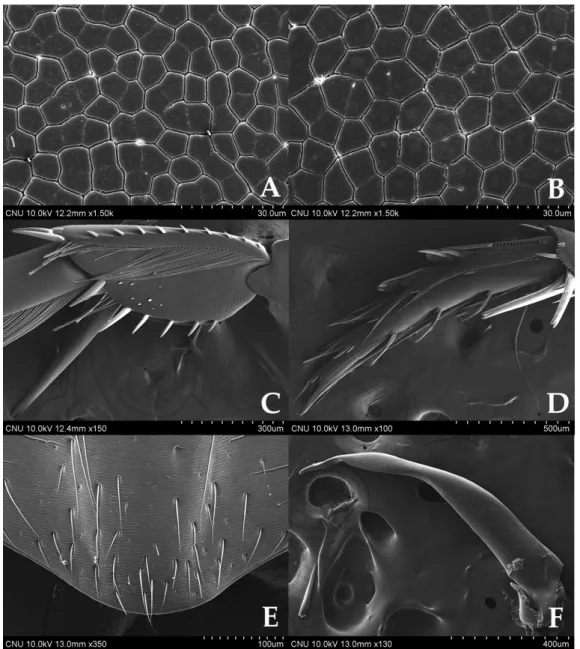
Fig. 2. Laccophilus difficilis. A: reticulation of pronotum (dorsal aspect); B: reticulation of elytra (dorsal aspect); C: metatibia (ventral aspect);
D: metatarsus (ventral aspect); E: sternite VII (ventral aspect); F: median lobe of aedeagus (lateral aspect).
Maxillary palpomere 4 dark brown at apical forth. Labial palpomere 3 dark brown at apical third. Pronotum with small polygonal meshes and few setae, mostly two or three meshes connected (Fig. 2A). Elytra yellow with irregular marking and vittae, small polygonal meshes and few setae present, meshes not connected and larger than pronotum (Fig. 2B). Metatibia with 7-9 spines on dorsal margin (Fig. 2C), largest spine as long as metatarsomere 1. Metatarsomere 1 longest, about 1.7 times as long as 2 (Fig. 2D). Postero-medial part of sternite VII slightly convex (Fig. 2E). Median lobe of aedeagus slender, curved; apex acute, subapical to middle expanded laterally;
anterior third narrowed; basal part widest (Fig. 2F).
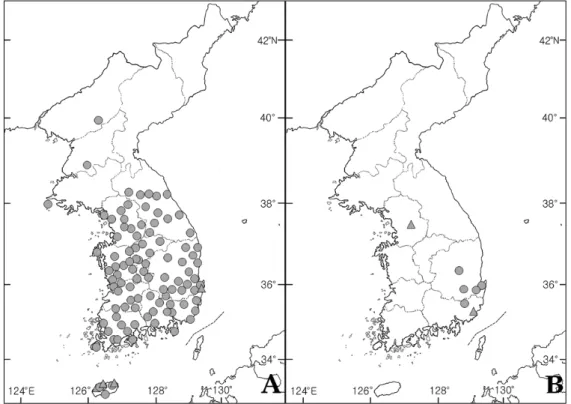
Material examined. Lectotype: 1♂ (NHM), with labels as follows: “Laccophilus diffiicilis Types D. S., Lectotype, Lectotypus, Japan., Japan. Lewis., Sharp Coll. 1905-313., Laccophilus difficilis Types D. S., Lectotype Laccophilus difficilis Sharp det. M. Brancucci”. NORTH KOREA: 8♂♂12♀♀, Pyeong Yang-City, SunAn-Airport, Light of Entrance, 17 VII 2008, Changdo Han leg; 5♂♂3♀♀, Hyangsan-Gun, Around Hyangsan-Hotel, Near Chaongchon-River, 29. VI. 2009. Changdo Han leg; SOUTH KOREA: More than 300 specimens from all area in South Korea.
Fig. 3. Laccophilus kobensis. A: reticulation of pronotum (dorsal aspect); B: reticulation of elytra (dorsal aspect); C: metatibia (ventral aspect); D: metatarsus (ventral aspect); E: sternite VII (ventral aspect); F: median lobe of aedeagus (lateral aspect).
Distribution. Korea, China (Beijing, Fujian, Guangdong, Guizhou, Hainan, Heilongjiang, Hebei, Hunan, Jiangsu, Jilin, Jiangxi, Liaoning, Sichuan, Shanghai, Shandong, Shanxi, Yunnan, Zhejiang), Japan, Russia (Far East).
Remarks. This species can be distinguished from L. minutus by the apical forth of median lobe expanded laterally.
Laccophilus kobensis Sharp 동쪽깨알물방개 (Figs. 1B, 3, 6A)
Laccophilus kobensis Sharp, 1873: 53; Nilsson, 1995: 69;
Kamite et al., 2005: 620.
Korean records. Laccophilus kobensis: Kwon and Suh, 1986: 93; Lee et al., 1992: 61; Kim et al., 1994: 132; Han et al., 2007: 271; Han et al., 2008: 215; Park et al., 2008: 211; Cho and Park, 2010: 95.
Diagnosis. Body length 3.5-4.0 mm. Dorsal surface yellowish brown and ventral surface brown. Maxillary palpomere 4 dark brown at apical third. Labial palpomere 3 dark brown at apical a third. Pronotum with small polygonal meshes and few setae, mostly two or three meshes connected (Fig. 3A). Elytra yellowish brown to brown with irregular marking and indistinct vittae, small polygonal meshes and few setae present; meshes
Fig. 4. Laccophilus lewisioides. A: reticulation of pronotum (dorsal aspect); B: reticulation of elytra (dorsal aspect); C: metatibia (ventral aspect); D: metatarsus (ventral aspect); E: sternite VII (ventral aspect); F: median lobe of aedeagus (lateral aspect).
not connected and larger than pronotum (Fig. 3B). Metatibia with 7-9 spines on dorsal margin (Fig. 3C), largest spine longer than metatarsomere 1. Metatarsomere 1 longest, about 1.5 times as long as 2 (Fig. 3D). Postero-medial part of sternite VII valvular (Fig. 3E). Median lobe of aedeagus slender, weakly curved; apex acute, subapical to middle expanded laterally;
widest at middle (Fig. 3F).
Material examined. Lectotype: 1 ♂ (NHM), with labels as follows: “Laccophilus kobensis Types D. S., Lectotype, Japan.
Lewis, Sharp Coll. 1905-313., Japan, Kobé, Japan. L. kobensis Type D. S., Lectotype Laccophilus kobensis Sharp det. M.
Brancucci”. SOUTH KOREA: Gyeongbuk Prov.: 1♂♂3♀
♀, Pohang-si, Nam-gu, Jigok-dong, 26 IV 1992, SH Lee; Jeju Prov.: 1♂1♀, Jeju-si, Hangyeong-myeon, Yongsu-ri, 17 VIII 1992, SH Lee, pond; 1♂1♀, Jeju-si, Jocheon-eub, Seonheul-ri, 11 VI 2005, DH Lee, pond; 1♂3♀♀, same data as former except for 12 VI 2005; 2♂♂1♀, same data as former except for 22 V 2006 (1♂1♀, on slide); 1♂, same data as former except for 2 III 2007 (1♂, on slide); 2♂♂3♀♀, same data as former except for Dongbaek-park, 25 IX 2008 (1♂, on slide); 1♂, Seogwipo-si, Galmae-pond, 25 VII 2005, SH Lee, pond (1♂, on slide); 3♂♂5♀♀, Jeju-si, Saekdal-dong, 10 V
Fig. 5. Laccophilus vagelneatus. A: reticulation of pronotum (dorsal aspect); B: reticulation of elytra (dorsal aspect); C: metatibia (ventral aspect); D: metatarsus (ventral aspect); E: sternite VII (ventral aspect); F: median lobe of aedeagus (lateral aspect).
2012, HG Min, marsh; 1♀, Jeju-si, Saekdal-dong, 1100goji, N33°21'36.45" E126°47'46.42", 1098m, 24 V 2006, DH Lee, mountain stream; 2♂♂, same data as former except for 8 XI 2006 (1♂, on slide);
Distribution. Korea, China (Fujian, Guanxi, Hunan, Shang- dong), Japan, Taiwan.
Laccophilus lewisioides Brancucci 줄무늬깨알물방개(신칭) (Figs 1C, 4, 6B)
Laccophilus lewisioides Brancucci, 1983: 272.
Laccophilus lewisius: Cho et al., 1985: 19; Kwon and Suh,
1986: 93; Yoon, 1988: 570; Yoon and Ahn, 1988: 192; Lee et al., 1992: 50; Kim et al., 1994: 132; Lee, 1994: 17; Lee, 1995:
11; Han et al., 2007: 271; Han et al., 2008: 216; Cho and Park, 2010: 95. [misidentification].
Korean records. Laccophilus lewisioides: Brancucci, 1983:
272; Nilsson, 1995: 69; Hua, 2002: 39; Hájek, 2003: 117;
Nillson, 2003; 46; Nilsson and Hájek, 2014: 47.
Diagnosis. Body length 4.0-4.5 mm. Body mostly yellowish brown. Maxillary palpomere 4 dark brown at apical third.
Labial palpomere 3 brown at apical part. Pronotum with large irregular meshes and few setae (Fig. 4A). Elytra yellow with
Fig. 6. Distribution map. A: Laccophilus difficilis (circle), L. kobensis (triangle); B: L. lewisioides (circle), L. vagelneatus (triangle).
distinct dark brown vittae, large transverse meshes and few setae present; meshes larger than pronotum (Fig. 4B). Metatibia with 7-9 of spines on dorsal margin (Fig. 4C), largest spine as long as metatarsomere 1. Metatarsomere 1 longest, about 1.5 times as long as 2 (Fig. 4D). Postero-median part of sternite VII slightly convex (Fig. 4E). Median lobe of aedeagus slender, bent and widest at middle, apex acute (Fig. 4F).
Material examined. SOUTH KOREA: Gyeongbuk Prov.: 1
♂, Euiseong-gun, Dongseong-pond, 6 VI 2010, SH Lee, pond;
1♀, same data as former except for Hwajeon-pond; 1♂1♀, Gyeongsan-si, Gyeyang-dong, Nammae-reservoir, N35°49'41.37"
E128°44'40.37", 58 m, 12 IX 1984, R. Pinger, reservoir; 1♂, same data as former except for 18 IV 1985; 1♀, same data as former except for 25 IV 1985; 1♂1♀, same data as former except for 13 V 1989; 1♂1♀, Gyeongju-si, Geoncheon-eub, Sinpyeong-ri, 28 V 1993, SH Lee; 1♀, Pohang-si, Nam-gu, Daejam-dong, Daejam-reservoir, N36°00'55.79" E129°20'07.38"
38 m, 12 V 1988, SH Lee, reservoir; 1♀, same data as former except for 18 IX 1988; 4♂♂2♀, Pohang-si, Nam-gu, Yeonil- eub, Yugang-ri, 23 VIII 1992, SH Lee (2♂♂1♀, on slides);
Gyeongnam Prov.: 2♂♂3♀♀, Milyang-si, Bubuk-myeon, Uiyang-ri, Uiyang-reservoir, N35°32'46.60" E128°42'58.68", 71 m,
14 IX 1996, SH Lee, reservoir.
Distribution. Korea, China (Hebei, Jiangsu, Inner Mongol, Shanghai), Russia (Far East).
Remarks. This species can be distinguished from L. lewisius Sharp by the median lobe bent at middle
Laccophilus sharpi Régimbart 샤아프깨알물방개 Laccophilus sharpi Régimbart, 1889: 151 Laccophilus similis Régimbart, 1889: 150.
Laccophilus samosir Csiki, 1938: 125.
Korean records. Laccophilus sharpi: Takizawa, 1932: 23;
Kamiya, 1938a: 8; 1938b: 28; Ishii, 1940: 42; Cho, 1957: 198;
1969: 173; Brancucci, 1983: 347; Kwon and Suh, 1986: 93;
Yoon, 1988: 571; Yoon and Ahn, 1988: 193; Kim et al., 1994:
132; Nilsson, 1995: 71; Yoon, 1995: 125; Hua, 2002: 39;
Nilsson, 2010: 49; Cho and Park, 2010: 95; Nilsson and Hájek, 2014: 48. Laccophilus sharpi similis: Mori, 1932: 2 [synonym of L. sharpi].
Distribution. Korea, Australia, China (Anhui, Beijing, Fujian, Guangdong, Guizhou, Guanxi, Hainan, Hebei, Hongkong, Hubei, Hunan, Jiangsu, Jilin, Jiangxi, Liaoning, Sichuan,
Shangdong, Yunnan, Zhejiang), Himachal Pradesh, India, Iran, Japan, Nepal, Pakistan, Philippines, Saudi Arabia, Sri Lanka, Sumatra, Taiwan, Vietnam,
Remarks. We could not find specimens in Korea but cited this species based on Brancucci (1983).
Laccophilus vagelineatus Zimmermann 얼룩깨알물방개 (Figs. 1D, 5, 6B)
Laccophilus vagelineatus Zimmermann, 1922: 19; Kamite et al., 2005: 623.
Laccophilus hyalinus: Jung et al., 2011: 42 [misidentification].
Korean records. Laccophilus vagelineatus: Brancucci, 1983:
282; Lee, 1994: 17; Nilsson, 1995: 69; Hua, 2002: 39; Hájek, 2003: 120; Nillson, 2003; 46; Nilsson and Hájek , 2014: 48.
Diagnosis. Body length 3.5-4.0 mm. Dorsal surface yellow to yellowish brown and ventral surface dark brown. Maxillary palpomere 4 without dark brown marking. Labial palpomere 3 without dark brown marking. Pronotum with small transverse meshes and few setae (Fig. 5A). Elytra brown with distinct dark brown vittae; transverse yellowish brown marking present on anterior fourth; small polygonal meshes and few setae present; meshes smaller than pronotum (Fig. 5B). Metatibia with 5-6 spines on dorsal margin (Fig. 5C); largest spine longer than metatarsomere 1. Metatarsomere 1 longest, about 1.7 times as long as 2 (Fig. 5D). Postero-median part of sternite VII valvular (Fig. 5E). Median lobe of aedeagus slender, weakly curved; apex acute, anterior fifth broadly expanded laterally; basal part widest (Fig. 5F).
Material examined. SOUTH KOREA: Gyeonggi Prov.: 4♂
♂3♀♀, Suwon-si, Paldal-gu, Hwaseo-dong, Seoho-reservoir, N37°16'38.87" E126°59'17.42", 35 m, 4 IX 1990, SH Lee, reservoir (2♂♂1♀, on slides); Gyeongnam Prov.: 1♂, Busan-si, Mulam, 24 VII 1991, SH Lee.
Distribution. Korea, China (Anhui, Fujian, Hubei, Jiangsu, Jiangxi, Yunnan, Zhejiang), Japan, Russia (Far East).
Remarks. This species can be distinguished from L. hyalinus by the elytra with transverse yellow marking.
Acknowledgements
We thank Mr. S. H. Lee (Acheon Elementary School, Gimcheon), Ms. C. Taylor (NHM, London) and Dr. H. Yoshitomi
(EUMJ, Matsuyama) for providing many specimens including type series and the literature. Financial support was provided by the National Institute of Biological Resources (NIBR, Incheon) of Ministry of Environment, KOREA (1834- 302) and the research on the three species newly recorded in Korea was supported by a grant from the National Institute of Biological Resources (NIBR), funded by the Ministry of Environment (MOE) of the Republic of Korea (NIBR 201501203).
This work was also supported by the research fund of 2014 Chungnam National University.
Literature Cited
Balke, M., 2005. Chapter 7.6. Dytiscidae, in: Beutel, R.G., Leschen, R.A.B. (Eds.) Handbuch der Zoologie/Handbook of Zoology, Volume IV, Arthropoda: Insecta, Part 38, Coleoptera, Beetles, Volume 1: Morphology and Systematics (Achostemata, Adephaga, Myxophaga, Polyphaga partim). Walter de Gruyter, Berlin, New York, pp. 90-116.
Brancucci, M., 1983. Révision des espèces est-paléarctiques, orientales et australiennese du Laccophilus (Col. Dytiscidae). Ent.
Arb. Mus. Fery 31/32, 241-426.
Cho, P.S., 1957. A Systematic Catalogue of Korea Coleoptera.
Humanities and Sciences, Kor. Univ. 2, 173-338.
Cho, P.S., 1969. Illustrated Encyclopedia of Fauna and Flora of Korea, Vol. 10, Insecta (II). Samhwa Publishing Company, Seoul.
Cho, Y.B., Park, S.W., 2010. Coleoptera, in: Paek, M.K., (Eds.), Checklist of Korean Insects. Nature and Ecology, Seoul, pp.
83-157.
Cho, Y.B., Park, H.C., Lee, C.E., 1985. Notes on unrecorded water-beetles from Korea (Coleoptera). Nature and Life. 15(1), 19-21.
Csiki, E., 1938. Die Schwimmkäfer (Haliplidae und Dytiscidae) von Sumatra, Java und Bali der Deutschen Limnologischen Sunda-Expedition. Arch. Hydrobiol. supplement 15[1937], 121-130.
Gistel J.N.F.K., 1856. Die Mysterien der europaischen Insektenwelt.
Danuheimer, Kempten.
Han M.S., Na Y.E., Bang H.S., Kim, M.H., Kim, K.M., Roh, K.A., Lee, J.T. 2007. The Fauna of Aquatic Invertebrates in Paddy Field. Korean J. Environ. Agric. 26(3), 267-273.
Han M.S., Na Y.E., Bang H.S., Kim, M.H., Kang, K.K., Hong, H.K., Lee, J.T., Ko, B.G., 2008. An Illustrated book of Aquatic Invertebrates in Paddy Field (a Revised Edition). National Institute of Agricultural Science and Technology, RDA, Suwon.
Hájek, J., 2003. Dytiscidae: III. The genus Laccophilus Leach in China, in: Jäch, M.A. Ji, L. (Eds.), Water Beetles of China, Vol.
III. Zoologisch-Botanische Gesellschaft in Österreich and
Wiener Coleopterologenverein, Wien, pp. 115-123.
Hua, L.Z., 2002. List of Chinese Insects Vol. II. Zhongshan University Press, Guangzhou.
Ishii, S., 1940. List of Coleoptera kept in Science group of Keityu.
Science Report, Keityu 5, 38-60.
Jung, S.W., Lee, D.H., Ham, S.A., Huh, J.M., Hwang, J.M., Bae, Y.J., 2011. Revised Checklistof the Korean Aquatic Insects.
Entomological Research Bulletin 27, 37-51.
Kamite, Y., Hikida, N., Satô, M., 2005. Notes on the Laccophilus kobensis Species-group (Coleoptera, Dytiscidae) in Japan. Elytra 33(2), 627-628.
Kamiya, K., 1938a. A systematic study of the Japanese Dytiscidae.
Jour. Tokyo Agri. Univ. 5, 1-68.
Kamiya, K., 1938b. Family Dytiscidae. Fauna Nipponica. 10(8/11), 8 + 137 pp.
Kamiya, K., 1940. Aquatic beetles of Manchoukuo. Report of the Limnological Survey of Kwangtung and Manchoukuo. Otzu 1940, 113-139.
Kim, J.I., 2000. Coleopteran fauna of the National Forest Reserve Area of Uljin-gun, Gyeoungsangbuk-do. The Report of the KACN 40, 127-147.
Kim, J.I., Kim, S.Y., 1996. Coleopteran fauna of the Mt. Pangtae, Inje-kun, Kangwn-do, Korea. The Report of the KACN 37, 121-131.
Kim, J.I., Kim, S.Y., 1998. Coleopteran fauna of Mt. Odae National Park, Hongcheon, Kangwon-do, Korea. The Report of the KACN 38, 163-177.
Kim, J.I., Lee, O.J., 1991. Changes in insect fauna due to urbanization of Suwon city. Bulletin of the KACN Series 11, 49-105.
Kim, J.I., Kwon Y.J., Paek, J.C., Lee, S.M., An, S.R., Park, H.C., Chu, H.Y., 1994. Order 23. Coleoptera, in: The Entomological Society of Korea and Korean Society of Applied Entomology (Eds.), Check List of Insects from Korea. Kon-Kuk University Press, Seoul, pp. 117–214.
Kusanagi, T., 1936. A list of Coleoptera from Shikoku. The Entomological World 4(27), 297-329.
Kwon, Y.J., Suh, S.J., 1986. Check list of Water Beetles from Korea. Insecta Koreana 6, 91-113.
Leach, W.E., 1815. Entomology, in: Brewster, D. (Eds.), The Edinburgh Encyclopedia. Vol 9, part 1. Balfour, Edinburgh, pp.
57-172.
Lee, S.H., 1994. Water beetles of Hyeong San river. Corentomon 5(1), 14-21.
Lee, S.H., 1995. Water beetles of Bulyeong valley. Corentomon 5(1), 11-16.
Lee, S.H., Cho, Y.B., Lee, C.E., 1992. The water beetles of Quelpart
Island (Coleoptera). Nature and Life 22(2), 45-60.
Linné, C. von, 1758. Systema naturae per regna tria naturae, secundum classes, ordines, genera, species, cum characteribus, differentiis, synonymis, locis. Editio decimal, reformata. Tomus I. Laurentii Salvii, Stockholm, iv + 824 pp.
Mori, T., 1932. A list of the Korean Dytiscidae. Journal of Chosen Natural History Society 14, 1-5.
Nilsson, A.N., 1995. Noteridae and Dytiscidae: Annotated check list of the Noteridae and Dytiscdae of China (Coleoptera), in:
Jäch, M.A., Ji, L. (Eds.), Water Beetles of China, Volume I.
Zoologisch-Botanische Gesellschaft in Österreich and Wiener Coleopterologenverein, Wien, pp. 35-56.
Nilsson, A.N., 2003. Family Dytiscidae. in: Löbl, M., Smetana, A., (Eds.), Catalogue of Palaearctic Coleoptera, Volume 1, Achostemata, Myxophaga, Adephaga. Apollo books, Stenstrup, Denmark, pp.
35-78.
Nilsson, A.N., 2014. A World Catalogue of the Family Dytiscidae, or the Diving Beetles (Coleoptera, Adephaga). DOI: http://
www2.emg.umu.se/projects/biginst/andersn/WCD_20140101.
pdf.
Nilsson, A.N., Hájek, J., 2014. Catalogue of Palearctic Dytiscidae (Coleoptera). DOI: http://www2.emg.umu.se/projects/biginst/
andersn/Cat_main.htm.
Park, H.C., Sim, H.S., Hwang, J.H., Kang, T.H., Lee, H.A, Lee, Y.B., Km, M.A., Kim, J.G., Hong, S.J., Seol, K.Y., Kim, N., Kim, S.H., Ahn, N.H., Oh, C.K., 2008. A Field Guide to Aquatic Insects of Rural Environments in Korea. National Institute of Agricultural Science and Technology, RDA, Suwon.
Park, J.M., Kim, J.I., 1993. Change of insect fauna in modern times from Korea. Bulletin of the KACN Series 12, 107-134.
Régimbart, M., 1889. Contributions à la faune Indo-Chinoise. 2e mémorie. Hydrocahthares. Ann. Soc. Entomol. Fr. (6)9, 147-156.
Roughley, R.E., Larson, D., 2001. Dytiscidae, in: Arnett, R.H.Jr., Thomas, M.C. (Eds.), American beetles Volume 1. CRC press, Boca Raton London, New York, Washington, D.C., pp. 156-186.
Sharp, D., 1873. The water beetles of Japan. Trans. Ent. Soc.
Lond. 1873, 45-67.
Takizawa, M., 1932. The Dytiscidae of Japan. I (Noterinae, Laccophilinae). Insecta Matsumurana 7(1), 17-24.
Yoon, I.B., 1988. Aquatic Insects, in: Ministry of Education Republic of Korea. Illustrated Encyclopedia of Fauna and Flora of Korea, Volume 30. State-Compiled Textbook Company Limited, Seoul.
Yoon, I.B., Ahn, K.J., 1988. A Systematic Study of Korean Dytiscidae II. Laccophilinae. Korean J. Entomol., 18(3), 191-195.
Zimmermann, A., 1922. Einige neue Dytisciden. Not. Entomol. 2, 19-21.