Original article KOREAN JOURNAL OF APPLIED ENTOMOLOGY
한국응용곤충학회지 ⓒ The Korean Society of Applied Entomology
Korean J. Appl. Entomol. 55(3): 205-214 (2016) pISSN 1225-0171, eISSN 2287-545X
DOI: http://dx.doi.org/10.5656/KSAE.2016.05.0.007
A Taxonomic Review of the Berosus Leach (Coleoptera: Hydrophilidae) in Korea
Dae-Hyun LEE and Kee-Jeong AHN*
Department of Biology, Chungnam National University, Daejeon 34134, Korea
한국산 점박이물땡땡이속(딱정벌레목 : 물땡땡이과)의 분류학적 연구
이대현ㆍ안기정*
충남대학교 생물과학과
ABSTRACT: A taxonomic study of Korean Berosus Leach is presented. Four species [Berosus (Berosus) japonicus Sharp, Berosus (Berosus) punctipennis Harold, Berosus (Enoplurus) lewisius Sharp, and Berosus (Enoplurus) spinosus (Steven)] in two subgenera are recognized, one of which [B. (E.) spinosus] is reported for the first time in Korea. We also found that B. (B.) puchellus MacLeay previously recorded in Korea was an incorrect identification of B. (E.) lewisius Sharp. Habitus and SEM photographs, key and diagnoses of the known species are provided.
Key words: Taxonomy, Berosus, Hydrophilidae, Coleoptera, Korea
초 록: 한국산 점박이물땡땡이속(Berosus Leach)의 분류학적 재검토를 수행한 결과, 1미기록종[Berosus (E.) spinosus (Steven) (가시점박이물땡땡 이: 신칭)] 포함 총 2아속 4종이 발견되었다[Berosus (Berosus) japonicus Sharp (새가슴물땡땡이), Berosus (Berosus) punctipennis Harold (점박이 물땡땡이), Berosus (Enoplurus) lewisius Sharp (뒷가시물땡땡이)]. 또한, 이전의 한국기록 B. (B.) puchellus MacLeay (남쪽점박이물땡땡이)는 B.
(E.) lewisius Sharp의 오동정이다. 각 종에 대한 성충 외형사진, 미세형질 주사전자현미경 사진 및 식별형질과 검색표를 제시한다.
검색어: 분류, 점박이물땡땡이속, 물땡땡이과, 딱정벌레목, 한국
*Corresponding author: [email protected]
Received February 6 2016; Revised May 26 2016 Accepted June 7 2016
The genus Berosus Leach contains about 270 described species worldwide (Hansen, 1999; Short and Fikáček, 2011) and 38 species occur in Palaearctic region (Hansen, 2004). In East Asia, four species have been recorded in Korea (Kim et al., 1994;
Jung et al., 2011), 15 species in China, eight species in Japan and three species in the Far East of Russia (Hansen, 2004).
Kwon and Suh (1986) first reported two Berosus species (B.
lewisius Sharp and B. puchellus MacLeay) in Korea and later, Lee et al. (1988) added B. japonicus Sharp to the Korean fauna, redescribing B. lewisius and B. punctipennis Harold with
illustrations.
Members of Berosus are characterized by the combination of the following features: head strongly flexed down; eyes large and globular; antenna with 7 antennomeres; scutellum longer than wide; protarsus with 4 tarsomeres in male; meso- and metatarsus with long natatory setae; aedeagus of male subcylindrical or laterally compressed (Archangelsky, 2008;
Deler-Hernández et al., 2013).
In this paper, we document four Berosus species including a new addition of B. (E.) spinosus (Steven) to the Korean fauna.
We also found that B. (B.) puchellus MacLeay previously recorded in Korea was an incorrect identification of B. (E.) lewisius Sharp. Habitus and SEM photographs, key and diagnoses of
Figs 1A–D. Habitus. A: Berosus (B.) japonicus, 5.0 mm; B: B. (B.) punctipennis, 6.5 mm; C: B. (E.) lewisius, 4.7 mm; D: B. (E.) spinosus, 5.2 mm.
these four species are provided.
Materials and Methods
To identify Korean Berosus Leach more reliably, we compared them with one lectotype, one syntype, and 24 voucher specimens in the Natural History Museum (NHM), London, United Kingdom.
A total of 196 specimens used in this study are deposited in Chungnam National University Insect Collection (CNUIC), Daejeon, Korea and Ehime University Museum (EUMJ), Matsuyama, Japan. Habitus and scanning electron microscope (SEM) photographs were prepared based on our former study (Lee and Ahn, 2015). The terms of taxonomic characters and measurements of specimens mainly followed Komarek (2004) and Archangelsky et al. (2005).
Taxonomic accounts
Family Hydrophilidae Latreille Subfamily Hydrophilinae Latreille
Genus Berosus Leach, 1817 점박이물땡땡이속
Berosus Leach, 1817: 92 (type species: Dytiscus luridus Linné, 1760).
Hygrotrophus MacLeay, 1871: 131 (type species: Hygrotrophus nutans W.S. MacLeay, 1871).
Paraberosus Kuwert, 1890: 113 (type species: Paraberosus nigriceps Kuwert, 1890).
Euberosus Acloque, 1896: 94 (type species: Dytiscus luridus Linné, 1760).
Key to the species of Korean Berosus
1. Subapical part of elytron (Figs. 2B, 3B) without spine ···
··· 2 (subgenus Berosus) - Subapical part of elytron (Figs. 4B, 5B) with spine ···
··· 3 (subgenus Enoplurus) 2. Body length less than 6.0 mm and convex dorsally; medial
part of emargination on sternite VII (Fig. 2D) narrowly bifid ··· B. japonicus - Body length more than 6.0 mm and strongly convex
dorsally; medial part of emargination on sternite VII (Fig.
3D) widely bifid ··· B. punctipennis 3. Apical margin of sternite VII (Fig. 4D) with emargination
··· B. lewisius - Apical margin of sternite VII (Fig. 5D) rounded ···
··· B. spinosus
Subgenus Berosus Leach, 1817
Berosus Leach, 1817: 92 (type species: Dytiscus luridus Linné, 1760).
Berosus (Berosus) japonicus Sharp 새가슴물땡땡이 (Figs. 1A, 2, 6A)
Berosus japonicus Sharp, 1873: 61.
Published Korean records. Berosus japonicus: Lee et al., 1988: 88; Yoon, 1988: 638; Lee et al., 1992: 57; Kim et al., 1994: 136; Lee, 1994: 20; Kim and Kim, 1996: 126; Kim, 2000: 131; Hansen, 2004: 46; Park et al., 2008: 267; Cho and Park, 2010: 96.
Diagnosis. Length 4.5-5.5 mm. Body oval, convex dorsally,
Figs 2A–G.Berosus (B.) japonicus. A: anterior part of elytron (dorsal aspect); B: posterior part of elytron (dorsal aspect); C: mesoventral process (ventral aspect); D: apical part of sternite VII (ventral aspect); E: aedeagus (dorsal aspect); F: apical part of aedeagus (dorsal aspect);
G: aedeagus (lateral aspect).
most yellowish brown. Ventral surface mostly brown to dark brown and antenna, palpi, hypomera, epipleura, legs mostly yellow. Maxillary palpomere 4 slightly shorter than 2. Lateral margin of pronotum broadly rounded and sinuate. Elytral interval (Figs. 2A-B) 5 with a row of punctures. Protarsomere 3 as long as 4. Mesoventral process (Fig. 2C) strongly acute medially, posterior part rounded. Mesotibial inner spine as long as tarsomeres 1-2 combined. Mesotarsomere 5 slightly
longer than 3. Apical emargination of sternite VII (Fig. 2D) with distinctly pointed two teeth on baso-medial part. Median lobe of aedeagus (Figs. 2E-F) long, slender, widest at basal sixth, apex protruded and acute in dorsal view. Paramere (Figs.
2E-G) long, slender, nearly straight at subapical part in dorsal view, apex distinctly curved, acute in lateral view.
Material examined. Lectotype: 1♂ (NHM), with labels as follows: “Berosus japonicus Type D. S., Type, Japan., Sharp
Figs 3A–G. Berosus (B.) punctipennis. A: anterior part of elytron (dorsal aspect); B: posterior part of elytron (dorsal aspect); C: mesoventral process (ventral aspect); D: apical part of sternite VII (ventral aspect); E: aedeagus (dorsal aspect); F: apical part of aedeagus (dorsal aspect);
G: aedeagus (lateral aspect).
Coll. 1905-313., Lectotypus Berosus japonicus Sharp des. S.
Schödl, 1991”. KOREA: Chungbuk Prov.: 1♂1♀, Cheongju-si, Heungdeok-gu, Jidong-dong, 3 V 2005, DH Lee, ex casual water (1♂ on slide); 1♀, same date as former except for Gangseo1dong, 4 V 2005, ex pond; 1♂, Jecheon-si, Angmanjeon, 30 VII 1994, SH Lee; Chungnam Prov.: 1♀, Asan-si, Onyang-dong, Mojong, 31 VII 1994, SH Lee; Gangwon Prov.: 1♂, Hoingseong-gun, Cheongil-myeon, Mt. Balgyosan, 9 IX 1998, KL You, HJ Lim,
KJ Ahn, at light; 1♂, Pyeongchang-gun, Baesujang, 29 VII 1994, SH Lee; Gyeongbuk Prov.: 1♀, Gyeongju-si, Song-pond, 16 IX 1989, SH Lee; 1♂2♀, Pohang-si, Taejeon-pond, 18 IX 1988, SH Lee; 1♂, Pohang-si, Yeongil-myeon, Haengsu-pond, 17 IX 1988, SH Lee; Gyeonggi Prov.: 1♂1♀, Yangpyeong- gun, Kaeun-pond, 20 VIII 1989, SH Lee; Gyeongnam Prov.: 1
♂2♀, Haman-gun, Yujeon-swamp, 25 V 1988, SH Lee; 2♀, Hamyang-gun, Aneui-myeon, Sangwon-ri, Yongchu-temple,
Figs 4A–G. Berosus (E.) lewisius. A: anterior part of elytron (dorsal aspect); B: posterior part of elytron (dorsal aspect); C: mesoventral process (ventral aspect); D: apical part of sternite VII (ventral aspect); E: aedeagus (dorsal aspect); F: apical part of aedeagus (dorsal aspect);
G: aedeagus (lateral aspect).
16 VII 1985, SH Lee; Jeju Prov.: 1♀, Bukjeju-gun, Sangumburi, 18 VIII 1992, SH Lee; 1♂, Bukjeju-gun, Sobu-pond, 23 VII 1990, SH Lee; 3♂, Bukjeju-gun, Jocheon-eub, Seonheul-ri, Dongbaek-park, 25 IX 2008, DH Lee, ex pond; 1♂, Namjeju- gun, Galmae-pond, 26 VII 2005, SH Lee; 1♂4♀, Namjeju-gun, Posong-ri, 9 VIII 1985, YB Cho.
Distribution. Korea, China (Hubei, Hunan, Jiangxi, Zhejiang), Japan, Taiwan.
Berosus (Berosus) punctipennis Harold 점박이물땡땡이 (Figs. 1B, 3, 6A)
Berosus punctipennis Harold, 1878: 67: Fikáček et al., 2015: 39.
Berosus (s. str.) punctipennis Schödl, 1993: 200.
Berosus signaticollis punctipennis: Knisch, 1924: 274.
Published Korean records. Berosus punctipennis: Hansen,
Figs 5A–G.Berosus (E.) spinosus. A: anterior part of elytron (dorsal aspect); B: posterior part of elytron (dorsal aspect); C: mesoventral process (ventral aspect); D: apical part of sternite VII (ventral aspect); E: aedeagus (dorsal aspect); F: apical part of aedeagus (dorsal aspect);
G: aedeagus (lateral aspect).
2004: 47; Ryndevich and Fikáček, 2013: 34. Berosus signaticollis:
Kamiya, 1940: 137 [misidentification of B. punctipennis].
Berosus signaticollis punctipennis: Cho, 1957: 213; 1969: 256;
Kwon and Suh, 1986: 102; Lee et al., 1988: 88; Yoon, 1988:
637; Kim and Lee, 1991: 65; Kim et al., 1994: 136; Lee, 1994:
19; 1995: 15; Kim and Kim, 1996: 126; Hua, 2002: 43; Park et al., 2008: 269; Cho and Park, 2010: 96.
Diagnosis. Length 6.0-7.0 mm. Body oval, strongly convex
dorsally, mostly yellowish brown. Ventral surface mostly brown to dark brown and antenna, palpi, hypomera, epipleura, legs mostly yellowish brown. Maxillary palpomere 4 elongated, slightly shorter than 2. Lateral margin of pronotum broadly rounded and sinuate. Elytral interval (Figs. 3A-B) 5 with 2 or 3 rows of punctures. Protarsomere 3 shorter than 4. Mesoventral process (Fig. 3C) strongly acute medially, posterior part rectangular. Mesotibial inner spine shorter than tarsomeres 1-2
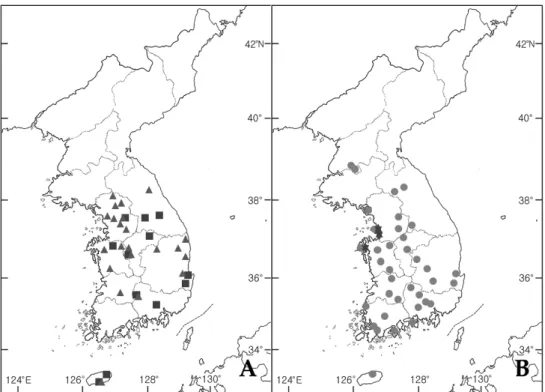
Fig. 6. Distribution maps. A: Berosus (B.) japonicus (square), B. (B.) punctipennis (triangle); B: B. (E.) lewisius (circle), B. (E.) spinosus (star).
combined. Mesotarsomere 5 slightly longer than 3. Apical emargination of sternite VII (Fig. 3D) with weakly pointed two teeth on baso-medial part. Median lobe of aedeagus (Figs. 3E-F) long, slender, widest at basal sixth, apex slightly protruded and rounded in dorsal view. Paramere (Figs. 3E-3G) long, slender, protruded laterally at subapical part in dorsal view, apex slightly curved, acute in lateral view.
Material examined. KOREA: Chungbuk Prov.: 1♂1♀, Cheongju-si, Heungdeok-gu, Ganseo1dong, 4 V 2005, DH Lee, ex pond; 4♂1♀, Choengwon-gun, Chisil-pond, 16 VIII 1988, SH Lee; Chungnam Prov.: 1♂1♀, Buyeo-gun, Mt.
Mansusan, 19 VII 1999, KJ Ahn, at light (1♂, on slide); 1♂1
♀, Cheonan-si, Cheongsu-pond, 14 IX 1990, SH Lee; 1♂, Yesan-gun, Sudeok-temple, 26 VII 1995, SH Lee; Gangwon Prov.: 1♂1♀, Inje-gun, Namjeon-ri, 1 VIII 1991, SH Lee;
Gyeongbuk Prov.: 2♀, Pohang-si, Yeongil-myeon, Haengsu- pond, 17 IX 1988, SH Lee; 3♂1♀, Uljin-gun, Goseong-ri, 22 VIII 1987, SH Lee; 2♂, Yecheon-gun, Upbu-ri, 6 VI 1989, SH Lee; 1♂, Yoongdeok-gun, Chuksan, 25 IX 1994, SH Lee; 1♀, Yeongyang-gun, Sadol-pond, 6 VI 1990, SH Lee; Gyeonggi Prov.: 1♂1♀, Icheon-si, Songho-pond, 19 VIII 1989, SH Lee;
1♂, Kwangju-gun, Hongjang-pond, 20 VIII 1989, SH Lee; 1
♀, Poncheon-si, Gomo-ri, 17 VII 1992, SH Lee, at light; 1♀, Siheung-gun, Tochang-ri, 2 V 1985, YB Cho; 1♂, Suwon-si, Gwonseon-gu, Homaesil-dong, Mt. Chilbosan, 15 IX 2009, DH Lee, HM Lim, at light (1♂, on slide); 1♂2♀, Tongducheon- si, Tap-dong, 7 VIII 1988, SH Lee; 1♂, Yangpyeong-gun, Kaeun-pond, 20 VIII 1989, SH Lee; 1♂, Yeoncheon-gun, Hwang-pond, 7 VIII 1989, SH Lee; Gyeongnam Prov.: 1♀, Hamyang-gun, Aneui-myeon, Sangwon-ri, Yongchu-temple, 16 VII 1985, SH Lee; Jeju Prov.: 1♂, Namjeju-gun, Galmae- pond, 26 VII 2005, SH Lee; Jeonbuk Prov.: 1♀, Imsil-gun, Samgye-myeon, 14 VIII 1989, SH Lee.
Distribution. Korea, China (Heilongjiang, Nei Mongol), Japan, Mongolia, Russia (East Siberia, Far East), Taiwan
Remarks. According to Ryndevich and Fikáček (2013), records of B. signaticollis from the Far East of Asia are erroneous and all belong to B. punctipennis. The latter species clearly differs from B. signaticollis by the structure of the mesoventral elevation, which is lower in B. signaticollis.
Subgenus Enoplurus Hope, 1838
Enoplurus Hope, 1838: 128 (type species: Hydrophilus spinosus Steven, 1808).
Berosus (Enoplurus) lewisius Sharp 뒷가시물땡땡이 (Figs. 1C, 4, 6B)
Berosus lewisius Sharp, 1873: 61.
Published Korean records. Berosus lewisius: Kwon and Suh, 1986: 102; Lee et al., 1988: 87; Yoon, 1988: 637; Kim et al., 1994: 136; Lee, 1994: 20; Hua, 2002: 43; Hansen, 2004: 47;
Cho and Park, 2010: 96. B. puchellus: Kwon and Suh, 1986:
102; Kim et al., 1994: 136; Cho and Park, 2010: 96 [misidentifi- cation of B. lewisius].
Diagnosis. Length 4.0-5.3 mm. Body long oval, convex dorsally, mostly yellowish brown. Ventral surface mostly brown and antenna, palpi, hypomera, epipleura, legs mostly yellowish brown. Maxillary palpomere 4 elongated, 1.3 times as long as 3. Lateral margin of pronotum sinuate and nearly parallel. Elytral interval (Figs. 4A-B) 5 with a rows punctures. Protarsomere 3 shorter than 4. Mesoventral process (Fig. 4C) protruded from anterior third to end. Mesotibial inner spine shorter than tarsomeres 1-2 combined. Sternite VII (Fig. 4D) with rectangular emargination on apical part, emargination without teeth.
Median lobe of aedeagus (Figs. 4E-G) long, slender, nearly parallel-sided in dorsal view and curved at apical fourth in lateral view, apex bifid and flattened in lateral view. Paramere (Figs. 4E-G) long, slender, curved at apical third and apex bulbed in lateral view.
Material examined. Syntype: 1♂ (NHM), with labels as follows: “Type, Japan., G. Lewis. 1910-320., Berosus lewisius.
Type D.S.”. KOREA: 16 exx. DPR. KOREA. PyongYang-city Around PyongYang-Hotel Near Daedong-River 20 vi 2008 Changdo Han leg; 10 exx. DPR. KOREA. PyongYang-city Around Mt. RyongAck-San Near Suna-River 3 Vii 2009.
Changdo Han leg; Chungbuk Prov.: 1♂1♀, Eumseong-gun, Chucheon-pond, 18 VIII 1989, SH Lee; 2♂3♀, Goisan-gun, Ihdam-pond, 18 VIII 1989, SH Lee; Chungnam Prov.: 1♂1♀, Cheonan-si, Cheongsu-pond, 14 IX 1990, SH Lee; 1♂, Cheongyang-gun, Mumak-pond, 25 VII 1995, SH Lee; 1♂, Nonsan-gun, Songdang-ri, 1 VIII 1990, SH Lee; 5♂5♀, Taean-gun, Anmyeon-eub, Seungeon-ri, N36°29′18.5″ E126°
20′47.5″ 26 m, DH Lee, saline pond near salt farm. 1♂1♀, Yesan-si, Sabgyocheon, 26 VII 1995, SH Lee; Gangwon Prov.:
1♀, Cheorwon-gun, Kimhwa-eub, Haksa-ri, Namdae-stream, 9 IX 2008, DH Lee, at light; 1♂, Hwacheon-gyn, Yuchon-ri,
30 VII 1991, SH Lee; 1♂2♀, Wonju-si, Gwangkyok-pond, 3 VIII 1988, SH Lee; Gyeongbuk Prov.: 2♂, Daegu-si, Gyeongbuk Univ., 15 VII 1974 JH Kang; 3♀, Gumi-si, Mt.
Geumosan, 19 VII 2001, KJ Ahn, CW Shin, at light (1♂, on slide); 2♂, Gyeongju-si, Geoncheon, 6 VI 1991, SH Lee; 1♀, Pohang-si, Taejam-pond, 18 IX 1988, SH Lee; 1♂, Sangju-gun, Kaeun-pond, 8 VIII 1990, SH Lee; 2♂, Yecheon-gun, Upbu-ri, 6 VI 1988, SH Lee; 1♀, Yeongcheon-gun, Yongdo-dong, 8 X 1988, SH Lee; Gyeonggi Prov.: 1♀, Ansan-si, Danwon-gu, Daebudong-dong, Dongju-salt farm, N37°14′05.60″ E126°36′
19.55″ 4 m, 3 XI 2014, DH Lee, IS Yoo, SG Lee, saline pond near salt farm; 1♂2♀, Icheon-gun, Songho-pond, 19 VIII 1989, SH Lee; 1♀, Incheon-si, Ganghwa-gun, Gyodong-myeon, 6 X 2009, HM Lim, at light; 1♂, Yangpyeong-gun, Kaegun-pond, 20 VIII 1989, SH Lee; Gyeongnam Prov.: 1♂, Euiryeong-gun, Haengjeong-pond, 8 V 2009, SH Lee; 1♂1♀, Geochang-gun, Hwanggang, 29 V 2005, SH Lee; 8♂8♀, Jinju-si, Panmun-dong, 29 VII 2005, SJ Park, JS Park, SI Lee (1♂, on slide); 2♂, Haman-gun, Yujeon-swamp, 25 V 1988, SH Lee; 1♂, Hapcheon- gun, Cheongyang-pond, 3 VI 1990, SH Lee; 1♀, Namhae-gun, Namri-pond, 12 VI 20012, SH Lee; Jeju Prov.: 1♂, Bukjeju- gun, Yongsu, 17 VIII 1992, SH Lee; Jeonbuk Prov.: 1♂1♀, Imsil-gun, Ohun-ri, 14 VIII 1989, SH Lee; 1♀, Namwon-si, Daesan-myeon, Gilgok-ri, N35°26'13.0" E127°19'0", 7 VI 2007, TK Kim, HW Kim, YH Kim, Sweeping; 1♂, Wanju-gun, 24 VII 1995, SH Lee; Jeonnam Prov.: 10♂8♀, Gangjin-gun, Maryang-myeon, 27 VIII 2004, SW Choi, at light; 1♂, Goheung-gun, Daeseo-myeon, Ondong-pond, 12 VI 2010, SH Lee; 1♀, Hwasun-gun, Dong-myeon, Jangdong-pond, 3 VIII 2009, SH Lee; 1♂2♀, Yongam-gun, Taegan-pond, 22 VII 1988, SH Lee 1♀, Yeonggwan-gun, Jangdeung-pond, 3 VIII 2009, SH Lee.
Distributon. Korea, China (Beijing, Heilongjiang, Hongkong, Jiangsu, Nei Mongol, Shanghai, Yunnan, Zhejiang), Japan, Mongolia, Russia (Far East).
Remarks. Berosus puchellus MacLeay was first recorded in Korea by Kwon and Suh (1986). After that, Kim et al. (1994:
134) and Cho and Park (2010: 95) reported this species only in the checklist without any taxonomic comments. After examining specimens previously studied by Kwon and Suh (1986), we found that they had been incorrectly identified and actually represent B. lewisius. Berosus puchellus can be distinguished
from B. lewisius by the elytra with compact setae and the absence of subapical spine on them.
Berosus (Enoplurus) spinosus (Steven) 가시점박이물땡땡 이 (신칭)
(Figs 1D, 5, 6B)
Hydrophilus spinosus Steven, 1808: 8.
Hydrophilus apicalis Samouelle, 1832: no. 5-1.
Berosus (Acanthoberosus) lenkoranus Kuwert, 1888: 132.
Berosus (Acanthoberosus) sanarkanti Kuwert, 1888: 132.
Berosus (Acanthoberosus) schusteri Kuwert, 1888: 133.
Diagnosis. Length 4.5-6.0 mm. Body long oval, convex dorsally, mostly yellowish brown. Ventral surface mostly brown and antenna, palpi, hypomera, epipleura, legs mostly yellowish brown. Maxillary palpomere 4 elongated, 1.3 times as long as 3. Lateral margin of pronotum nearly parallel and sinuate. Elytral interval (Figs. 5A-B) 5 with a row of punctures. Protarsomere 3 slightly longer than 4. Mesoventral process (Fig. 5C) protruded from half to end. Mesotibial inner spine shorter than tarsomeres 1-2 combined. Mesotarsomere 5 about 1.8 times as long as 3.
Sternite VII (Fig. 5D) without emargination, apical margin rounded. Median lobe of aedeagus (Figs. 5E-G) long, slender, narrowed basally in dorsal view and distinctly curved at subapical part in lateral view, apex truncate and cylindrical in lateral view. Paramere (Figs. 5E-G) long and slender, straight at apical third and apex not bulbed in lateral view.
Material examined. KOREA: Chungnam Prov.: 5♂3♀, Taean-gun, Wonbuk-myeon, Hwangchon-ri, N36°51′41.0″
E126°11′59.9″ 13 m, 4 VII 2014, DH Lee, at light nearby abandon salt farm (2♂, on slide); Gyeonggi Prov.: 1♂2♀, Ansan-si, Danwon-gu, Daebudong-dong, Dongju-salt farm, N37°14′05.60″ E126°36′19.55″ 4 m, 7 XI 2013, DH Lee, IS Yoo, SG Lee, saline pond near salt farm; 1♂, Hwaseong-si, Ujeong-eub, Unpyeong-ri, Hwaong-seawall, N36°35′45.00″
E126°17′30.55″ 3 m, 7 IX 2013, DH Lee, SG Lee, saline pond on salt marsh.
Distribution. Asia: Korea (new record), China (Tianjin, Xinjiang), Afghanistan, Iran, Kyrgyzstan, Kazakhstan, Mongolia, Tajikistan, Turkmenistan, Turkey, Uzbekistan, Russia (West Siberia); Eroupe: Azerbaijan, Albania, Austria, Bulgaria, Belarus, Czech Republic, Denmark, Estonia, Finland, France, Great
Britain, Germany, Georgia, Greece, Hungary, Italy, Latvia, Norway, Poland, Romania, Slovakia, Russia (South European Territory), Sweden, Turkey.
Acknowledgments
We thank C. Taylor (NHM, London), S. H. Lee (Acheon Elementary School, Gimcheon) and H. Yoshitomi (EUMJ, Matsuyama) for providing many specimens including type series and literature. Suggestions on synonymy by Y. Minoshima (Kitakyushu Museum of Natural History and Human History, Fukuoka) and comments on the manuscript by an anonymous reviewer significantly improved the paper. Financial support was provided by a grant from the National Institute of Biological Resources (NIBR), funded by the Ministry of Environment (MOE) of the Republic of Korea (NIBR 201601203).
Literature Cited
Acloque, A., 1896. Faune de France contenant la description de toutes les espèces indigères disposées en tableau analytique et illustrée de figures représentant les types chractéristiques des genres et des sous-genres. Coléoptères. J.-B. Ballière et Fils, Paris.
Archangelsky, M., 2008. Phylogeny of Berosini (Coleoptera:
Hydrophilidae, Hydrophilinae) based on larval and adult characters, and evolutionary scenarios related to habitat shift in larvae.
Systematic Entomology 33, 635-650.
Archangelsky, M., Beutel, R.G., Komarek, A., 2005. Chapter 10.
Hydrophilidae, in: Beutel, R.G., Leschen, R.A.B. (Eds.), Handbuch der zoologie/handbook of zoology, Volume IV, Arthropoda:
Insecta, part 38, Coleoptera, Beetles, volume 1: morphology and systematics (Achostemata, Adephaga, Myxophaga, Polyphaga partim). Walter de Gruyter, Berlin, New York, pp. 158-183.
Cho, P.S., 1957. A systematic catalogue of Korea Coleoptera.
Humanities and Sciences, Kor. Univ. 2, 173-338.
Cho, P.S., 1969. Illustrated encyclopedia of fauna and flora of Korea, Vol. 10, Insecta (II). Samhwa Publishing Company, Seoul.
Cho, Y.B., Park, S.W., 2010. Coleoptera, in: Paek, M.K. (Eds.), Checklist of Korean Insects. Nature and Ecology, Seoul, pp.
83-157.
Deler-Hernández, A., Fikáček, M., Cala-Riquelme, F., 2013. A review of the genus Berosus Leach of Cuba (Coleoptera, Hydrophilidae).
ZooKeys 273, 73-106.
Fikáček, M., Angus, R.B., Gentili, E., Jia, F., Minoshima, Y.N., Prokin, A., Przewoźny, M., Ryndevich, S.K., 2015. Family Hydrophilidae, in: Löbl, I. and Löbl, D. (Eds.), Catalogue of
Palaearctic Coleoptera. Volume 2/1. Revised and updated edition.
Hydrophiloidea - Staphylinoidea, E. J. Brill, Leiden and Boston, pp. 37-76.
Hansen, M., 1999. World catalogue of Insects. Volume 2.
Hydrophiloidea (s. str.) (Coleoptera). Apollo Books, Stenstrup.
Hansen, M., 2004. Family Hydrophilidae, in: Löbl, I., Smetana, A.
(Eds.), Catalogue of Palaearctic Coleoptera, Vol. 2, Hydrophiloidea, Histeroidea, Staphylinoidea. Apollo Books, Stenstrup, pp. 44-68.
Harold, E. von., 1878. Beiträge zur käferfauna von Japan. (Viertes Stück.) Japanische Käfer des Berliner Königl. Museums. Deutche Entomologische Zeitschrift 22, 65-88.
Hope, F.W., 1838. The coleopterist’s manual, part the second, sontaining predaceous land and water beetles of Linneaus and Fabricius. London: Henry G. Bohn, xvi + 168 pp., 4pls.
Hua, L.Z., 2002. List of Chinese insects Vol. II. Zhongshan University Press, Guangzhou.
Jung, S.W., Lee, D.H., Ham, S.A., Huh, J.M., Hwang, J.M., Bae, Y.J., 2011. Revised checklist of the Korean aquatic insects.
Entomol. Res. Bull. 27, 37-51.
Kamiya, K., 1940. Aquatic beetles of Manchoukuo. Report of the Limnological Survey of Kwangtung and Manchoukuo. Otzu 1940, 113-139.
Kim, J.I., 2000. Coleopteran fauna of the national forest reserve area of Uljin-gun, Gyeoungsangbuk-do. The Report of the KACN 40, 127-147.
Kim, J.I., Kim, S.Y., 1996. Coleopteran fauna of the Mt. Pangtae, Inje-kun, Kangwon-do, Korea. The Report of the KACN 37, 121-131.
Kim, J.I., Kwon Y.J., Paek, J.C., Lee, S.M., An, S.R., Park, H.C., Chu, H.Y., 1994.Order 23. Coleoptera, in: The Entomological Society of Korea and Korean Society of Applied Entomology (Eds.), Check list of Insects from Korea. Kon-Kuk University Press, Seoul, pp. 117-214.
Kim, J.I., Lee, O.J., 1991. Changes in insect fauna due to urbanization of Suwon city. Bulletin of the KACN Series 11, 49-105.
Knisch, A. 1924. Hydrophilidae. in: S. Schenkung (Eds.), Coleopterorum catalogus, pars 79. Junk W., Berlin, pp. 1-306.
Komarek, A., 2004. Taxonomic revision of Anacaena Thomson, 1859 I. Afrotropical species (Coleoptera: Hydrophilidae). Koleop.
Rdsch. 74, 303-349.
Kuwert, A., 1888. Uebersicht der Berosus-Arten Europas, der Mittelmeer-Fauna und der angrenzenden Länder. Deutsche Entomologische Zeitschrift 32: 129-144.
Kuwert, A., 1890. Bestimmungs-Tabellen der europäischen Coleo- pteren. XIX. Heft. Hydrophilidae. I. Abeteilung: Hydrophilini.
Verhandlungen des Naturforschenden Vereins in Brünn 28[1889], 1-121.
Kwon, Y.J., Suh, S.J., 1986. Check list of water beetles from Korea.
Insecta Koreana 6, 91-113.
Leach, W.E., 1817. The zoological miscellany, being descriptions of new or interesting animals. Vol. III. London: R. P. Nodder, v + [1] + 151 pp., pls. 121-150.
Lee, D.-H., Ahn, K.-J., 2015. A taxonomic review of the Gyrinidae in Korea. ZooKeys 509: 87-107.
Lee, S.H., 1994. Water beetles of Hyeong San river. Corentomon 5(1), 14-21.
Lee, S.H., 1995. Water beetles of Bulyeong valley. Corentomon 5(1), 11-16.
Lee, S.H., Cho, Y.B., Lee, C.E., 1992. The water beetles of Quelpart Island (Coleoptera). Nature and Life 22(2), 45-60.
Lee, S.H., Lee, C.E., Park, H.C., 1988. A taxonomy of the aquatic Hydrophilidae of South Korea (Coleoptera). Nature and Life 18(2), 79-91.
Linné, C. von., 1760. Fauna Suecica. Stockholmiae, 578 pp.
MacLeay, W.S., 1871. Notes on a collectionof insects from Gayndah.
Transactions of the Entomological Society of New South Wales 2[1873], 79-205.
Park, H.C., Sim, H.S., Hwang, J.H., Kang, T.H., Lee, H.A, Lee, Y.B., Km, M.A., Kim, J.G., Hong, S.J., Seol, K.Y., Kim, N., Kim, S.H., Ahn, N.H., Oh, C.K., 2008. A field guide to aquatic insects of rural environments in Korea. National Institute of Agricultural Science and Technology, RDA, Suwon.
Ryndevich, S. K., Fikacek, M., 2013. Faunistic and zoogeographic notes on hydrophiloid beetles from the Palaearctic region. Vestnik BarDU, Seriya Biologicheskiye nauki selskokhozyaistvennye nauki 1, 32-37.
Samouelle, G., 1832. [new taxon, no. 5-1], in: Samouelle, G., Entomological cabinet; being a natural history of British insects.
2 vols. London, 156 pls. [published in parts, 1832-1834].
Schödl, S., 1993. Revision der Gattung Berosus Leach 3. Teil: Die paläarktischen und orientalischen Arten der Untergattung Berosus s. str. (Coleoptera: Hydrophilidae). Koleopt. Rdsch. 63, 189-233.
Sharp, D., 1873. The water beetles of Japan. Trans. Ent. Soc. Lond.
1873, 45-67.
Short, A.E.Z., Fikáček, M., 2011. World catalogue of the Hydrophiloidea (Coleoptera): additions and corrections II (2006-2010). Acta Entomologica Musei Nationalis Pragae 51(1), 83-122.
Steven, C. von., 1808. [new taxa], in: Schönherr, C.J. (Eds.), Synonymia Insectorum, oder versuch einer synonymie aller bisher bekannten Insecten, nach Fabricii systema Eleutheratorum & c. geordnet.
Erster Theil. Eleutherata oder Käfer. Zweiter Band. (Spercheus- Crypocephalus). Stockholm: C. F. Marquard, x + 424 pp., 1 pl.
Yoon, I.B., 1988. Aquatic Insects, in: Ministry of education republic of Korea, Illustrated encyclopedia of fauna & flora of Korea, Volume 30, pp. 1-840. State-Compiled Textbook Company Limited, Seoul.