Food protein-induced proctocolitis: Is this allergic disorder a reality or a phantom in neonates?
Jin-Bok Hwang, MD, PhD
1, Jeana Hong, MD
21
Department of Pediatrics, Keimyung University School of Medicine, Daegu,
2Department of Pediatrics, Kangwon National University Hospital, Chuncheon, Korea
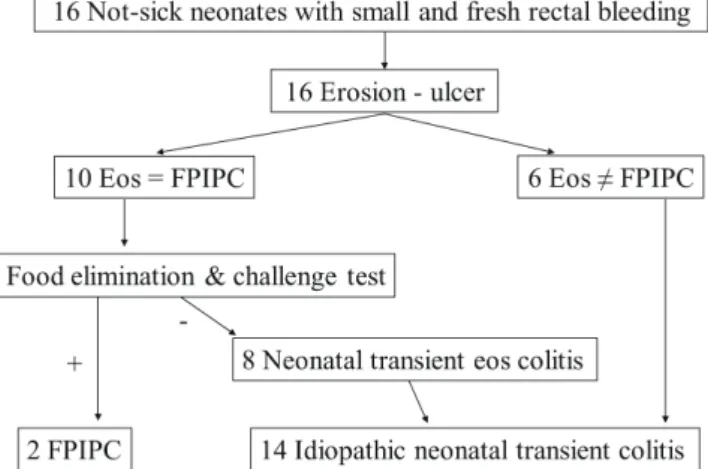
The etiology of small and fresh rectal bleeding in neonates who are not sick is usually unknown; the only known cause is food protein-induced proctocolitis (FPIPC). It has been recently reported that FPIPC is a rare cause of rectal bleeding in newborns, and most cases have been proved to be due to idiopathic neonatal transient colitis. A recommended strategy for diagnosing suspected FPIPC in neonates is as follows. During the early stage, the etiology of small and fresh rectal bleeding in an otherwise healthy newborn need not be studied through extensive investigations. In patients showing continued bleeding even after 4 days, sigmoidoscopy and rectal mucosal biopsy may be performed. Even if mucosal histological findings indicate a diagnosis of FPIPC, further oral food elimination and challenge tests must be performed sequentially to confirm FPIPC. Food elimination and challenge tests should be included in the diagnostic criteria of FPIPC.
Key words: Food allergy, Proctocolitis, Dietary protein, Food hypersensitivity, Neonates, Rectal bleeding
Corresponding author: Jin-Bok Hwang, MD, PhD Division of Pediatric Gastroenterology & Nutrition, Department of Pediatrics, Keimyung University Dongsan Medical Center, Keimyung University School of Medicine, 56 Dalseong-ro, Jung-gu, Daegu 700-712, Korea
Tel: +82-53-250-7331 Fax: +82-53-250-7783 E-mail: [email protected] Received: 29 May 2013 Accepted: 28 August 2013
Copyright © 2013 by The Korean Pediatric Society This is an open-access article distributed under the terms of the Creative Commons Attribution Non- Commercial License (http://creativecommons.org/
licenses/by-nc/3.0/) which permits unrestricted non- commercial use, distribution, and reproduction in any medium, provided the original work is properly cited.