ORIGINAL ARTICLE
Outcomes of Delirium Prevention Protocol in Short-term Stay Intensive Care Unit Patients: A Randomized Controlled Trial
Moon, Kyoungja
Assistant Professor, College of Nursing, Keimyung University · Research Institute of Nursing Science, Keimyung University, Daegu, South Korea
Purpose: This study investigated the effect of a delirium prevention protocol on patient outcomes in patients admitted to a short-term stay intensive care unit (SSICU). This study was a randomized controlled trial of patients admitted to a SSICU for three months between April 2013 and June 2013. Methods: Delirium was assessed by the Confusion Assessment Method for Intensive Care Unit for both groups. A preventative protocol, consisting of high-risk screening, cognitive function assessment and orientation, environmental intervention, and therapeutic intervention to correct risk factors of delirium at an early stage, was applied to the experimental group. The effect on patient outcome was assessed in terms of the development of delirium, in-hospital mortality, re-hospitalization, and length of stay. Data were analyzed by regression and logistic regression analysis. Results: The delirium prevention protocol applied to patients admitted to the SSICU was not effective in reducing the incidence of delirium, in-hospital mortality, re-hospitalization, and length of stay. Conclusion: The application of the delirium prevention protocol was not effective in reducing the incidence of delirium, in-hospital mortality, re-admission, and LOS. Therefore, it is suggested that replication of study using a large group is needed to confirm its effectiveness.
Key words: Delirium, Evidence-Based Nursing, Intensive Care Unit, Mortality
∙ Correspondence concerning this article should be addressed to : Moon, Kyoungja
College of Nursing, Research Institute of Nursing Science, Keimyung University 1095 Dalgubeol-daero, Dalseo-gu, Daegu 42601, Korea
Tel:+82-53-580-3906 E-mail: [email protected] Received: May 10, 2017 Revised: May 22, 2017 Accepted: May 24, 2017
Introduction
Delirium is an acute neuropsychiatric syndrome prevalent among intensive care unit (ICU) patients, and associated with negative patient outcomes [1,2]. A study involving patients in 104 intensive care units across several countries reported a delirium prevalence rate of 80% among patients receiving artificial ventilation, and 87% among those who were critically ill [2-4]. A large-scale Korean study also reported that 25% of patients admitted to the ICU developed delirium [5]. Delirium is associated with a longer hospital stay and consequent increased mortality rate and healthcare costs. Delirium is also associated with an elevated risk of chronic cognitive impairment, resulting in an increased likelihood of institutionalization in long-term care facilities [6-9]. A Korean study examining delirium in patients on ICUs, found that patients who developed delirium had an increased risk of in-hospital mortality, hospital 30-day mortality, readmission to ICU, and longer ICU stay, and higher overall healthcare costs [5].
Despite the reported poor patient outcomes, clinical awareness of delirium and its assessment remains unsatisfactory. Pharmacological and non-pharmacological approaches for the treatment of delirium are currently being implemented, although there are no recommended pharmacological interventions based on robust evidence [3].
Prevention of delirium is crucial and it is recommended that prevention guidelines and evidence-based interventions are developed to identify and monitor the risk factors associated with delirium (both predisposing and precipitating) on admission and throughout the hospital stay [10-12].
The following have been identified as risk factors for delirium: damage to the brain, cognitive impairment due to dementia or stroke, impaired vision or hearing, electrolyte imbalance and metabolic dysfunction, emergency hospitalization and surgery, pain, infection, and sleep disruption; complex interactions involving these factors eventually result in the development of delirium [11,12].
Therefore, multidisciplinary and multicomponent
interventions are recommended for effective delirium prevention [13-15].
Nurses typically spend the greatest number of hours with patients. Taking into account the negative consequences of delirium and the importance of prevention, it appears that nurses play a key role in the successful implementation of multidisciplinary and multicomponent delirium interventions recommended above. In fact, nurses are in the frontline position to the detection and recognition of any changes in the level of consciousness of patients under their care. Key elements of delirium prevention are timely identification of cognitive changes in patients, followed by accurate delirium assessment using a standardized screening instrument [16]. The following are used as delirium screening instruments: the Cognitive test for Delirium, the Intensive care Delirium Screening Checklist, the Neecham Scale, the Delirium Detection Score, the Confusion Assessment Method for Intensive Care Unit (CAM-ICU) [17]. The CAM-ICU is widely used for delirium assessment in ICU patients. The Korean language version has been validated, showing high sensitivity (89.9%) and accuracy (88.3%) [18].
A number of previous studies implemented non-pharmacological interventions, including regular assessment of delirium, provision of orientation, exercise, and elderly counseling [19]. A further delirium study reported a reduction in delirium among patients hospitalized in internal medicine wards and elderly patients undergoing hip surgery [20,21]. However, there are few studies examining the effects of multicomponent delirium interventions on ICU patients. Delirium most frequently occurs two days after surgery [22]. Therefore, it is important to examine the efficacy of delirium prevention protocols on short-term stay ICU patients in terms of the incidence of delirium, in-hospital mortality, ICU readmission rates, and duration of ICU stay.
Methods
Study design
This study is a single blind randomized controlled trial (RCT); subjects were unaware of whether they belonged to the intervention group or the control group until conclusion of the study.
Randomization
Strips of opaque paper representing the intervention group and the control group (40 each) were placed in a large envelope and then sealed. To ensure allocation concealment, the leader of the ICU nursing team, who did not participate in the implementation of the prevention protocol, helped with subject allocation on the first day of the study; each qualifying ICU patient (identified according to predetermined participant selection criteria) draw a paper strip in the order of admission to the unit. Once drawn, the paper strips were not returned to the envelope.
Furthermore, to reduce the risk of contamination resulting from potential confusion between the intervention group and the control group, a small heart-shaped sticker was attached to the corner of the bed of each intervention group’s subjects.
Study subjects
The participating general hospital was located in a city and had a capacity of 1,049 beds. Post-surgery patients and high dependency patients were admitted to the short-term stay ICU (SSICU) that had a capacity of 25 beds. The subjects were patients aged over 18 years, who provided consent or whose legal caregivers provided consent for participation in the study based on full understanding of the study’s purpose, and who also remained in the SSICU for the duration of the study.
Exclusion criteria included the following: a consistent Richmond Agitation and Sedation Scale (RASS) score of -4, -5 points, severe vision or hearing impairment that prohibited participation in the CAM-ICU assessment, history of serious psychiatric or neurologic disorders, a Mini-Mental State Examination-Korean version (MMSE-K) score of less than 23 points, admission into the isolation
unit due to infection, inability to assess the patient [unable to assess (UTA)], intervention due to emergency procedures, or other logistical reasons.
Development and details of the delirium prevention protocol
The delirium prevention protocol used in this study was the evidence-based ICU delirium prevention protocol developed by Moon and Lee [6]. The results of a 2010 follow-up study were incorporated into this protocol. The protocol of the follow-up study visualized into a delirium care algorithm for implementation. The algorithm consisted of monitoring changes in cognitive, sensory, physical, social functions from the point of ICU admission, cognitive function assessment and orientation, and environmental and early therapeutic interventions Figure 1. For cognitive function assessment and orientation, continued orientation was provided using both verbal and non-verbal communication methods using the delirium assessment tool, a large clock, and a calendar. For the environmental intervention, subject vision and hearing were tested and corrective eyewear or hearing aids were provided if deemed necessary. For improved sleep environment, a night light was supplied, and nursing staff did not change shifts overnight unless absolutely necessary. To help reduce subject anxiety due to environmental factors in the ICU, relocation from one room to another was minimized, and preferred clothes or possessions were allowed to be brought into the unit, following approval by the nursing staff, ensuring that the process was in compliance with the unit rules. For the early therapeutic intervention, basic information of the subjects was reviewed with the EMR and predisposing and precipitating risk factors were identified for their timely and effective correction/elimination. On the basis of clinical pathology exams, nursing care records, nursing care plans, prescriptions, referrals to other departments, and physician records, risk factors were identified and corrected/addressed by applying the following measures: 1) prompt correction of
electrolyte imbalances; 2) maintenance of nutritional balance; 3) maximizing mobility; 4) cautious approach to prescribing anticholinergics, opioids, or sedative hypnotics;
5) limited use of catheters to prevent infection; 6) monitoring of oxygen saturation and oxygen supply when hypoxemia was detected; 7) pain management.
Applying the delirium prevention protocol
Intervention group
To implement the delirium prevention protocol, four researchers visited the ICU for two hours daily (9-11 a.m.
or 5-7 p.m.) throughout the study period and met with each patient for 10-20 minutes. Daily delirium assessment was administered to both the intervention and the control groups, while the prevention protocol was implemented for the intervention group only. In an effort to build rapport with the patients while implementing the protocol, the researchers gently wiped each patient’s hands and face with wet towels and promoted comfort by repositioning them when necessary. For implementing the protocol’s early therapeutic intervention, the use of sedative hypnotics, anticholinergics, or opioids was minimized and closely monitored. To ensure effective implementation of the protocol, the researchers provided two 1.5-hour training sessions to the ICU nurses using relevant training materials.
Control group
The patients in the control group were assessed for cognitive function while using the CAM-ICU, and the ICU nurses provided usual care in accordance with the unit manual, as with the intervention group patients. Usual care did not include the following: continued provision of orientation, use of verbal and non-verbal communication methods, provision of vision and hearing aids, sleep management, allocation of the same nurses to the patient, minimizing the relocation of patient beds, and provision of specific medication (including anticholinergic and opiates).
In addition, usual care did not focus on the items listed under early therapeutic intervention.
Assessing delirium with the CAM-ICU
Prior to assessment of delirium with the CAM-ICU, the RASS was used to evaluate patients. The overall score ranged from +5 to -4. The maximum score indicates a combative state while the minimum score indicates an unarousable state. The CAM-ICU was measured if the RASS score was -3 or over. The CAM-ICU assessment consists of the following four delirium features: acute onset or fluctuation, inattention, disorganized thinking, and altered level of consciousness. To establish the validity of the tool, the four researchers used the expert spot checking method (http://www.icudelirum.com). The CAM-ICU was shown to have a sensitivity of 95-100% against the DSM-4 criteria, which was found to have a specificity of 93-98% and a validity of .79-.95 [24].
Outcomes
The primary outcomes were incidence of delirium and in-hospital mortality. The secondary outcomes were the length of ICU stay and readmission to the ICU during the same hospitalization period. Considering the average length of stay in the SSICU and the fact that delirium typically occurs 2-3 days following hospitalization, the prevention protocol was implemented for 7 days following admission.
Data analysis
The general and clinical characteristics of patients in both groups were analyzed and compared using the chi-square test and the t-test. The protocol’s effects on delirium incidence, mortality, and readmission to ICU during the same hospital stay were analyzed using logistic regression analysis, while its effects on the reduction in the length of ICU stay was analyzed using linear regression analysis.
Results
General characteristics of the subjects
A total of 189 patients were hospitalized during the study period. Of these, 113 were excluded due to refusal to participate or failure to meet the selection criteria. The remaining 76 patients were randomly assigned to the intervention group (n=39) or the control group [37]. Upon exclusion of those who refused to participate or did not qualify due to UTA, 31 patients were ultimately assigned to the intervention group, and 20 patients, to the control group Figure 1.
No significant group differences were found in terms of general and clinical characteristics Table 1. For univariate analysis of the two groups, three subgroups were defined:
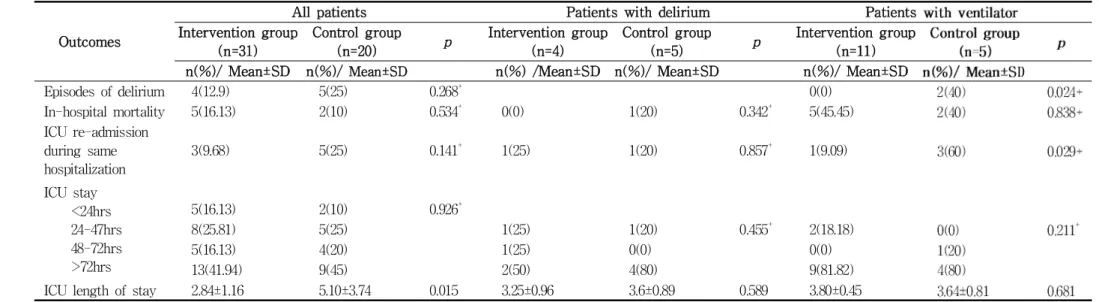
subjects who developed delirium, subjects receiving artificial ventilation, and all subjects Table 2. The control group exhibited a greater number of delirium incidences, but the difference was not statistically significant. The length of ICU stay was significantly shorter in the intervention group (2.84±1.16) than in the control group (5.10±3.74). Group differences in in-hospital mortality, readmission to ICU, and the ICU LOS per hours were not statistically significant. Subgroup comparisons found that the intervention group subjects receiving artificial ventilation had a significantly lower incidence of delirium and readmission rate, while the differences in ICU LOS per hours and total length of ICU stay were not statistically significant Table 2.
The effects of the delirium prevention protocol The results of univariate and multivariate analyses of protocol effects are presented in Table 3. Adjustments for the following variables were made: age, delirium incidence, and Acute Physiologic Assessment and Chronic Health Evaluation (APACHE) II scoring system. Results of the analysis performed without adjusting for the above variables indicated that in-hospital mortality was significant
in the intervention group (odds ratio [OR]: 1.73; 95%
confidence interval [CI]: 0.32-9.92), while no significant group differences were found in delirium incidence, readmission, or length of ICU stay. Furthermore, when no adjustments were made for the variables, no significant group differences were found in the incidence of delirium, in-hospital mortality, readmission, or length of ICU stay Table 3.
Table 1. Characteristics of the Patients
(N=51)
Variables Values
Intervention group (n=31)
Control group
(n=20) χ² / t p
n(%) or Mean±SD n(%) or Mean±SD
Age (yrs) 67.94±14.93 66.3±13.66 0.39 0.694
Female 15(48.39) 9(45)
Smoking 10(32.26) 6(30) 0.02 0.865
Alcohol 7(22.58) 7(35) 0.94 0.331
BMI (kg/m2) 21.61±2.65 20.35±3.34 1.50 0.140
APACHE II 12.97±6.79 12.97±6.79 0.70 0.489
RASS Alert
Other
19(61.29) 12(38.71)
13(65)
7(35) 0.07 0.789
Surgery Ever 11(35.48) 4(20) 1.40 0.236+
Ventilator use Ever 11(35.48) 5(25) 0.62 0.430
Infection Ever 13(41.94) 11(55) 0.83 0.361
Fall history Ever 10(32.26) 4(20) 0.91 0.338
Transfusion Ever 6(19.35) 4(20) 0.00 0.954+
Dementia Ever 0(0) 1(5) 1.58 0.208+
Cognition Ever 3(9.68) 1(5) 0.36 0.544+
Stroke Ever 1(3.23) 1(5) 0.10 0.750+
Brain Hx Ever 1(3.23) 0(0) 0.65 0.417+
Visual or hearing disturbance Ever 8(25.81) 6(30) 0.10 0.743+
Dehydration Ever 15(48.39) 14(70) 2.31 0.128
Nutrition Ever 10(32.26) 8(40) 0.31 0.572+
Electrolyte imbalance Ever 23(74.19) 19(95) 3.62 0.057
Pain Ever 19(61.29) 14(70) 0.40 0.525
Sleep disturbance Ever 9(29.03) 11(55) 3.43 0.063
Restrain Ever 15(48.39) 8(40) 0.34 0.556
Immobility Ever 22(70.97) 16(80) 0.52 0.469+
Bed sore Ever 3(9.68) 3(15) 0.33 0.564+
Delirium medication Ever 31(100) 20(100)
BMI=Body Mass Index, APACHE II=Acute Physiology And Chronic Health Evaluation higher scores mean more severe disease and higher risk of death, RASS=Richmond Agitation & Sedation Scale (alert: 0, agitated: +1~+4, sedated: -1~-5), Fisher’s exact test.
Table 2. Univariate Comparison of the Patient Outcomes between Intervention and Control Groups for all Patients and the Subgroup
Outcomes
All patients Patients with delirium Patients
Intervention group (n=31)
Control group
(n=20) p Intervention group
(n=4)
Control group
(n=5) p Intervention group
(n=11)
n(%)/ Mean±SD n(%)/ Mean±SD n(%) /Mean±SD n(%)/ Mean±SD n(%)/ Mean±SD
Episodes of delirium 4(12.9) 5(25) 0.268+ 0(0)
In-hospital mortality 5(16.13) 2(10) 0.534+ 0(0) 1(20) 0.342+ 5(45.45)
ICU re-admission during same hospitalization
3(9.68) 5(25) 0.141+ 1(25) 1(20) 0.857+ 1(9.09)
ICU stay
<24hrs 24-47hrs 48-72hrs
>72hrs
5(16.13) 2(10) 0.926+
8(25.81) 5(25) 1(25) 1(20) 0.455+ 2(18.18)
5(16.13) 4(20) 1(25) 0(0) 0(0)
13(41.94) 9(45) 2(50) 4(80) 9(81.82)
ICU length of stay 2.84±1.16 5.10±3.74 0.015 3.25±0.96 3.6±0.89 0.589 3.80±0.45
ICU=Intensive Care Unit, +Fisher’s exact test
Table 3. Effects of the Delirium Prevention Protocol on the Patient Outcomes
Outcomes Univariate logistic/linear regression Multivariate logistic/linear r
OR (CI) β SE p OR (CI) β
Episodes of delirium+ 0.444(0.103-1.911) 0.275 0.427(0.097-1.874)
In-hospital mortality+ 1.731(0.302-9.925) 0.538 1.498(0.211-10.653)
ICU re-admission during same hospitalization+
0.321(0.067-1.534) 0.154 0.324(0.066-1.605)
ICU length of stay∥ 0.161 0.323 0.619 0.176 0
CI=Confidence Interval; ICU=Intensive Care Unit; OR=Odds Ratio, +Logistic regression, ∥Linear regression, Adjusted variables, episodes of del excluding episodes of delirium for analysis of the episode of delirium as the dependent variable.
Discussion
Regular assessment and early intervention are key elements of successful delirium prevention [6,11]. The present study implemented a delirium prevention protocol in the SSICU for 7 days to evaluate its effects on delirium incidence, in-hospital mortality, readmission rate, and the length of ICU stay.
Results indicated that the prevention protocol reduced the length of ICU stay in the intervention group (intervention group, 2.84±1.16 days; control group, 5.10±3.74 days).
Subgroup comparisons found a lower incidence of delirium and a lower readmission rate among intervention subjects receiving artificial ventilation compared with the control group. A regression analysis performed without adjusting for age, delirium incidence, or APACHE II found that the protocol had an effect on in-hospital mortality. However, no effect was observed on delirium incidence, in-hospital mortality, readmission, or length of ICU stay. Regression analysis without adjusting for age, delirium incidence, and APACHE II found that the protocol had no effect on delirium incidence, in-hospital stay, readmission, or the length of ICU stay.
A higher incidence of delirium has been reported among ICU patients than among patients on general wards, and this has been attributed to different causes, including the increased severity of conditions affecting ICU patients [4,16]. In this study, subgroup comparisons found a delirium incidence of 40% among patients on ventilators.
Both pharmacological and non-pharmacological approaches are used in an effort to reduce the negative consequences of delirium in ICU patients. As for pharmacological approach, early mobilization, risk factor correction/elimination and other multicomponent interventions are currently employed [25].
The delirium prevention protocol used in this study was characterized by multiple components, including risk factor monitoring and regular delirium assessment, provision of orientation, environmental intervention, and early therapeutic intervention. This approach is comparable to a previous study reporting a decrease in the prevalence of delirium
among ICU patients by continuously providing orientations [26], and a further study in which the prevalence of delirium among ICU patients was reduced by promoting awareness of delirium risk factors and early intervention strategies among ICU nurses [27]. A recent comprehensive study on non-pharmacological delirium interventions [25]
presented evidence based strategies to correct/ eliminate or effectively manage the existing risk factors, which are important elements of non-pharmacological delirium interventions.
In the present study, an evidence-based delirium prevention protocol was implemented in the SSICU. Results indicated that the protocol did not have an effect on delirium incidence, in-hospital mortality, readmission to the ICU, or the length of hospital stay. It is recommended that a follow-up study incorporating a larger sample be conducted.
The present study was conducted in 2015 around the time of the publication of the author’s IJNS paper [6]. Both studies involve the same hospital and the same delirium protocol, although the present study focuses on the protocol’s efficacy on the hospital’s SSICU, rather than on the regular ICU. These results indicated that the protocol had an effect on improving the mortality rate within 7 days of implementation. However, the protocol was not found to have an effect on the incidence of delirium, in-hospital mortality, readmission, and length of ICU stay.
Nevertheless, considering the results of a previous study, which suggested that regular delirium assessment can shorten the length of ICU stay, hospital stay, and the duration of ventilator treatment [28], the significance of the present study lies in the implementation of a multicomponent delirium prevention protocol specifically targeting patients on the SSICU.
To ensure successful implementation of the delirium protocol, nursing team leaders and nurses received appropriate education and training from the researchers.
The rationale for this was that nurses are the most suitable persons for the detection of signs of delirium as
they spend the greatest number of hours with the patients;
therefore, educating and training these healthcare members is a key factor for successful implementation of a new protocol [25]. In order to maximize the protocol effectiveness in preventing delirium in patients on the SSICU, the nurses were educated and trained on the study delirium prevention protocol before implementation.
There are a number of limitations to the present study.
First, due to the small sample size, 7-day in-hospital mortality and survival rate could not be analyzed. This is because the present study focused on a specific unit (the SSICU) within the ICU. The small sample size did not allow the analysis of mortality at a 24-hour interval (taking into account the average length of patient SSICU stay). Therefore, a follow-up study incorporating a larger sample and a longer research period would be useful.
Second, the study’s multidisciplinary and multicomponent protocol required cooperation from other departments and staff members, although this need was not sufficiently met.
Therefore, a follow-up study incorporating nurses, as well as staff members from other departments, would be beneficial.
A further limitation is the fact that delirium assessment was performed only once per day. Delirium develops acutely, at specific times of the day, such as at dusk [29], while delirium assessment was performed either in the morning or in the afternoon. Therefore, further studies with a minimum of twice daily delirium assessments would be useful.
Conclusions
In the present study, an evidence-based delirium prevention protocol was implemented in the SSICU. Results indicated that the protocol did not have an effect on delirium incidence, in-hospital mortality, readmission to the ICU, or the length of hospital stay. It is recommended that a follow-up study incorporating a larger sample be conducted.
Conflicts of Interest
The authors declare no conflict of interest
References
1. Rivosecchi RM, Kane-Gill SL, Svec S, Campbell S, Smithburger PL. The implementation of a nonpharmacologic protocol to prevent intensive care delirium. J Crit Care. 2016;31(1):206-11. Epub 2015/11/26.
doi: 10.1016/j.jcrc.2015.09.031. PubMed PMID: 26596509.
2. Salluh JI, Soares M, Teles JM, Ceraso D, Raimondi N, Nava VS, et al. Delirium epidemiology in critical care (DECCA): An international study. Crit Care (London, England). 2010;14(6):R210. Epub 2010/11/26. doi:
10.1186/cc9333. PubMed PMID: 21092264; PubMed Central PMCID: PMCPmc3220001.
3. Barr J, Fraser GL, Puntillo K, Ely EW, Gelinas C, Dasta JF, et al. Clinical practice guidelines for the management of pain, agitation, and delirium in adult patients in the intensive care unit. Crit Care Med. 2013;41(1):263-306.
Epub 2012/12/28. doi: 10.1097/CCM.0b013e3182783b72.
PubMed PMID: 23269131.
4. Balas MC, Rice M, Chaperon C, Smith H, Disbot M, Fuchs B. Management of delirium in critically ill older adults. Critical Care Nurs. 2012;32(4):15-26. Epub 2012/08/03. doi: 10.4037/ccn2012480. PubMed PMID:
22855075.
5. Moon KJ, Piao J, Jin Y, Lee SM. Is delirium an unrecognized threat to patient safety in Korean intensive care units? J Nurs Care Qual. 2014;29(1):91-8.
Epub 2013/07/31. doi: 10.1097/NCQ.0b013e31829f828b.
PubMed PMID: 23896778.
6. Moon KJ, Lee SM. The effects of a tailored intensive care unit delirium prevention protocol: A randomized controlled trial. Int J Nursing Stud. 2015;52(9):1423-32.
Epub 2015/06/03. doi: 10.1016/j.ijnurstu.2015.04.021.
PubMed PMID: 26032729.
7. Milbrandt EB, Deppen S, Harrison PL, Shintani AK, Speroff T, Stiles RA, et al. Costs associated with
delirium in mechanically ventilated patients. Crit Care Med. 2004;32(4):955-62. Epub 2004/04/09. PubMed PMID:
15071384.
8. Rathier MO, Baker WL. A review of recent clinical trials and guidelines on the prevention and management of delirium in hospitalized older patients. Hospital Practice.
2011;39(4):96-106. Epub 2011/11/08. doi:
10.3810/hp.2011.10.928. PubMed PMID: 22056829.
9. Mehta S, Cook D, Devlin JW, Skrobik Y, Meade M, Fergusson D, et al. Prevalence, risk factors, and outcomes of delirium in mechanically ventilated adults.
Crit Care Med. 2015;43(3):557-66. Epub 2014/12/11. doi:
10.1097/ccm.0000000000000727. PubMed PMID: 25493968.
10. Jung JH, Lim JH, Kim EJ, An HC, Kang MK, Lee J, et al. The experience of delirium care and clinical feasibility of the CAM-ICU in a Korean ICU. Clin Nurs Res. 2013;22(1):95-111. Epub 2012/06/16. doi:
10.1177/1054773812447187. PubMed PMID: 22701035.
11. Sendelbach S, Schoenfelder DP. Acute confusion/delirium.
J Gerontol Nurs. 2009;35:11-8.
12. Michaud L, Bula C, Berney A, Camus V, Voellinger R, Stiefel F, et al. Delirium: guidelines for general hospitals. J Psychosom Res. 2007;62(3):371-83. Epub 2007/02/28. doi: 10.1016/j.jpsychores.2006.10.004. PubMed PMID: 17324689.
13. Holroyd-Leduc JM, Abelseth GA, Khandwala F, Silvius JL, Hogan DB, Schmaltz HN, et al. A pragmatic study exploring the prevention of delirium among hospitalized older hip fracture patients: Applying evidence to routine clinical practice using clinical decision support.
Implement Sci. 2010;5:81. Epub 2010/10/26. doi:
10.1186/1748-5908-5-81. PubMed PMID: 20969770;
PubMed Central PMCID: PMCPmc2972236.
14. Cerejeira J, Mukaetova-Ladinska EB. A clinical update on delirium: from early recognition to effective management. Nurs Res Pract. 2011;2011:875196. Epub 2011/10/14. doi: 10.1155/2011/875196. PubMed PMID:
21994844; PubMed Central PMCID: PMCPmc3169311.
15. Boorsma M, Frijters DH, Knol DL, Ribbe ME, Nijpels G, van Hout HP. Effects of multidisciplinary integrated
care on quality of care in residential care facilities for elderly people: a cluster randomized trial. CMAJ.
2011;183(11):E724-32. Epub 2011/06/29. doi:
10.1503/cmaj.101498. PubMed PMID: 21708967; PubMed Central PMCID: PMCPmc3153543.
16. Mori S, Takeda JR, Carrara FS, Cohrs CR, Zanei SS, Whitaker IY. Incidence and factors related to delirium in an intensive care unit. Revista da Escola de Enfermagem da U S P. 2016;50(4):587-93. Epub 2016/09/30. doi: 10.1590/s0080-623420160000500007.
PubMed PMID: 27680043.
17. Devlin JW, Fong JJ, Fraser GL, Riker RR. Delirium assessment in the critically ill. Intensive Care Med.
2007;33(6):929-40. Epub 2007/04/03. doi:
10.1007/s00134-007-0603-5. PubMed PMID: 17401550.
18. Heo EY, Lee BJ, Hahm BJ, Song EH, Lee HA, Yoo CG, et al. Translation and validation of the Korean Confusion Assessment Method for the Intensive Care Unit. BMC Psychiatry. 2011;11:94. Epub 2011/05/25. doi:
10.1186/1471-244x-11-94. PubMed PMID: 21605375;
PubMed Central PMCID: PMCPmc3118892.
19. Inouye SK, Bogardus ST, Jr., Williams CS, Leo-Summers L, Agostini JV. The role of adherence on the effectiveness of nonpharmacologic interventions: evidence from the delirium prevention trial. Arch Intern Med.
2003;163(8):958-64. Epub 2003/04/30. doi:
10.1001/archinte.163.8.958. PubMed PMID: 12719206.
20. Lundstrom M, Edlund A, Karlsson S, Brannstrom B, Bucht G, Gustafson Y. A multifactorial intervention program reduces the duration of delirium, length of hospitalization, and mortality in delirious patients. J Am Geriatr Soc. 2005;53(4):622-8. Epub 2005/04/09. doi:
10.1111/j.1532-5415.2005.53210.x. PubMed PMID: 15817008.
21. Milisen K, Foreman MD, Abraham IL, De Geest S, Godderis J, Vandermeulen E, et al. A nurse-led interdisciplinary intervention program for delirium in elderly hip-fracture patients. J Am Geriatr Soc.
2001;49(5):523-32. Epub 2001/06/15. PubMed PMID:
11380743.
22. Arenson BG, MacDonald LA, Grocott HP, Hiebert BM,
Arora RC. Effect of intensive care unit environment on in-hospital delirium after cardiac surgery. J Thorac Cardiovasc Surg. 2013;146(1):172-8. Epub 2013/01/16.
doi: 10.1016/j.jtcvs.2012.12.042. PubMed PMID: 23317943.
23. Moon KJ, Lee SM. Development of an evidence-based protocol for preventing delirium in intensive care unit patients. J Korean Clin Nurs Res. 2010;16(3):175-86.
24. Schiemann A, Hadzidiakos D, Spies C. Managing ICU delirium. Curr Opin in Crit Care. 2011;17(2):131-40.
Epub 2011/02/09. doi: 10.1097/MCC.0b013e32834400b5.
PubMed PMID: 21301333.
25. Rivosecchi RM, Smithburger PL, Svec S, Campbell S, Kane-Gill SL. Nonpharmacological interventions to prevent delirium: an evidence-based systematic review.
Crit Care Nurse. 2015;35(1):39-50; quiz 1. Epub 2015/02/03. doi: 10.4037/ccn2015423. PubMed PMID:
25639576.
26. Colombo R, Corona A, Praga F, Minari C, Giannotti C, Castelli A, et al. A reorientation strategy for reducing delirium in the critically ill. Results of an interventional
study. Minerva Anestesiol. 2012;78(9):1026-33. Epub 2012/07/10. PubMed PMID: 22772860.
27. Tabet N, Hudson S, Sweeney V, Sauer J, Bryant C, Macdonald A, et al. An educational intervention can prevent delirium on acute medical wards. Age and Ageing. 2005;34(2):152-6. Epub 2005/02/17. doi:
10.1093/ageing/afi031. PubMed PMID: 15713859.
28. Luetz A, Weiss B, Boettcher S, Burmeister J, Wernecke KD, Spies C. Routine delirium monitoring is independently associated with a reduction of hospital mortality in critically ill surgical patients: A prospective, observational cohort study. J Crit Care. 2016;35:168-73.
Epub 2016/08/03. doi: 10.1016/j.jcrc.2016.05.028. PubMed PMID: 27481754.
29. El Hussein M, Hirst S, Salyers V. Factors that contribute to underrecognition of delirium by registered nurses in acute care settings: a scoping review of the literature to explain this phenomenon. J Clin Nurs. 2015;24(7-8):906-15.
Epub 2014/10/09. doi: 10.1111/jocn.12693. PubMed PMID:
25293502.