․교신저자: 정우상 서울시 동대문구 회기동 1번지 경희의료원 한방2내과
TEL: 02-958-9129 FAX: 02-958-9132 E-mail: [email protected]
중풍환자에서 수족냉증과 적혈구변형능의 관련성 연구
박주영, 임정태, 박수경, 우수경, 곽승혁, 정우상, 문상관, 조기호, 박성욱*, 고창남*
경희대학교 한의과대학 한방순환신경내과, *경희대학교 동서신의학병원 중풍⋅뇌질환센터
The Relationship between Coldness of Hands and Feet and the Erythrocyte Deformability in Stroke Patients
Joo-young Park, Jung-tae Leem, Su-kyung Park, Su-kyung Woo, Seung-hyuk Kwak, Woo-sang Jung, Sang-kwan Moon, Ki-ho Cho, Sung-wook Park*, Chang-nam Ko*
Dept. of Cardiovascular & Neurologic Disease(Stroke center), College of Oriental Medicine, Kyung-Hee University
*Stroke & Neurological disorders center, East-West Neo Medical Center, College of Oriental Medicine, Kyung-Hee University ABSTRACT
Objectives :
Coldness of hands and feet has been regarded to be associated with blood circulation. This study was performed to assess the correlation between erythrocyte deformability and coldness of hands and feet.
Methods :
145 patients who had taken an erythrocyte deformability test were selected for this study among hospitalized patients within 4 weeks after their cerebral infarction at the Internal Medical Department at Kyunghee Oriental Medical Center from August 2008 to August 2009.
We divided the selected patients into two groups, with and without of coldness of hands and feet groups. The two groups were compared on risk factors for atherosclerosis and examined for variables including erythrocyte deformability.
Results :
1. On demographic variables of the patients, only body mass index was significantly lower in the coldness of hands and feet group than the control group. There was no significant difference of the rate of hypertension, diabetes mellitus, hyperlipidemia, ischemic heart disease, smoking, drinking and carotid artery stenosis between the two groups.
2. According to blood test, the coldness of hands and feet group showed significantly lower erythrocyte deformability index than the control group.
3. Body mass index and erythrocyte deformability index showed a close relationship with coldness of hands and feet in multivariate analysis.
Conclusions :
The correlation between the erythrocyte deformability and coldness of hands and feet in cerebral infarction patients were decreased erythrocyte deformability participated in the mechanism of coldness of hands and feet.
Key words : Erythrocyte deformability, Coldness of hands and feet. Elongation index. Microcirculation
Ⅰ. 서 론
수족냉증은 추운 곳에 있을 때뿐 만 아니라 추
위를 느끼지 않을 만한 온도에서도 손이나 발에
지나칠 정도로 냉기를 느끼는 증상이다
1. 주로 동
양인, 여자에게 많으며 특히 기후 변화가 뚜렷한
우리나라에서 수족냉증은 흔히 접할 수 있는 건강
상의 문제이다. 한 연구에서
6수족냉증을 접한 의
사의 60%가 약물처방을 하였으며 그 중 83%가 혈
액순환개선제를 처방하고 있다는 결과를 보여주었 듯이 수족냉증은 곧 혈액순환장애로 인식되고 있 으나 관련된 연구는 미비하다.
최근 미세혈류 순환장애로 발생하는 질환들의 진단에 응용되고 있는
13적혈구 변형능은 지름이 6-8 µm 정도인 적혈구가 3-5 µm 직경의 모세혈관 을 통과하기 위해 모양을 적응시키는 것을 말하며 이러한 변형능이 저하되면 혈액의 점도가 증가되 고 유동성이 감소되어 결과적으로 미세혈류 순환 장애에 관여하게 된다
10,11.
이에 저자는 수족냉증의 발생 기전과 적혈구변 형능의 저하가 관련이 있을 것이라고 가정하고, 뇌 경색으로 입원한 환자를 대상으로 설문조사와 적 혈구변형능 검사를 시행한 후 관련성을 객관적으 로 분석하여 보았다.
Ⅱ. 연구방법
1. 연구대상 1) 선정기준
(1) 2008년 8월부터 2009년 8월까지 경희대학교 한의과대학 부속 한방병원에 입원하여 컴퓨터뇌단층 촬영(Brain-CT)이나 뇌자기공명영상촬영(Brain-MRI) 상 뇌경색을 진단 받은 환자 중에서 적혈구 변형 능에 대한 검사가 이루어진 환자 162명중 설문에 대답이 가능한 상태의 환자 145명을 대상으로 하였 다. 본 연구는 과학적 윤리적 연구 수행을 위해 임상 심사위원회(Institutional Review Board, 이하 IRB) 의 승인을 받았다.
2. 조사변수
1) 수족냉증의 조사
훈련된 조사자가 환자들을 대상으로 “평소 중풍 발병 이전에 손발이 차갑고 시린증상을 수차례 경 험했는지 혹은 중풍으로 입원해 있는 현재 손발이 차고 시린 증상이 지속됩니까” 라는 질문에 그렇 다 혹은 아니다로 대답하게 하였다.
2) 적혈구 변형능
적혈구의 변형능을 측정하기 위하여 레이저 회절 방식을 이용한 ektacytometer로 Rheoscan-D(Rheo Meditech, 서울, 대한민국)을 사용하였다. 이 장비 는 전단응력(shear stress)의 범위가 0 Pa 부터 30 Pa 까지 변할 때의 적혈구의 변형능을 측정하며 측정값 은 연장지수(elongation Index, EI)로 표현된다
15.,16.
(1) 샘플채취
란셋(Seahan Medical,Korea),을 사용하여 환자 의 가운데 손가락 끝부분에서 혈액 한 두 방울이 나게 되면, 피펫으로 혈액 6.0 µl 를 고점도 PVP solution(31 mPas) 0.5ml 와 섞는다. 현탄액중 0.5 ml 를 피펫을 이용하여 disposable microchannel에 채운다.
(2) 측정방법
혈액검체를 disposable microchannel에 투입하면
진공생성기(vacuum generator)에 의해 압력이 가
해지고 시간이 지남에 따라 가해지는 압력이 줄어
들면서 생성되는 혈액의 흐름을 레이져로 통과시
켜 그 영상을 카메라에 담아 혈구의 모양을 분석
하였다. 시간의 흐름에 따라 압력이 감소되면 적혈
구의 모양이 타원형에서 구형으로 변하게 되는데
선행연구결과 3Pa의 전단응력에서 정상적혈구와
비정상 적혈구간의 적혈구 변형능 차이를 확실하
게 나타내어 본 연구에서는 압력 3Pa를 기준으로
EI를 산출하였다. EI는 적혈구 변형능의 단위로
(L-W)/(L+W)로 계산하였고 L과 W는 각각 적혈
구의 장축과 단축을 의미한다
15.17(Fig. 1).
Fig. 1. (a) Schematics of the microfludic ektacytometer, RheoScan-D. (b) Diffraction images of erythrocyte at various shear stress levels.
3) 대상환자들의 일반적 특성
(1) 대상자들의 연령, 성별, National Institutes of Health Stroke Scale(NIHSS)과 체질량지수(Body Mass Index, BMI), 고혈압, 당뇨병, 고지혈증, 허 혈성심장질환의 진단, 음주와 흡연 여부를 조사하 였다.
(2) 각 질환의 진단 기준은 다음과 같다.
․고혈압은 심전도에서 Left Ventricular Hypertrophy (LVH) 소견을 보이면서 Joint National Committee (JNC) 7차 기준
18에 의거하여 평균혈압이 140/90 mmHg 이상인 경우, 증상 발현 2주가 지나도 지속 적으로 높은 혈압을 보일 때, 또는 입원 중 혈압약 투여가 개시된 경우로 하였다.
․당뇨병은 1997년 American Diabetes Association (ADA)에서 제안한 기준
19에 의거하여 공복혈당
(Fasting blood sugar: 이하 FBS)>126mg/dL, 식후 2시간 혈당(2 hours postprandial plasma glucose level: 이하 PP2)>200mg/dL, HbA1C>7.0%의 검사 실 소견을 보이거나 입원 중 당뇨약 투여가 개시 된 경우로 하였다.
․고지혈증은 National Cholesterol Education Program (NECP) 기준
20에 따라 총콜레스테롤(total cholesterol:
이하 T-chol)>240mg/dL 또는 저밀도지단백 콜레 스테롤(low density lipoprotein-cholesterol: 이하 LDL)
>160mg/dL 또는 중성지방(triglyceride: 이하 TG)>
200mg/dL의 검사실 소견을 보이거나 입원 중 고 지혈증 치료제의 투여가 개시된 경우로 하였다.
4) 혈액검사
채혈은 입원 당일 오후 10시부터 8시간 공복 후 익일 오전 6시에 전주와 정맥에서 실시하였다. 백 혈구수, 적혈구수, 혈소판수, 혈색소(Hematocrit:
Hct), 헤모글로빈(Hemoglobin: Hb), 피브리노겐 (Fibrinogen), 총 콜레스테롤(Total Cholesterol), 중 성지방(Triglyceride), 공복시혈당(Fasting blood Sugar:
FBS), 식후 2 시간 혈당(2 hours postprandial plasma glucose level: PP2), 호모시스틴(Homocysteine)등 을 측정하였다.
5) 경동맥 초음파검사
경희의료원 초음파 검사실에서 의료기사가 B-mode 의 초음파로 좌우 총경동맥(Common carotid artery, CCA),내경동맥(ICA), 외경동맥(ECA),내외경동맥 의 분지점(bifurcation)을 측정하였으며 각 혈관의 계산된 협착도중 가장 큰 값을 기준으로 하였다.
4. 통계분석
본 연구의 통계처리는 Statistical Program for
Social Science(SPSS) 18 for Windows를 이용하였
으며, 모든 자료는 Mean±standard deviation(SD)
또는 Number(%)로 나타내었다. 두 군간의 차이는
연속변수는 Independent sample T-test, 비연속변수
는 Chi-square test 를 사용하여 분석하였다. 수족냉
증과 다양한 변수들과의 관계를 알아보기 위해 multiple
logistic regression analysis를 하였다. P value가 0.05 미만인 경우를 유의한 것으로 간주하였다.
Ⅲ. 연구결과
1. 대상 환자들의 일반적 특성
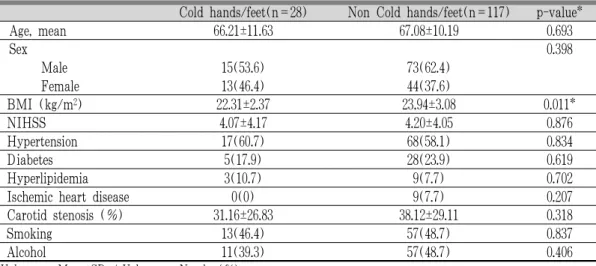
연구 대상 환자는 총 145명으로 그중 평소 수족 냉증이 있다고 대답한 환자는 28명이다. 두 군간 비교에서 체질량지수(BMI)는 수족냉증을 호소한 군에서 유의하게 낮았다 (p=0.011). 연령, 성별과 고혈압, 당뇨, 고지혈증, 허혈성 심장질환의 진단, 경동맥의 협착정도, 흡연, 음주 여부에는 양 군간 의 차이가 없었다(Table 1).
2. 수족냉증 유무에 따른 혈액검사 결과
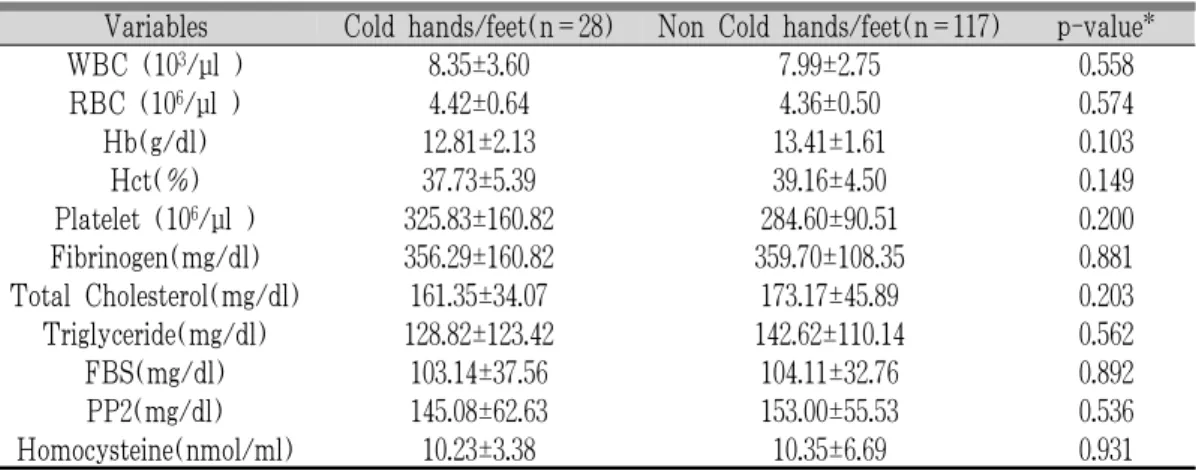
WBC, RBC, platelet counts, fibrinogen, total cholesterol, triglyceride, FBS, PP2, homocysteine 은 두 군간에 차이가 없었다. Hct 과 Hb 은 수족 냉증군에서 더 낮은 경향을 보였으나 유의하지는 않았다(p=0.103, p=0.149)(Table 2).
3. 수족냉증의 유무에 따른 적혈구 변형능의 차이 두 군간의 EI값의 평균은 수족냉증군에서 유의 하게 낮았다(p=0.039). 두 군에서 EI값 상위 1/4 군과 하위 1/4군의 분포를 비교하였을 때, 수족냉 증 환자에서는 EI 값의 하위 1/4군이 더 많았고 (70.6%), 대조군에서는 상위 1/4군이 더 많은 (54.4%) 경향을 보였으나 통계적으로 유의하지는 않았다 (p=0.098)(Table 3).
4. 수족냉증 환자군의 제특성에 대한 다변량 로지 스틱 회기분석
수족냉증과 관련 가능성이 있다고 생각되는 성 별(여성), 체질량지수 등과 말초동맥질환 관련 위 험 인자들, 적혈구 변형능 등의 특성들에 대한 다변 량 로지스틱 회기분석에서는 체질량지수(OR=0.79, p=0.030), 적혈구 변형능 저하(OR=3.79, p=0.025) 가 유의하게 나타났다. 체질량지수가 낮을수록, 적 혈구 변형능이 저하되어 있을수록 수족냉증의 발 생 확률이 증가할 것으로 예측된다(Table 4).
Cold hands/feet(n=28) Non Cold hands/feet(n=117) p-value*
Age, mean 66.21±11.63 67.08±10.19 0.693
Sex 0.398
Male 15(53.6) 73(62.4)
Female 13(46.4) 44(37.6)
BMI (kg/m
2) 22.31±2.37 23,94±3.08 0.011*
NIHSS 4.07±4.17 4.20±4.05 0.876
Hypertension 17(60.7) 68(58.1) 0.834
Diabetes 5(17.9) 28(23.9) 0.619
Hyperlipidemia 3(10.7) 9(7.7) 0.702
Ischemic heart disease 0(0) 9(7.7) 0.207
Carotid stenosis (%) 31.16±26.83 38.12±29.11 0.318
Smoking 13(46.4) 57(48.7) 0.837
Alcohol 11(39.3) 57(48.7) 0.406
Values are Mean±SD / Values are Number(%)
DM, Diabetes mellitus; NIHSS, National Institutes of Health Stroke Scale; BMI , Body Mass Index.
* : Statistical significance was calculated by student T test for Continuous variables and Chi-square & Fisher's exact test for Categorical variables.
Table 1. Demographic Data of the Subjects by Cold hypersensitivity on hands and feet
Variables Cold hands/feet(n=28) Non Cold hands/feet(n=117) p-value*
WBC (10
3/μl ) 8.35±3.60 7.99±2.75 0.558 RBC (10
6/μl ) 4.42±0.64 4.36±0.50 0.574
Hb(g/dl) 12.81±2.13 13.41±1.61 0.103
Hct(%) 37.73±5.39 39.16±4.50 0.149
Platelet (10
6/μl ) 325.83±160.82 284.60±90.51 0.200 Fibrinogen(mg/dl) 356.29±160.82 359.70±108.35 0.881 Total Cholesterol(mg/dl) 161.35±34.07 173.17±45.89 0.203 Triglyceride(mg/dl) 128.82±123.42 142.62±110.14 0.562 FBS(mg/dl) 103.14±37.56 104.11±32.76 0.892 PP2(mg/dl) 145.08±62.63 153.00±55.53 0.536 Homocysteine(nmol/ml) 10.23±3.38 10.35±6.69 0.931
Values are Mean±SD* : Statistical significance was calculated by Independent-sample T test for Continuous variables
FBS, fast blood sugar; PP2, 2hours postprandial plasma glucose level ; WBC, White blood cell; RBC, Red blood cell ; Hb, Hemoglobin ; Hct, hematocrit
Table 2. Distribution of Blood Test Result by Cold hypersensitivity on hands and feet
Erythrocyte Deformability
(Elongation index) Cold hands/feet
(n=28) Non Cold hands/feet
(n=117) p-value*
EI 0.288±0.023 0.298±0.020 0.039*
Lower rank 1/4 12(70.6) 26(45.6) 0.098
Higher rank 1/4 5(29.4) 31(54.4)
* : Statistical significance was calculated by Independent-sample T test for Continuous variables and Chi-square
& Fisher's exact test for Categorical variables
Table 3. Erythrocyte Deformability expressed by Elongation Index in Cold hypersensitivity on hands and feet group and control group.
Variables Odds ratio 95% CI p-value
Older Age
†0.87 0.23-3.27 0.837
Female Gender 2.20 0.48-10.04 0.308
BMI 0.79 0.64-0.97 0.030
HTN 1.46 0.45-4.70 0.518
DM 0.56 0.14-2.16 0.402
Hyperlipidemia 0.49 0.14-1.73 0.273
Carotid stenosis 0.99 0.97-1.01 0.630
Smoking 1.36 0.30-6.10 0.685
Erythrocyte Deformability
‡3.79 1.18-12.13 0.025
CI, confidence interval; DM, diabetes mellitus; BMI, body mass index.†: Age≥65
‡: Lower rank 1/4 of Elongation Index