An Efficient Engineering Design Education Framework in Information Network Engineering
Sang-Gon Lee
*,†․ Kyeong-Uk Koh
****Division of Computer & Information Engineering, Dongseo University
**Division of Design, Dongseo University
ABSTRACT
Design factors such as design objects establishment, analysis, synthesis, production, test and evaluation should be educated in a systematic way. Also design ability to reflect practical restrictive conditions such as industrial standards, economic feasibility, environmental impact, aesthetics, safety and reliability, ethical impacts and social impacts should be cultivated. In this paper, we explain the meaning of these terms and propose a systematic engineering design education framework satisfying Korean engineering education accreditation criteria. We also present a simple implementation in information network engineering.
Keywords: Engineering design, Design factor, Practical restrictive conditions, ABEEK, EAC 2005
I. Introduction
1)Since Washington Accord had been introduced in Korea in 2001, 616 programs (EAC : 544, CAC : 51, TAC : 35) of 95 universities have been accredited by 2012 [1]. En- gineering design education is one of important components such as program outcomes, continuous quality improvement (CQI), quality assurance (QA) in engineering education criteria (EAC2005) of ABEEK. According to EAC2005 [2], students must acquire 18 credit points in design subjects.
Basic engineering design in lower grade and capstone design in higher grade is requisite. Design factors such as design objects establishment, synthesis, analysis, production, test and evaluation should be educated in a systematic way. Also design abilities, reflecting practical restrictive conditions such as industrial standards, economic feasibility, environmental impact, aesthetics, safety and reliability, ethical impacts and social impacts should be cultivated. Hereafter we refer the design factors and the practical restrictive conditions as ‘design education factors’.
As far as engineering design education, no systematic education framework harmonizing the design education factors in the whole program aspect has been proposed
Received 4 October, 2011; Revised 12 June, 2012 Accepted 10 September, 2012
† Corresponding Author: [email protected]
in Korea.
In this paper, we explain general meaning of each design education factors, point out the problems in engineering education framework in Korea and propose a systematic engineering design education framework to meet Korean engineering education accreditation criteria.
II. Design Process
1. General Design Process [3]
General design development process can be divides into 8 steps.
1)
Design initiative stage
– It begins with the question of“What kind of design product do we want to develop?”
Initiative can be come from designer, company or customer.
2)
Design identification stage
- check the validity of design object selected in design initiative stage. Thoroughly identify all expected problems related with development.3)
Design research
– carry out research on all problems identified in design identification stage. In this case, designer gathers all possible information and materials and investigates the expected consumer reaction.4)
Design analysis
– systematically categorize and doanalysis on all materials collected in design research stage. Especially, it is very important intensively ana- lyzing the requirements to meet the characteristics of design object. Design (appearance) analysis, technology analysis and sales analysis should be carried out.
5)
Design synthesis
– synthesize the result of design analysis. Systematically classify and systematize the analyzed material. To smoothly carry out this mission, get involve not only experts for the design object also experts from neighboring division.6)
Design evaluation
– based on synthesized materials, do a final evaluation for the design objects. Do an extensive evaluation of broadly selected design objects in design initiative stage. At this time, relative evaluation among multiple objects or absolute evaluation for one object can happen. Because this stage is final to decide if the object is to be developed, it is very important.7)
Design development
– This stage is a core in design deploying process. Through design initiative stage to design evaluation stage, object is finally decided to be developed. Now it is time to develop the design object.Even though most of the design development deploying process, say from stage 1 to stage 6, was carried out by objective factors, designer’s subjective ability have a significant effect on development stage. As according to designer’s sense, preference and philosophy various product s can be created, designer’s gift and ability become very important factors.
8) Design communication – deliver the product to the customers. Producers, customers, and designers com- municate each other by empathy via design object. In design communication stage designers should prove that the product he developed does not breach social and moral norm or environmental aspect.
2. Engineering Design Process [4]
Design process can be varied according to design com- pany, manufacturing factory and person. But design is basically a creative problem solving process by decision- making and communication. So we can drive a similar process commonly applicable to all kinds of design process.
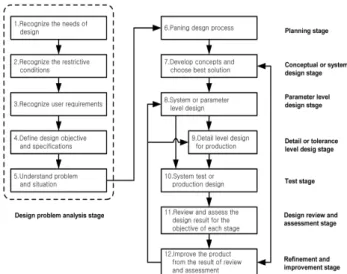
Fig. 1 Common engineering design process
A common engineering design process is presented in Fig. 1.
In this figure, engineering process is composed of 12 steps and can be grouped into 8 processing stages.
y
Design problem analysis stage
(Step 1 to Step 5) – at the end of this process, we can get design documents regarding design problem analysis and description.y
Planning stage
(Step 6) – project plan and design pro- posal can be drawn out as outputs at this stage.y
Conceptual or system design stage
(Step 7) – sketches or documents describing design concept can be drawn out as outputs at this stage.y
Parameter level design stage
(Step 8) – design pro- cessing report which includes summaries of a series of decisions on design which including assembly drawings and technical specification can be drawn out as outputs at this stage.y
Detail or tolerance level design stage
(Step 9) – docu- ments for the production including detail design drawings, detail specification and tolerance level can be drawn out as outputs at this stage.y
Test stage
(Step 10) – documents for prototype or production model test plan and test results as outputs at this stage.y
Design review and assessment stage
(Stage 11) – this stage should be processed after step 7, 8, and 9 anddesign evaluation report can be drawn out as outputs.
y
Refinement and improvement stage
(Stage 12) – a repetitive design improvement job is carried this stage and final design project report can be drawn as output.III. Interpretation of Design Education Factors 1. Design Factors
In this section we briefly describe the meaning of design factors: design objects establishment, analysis, synthesis, production and test and evaluation.
y
Design objects establishment
- things or facts that should be considered in this stage include identifying customer’s needs and design product specification.QFD (quality function deployment) is useful in this stage [5]. QDF is composed of 4 steps - item plan, component deployment or component factor plan, pro- cess plan and production plan.
y
Analysis
– activities for design analysis includes pre- liminary analysis (technological and economical feasibility), sketch modeling, CAE(computer aid engineering) and economics analysis.y
Synthesis
- investigate required technologies to meet design object and make design drawing. At this stage, combining ideas, materials, or technologies can be carried.Also some design work can be carried out such as concept design, detail design and product design. In terms of detail design, component shape, material and manufacturing methods can be decided. Real production drawing can be provided. Use prototype or CAD to check operational status, assembly status, shape, dimensions and product design.
y
Production
- Mock-up production and prototype pro- duction. Mock-up is a scale or full-size model of a design or device, used for teaching, demonstration, design evaluation, promotion and other purposes. Refer [6] for application in automotive devices, system engineering, consumer goods, furniture and cabinetry and software engineering.y
Test & Evaluation
- mockup evaluation, prototypeperformance test, evaluate satisfaction of test require- ments, durability and safety test, performance meas- urement and analysis.
2. Practical Restrictive Conditions
In this section we briefly describe the meaning of practical restrictive conditions, industrial standards, eco- nomic feasibility, environmental impacts, aesthetics, safety and reliability, ethical impacts and social impacts.
y
Industrial standards
- Designers should identify the existence of industrial standard to conform and consider using standard components to reduce the price and enhance the productivity.y
Economic feasibility
- perform market analysis and evaluate of the cost of the products. Also a cost for royalty, patent fee, copyright charge, etc.y
Environmental impacts
- The environment in which the products are used is very important factor to be considered in engineering design. There are two aspects to be considered when assessing environmental effect.Environment should be protected from the effect of a product and, on the other hand, a product also must be protected from the environment. Therefore design can be changed according to the environment where it will operate and environmental factor can be affected by the design [7]. Designers should consider these problems before the design strategy have been established.
y
Aesthetics
- An object of aesthetics is material, fun- ction and structure. Facts that affect the appearance of products are visual balance, rhythm (order), proportion, line and plane and joint.y
Safety and reliability
- The problems about security of users. Does the product have excellent precision, du- rability and robustness? Does the software products have countermeasure against error or hacking?y
Ethical impacts
- In design and production stage, we must be aware of professional liability and ethical res- ponsibility. Also consider the effect of the applied technology in terms of protection or violation of in- tellectual property rights. As an example of ethicalTable 1 Design factors for each subject Design objects
establishment Analysis Synthesis Production Test & Evaluation
Network Fundamental
Subnet an address space for a given requirements.
Use network analysis tools to analyze the network operation
Build a simple network with server, router and switch
Configure an IP address
on the router -
Routing Protocols
Setup network routing
protocol Routing table analysis Use more than 2 routing schemes in the network
Configure the routing pro- tocols and other mis- cellaneous things
Check the contents the routing or topology table if the expected network entries are exists Switching
Technology
Design VLAN and imple- ment
VLAN database & top-
ology analysis - - Switch network test and
evaluation WAN
Technology - - WAN Tech+Security Configure WAN protocol PPP and Frame relay net-
work test
Table 2 Practical restrictive conditions for each subject Industrial
standard
Economic feasibility
Environmental
impacts Aesthetics Safety and
reliability
Ethical impacts
Social impacts Network
Fundamental
RJ-45 Cabling
standard -
Discuss the impact of cables when they became worthless
Arrange cable runs
neatly -
Ethical attitude of network user and administrator
Think about how the network affect our life
Routing
Protocols -
Choose suitable routers for a given requirement
- Arrange network devices neatly
Provide alternative path
Setup routing se- curity to protect routing attacks
Think about the influence of the network in the so- cial aspect.
Switching Technology
Identify open switching tech- nology
Choose suitable switches for a given requirement
Power consumption of network device
Arrange network devices neatly
Provide redundancy
in switching path -
Think about pros and cons of IT technology WAN
Technology
Identify open WAN technology
Choose suitable WAN tech for a given requirement
Power consumption
of network device - Protect well-known hacking attacks
Setup WAN security
to protect WAN link -
impact of iPod on society, refer to [8].
y
Social impacts
– The design output must be obey social regulation and law. Should consider the effect of the product on society. Also design output should be in accord with social and political environmental changes.IV. A Proposal of Engineering Design Education Framework
1. Problems in Design Education Framework
To meet ABEEK requirements, most universities in Korea which deployed the ABEEK system have their own en- gineering design education framework. But in the way of implementing the design education factors, it is very poor. Some of design education factors are just allocated for each subject with no concrete descriptions. In this
situation a lecture can implement the factors in an arbi- trary ways, and they will not be harmonized with other items in the whole program aspect. So it is needed to define concretely the factors for subjects and fine-tune the allocated design education factors among subjects in perspective.
2. An Enhanced Engineering Design Education Framework
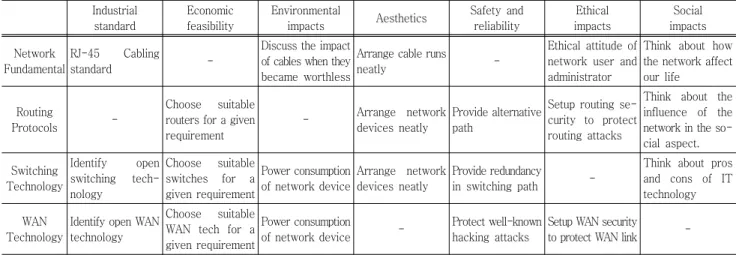
In this paper, we propose a systematic engineering design education framework and present some implementations in information network engineering. Before showing an instance of the framework, we define a subject-design education factor matrix. The subject-design education factor matrix have the name of design factors in the first raw of the matrix and the name of course subjects in the
first column. In a cell of the matrix, we describe the scope or content of the corresponding design education factor for the subject.
Now we describe the organizing process of the design education framework into 3 steps;
y Step 1 – Choose some adequate design education factors for each subject and keep balance in the matrix in terms of selecting the factors.
y Step 2- describe the scope or content of the selected design education factors.
y Step 3 – Fine-tune the allocated design education factor among subjects in perspective.
Table 1 and 2 in the appendix shows an implementation instance of the framework in information network en- gineering.
IV. Conclusion
In the implantation of engineering design education, a framework should be well-organized so that the design factors are educated in a systematic way and design ability is well cultivated. For a well-organized framework, a design education factor of one subject must be well harmonized with the same factor of the other subjects in the whole program aspect and design education factors must keep balance in the subject-design education factor matrix in terms of selecting the factors.
In this paper, we pointed out problems in engineering design education framework of the most of the Korean university. Also we proposed a subject-design education factor matrix and a procedure to build a well-organized design education frame. We present a simple implementation in information network engineering.
This work was supported by 2011 Dongseo University research fund.
Reference
1. ABEEK accreditation status URL: http://www.abeek.or.kr/
htmls_kr/contents.jsp?menu_l=4&menu_m=24.
2. EAC 2550 URL: http://www.abeek.or.kr/download?path=
board&file=KEC2005 공학인증기준_2011년 적용.pdf (accessed on 28th July, 2011).
3. Lim Yeon-ung(1992) research on Design Metholgy, Mijinsa, Chapter 2.
4. Edward Lumsdaine, Monika Lumsdaine, J. William Shelnutt, Creative Problem solving and Engineering Design, McGraw- Hill, 1999.
5. http://en.wikipedia.org/wiki/Quality_function_deployment (accessed on 28th July, 2011).
6. http://en.wikipedia.org/wiki/Mockup (accessed on 28th July, 2011).
7. Eskild Tjalve, A Short Course in Industrial Design, Newnes- Butterworths, 1979.
8. EU Ecodesign Directive: http://ec.europa.eu/enterprise/
policies/sustainable-business/ecodesign/index_en.htm (accessed on 28th July, 2011).
9. Ryang In-Mok(2009), Green Ocean, Tornado, p.65 10. Ethical impacts of ipod on society: http://clearlyexplained.
com/answers/ipodethics.html (accessed on 28th July, 2011).
Lee, Sang-Gon
1986 B.Eng. Electronics Engr. Kyungpook University 1988 M.Eng. Electronics Engr. Kyungpook University 1993 Ph.D, Electronics Engr. Kyungpook University Research area: Information Security, Network Security, Wireless Mesh Network, Future Internet
Phone: +82-51-320-1760 Fax: +82-51-327-8955 E-mail: [email protected]
Koh, Kyeong-Uk
1984 BFA. Dept. Industrial Design, Hongik University 1994 MFA. Dept. Industrial Design, Hongik University Research area : Ecodesign, UX(User Experience) design Phone: +82-51-320-1863
Fax: +82-51-320-2674 E-mail: [email protected]