The Effect of Traditional Korean Medicine Treatment on CREST Syndrome: A Case Report
Jin-yong Joung, Hyun-sik Seo, Chang-gue Son, Nam-hun Lee, Jung-hyo Cho Dept. of Internal Medicine, Dae-Jeon Oriental Hospital of Dae-Jeon University
The Effect of Treatment with Traditional Korean Medicine on CREST Syndrome:
a Case Report
Jin-yong Joung, Hyun-sik Seo, Chang-gue Son, Nam-hun Lee, Jung-hyo Cho Dept. of Internal Medicine, Dae-Jeon Oriental Hospital of Dae-Jeon University ABSTRACT
CREST syndrome is a form of limited cutaneous scleroderma that occurs only in certain parts of the body, such as the skin of the hands and face. CREST refers to the five main features of the syndrome: calcinosis, Raynaud’s phenomenon, esophageal dysmotility, sclerodactyly, and telangiectasia. Currently, there is no standard treatment for CREST syndrome, and there have been no studies of the use of traditional Korean medicine (TKM) for this disease. This study describes the effects of Keumsuyukun-jeon on CREST syndrome. The patient in this case had typical clinical symptoms of CREST syndrome.
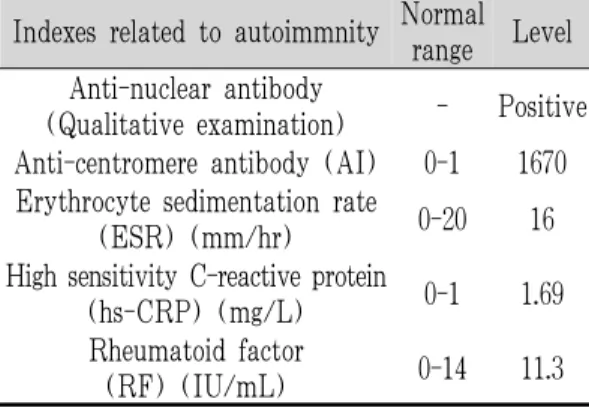
These symptoms improved within a relatively short period of receiving the TKM treatment. The results of Anti-centromere antibody (AI) and high sensitivity C-reactive protein (mg/L) also improved.