• 검색 결과가 없습니다.

Facial Bone Fracture Patients Visiting Pusan National University Hospital in Busan and Yangsan: Trends and Risks

N/A
N/A
Protected

Academic year: 2021

Share "Facial Bone Fracture Patients Visiting Pusan National University Hospital in Busan and Yangsan: Trends and Risks"

Copied!
6
0
0

로드 중.... (전체 텍스트 보기)

전체 글

(1)

ISSN 2288-8101(Print) ISSN 2288-8586(Online)

Original Article

RECEIVED May 24, 2014, REVISED June 9, 2014, ACCEPTED July 24, 2014 Correspondence to In-Kyo Chung

Department of Oral and Maxillofacial Surgery, School of Dentistry, Pusan National University 20 Geumo-ro, Mulgeum-eup, Yangsan 626-787, Korea

Tel: 82-55-360-5100, Fax: 82-55-360-5104, E-mail: [email protected]

Copyright © 2014 by The Korean Association of Maxillofacial Plastic and Reconstructive Surgeons. All rights reserved.

CC

This is an open access article distributed under the terms of the Creative Commons Attribution Non-Commercial License (http://creativecommons.org/licenses/

by-nc/3.0) which permits unrestricted non-commercial use, distribution, and reproduction in any medium, provided the original work is properly cited.

Facial Bone Fracture Patients Visiting Pusan National University Hospital in Busan and Yangsan: Trends and Risks

Hyo-Geon Kim, Yong-Hyun Son, In-Kyo Chung

Department of Oral and Maxillofacial Surgery, School of Dentistry, Pusan National University

Abstract

Purpose: This study examined patients with facial bone fracture visiting Pusan National University Dental Hospital to understand the trends, and to enhance appropriate care and treatment for patients with facial bone fracture.

Methods: We investigated 531 patients presenting with facial bone fracture in Yangsan and 802 patients in Busan from January 2010 to December 2013. We divided the patients by year, month, gender, age, site, and cause to compare with historic data and other studies.

Results: The gender ratio was 3.58:1 in Yangsan and 4.31:1 in Busan. Patients aged in their 20s had the highest number of facial bone fractures in both Yangsan and Busan. The most frequent fracture site was the mandible, and the most frequent cause was slip down in both Yangsan and Busan.

Conclusion: The investigation and comparison of patients with facial bone fracture who visited Pusan National University Hospital located at Yangsan and Busan from 2010 to 2013 found a difference in the total number of patients at each hospital, but the trends were not significantly different.

Key words: Bone fractures, Facial bones, Maxilla, Mandible, Zygoma

Introduction

In oral and maxillofacial surgery, facial bone fracture is a common trauma, resulting from traffic accident (TA), assault, slip down, or industrial accident. If the facial bone fracture is not appropriately treated, the result may be func- tional disability and an aesthetic problem. In some cases, a fatal emergency may develop. Bell[1] reported that mor- tality rate due to head and neck injuries is the highest cause of death under 34 years old. Since there are many emergency circumstances requiring appropriate and imme-

diate treatment, many clinical studies have investigated the trends and characteristics.

Generally, the risk of facial bone fracture is increased by population, traffic, exercise, and leisure activity with differences by age, gender, cause, and site. The research literature is rich on this topic, and results vary by social, regional, and cultural conditions of study populations.

This study examined patients with facial bone fracture

visiting a Dental Hospital of Pusan National University

Hospital after January 2010󰠏divided into the Dental Clinic

Center of Pusan National University Hospital at Ami-dong,

(2)

Fig. 1. Year distribution of number of patients in Yangsan.

Fig. 2. Year distribution of number of patients in Busan. Fig. 4. Month distribution of number of patients in Busan.

Fig. 3. Month distribution of number of patients in Yangsan.

Busan and Pusan National University Dental Hospital at Yangsan󰠏and investigated the distribution by period, age, gender, site, and cause. We compared these data with previous data to understand the trends, and performed an observational study to enhance appropriate care and treatment for patients with facial bone fracture.

Materials and Methods

The targets of this study were the patients with facial bone fracture who visited the Department of Oral and Maxillofacial Surgery of Pusan National University Dental Hospital located in Yangsan and the Dental Clinic Center in Pusan National University Hospital located in Busan from January 2010 to December 2013. Based on their charts, the patients were classified by year, month, gender, age, site, and cause. The sites were categorized by maxilla, mandible, zygoma, nasal bone, and orbital cavity following Schultz[2]. Exclusion criteria included fracture with limi- tation of alveolar bone, fracture of teeth, trauma with limi- tation of soft tissue, and death of patient without any treat- ment for the injuries of facial bone before the death. And, this study protocol was reviewed and approved by Pusan National University Dental Hospital Institutional Review Board.

Results

1. Distribution by year

This study investigated 531 patients with facial bone frac- ture in Yangsan and 802 patients in Busan. The number of patients continuously increased after 2010 in Yangsan, while a similar number of patients was counted in each year in Busan (Fig. 1, 2).

2. Distribution by month

The number of patients by month in Yangsan was the

highest in March at 11.5%, followed by June and September

(Fig. 3). In Busan, the highest number was in April at

10.5%, followed by June and October (Fig. 4). However,

special trends were not observed at either hospital.

(3)

Fig. 6. Gender distribution in Busan.

Fig. 5. Gender distribution in Yangsan.

Fig. 8. Age distribution in Busan.

Fig. 7. Age distribution in Yangsan.

3. Distribution by gender and the ratio

The number of males was the highest at both Yangsan and Busan, and the gender ratio of male and female was 3.58:1 in Yangsan and 4.31:1 in Busan (Fig. 5, 6).

4. Distribution by age

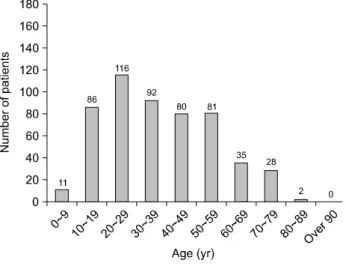
Regarding the distribution by age, the number in their 20s was the highest at 21.8%, followed by those in their 30s at 17.3% and in their 10s at 16.2% in Yangsan (Fig.

7). In Busan, the number in their 20s was the highest at 22.2%, followed by those in their 30s at 16.3% and in their 50s at 15.5% (Fig. 8).

5. Distribution by site of facial bone fracture

Regarding the distribution by site, mandible fracture was most common in Yangsan (46.7%), and in Busan (41.8%) (Fig. 9, 10). In Yangsan, the order occurrence was man- dible, nasal bone, maxilla, zygoma, and orbital cavity; in Busan, the order was mandible, nasal bone, zygoma, orbi- tal cavity, and maxilla.

6. Distribution by cause of fracture

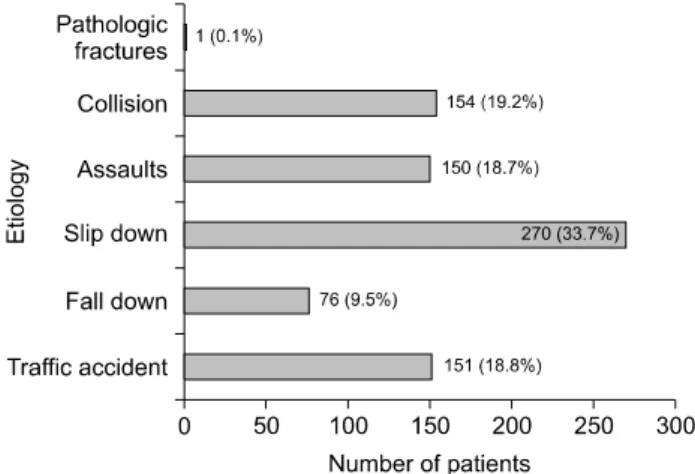
Regarding the causes of fractures, slip down was most

common (36.5%), followed by collision, TA, assaults, and

fall down in Yangsan, and no patient had pathologic frac-

ture (Fig. 11). In Busan, slip down was most common

(33.7%), followed by collision, TA, assault, and fall down,

(4)

Table 2. Compared with previous gender distribution and ratio

Gender

Period

1992∼1996

(5 yr) 1999∼2003 (5 yr)

2010∼2013 (4 yr) Yangsan Busan No. of male

No. of female Male to female

ratio

429 86 4.6:1

466 93 3.9:1

415 116 3.58:1

651 151 4.31:1 Fig. 10. Site distribution in Busan.

Fig. 9. Site distribution in Yangsan. Fig. 11. Etiology distribution in Yangsan.

Fig. 12. Etiology distribution in Busan.

Table 1. Compared with previous years Period

1992∼1996 (5 yr)

1999∼2003 (5 yr)

2010∼2013 (4 yr) Yangsan Busan No. of Patients

Average no.

per year

429 86

466 93

531 133

802 201

the same as in Yangsan, and there was one patient with pathologic fracture (Fig. 12).

Discussion

Our investigation and comparison of patients with facial bone fracture who visited Pusan National University Hospital at Yangsan and Busan from 2010 to 2013 found differences in the total number of patients at each hospital

but the trends were not significantly different. The number

of patients who visited the hospitals investigated in this

study was 531 in Yangsan and 802 in Busan. Generally,

patients visited the hospital in Busan more than the hospital

in Yangsan, presumably caused by difference of standard

population in 2013 (3.56 million in Busan and 0.27 million

in Yangsan). However, other explanations could be the

difference in the number of hospitals, or accessibility to

Yangsan from other areas of Gyeongsangnam-do province.

(5)

Table 3. Compared with previous age distribution (%)

Age of range (yr)

Period

1992∼1996 (5 yr)

1999∼2003 (5 yr)

2010∼2013 (4 yr) Yangsan Busan 10∼19

20∼29 30∼39

15.9 30.5 20.8

20.1 32.4 15.7

16.2 21.8 17.3

13.6 22.2 16.3

Table 4. Compared with previous site distribution (%)

Fracture site

Period

1992∼1996

(5 yr) 1999∼2003 (5 yr)

2010∼2013 (4 yr) Yangsan Busan Mandible

Maxilla Zygoma Nasal bone

70.6 4.0 7.5 4.0

69.0 12.9 8.0 7.0

46.7 13.1 12.0 19.2

41.8 9.7 15.6 20.4

Comparing the patients with facial bone fracture visiting the hospitals from 1992 to 1996 and from 1999 to 2003, the yearly average number of patients increased over two times (Table 1). Presumably this increase stemmed from the development of a regional emergency clinic center, a 1,339 emergency medical information center, and in- creased awareness of the citizens. Since the population of Busan was 3.81 million in 2000 and the total population decreased, we surmise that the number of patients was not proportional to the population. Comparing the monthly distribution to other publications from different regions, it was highest in July at 13.4% in Chuncheon according to Kim et al .[3], in September at 12.7% in Seongnam accord- ing to Oh et al .[4], in March at 10.7% in Masan according to Lee and Ro[5], and in July at 10.8%, and in Daegu accord- ing to Lee and Moon[6]. In this study, it was the highest in March at 11.5% in Yangsan and in April at 10.5% in Busan. According to Breytenbach[7], fractures occur in warm seasons, seen in several studies that found highest numbers in spring (when temperatures are rising) or summ- er (the hottest season).

The male:female ratio was 3.58:1 in Yangsan and 4.31:1 in Busan. The gender ratio in the standard population of 2013 was 1.01:1 in Yangsan and 0.98:1 in Busan, indicating that the rate of male in Busan was dominant over female although more females inhabit Busan, but the rate of female patients were higher than the male in Yangsan. Compared to previous data, facial bone fractures occur more often in males (Table 2). The gender ratio was similar to other studies indicating the ratio of facial bone fracture between male and female as 4:1 according to Kim et al .[3], 4.7:1 according to Oh et al .[8], 3.19:1 according to Oh et al .[4], 4.2:1 according to Jang and Jang[9]. Presumably there are more male drivers and males are more prone to violence, resulting in fractures, social activity, and drinking. As fe- males take jobs with high risk and their social activity in-

creases, they are exposed to more risks of facial fracture, increasing the female ratio of fracture.

We noted that of the age groups, the highest numbers were patients in their 20s, followed by those in their 30s at both Yangsan and Busan, then those in their 10s in Yangsan and 50s in Busan. Age was normally distributed.

Comparing with other studies, the highest rate in 20s is seen in many clinic studies such as domestic studies of Kim et al .[3] and Oh et al .[8], and overseas studies of Olson et al .[10] and Nakamura and Gross[11]. Presumably social activities increased in the 20s, with more exposure to beat- ing, violence, drinking, driving that might cause fracture.

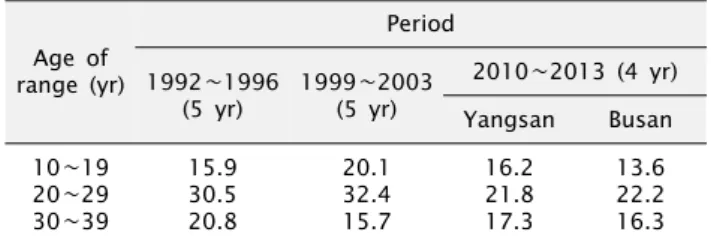
Our old data also shows patients in their 20s with the highest number of fractures (Table 3). Following the high risk in the 20s, the rate decreased significantly. The number of patients with fracture in 10s, 30s, 40s, and 50s was similar at both Yangsan and Busan.

By sites, the mandible was the most frequent, followed by nasal bone at both Yangsan and Busan. In the older data, the mandible was the highest but the patients with nasal bone fracture were few (Table 4). Jang and Jang[9]

reported that the cases of mandible were 59.3% but there were no isolated nasal bone fractures. Their explanation was that patients with isolated nasal bone fracture went to plastic surgery or otorhinolaryngology. The rate of pa- tients with the isolated nasal bone fracture visiting this hospital was high since many came to this maxillofacial surgery. Comparative frequency of mandibular and maxil- lary fracture was variously reported as 9:1 according to Lee and Ro[5], 6.1:1 according to Rim et al .[12], and 3.3:1 according to Oh et al .[4] in domestic studies; and it was 3.56:1 in Yangsan and 4.33:1 in Busan according to this study.

In the distribution by causes, slip down was the highest

at both Yangsan (36.5%) and Busan (33.7%), and collisions

(6)

Table 5. Compared with previous etiology distribution (%)

Etiology

Period

1992∼1996 (5 yr)

1999∼2003 (5 yr)

2010∼2013 (4 yr) Yangsan Busan Traffic accident

Fall Assault Slip down

27.5 28.3 30.2 11.4

33.5 12.9 22.3 18.0

20.5 7.9 12.8 36.5

18.8 9.5 18.7 33.7

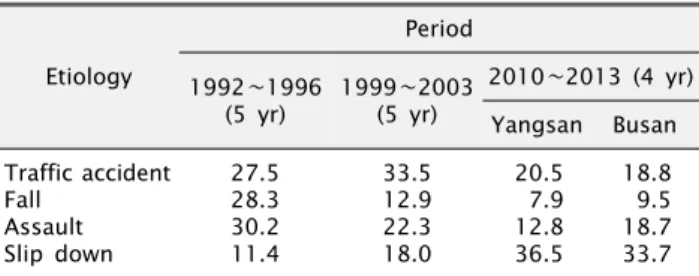
and TA showed similar rate. Compared to our older data, assault was significantly less and slip down increased no- ticeably (Table 5). Our explanation is that the general psy- chological atmosphere of this society became more non-vi- olent, but there may be many cases providing inaccurate medical history to hide the cause related to violence due to the medical insurance system. Also, TA was reported as the highest cause in many domestic and overseas studies but Park et al .[13], reported the highest causes in order of slip down, fall down, assault, and TA; Oh et al .[4] sum- marized the causes in order of slip down, fall down, TA, and assaults. In concentrated residential areas or with pa- tients aged 10s to 20s, slip down and assault were more frequent causes than TA.

Conclusion

This study investigated and targeted patients with facial bone fracture visiting the Department of Oral and Maxillofacial Surgery of the Dental Clinic Center in Pusan National University Hospital located at Busan and of Pusan National University Dental Hospital located at Yangsan for outpatient department and emergency room from January 2010 to December 2013. Five-hundred and thirty-one pa- tients with facial bone fracture visited Yangsan and 802 patients visited Busan. The gender ratio was 3.58:1 in Yangsan and 4.31:1 in Busan, showing that the male was dominant. The number of patients with fractures was the highest in 20s at both Yangsan and Busan and the next

was 30s. The site of fracture was highest in order of man- dible, nasal bone, maxilla, zygoma, and orbital cavity in Yangsan and mandible, nasal bone, zygoma, orbital cavity, and maxilla in Busan. The commonest cause of fracture was slip down at both Yangsan and Busan and the next was in order of collision, TA, assaults, and fall down.

References

1. Bell WH. Revascularization and bone healing after anterior maxillary osteotomy: a study using adult rhesus monkeys. J Oral Surg 1969;27:249-55.

2. Schultz RC. One thousand consecutive cases of major facial injury. Rev Surg 1970;27:394-410.

3. Kim KS, Kang HI, Kil YK, et al . A clinical study of man- dible fracture for 10 years at Chuncheon city. J Korean Assoc Maxillofac Plast Reconstr Surg 2009;31:519-25.

4. Oh SS, Son SJ, Kim IK. A clinical study of facial bone frac- ture for five years at Seong Nam city. J Korean Assoc Maxillofac Plast Reconstr Surg 1995;17:396-406.

5. Lee JW, Ro HS. Clinical study of facial bone fracture. J Korean Assoc Maxillofac Plast Reconstr Surg 1992;14:89-96.

6. Lee YO, Moon SH. Analysis of 334 case reports of man- dibular fracture. J Korean Assoc Maxillofac Plast Reconstr Surg 1991;13:291-9.

7. Breytenbach HS, editor. A pattern of facial fractures of the cape colored population of Republic of South Africa.

I.C.O.S. oral maxillofacial surgery. Chicago: Quintessence Book; 1985. p.150-60.

8. Oh MS, Kim SG, Kim HK, Moon SY. Seven-year retro- spective study of facial fracture. J Korean Assoc Maxillofac Plast Reconstr Surg 2007;29:50-4.

9. Jang HS, Jang MJ. A clinical study on the facial bone fracture. J Korean Assoc Maxillofac Plast Reconstr Surg 1996;18:454-62.

10. Olson RA, Fonseca RJ, Zeitler DL, Osbon DB. Fractures of the mandible: a review of 580 cases. J Oral Maxillofac Surg 1982;40:23-8.

11. Nakamura T, Gross CW. Facial fractures: analysis of five years of experience. Arch Otolaryngol 1973;97:288-90.

12. Rim JS, Kim SM, Seo BY, Bae MK, Chung HK. A clinical study on facial bone fractures. J Korean Assoc Maxillofac Plast Reconstr Surg 1989;11:41-9.

13. Park JH, Heo NO, Jeon IS, Shin MS, Rho YS, Yoon KH. A

clinical and statistical study of mandibular fractures. J

Korean Assoc Maxillofac Plast Reconstr Surg 1994;16:281-9.

수치

Fig. 2. Year distribution of number of patients in Busan. Fig. 4.  Month  distribution  of  number  of  patients  in  Busan.
Fig. 6. Gender distribution in Busan.
Table 1. Compared with previous years Period 1992∼1996  (5 yr) 1999∼2003 (5 yr) 2010∼2013 (4 yr) Yangsan Busan No
Table 4.  Compared  with  previous  site  distribution  (%)
+2

참조

관련 문서

Therefore, this study aimed to confirm the clinical courses of patients who underwent reconstruction of facial bone fractures using absorbable plates and to compare the

To investigate the present trends in the causes of patients visiting the emergency room of tertiary care hospital and were treated at the Department of Oral and Maxillofacial

Department of Oral and Maxillofacial Surgery, School of Dentistry, Pusan National University Young-Jae Baek, Dong-Ho Geum, Jung-Han Lee, Sung-Hee Kim, Kyung-Yong Ahn, Uk-Kyu

Purpose: The purpose of this study was to evaluate the causes of blow-out fractures, the computed tomogra- phy findings, and the associated facial bone fractures in

Methods: 30 Korean patients (15 male and 15 female) who had visited the Department of Oral and Maxillofacial Surgery, College of Dentistry, Yonsei University,

In this study, 13 cleft lip patients who had undergone a secondary cheilorhinoplasty at the Department of Oral and Maxillofacial Surgery, Pusan National University