• 검색 결과가 없습니다.

Simultaneous Glossectomy with Orthognathic Surgery for Mandibular Prognathism

N/A
N/A
Protected

Academic year: 2021

Share "Simultaneous Glossectomy with Orthognathic Surgery for Mandibular Prognathism"

Copied!
5
0
0

로드 중.... (전체 텍스트 보기)

전체 글

(1)

ISSN 2288-8101(Print) ISSN 2288-8586(Online)

Case Report

RECEIVED June 25, 2014, ACCEPTED July 14, 2014 Correspondence to Seung-Il Song

Division of Oral and Maxillofacial Surgery, Department of Dentistry, Ajou University School of Medicine 164 WorldCup-ro, Yeongtong-gu, Suwon 443-749, Korea

Tel: 82-31-219-5328, Fax: 82-31-219-5329, E-mail: [email protected]

Copyright © 2014 by The Korean Association of Maxillofacial Plastic and Reconstructive Surgeons. All rights reserved.

CC

This is an open access article distributed under the terms of the Creative Commons Attribution Non-Commercial License (http://creativecommons.org/licenses/

by-nc/3.0) which permits unrestricted non-commercial use, distribution, and reproduction in any medium, provided the original work is properly cited.

Simultaneous Glossectomy with Orthognathic Surgery for Mandibular Prognathism

Young-Wook Jung, Sung-Woon On, Kyu-Rhim Chung, Seung-Il Song

Division of Oral and Maxillofacial Surgery, Department of Dentistry, Ajou University School of Medicine

Abstract

Macroglossia can create dental and skeletal instability after orthodontic treatment or orthognathic surgery for mandibular prognathism. In relevant literature, partial glossectomy is suggested for a good post-treatment prognosis. Most of the published partial glossectomy cases are two-staged surgery, because of concern about postoperative airway obstruction. As orthognathic surgical techniques and fixation method develop, however, concerns about postoperative airway obstruction have lessened.

In this case, mandibular setback surgery and partial glossectomy were performed simultaneously, leading to stable recovery without any postoperative respiratory problems. After surgical technique to preserve the tongue tip, we achieved good outcomes without postoperative side effects of lingual hypoesthesia, pronunciation disorder and dyskinesia. We report this case with a literature review.

Key words: Macroglossia, Glossectomy, Orthognathic surgery

Introduction

Macroglossia can create dentomusculoskeletal deform- ities such as open bite and mandibular prognathism, and create instability after orthodontic and orthognathic surgical treatment. Therefore, in some cases, partial glossectomy is necessary for a good post-treatment prognosis[1,2].

Macroglossia is divided largely into true macroglossia and pseudomacroglossia. True macroglossia is a condition where the tongue itself is enlarged. Congenital factors in- clude muscle hypertrophy, glandular hyperplasia, he- mangioma, and acquired factors may include acromegaly, myxedema, amyloidosis[1].

Pseudomacroglossia is a condition where the tongue is normal in size, but appears relatively large compared to surrounding anatomic structures. Possible causes include habitual posturing of the tongue, transverse, vertical, or antero-posterior deficiency of the maxillary or mandibular arches that decreases the oral cavity volume, and severe mandibular deficiency[1].

To determine whether a reduction glossectomy is neces-

sary, it is important to clarify sign and symptoms of

macroglossia. Wolford and Cottrell[1] described several

clinical and cephalometric features. The clinical features

include (1) grossly enlarged, broad and flat tongue, (2)

open bite, (3) mandibular prognathism, (4) crenations on

(2)

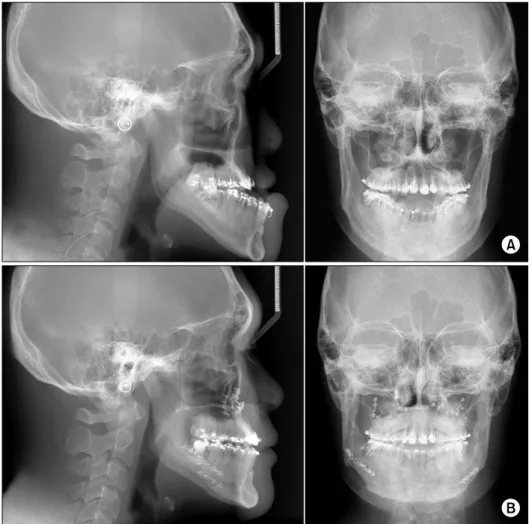
Fig. 1. (A) Preoperative cephalogram.

(B) Postoperative 9 months cephalog- ram.

the tongue, and (5) glossitis. The cephalometric radio- graphic features include (1) mandibular dentoalveolar pro- trusion, (2) overangulation of anterior teeth, (3) increased gonial angle, mandibular plane angle, occlusal plane angle.

In mandibular setback surgery for macroglossia, post- operative relapse can be reduced by partial glossectomy[3].

Most reports were of two-stage surgery, because of concern about postoperative airway obstruction secondary to tongue edema and bleeding immediately after surgery.

However, as orthognathic surgical techniques and fixation method developed, postoperative airway management problems were reduced.

In this case, mandibular setback surgery and glossec- tomy were performed simultaneously, leading to stable re- covery without any postoperative respiratory problems.

After surgical technique to preserve the tongue tip, we achieved good outcomes without postoperative side effects of lingual hypoesthesia, pronunciation disorder and dyskinesia. We report this case with a literature review.

Case Report

A 24-year-old male patient, with no history of a congenital abnormality such as Down syndrome or Beckwith-Widemann syndrome, showed severe mandibular prognathism (󰠏19 mm incisor overjet) and excessive anterior open bite (󰠏8.7 mm incisor overbite, not occluded from the mandibular left first molar to the mandibular right first molar). Several clinical features of macroglossia (grossly enlarged and broad tongue, crenations on the tongue) were seen. Following diagnostic criteria suggested by Wolford and Cottrel[1], pseudomacroglossia was diagnosed. Lateral cephalometric analysis revealed severe mandibular prognathism and Angle Class III malocclusion (point A-nasion-point B=󰠏9.19, sella- nasion-point A=89.86, sella-nasion-point B=99.05; Fig. 1A).

For mandibular setback surgery, bilateral sagittal split

ramus osteotomy was performed. Following 10 mm man-

dibular setback movement, semi-rigid fixation was con-

ducted with miniplates and screws. Subsequently, Le Fort

(3)

Fig. 2. T-shape tongue reduction method was used as suggested by Harada and Enomoto[2].

I maxillary osteotomy was performed. After 5 mm advance- ment and 5 mm posterior impaction, semi-rigid fixation was placed using miniplates and screws (Fig. 1B). The Harada-Enomoto method[2] was employed for glossectomy.

A wedge-shaped incision was made along the middle of the tongue, and a crescent-shaped incision on the posterior portion of the dorsum (Fig. 2). Weak intermaxillary fixation using elastic guiding rubber was applied to allow the pa- tient to breathe more readily through the mouth.

Immediately after the surgery, there were no airway prob- lems and stable recovery was achieved.

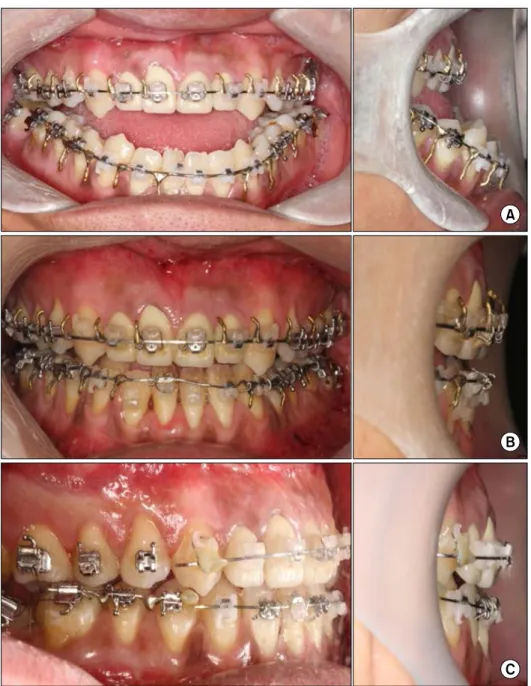
To observe any changes in occlusion, clinical examina- tions were done preoperative and postoperative 2 weeks and 3 months. At postoperative 2 weeks, the open bite resolved and stable occlusion of Angle Class I was seen (Fig. 3B). At postoperative 3 months, no findings suggestive of occlusion worsening including recurrent open bite were observed, and the occlusion remained stable (Fig. 3C).

Tongue movement, sensation, taste, pronunciation were evaluated during the observation period. The patient com- plained of dysesthsia and pronunciation problems shortly after the surgery, but the symptoms were gone at the three month exam.

Discussion

The effects of glossectomy on the skeletal and dental components after orthodontic treatment or orthognathic

surgery in patients with pseudomacroglossia are an open question. Some studies insisted that there was no effect of glossectomy on skeletal and dental stability after man- dibular setback surgery. Kawakami et al .[4] found no sig- nificant difference in the skeletal and dental changes be- tween glossectomy or no glossectomy. They insisted that adaptation of the hyoid bone position and tongue position precludes the necessity for glossectomy.

Other research suggests that the tongue is important in the recurrence after orthodontic treatment or orthognathic surgery[3,5-7]. The tongue size may be increased by the mandibular setback, increasing the force on the mandibular and anterior teeth, resulting in recurrence. The risk of re- lapse might be higher especially in cases of severe open bite or severe mandibular prognathism. In our case, the patient had a severe open bite and mandibular prognathism;

even worse he had a pseudomacroglossia. Orthognathic surgery with glossectomy was considered because of a strong risk of postoperative relapse.

Wolford and Cottrell[1] described three choices on surgi-

cal sequencing: (1) Stage 1: reduction glossectomy, Stage

2: orthognathic surgery; (2) Stage 1: orthognathic surgery,

Stage 2: reduction glossectomy; and (3) perform the orthog-

nathic surgery and reduction glossectomy in one surgical

stage. In comparison with two-staged surgery, simulta-

neous surgery has the benefits of reducing the frequency

of general anesthesia and the possibility of relapse immedi-

ately after surgery. However, most cases reported are

(4)

Fig. 3. (A) Preoperative photograph.

(B) Postoperative 2 weeks photograph.

(C) Postoperative 3 months photo- graph.

two-staged surgery, because of concern about post- operative airway obstruction secondary to tongue edema and bleeding immediately after surgery.

As orthognathic surgical techniques and fixation method develop, the risk of postoperative airway obstruction is reduced. Rigid fixation (or semi-rigid fixation) makes it possible to release the intermaxillary fixation, if necessary, and it is a significant advantage to prevent airway problems Petdachai et al .[6] reported successful outcomes performing orthognathic surgery and glossectomy simultaneously.

They insisted that intermaxillary fixation should not be per- formed until at least 12 hours have passed to allow tongue

edema reduction and to be able to assist the patient imme- diately in any airway emergency. In our surgical experi- ence, there are no postoperative airway management prob- lems in the absence of intermaxillary fixation. The other concern about airway management problem is post- operative tongue bleeding. The partial glossectomy techni- que used in this case is a minimally invasive surgical technique. In our surgical experience, the glossectomy-in- duced bleeding was negligible. Therefore the risk of airway obstruction was low, and there were no significant post- operative airway management problems.

There is a variety of partial glossectomy techniques in

(5)

the literature, although in most, the tip of tongue is excised.

Mixter et al .[8] reported that standard partial glossectomy may result in an ankylosed, globular tongue with an in- sensitive tip. Harada and Enomoto[2] reported a new meth- od of tongue reduction in which the tip of tongue is main- tained, solving the problems associated with losing the tip of the tongue. Matsumoto et al .[9] reported that while their patient felt some sensory changes soon after using this technique, after a few weeks, all sensation returned to normal. Consistent with their results, this patient re- ported hypoesthesia just after the surgery, but sensation returned to normal at three months after the surgery.

References

1. Wolford LM, Cottrell DA. Diagnosis of macroglossia and in- dications for reduction glossectomy. Am J Orthod Dentofacial Orthop 1996;110:170-7.

2. Harada K, Enomoto S. A new method of tongue reduction for macroglossia. J Oral Maxillofac Surg 1995;53:91-2.

3. Swanson LT, Murray JE. Partial glossectomy to stabilize oc- clusion following surgical correction of prognathism. Report of a case. Oral Surg Oral Med Oral Pathol 1969;27:707-15.

4. Kawakami M, Yamamoto K, Noshi T, Miyawaki S, Kirita T.

Effect of surgical reduction of the tongue on dentofacial struc- ture following mandibular setback. J Oral Maxillofac Surg 2004;62:1188-92.

5. Hotokezaka H, Matsuo T, Nakagawa M, Mizuno A, Kobayashi K. Severe dental open bite malocclusion with tongue reduc- tion after orthodontic treatment. Angle Orthod 2001;71:228-36.

6. Petdachai S, Inoue Y, Inoue H, Sakuda M. Orthognathic surgical approach and partial glossectomy to a skeletal 3 adult open bite. J Osaka Univ Dent Sch 1993;33:14-20.

7. Ruff RM. Orthodontic treatment and tongue surgery in a class III open-bite malocclusion. A case report. Angle Orthod 1985;

55:155-66.

8. Mixter RC, Ewanowski SJ, Carson LV. Central tongue reduc- tion for macroglossia. Plast Reconstr Surg 1993;91:1159-62.

9. Matsumoto K, Morita K, Jinno S, Omura K. Sensory changes

after tongue reduction for macroglossia. Oral Surg Oral Med

Oral Pathol Oral Radiol 2014;117:e1-2.

수치

Fig. 1. (A) Preoperative cephalogram.
Fig. 2. T-shape tongue reduction method was used as suggested by Harada and Enomoto[2].
Fig. 3. (A) Preoperative photograph.

참조

관련 문서

Postoperative adhesion formation and reproductive outcome using interceed ® after ovarian surgery: a randomized trial in the rabbit model.. Adhesion reformation

With the increase of the dental implant procedure, there are many cases of Maxillary Sinus Floor Elevation Surgery(MSFES). Additionally, its side effect has

This showed that the surgical outcome was successfulin 269 patients (98.89%),butthe revision surgery due to surgicalrelapse was performed in three patients.Of 152 patients

This study prepares an educational program which helps the patients reduce anxiety on surgery which is considered as one of the biggest emotional crises

Using this leap motion, a surgeon can perform the virtual shoulder arthroscopic surgery skillfully and reduce mistakes in surgery.. The simulation using leap motion shows

US-guided FNAB diagnosis and corresponding histologic findings after thyroid surgery of infracentimetric nodule --- 16 Table 3..

Then humeral head prosthetic design of a Bigliani-Flatow (BF) shoulder system was used to do simulation humeral arthroplasty surgery and the humeral head size

They reported that single injection of dexamethasone, 2 to 3 hr prior to surgery, hastened the recovery profiles (clinical duration, recovery index, as