• 검색 결과가 없습니다.

Effect of Heat Treatment on the Bending Strength and Hardness of Wood

N/A
N/A
Protected

Academic year: 2021

Share "Effect of Heat Treatment on the Bending Strength and Hardness of Wood"

Copied!
8
0
0

로드 중.... (전체 텍스트 보기)

전체 글

(1)

*1 Received on June 26, 2012; accepted on September 11, 2012

*2 College of Agriculture & Life Science, Gyeongsang National University, Jinju 660-701, Korea

*3 Forest Training Institute, Korea Forest Service, Namyangju city, Kyounggido 472-865, Korea

*4 College of Agriculture & Life Science, IALS. Gyeongsang National University, Jinju 660-701, Korea

Corresponding author : Hee-Seop Byeon (e-mail: [email protected])

Effect of Heat Treatment on the Bending Strength and Hardness of Wood* 1

Kyung-Rok Won*

2

, Tae-Hong Kim*

2

, Kyo-Kil Hwang*

2

, Song-Ho Chong*

3

, Nam-Euy Hong*

2

, and Hee-Seop Byeon*

4†

ABSTRACT

Heat treatment improves dimensional stability and sound absorption properties of wood. However, me- chanical properties of wood can be deteriorated during the heat treatment. The effect of heat treatment on the bending strength and hardness of wood for Korean paulownia, Pinus densiflora, Lidiodendron tuli- pifera and Betula costata were measured. The heat treatment temperature has been investigated at 175°C and 200°C, respectively. The results showed that the weight and density of wood decreased after heat treatment. It was found that the density by heat treatment was lower at 200°C than that at 175°C. And, MOE increased with the reduced density. On the contrary, MOR and hardness decreased. In all conditions, It was found that there was a high correlation of 1% level between bending modulus of elasticity and modulus of rupture.

Keywords : heat treatment, density, bending MOE and MOR, hardness

1. INTRODUCTION

The demand of wood has risen sharply be- cause of the necessity for environment friendly fuels with an increase of personal income and economic growth. Until recently, Korea is im- porting more than 90% of the annual wood con- sumption (2.60 million m

3

) because most of the resources are low-diameter wood or low-quality wood in Korea. It is an inevitable consequence because the timber resources of high quality are reducing and every consumer want to use cheap wood resource of high quality.

Recently, the “ThermoWood” (heat treated

wood product) is manufactured to make high

value and to accept consumers’ preference in

Europe. And the thermal treatment of wood is

an alternative to the chemical treatment for pre-

servation purposes (Poncsak et al., 2006). Also,

It has been continuously researching around the

world about removing resin from conifer, chang-

ing of the material quality for softwood and

hardwood, and improving of dimensional stabil-

ity (Shin et al., 2009). And relatively mild ther-

mal treatments of wood according to a two step

process which leads to improved dimensional

(2)

stability (Tjeerdsma et al., 1998). Hydrothermal processing of lignocellulosic materials (wood or agricultural residues) causes a variety of effects including extractive removal, hemicellulose hy- drolysis and alteration of the properties of both cellulose and lignin (Garrote et al., 1999).

Changes in the chemical structure of wood caused by thermal treatment and modification during heat treatment could be explained by a modification of conformational arrangement of wood biopolymers due to loss of residual water or more probably to plasticization of lignin (Sivonen et al., 2002, Hakkou et al., 2005).

And decrease in hydroxyl groups increases the hydrophobicity of wood and reduces the adop- tion of water (Kamdem et al., 2002, Stamm et al., 1946, Pavlo et al., 2003). The wood struc- ture changes due to decomposition of hemi- celluloses, ramification of lignin, and crystal- lization of cellulose. These changes improve the dimensional stability of wood, increase its re- sistance to micro-organisms, darken its color, and modify its hardness (Kocaefe et al., 2008).

The heat-treated wood is more dimensionally stable in the change of moisture condition and the mechanical properties of heat-treated wood showed relatively higher performance (Kim et al., 2009).

It has been suggested that this study takes a subsequent investigation for the research of the sound absorption property of heat-treated wood at a low temperature and vacuum conditions (Byeon et al., 2010). In this study, the effect of heat treatment on the bending strength and hardness of Korean paulownia, Pinus densi- flora, Lidiodendron tulipifera and Betula costata was investigated under different conditions.

2. MATERIALS and METHODS 2.1. Material

The species of Korean paulownia, Pinus den-

siflora, Lidiodendron tulipifera and Betula cos- tata were used in the dry ingredients. Speci- mens of each species were made from edge grain 20 (R) × 10 (T) × 100 mm(L) and flat grain 10 (R) × 20 (T) × 100 mm(L) and proc- essed 8 each.

The humidification of specimens was treated over 1 week in the constant temperature and humidity room (20°C ± 1°C, 65% ± 5%), and heated for 6 hours at 120°C in dry oven. The heat treatment of specimens treated at the heat- ing rate 10°C/min heating conditions in the vac- uum sintering furnace (KOVACO KSF-100 Type). At this time, maintained for 30 minutes in the maximum temperature of 175°C and 200°C. After heat treatment, the humidification of treated samples were treated again over 1 week in the constant temperature and humidity room (20 ± 1°C, 65 ± 2%). After that, bending strength and hardness test of specimen was conducted.

2.2. Weight and Density Changes

Weight and density were measured before and after heat treatment of each specimen with electronic scale, and used electronic calipers to measure the size.

2.3. Bending Strength and Hardness Test

Bending strength test was conducted using a span (80 mm) by central method of three points, and carried out test load speed of 1 mm/min. In this condition, bending MOE and MOR was determined. TAESIN Precision Machinery TSU-2 Universal Mechanical Testing Machine was used for the measurement.

Hardness test was conducted using the univer- sal strength tester by Brinell hardness test method.

When the load in the 0.32 mm indentation hard-

ness was measured using steel balls of 10mm di-

ameter by loading rate of 0.5 mm/min.

(3)

Table 1. Mass and density properties of heat-treated woods

Species Heat treatment condition

Mass  Density 

  (g) R

M

(%) (g/cm

3

) R ρ (%)

Korean Paulownia

solid Mean 5.730 0 0.299 0

  S.D 0.483 0.023

175 Mean 4.310 -24.78 0.224 -25.08

  S.D 0.280 0.013

200 Mean 3.705 -35.34 0.194 -35.12

  S.D 0.275 0.011

Pinus densiflora

solid Mean 10.960 0 0.546 0

  S.D 0.695 0.034

175 Mean 9.40 -14.23 0.497 -9.64

  S.D 0.40 0.021

200 Mean 8.053 -26.52 0.452 -17.82

  S.D 0.462 0.031

Lidiodend-ron tulipifera

solid Mean 10.550 0 0.548 0

  S.D 0.653 0.039

175 Mean 7.729 -26.73 0.440 -20.00

  S.D 0.357 0.023

200 Mean 6.331 -39.99 0.374 -32.00

  S.D 0.586 0.045

Betula costata

solid Mean 13.440 0 0.694 0

  S.D 0.275 0.023

175 Mean 11.755 -12.53 0.648 -6.67

  S.D 0.774 0.037

200 Mean 9.174 -31.74 0.572 -11.01

  S.D 0.371 0.021

Notes; R

M

: Ratio change in mass after heat treatment,

ρ
: Density,

R

ρ

: Ratio change in density after heat treatment, S.D: Standard deviation.

3. RESULTS and DISCUSSION 3.1. The Weight and Density of Species

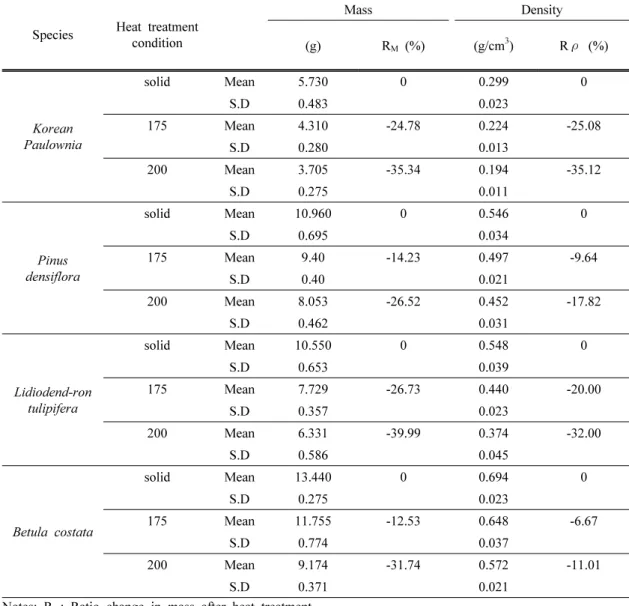
According to the Heat Treatment Table 1 shows weight of each species after

heat treatment. The weight of wood after heat

treatment decreased according to increase of

temperature. Especially, Korean paulownia and

Lidiodendron tulipifera showed very high de-

creasing rate. The decreasing rate at temperature

between 175°C and 200°C for Korean paulow-

(4)

Table 2. Bending strength and hardness properties of heat-treated woods Species

Heat treatment condition

  MOE

(kgf/cm

2

)

R

MOE

(%)

MOR (kgf/cm

2

)

R

MOR

(%)

Hardness (kgf/mm

2

)

R

HB

(%)

Korean Paulownia

Solid mean 57,374 0 433 0 3.35 0

  S.D 8,229 14 0.38

175°C mean 55,010 -4.12 264 -39.03 3.12 -6.87

  S.D 6,608 39 0.72

200°C mean 51,396 -10.42 145 -66.51 2.26 -32.54

  S.D 7,449 28 0.51

Pinus densiflora

Solid mean 95,299 0 876 0 10.37 0

  S.D 18,045 61 0.21

175°C mean 104,778 +9.95 875 -0.11 8.65 -16.59

  S.D 16,162 102 1.81

200°C mean 113,342 +18.93 660 -24.66 8.58 -17.26

  S.D 17,050 126 1.23

Lidiodend-ron tulipifera

Solid mean 105,984 0 830 0 8.54 0

  S.D 24,611 103 0.46

175°C mean 109,300 +3.13 583 -29.76 8.35 -2.22

  S.D 21,720 77 1.54

200°C mean 111,624 +5.32 334 -59.76 6.33 -25.88

  S.D 24,458 160 1.29

Betula costata

Solid mean 125,461 0 1236 0 10.39 0

  S.D 31,463 104 0.58

175°C mean 125,007 -0.36 1002 -18.93 12.11 +16.55

  S.D 9,226 162 1.69

200°C mean 139,683 +11.34 665 -46.20 9.76 -6.06

  S.D 29,467 136 1.69

Notes; R

MOE

: Ratio of change in MOE after heat treatment, R

MOR

: Ratio of change in MOR after heat treatment, R

HB

: Ratio of change in Hardness after heat treatment, S.D: Standard deviation. RF : Resonance frequency.

nia, Pinus densiflora, Lidiodendron tulipifera and Betula costata showed -24.78%, -35.34% and -14.23%, -26.52% and -26.73%, -39.99% and -12.53%, -31.74%, respectively. It was acted commonly as well not only moisture desorption of wood fiber at the over 100°C but also differ-

ent composition of each species. Borrega and Kärenlamopi (2008) reported that the weight loss of spruce at the same moisture content in- creased at the high temperature.

Table 1 shows density of each species after

heat treatment. Especially, the highest decreas-

(5)

Fig. 1. Bending strength properties of heat-treated woods.

ing rate on the Korean paulownia showed -25.08% at the 175°C and -35.12% at the 200

°C. The Lidiodendron tulipifera also showed very high decreasing rate of -20% at the 175 °C and -32% at the 200°C. This result is also due to different component of each species. In addi- tion, the density of heat treatment at the high temperature is lower than heat treatment at the low temperature. The reason why the density of heat treatment at the high temperature is low because hemicellulose was degraded as well at the 200°C more than 175°C. Esteves et al (2007) reported that wood density decrease be- cause of the removal of wood components by heat treatment and moisture desorption.

In studies of the characteristics of pyrolysis for wood has been reported that cellulose, hemi- cellulose and lignin consist of each component and differ from decomposition temperature (Shafizadeh and McGinnis, 1971; Bridgwater, 2000; Demirbas, 2002). They said that the de- composition temperature was 275∼350°C for cellulose, 150∼300°C for hemicellulose and 250∼500°C for lignin. It shows in the other studies such as the pyrolysis characteristics of wood (Lee, 2003) and hemicellulose was a vari- ety of heterogeneous materials (Manninen, 2002).

3.2. The Bending Strength of Each Species According to the Heat Treatment

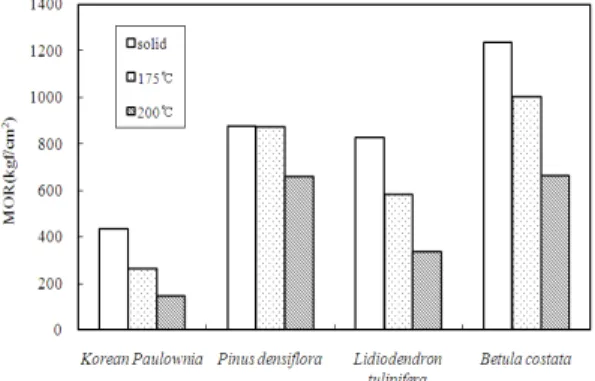
Table 2 and Fig. 1 shows the averages be- tween the modulus of elasticity (MOE) and the modulus of rupture (MOR) of each species after heat treatment. Before and after heat treatment, Betula costata showed highest bending modulus followed by Lidiodendron tulipifera, Pinus den- siflora and Korean paulownia, respectively.

Every species increased the bending modulus except Korean paulownia. MOE showed much higher at the 200°C than 175°C. Kocaefe et al (2010) reported that there is a significant change in mechanical properties (MOE, MOR, hardness, etc.) due to heat treatment. Mechani- cal properies of heat-treated jack pine generally were deteriorated at temperatures higher than 200°C compared to those of untreated jack pine.

The density is generally proportional to the modulus of elasticity. However, like in this ex- periment, decreasing density of the heat-treated wood was caused by decomposition of hemi- celluloses, ramification of lignin, and crystal- lization of cellulose. (Kocaefe et al, 2008).

Thereby increasing the MOE. But, further re-

search is required why unlike other species,

(6)

Fig. 2. Hardness property of heat treated woods.

Fig. 3. Relation of bending MOE to MOR of heat treated woods.

MOE of Korean paulownia decreased after heat treatment.

The MOR of heat-treated Betula costata, Lidiodendron tulipifera, Pinus densiflora and Korean paulownia were decreased at temper- ature of 200°C more than those at 175°C. This deterioration might be explained as due to hem- icellulose degradation. Yildiz et al (2006) re- ported that the heat treatment and control sam- ples were tested for some mechanical proper- ties; compression strength, bending strength, modulus of elasticity in bending, hardness, im- pact bending strength and tension strength per- pendicular to grain. The results indicated that

heat treatment samples had lower mechanical properties compared to the control samples. It was seen that hemicelluloses were the wood-cell components most degraded by the heat treatment.

3.3. The Hardness of Each Species According to the Heat Treatment

Table 2 and Fig. 2 shows the mean value of

each species after heat treatment. Before and af-

ter heat treatment, the bending solidity and den-

sity was measured lower at the 200°C than

175 °C. Betula costata showed highest hardness

followed by Lidiodendron tulipifera, Pinus den-

(7)

siflora and Korean paulownia, respectively.

The bending strength and hardness decreased due to the reduction of density after heat treat- ment. In this study, the heat treatment of speci- mens treated at the heating rate 10°C/min heat- ing conditions, and maintained for 30 minutes in the maximum temperature of 175°C and 200°C.

Therefore, the maximum temperature of 200°C was more active degradation of hemicellulose than 175°C. Kocaefe et al (2010) reported that there is a significant change in hardness due to heat treatment. The hardness of heat-treated jack pine generally were deteriorated at temperatures higher than 200°C compared to those of un- treated jack pine.

3.4. The Bending MOE-Bending MOR, Density-Bending MOE and Density- Hardness Correlation of Heat Treated Wood

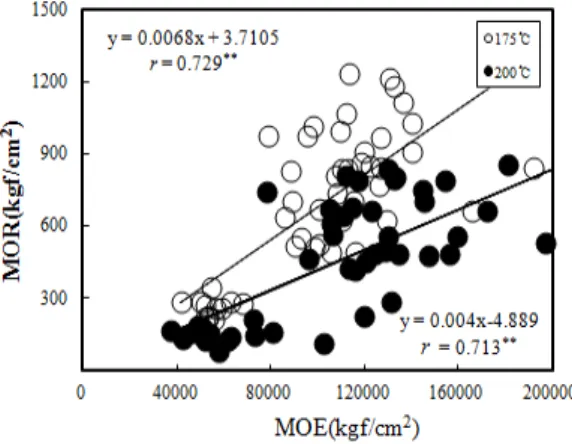
Fig. 3 shows the relation of bending MOE to MOR of heat treated woods. The correlation co- efficients for the regression bending MOE to MOR were 0.729 at the 175°C and 0.713 at the 200°C. Both were significant at the 1% level, and there were a similar correlations between 175°C and 200°C. Byeon et al (2005) reported that a high correlation coefficient between bend- ing MOE and MOR of finger-jointed wood were similar to this results (significant at the 1% level). And Nakai (1984) also reported that solid Japanese cedar showed a high correlation coefficient (0.69-0.78) between bending MOE and MOR.

4. CONCLUSIONS

Heat treatment tests for four species of woods were performed in order to assess the effects on the bending strength performence and hardness.

The results showed that there was a significant change in mechanical properties such as MOE, MOR and hardness due to heat treatment. The density of heat treatment at the high temper- ature was lower than heat treatment at the low temperature. The reason why the density of heat treatment at the high temperature is low because hemicellulose was degraded as well at the 200°C more than 175°C. And MOE showed much higher at the 200°C than 175°C. The hardness decreased due to the reduction of den- sity after heat treatment. And, a high correlation and 1% level of significance were observed in all conditions between bending MOE and bend- ing MOR.

ACKNOLEDGEMENT

This study was carried out with the support of ‘Research center for Ecological Restora- tion in Damaged land (Project No. S211212L0504)’ pro- vided by Korea Forest Service.

REFERENCES

1. Borrega, M. and P. P. Kärenlamopi. 2008. Mech- anical behavior of heat-treated spruce (Picea abies) wood at constant moisture content and ambient humidity. Holz als Roh-und Werkstoff 66: 63∼69.

2. Bridgwater, A. V. 2003. Renewable fuels and chemicals by thermal processing of biomass.

Chem. Eng. J 91(2∼3): 87∼102.

3. Byeon, H. S., H. M. Park, and F. Lam. 2005.

Nondestructive evaluation of strength perform- ance for finger-jointed wood using flexural vi- bration techniques. Forestry Products Journal 55(10): 37 ∼42.

4. Byeon, H. S., J. H. Park, K. K. Hwang, H. M.

Park, B. S. Park, and S. H. Chong. 2010. Sound absorption property of heat-treated wood at a low temperature and vacuum conditions. Mokchae Konghak 38(2): 123 ∼129.

5. Chang, Y. S., Y. J. Han, C. D. Eom, J. S. Park,

(8)

M. J. Park, I. G, Choi, and H. M. Yeo. 2012.

Analysis of factors affecting the hygroscopic per- formance of thermally treated Pinus koraiensis wood. Mokchae Konghak 40(1): 10∼18.

6. Demirbas, A. 2002. Gaseous products from bio- mass by pyrolysis and gasification: Effects of catalyst on hydrogen yield. Energy conversion and management 43(7): 897 ∼909.

7. Esteves, B., A. V. Marques, I. Domingos, and H.

Pereira. 2007. Influence of steam heating on the properties of pine (Pinus Pinaster) and eucalypt (Eucalypus globulus) wood. Wood Sci Technol 41(3): 193∼207.

8. Garrote, G., H. Dominguez, and J. C. Parajo.

1999. Hydrothermal processing of lignocellulosic materials. European J. of wood and wood prod- ucts 57(3): 191∼202.

9. Hakkou M, M. Pétrissens, A. Zoulalian, and P.

Gérardin. 2005. Investigation of wood wettability changes during heat treatment on the basis of chemical analysis. Polymer degradation and sta- bility 89(1): 1 ∼5.

10. Kamdem D. P., A. Pizzi, and A. Jermammaud.

2002. Durability of heat-treated wood. Holz als Roh-und Werkstoff 60: 1∼6.

11. Kim, K. M., J. H. Park, B. S. Park, D. W. Son, J. S. Park, W. S. Kim, B. N. Kim, and S. R.

Shim. 2009. Physical and mechanical properties of heat-treated domestic cedar. Mokchae Kong- hak 37(4): 330∼339.

12. Kim, K. M., J. H. Park, B. S. Park, D. W. Son, J. S. Park, W. S. Kim, B. N. Kim, and S. R.

Shim. 2009. Physical and mechanical properties of heat-treated domestic yellow poplar. Mok- chae Konghak 38(1): 17∼25.

13. Kocaefe D, S. Poncsak and J. Tang. 2010. Effect of heat treatment on the mechanical properties of North American jack pine: thermogravimetric study. J Mater Sic 45: 681∼687.

14. Kocaefe D, S. Poncsak and Y. Boluk. 2008.

Effect of thermal treatment on the chemical com- position and mechanical properties of birch and

aspen. Bioresources 3(2): 517 ∼537.

15. Lee, S. H., Y. C. Choi, J. G. Lee, and J. H. Kim.

2003. Pyrolysis characteristic study of lumber wastes. Theories and Applications of Chem. Eng 3∼6.

16. Manninen, A. M., P. Pasanen, and J. K. Holo- painen. 2002. Comparing the VOC emissions be- tween air-dried and heat-treated Scots pine wood.

Atmospheric Environment 36(11): 1763∼1768.

17. Nakai, T. 1984. Full size bending strength of su- gi timber. Wood industry 39(11): 42∼46.

18. Pavlo, B. and P. Niemz. 2003. Effect of high temperature on the change in color, dimensional stability and mechanical properties of spruce wood. Holzforschung 57(5): 539 ∼546.

19. Poncsak S, D. Kocaefe, M. Bouazara, and A.

Pichette. 2006. Effect of high temperature treat- ment on the mechanical properties of birch. Wood Sci Technol 40(8): 647∼663.

20. Shafizadeh, F. and G. D. McGinnis. 1971. Che- mical composition and thermal analysis of cotton- wood. Carbohydrate Research 16(2): 273 ∼277.

21. Shin, R. H., S. H. Yoon, T. H. Han, and J. H.

Kwon. 2009. A study on the development of liv- ing products using heat and color conversion treated woods. KFS Journal 20(5): 457∼466.

22. Sivonen H, S. L. Maunu, F. Sundholm, S. J Jämsä, and P. Viitaniemi. 2002. Magnetic Reso- nance Studies of Thermally Modified Wood.

Holzforschung 56(6): 648∼654.

23. Stamm A. J., H. K. Burr and A. A. Kline. 1946.

Staybwood-Heat-Stabilized Wood. Ind Eng Chem 38(6): 630∼634.

24. Tjeerdsma B. F., M. Boonstra, A. Pizzi, H.

Tekely and H. Millitz. 1998. Characterisation of thermally modified wood: molecular reasons for wood performance improvement. European J. of wood and wood products 56(3): 149∼153.

25. Yildiz, S., E. D. Gezer, and U. C. Yildiz. 2006.

Mechanical and chemical behavior of spruce

wood modified by heat Building and Environ-

ment. 41(12): 1762∼1766.

수치

Table 1. Mass and density properties of heat-treated woods
Table 2. Bending strength and hardness properties of heat-treated woods Species Heat  treatment  condition   MOE (kgf/cm 2 ) R MOE (%) MOR (kgf/cm 2 ) R MOR(%) Hardness(kgf/mm2 ) R HB(%) Korean  Paulownia Solid mean 57,374  0 433  0 3.35 0 S.D 8,229 14  0.
Table 2 and Fig. 1 shows the averages be- be-tween the modulus of elasticity (MOE) and the  modulus of rupture (MOR) of each species after  heat treatment
Fig. 3. Relation of bending MOE to MOR of heat treated woods.

참조

관련 문서

Wood cultivated from the seeds of Italy, United Kingdom, and Bulgary showed higher growth rate and had lower compression strength and compression young’s modulus.. Wood from

Bending strength of Korean red pine was 76.5 N/mm 2 , which was slightly higher than the pine (Pinus densiflora S. Z.) and nut pine (Pinus koraiensis) in Korea. Similar to

Keywords : wood screw withdrawal load, screw diameter, effective depth of penetration, shear strength, growth ring orientation and domestic wood.. 서

The tensile strength of untreated waste wood powder(W3) and homogeneous wood powder(H3) were about 18.5 MPa, 21.5 MPa while the tensile strength of plasma treated waste

3 Dept. The hardness was varied with annealing temperature and slightly decreased with annealing heat treatment. However, the relation between annealing temperature

Effect of chemical surface treatment on the flexural bond strength of heat curing denture base resin and reliners.. Esther Choi, Min-Soo Han,

Purpose: This study was to assess the effect of surface and heat treatment on the bond strength of veneering ceramics to zirconia.. Methods: The specimens were divided into

In this study, a combination of laser heat treatment and vibration peening was proposed to increase fatigue strength without changing the material characteristics..