• 검색 결과가 없습니다.

Nondestructive Evaluation of Strength Performance for Heat-Treated Wood Using Impact Hammer & Transducer

N/A
N/A
Protected

Academic year: 2021

Share "Nondestructive Evaluation of Strength Performance for Heat-Treated Wood Using Impact Hammer & Transducer"

Copied!
8
0
0

로드 중.... (전체 텍스트 보기)

전체 글

(1)

*1 Received on June 19, 2013; accepted on September 17, 2013

*2 College of Agriculture & Life Science, IALS, Gyeongsang National University, Jinju 660-701, Korea

*3 College of Agriculture & Life Science, Gyeongsang National University, Jinju 660-701, Korea

*4 Forest Training Institute, Korea Forest Service, Namyangju city, Kyounggido 472-865, Korea

Corresponding author : Hee-Seop Byeon (e-mail: [email protected])

Nondestructive Evaluation of Strength Performance for Heat-Treated Wood Using Impact Hammer & Transducer* 1

Kyung-Rok Won *

3

, Song-Ho Chong *

4

, Nam-Euy Hong *

3

, Sang-Uk Kang *

3

, and Hee-Seop Byeon *

2†

ABSTRACT

Nondestructive evaluation (NDE) technique method using a resonance frequency mode was carried out for heat-treated wood under different conditions. The effect of heat treatment on the bending strength and NDE technique using the resonance frequency by impact hammer and force transducer mode for Korean paulownia, Pinus densiflora, Lidiodendron tulipifera and Betula costata were measured. The heat treatment temperature has been investigated at 175°C and 200°C, respectively.

There were a close relationship of dynamic modulus of elasticity and static bending modulus of elas- ticity to MOR. In all conditions, It was found that there were a high correlation at 1% level between dy- namic modulus of elasticity and MOR, and static modulus of elasticity and MOR. However, the result indicated that correlation coefficient is higher in dynamic modulus of elasticity to MOR than that in static modulus of elasticity to MOR. Therefore, the dynamic modulus of elasticity using resonance frequency by impact hammer mode is more useful as a nondestructive evaluation method for predicting the MOR of heat-treated wood under different temperature and species conditions.

Keywords : nondestructive evaluation(NDE), heat treatment, impact hammer, MOE, MOR

1. INTRODUCTION

Recently, the “ThermoWood” is manufac- tured to make high value and to accept consum- ers preference in Europe. These heat treatment improve the dimensional stability of wood, in- crease its resistance to micro-organisms, darken its color, and modify its hardness (Kocaefe et al., 2008). Also, Byeon et al (2012) and Kocaefe

(2008 & 2010) found effect of heat treatment on the bending strength of wood which de- creased due to the reduction of density after heat treatment.

Nondestructive evaluation (NDE) techniques

have been extensively used for sorting or grad-

ing of wood products. Examples include visual

grading and machine stress rated (MSR) of

lumber. Dynamic modulus of elasticity (MOE

d

)

(2)

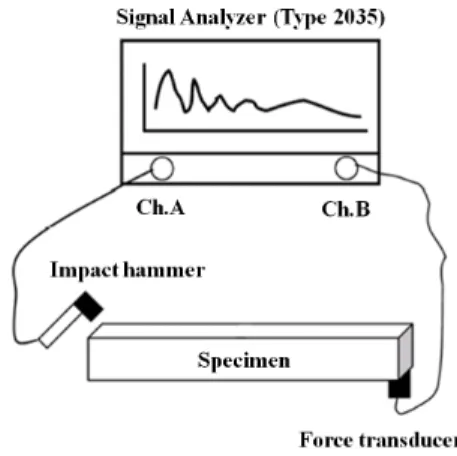
Fig. 1. Schematic diagram of impact hammer vibration mode.

and ultrasonic techniques also have been used for the same purpose. There are two methods to measure dynamic MOE

d

using a resonance fre- quency and the velocity of acoustic propagation.

The resonance frequency can be achieved by a free vibration and/or the fast Fourier transform (FFT) analyzer of impact hammer signals. The dynamic MOE

d

method using the resonance fre- quency has been extensively used for the char- acterization of wood for musical instruments (Sobue et al., 1984; Hong, 1985; Byeon &

Hong, 1997). Park and Byeon(2006) reported that dynamic MOE by resonance frequency us- ing flexural vibration and comparison with bending strength and creep performances of 3-ply woods had a high correlation coefficient of 0.811 ~0.947. The MOE

d

method by impact hammer has been developed as a simple and ef- ficient method. Gehards (1974) showed that the stress wave speed are affected by such as mois- ture and temperature, grain angle, knot. A lon- gitudinal stress wave and transverse vibration methods were developed for the estimation of modulus of the elasticity for lumber (Ross &

Pellerin, 1991).

Therefore, NDE technique using the reso- nance frequency by impact hammer mode was applied to heat-treated wood (Korean pau- lownia, Pinus densiflora, Lidiodendron tulipi- fera and Betula costata) under different temper- ature conditions and the relationship between the resonance frequency parameter and static bending strength properties was analysed.

2. MATERIALS and METHODS

2.1. Material

The species of Korean paulownia, Pinus den- siflora, Lidiodendron tulipifera and Betula cos- tata were used in the dry ingredients. Speci- mens of each species were made from edge

grain 20 mm (R) × 10 mm (T) × 100 mm (L) and flat grain 10 mm (R) × 20 mm (T) × 100 mm (L) and processed 8 each.

The humidification of specimens was treated over 1 week in the constant temperature and humidity room (20°C ± 1°C, 65% ± 5%), and heated for 6 hours at 120°C in dry oven. The heat treatment of specimens treated at the heat- ing rate 10°C/min heating conditions in the vac- uum sintering furnace (KOVACO KSF-100 Type). At this time, maintained for 30 minutes in the maximum temperature of 175°C and 200°C. After heat treatment, the humidification of treated samples were treated again over 1 week in the constant temperature and humidity room (20°C ± 1°C, 65% ± 2%). After that, bending strength and hardness test of specimen was conducted.

2.3. Dynamic MOE Measurement by an Impact Hammer

The measurement was performed by impact- ing the top end of a specimen with an impact hammer (Type 8203, B & K), as shown in Fig.

1. An force transducer (Type 4372V, B & K)

was set at the bottom end plane to receive the

(3)

temperature Species Density (g/cm

3

)

Resonance frequency (Hz)

MOR (MPa)

MOEs (GPa)

MOEd (GPa)

Solid

Korean Paulownia 0.299 (0.023)

4,276 (160)

42.43 (1.37)

5.62 (0.81)

4.73 (0.38) Pinus densiflora 0.546

(0.034)

4,625 (279)

85.85 (5.98)

9.34 (1.77)

10.08 (1.20) Lidiodend-ron

tulipifera

0.548 (0.039)

4,061 (240)

81.34 (10.09)

10.39 (2.41)

7.80 (1.12) Betula costata 0.694

(0.023)

4,748 (160)

121.13 (10.19)

12.30 (3.08)

13.78 (1.07)

175°C

Korean Paulownia 0.222 (0.013)

4,594 (202)

25.77 (3.82)

4.60 (0.65)

4.19 (0.49) Pinus densiflora 0.497

(0.021)

5,042 (223)

85.65 (10.00)

11.73 (1.58)

11.46 (1.12) Lidiodend-ron

tulipifera

0.440 (0.023)

4,427 (394)

57.13 (7.55)

7.85 (2.13)

8.47 (1.79) Betula costata 0.648

(0.037)

5,067 (261)

98.20 (15.88)

15.67 (0.90)

15.62 (2.13)

200°C

Korean Paulownia 0.194 (0.011)

4,095 (295)

14.21 (2.74)

3.22 (0.73)

2.87 (0.42) Pinus densiflora 0.452

(0.031)

4,622 (273)

64.68 (12.35)

9.38 (1.67)

9.30 (1.67) Lidiodend-ron

tulipifera

0.374 (0.045)

3,779 (420)

32.73 (15.68)

5.13 (2.40)

5.31 (1.71) Betula costata 0.571

(0.021)

4,352 (307)

65.17 (13.33)

12.02 (2.89)

11.63 (1.94) Parenthesis is standard deviation, mean value was calculated from 10 replications.

MOE : modulus of elasticity, MOR : modulus of rupture.

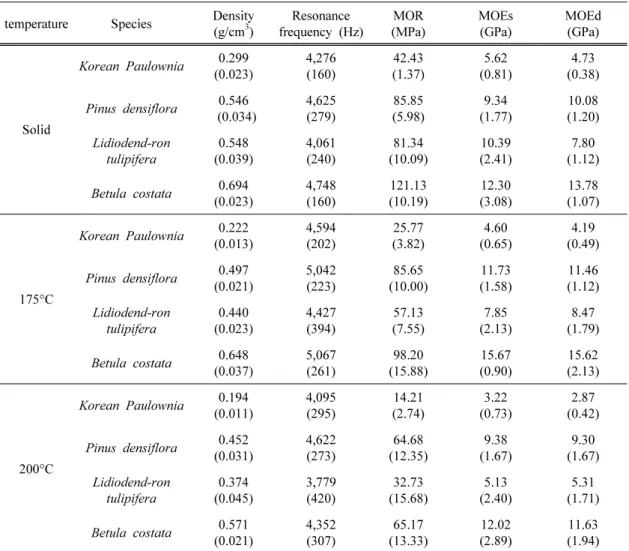
Table 1. The properties of each species according to the heat treatment excitation and transmit it to a signal analyzer

unit (Type 2035, B & K). Each specimen was tapped twice with a hammer and an averaged frequency was obtained from the frequency do- main system. Resonance frequency and dynamic MOE were calculated using Equations [1] and [2], respectively.

f = f

0

(1 + αh

2

/l

2

) (1)

where f

0

: value at frequency counter timer, α: value according to vibration type-8.2,

h: thickness of specimen (cm), l: length of specimen (cm).

MOE

d

= 48 π

2

ρl

4

f

2

/ m

4

h

2

(2)

where ρ: density (g/cm

3

), m: value according

(4)

Fig. 2. Resonance frequency of heat-treated woods.

to basic vibration-4.73, h: thickness of specimen (cm), l: length of specimen (cm).

After resonance frequency measurement, bend- ing strength property test for the same specimen was performed by a three point loading method (concentrated load at midspan and supported at its ends) in a universal testing machine (UTM, Taeshin accuracy machine, TSU-2). The span was 80 mm, and the cross-head speed was set at 0.6 mm/min. The static modulus of elasticity (MOEs) and modulus of rupture (MOR) were calculated from the test result.

3. RESULTS and DISCUSSION

3.1. Strength Properties of each species according to the heat treatment

Table 1 shows the average values of density, resonance frequency, modulus of rupture (MOR), static modulus of elasticity (MOEs) and the dy- namic modulus of elasticity (MOEd) for four species after heat treatment. Before and after heat treatment, Betula costata showed highest dynamic modulus of elasticity followed by Pinus densiflora, Lidiodendron tulipifera and Korean paulownia, respectively.

The density of heat-treated wood is almost proportional to the dynamic modulus of elasticity. Density of heat-treated wood at the high temperature is lower than that at the low temperature. The density of heat-treated wood at the higher temperature was low since hemi- cellulose was more degraded at the 200°C more than at 175°C. Esteves et al (2007) reported that wood density decrease because of the re- moval of wood components by heat treatment and moisture desorption. And Kocaefe et al (2008) reported that decreasing density of the heat-treated wood was caused by decomposition of hemicelluloses, ramification of lignin, and

crystallization of cellulose.

3.2. Resonance Frequency

Table 1 and Fig. 2 shows the resonance fre- quency value of each species after heat treatment. The highest values of resonance fre- quency were shown at heat treatment temper- ature of 175°C for all species. Heat treatment resulted that the values of MOEd was 175°C >

solid wood > 200°C.

The dynamic MOE decreased due to the re- duction of density after heat treatment of 200°C. In this study, the heat treatment of specimens treated at the heating rate 10°C/min heating conditions, and maintained for 30 mi- nutes in the maximum temperature of 175°C and 200°C.

3.3. Dynamic MOE for all Species According to the Heat Treatment

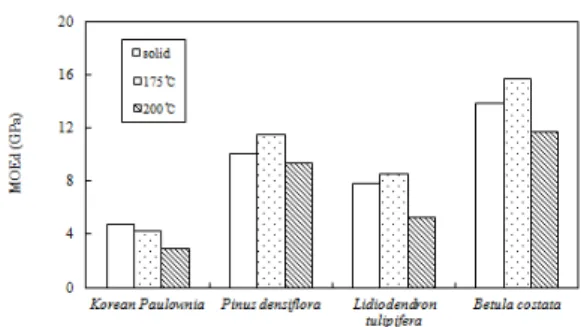
Table 1 and Fig. 3 shows the dynamic mod- ulus of elasticity (MOEd) value of each species after heat treatment. Before and after heat treat- ment, the MOEd was measured lower at the 200°C than 175°C.

The MOEd of heat-treated Betula costata,

Lidiodendron tulipifera, Pinus densiflora and

Korean paulownia decreased at temperature of

200°C more than those at 175°C. This deterio-

(5)

Temperature Parameter Regression model

Correlation coefficient

r

175°C

Density vs. MOR y = 1814.x - 139.5 r = 0.929**

Density vs. MOEs y = 16444x + 24181 r = 0.854**

Density vs. MOEd y = 278267x - 24447 r = 0.957**

MOEs vs. MOR y = 0.007x - 87.47 r = 0.768**

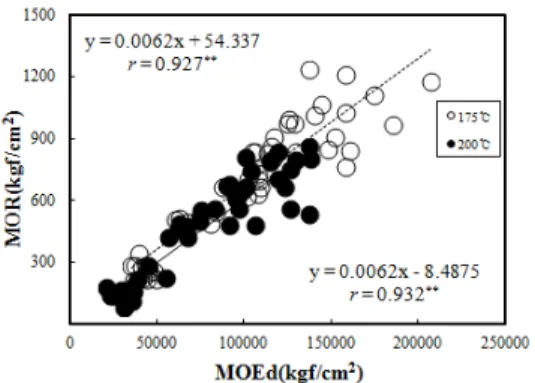
MOEd vs. MOR y = 0.0062x + 54.337 r = 0.927**

MOEs vs. MOEd y = 0.1325x + 11517 r = 0.727**

200°C

Density vs. MOR y = 1570.x - 173.9 r = 0.875**

Density vs. MOEs y = 23033x + 12301 r = 0.843**

Density vs. MOEd y = 252121x - 26133 r = 0.933**

MOEs vs. MOR y = 0.004x - 32.64 r = 0.708**

MOEd vs. MOR y = 0.0062x – 8.4875 r = 0.932**

MOEs vs. MOEd y = 0.2302x + 9952 r = 0.820**

Table 2. Summary of regression parameters for relationships between density, MOR, RF, MOEs, and MOEd for species after heat treatment

Fig. 3. Dynamic modulus of elasticity of heat-treated woods.

ration might be explained as due to hemi- cellulose degradation. Kocaefe et al (2010) re- ported that there is a significant change in hard- ness due to heat treatment. The hardness of heat-treated jack pine generally were deterio- rated at temperatures higher than 200°C com- pared to those of untreated jack pine.

3.4. Relationships Between Density, MOEs, MOEd and MOR for all Species After Heat Treatment.

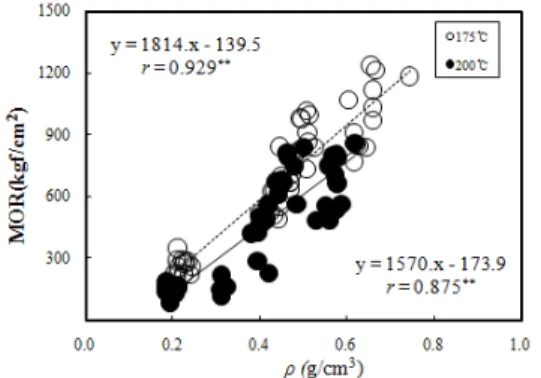
Least squares regression analysis method has been used in the field of wood properties, be- cause mechanical properties of wood are line- arly related (Bodig & Jayne, 1982; Bucur, 1995). Regression parameters are presented in Table 2. Fig. 4 ~6 show relationships between density, static MOEs, dynamic MOEd and MOR.

The correlation coefficients for density-MOR,

density-static MOE, density-dynamic MOE for

heat treated woods were 0.929, 0.854, 0.935 at

the 175°C and 0.875, 0.843, 0.928 at the

200°C. The results showed that correlation co-

efficient of density to MOEd of heat treated

woods was much higher than the others. Hong

(6)

Fig. 4. Relation of density to bending MOR of heat- treated woods.

Fig. 5. Relation of bending MOEs to MOR of heat- treated woods.

(1985) reported that the correlation coefficient values of density versus dynamic MOEd rela- tionship for normal wood and compression wood in Pinus densiflora were very high values of 0.896 and 0.688. Ross & Pellerin (1991) re- ported that close correlation between MOE

d

and MOEs for clear solid wood by stress wave mode.

Correlation coefficients for static MOE - MOR, dynamic MOE - MOR for heat treated woods were 0.708, 0.927 at the 175°C and 0.708, 0.932 at the 200°C. The correlation co- efficient of dynamic MOE and MOR of heat-treated woods was much higher than the static MOE and MOR.

3.5. Relationship Between Density and Mechanical Properties

Regression parameters are presented in shows the relation of density to MOR of heat treated woods. The correlation coefficients for the re- gression bending density to MOR were 0.929 at the 175°C and 0.875 at the 200°C. Both corre- lation coefficients were very high and sig- nificant at the 1% level, and there were a sim- ilar correlations between 175°C and 200°C.

3.6. Relationship Between Static MOE and Mechanical Properties

Fig. 5 shows the relation of bending MOEs to MOR of heat treated woods. The correlation coefficients for the regression bending MOEs to MOR were 0.768 at the 175°C and 0.708 at the 200°C. Both were significant at the 1% level, and there were a similar correlations between 175°C and 200°C. Byeon et al (2005) reported that a high correlation coefficient between bend- ing MOE and MOR of finger-jointed wood were similar to this results (significant at the 1% level). And Nakai (1984) also reported that solid Japanese cedar showed a high correlation coefficient (0.69 ~0.78) between bending MOE and MOR.

3.7. Relationship Between Dynamic MOE and Mechanical Properties

Fig. 6 shows the relation of bending MOEd

to MOR of heat treated woods. The correlation

coefficients for the regression bending MOEd to

MOR were 0.927 at the 175°C and 0.932 at the

200°C. Both were significant at the 1% level,

and there were a similar correlations between

175°C and 200°C. The correlation coefficient

was higher in dynamic modulus of elasticity to

(7)

Fig. 6. Relation of bending MOEd to MOR of heat treated woods.

MOR than those in static modulus of elasticity to MOR and density to MOR. Therefore, the dynamic modulus of elasticity using impact hammer mode is more useful as a non- destructive evaluation method for predicting the MOR.

4. CONCLUSIONS

Nondestructive testing method using resonance frequency by impact hammer and force trans- ducer mode was carried for heat-treated wood.

The MOR of heat-treated Betula costata, Lidiodendron tulipifera, Pinus densiflora and Korean paulownia decreased at temperature of 200°C more than those at 175°C.

After heat treatment, the dynamic MOE was lower at 200°C than that at 175°C.

Also, close correlations were found between dynamic modulus of elasticity and static bend- ing modulus of elasticity and between dynamic modulus of elasticity and MOR and between static bending modulus of elasticity and MOR.

And, a high correlation and 1% level of sig- nificance were observed in all conditions be- tween bending MOE and MOR.

The correlation coefficient is higher in dy- namic modulus of elasticity to MOR than those

in static modulus of elasticity to MOR and in density to MOR.

Therefore, the dynamic modulus of elasticity using resonance frequency by impact hammer and force transducer mode is useful as a non- destructive evaluation method for predicting the MOR of heat-treated wood.

ACKNOWLEDGEMENT

This study was carried out with the support of ‘Research center for ecological restoration in damaged land (Project No. S211213L020000)’

provided by Korea Forest Service.

REFERENCES

1. Bodig, J. and B. A. Jayne. 1982. Mechanics of Wood and Wood Composites. Van Nostrand Reinhold company. New York. pp. 247 ~269, 645~650.

2. Bucur, V. 1995. Acoustics of Wood. CRC Press, Boca Ration, Fla. pp. 105 ~106.

3. Byeon H.-S. and B.-H. Hong. 1997. The dynam- ic mechanical properties of Agathis Alba used for piano soundboards. J. of Korean Society of furniture technology 8(1/2): 9 ~16.

4. Byeon, H. S., H. M. Park, and F. Lam. 2005.

Nondestructive evaluation of strength perform- ance for finger-jointed wood using flexural vi- bration techniques. Forestry Products Journal 55(10): 37 ~42.

5. Byeon, H. S., K. R. Won, T. H. Kim, K. K.

Hwang, S. H. Chong, and N. E. Hong. 2012.

Effect of heat treatment on the bending strength and hardness of wood. Mokchae Konghak 40(5):

303 ~310.

6. Esteves, B., A. V. Marques, I. Domingos, and H.

Pereira. 2007. Influence of steam heating on the properties of pine (Pinus Pinaster) and eucalypt (Eucalypus globulus) wood. Wood Sci Technol 41(3): 193 ~207.

7. Gehards, C. C. 1974. Stress wave speed and

MOE of sweetgum ranging from 150 to 15 per-

cent MC. Forest Prod. J. 25(4): 51 ~57.

(8)

8. Hong B.-H. 1985. The dynamic mechanical properties of Paulownia coreana used for sound- ing boards. Mokchae Konghak 13(3): 34 ~40.

9. Hong B.-H. and H.-S. Byeon. 1995. Dynamic MOE and Internal Friction of Compression Woods in Pinus densiflora. Mokchae Konghak 23: 32 ~36.

10. Kocaefe D, S. Poncsak and Y. Boluk. 2008.

Effect of thermal treatment on the chemical com- position and mechanical properties of birch and aspen. Bioresources 3(2): 517 ~537.

11. Kocaefe D, S. Poncsak and J. Tang. 2010. Effect of heat treatment on the mechanical properties of North American jack pine: thermogravimetric study. J Mater Sic. 45: 681 ~687.

12. Nakai, T. 1984. Full size bending strength of su-

gi timber. Wood industry 39(11): 42 ~46.

13. Park H.-M. and H.-S. Byeon. 2006. Measurement of dynamic MOE of 3-ply woods by flexural vi- bration and comparison with bending strength and creep performances. Mokchae Konghak 34(2):

46 ~57.

14. Ross, R. J. and R. F. Pellerin. 1991. NDE of green material with stress waves: Preliminary re- sults rosing dimension lumber. Forest Prod. J.

41(6): 57 ~59.

15. Ross, R. J., J. C. Ward, and A. Tenwolde. 1994.

Stress wave nondestructive evaluation of wet wood. Forest Prod. J. 44(7/B): 79 ~83.

16. Sobue, N., H. Nakano, and I. Asano, 1984.

Vibrational properties of spruce plywood for mu-

sical instruments. Mokuzai gakkaishi 31(1): 93 ~97.

수치

Fig. 1. Schematic diagram of impact hammer vibration mode.
Table 1. The properties of each species according to the heat treatmentexcitation and transmit it to a signal analyzer
Fig. 2. Resonance frequency of heat-treated woods.
Table 2. Summary of regression parameters for relationships between density, MOR, RF, MOEs,  and MOEd for species after heat treatment
+3

참조

관련 문서

Also, the design of an optimal heat sink requires a complete knowledge of all heat transfer characteristics between the heat source and the ambient air

For patients treated for chin augmentation using either genioplasty with Medpor Ⓡ or osteotomy, the predictive value of the correlation of the hard and

In this study, therefore, the method for measuring residual stresses using ESPI technique that is one of the laser applied measurement technique excellent in the view

A Study on Heat Dissipation Design and Performance Evaluation of Lithium-ion Battery Pack for Automated Logistics Robot Using Infrared Thermal Imaging

Three-Dimensional heat conduction analysis on dissimilar joint by TIG Assisted FSW (TAFSW) is carried out using an analytical model to determine the thermal histories

S., An Experimental Study on the Cooling and Heating Performance of a Residential Ground Source Heat Pump System, Korean Journal of Air-Conditioning

Null hypotheses of this study was there is no difference in root canal length determination between conventional and heat-treated Ni-Ti files by 2

The average tensile strength value before heat treatment of PLA output was 9.67 N/㎟, and the average tensile strength value after heat treatment was 24.17 N/㎟, which