복숭아 유과 씨 추출물을 이용한 화장품 소재 개발에 관한 연구
김다미1․김경희1․김영식2․고종호3․이경행4․육홍선1†
1
충남대학교 식품영양학과,
2상명대학교 식물식품공학과
3
한국폴리텍바이오대학 바이오식품분석과,
4충주대학교 식품영양학과
A Study on the Development of Cosmetic Materials Using Unripe Peaches Seed Extracts
Da-Mi Kim1, Kyoung-Hee Kim1, Young Shik Kim2, Jong-Ho Koh3, Kyong-Haeng Lee4, and Hong-Sun Yook1†
1Dept. of Food and Nutrition, Chungnam National University, Daejeon 305-764, Korea
2Dept. of Plant and Food Science, Sangmyung University, Chungnam 330-720, Korea
3Dept. of Bio-Food Analysis, Korea Bio-Polytechnic College, Chungnam 320-905, Korea
4Dept. of Food Science and Nutrition, Chungju National University, Chungbuk 368-701, Korea
Abstract
Various unripe peach (Prunus persica L. Batsch) seeds, which were picked on late May, were subjected to 80% methanol extracts to investigate the antioxidant activities, whitening effects, and anti-wrinkle activities.
The yield of 6 cultivars (Takinosawa Gold, Kawanakawase Hakuto, Madoka, Yumefuji, Nagasawa Hakuho, and Hong Bak) from unripe peaches were the highest on Yumefuji, followed by Madoka, Kawanakawase Hakuto, Takinosawa Gold, Hong Bak, and Nagasawa Hakuho (6.16%, 6.08%, 5.65%, 5.25%, 5.23%, and 5.20%). The content of the total polyphenol of seed extracts ranged from 18.33 to 27.08 mg/g. The antioxidant in vitro assays including the DPPH and ABTS radical scavenging activities were the highest with Hong Bak and Kawanakawase Hakuto. The tyrosinase inhibition activity greatly affected the Takinosawa Gold and Kawanakawase Hakuto.
Compared to the elastase inhibition activity of 6 cultivars, Madoka was higher than others, while the lowest was Hong Bak. The significant correlation coefficient values were determined (more than p=0.05) between the yield, total polyphenol content, antioxidant activities, tyrosinase inhibition, and elastase inhibition activities.
The results suggested that the total polyphenol content has a high positive value on the DPPH, ABTS radical scavenging activity, and tyrosinase inhibition activity. Also, the tyrosinase inhibition activity and elastase in- hibition activity showed a significant correlation (r=+0.594). The ABTS inhibition activity and tyrosinase in- hibition activity that is the most suitable character represented significant positive correlation (r=+0.846). This data suggested that the methanol extracts from these unripe peaches could be potential candidates for natural cosmetics.
Key words: Korean unripe peaches, total polyphenolic compounds content, antioxidant activities, tyrosinase inhibition activities, correlation analysis
†
Corresponding author. E-mail: [email protected]
†
Phone: 82-42-821-6840, Fax: 82-42-821-8887
서 론
최근 여성의 사회진출 증가, 고학력화, 생활패턴의 변화에 따라 화장품에 대한 욕구도 단순히 아름답게 꾸미는 용도를 넘어서서 고급화, 다양화되는 추세이며 점차 기능적 측면이 강조된 화장품의 수요가 증가되고 있다. 현재 기존의 화장품 에 사용되고 있는 합성물질들은 피부의 알레르기를 일으키거 나 사람에 따라 유해한 영향을 미칠 수 있으므로 인체에 무해 한 천연물질 소재에 관한 연구가 활발히 진행 중에 있다(1).
알칼리성 식품인 복숭아(
Prunus persicaL. Batsch)는 복 사나무의 열매로서 주성분이 수분과 당분이며, tartaric acid,
malic acid, citric acid 등의 organic acid와 pectin 등이 풍부 한 과실이다. 그러나 복숭아 유과는 4월 초부터 5월 초순까 지 한 가지에 한 개씩만 남도록 적과하며 적과된 복숭아 유 과는 모두 폐기시키고 있는 상황이다(2).
생체 내에서 필요한 에너지 공급을 위해 생화학적 산화반
응은 계속적으로 일어나는데 이 과정에서 발생하는 것이 유
해산소라 불리는 활성산소이다. 각종 성인병 및 노화의 원인
이 활성산소에 기인된 것이라는 학설이 점차적으로 인정됨
에 따라 활성산소를 조절하는 인자로 알려진 항산화제의 개
발이 활발하게 진행되어 많은 항산화제의 개발 연구가 보고
되어 있다(3).
멜라닌은 기저층에 존재하는 색소 세포인 멜라노사이트 에서 합성되는 검은 색소로 외부 환경으로부터 피부를 보호 해주는 역할을 하는 단백질이다. 그러나 피부 노화나 자외선 노출로 멜라닌의 과잉생성은 기미, 주근깨를 형성하고 나아 가 피부암을 유발하는 것으로 알려져 있다(4). 멜라닌 합성 과정의 주요 효소인 tyrosinase는 L-tyrosine이 L-3,4-di- hydroxy-L-phenylalanine(DOPA)가 합성되는 단계와 L- DOPA로부터 DOPAquinone이 합성되는 단계를 촉진하여 멜라닌 합성을 촉진한다(5). 기존에 피부 미백제로 사용된 감초 추출물, 상백피 추출물 등이 tyrosinase의 작용을 저해 하여 미백 기능을 나타낸다고 알려져 있다(6,7).
노화의 대표적인 현상으로서 가장 두드러진 특징은 주름 이 형성되는 것이며 자외선을 가장 큰 요인으로 보고 있다 (8-10). 자외선으로 인한 피부 노화 및 주름을 방지하기 위하 여 자외선 차단제를 바르는 방법이 있지만, 피부노화를 저해 하거나 노화된 피부를 개선시키기 위한 물질개발 연구가 지 속되고 있다(11). Vitamin A, C, E 등과 AHA(α-hydroxy acids)는 노화된 피부를 개선해주는 대표적인 물질이며, 이 를 포함하여 주름개선 화장품도 활발히 개발, 연구 중에 있 다(12-14).
복숭아 적과 시 발생하는 유과는 이를 활용한 제품 가공방 법이 없어 식량자원의 손실이 일어나고 있으며 복숭아 유과 에 관한 연구 또한 미비한 실정이다. 따라서 본 연구는 복숭 아 적과 시 발생하여 전량 폐기되는 복숭아 유과의 활용증진 을 위한 연구의 일환으로 복숭아 유과 씨를 이용한 화장품 소재로서의 가능성을 평가하였다.
재료 및 방법
실험재료 및 추출
본 실험에 사용된 복숭아 유과는 충남 연기군 조치원읍 일원에서 2011년 5월 하순에 적과한 것을 이용하였으며, 용 택골드(Takinosawa Gold), 천중도백도(Kawanakawase Hakuto), 마도카(Madoka), 몽부사(Yumefuji), 장택백봉 (Nagasawa Hakuho), 홍백(Hong Bak) 총 6 품종을 사용하 였다. 시료는 1% Na
2HCO
3로 수세하여 털을 제거 후 씨만 실험에 사용하였으며, 시료 100 g당 10배량(w/v)의 80%
methanol로 24시간 동안 3회 반복 추출한 다음, 추출액은 여과지(Whatman No. 4, Maidstone, England)로 여과하였 다. 여액을 40
oC 수욕상에서 회전식 감압농축기(Eyela A-1000S, Tokyo Rikakikai Co., Tokyo, Japan)로 용매를 제거하고 감압․농축한 후 동결건조(SFDSM12-60Hz, Samwon Freezing Engineering Co., Seoul, Korea)하여 분 말화하여 밀봉 냉동 보관하면서 시료로 사용하였다.
Total polyphenol content
총 폴리페놀의 함량은 분석방법으로 널리 사용되고 있는 Folins-Denis 방법(15)으로 측정하였으며, 제조된 추출액을
80% methanol로 희석하여 사용하였다. 희석액 0.2 mL에 Folin reagent 0.2 mL를 가하고 3분간 정치한 후 3 mL의 10% Na
2CO
3용액을 가한 뒤 1시간 반응하였다. 반응이 끝난 용액은 분광광도계를 사용하여 765 nm에서 흡광도를 측정 하였다. 시료의 총 폴리페놀 함량은 gallic acid로 표준곡선 을 작성한 표준 검량식에 적용하여 구하였다(16).
DPPH radical scavenging activity
자유라디칼 소거활성 실험은 안정한 자유라디칼 2,2-di- phenyl-1-picrylhydrazyl(DPPH)을 사용하는 방법으로 60 μ M DPPH 용액 3.9 mL에 80% methanol에 농도별로 희석시 킨 시료 0.1 mL를 혼합하였다. 암실에서 30분 동안 반응시킨 후 UV/Vis-spectrophotometer(Shimadzu UV-1800, Shimadzu Co., Kyoto, Japan)로 517 nm에서 흡광도를 측정 하였다. 대조군은 시료액 대신 80% methanol을 넣었으며, DPPH 용액 대신 methanol을 넣어 보정 값을 얻었다. 아래 의 식을 이용하여 각 시료의 농도 별 free radical scavenging activity 곡선을 그린 뒤, 50%의 DPPH free radical scav- enging activity(DPPH IC
50)를 나타내는 값을 구하였다.
DPPH radical scavenging activity (%)=
( 1- absorbance of sample absorbance of control ) × 100
ABTS radical scavenging activity
7 mM의 ABTS diammonium salt를 증류수에 용해시켜 만든 용액 5 mL에 140 mM potassium superoxide 용액 88 μ L을 섞었다. 20
oC의 암소에서 12시간 동안 방치한 뒤, 에탄 올로 희석하여 734 nm에서 용액의 흡광도 값이 0.700±0.02 가 되도록 만들었다. 이 용액 1 mL와 농도별로 희석한 용액 50 μL을 3분 동안 반응시켜 734 nm에서 UV/Vis-spec- trophotometer(Shimadzu UV-1800)를 사용하여 흡광도를 측정하였다. 다음의 식을 이용하여 각 시료의 농도 별 free radical scavenging activity 곡선을 그린 뒤, 50%의 ABTS free radical scavenging activity(ABTS IC
50)를 나타내는 값 을 구하였다. 복숭아 유과의 ABTS radical 소거능은 다음의 식에 따라 계산하였다(17).
ABTS radical scavenging activity (%)=
( 1- Absorbance of sample Absorbance of control ) × 100
Tyrosinase inhibition activity
Tyrosinase 저해능은 tyrosinase의 작용 결과 생성되는
dopachrome을 비색법을 이용하여 측정하였다(18). Sigma
사(St. Louis, MO, USA)에서 구입한 효소액(mushroom ty-
rosinase, 100 unit/mL)을 0.1 mL, 기질로서 10 mM L-
DOPA(dihydroxyphenylalanine) 0.2 mL, 0.1 M potassium
phosphate buffer(pH 6.8) 0.5 mL의 혼합액에 시료 0.2 mL을
첨가한 후 37
oC에서 15분간 반응시켜 475 nm에서 측정하고
dopachrome의 변화를 저해능으로 환산하였다. Tyrosinase
Table 1. Changes in yields of unripe peaches seed according to cultivars
Cultivars Yields (%)
Takinosawa Gold Kawanakawase Hakuto Madoka
Yumefuji
Nagasawa Hakuho Hong Bak
5.25±0.25
1)b2)5.65±0.65
ab6.08±0.08
a6.16±0.16
a5.20±0.20
b5.23±0.21
b1)
Mean±SD (n=3).
2)
Different letters (a,b) within a same column differ significantly (p<0.05).
Table 2. Total polyphenol content of unripe peaches seed ac- cording to cultivars
Cultivars Total polyphenol content (mg/g) Takinosawa Gold
Kawanakawase Hakuto Madoka
Yumefuji
Nagasawa Hakuho Hong Bak
20.49±0.06
1)b2)27.08±0.01
a20.18±0.03
b20.61±0.02
b19.97±0.05
b18.33±0.04
b1)
Mean±SD (n=3).
2)
Different letters (a,b) within a same column differ significantly (p<0.05).
저해능은 다음의 환산식에 의하여 계산되었다.
Tyrosinase inhibition ability (%)= ( 1- A-B C ) × 100
A: Absorbance at 475 nm determined with sample B: Absorbance at 475 nm determined with buffer instead
of enzyme
C: Absorbance at 475 nm determined with buffer instead of sample
Elastase inhibition activity
0.2 M Tris-HCl(pH 8.0) buffer 700 μL에 기질인 3.2 mM N-succinyl-(Ala)
3-
p- nitroanilide 250 μL와 측정시료용액 40 μL을 첨가한 뒤 5 μg/mL Porcine Pancreatic Elastase (PPE) 효소용액 10 μL을 가하여 37
oC에서 20분 동안 반응시 킨 후
p-nitroaniline의 생성량을 410 nm에서 흡광도를 측정 하였다. Elastase 저해 활성은 시료용액의 첨가구와 무첨가 구의 흡광도 감소율을 백분율(%)로 나타내었다.
Elastase inhibition ability (%)= ( 1- A-B C ) × 100
A: Absorbance at 410 nm determined with sample B: Absorbance at 410 nm determined with 0.2 M Tris-
HCl buffer instead of enzyme
C: Absorbance at 410 nm determined with 0.2 M Tris- HCl buffer instead of sample
통계처리
통계처리는 SPSS Statistics 18.0 Network Version(on release 18.0.1 of PASW Statistics, SPSS Inc., Chicago, IL, USA) software를 이용하여 분산분석을 실시하였다. 유의적 차이가 있을 경우 다중비교분석법인 Duncan's multiple range test를 이용하여 p<0.05 수준에서 유의차 검정을 실시 하였으며, 요인간의 상관관계를 Pearson 상관계수(Pearson correlation coefficient)로 조사하였다.
결과 및 고찰
복숭아 유과 씨의 추출수율
산업적 측면에서 볼 때 천연물의 추출수율 증가는 부가 가치적 측면에서 매우 중요한 요소이다(19). 본 연구에서는 품종별 복숭아 유과 씨에 따른 80% methanol 추출수율에 관하여 알아보았으며, 추출수율은 Table 1에 나타내었다. 품 종별 복숭아 유과 씨의 추출수율을 관찰한 결과, 몽부사, 마 도카, 천중도백도, 용택골드, 홍백, 장택백봉 순으로 각각 6.16, 6.08, 5.65, 5.25, 5.23, 5.20%의 수율을 갖는 것으로 관찰 되었다.
Total polyphenol content
본 실험에서 gallic acid 검량곡선을 작성하여 복숭아 유과 씨 추출물의 폴리페놀 함량을 측정한 결과는 Table 2에 나타
내었다. 복숭아 유과 씨의 품종별로 보면 천중도백도 추출물 에서 27.08 mg/g로 비교적 높은 폴리페놀 함량이 존재하는 것으로 나타났으며, 홍백 추출물에서는 18.33 mg/g로 복숭 아 품종별로 유의적 차이를 나타내었다. Yu 등(20)의 실험에 서 생대추 씨 추출물의 총 폴리페놀 함량이 138.99 mg/g이 라는 결과와 비교하면 복숭아 유과 씨의 폴리페놀 화합물의 함량이 대체적으로 낮았으나, Lee 등(21)의 연구 결과, 물과 에탄올을 용매로 사용한 완숙 탱자 씨 추출물에서 각각 17.90 mg/g, 19.44 mg/g로 복숭아 유과 씨의 폴리페놀 화합 물의 함량이 높음을 알 수 있었다.
복숭아 유과 씨의 항산화능
복숭아 유과 씨의 DPPH 및 ABTS radical 소거능을 측정 한 결과는 Table 3과 같다. DPPH radical 소거능은 ABTS radical 소거능과 상관관계가 높은데, DPPH는 free radical 이며 ABTS는 cation radical이라는 점에서 차이가 있다(22).
품종별 복숭아 유과 씨의 DPPH radical 소거능의 IC
50값을 dry basis로 산출한 결과 홍백, 천중도백도, 용택골드, 몽부 사, 마도카, 장택백봉 순으로 각각 4.04, 4.20, 4.91, 5.06, 5.20, 5.30 mg/mL로 나타났으며, 본 실험에서 양성대조군으로 사 용한 vitamin C는 10.43 μg/mL에서 IC
50값을 보여주었다.
가장 DPPH radical 소거능이 좋은 시료는 홍백으로, 4.04
mg/mL의 IC
50값을 갖는 것으로 나타났다. 대체적으로 품종
별에 따른 큰 차이가 없이 비슷한 DPPH radical 소거능을
가지고 있는 것으로 판단된다. Yoo 등(23)이 보고한 바에
따르면 살구 씨 및 살구과육 추출물에서 항산화효과가 있음
을 나타내었으며, 비파의 부위별 항산화 활성을 연구한 결과
Table 3. DPPH radical scavenging activity and ABTS radical scavenging activity of unripe peaches seed according to cul- tivars
Cultivars
DPPH radical scavenging activity IC
50(mg/mL)
1)ABTS radical scavenging activity IC
50(mg/mL) Takinosawa Gold
Kawanakawase Hakuto Madoka
Yumefuji
Nagasawa Hakuho Hong Bak
4.91±0.16
2)a3)4.20±0.28
b5.20±0.09
a5.06±0.23
a5.30±0.25
a4.04±0.19
b1.12±0.02
c1.05±0.04
c1.45±0.01
a1.24±0.04
b1.39±0.05
a1.31±0.01
b1)
Inhibitory activity was expressed as the mean of 50% in- hibitory concentration of triplicate determines, obtained by in- terpolation of concentration inhibition curve.
2)
Mean±SD (n=3).
3)
Different letters (a-c) within a same colume differ signifi- cantly (p<0.05).
Table 4. Tyrosinase inhibition activity of unripe peaches seed according to cultivars
Cultivars Tyrosinase inhibition activity (%) Takinosawa Gold
Kawanakawase Hakuto Madoka
Yumefuji
Nagasawa Hakuho Hong Bak
29.23±0.33
1)a2)29.17±0.24
a24.11±0.16
b18.30±0.43
c17.18±0.25
d9.31±0.43
e1)
Mean±SD (n=3).
2)
Different letters (a-e) within a same colume differ signifi- cantly (p<0.05).
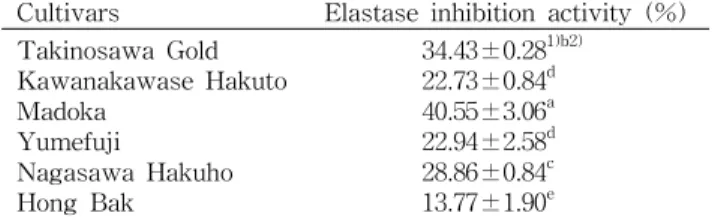
Table 5. Elastase inhibition activity of unripe peaches seed according to cultivars
Cultivars Elastase inhibition activity (%) Takinosawa Gold
Kawanakawase Hakuto Madoka
Yumefuji
Nagasawa Hakuho Hong Bak
34.43±0.28
1)b2)22.73±0.84
d40.55±3.06
a22.94±2.58
d28.86±0.84
c13.77±1.90
e1)
Mean±SD (n=3).
2)
Different letters (a-e) within a same colume differ signifi- cantly (p<0.05).
(24)에서는 MeOH 추출물에서 종자가 60% 이상의 높은 항 산화능을 보이며 잎 및 과실에 비해 높은 활성을 나타냈다.
Hwang 등(25)의 포도 씨의 항산화 활성 연구에서는 실험에 사용한 표준물질인 100 μM gallic acid, trolox에 비해 포도 씨 추출물의 DPPH radical 소거능이 더 높게 나온바가 있다.
복숭아 유과 씨의 ABTS radical 소거능의 IC
50값을 dry basis로 산출한 결과 품종에 따라 1.05~1.45 mg/mL로 나타 났으며, 본 실험에서 양성대조군으로 사용한 vitamin C의 IC
50값은 50.79 μg/mL이었다. ABTS radical 소거능이 가장 높은 시료는 천중도로, 1.05 mg/mL의 IC
50값을 갖는 것으로 나타났다. 복숭아 유과 씨 추출물의 ABTS radical 소거활성 은 DPPH radical 소거활성에서보다 저농도에서도 높은 활 성을 보여주는 것으로 나타났다.
총 페놀함량과 DPPH radical 소거활성과의 상관관계를 분석한 결과 상관계수가 0.670(p<0.05)으로 비교적 높은 상 관관계를 보였다. 이 결과는 총 페놀함량과 항산화활성과의 상관관계가 있다는 Ji 등(26)의 연구결과와 관련이 있으며, Jeong 등(27)은 감귤의 원적외선 처리에 의한 총 페놀함량의 증가가 DPPH 라디칼 소거능의 증가에 영향을 미친다고 보 고하였다. Pyo 등(28) 역시 free radical 소거능 증가에 폴리 페놀 함량이 중요한 역할을 한다고 보고하였다.
Tyrosinase inhibition activity
Tyrosinase는 피부 기저층에 있는 melanocyte의 mela- nosome에서 tyrosine 혹은 DOPA를 기질로 하여 피부의 색 소 성분인 melanin을 생합성 하는데 있어서 key enzyme으 로 작용하는 효소이다(29). 따라서 tyrosinase 효소활성을 저해하거나 중간체들의 산화반응이 저해됨으로써 멜라닌 색소가 감소된다(30).
본 연구에서는 tyrosinase 효소의 작용 저해 효과를 나타 내는 대표적인 물질인 kojic acid를 사용하여 비교하였으며, 복숭아 유과 씨의 tyrosinase 활성 저해효과는 Table 4와 같다. 양성 대조군인 kojic acid는 1 mg/mL의 농도에서 약
95.95%로 높은 저해율을 나타낸 것을 확인할 수 있다. 품종 별 복숭아 추출물에서는 20 mg/mL의 농도로 용택골드, 천 중도백도, 마도카, 몽부사, 장택백봉, 홍백 순으로 29.23, 29.17, 24.11, 18.30, 17.18, 9.31%로 나타났다. Han 등(31)은 농도 1 mg/mL의 포도 씨 methanol 분획 추출물에서 약 18%
의 tyrosinase 활성을 나타내었다고 보고하였으며, Lee 등 (32)의 완숙된 탱자 씨의 tyrosinase의 저해효과에서 물 추 출물에서는 tyrosinase를 저해하는 효과가 없었으나 에탄올 추출물에서는 2 mg/mL의 농도에서 12.96%가 나타났다.
Elastase inhibition activity
세포외기질의 주요 구성 성분인 collagen은 피부의 섬유 아세포에서 생성되는 주요 기질 단백질로 피부, 건(tendon), 뼈 및 치아의 유기 물질의 대부분을 형성하고 피부의 기계적 견고성, 세포 접착의 지탱, 세포 분할과 분화의 유도, 결합 조직의 저항력과 조직의 결합력 등의 다양한 기능을 가지고 있다. 이러한 collagen은 피부의 주름 형성과 관련이 있어 collagen이 부족할 경우 주름이 유발된다(33).
본 연구에서는 elastase 효소의 작용 저해 효과를 나타내
는 대표적인 물질인 vitamin C를 사용하여 비교하였고, 복숭
아 유과 씨의 elastase 활성 저해효과는 Table 5에서 보는바
와 같다. 양성 대조군인 vitamin C가 0.1 mg/mL의 농도에서
약 20.68%를 나타냈으며, 품종별 복숭아 유과 씨 추출물에
서는 5 mg/mL의 농도에서 유의차를 보이며 마도카, 용택골
드, 장택백봉, 몽부사, 천중도백도, 홍백 순으로 40.55, 34.43,
28.86, 22.94, 22.73, 13.77%의 저해능을 보였다. Park과 Kim
(34)의 오배자의 elastase 활성저해 연구 결과에서는 농도
Table 6. Correlation coefficients among extraction yield, total polyphenol, DPPH, ABTS radical scavenging activity, tyrosinase inhibition activity and elastase inhibition activity of unripe peaches seed according to cultivars
Factor Total polyphenol DPPH ABTS Tyrosinase inhibition Elastase inhibition Yield
Total polyphenol DPPH ABTS
Tyrosinase inhibition
+0.172
-
- -
-
+0.264 +0.670
*- -
-
+0.147 +0.522 +0.144
- -
+0.162 +0.636
*+0.195 +0.846
***-
+0.241 -0.020 -0.547 +0.414 +0.594
**
p<0.05,
***p<0.001.
1 mg/mL에서 52.42%의 저해능을 보였으며, Jung과 Kim (35)이 보고한 자료에서는 농도 1 mg/mL에서 황기, 자초, 지실의 elastase 활성저해능이 각각 3.73%, 8.73% 15.59%를 나타냈다. 오배자의 elastase 저해능보다는 다소 떨어지지 만, 황기, 자초, 지실 등의 한약재보다는 높은 것으로 나타났 다. 이에 따라 복숭아 유과 씨 추출물을 첨가한 화장품의 제조는 피부 각질층의 elastin을 분해하여 피부의 탄력성을 소실시켜 피부의 노화를 야기하는 elastase의 작용을 저해함 으로써 이와 관련한 피부 개선 능력을 가질 것으로 생각된 다. 따라서 화장품 소재로서의 이용뿐만 아니라 복숭아 유과 씨 추출물을 이용한 항산화 건강 기능성 식품의 소재로도 유용하게 활용될 수 있을 것으로 기대된다.
복숭아 유과 품종별 항산화능, 총 폴리페놀 함량, ty- rosinase 및 elastase 활성과의 상관관계
추출수율과 활성들 간의 상관관계를 분석한 결과 양의 상 관관계를 보였으나 유의성이 없는 것으로 나타났으며, 항산 화능, 총 폴리페놀 함량, tyrosinase 저해활성 및 elastase 저해활성과의 상관관계는 Table 6과 같이 대체로 양의 상관 관계를 보이며 유의성이 있는 것으로 나타났다. 항산화성분 인 폴리페놀과 항산화활성 간의 상관관계에서는 매우 높은 양의 상관성을 보였으며, ABTS radical 소거활성과 ty- rosinase 저해활성과의 상관계수는 0.846(p<0.001)으로 전 체적으로 가장 높은 상관관계를 나타내었다. 총 폴리페놀 함량과 tyrosinase 저해활성과의 상관계수는 0.636(p<0.05) 으로 비교적 높은 상관관계를 보이는 것으로 나타났으며, tyrosinase 저해활성과 elastase 저해활성간의 상관계수도 0.594(p<0.05)로 비교적 높은 상관관계를 보였다.
요 약
본 연구에서는 복숭아 유과 씨의 품종에 따른 총 폴리페놀 함량과 항산화능, tyrosinase 저해활성 및 elastase 저해활성 을 알아보고자 하였으며 폴리페놀 화합물과 총 항산화력 과 의 상관관계를 비교․분석하고자 하였다. 품종별 복숭아 유 과씨의 추출수율을 관찰한 결과, 몽부사에서 가장 높게 나타 났으며, 5.20~6.16%의 수율을 갖는 것으로 관찰되었다. 총 폴리페놀 함량은 18.33~27.08 mg/g의 함량을 나타내었으 며, DPPH 및 ABTS radical 소거능에서 천중도의 radical 소거능이 가장 높게 나타났다. Tyrosinase 저해활성에서는
용택골드, 천중도백도에서 높은 tyrosinase 저해능을 보였으 나, elastase 저해활성에서는 마도카에서 다른 품종에 비해 유의적으로 높은 elastase 저해능을 보였다. 총 폴리페놀 함 량과 항산화활성과 높은 상관관계를 가졌으며 항산화능과 tyrosinase 저해활성 또한 비교적 높은 상관관계를 나타내었 다. 따라서 본 연구 결과에 따라 복숭아 유과 씨는 항노화, 미백, 주름방지로 화장품 산업에서 천연 물질로 잠재적인 기능성을 가지고 있을 것으로 사료된다.
문 헌