40(11), 1623~1630(2011) http://dx.doi.org/10.3746/jkfn.2011.40.11.1623
감귤과피분말 및 건 표고버섯을 첨가한 돈육 소시지의 관능적 특성
김정현
1
․최주락1
․김민영2†
1
제주관광대학 관광외식조리계열
2
제주대학교 생명자원과학대학 생명공학부
Sensory Characteristics of Pork Sausages with Added Citrus Peel and Dried Lentinus edodes Powders
Jung Hyon Kim
1
, Ju Rak Choi1
, and Min Young Kim2†
1
Dept. of Tourism & Food Service Cuisine, Cheju Tourism College, Jeju 690-791, Korea2
Faculty of Biotechnology, College of Applied Life Sciences, Jeju National University, Jeju 690-756, KoreaAbstract
The effects of addition of citrus peel powders (C 0, 0.5, 1 & 2%), dried Lentinus edodes powders (L 0, 0.5, 1 & 2%), and their combination (C-L) on the chemical, sensory and textural properties of pork sausages were studied. Addition of 0.5, 1 or 2% C, L, and C-L all significantly decreased moisture content, pH, and color a-values of sausage samples, whereas ash content and color b-value were increased (p<0.05). C, L, and C-L did not affect protein, fat, carbohydrates contents or texture characteristics. Sensory evaluation was performed by multivariate data analysis, namely principal component analysis (PCA). Eighty-two percent total variation was observed in the main structured information among the test groups: the first (PC1) and second (PC2) compo- nents of variation were 59 and 23%, respectively. Eight parameters (sweet flavor, pork aroma, bitterness, rancid- ity, salty flavor, color, sour flavor and citrus aroma) were utilized to describe the main sensory characteristic of the sausages. Addition of 0.5, 1 & 2% citrus peel was obviously correlated with PC1 (salty flavor, sour flavor and citrus aroma, pork aroma, and sweet flavor and rancidity), whereas addition of 0.5 & 1% Lentinus edodes was related with PC2 (aroma and rancidity).
Key words: pork sausage, citrus peel, Lentinus edodes, sensory attributes, principal component analysis
†
Corresponding author. E-mail: [email protected]
†
Phone: 82-64-754-3349, Fax: 82-64-756-3351
서 론
표고버섯은 고대 이후 지속적으로 섭취하여 왔으며, 극동 아시아 지역에서 인기 있는 식용버섯 중의 하나이다. 건조된 표고버섯은 생 표고버섯에는 없는 특징적인 냄새를 가지고 있는 lenthionine에 의해 독특한 향기를 가지고 있다(1). 표 고버섯은 조리하기 위해 스팀에 찌거나 데쳐서 제공된다.
이때 사용되는 건조표고버섯은 건조과정에서 단백질을 아 미노산으로 분해하여 풍미 있는 감칠맛을 생성해 내어 많은 사람들이 생 표고버섯보다 좋아하고 있다. 최근에는 구미각 국에서 생산량이 증가되고 있으며 시장 경제적인 측면에서 관심이 되는 상품으로 인식되고 있다(2). 또한 항균 및 항산 화 물질로서 다양한 기능적 성질을 가지고 있으며 콜레스테 롤 수치를 낮출 수 있는 활성성분뿐만 아니라 항바이러스 및 항암 작용을 하는 생리활성 성분을 함유하고 있어 건강식 품으로 관심을 받고 있다(3-5). 이러한 생리적 기능성과 기 호성을 증가시키기 위해 표고버섯 분말을 이용한 선행 연구
로 국수, 파스타, 냉면, 어묵, 저지방소시지 등의 제품 개발이 보고되고 있다(6-10).
소시지의 지방 함량을 줄이기 위한 제품개발이 다양하게 시도되고 있는데, 프랑크푸르트 형태의 소시지에 citrus fiber를 지방 대체품으로 첨가함으로써 콜레스테롤의 함량 의 감소를 나타냈다고 보고하고 있으며(11), Spanish dry-fermented sausage지에 오렌지 fiber를 첨가함으로써 미생물의 성장을 억제시키고 잔류되어 있는 nitrite의 수준 을 낮출 수 있다고 보고하고 있다(12).
감귤껍질은 폴리페놀 성분이 풍부한 것으로 알려져 있으 며, 주요한 flavonoid로 hesperidin, narirutin, naringin과 eriocitrin 등이며 ascorbic acid 함량도 감귤껍질에 많이 함 유되어 있는 것으로 알려져 있다(13,14).
본 연구에서는 기호성을 맞춘 표고버섯과 감귤과피분말
을 첨가한 소시지의 배합비율을 선정하고 그 품질 특성을
측정하고자 하였다.
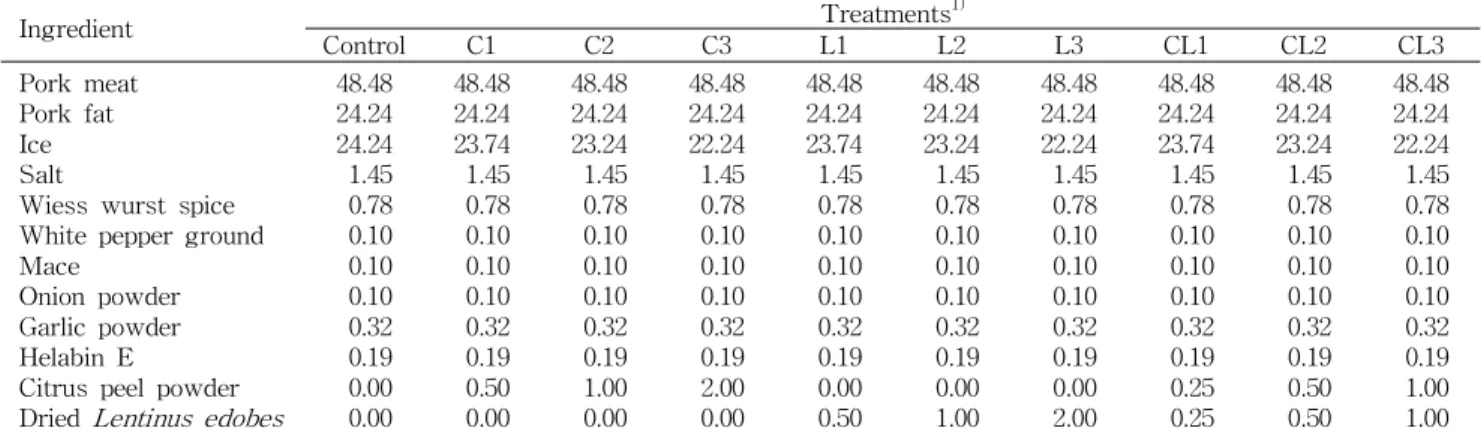
Table 1. Formula for sausages added to different citrus peel powder and dried Lentinus edodes (units: %)
Ingredient Treatments
1)Control C1 C2 C3 L1 L2 L3 CL1 CL2 CL3
Pork meat Pork fat Ice Salt
Wiess wurst spice White pepper ground Mace
Onion powder Garlic powder Helabin E
Citrus peel powder Dried Lentinus edobes
48.48 24.24 24.24 1.45 0.78 0.10 0.10 0.10 0.32 0.19 0.00 0.00
48.48 24.24 23.74 1.45 0.78 0.10 0.10 0.10 0.32 0.19 0.50 0.00
48.48 24.24 23.24 1.45 0.78 0.10 0.10 0.10 0.32 0.19 1.00 0.00
48.48 24.24 22.24 1.45 0.78 0.10 0.10 0.10 0.32 0.19 2.00 0.00
48.48 24.24 23.74 1.45 0.78 0.10 0.10 0.10 0.32 0.19 0.00 0.50
48.48 24.24 23.24 1.45 0.78 0.10 0.10 0.10 0.32 0.19 0.00 1.00
48.48 24.24 22.24 1.45 0.78 0.10 0.10 0.10 0.32 0.19 0.00 2.00
48.48 24.24 23.74 1.45 0.78 0.10 0.10 0.10 0.32 0.19 0.25 0.25
48.48 24.24 23.24 1.45 0.78 0.10 0.10 0.10 0.32 0.19 0.50 0.50
48.48 24.24 22.24 1.45 0.78 0.10 0.10 0.10 0.32 0.19 1.00 1.00
1)
Control: sausage without citrus peel powder and dried Lentinus edodes. C∼CL3 indicate contents of sausage with citrus peel powder and dried Lentinus edodes , respectively.
재료 및 방법
실험재료
돈정육과 돈지방육은 시중 대형마트에서 구입하였으며, 혼합제제 첨가물인 Wiess Wurst Spice(WWS)와 Helabin E는 독일 함부르크의 Gewurzwerk Hermann Laue에서 제 조된 것과 Ground White Pepper(WPG) 및 Ground mace는 미국 캘리포니아 Pacific spice company의 제품을 사용하였 다. 소금은 한주 청정소금, 마늘분말과 양파분말은 은진물산 (주)(경기, 한국)의 제품, 천연장은 우성미트프로(주)(서울, 한국)에서 구입한 양장(sheep casing, 직경 20~22 mm)을 사용하였다. 표고버섯(
Lentinus edobes)은 (영)대흘표고버 섯에서 생산된 제주산 건 표고버섯으로 24 hr 동안 찬물에 냉장하여 보관 후 슬라이스 하여 소금과 후추로 조미 후 기 름에 볶아 사용하였으며, 감귤 과피는 2007년 제주산 온주밀 감(
Citrus unshiuM.)으로 제주특별자치도 서귀포시 남원읍 에서 공급받아 분리, 선별, 세척한 후 과피가 손상되지 않게 과육을 분리하여, 과피를 60
oC에서 24 hr 동안 열풍건조 (WISE VEN
TMDry Oven, DAIHAN Scientific, Co., Seoul, Korea)하여 분쇄기(FM-909T, Hanil Co., Seoul, Korea)로 분쇄하고 60 mesh(Sie200-060, Taemin Science, Suwon, Korea)채로 내려 사용하였다.
소시지 제조
소시지 재료의 배합비율은 Table 1과 같다. 감귤과피 및 건 표고버섯을 첨가하지 않은 소시지를 대조군으로, 감귤과 피 분말 0.5%(C1), 1.0%(C2), 2.0%(C3), 건표고버섯 0.5%
(L1), 1.0%(L2), 2.0%(L3) 그리고 감귤과피 분말 및 건표고 버섯 혼합군 0.5%(CL1), 1.0%(CL2), 2.0%(CL3)을 첨가하여 실험하였다.
소시지 제조는 돈정육과 냉동 돈지방육을 chopper(4812 meat chopper, Hobart corporation, Troy, OH, USA)로 분쇄 후 bowl cutter(84145 food cutter, Hobart corporation)에 원 료육과 얼음, 향신료, 건 표고버섯, 감귤과피 분말 등을 첨가
하여 혼합하였다. Stuffer(H26, TALSA, Valencia, Spain)에 서 유화시킨 에멀젼을 양장에 충진하여 중심온도 72
oC에서 30 min간 가열 후 급냉시키고, 진공포장기(Compace 2B 640, Compact system Ind. Co., Ltd., Ansan, Korea)로 포장 후 4
oC에 보관하면서 실험에 사용하였다.
일반성분 분석
일반성분은 AOAC법(15) 및 Food Code(16)에 따라 분석 하였으며, 수분은 105
oC 상압 가열 건조법, 조회분은 건식 회 화법, 조지방은 에테르 추출법, 조단백질은 Kjeldahl법으로 분석하였다. 탄수화물은 고형분의 총량에서 수분, 회분, 조 지방, 조단백질 함량을 뺀 값으로 나타내었고, 각 실험은 3회 반복 실시하였다.
pH
pH는 시료 10 g에 증류수 90 mL로 희석하고 균질화 후 pH meter(S20-K, Mettler Toledo, Zürich, Switzerland)를 이용하여 5회 반복 측정하였다.
색도 측정
소시지의 색은 시료를 5×5×2 cm 크기로 자른 후 색차계 (CR-300, Minolta, Tokyo, Japan)를 이용하여 명도(lig- htness, L), 적색도(redness, a), 황색도(yellowness, b) 값을 측정하였다. 이때 사용된 표준 색판으로 백판(Y=94.89, x=0.3129, y=0.3196)을 사용하였다. 각 시료는 5회 반복 측정 하여 평균값을 나타내었다.
물성 측정
소시지의 물성 측정을 위하여 Rheometer(Compac-100
Ⅱ, Sun Scientific Co. Ltd., Tokyo, Japan)를 사용하여 2×
2×2 cm 크기로 자른 시료를 2회 반복 압착실험(two-bite
compression test)으로 stainless steel cylinder probe(2.0
cm)를 이용하여 60 mm/min의 속도로 측정하였다. TPA
(Texture Profile Analysis) 분석을 통하여 각 시료의 경도
(hardness), 탄력성(springing), 응집성(cohesiveness), 씹힘
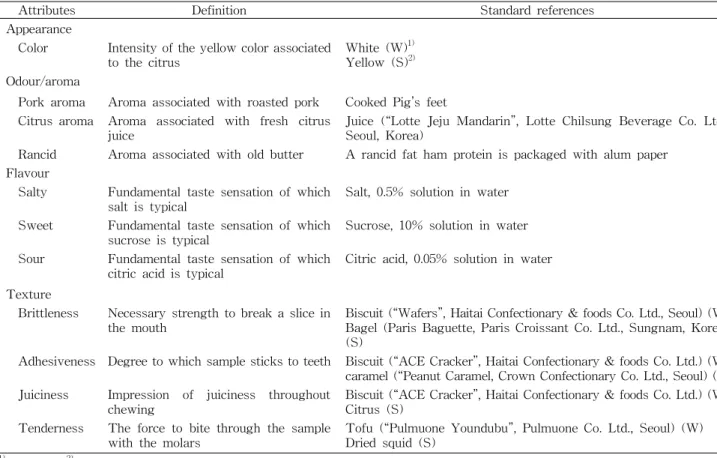
Table 2. Definition of the descriptive attributes and standard references
Attributes Definition Standard references
Appearance
Color Intensity of the yellow color associated
to the citrus White (W)
1)Yellow (S)
2)Odour/aroma
Pork aroma Aroma associated with roasted pork Cooked Pig’s feet Citrus aroma Aroma associated with fresh citrus
juice Juice (“Lotte Jeju Mandarin”, Lotte Chilsung Beverage Co. Ltd., Seoul, Korea)
Rancid Aroma associated with old butter A rancid fat ham protein is packaged with alum paper Flavour
Salty Fundamental taste sensation of which
salt is typical Salt, 0.5% solution in water Sweet Fundamental taste sensation of which
sucrose is typical Sucrose, 10% solution in water Sour Fundamental taste sensation of which
citric acid is typical Citric acid, 0.05% solution in water Texture
Brittleness Necessary strength to break a slice in
the mouth Biscuit (“Wafers”, Haitai Confectionary & foods Co. Ltd., Seoul) (W) Bagel (Paris Baguette, Paris Croissant Co. Ltd., Sungnam, Korea) (S)
Adhesiveness Degree to which sample sticks to teeth Biscuit (“ACE Cracker”, Haitai Confectionary & foods Co. Ltd.) (W) caramel (“Peanut Caramel, Crown Confectionary Co. Ltd., Seoul) (S) Juiciness Impression of juiciness throughout
chewing Biscuit (“ACE Cracker”, Haitai Confectionary & foods Co. Ltd.) (W) Citrus (S)
Tenderness The force to bite through the sample
with the molars Tofu (“Pulmuone Youndubu”, Pulmuone Co. Ltd., Seoul) (W) Dried squid (S)
1)
W: weak.
2)S: strong.
성(chewiness), 파쇄성(fracturability) 및 부착성(adhesive- ness)을 각각 5회 반복 측정하였다.
관능적 특성 평가
성분비에 따른 감귤과피 분말 및 건 표고버섯을 첨가한 소시지 시료에 대해 묘사분석을 실시하였다. 관능검사원은 관능평가 강의를 수강한 19~22세의 학생 8명(남 3명, 여 5 명)으로 훈련은 1회 1시간씩 6번에 걸쳐 실시하였다. 소시지 에 대한 개념을 정립하고 특성에 대해 표준물질을 제시하고 11가지 관능적 특성 용어를 개발하고 정의를 내렸다(Table 2). 평가 시료는 투명한 플라스틱 용기에 상온(15~21
oC)으 로 제시하였으며 검사물의 편견을 없애기 위해 난수표에서 추출한 세 자리 숫자를 표기하고, 순서상의 오차를 최소화하 기 위하여 Williams' latin square 법에 의해 10개의 시료를 제시하였다. 관능특성 강도는 3일에 걸쳐 3회 반복하여 수행 하였으며, 15점 선 척도를 이용하여 실시하였다.
통계처리
이화학적 특성에 대한 평가는 SPSS 12.0 ver(SPSS Inc., Chicago, IL, USA) 통계프로그램을 이용하여 처리 그룹간 비모수 분산분석인 Kruskal-Wallis tests로 유의차를 검증 하고 실험군 간 통계적 유의성은 Mann-Whitney test를 통 하여 α=0.05 수준에서 시행하였다. 관능적 특성 평가는 일반 선형모델분석(GLM)을 이용하여 분산분석(ANOVA)으로
유의차를 검증하고 p<0.05 수준에서 Tukey의 다중범위검 정으로 통계적 유의성을 검증하였다. 패널간 변동을 제거하 여 소시지의 관능적 특성을 이해하기 위하여 신뢰수준에서 제품의 모든 특성들에 대한 공선성(collinearity)을 고려하 여, 시료들의 평균값을 적용하여 공분산(covariance)방법으 로 XLSTAT-Pro(Addinsoft Inc., Paris, France)를 이용하 여 주성분 분석(Principal Component Analysis)으로 검증하 였다. 시료의 관능적 특성과 물성 특성 강도 간의 관계를 파 악하기 위하여 부분최소평방회귀분석(partial least square regression, PLSR)을 수행하였다.
결과 및 고찰
일반성분 분석
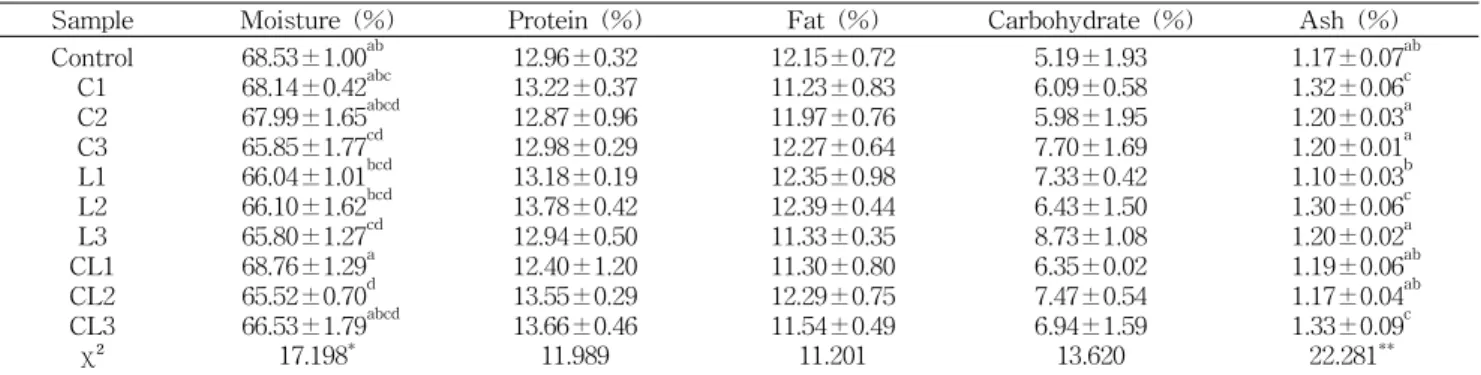
감귤과피 분말 및 건 표고버섯을 첨가하여 제조한 소시지
의 일반성분 비교 결과는 Table 3과 같다. 소시지의 수분함
량은 처리군별 65.52~68.76%의 범위로 측정되었으며, 함량
에 따라 각 군별 유의한 차이를 보였으나(p<0.05), 감귤과피
분말 2%(C3)와 건 표고버섯 2%(L3) 처리군에서 대조군과
유의한 차이를 나타냈다(p<0.05). 저지방소시지에 첨가되는
성분들은 수분결합력에 영향을 미칠 수 있다고 보고하고 있
다(17). 감귤과피분말과 건 표고버섯 첨가에 따른 조단백질,
조지방 및 탄수화물 함량은 유의적인 차이를 나타내지 않았
Table 3. Proximate composition of sausages containing varied levels of citrus peel powder and dried Lentinus edodes (%, w/w)
Sample Moisture (%) Protein (%) Fat (%) Carbohydrate (%) Ash (%)
Control C1 C2 C3 L1 L2 L3 CL1 CL2 CL3 χ ²
68.53±1.00
ab68.14±0.42
abc67.99±1.65
abcd65.85±1.77
cd66.04±1.01
bcd66.10±1.62
bcd65.80±1.27
cd68.76±1.29
a65.52±0.70
d66.53±1.79
abcd17.198
*12.96±0.32 13.22±0.37 12.87±0.96 12.98±0.29 13.18±0.19 13.78±0.42 12.94±0.50 12.40±1.20 13.55±0.29 13.66±0.46
11.989
12.15±0.72 11.23±0.83 11.97±0.76 12.27±0.64 12.35±0.98 12.39±0.44 11.33±0.35 11.30±0.80 12.29±0.75 11.54±0.49
11.201
5.19±1.93 6.09±0.58 5.98±1.95 7.70±1.69 7.33±0.42 6.43±1.50 8.73±1.08 6.35±0.02 7.47±0.54 6.94±1.59 13.620
1.17±0.07
ab1.32±0.06
c1.20±0.03
a1.20±0.01
a1.10±0.03
b1.30±0.06
c1.20±0.02
a1.19±0.06
ab1.17±0.04
ab1.33±0.09
c22.281
**a-d
Values with different superscripts in a column are significantly different (p<0.05).
*
p<0.05,
**p<0.01.
Table 4. Color characteristics and pH of sausages containing varied levels of citrus peel powder and dried Lentinus edodes
Sample pH L-value a-value b-value
Control C1 C2 C3 L1 L2 L3 CL1 CL2 CL3 χ ²
6.42±0.02
a6.31±0.01
b6.23±0.02
cd6.22±0.04
cd6.30±0.01
b6.32±0.02
b6.33±0.03
b6.34±0.03
b6.28±0.03
bc6.22±0.02
d25.392
**80.59±1.10
abcd80.89±0.52
abc81.88±0.48
a80.37±1.24
bcd80.43±0.75
bcd79.31±0.84
ae78.37±1.46
e81.50±0.90
ab80.52±0.48
abcd79.78±0.19
cd23.639
**6.30±0.06
a5.81±0.08
bc5.68±0.12
bcd5.30±0.20
de5.88±0.11
ab5.71±0.24
bcd5.87±0.14
ab5.51±0.44
bcde5.37±0.53
cde5.13±0.48
e23.788
**8.79±0.18
ab10.44±0.32
d11.90±0.46
e14.96±0.78
f8.35±0.77
a9.58±0.64
bc9.28±0.61
b9.57±0.45
bc10.31±0.68
cd12.08±0.16
e34.303
**L: degree of lightness (white +100 ↔ 0 black), a: degree of redness (red +60 ↔ -70 green), b: degree of yellowness (yellow +60 ↔ -70 blue).
a-e
Values with different superscripts in a column are significantly different (p<0.05).
**
p<0.01.
으며(p>0.05), 회분 함량은 1.10~1.33%로 처리 그룹간 유의 한 차이를 나타내었다(p<0.05). 이러한 결과는 소시지 제조 시 첨가되는 성분 및 함량에 따라 일반성분의 차이를 나타내 는 것으로 사료된다(18,19).
pH 및 색도 변화
소시지의 pH는 감귤과피분말 함량이 증가함에 따라 유의 적인 차이를 나타내며 pH가 낮아지는 경향을 나타났으며, 건 표고버섯 첨가군들은 함량 증가와 상관없이 대조군과 유 의적인 차이만을 나타냈다(p<0.05)(Table 4). 이러한 pH는 6.22~6.42로 대조군에 비하여 첨가군 소시지의 pH가 유의 하게 낮게 나타났다(p<0.05). 표고버섯가루 저지방 소시지 에 첨가된 젖산나트륨 2%와 자몽종자 추출물 0.2% 첨가는 최종 제품의 pH에 영향을 주지 않고(20), 천연부산물(chito- san, sesamol, 감귤껍질의 ascorbic acid)을 첨가한 소시지의 저장온도에 따라 pH가 변화되는 경향을 나타낸 것으로 보고 되었다(21). 이는 첨가물의 종류에 따라 pH에 영향을 주는 것으로 사료된다.
색도 측정 결과(Table 4), L값에 있어서 감귤과피분말 첨 가군은 대조군과 유의한 차이를 나타나지 않았으나 건 표고 버섯 첨가군은 첨가량이 증가할수록 명도가 낮아졌다. 적색
의 a값은 감귤과피분말과 건조표고버섯 첨가량이 증가함에 따라 대조군과 비교하여 유의적으로 감소하였으나, 황색의 b값은 감귤과피분말 첨가량이 증가함에 따라 유의하게 증가 하였다(p<0.05). Choi 등(18)은 유화형 소시지에 첨가한 밤 껍질 가루에 의해 색상의 변화를 유도하고, Jeong 등(22)은 레드비트 첨가 저지방 소시지의 적색도를 증진시키는 데 효 과적이라고 보고하였다. 이러한 색도의 변화는 소시지 제조 에 첨가되는 다양한 천연 섬유질 존재에 의해 유도되는 것으 로 보고되고 있다(18).
소시지 조직감
소지지의 조직감 측정 결과 경도(hardness), 탄력성(spri-
nginess), 응집성(cohesiveness), 씹힘성(chewiness), 파쇄
성(fracturability), 부착성(adhesivenss)등 모든 처리군에서
유의한 차이를 나타내지 않았다(p>0.05)(Table 5). Chin 등
(23)이 저지방소시지에 첨가된 돼지살코기와 수분함량 비에
따른 조직감에 대한 연구에서 돼지살코기 함량은 파쇄성인
경우 60% 이상, 경도는 55% 이상, 검성, 씹힘성 및 응집성은
50% 이상부터 일반 유화형 소시지와 차이가 없는 것으로
보고하였으며, Jeong 등(23)은 레드비트 첨가 소시지의 고기
함량이 60%인 경우 조직감은 첨가물의 양에 영향을 받지
Table 5. Mechanical characteristics of sausages containing varied levels of citrus peel powder and dried Lentinus edodes Sample Hardness
(g/cm
2) Springiness
(%) Cohesiveness
(%) Chewiness
(g) Fracturability
(g) Adhesivenss
(g) Control
C1 C2 C3 L1 L2 L3 CL1 CL2 CL3 χ ²
1669.00±222.21 1577.20±124.29 1643.80±133.14 1770.60±66.27 1618.80±104.40 1623.60±89.61 1714.40±130.48 1631.00±109.11 1629.60±95.10 1697.40±99.28
10.259
82.64±1.83 79.02±1.03 82.96±4.09 79.60±2.86 79.70±0.95 80.14±2.82 80.34±2.45 79.74±2.15 80.26±1.68 80.12±3.53
7.800
67.54±2.87 66.58±3.35 64.10±5.37 61.12±5.53 64.20±6.86 61.76±5.28 63.62±4.35 65.40±2.85 64.56±4.02 62.88±3.33
9.266
1628.86±152.80 1521.36±93.30 1552.32±206.88 1596.44±126.78 1515.98±61.19 1490.12±222.03 1602.54±70.54 1579.04±127.94 1548.34±98.16 1593.96±62.24
5.847
133000.60±13234.80 119220.04±9235.43 128887.26±18591.54 125979.52±13467.09 120349.22±4171.42 125587.54±6391.15 128736.74±6122.41 123144.52±11509.07 120475.30±7675.25 124688.62±7110.99
8.159
-20.00±15.81 -14.00±16.73 -20.00±20.00 -22.00±13.04 -10.00±12.25 -8.00±13.04 -14.00±8.94 -18.00±13.04 -14.00±11.40 -14.00±11.40
5.593
Table 6. F-value from analysis of variance on 11 sensory attributes of sausages containing varied levels of citrus peel powder and dried Lentinus edodes
Attributes Samples
Appearance Color 27.74
***Odour/aroma Pork aroma Citrus aroma Rancid
7.93
***41.41
***0.48
Flavour Salty
Sweet Sour
1.25 10.74
***18.58
***Texture
Brittleness Adhesiveness Juiciness Tenderness
3.83
***1.72 4.48
***6.49
******
p<0.001.
않는다고 보고하였다. 본 연구의 결과에서 기계적 물성이 감귤과피분말 및 건 표고버섯의 첨가에 영향을 받지 않는 것은 원료 배합 비율 중 돼지살코기와 지방 비율이 72.7%를 차지하고 있는 것이 주요인인 것으로 사료된다.
소시지 관능 특성
감귤과피분말 및 건 표고버섯의 첨가수준을 달리하여 제 조한 소시지의 관능 특성 결과는 Table 6과 Fig. 1과 같다.
관능평가 특성들 중 8개 항목인 색상, 돼지고기향, 감귤향, 단맛, 신맛, 부서짐성, 촉촉함 그리고 부드러움이 각각 유의 한 차이를 나타냈다(p<0.05). 색상은 적색과 황색의 균일성 으로 나누어 살펴보았다. 감귤 진피 첨가량이 증가할수록 높게 나타났으며, 대조군 및 건 표고버섯 첨가군과 유의한 차이를 나타내었다(p<0.05). 향기인 경우 돼지고기향, 감귤 향, 부패취로 나누어 살펴보았다. 돼지고기 향에 있어서 대 조군과 건 표고버섯 첨가군이 감귤과피분말 첨가군에 비해 높게 평가되었으며 감귤향은 상대적으로 낮게 평가하였다 (p<0.05). 향미인 경우 짠맛, 단맛, 신맛을 평가하였다. 짠맛 인 경우 유의한 차이를 나타내지 않았으나(p>0.05), 단맛인 경우 감귤과피분말 1%(C2), 2%(C3) 및 감귤과피분말과 건 표고버섯 혼합 2%(CL3) 첨가군에서 대조군과 유의한 차이 를 나타냈다(p<0.05). 신맛인 경우 감귤과피분말 첨가군이
대조군 및 건 표고버섯 첨가군과 유의한 차이를 보였다(p<
0.05).
텍스처의 특성을 살펴보면 부서짐성은 건 표고버섯 2%
첨가군에서 감귤과피분말 첨가군과 유의한 차이를 나타냈 으며 촉촉함은 감귤과피분말과 건 표고버섯의 첨가량이 증 가할수록 낮아지는 경향을 나타냈으며 대조군과 유의차를 보였다(p<0.05). 부드러움은 건 표고버섯의 첨가량이 증가 할수록 부드럽다고 나타났으며, 감귤과피분말 첨가군에 비 하여 유의하게 높아짐을 알 수 있었다.
대조군과 감귤과피분말 및 건 표고버섯 처리군의 관능평 가 자료를 사용한 주성분 분석(Principal Components Anal- ysis) 결과는 Fig. 2와 같다. Fig. 2a는 주성분 분석의 제 1주 성분(PC1), 제 2주성분(PC2)으로 구분된 관능적 특성의 분 포를 나타내고 있으며 Fig. 2b는 감귤과피분말 및 건 표고버 섯 처리군의 위치를 나타내고 있다. PC1과 PC2의 변동은 58.96%와 23.08%로 총 변동의 82.04%가 설명되었다. 제 1주 성분은 향미 특성에 따라 맛 성분인 짠맛, 신맛, 감귤향과 부서짐성, 돼지고기향, 단맛 그리고 부패취 3부분으로 관찰 되었다(Fig. 2a). 제 2주성분은 향미 및 부패취와 관련 있는 것으로 나타났다. Fig. 2b에서 주성분 분석에 의해 소시지에 첨가된 성분에 따라 유의하게 구분이 되었으며, 대조군 및 건 표고버섯 첨가군(L1, L2)은 음의방향으로 부하되어 있으 며, 감귤과피분말 첨가군(C1~C3) 및 혼합군(CL3)은 양의 방향으로 부하되어 있었다. 신맛 및 감귤향은 감귤과피분말 첨가군의 특징으로 나타났으며, 일반적인 소시지의 돼지고 기 향과 단맛은 대조군과 건 표고버섯 첨가군으로 묘사되었 다. 관능평가 분석결과 소시지 제조 시 0.5~1% 건 표고버섯 첨가는 단맛과 돼지고기향과 관련되어 있으며, 감귤과피분 말 첨가는 신맛과 짠맛을 만드는 주요한 성분과 연관성이 있는 것으로 평가되었다.
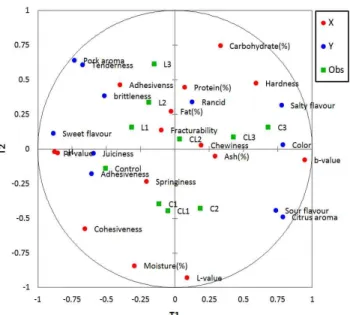
소시지의 관능적 특성과 물성 특성 강도의 관계 관능적 특성과 기계적 물성 강도 간의 관계를 파악하기 위하여 부분최소평방회귀분석(PLSR)을 수행한 결과, 제1주 성분(T1)과 제2주성분(T2)이 각각 총 변동의 46.98%와 14.75
%를 설명하여 총 변동의 61.73%를 설명하였다(Fig. 3).
0 2 4 6 8 10 12 14
Color
Pork aroma
Citrus aroma
Rancid
Salty flavour
Sweet flavour Sour flavour
Brittleness Adhesiveness
Juiciness Tenderness Control
0 2 4 6 8 10 12 14
Color
Pork aroma
Citrus aroma
Rancid
Salty flavour
Sweet flavour Sour flavour
Brittleness Adhesiveness
Juiciness Tenderness C1
C2 C3
0 2 4 6 8 10 12 14
Color
Pork aroma
Citrus aroma
Rancid
Salty flavour
Sweet flavour Sour flavour
Brittleness Adhesiveness
Juiciness Tenderness L1
L2 L3
0 2 4 6 8 10 12 14
Color
Pork aroma
Citrus aroma
Rancid
Salty flavour
Sweet flavour Sour flavour
Brittleness Adhesiveness
Juiciness Tenderness CL1
CL2 CL3
Fig. 1. Sensory characteristics of sausages with different levels of citrus peel powder and dried Lentinus edodes. As the value increases from 1 to 15, the intensity of sensory characteristics increases.
Brittleness
Sour flavour Sweet
flavour
Salty flavour Rancid
Citrus aroma Pork aroma
Color
-1 -0.75 -0.5 -0.25 0 0.25 0.5 0.75 1
-1 -0.75 -0.5 -0.25 0 0.25 0.5 0.75 1
Principal component 1 (58.96 %)
P ri n c ip a l c o m p o n e n t 2 ( 2 3 .0 8 % ) .
(A)
CL2 CL3 CL1
L3
L2
L1
C3
C2 C1
Control
-2 -1 0 1 2 3 4
-4 -3 -2 -1 0 1 2 3 4
Principal component 1 (58.96 %)
P ri n c ip a l c o m p o n e n t 2 (2 3 .0 8 % ) .
(B)
Fig. 2. Principal component analysis (PCA) loading for (a) sensory attributes and (b) the ten sausage samples.
PLSR 분석 결과, 관능적 특성인 감귤향과 신맛, 짠맛, 색상 이 양의 방향으로 높게 부하되어 있고, 감귤과피 분말 2.0%
(C3) 및 감귤과피 분말 및 건표고버섯 혼합군 2.0%(CL3) 또한 T1에 대하여 양의 방향으로 부하되어 있었다. 이에 비 해 단맛, 돼기고기 향미, 부서짐성, 다즙성, 부착성 및 부드러 움 등의 특성은 관능 특성에 부정적인 영향을 미치는 것으로 나타났다. 물성 특성중 경도 및 황색도는 T1의 양의 방향으 로 부하되어 있으며, pH, 적색도, 응집성, 부착성 등은 반대
방향에 위치되어 있었다. 이를 통해 관능특성과 물성검사의
특성 강도는 부착성, 응집성, 다즙성 등이 T1의 음의 방향으
로 나타났고, 일반성분 특성과 관능 특성 강도가 밀접한 관
계를 가지고 있지 않음을 알 수 있었다. 위와 같이 감귤과
표고버섯이 첨가된 소시지 제품의 적합성을 설명하기 위해
서는 수분함량을 적절히 조절할 수 있는 다양한 방법을 적용
해 보거나, 첨가된 성분들의 수준을 조절하는 등의 추후 연
구가 필요하다고 사료된다.
Fig. 3. The correlation plot of relationship between mechan- ical (X) and sensory attributes of sausages (Y) containing varied levels of citrus peel powder and dried Lentinus edodes (Obs).
요 약
감귤과피 및 건 표고버섯을 첨가하지 않은 소시지를 대조 군으로, 감귤과피분말 0.5%(C1), 1.0%(C2), 2.0%(C3), 건표 고버섯 0.5%(L1), 1.0%(L2), 2.0%(L3) 그리고 감귤과피분말 및 건표고버섯 혼합군 0.5%(CL1), 1.0%(CL2), 2.0%(CL3)를 첨가하여 소시지의 품질 및 관능 특성에 미치는 영향을 살펴 보았다. 수분함량은 대조군에 비하여 첨가군에서 유의하게 낮게 나타났으며, 회분 함량은 높게 나타났다. pH와 색도 적색도는 감소하고 황색도는 증가하는 경향을 보였다. 기계 적 특성을 이용한 조직감은 유의한 차이를 나타내지 않았다.
소시지 관능특성 중 8개의 특성들이 유의한 차이를 나타냈 다. 제1주성분(PC1)과 제2주성분(PC2)의 변동은 58.96%와 23.08%로 총 변동의 82.04%가 설명되었다. 관능적 특성에 따른 제1주성분은 향미 특성인 짠맛, 신맛, 감귤향과 부서짐 성, 돼지고기향, 단맛 그리고 부패취 3부분으로 관찰되었다.
제2주성분은 향미와 부패취와 관련이 있는 것으로 나타났 다. 주성분분석(PCA)결과 소시지 제조 시 0.5~1% 건 표고 버섯 첨가는 단맛과 돼지고기향과 관련되어 있으며, 감귤과 피분말 첨가는 신맛과 짠맛을 만드는 주요한 성분과 연관성 이 있는 것으로 평가되었다. 관능적 특성과 기계적 물성 강 도 간 부분최소평방회귀분석(PLSR) 수행 결과, 제1주성분 (T1)과 제2주성분(T2)이 각각 총 변동의 46.98%와 14.75%
를 설명하여 총 변동의 61.73%를 설명되었으며 관능적 특성 인 감귤향과 신맛, 짠맛, 색상이 양의 방향으로 높게 부하되 어 있고, 감귤과피 분말 2.0%(C3) 및 감귤과피 분말 및 건표 고버섯 혼합군 2.0%(CL3) 또한 T1에 대하여 양의 방향으로 부하되어 있었다.
감사의 글
본 연구는 2011년도 제주관광대학 연구비 지원에 의해 수 행된 결과의 일부이며, 이에 감사드립니다.
문 헌