• 검색 결과가 없습니다.

Integrating IndoorGML and Indoor POI Data for Navigation Applications in Indoor Space

N/A
N/A
Protected

Academic year: 2021

Share "Integrating IndoorGML and Indoor POI Data for Navigation Applications in Indoor Space"

Copied!
8
0
0

로드 중.... (전체 텍스트 보기)

전체 글

(1)

https://doi.org/10.7848/ksgpc.2019.37.5.359

Integrating IndoorGML and Indoor POI Data for Navigation Applications in Indoor Space

Claridades, Alexis Richard

1) 2)

·Park, Inhye

3)

·Lee, Jiyeong

4)

Abstract

Indoor spatial data has great importance as the demand for representing the complex urban environment in the context of providing LBS (Location-based Services) is increasing. IndoorGML (Indoor Geographic Markup Language) has been established as the data standard for spatial data in providing indoor navigation, but its definitions and relationships must be expanded to increase its applications and to successfully delivering information to users. In this study, we propose an approach to integrate IndoorGML with Indoor POI (Points of Interest) data by extending the IndoorGML notion of space and topological relationships. We consider two cases of representing Indoor POI, by 3D geometry and by point primitive representation. Using the concepts of the NRS (node-relation structure) and multi-layered space representation of IndoorGML, we define layers to separate features that represent the spaces and the Indoor POI into separate, but related layers. The proposed methodology was implemented with real datasets to evaluate its effectiveness for performing indoor spatial analysis.

Keywords : Indoor POI, Point of Interest, IndoorGML, IndoorGML Integration

Original article

1. Introduction

Nowadays, the interest in spatial information services is growing and moving towards indoor navigation and location (Giudice et al ., 2010). For these purposes, conventional GIS (Geographic Information System) datasets and tools are inadequate, and simple block models in 3D are inappropriate, so the need for data models that model interior space and their respective relationships as networks have risen (Lee and Kwan, 2005). In addition, representing the urban environment requires complex datasets, which poses problems for people trying to navigate inside a building, especially if the person has not yet visited it or the space is large or complex (Kim and Lee, 2018). IndoorGML (Indoor Geographic Markup Language) is the OGC (Open Geospatial Consortium) standard for indoor spatial information,

particularly for navigation systems (OGC, 2015). While there are other documents that deals with 3D representations, IndoorGML focuses on how topological relationships would be represented in indoor space (Kim and Lee, 2015).

In providing indoor spatial applications, however, not only space is represented. POI (Points of Interest), or sometimes

“Places of Interest”, “Objects of Interest”, or “Landmarks”, also provide a fundamental requirement in these systems (Spangenberg, 2014). They are entities that represent locations of spaces, objects, facilities or events (Park et al ., 2017) for labeling features and visualization (Trapp et al ., 2009).

However, in contrast to conventional POI data, an Indoor POI represents a place, service, facility or event in an indoor space. The distinction between POI and Indoor POI apart from their inherent locations include expanded notions of spatial range, importance of classification, and some aspects

Received 2019. 09. 30, Revised 2019. 10. 16, Accepted 2019. 10. 18

1) Member, Dept. of Geoinformatics, University of Seoul (E-mail: [email protected])

2) Member, Dept. of Geodetic Engineering, University of the Philippines Diliman, Quezon City, Philippines 3) Member, Dept. of Geoinformatics, University of Seoul (E-mail: [email protected])

4) Corresponding Author, Member, Dept. of Geoinformatics, University of Seoul (E-mail: [email protected])

This is an Open Access article distributed under the terms of the Creative Commons Attribution Non-Commercial License (http://

(2)

of temporal information management. While IndoorGML provides extensive definitions for representations and the structure of indoor space, the components irrelevant to describe these spaces (such as furniture and installations) are not within its scope. However, ignoring these objects in describing the indoor spaces limits the possible applications and implementations for which the standard was primarily intended for- indoor navigation.

This paper presents an approach to integrate representations of space using IndoorGML and Indoor POI. In the age where LBS (Location-based Services) are high in demand, integrating IndoorGML and Indoor POI datasets would promote utilization, ensure efficiency, and enable proper data management, as these datasets form as their essential infrastructure. the relationships between indoor spaces that IndoorGML defines poses opportunities for extension to accommodate the concept of IndoorPOI.

The paper is structured as follows. We first begin with studies relating and leading to the idea of IndoorGML and IndoorPOI integration, then we proceed by characterizing how spaces and relationships between them are currently described in IndoorGML, and from there an approach to describe Indoor POI is illustrated. Two approaches in integration is described, depending on how Indoor POIs are represented by geometric primitives in the data. We conduct an experiment using real data in Section 4. The last section discusses conclusions and notes on future work.

2. Related Studies

Human lives are now heavily entangled with mobile technology, as most daily activities from transportation, commerce, navigation, and even recreation now rely more on handheld devices. In urban areas, humans spend more time indoors, and the growth of these spaces in terms of complexity and size are accompanied by the increasing demand for facilities and services (Kim and Lee, 2018). Indoor LBS gives timely information to users across application domains, and form core requirement of Smart Cities.

IndoorGML is one of the focal points of indoor spatial data research (Gunduz et al ., 2016). It is the standard established by OGC for indoor topological data, geared

for navigation applications, stemming from the need of systems to improve capabilities in handling 3D topological relations, visualization, and query (Lee and Kwan, 2005). In IndoorGML, space is defined as a space within one or more structures where navigation occurs and where objects can be located. These objects, such as furniture and installation, in turn are ignored in representation, as this standard focuses on the usage of indoor space rather than the management of components and facilities (OGC, 2015).

Despite and with this, IndoorGML presents a prospect for integration with datasets of other forms. Conversion from IFC (Industry Foundation Classes) -format BIM data to IndoorGML has been attempted in the aim to extract building information and route planning such as in (Teo and Cho, 2016; Teo and Yu, 2017). Similarly, CityGML has also been used to generate IndoorGML data (Khan et al ., 2014), and combined together based on topological relationships in (Kim et al ., 2013; Lee et al ., 2014). A more general approach was defined by (Park et al ., 2018), proposing a method to integrate topological data with other volume-based, surface-based, or network-based data. These approaches, however, still address the representation of the indoor space themselves, and not the objects that can be found inside these spaces.

Using IndoorGML data and omnidirectional images, an indoor patrol service operation was proposed by (Jung and Lee, 2017). In order to incorporate indoor facilities in the application, which is essential in delivering information through the LBS, a Within relationship between the space and relationship is defined, so that the Indoor facilities can be represented along with the IndoorGML NRG (Node- Relation Graphs).

Indoor POIs are a special type of POI data that can be found in the interior of the building, essentially in the same spaces that the IndoorGML is trying to represent. Various applications have utilized Indoor POI, such as in the area of mobile web mapping (Kim and Lee, 2018) and in exploring user preferences to improve recommender systems (Zheng et al ., 2017). Increasing significance of this data is also supported by commercial GIS software companies such as ESRI providing support for Indoor POI data (ESRI, 2019).

However, despite this extensive evidence of growing interest

(3)

in Indoor POI and its huge potential in LBS applications, its direct integration with indoor space data, such as IndoorGML, have been understudied.

3. Modified Notion of Spaces and Relationships in IndoorGML

IndoorGML covers topological, geometric and semantic specifications which are relevant for indoor navigation, which sets it apart and makes it complementary to other standards such as CityGML and IFC. This aims for full specification of navigation context, constraints, space connectivity and subdivision, geometric and semantic properties of spaces, and the logical and metric definition of navigation networks (OGC, 2015).

Based on the Combinatorial Data Model (Lee, 2004;

Lee and Kwan, 2005), IndoorGML defines NRGs as outputs of a dual transformation, shown in Fig. 1(a), from their respective representations in the primal space, which either a geometric or a topological space, in order to determine which spaces allow navigation, that is which are navigable or non-navigable. NRG is a representation of the compartmentalization of indoor space where the states (or nodes) represent each navigable space. The transitions (also called edges) that connect each node represent the topological relationships between each respective space. Each transition may represent an Adjacency, Connectivity, or Accessibility relationship between spaces.

(a) Dual transformation to

obtain NRG (b) Inter-layer relationship Fig. 1. Representation of navigable spaces in IndoorGML

using the NRG

An indoor space may be abstracted into several cellular spaces, as a matter of decomposing each component of reality

in the process of abstraction. In this regard, IndoorGML defines an MLS (Multi-layered Space) representation, in Fig. 1(b), for these cases. Each cell space (say, one for the topographic space, and another for the WiFi (Wireless Fidelity) Connectivity space), are different decompositions of the same indoor spaces, and each decomposition is a separate layer of cellular space, in turn connected to each other through an interlayer relationship.

Together with the NRG and the MLS representation of space together form the framework of IndoorGML to define indoor spatial information for navigation purposes, and to locate stationary or mobile features in indoor space.

However, this is where IndoorGML’s limitation arises, it does not define how to represent these features, it is not considered in its process of abstraction. These features may be represented as Indoor POI, but we must consider first how they will be represented in IndoorGML.

(a) Navigable facility (b) Non-navigable facility Fig. 2. Types of indoor features to be represented by

Indoor POI

Consider the indoor facilities that can be found in subway stations in Fig. 2. Fig. 2(a) is a ticket gate, where passengers use their transportation tokens, tickets or cards as they pass through in both directions. This is an example of an Indoor POI that is navigable, and it that case, it may be represented in IndoorGML with the standard’s current definitions of space and topological relationships. However, consider the ticket machine in Fig. 2(b). It is an installation that does not permit navigation, but users can approach it closely and may be the target or source points of navigation routes. Hence, we can say that this is a non-navigable, but approachable space.

However, IndoorGML does not represent non-navigable

spaces in its graphs. In this regard, there is a need to extend

IndoorGML relationships to accommodate these cases,

(4)

especially concerning navigation-related implementation.

Following from the work of (Kang et al ., 2015) these implementation-oriented topological relationships now include Adjacency and Connectivity among room objects, while relationships between the room objects and the Indoor POI that they contain may be defined with an inter- layer relationship Within. For example, in Fig. 3 below is an improved illustration from (Jung and Lee, 2017), where rooms R1, R2 have space relations, that is they are connected and adjacent, respectively to room R3. Also, while Indoor POIs F1, F2, F3 and F4 contained in room R3, have Within relationships with the latter.

Fig. 3. Modified notion of spaces and relationships in IndoorGML

4. Methodology

In this section, we approach two methods of Indoor POI representation and the process to integrate each with IndoorGML data. Since Indoor POI is intended for use in indoor environments, its integration with IndoorGML would be an important aspect towards ubiquitous use. In this regard, we consider two cases for integration, specifically on how geometry primitives represent the Indoor POIs in the indoor environment. First, Indoor POI may be represented as 3D Geometry Primitives such as IntBuildingFurniture, second is when they are represented as points in 3D space, as the three TicketMachine and Fire Extinguisher POIs shown by Fig. 4(a) and Fig. 4(b), respectively.

(a) 3D geometry representation (b) Point representation Fig. 4. Two cases of POI representation in IndoorGML

4.1 2D or 3D representation of Indoor POI In the first case, Indoor POIs are represented as geometric primitives as indoor features in 3D, hence they must undergo duality together to produce NRGs. Fig. 5 illustrates this operation. First, the Indoor Space data and the Indoor POI both represented as 3-dimensional geometric primitives must be combined through a union operation, and this output would correspond to 0-dimensional objects (i.e., nodes) in the dual space. These, in turn, must be classified according to navigability to determine their respective layers in the multi- layered IndoorGML data. Navigable spaces are placed in the Indoor Space layer (say, the node representing the hall pictured in Fig. 4), having an inter-layer within relation with the Indoor POI Space layer containing the Non-navigable spaces (say, the Ticket Machines and the Fire Extinguisher in Fig. 3). An illustrative example is shown in Fig. 6.

Fig. 5. Integrating Indoor POI represented as 3D geometry primitives

Fig. 6. Result of integrating IndoorGML and Indoor POI

(5)

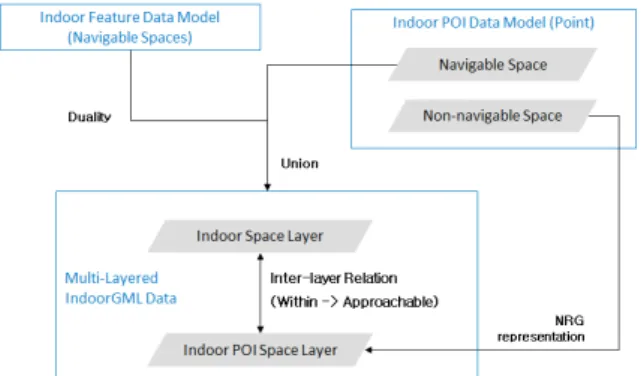
4.2 Point object representation of Indoor POI For the second case, the Indoor POIs are represented as Point Primitives, therefore having a different dimensionality with the Indoor Space. A different approach therefore is necessary to integrate them with IndoorGML data. First, the Indoor Feature data undergoes duality, and together with the navigable spaces from the Indoor POI, would constitute the Indoor Space Layer in the integrated Multi-layered IndoorGML Data. All non-navigable spaces in the Indoor POI data model will constitute the Indoor POI Space layer in the said dataset. This process is illustrated in Fig. 7 and an illustrative example is shown in Fig. 8.

Fig. 7. Integrating Indoor POI represented as point primitives

Fig. 8. Result of integrating IndoorGML and Indoor POI represented as Points

Again, considering the case presented in Fig. 4(a) and 4(b), using either approaches would result in an NRG composed of the four nodes, one for each of the Indoor POIs in the

Indoor POI space, and one node for the hallway in the Indoor Space. As shown in Fig. 9, These spaces are related to each other through IndoorGML’s multi-layer relationships, and consequently each of the four POIs have an inter-space relation of Within with the main hall node, which in turn have space relationships with other nodes representing other spaces in the that interior.

Fig. 9. Indoor POI integrated to multi-layered IndoorGML data

5. Experimental Implementation

To demonstrate the methodology described in the previous section, an experimental implementation was conducted with real data based on the 21

st

Century Building of the University of Seoul, South Korea (Fig. 10).

Fig. 10. Study area of the experimental implementation

For the study area, IndoorGML-based NRS (node- relation structure) data was generated based on floor plans to represent the spaces in the structure, and z-values were assigned to each respective floor levels to reflect elevations.

To implement the methodology, we also have selected facilities present in the structure as Indoor POI, shown in Fig.

11. For simplicity, the office table located in Room 611 at the

6

th

floor, the south wing ground floor vending machine, and

toilet on the north wing 5

th

floor were selected.

(6)

Fig. 11. Selected Indoor POI in the study area

The experiment is conducted in ESRI ArcScene, a 3D visualization application, which can carry out fundamental GIS analysis tools from ArcMap. First, we consider the case when Indoor POIs to be represented by 3D geometries, to demonstrate the first approach presented in the previous section. First, the indoor spaces not yet represented by IndoorGML data, and the Indoor POI as 3D objects must be represented together through a Union operation, then together undergo the process of duality to generate the node- relation structure. Fig. 12 shows the corresponding result.

The indoor feature data representing rooms and hallways and the 3D object representing the facilities are shown on the left, while the resulting NRG representation after undergoing duality is shown on the right

Fig. 12. Result of integrating IndoorGML and Indoor POI from 3D geometry

Next, we consider the second approach discussed from the previous section where Indoor POI is represented by a 1D geometry, a point. When the Indoor POI data are represented as points, it does not need to undergo duality transformation.

After the indoor space has been transformed into a set of nodes and edges, a union operation is performed with the Indoor POI point data to produce the similar result as Fig. 12.

Fig. 13 shows the output of this operation.

Fig. 13. Result of integrating IndoorGML and Indoor POI as point primitives

Both above approaches result in a dataset together representing the rooms and hallways of the building, and the selected facilities through a multi-layered IndoorGML data, with the rooms and hallways in the indoor space layer, and the facilities in the Indoor POI space layer. Now, to demonstrate the inter-layer relationships between the two layers, we demonstrate a navigation analysis using the resulting dataset.

Say that a person in Room 611 wants to use the vending machine in the 1

st

floor but needs to stop by the restroom in the 5

th

floor- and wants to know which path should be taken.

This analysis would only be possible if the target locations in the navigation (the Indoor POI data placed in the Indoor POI space layer) lies within (has an inter-layer relationship) with the navigation paths (represented by the nodes in the indoor space layer).

Using the 3D Network Analyst tools of ArcScene, a network data was built based on the resulting node-relation structure from the previous step. Through the Find Best Route tool with the Indoor POI locations as target locations, the best path from the starting point (Room 601), towards the other two locations is solved. Fig. 14 shows the result of the route analysis, showing in thicker green lines the route from Room 611, to the 5

th

Floor toilet, down to the ground floor vending machine.

Fig. 14. Result of the route analysis

(7)

6. Conclusions and Future Studies

IndoorGML is an established OGC standard for indoor spatial information, focusing on navigation, however in certain applications, would necessitate information from other datasets to provide comprehensive information especially in LBS. Indoor POIs provide useful location on objects, events, or facilities in a specific location in the indoor environment, and may be utilized together with IndoorGML for a more complete depiction of indoor space.

In this paper, we revisit the IndoorGML notion of space and their relationships and use Multi-layered Space Model to define separate layers- the Indoor space and Indoor POI space. These spaces linked to each other through by extending IndoorGML-defined relationships with the Within relationship between the Indoor space in IndoorGML and the Indoor POI that it contains. Using two approaches- first when Indoor POI is a 2D or 3D geometric primitive, and second when a point primitive is used as a representation.

Both approaches result in an NRG representing both the spaces and the Indoor POIs, as a multi-layer IndoorGML data. Finally, we conduct an experimental implementation of the proposed methodology using data from a building in the University of Seoul. Data representing the spaces and selected Indoor POI in the structure are used to demonstrate the methodology for integrating IndoorGML and Indoor POI data using a navigation analysis.

This paper has some limitations that future studies would like to address. Omnidirectional images have been used to generate, and have been integrated with IndoorGML data, so an LBS service integrating IndoorGML, Indoor POI and image data shows great promise. In addition, extending this concept towards a full integration of IndoorGML and Indoor POI data with outdoor networks containing POIs would provide a good avenue towards seamless indoor-outdoor navigation research.

Acknowledgments

This research was supported by a grant (19NSIP-B135746-03) from National Spatial Information Research Program (NSIP) funded by Ministry of Land, Infrastructure and Transport of Korean government.

References

ESRI (2019), Points of interest and categories, ArcGIS Indoors , https://pro.arcgis.com/en/pro-app/help/data/indoors/points- of-interest-and-categories.htm (last date accessed: 23 September 2019).

Giudice, N.A., Walton, L.A., and Worboys, M. (2010), The informatics of indoor and outdoor space : A research agenda, Proceedings of the 2nd ACM SIGSPATIAL International Workshop on Indoor Spatial Awareness (ISA 2010) , 02 November, San Jose, California, pp. 47–53.

Gunduz, M., Isikdag, U., and Basaraner, M. (2016), A Review of Recent Research in Indoor Modelling &

Mapping, International Archives of the Photogrammetry, Remote Sensing and Spatial Information Sciences - ISPRS Archives , Vol. 41, No. July, pp. 289–294.

Jung, H. and Lee, J. (2017), Development of an Omnidirectional-Image-Based Data Model through Extending the IndoorGML Concept to an Indoor Patrol Service, Journal of Sensors , Vol. 2017, No. 1, pp. 1–14.

Kang, H.Y., Jung, H., and Lee, J. (2015), A Study of Subspacing Strategy for Service Applications in Indoor Space, Journal of Korea Spatial Information Society , Vol.

23, No. 3, pp. 113–122. (in Korean with English abstract) Khan, A.A., Donaubauer, A., and Kolbe, T.H. (2014), A

Multi-Step Transformation Process for Automatically Generating Indoor Routing Graphs from Existing Semantic 3D Building Models, 9th 3DGeoInfo Conference 2014 – Proceedings , 11-13 November, Dubai, pp. 123-156.

Kim, K. and Lee, K. (2018), Handling Points of Interest (POIs) on a Mobile Web Map Service Linked to Indoor Geospatial Objects: A Case Study, ISPRS International Journal of Geo-Information , Vol. 7, No. 6, pp. 216.

Kim, M. and Lee, J. (2015), Developing a Method to Generate IndoorGML Data from the Omni-directional Image, International Archives of the Photogrammetry, Remote Sensing and Spatial Information Sciences - ISPRS Archives , Vol. 40, No. 2W4, pp. 17–19.

Kim, Y.J., Kang, H.Y., and Lee, J. (2013), Development

of Indoor Spatial Data Model using CityGML ADE,

International Archives of the Photogrammetry, Remote

Sensing and Spatial Information Sciences - ISPRS

(8)

Archives , Vol. XL-2/W2, No. November, pp. 41–45.

Lee, J. (2004), A Spatial Access-Oriented Implementation of a 3-D GIS Topological Data Model for Urban Entities, Geoinformatica , Vol. 15, , pp. 1–7.

Lee, J., Kang, H.Y., and Kim, Y.J. (2014), Developing Data Fusion Method for Indoor Space Modeling based on IndoorGML Core Module, Journal of Korea Spatial Information Society , Vol. 22, No. 2, pp. 31–44.

Lee, J. and Kwan, M.P. (2005), A Combinatorial Data Model for Representing Topological Relations among 3D Geographical Features in Micro-Spatial Environment, International Journal of Geographical Information Science , Vol. 19, No. 10, pp. 1039–1056.

OGC (2015), OGC® IndoorGML. Open Geospatial Consortium , No. 05, pp. 1–17.

Park, J., Ahn, D., and Lee, J. (2018), Development of Data Fusion Method Based on Topological Relationships Using IndoorGML Core Module, Journal of Sensors , Vol. 2018, No. 1, pp. 1–14.

Park, J., Kang, H.Y., and Lee, J. (2017), A Spatial-temporal POI Data Model for Implementing Location-based Services, Journal of the Korean Society of Surveying, Geodesy, Photogrammetry and Cartography , Vol. 34, No.

6, pp. 609–618.

Spangenberg, T. (2014), Standardization, Modeling and Implementation of Points of Interest – a Touristic Perspective, International Journal of u- and e- Service, Science and Technology , Vol. 6, No. 6, pp. 59–70.

Teo, T.A. and Cho, K.H. (2016), BIM-oriented Indoor Network Model for Indoor and Outdoor Combined Route Planning, Advanced Engineering Informatics , Vol. 30, No.

3, pp. 268–282.

Teo, T.A. and Yu, S.C. (2017), The Extraction of Indoor Building Information from BIM to OGC IndoorGML, International Archives of the Photogrammetry, Remote Sensing and Spatial Information Sciences - ISPRS Archives , Vol. 42, No. 4W2, pp. 167–170.

Trapp, M., Schneider, L., Holz, N., and Döllner, J. (2009), Strategies for Visualizing Points-of-Interest of 3D Virtu- al Environments on Mobile Devices, Proceedings of the International Symposium on Location Based Services

& TeleCartography , 2-4 September, Nottingham, United

Kingdom, pp. 1–14.

Zheng, Z., Chen, Y., Chen, S., Sun, L., and Chen, D. (2017), Location-aware POI recommendation for indoor space by exploiting WiFi logs, Mobile Information Systems , Vol.

2017, No. 1, pp. 1–17.

수치

Fig. 3. Modified notion of spaces and relationships in  IndoorGML
Fig. 8. Result of integrating IndoorGML and Indoor POI  represented as Points
Fig. 12. Result of integrating IndoorGML and Indoor POI  from 3D geometry

참조

관련 문서