• 검색 결과가 없습니다.

Determining Spatial Neighborhoods in Indoor Space using Integrated IndoorGML and IndoorPOI data

N/A
N/A
Protected

Academic year: 2021

Share "Determining Spatial Neighborhoods in Indoor Space using Integrated IndoorGML and IndoorPOI data"

Copied!
10
0
0

로드 중.... (전체 텍스트 보기)

전체 글

(1)

Determining Spatial Neighborhoods in Indoor Space using Integrated IndoorGML and IndoorPOI data

Claridades, Alexis Richard

1) 2)

·Lee, Jiyeong

3)

Abstract

Indoor space has been one of the focal points for geospatial research as various factors such as increasing demands for application and demand for adaptive response in emergencies have arisen. IndoorGML (Indoor Geography Markup Language) has provided a standardized method of representing the topological aspect of micro-scale environments, with its extensive specifications and flexible applicability. However, as more real-world problems and needs demand attention, suggestions to improve this standard, such as representing IndoorPOI (Indoor Points of Interest), have arisen. Hence, existing algorithms and functionalities that we use on perceiving these indoor spaces must also adapt to accommodate said improvements. In this study, we explore how to define spatial neighborhoods in indoor spaces represented by an integrated IndoorGML and IndoorPOI data. We revisit existing approaches to combine the aforementioned datasets and refine previous approaches to perform neighborhood spatial queries in 3D. We implement the proposed algorithm in three use cases using sample datasets representing a real-world structure to demonstrate its effectiveness for performing indoor spatial analysis.

Keywords : Indoor Space, IndoorGML, IndoorPOI, Point of Interest, Spatial Neighborhoods

1. Introduction

Interest in 3D indoor space has been increasing due to different factors such as the ubiquity of mobile devices that trigger more services indoors (Kim and Lee, 2018) development of advanced construction technologies (Kang et al., 2015) the long time spent by humans inside structures (Klepeis et al., 2001), and the spaces themselves being increasingly complex (Worboys, 2011). Though indoor applications frequently mirror the outdoor environment’s needs, the structure of indoor space and the datasets that represent it demand different approaches.

Because of its dimensionality, indoor spaces tend to have more regular geometries but tend to be more intricate (Giudice et al., 2010). The representation of indoor space itself would

depend on which aspect is vital in the analysis- geometry, semantics, or topological relationships. Topological models have been of interest in multiple studies as the field moves towards problem-solving and decision making, from merely as a data integration and presentation tool (Ellul and Haklay, 2006) requirements in three-dimensional (3D. The relationships of spaces represented in topological models have been crucial, especially in navigation, emergency situations, and LBS (Location-Based Services).

IndoorGML (Indoor Geographic Markup Language) has been established by the OGC (Open Geospatial Consortium) as the standard for indoor spatial information due to the demand for a formal standard defining requirements of indoor space applications (OGC, 2018). IndoorGML is heavily based on the Node-Relation Structure (J. Lee and

Received 2020. 09. 28, Revised 2020. 10. 13, Accepted 2020. 10. 21

1) Member, Dept. of Geoinformatics, University of Seoul (E-mail: [email protected])

2) Member, Dept. of Geodetic Engineering, University of the Philippines Diliman, Quezon City, Philippines 3) Corresponding Author, Member, Dept. of Geoinformatics, University of Seoul (E-mail: [email protected])

https://doi.org/10.7848/ksgpc.2020.38.5.467 Original article

This is an Open Access article distributed under the terms of the Creative Commons Attribution Non-Commercial License (http://

(2)

Kwan, 2005) to represent topological relationships among spaces, and can represent space flexibly through the MLSM (Multi-layer Space Model) (Becker et al., 2009). However, more definitions are necessary to increase the standard’s applicability in more LBS applications despite the strong core concept, so proponents have been preparing for IndoorGML 2.0 et al., 2020).

Moreover, the current version of IndoorGML still has not provided a representation of features contained within the indoor spaces, represented as IndoorPOI (Indoor Points of Interest) but are crucial for navigation and LBS. Just like in the outdoors, IndoorPOIs can also hierarchically represent spaces and support time-series analysis. (Claridades and Lee, 2020). Recent studies within the past year have also described critical characteristics of IndoorPOI in contrast to its outdoor counterparts as well as its integration with IndoorGML using various approaches such as utilizing the MLSM (Claridades and Lee, 2020; Claridades et al., 2019) or appending an attribute to the IndoorGML core module, particularly the CellSpace class (Diakité et al., 2020).

Regardless, the availability of topological models has facilitated a greater understanding of indoor space and its relationships with other spaces, or the objects it contains within. One fundamental functionality that describes how entities in indoor 3D space interact is the concept of Spatial Neighborhood. Using the NRS (Node-Relation Structure), neighborhoods based on adjacency, rather than distance may be expressed for indoors, while maintaining the concept of the continuity of space (S. Lee et al., 2010; I. Park and Lee, 2010). The NRS models, based on the Poincare duality, only the spaces. To fully understand indoor space, we also have to take the IndoorPOIs into account and understand how the objects and spaces represented by the latter can affect our notion of proximity.

In this paper, we build and improve on a method to describe spatial neighborhoods for NRS data towards applying it on an integrated IndoorGML and IndoorPOI data. The paper is structured as follows. In the following section, we examine previous studies related to our purpose, and then we describe our methodology to express 3D neighborhoods in indoor spaces. Following those, we demonstrate our algorithms using sample datasets using data for a university building.

The last section summarizes our conclusions and possible directions for future work.

2. Related Literature

In this section, we review how the NRS, and eventually IndoorGML, has represented indoor space. We revisit how the importance of representing IndoorPOI data together with these spaces and various approaches that make this possible.

We also look at how previous studies have implemented neighborhood analysis in indoor space represented by NRS.

Lee and Kwan (2005) proposed the NRS to represent topological relationships more efficiently in indoor spaces compared with boundary representation models. It simply, but elegantly, abstracts relationships between sub-units of indoor space while improving computational efficiency by avoiding the direct use of 3D objects (J. Lee and Kwan, 2005).

Studies have shown that among topological models, queries implemented on network-based data such as the NRS are more efficient (S. Lee and Lee, 2010). Based on this approach, IndoorGML was established by OGC as a defining standard for indoor space representation, particularly in providing LBS indoors (OGC, 2018), and currently remains to be one of the main interest of researchers of 3D GIS (Diakité et al., 2020; Gunduz et al., 2016). Based on how the NRS abstracts indoor space, IndoorGML uses the process of duality in order to represent topological relationships- 3D spaces are represented as nodes, while the edges represent respective relationships. This standard has been one focus of attention for researchers that concern with indoor space, as this has versatile enough concepts that encapsulate representation of various levels of hierarchy in space, handling semantic and geometric information, as well as external referencing for extending applications with other datasets.

Since the first version of IndoorGML arose out of the

indoor spatial data community’s urgent requirements for

standardization, and the goal is that the standard may handle

inadequacies such as the capability to handle indoor facility

management in the next version. One aspect for such an

application is the ability to represent objects in indoor space

in the form of IndoorPOI. With wide-ranging applications

in Indoor LBS such as in navigation (Zeinalipour-Yazti and

(3)

Laoudias, 2017; Zhang and Ye, 2017), localization (Alaoui et al., 2017; Zhuang et al., 2010)absolute position updates are made possible with the online detection of different types of points of interest (POIs, and for landmarks (Willems, 2017), IndoorGML still ignores this in representation in the standard.

Jung and Lee (2017) initially utilized the idea of using IndoorPOI data along with IndoorGML as the core to create an omnidirectional image-based indoor patrol application to demonstrate how these data plays a role in facilities management indoors (Jung and Lee, 2017). Based on this study’s method of utilizing the Within relationships between the objects and spaces, the MLSM concept became the key concept for an approach to integrate IndoorGML and IndoorPOI data. This integration considers whether represented by 3D geometry or point primitive objects (Claridades et al., 2019). Conversely, Diakite et al. (2020) suggested utilizing a Boolean variable in the CellSpace class to denote that a cell is a POI. Furthermore, the re-definition of IndoorGML to accommodate IndoorPOI data accounts as a more substantial support for LBS, along with indoor feature modeling and inclusion of IoT sensors (Sarmiento and Diakité, 2020) These recent efforts to expand the standard is leading towards a newer version of IndoorGML. Studies on the data models for POI and IndoorPOI cite the indoor space as a critical application area, and concepts compatible integration with IndoorGML is available (Claridades and Lee, 2020; J. Park et al., 2017).

The determination of spatial relationships is one fundamental functionality of systems that use geospatial information. Along with the various approaches of representing indoor space, different methods of performing query operations are of question. Based on the relationships defined by the 9-intersection model (Clementini et al., 1994) for which current database solutions are inappropriate.

Topological relations, such as disjoint, meet, overlap, inside, and contains, have been well defined by the 9-intersection, a comprehensive model for binary topological relations.

We focus on two types of queries: (1, Bormann and Rank (2009) used SQL (Structured Query Language) to perform topological analysis on 3D building models based on the 3D Formal Data Structure (Rikkers et al., 1994). Recursive

algorithms traverse octree representations of these models and handle topological relationships in a fuzzy manner, so computation speed does not sacrifice accuracy (Borrmann and Rank, 2009)

Data models that represent indoor space based on geometry have larger data sizes and more complexity, so processing speeds are generally slower and less efficient compared to topology-based counterparts, and within topological models network-based models perform better in topological spatial analysis over boundary models (J. Lee and Kwan, 2005).

Furthermore, Lee and Lee (2010) have shown that adjacency queries performed on network models outperform those performed on boundary representations (S. Lee and Lee, 2010).

To define spatial neighborhoods conveniently and accurately in 3D indoor space represented by the NRS, Lee et al. (2010) proposed a process based on Dijkstra’s algorithm. The main goal is to define these neighborhoods in an adjacency-based manner, compared to the conventional distance-based buffers that are computationally expensive to perform in 3D and may be counterintuitive to perform on topological models. Spatial neighborhoods usually occur on a degree basis. For example, 1

st

-order neighbors are those spaces that are immediately adjacent to each other- hence connected by a single edge on the NRS. The number of the spaces’ direct connections through the edges in the NRS define the higher degrees (2

nd

-order, 3

rd

-order, and more) (I. Park and Lee, 2010)2001, geospatial researchers have been interested in utilizing GIScience technologies to solve geographical questions in micro-scale space in built- environments such as indoor space within a building. The indoor space should be dealt with differently from outdoor space in order to provide integrated and seamless location- based services (Li, 2009. Hence, in executing the Dijkstra’s algorithm, a fixed value of 1 was used as the weight for edges in determining degrees, regardless of what the edge represents in the NRS (S. Lee et al., 2010).

As NRS, and eventually, IndoorGML captures topological

relationships among spaces, the study of spatial syntax has

also taken advantage of graph theory to create mind maps of

spaces (Hillier, 2012). Space syntax concerns the investigation

of spatial layouts and the relevant human activity, especially

(4)

in urban areas. One of its significant components focuses on spatial representations, where applications schematically locate phenomena in spaces into graphs, effectively showing configurations and reproducing hierarchical relationships.

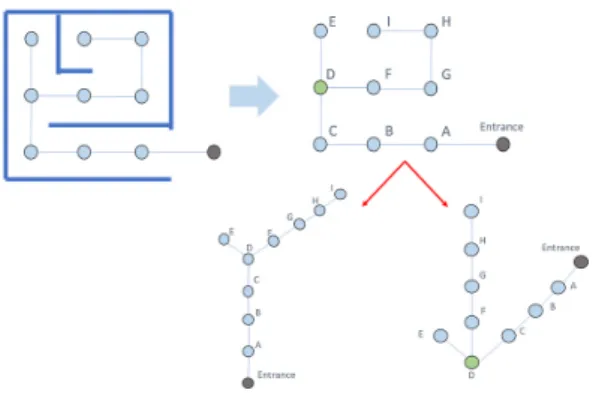
Discrete spatial elements describe space, and these elements also include those that relate to human behavior, not just geometric configurations of space (UCL, 2020). Consider Fig. 1 adapted from the UCL (University College London) Space Syntax Laboratory, where a house, on the left, is represented as a graph on the left, where the spaces are nodes and the areas for movement between spaces are links, very similar to the NRS. This graph can then be reconfigured in multiple ways, say from the view of the entrance (lower left) or from a specific room (lower right). This is an example of analyzing the same space to examine spatial relationships that occur within it.

Fig. 1. Representation of spaces in the Space Syntax concept

The Space Syntax theory imposes that space is not just a mere container for human activity but is a vital component to it. Any object contained in a space, and space itself, influences any activity or event held in that space (UCL, 2020). Implementations of this theory utilize variables assigned to edges that describe relevant spatial configurations that may be intangible in the real world space (Bafna, 2003).

Multiple studies have applied this simple yet robust method of abstraction to representing transportation systems, cognition and socio-economic phenomena in urban spaces, and even human behavior (Van Nes and Yamu, 2018).

3. Methodology

In this section, we describe the framework to perform neighborhood analysis using an integrated IndoorGML and Indoor POI data. Then we illustrate the algorithms to perform this analysis, based on a modified Dijkstra’s algorithm. Fig.

2 below illustrates the framework for our methodology.

IndoorGML-based data composed of nodes and edges represent indoor spaces and their topological relationships, respectively. On the other hand, point-based IndoorPOI data represent objects inside the Indoor space, or in some cases, indoor spaces as well. We combine these two datasets using an approach described in Claridades and Lee (2019) to obtain the integrated data, which in turn is the base dataset for performing the 3D network-based neighborhood query.

Finally, given a target object or target object, represented by nodes in the integrated data, and desired degree of relationship, the algorithm yields the spatial neighborhoods.

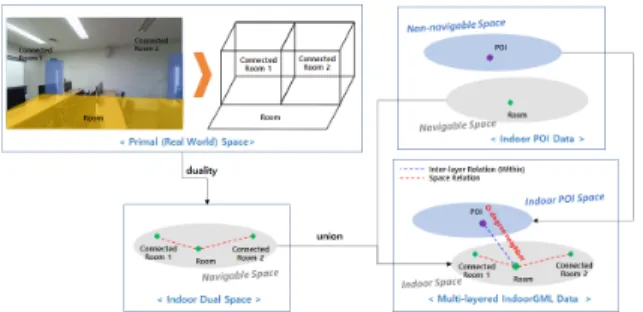
Fig. 2. Framework for 3D Neighborhood Query for integrated IndoorGML and IndoorPOI data First, we combine the IndoorGML data representing the indoor space and the IndoorPOI data that represents the objects contained in those spaces. We take the case of representing the IndoorPOI data through point objects.

Through the MLSM concept, we can define two separate

Space Layers, one for the indoor space, and another one

for the IndoorPOI space. The real-world space undergoes

a process of duality to towards an NRS representation. At

the same time, we classify the objects and spaces in the

IndoorPOI data into non-navigable (yet approachable) spaces

and navigable spaces, respectively. We combine the latter

with the nodes from the previous step to generate the nodes

(5)

and edges in the Indoor Space Layer, and the IndoorPOI is in a separate IndoorPOI Space Layer. Consequently, these two layers have a Within inter-layer relationship. Fig. 3 illustrates this process.

Fig. 3. Integrating IndoorGML data with IndoorPOI represented as point data

The integrated data is now input to the neighborhood query. A modified Dijkstra’s algorithm can calculate degrees of network-based neighborhoods for the spaces surrounding a target node. This target node may either represent an indoor space or an object contained in these spaces. The algorithm is heavily-based on a weight variable, which represents how this algorithm conceptualizes neighborhood relationships the query analysis. For the most basic cases, we may assign a constant value, for example, a weight equal to one (1) for each edge to signify that a node connected by a single edge to another node is a First-order neighbor of each other. This constant value means each node in the graph connected through a single edge corresponds to a 1

st

-order neighborhood relationship, or in other words, conceptualizing neighborhoods in a degree-based manner. Furthermore, we can define the inter-layer relationship between the IndoorPOI Space and the Indoor Space, specifically, the within relationship between the object and the space that contains it as a 0-order neighborhood.

In contrast, utilizing the space syntax concept, we can conceptualize a phenomenon in space through numerical values and abstract the same in the edges, assigning varying numerical values, depending on how we abstract proximity.

This weight variable can now numerically represent a strength of neighborhood relationships. This strength-based approach expands the applicability of the algorithm by more

realistically incorporating real-world relationships, not just connectivity or adjacency.

Upon selecting the target node, the algorithm assigns every other node a respective degree of neighborhood concerning the target node through a priority-queue method.

The priority-queue method ensures that the assigned degree for each node is the least possible degree of neighborhood, or in other words, the minimum number of edges that connect a particular node to the target node. After determining all degrees of neighborhood for each node, the algorithm performs a query to determine nodes within the n-th order spatial neighborhood based on the user-specified degree. The resulting graph contains all nodes having an assigned degree less than the query argument and the edges connecting said nodes. Table 1 illustrates the pseudocode for the procedure described above.

Hence, analysis is possible on either indoor environment components represented by IndoorGML data, on the IndoorPOI, or the indoor spaces themselves, depending on the needs of the application. Fig. 4 illustrates the possible analysis cases where the proposed algorithm may be applied. Analysis of an indoor space’s neighborhood is applicable for indoor navigation and guidance purposes, while an analysis targeting an IndoorPOI is ideal for facility management applications. In either case, we can also analyze neighborhoods based on degrees (orders) or through a strength-based approach. The degree-based analysis relies on the adjacency and connectivity graphs themselves and only focuses on the topological relationships of the spaces.

Fig. 4. Conceptual framework of the proposed algorithm

(6)

Conversely, the strength-based analysis is a more generalized approach, which may be applicable for specific application cases where the phenomena vary among the spaces continuously. Furthermore, the edges may represent either an adjacency or connectivity relationship, depending on the needs of the application. For example, analysis of neighborhoods for emergency evacuation situations might use connectivity graphs, but applications leaning towards environmental analysis, such as noise and smoke spread, might use adjacency graphs.

4. Experimental Implementation

In this section, we implement algorithms described in a previous section on experimental data representing the indoor spaces, and some sample IndoorPOI data of the 21

st

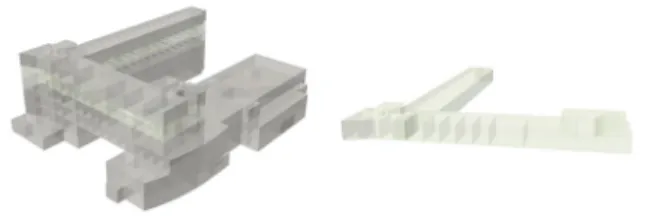
Century Hall of the University of Seoul, South Korea. For simplicity and ease of illustration, the results shown are from the 6th floor of this building. Fig. 5 shows the experimental study area.

Fig. 5. Study area of the experimental implementation We conduct the experimental implementation using ESRI ArcScene, a commercial application capable of executing spatial analysis tools from the fundamental ArcMap while still enabling 3D visualization. In this paper, we consider the case where point primitives represent the IndoorPOI data.

First, an NRS-based IndoorGML data represents the indoor spaces through undergoing a process of duality. The nodes in this graph represent all navigable spaces. Then, the point- represented IndoorPOI data, in this case, only representing objects inside the building, represents non-navigable spaces.

The edges in the sample data represent the navigable paths between the spaces. The datasets undergo a union operation in preparation for the implementation of the algorithms in the previous section. Fig. 6 illustrates this process.

Pseudocode. 3DNeighborhoodQuery (Graph, sourceNode, degree) Step 1: User selects sourceNode.

Step 2: Assign weight on the edges, constant value for degree-based or a variable for strength-based Step 3: Perform Dijkstra’s Algorithm, modifiedDijkstra(Graph, sourceNode,)

Step 3.1: For every node in G(v) except the sourceNode, define dist[v] as infinity. Add the node to priority queue Q.

Step 3.2: Set dist[sourceNode] = 0.

Step 3.3: Check which v in Q has the minimum value for dist. Set this node as u. Remove u from Q.

Step 3.4: For each v still in Q, connected to u through an edge[u,v] , calculate alt = dist[u] + weight [edge]. If alt is less than dist[v], replace dist[v] by alt. Decrease priority of v in Q.

Step 3.5: Repeat Step 3.3 and Step 3.4 while Q is still non-empty.

Step 3.6: Return all dist[v].

Step 4: Calculate Spatial Neighborhoods, neighborhood (Graph, sourceNode, degree)

Step 4.1: Obtain all nodes w in G(v) such that dist[w] with respect to targetNode is less than or equal to degree as Ordered_Nodes

Step 4.2: Return all edges connecting the Ordered_Nodes as Ordered_Edges Step 4.3: Return all Ordered_Nodes, Ordered_Edges

Table 1. Pseudocode for the 3D adjacency-based Neighborhood Query

(7)

Fig. 6. Result of Integrating the IndoorGML and IndoorPOI data

We consider three implementation cases in this paper—

first, a spatial neighborhood query for an indoor space through a degree-based analysis, and the latter as degree- based and strength-based neighborhood for an IndoorPOI.

For the first case, consider the space highlighted in Fig. 7.

This highlighted space is a sub-section of a long hallway, equivalent to a single node in the IndoorGML data. Suppose we are interested in finding second-order neighbors of this space, or up to the spaces adjacent to the immediately adjacent spaces. A green flag marks the target space for this query in Fig. 8. Similar to the results of Lee et al. (2010) and Park and Lee (2010), the algorithm can locate 2

nd

-order neighborhoods, which is marked blue in the same figure.

Fig. 7. Location of the selected target space for the neighborhood spatial query

Fig. 8. Results of the Neighborhood spatial query for the target space

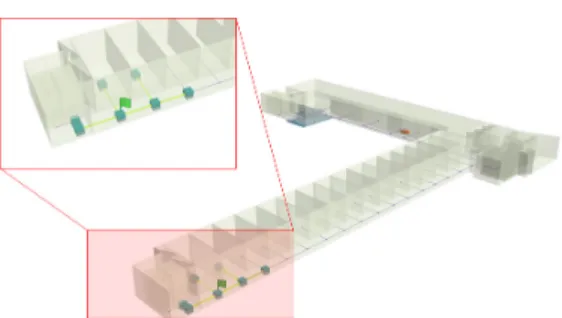
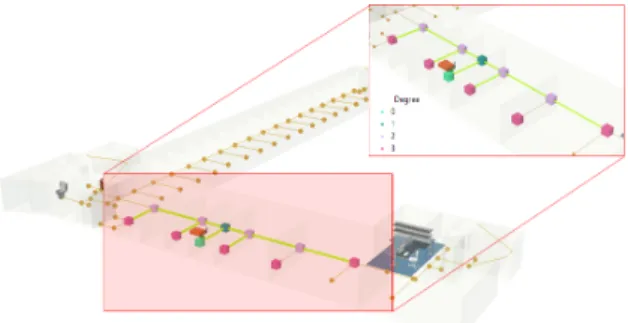
For the second case of implementation, we consider an object or facility in indoor space, say, a WiFi (Wireless Fidelity) router, shown in Fig. 9. Suppose we are interested in the coverage area of this equipment- for example, this router has a signal strong enough to reach devices for up to three rooms. We would want to identify, in this case, 3

rd

-order neighborhoods of the said WiFi router. Fig. 10 illustrates the result of this query. We consider the space containing the facility a 0-order neighborhood since the object has a within relationship with the space. Then the adjacent spaces to this containing space are 1

st

-order neighbors, and so on.

Fig. 9. Location of the target IndoorPOI for the neighborhood spatial query

Fig. 10. Results of the degree-based neighborhood spatial query for the target IndoorPOI

Finally, for the third case of implementation, we still consider the coverage area of this equipment, and this router has a signal strong enough to reach devices for up to three rooms. We would want to identify, in this case, 3

rd

- order neighborhoods of the said WiFi router. However, we consider that walls can obstruct WiFi signals. Hence, we apply different weights on the edges connecting rooms to the hallways, compared to the edges connecting hallway spaces.

Fig. 11 illustrates the weights applied to the edges. We have

assigned a weight value that considers signal strength in each

space as obstructed by concrete walls.

(8)

Fig. 11. Applying weights for a strength-based neighborhood spatial query

Now, running the same query for 3

rd

-order neighbors, but now with applied weights, we obtain the result in Fig. 12.

Similarly, the space containing the facility is the 0-order neighborhood, and the adjacent spaces to this containing space are 1

st

-order neighbors, and so on. However, along the hallway, the 2

nd

-order neighborhood extends to the spaces that are adjacent to the target space’s adjacent spaces (i.e., previous case’s 3

rd

-order neighborhoods) since the weight assigned to the hallway edges is smaller than the edges that connect to the room. Hence, we more have 3

rd

-order neighborhoods that extend towards the ends of the hallways, following the logic that WiFi signal strength can travel better in hallways, compared to rooms that are beside each other because concrete walls hinder signal propagation in the latter.

Fig. 12. Results of the strength-based neighborhood spatial query for the target IndoorPOI

5. Conclusions and Future Studies

OGC has established IndoorGML as the indoor spatial information standard, but current needs in applications trigger efforts in integrating data, pending the official

update of this standard. Literature demonstrated efforts to integrate IndoorPOI with IndoorGML data as an effective way to extend information contained in the latter, for LBS applications. However, along with the changes in the datasets that represent indoors, we must also rethink how we execute fundamental spatial operations that help us perceive relationships and interactions between and among the spaces and the objects within.

In this paper, we examined the implementation of neighborhood spatial queries on indoor spaces and objects represented by IndoorGML and IndoorPOI data. We revisit definitions of the spatial neighborhood through this reconfigured notion of space, and using a modified Dijkstra’s algorithm, propose an algorithm to calculate n-degrees of neighborhood on the integrated dataset. Finally, we conduct an experimental implementation of this method using sample data using three cases- with reference to either a space or an object in indoor space. We have also shown how determining neighborhoods based only on degrees of network adjacency may differ on how applications can define neighborhoods on a weighted basis.

Towards a more realistic representation of space, studies are now moving towards integrating indoor and outdoor space. Hence, in future studies, we would like to extend this application towards a seamless identification of neighborhoods in continuous indoor and outdoor representations. Furthermore, since our proposed algorithm operates based on a network-based representation, other approaches for grasping neighborhood relationships in other types of representations for 3D indoor spaces, such as geometric models, must be investigated.

6. Acknowledgment

This work was supported by the 2020 sabbatical year research grant of the University of Seoul.

References

Alaoui, F.T., Renaudin, V., and Betaille, D. (2017), Points

of interest detection for map-aided PDR in combined

outdoor-indoor spaces, 2017 International Conference on

(9)

Indoor Positioning and Indoor Navigation, IPIN 2017. 18- 21 September, Sapporo, Japan, pp. 1–8.

Bafna, S. (2003), Space syntax: A brief introduction to its logic and analytical techniques, Environment and Behavior, Vol. 35, No. 1, pp. 17–29.

Becker, T., Nagel, C., and Kolbe, T.H. (2009), A multilayered space-event model for navigation in indoor spaces, In:

Lee, J., Zlatanova, S. (eds.), 3D Geo-Information Sciences.

Springer Berlin Heidelberg, Berlin, Heidelberg, pp. 61–77.

Borrmann, A. and Rank, E. (2009), Topological analysis of 3D building models using a spatial query language, Advanced Engineering Informatics, Vol. 23, No. 4, pp.

370–385.

Claridades, A.R. and Lee, J. (2020), Developing a data model of indoor points of interest to support location- based services, Journal of Sensors, Vol. 2020, No.

Advanced Sensor Technologies in Geospatial Sciences and Engineering 2020.

Claridades, A.R., Park, I., and Lee, J. (2019), Integrating IndoorGML and Indoor POI data for navigation applications in indoor space, Journal of the Korean Society of Surveying Geodesy Photogrammetry and Cartography, Vol. 37, No. 5, pp. 359–366.

Clementini, E., Sharma, J., and Egenhofer, M. (1994), Modeling topological spatial relations: Strategies for query-processing, Computers & Graphics, Vol. 18, No. 6, pp. 815–822.

Diakité, A.A., Zlatanova, S., Alattas, A.F.M., and Li, K.J.

(2020), Towards IndoorGML 2.0: Updates and case study illustrations, ISPRS - International Archives of the Photogrammetry, Remote Sensing and Spatial Information Sciences, Vol. XLIII-B4-2, pp. 337–344.

Ellul, C. and Haklay, M. (2006), Requirements for topology in 3D GIS, Transactions in GIS, Vol. 10, No. 2, pp. 157–175.

Giudice, N.A., Walton, L.A., and Worboys, M. (2010), The informatics of indoor and outdoor space, Proceedings of the 2nd ACM SIGSPATIAL International Workshop on Indoor Spatial Awareness - ISA ’10, 2-5 November, San Jose, California, pp. 47-53.

Gunduz, M., Isikdag, U., and Basaraner, M. (2016), A review of recent research in indoor modelling & mapping, International Archives of the Photogrammetry, Remote

Sensing and Spatial Information Sciences - ISPRS Archives, Vol. 41, No. July, pp. 289–294.

Hillier, B. (2012), Studying cities to learn about minds: Some possible implications of space syntax for spatial cognition, Environment and Planning B: Planning and Design, Vol.

39, No. 1, pp. 12–32.

Jung, H. and Lee, J. (2017), Development of an omnidirectional-image-based data model through extending the IndoorGML concept to an indoor patrol service, Journal of Sensors, Vol. 2017, No. 1, pp. 1–14.

Kang, H.Y., Jung, H., and Lee, J. (2015), A study of subspacing strategy for service applications in indoor space, Journal of Korea Spatial Information Society, Vol. 23, No. 3, pp.

113–122. (in Korean with English abstract)

Kim, K. and Lee, K. (2018), Handling Points of Interest (POIs) on a mobile web map service linked to indoor geospatial objects: A case study, ISPRS International Journal of Geo- Information, Vol. 7, No. 6, pp. 216.

Klepeis, N.E., Nelson, W.C., Ott, W.R., Robinson, J.P., Tsang, A.M., Switzer, P., Behar, J.V., and Hern, S.C. (2001), The national human activity pattern survey (NHAPS):

A resource for assessing exposure to environmental pollutants, Journal of Exposure Analysis and Environmental Epidemiology, Vol. 11, No. 3, pp. 231–252.

Lee, J. and Kwan, M.P. (2005), A combinatorial data model for representing topological relations among 3D geographical features in micro-spatial environments, International Journal of Geographical Information Science, Vol. 19, No.

10, pp. 1039–1056.

Lee, S. and Lee, J. (2010), Efficient topological data models for spatial queries in 3D GIS, Geospatial Data and Geovisualization: Environment, Security, and Society Special Joint Symposium of ISPRS Commission IV and AutoCarto 2010 in conjunction with ASPRS/CaGIS 2010 Special Conference, 15-19 November, Orlando, Florida, USA, Vol. XXXVIII, No. 4.

Lee, S., Park, S.H., and Lee, J. (2010), 3D adjacency spatial query using 3D topological network data model, Journal of the Korean Spatial Information Society, Vol. 18, No. 5, pp. 93–105. (in Korean with English abstract)

OGC (Open Geospatial Consortium) (2018), IndoorGML

(10)

v.1.0.3 http://docs.opengeospatial.org/is/14-005r4/14- 005r4.html (last date accessed: 27 September 2020).

Park, I. and Lee, J. (2010), Defining spatial neighborhoods for 3D topological analysis in indoor space, International Archives of the Photogrammetry, Remote Sensing and Spatial Information Sciences - ISPRS Archives, Vol.

XXXVIII, pp. 155–158.

Park, J., Kang, H. Y., and Lee, J. (2017), A spatial-temporal POI data model for implementing Location-based Services, Journal of the Korean Society of Surveying, Geodesy, Photogrammetry and Cartography, Vol. 34(6), pp. 609–618.

Rikkers, R., Molenaar, M., and Stuiver, J. (1994), A query oriented implementation of a topologic data structure for 3-dimensional vector maps, International Journal of Geographical Information Science, Vol. 8, No. 3, pp.

243–260.

Sarmiento, A. and Diakité, A. A. (2020), Integration of IoT sensors to 3D indoor models with IndoorGML, ISPRS - International Archives of the Photogrammetry, Remote Sensing and Spatial Information Sciences, XLIV-4/W1- (September), pp. 135–142.

UCL, U.C.L. (2020), Space Syntax. URL https://www.

spacesyntax.online/overview-2/representations-of-space (last date accessed: 27 September 2020).

Van Nes, A. and Yamu, C. (2018), Space syntax: A method to measure urban space related to social, economic, and cognitive factors, The Virtual and the Real in Urban Planning and Design: Perspectives, Practices and Application, No. January, pp. 136–150.

Willems, O. (2017), Exploring a pure landmark-based approach for indoor localization, Delft University of Technology, Delft, Netherlands, 89p.

Worboys, M. (2011), Modeling indoor space. ISA ’11 Proceedings of the 3rd ACM SIGSPATIAL International Workshop on Indoor Spatial Awareness, 1 November, Chicago, Illinois, USA, pp. 1-6.

Zeinalipour-Yazti, D. and Laoudias, C. (2017), The anatomy of the anyplace indoor navigation service, SIGSPATIAL Special, Vol. 9, No. 2, pp. 3–10.

Zhang, H. and Ye, C. (2017), An Indoor wayfinding system based on geometric features aided graph SLAM for the

visually impaired, IEEE Transactions on Neural Systems and Rehabilitation Engineering, Vol. 25, No. 9, pp. 1592–

1604.

Zhuang, P., Wang, D., and Shang, Y. (2010), SMART:

Simultaneous indoor localization and map construction

using smartphones, Proceedings of the International

Joint Conference on Neural Networks, IEEE, 18-23 July,

Barcelona, Spain, pp. 1–8.

수치

Fig. 1. Representation of spaces in the Space Syntax  concept
Fig. 3. Integrating IndoorGML data with IndoorPOI  represented as point data
Fig. 5. Study area of the experimental implementation We conduct the experimental implementation using ESRI  ArcScene, a commercial application capable of executing  spatial analysis tools from the fundamental ArcMap while  still enabling 3D visualization
Fig. 10. Results of the degree-based neighborhood spatial  query for the target IndoorPOI
+2

참조

관련 문서

The implemented route guidance system follows the Indoor Geography Markup Language (IndoorGML), which is the indoor spatial information standard, and provides

Data standards and metadata in spatial database systems. 5.1 Issues with implementing standards and metadata in

For the system development, data collection using Compact Nuclear Simulator, data pre-processing, integrated abnormal diagnosis algorithm, and explanation

Pooling Cross-section and Time Series Data in the Estimation of a Dynamic Model: The Demand for Natural Gas. Econometric Analysis of Panel Data, second

Data quality is essential for Analytical CRM, where strategies are developed based on the results of data analysis.. Socio-economic data of customers is both easily gathered

The load command can be used for retrieving variables that were saved with the save command back to the workspace, and for importing data that was created with other

Data sampled at the scan interval is recorded in the internal memory as measured data for each specified data type (display data and event data).. Measured value at

Azure Data Factory (ADF) is a cloud-based data integration service that allows you to orchestrate and automate data movement and data transformation. Ingesting data can