• 검색 결과가 없습니다.

Developing Data Fusion Method for Indoor Space Modeling based on IndoorGML Core Module

N/A
N/A
Protected

Academic year: 2021

Share "Developing Data Fusion Method for Indoor Space Modeling based on IndoorGML Core Module"

Copied!
14
0
0

로드 중.... (전체 텍스트 보기)

전체 글

(1)

This is an Open-Access article distributed under the terms of the Creative Commons Attribution Non-Commercial License (http://creativecommons.org/licenses/

*

**

***

This work was supported by the 2012 Research Fund of the University of Seoul.

Jiyeong Lee. Associate Professor, Dept. of GeoInformatics, University of Seoul. [email protected](Corresponding author) HyeYoung Kang. Research Professor, Dept. of GeoInformatics, University of Seoul. [email protected]

YunJi Kim. Master Student, Dept. of GeoInformatics, University of Seoul. [email protected]

Developing Data Fusion Method for Indoor Space Modeling based on IndoorGML Core Module

Jiyeong Lee ․ Hye Young Kang ․ Yun Ji Kim

이지영*․ 강혜영**․ 김윤지***

Abstract According to the purpose of applications, the application program will utilize the most suitable data model and 3D modeling data would be generated based on the selected data model. In these reasons, there are various data sets to represent the same geographical features. The duplicated data sets bring serious problems in system interoperability and data compatibility issues, as well in finance issues of geo-spatial information industries. In order to overcome the problems, this study proposes a spatial data fusion method using topological relationships among spatial objects in the feature classes, called Topological Relation Model (TRM). The TRM is a spatial data fusion method implemented in application-level, which means that the geometric data generated by two different data models are used directly without any data exchange or conversion processes in an application system to provide indoor LBSs. The topological relationships are defined and described by the basic concepts of IndoorGML. After describing the concepts of TRM, experimental implementations of the proposed data fusion method in 3D GIS are presented. In the final section, the limitations of this study and further research are summarized.

Keywords : Spatial Data Fusion, Topological Model, IndoorGML, IndoorGIS

요 약 응용프로그램은 그 목적에 따라 최적의 데이터 모델을 활용하며, 이러한 응용프로그램을 위한 3차원 모델링 데 이터는 선택된 데이터 모델을 기반으로 생성된다. 이러한 이유로, 동일한 공간의 지형지물을 표현하기 위해 다양한 데 이터 셋이 존재한다. 그러한 중복된 데이터 셋은 공간정보 산업의 재정적 측면에서 문제를 가져올 뿐만 아니라, 시스템 호환성과 데이터 비교가능성에서도 심각한 문제를 야기한다. 이러한 문제를 극복하기 위하여, 본 연구에서는 항목클래 스내의 공간객체들 간의 위상적 관계를 이용하여 TRM (Topological Relation Method)이라고 하는 공간데이터융합 방 법을 제안한다. TRM은 응용프로그램 수준에서 구현되는 공간데이터 융합방법으로써, 서로 다른 데이터 모델에 의해 생성된 기하데이터들을 응용시스템에서 어떠한 데이터 변환이나 교환 과정을 거치지 않고, 직접적으로 실내공간 위치 기반 서비스에 제공하기 위해 사용된다. 이러한 위상관계는 IndoorGML의 기본 개념으로 정의 및 기술된다. TRM의 개 념을 기술한 후, 3D GIS상에서 제안된 데이터 융합방법의 실험적 구현을 보여준다. 마지막으로서 본 연구의 한계와 향 후 연구에 대해 정리한다.

키워드:공간데이터 융합, 위상모델, IndoorGML, 실내GIS

1. Introduction

3D geo-information has always been challenged due to a variety of data models, resolution and details, and ways of geometric and topological representations.

Since 9/11 there has been special interest in 3D models to represent internal structures of micro-scale environments (built-in urban areas). Such models are mostly

available from the design phase(as CAD models).

Although CAD models are, in most cases, too detailed for computing evacuation routes, for effective disaster management several different models have to be used.

It is a difficult task to select an appropriate data

structure designed for the characteristics of the

applications, for example, objects of interest, resolution,

required spatial analysis, etc.[15]. A model designed

(2)

for 3D spatial analysis may not exhibit good performance on 3D visualization and navigation. In other words, different data models might be suitable for the execution of specific tasks but not others.

The data structure of geometric modeling will be determined not only by the characteristics of the application, but also by the data acquisition techniques.

In order to model indoor space in more efficient ways, many researchers have developed various data acquisition techniques[5]. In general, the data capture methods are classified into four ways including indoor space modeling using point clouds data of 3D laser scanning, panorama digital images, BIM data, and 2D CAD drawing maps of buildings. Some research analyzed the effectiveness of the data acquisition methods through SWOT analyses as well as cost- benefit analyses[12].

Depending upon the creation methods of 3D indoor data, the different data model should be used. The indoor space data generated by 3D Laser scanning method and the panorama digital image method is modeled in surface-oriented geometric models, while the indoor space data constructed by BIM data or 3D CAD drawing data is modeled in volume-oriented geometric models. As mentioned above, according to the purpose of applications, the application will utilize the most suitable data model, and 3D modeling data for the application would be generated based on the selected data model. In the reasons, there are various data sets to represent the same geographical features.

The current duplicated process of data generation brings serious problems in system interoperability and data compatibility issues, as well in financial expense of geo-spatial information industries.

In order to overcome the problems, many researchers have developed several methods to deal with improving data compatibility to reuse the existing data generated for specific applications in two different aspects. One is to develop methods or algorithms to exchange one data format to the other data format such as the algorithm to transfer BIM data to CityGML data [4]. The other is to develop procedures to join attribute data of two different geo-spatial data such as the method of joining attribute data between road data of NGII and road data of New Address System[6]. Both

ways are based on feature class relation methods, which require several conditions in destination data and source data sets related to how to maintain feature identifiers(FID), how to define spatial-units of the feature, how to determine cardinalities between spatial units, etc. Because these problems are related to which data model is used, it is a difficult task to select an appropriate data model designed for the characteristics of the applications.

In order to fill out the gaps among data models, which are obstacles in implementing spatial data fusion based on feature class relation methods, this study proposes a spatial data fusion method using topological relationships among spatial objects in the feature classes, called Topological Relation Model(TRM). The TRM is a spatial data fusion method, which is implemented not in data-level, but in application-level.

This does not mean that the geometric data generated by two different data models is integrated each other by data exchange or conversion processes. It means that the geometric data generated by two different data models is used directly without data exchange or conversion processes in one application system. The topological relationships are defined and described by the basic concepts of IndoorGML. Section 2 of this paper reviews the previous works related to the data exchange issues, and Section 3 describe the basic concepts of IndoorGML. The following sections describes the proposed data fusion method for indoor space modeling data, which is developed by utilizing the topological data model of IndoorGML to represent the topological relationships among 3D entities in urban environments in dual graphs. In the next sections, experimental implementations of the proposed data fusion method in 3D GIS are presented. In the final section, the limitations of this study and further research are summarized.

2. Related Works

Data fusion models have been proposed by many

researchers. These models are classified into two

groups: data transformation models using feature class

relation models and attribute data integration models

using feature class relation models. The recent efforts

(3)

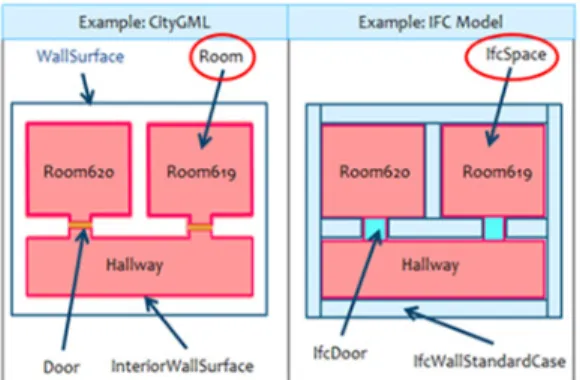
Figure 1. Example for Same Object Expressed in Different Class Names

into data transformation models using class relationships have been made on the feature data fusion models.

The feature integration models implement a method to define the associations of the features by mapping between class objects[3]. The feature integration model is required to refer to the same real features, even if the feature names are the same or not, in order to be able to match each class. For example, CityGML has Room class to represent rooms, and WallSurface class is divided by WallSurface, Door, and Window. On the other hand, IFC has IfcSpace class to describe the room, and WallSurface class is defined as IfcWall, IfcDoor, and IfcWindow. As seen in Figure 1, the different classes of CityGML and IFC represent the same Room class. The feature integration models are implemented to exchange the IFC data into CityGML data[4].

The feature data fusion models have used to integrate BIM which represents specific information of building with GIS which includes information of City or region based on geographic information[2]. The transformed data can be used to manage and analyze spatial information of building and city. In order to perform the data transformation model from IFC to CityGML, the procedures are defined as the three steps[4]. The first step is to define explicitly the rules of semantic mappings for each Level of Detail(LoD) of CityGML, and the second is to construct the algorithms to simplify the geometric model of IFC. Finally, the information of objects in IFC model should be defined to transform it into data for each LoD of CityGML.

As the second data fusion model, attribute integration

models have been proposed by many studies. The models implement a method to update or add the attribute information of one object in the destination table by joining the attribute information of the other object in source table when these objects represent the same geographical feature in real world[1]. The NGII (National Geographical Information Institute, South Korea) and New Address System of Korea have maintained different road data sets for the different purposes. The NGII has generated and maintained the road data as one of National Framework Datasets to update the geographical changes, while the New Address System has maintained the road data in real-time in order to assign a new address into the new constructed building in terms of the street-based address system.

In order to integrate the road data of the New Address System into NGII road data, the attribute integration model can be implemented, which requires 1) to have a common field and attribute values in both tables, 2) to be identified each record of both tables with a key field, and 3) to be related between the spatial units described as a record in a destination table and a source table with one-to-one or many-to-one cardinalities. The NGII, which is a Korean governmental institution has suggested constructing common attribute field by assigning unified UFID(Unique Feature Identifier) for implementing attribute integration models.

Both models described in the above are based on feature class relation methods, which require several conditions of destination data and source data sets related to how to maintain feature identifiers(FID), define spatial-units of the feature and determine cardinalities between spatial units. Because these problems are related to which data model is used, it is a difficult task to select an appropriate data model designed for the characteristics of the applications. Because of that, this study proposes another approach to implement spatial data fusion methods based on a network-based topological data model.

3. Basic Concepts of IndoorGML

IndoorGML is an open data model and XML-based

format for representing and exchanging indoor spatial

data, whose standard document is reviewed by the

(4)

IndoorGML SWG in Open Geospatial Consortium (OGC)[11].

The aim of IndoorGML is to establish a common schema framework for indoor navigation applications including building evacuation, indoor spatial awareness, indoor location based services, and the support for tracking of people and goods. IndoorGML also provides a framework for the flexible integration of different localization technologies and allows the ad-hoc selection of the appropriate navigation data according to the capabilities of the mobile device and the offered localization technologies of a building.

IndoorGML is a topological data model to represent topological relationships among spatial features in indoor space, which does not contain geometry of indoor spatial objects[10]. This is because there are several standards for the 3D geometric description of indoor objects, such as CityGML and IFCxml.

Due to the limitations of current 3D feature-based topological data models for micro-spatial applications[7], IndoorGML adopts a different approach for representing the topological relationships among 3D objects, which is called the Node-Relation Structure(NRS). It is the basis of the 3D topological data model utilized in IndoorGML. This section describes the three basic concepts involved in developing IndoorGML: (a) Node-Relation Structure; (b)Structure Space Model;

and (c)Space-Relation Model.

3.1 Node-Relation Structure

The topological model is closely related to the representation of spatial relationships among objects in geographic phenomena. Over the last twenty years, topological models for n dimensional objects have been developed by a number of researchers. However, the 3D topological models have not been implemented in the commercial 3D GIS systems. A number of researches have been proposed to implement 3D data structures based on boundary representations[14].

Boundary representation(B-rep) has a hierarchical data structure in which an object surface is composed of four elements of predefined primitives: point, edge, face and volume. Examples of the developed data models based upon 3D B-reps are the system of

‘simplicial complexes’ described by Carlson, the structured vector fields described by Burns, 3D formal data structure(FDS) developed by Molenaar and the

‘GOCAD’ system developed by Mallet. In addition, Zlatanova designed Simplified Spatial Model. In these models, topological relations are represented by a geometric representation of the cells, their neighbor- hoods defined in terms of their boundary and co-boundary cells based upon boundary representations by Corbett, which brings fundamental problems in maintaining topological consistency in databases.

In order to deal with the problems in maintaining local neighborhood relations, graph models have been developed[8]. Instead of representing the topological relationships between topological primitives(node, arc, face and body), the graph models present the topological relationships among 3D objects by drawing a dual graph interpreting the ‘meet’ relation between 3D objects as defined by the 9-intersection model by Egenhofer and Herring. Similar to the node-edge graphs which use duality to represent space-activity interactions, the Node-Relation Structure(NRS) was developed to represent more than just adjacency and connectivity relationships(G = (V(G), E(G) and H = (V(H), E(H), respectively), among 3D spatial objects in built environments[9].

IndoorGML employs Node-Relation Structure (NRS) to represent topological relationships, e.g., adjacency and connectivity, among 3D objects. The NRS allows to abstract, simplify, and represent the complex topological relationships between 3D spatial units in indoor environments, such as rooms within a building.

It can be transformed into a dual graph structure in topology space using the Poincaré Duality. The dual graph enables the efficient implementation of complex computational problems within indoor navigation and routing systems. The dual graph enables the efficient implementation of complex computational problems within indoor navigation and routing systems.

The NRS utilizes the Poincaré Duality in order to simplify the complex spatial relationships between 3D objects by a combinatorial topological network model.

Solid 3D objects in primal space, e.g., rooms within a building, are mapped to vertices(0D) in dual space.

The common 2D face shared by two solid objects is

(5)

Figure 2. Structure Space Model[11]

transformed into an edge(1D) linking two vertices in dual space. Thus, edges of the dual graph represent adjacency and connectivity relationships which may correspond to doors, windows, or hatches between rooms in primal space.

3.2 Structure Space Model

The Structured Space Model defines the general layout of each space layer independent from the specific space model which it represents. Each layer is systematically subdivided into four segments(see Figure 2).

Figure 2 illustrates the structured space model that allows for the distinct separation of primal space from dual space on the one hand, and geometry and topology on the other hand. This structure forms the basis for the framework proposed indoor space model.

The upper and the lower part of Figure 2 follows the rules of ISO 19107 for modelling geometrical and topological features of real world phenomena, but the transition from primal to dual space cannot be modelled or described via the ISO standard. Due to the fact that both spaces describe the same real world phenomena it must not be modelled by ISO 19107, because it breaks one of the base rules of ISO topology, which says that topology must be modelled as topological complex and that excludes the existing of overlapping objects or spaces[11].

In the structured space model, topological relationships such as connectivity and adjacency relationships among 3D spatial objects are represented within topology space(i.e., the right side of Figure 2). In primal space, topology is induced by the corresponding 3D geometry in Euclidean space. By applying a duality trans- formation based on the NRS, the 3D cells in primal topology space are mapped to nodes(0D) in dual space.

The topological relationships between 3D cells are transformed to edges(1D) linking pairs of nodes in dual space. The dual graph representing topological relation- ships among 3D spatial objects in topological space is called a Logical NRS that is presented by a logical network structure, while the dual graph embedded to Euclidean space is called a Geometric NRS as seen Figure 2. Because the Geometric NRS is presented by the network structure containing geometric properties, the Geometric NRS representing connectivity relationships among spatial objects in the building can be used to implement indoor navigation applications.

3.3 Space-Relation Model

The IndoorGML data model is thematically decomposed into a core module and thematic extension modules.

The core module comprises the basic concept of

Structure Space Model. In other words, the core

module of IndoorGML is a topological data model to

represent adjacency and connectivity relationships

(6)

Figure 3. UML Diagram of Space Relation Model[11]

among spatial entities in dual space, which is called as Space-Relation Model.

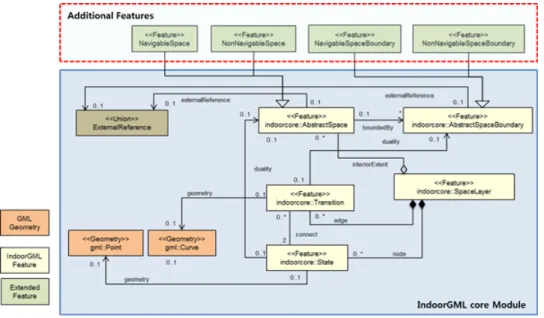
The UML diagram depicted in Figure 3 shows the data model of the IndoorGML core module [11]. The left side of the diagram presents the geometric model of the core model, while the right side of the diagram depicts the semantic-topological model of the core model. A SpaceLayer is a dual graph to represent topological relationships among space objects in the building. The dual graph is seen as a state and transition diagram. The active State is represented by a node within the dual graph and denotes the spatial area the guided subject or object is currently in. Once the subject or object moves into a topologically connected area, another node within the dual graph and thus a new active state is reached. The edge connecting both nodes represents the event of this state transition. A SpaceLayer aggregate States and Transitions which are directly associated with the corresponding topology classes of NRS for dual space. By this means, the state-transition diagram for each layer is realized. The SpaceLayer is related with AbstractSpace and

AbstractSpaceBoundary which are interface classes to be associated with space and space boundary feature classes defined in the feature data models such as CityGML and IFC model. Also, AbstractSpace and AbstractSpaceBoundary have external reference to the corresponding geometry classes for primal space.

As mentioned above, NRS as a part of the structured space model is implemented in IndoorGML core model. In dual space, the Logical NRS in the lower right part of Structured Space Model as seen in Figure 2 represents adjacency and connectivity relationships among spaces in topological space, which is described as the cardinalities of State and Transition to Geometry classes are 0 in Figure 3. When these cardinalities are 1 in Figure 3, the topological model is implemented by Euclidean space embedding of NRS, which is called Geometric NRG. The Geometric NRS is displayed in the lower left part of Structured Space Model as seen in Figure 2.

4. Data Fusion Model for Indoor

(7)

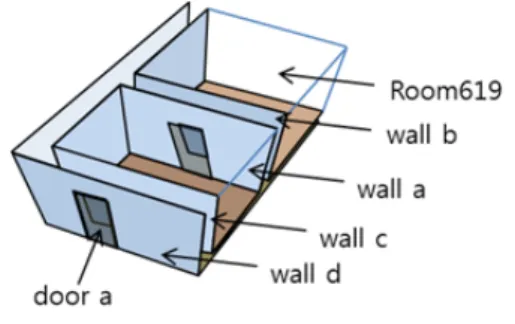
Figure 4. Example for Surface-based Indoor Space Modeling Using Terrestrial LiDAR

Figure 5. Example for Volume-based Indoor Space Modeling Using 2D CAD Drawing

Space Modeling

The data creation methods for representing indoor space have been developed, and two different methods were utilized in the projects funded by Korean governments in 2013, which are indoor space modeling using point clouds data of 3D laser scanning and 2D CAD drawing maps of buildings. Because the indoor space modeling methods apply to different geometric models, we need to develop data fusion model to integrate with two data sets in order to improve data applicability for re-use. In this section, because there are different strengths and weaknesses of each modeling methods in aspects of data affordability, data quality, data compatibility, and data source availability[13], we propose a Topological Relation Model based on the core model of IndoorGML, which is a different approach to spatial data fusion models comparing to the developed feature class relation methods.

4.1 Geometric Models for Indoor Space Modeling AbstractSpace in IndoorGML is represented as gml:AbstractGeometry and the geometry is realized to several geometry types according to the building models. As seen in Figure 4 and 5, the AbstractSpace mapped on gml:AbstractGeometry is can realized as gml:Solid or gml:Surface. As the first method of building modeling, the ‘indoor space modeling using point clouds data of 3D laser scanning’ is to model the indoor space based on surface-oriented geometric models. As seen in Figure 4, in the 3D indoor space modeling data generated by surface-oriented geometric models, each wall is modeled as a surface geometric

primitive, and the room is bounded by the surfaces based on B-rep representation. In Surface-oriented model such as CityGML as seen in Figure 4, the AbstractSpace in IndoorGML is represented as gml:

MultiSurface, and wells and doors are represented as gml:MultiSurface in 3D data model.

On the other hand, the ‘indoor space modeling using 2D CAD drawing maps of buildings’ method is implemented based on volume-oriented geometric models.

When the indoor space model is proposed based on 3D volume-oriented geometric model such as IFC models, the geometries of door and wall are represented as gml:Solid as shown in Figure 5. Also, the AbstractSpace such as rooms is represented as gml:Solid.

In other words, the class AbstractSpace can be related to a Room in CityGML or an IfcSpace in IFC as shown as Figure 5. The class AbstractSpaceBoundary can be related to a _BoundarySurface feature in CityGML (e.g. WallSurface, ClosureSurface, InteriorWallSurface, etc) or an IfcWall in IFC. The geometric spaces and their topological relationships in the NRS are realized as gml:Point and gml:Curve.

4.2 Topological Relation Method for Data Fusion In order to integrate with data sets generated by different data models, this paper proposes the TRM.

The TRM is a method to integrate two data sets based on topological models to represent topological relationships among 3D objects in a building. The topological model utilized in this paper is based on the core module of IndoorGML, which is a candidate international standard reviewed by the OGC.

4.2.1 Topological Model for TRM

(8)

Figure 6. Extended IndoorGML Model

Figure 7. Example of Matching Between Geometric Feature and Topological Feature in Case of Surface- based Modeling

Figure 8. Example of Matching Between Geometric Feature and Topological Feature in Case of Volume-based Modeling

The topological model implemented for the TRM is designed by extending IndoorGML Core Module. The Core Module represents the adjacency and connectivity relationships among 3D features in indoor space. The Figure 6 depicts the UML diagram of the Extended IndoorGML Core Module.

In Figure 6, the boxes colored in orange present GML Geometry objects, the boxes in yellow present the Feature Classes of IndoorGML Core Module, and the boxes in green are additional Feature Classes defined in this study in order to be used for spatial

data fusion in the TRM. A Indoorcore::SpaceLayer aggregates topological feature Indoorcore::States and Indoorcore::Transition which are directly associated with the corresponding spatial units (such as rooms) and topological relationships among the units in the building. In this study,

IndoorCore::AbstractSpace, representing a spatial unit(rooms) in indoor space is extended into two subclasses, NavigableSpace and NonNavigableSpace classes.

4.2.2 Space Unit( AbstractSpace) Representation in

(9)

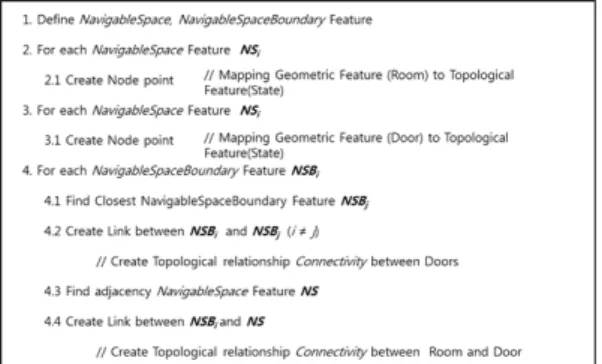
Figure 9. Construction Sequence of Topological Data for Surface-based Data

Figure 10. Construction Sequence of Topological Data for Volume-based Data

GeometricModel

The Figure 7 presents how to match spatial objects between the indoor modeling data based on Surface- orient geometric model and the Extended IndoorGML.

In the matching processes, wall features are defined as NonNavigableSpaceBoundary class, and door features are defined as NavigableSpaceBoundary class. Therefore, room features are defined as an aggregated class of NonNavigableSpaceBoundary and NavigableSpaceBoudary classes. These geometric objects are mapped into topological classes in IndoorGML, which are State (node) and Transition(link) classes.

On the other hand, the indoor modeling data based on Volume-oriented Geometric Model as seen in Figure 8 represents wall features defined as NonNavigableSpace with a solid and the boundaries of wall features defined as NonNavigableSpaceBoundary with a surface. The door features are defined as NavigableSpace with solid geometric type, while the boundaries of door features are defined as NavigableSpaceBoundary with a surface.

The rooms are defined as NavigableSpace, and the boundaries of room are defined as the aggregated boundaries of walls and doors. These geometric objects based on Volume-oriented Geometric Model are mapped into topological classes in IndoorGML, which are State(node) and Transition(link) classes.

4.2.3 Procedure to Generate Topological Models based on Extended IndoorGML

As seen in the above, the spatial objects defined by different geometric models can be mapped into the same topological objects based on the proposed Extended IndoorGML. For the surface-oriented data created by the method using 3D laser scanning, the spatial features are classified as either NavigableSpace features or NavigableSpaceBoundary features as the first step to define the topological model based on the proposed Extended IndoorGML. The features classified by NavigableSpace features and NavigableSpaceBoundary features are mapped into Indoorcore::State, which is realized as a Node. And the next step is to query the NavigableSpaceBoundary features of the Navigable Space defined in the previous step, and to map their relations into Indoorcore::Transition, which is realized as a Link in the IndoorGML. These procedures to

generate the topological model based on Extended IndoorGML are summarized as the Figure 9.

For the indoor modeling data created by the method using 2D CAD drawing maps of buildings, the topological model can be generated much simpler than the previous case.

The geometric objects in the indoor modeling classified by NavigableSpace features are mapped into Indoorcore::State, which is realized as a Node. And the next step is to query the NavigableSpaceBoundary features of the NavigableSpace defined in the previous step, and to map their relations into Indoorcore::

Transition, which is realized as a Link in the topological model. These procedures to generate the topological model are summarized as the Figure 10.

The Figure 11 demonstrates the example how to

generate the topological data of the indoor space

modeling data created by Surface-oriented Geometry

Model. The topological data based on the Extended

IndoorGML is a network data consisting of six Nodes

and five Links, which represent a building having two

rooms and two doors of a building. Meanwhile, the

Figure 12 shows how to generate the topological

(10)

Figure 11. Example of Extended IndoorGML for Surface-based Model

Figure 12. Example of Extended IndoorGML for Volume-based Model

Table 1. Essential Attributes for Node Attribute

Name

Attribute

Type description

id String Identifier

Type NodeType

NodeType is a enumeration.

It has two values such as GeneralSpace and TransferSpace.

GeneralSpace means a space for general purpose such as Room, Lobby, Hallway. TransferSpace means a space for moving between GeneralSpaces such as Door and Gate.

Related

SpaceId String Identifier of related AbstractSpace or AbstractSpaceBoundary

Connecte dLink

Set of

link A set of link to adjacent node

Table 2. Essential Attributes for Link Attribute

Name

Attribute

Type description

id String Identifier

L_Node String Identifier of one connected node R_Node String Identifier of the other connected

node

Type LinkType

LinkType is a enumeration.

It has two values such as Connectivity and Adjacency.

Connectivity means that object can move free between connected end nodes. Adjacency means that at least one of end nodes represents Non Navigable space or Non Navigable space boundary.

Related

SpaceId String Identifier of related AbstractSpace or AbstractSpaceBoundary

network data of the indoor space modelled by Volume-oriented Geometry Model. The network-based topological data is composed of four Nodes and three Links representing a building consisting of two rooms and two doors based on the proposed Extended IndoorGML.

4.2.4 Data Structure of Topological Model As seen in Figure 11 and Figure 12, the generated topological network data fully depends on the indoor spatial geometric model. In other words, because the geometric data generated by Surface-oriented Geometric Model is different from the geometric data generated by Volume-oriented geometric Model representing the same building, the topological data are different from each other. In order to integrate one data set with other data set using the proposed TRM, the topological network data needs additional attributes in Nodes and Links.

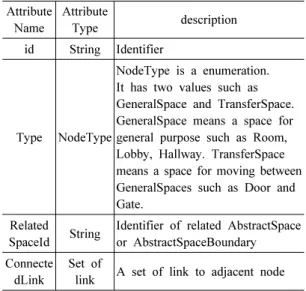
Each node in the databases has an identifier, node-type, RelatedSpaceID and ConnectedLinkNode.

Because the unit of Indoor LBS is a single room, the attribute data is also room-based information that is a description of node characteristics in the topological network. The node-type attribute is defined to match

with the type of spatial objects, which are represented

with different geometric data types in the different

Geometric Models. The reason is that one door feature

represented by Surface-oriented Geometry Model is

abstracted into two Nodes while the door represented

by Volume-oriented Geometry Model is abstracted into

one Node. The ConnectedLinkNode attribute is used

for querying the spatial objects being adjacent or

connected to the Node. The Table 1 describes the list

of essential attributes for implementing the Topological

Relation Model for data fusion.

(11)

Figure 13. Simple Map of Example Buildings for Experiment

Figure 14. 2D Example of Volume-based Modeling for Building A

Figure 15. 2D Example of Surface-based Modeling for Building B

Each link in the database has identifier, from_node, to_node, link-type and Related SpaceID. The Link is defined by from_node and to_node attributes, and the link-type attribute presents the type of topological relationships, which are adjacency and connectivity relationships. The topological relationships are used for implementing topological analysis such as shorted path analysis. In the Table 2, the basic attributes of the link are listed and described.

5. Experimental Examples

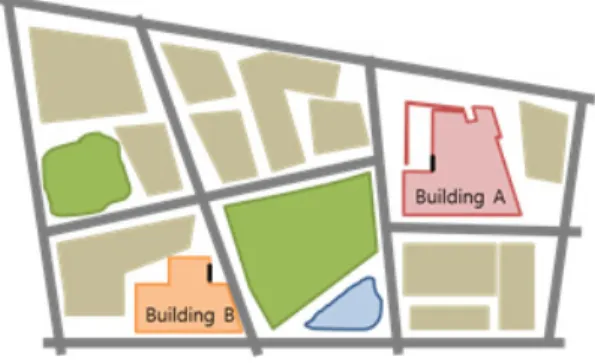
This section demonstrates how to implement the proposed Topological Relation Models to provide an indoor GIS application service, which uses two types of indoor space geometric data described in the previous section. As seen in Figure 13, the study area is a city block where two buildings and roads are located in. The entrances of the buildings are colored in black in the figure.

The geometry model of Building A is created by using 2D CAD drawing maps of buildings’ method.

The geometric model is based on Volume-oriented Geometry Model. As seen in Figure 14, six rooms, three hallways, one corridor and thirteen doors are displayed on the 2D building drawing map.

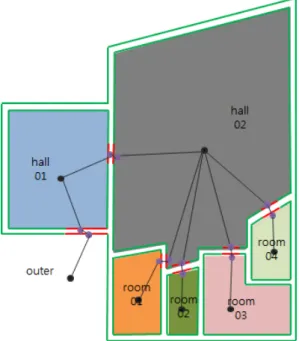
On the other hand, the geometric model of Building B is generated by the 3D laser scanning method, which utilizes the Surface-oriented Geometry Model. The Figure 15 is the 2D drawing map of the Building B, where four rooms, two hallways, and six doors are displayed on.

As mentioned in the above, the proposed TRM is a spatial data fusion method, which is implemented in application-level. One example of spatial query in indoor LBSs is “Please define the optimal route from a Room #5 in a Building A to a Room #3 in a Building B”. In order to perform this kind of spatial query analysis in the study area, the topological models of the study area should be generated from the indoor space geometric data of the study area in base of the proposed Extended IndoorGML.

In order to generate the topological network data,

the spatial features in the geometry model of Building

A created by the method using 2D CAD drawing maps

(12)

Figure 16. Example of IndoorGML for Building A

Figure 17. Example of IndoorGML for Building B of buildings, need to be identified as NavigableSpace

objects. The Rooms, Hallways, Corridors, Elevators, Outers, and Doors features are defined as Navigable Space objects, which are abstracted into States(realized by Nodes) in the topological model. The topological relationships among the spatial objects are abstracted into Transitions(realized by Edges) in the topological model based on the Extended IndoorGML. As seen in Figure 16, the topological network model consists of twenty four States and twenty four Transitions.

From the geometric model of Building B generated by the 3D laser scanning method, the topological model is derived according to the Extended Indoor GML in Figure 17. The geometric data of Building B is created by Surface-oriented Geometry Model, which the solid is represented by the set of surfaces.

Because of that, the topological model cannot be derived from the spatial relationships among the NavigableSpace features. Therefore, as seen in Figure 17 the topological model can be defined by the relationships between a NavigableSpaceBoundary feature and a NavigableSpace feature or among NavigableSpace Boundary features. The topological network of the Building B is composed of nineteen States(nodes) and eighteen Transitions(edges) as seen in Figure 17.

Suppose that a person wants to find a route from Room #5 in the Building A to Room #3 in the Building B at the study area(Figure 13). In order to perform the spatial query in indoor GIS applications, the indoor spatial models of Building A and B should be used in the same application even though the indoor data are represented differently according to the Geometry Models as described in the previous. In order to do that, the spatial data fusion process between two indoor modeling data sets is required to develop the system.

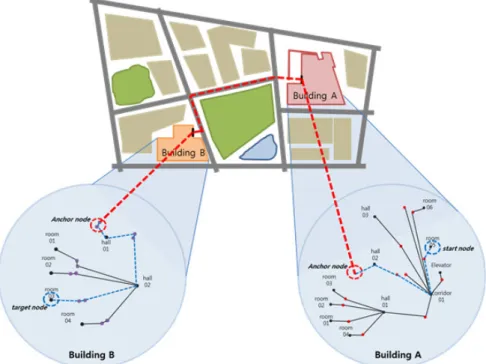
We used the proposed TRM to integrate the indoor spatial models of Building A and B without converting or exchanging the geometric data of buildings. The topological network of Building A is linked with the street network, and the topological network of Building B is also connected with the street network. The linked node is defined as an AnchorNode in the IndoorGML, which represents entrances of buildings. As a result, the composited topological network of the study area is generated as seen in Figure 18.

In order to perform the spatial query such that

“Please search the optimal route from Room #5 in

Building A(called a starting point) to Room #3 in

Building B(a destination)”, we can use the topological

network of the study area in Figure 18. The optimal

route is defined with three steps. The first step is to

define the path between a starting point(Room #5) to

an entrance of the building (called AnchorNode) in the

Building A, which is colored in blue, and then the path

(13)

Figure 18. Result of Query Processing Between Different Buildings Using Extended IndoorGML

between the entrances of Building A and Building B is defined and displayed with a red dot line in the Figure 18. Finally, the path from the entrance of Building B to the destination(Room #3) is defined and displayed with a blue dot line in the figure. From the results, the route from the starting point to the destination in the study is determined as seen in Figure 18.

6. Conclusion

According to the purpose of applications, the application will utilize the most suitable data model and 3D modeling data for the application would be generated based on the selected data model. Several researchers have developed several data fusion methods to deal with improving data comparability to integrate the data sets generated based on various data models.

With a different approach, this study proposes a spatial data fusion method using topological relationships among spatial objects in the feature classes, called Topological Relation Model(TRM). The TRM is a spatial data fusion method implemented in application- level, which means that the geometric data generated by two different data models are used directly without

any data exchange or conversion processes in an application system to provide indoor LBSs. And, to evaluate the potential benefit of a spatial data fusion method for improving the data compatibility and reuses, we presented experimental implementations of the proposed data fusion method.

However, further researches are required to implement the proposed data fusion methods to handle the more complex urban built-environment. Further research will include: 1) automatic generation of topological models based on IndoorGML, 2) standardization of the database schema of the topological model to implement the proposed Topological Relation Model for various indoor space modeling data sets, and 3)integration with 3D visualization system to allow the manipulation and exploration of geo-referenced virtual indoor space with the provision of handle spatial(geometric and topologic) information in the various data sets of 3D indoor.

References

[1] Bang, Y. S; Ga, C. L; Yu, K. Y. 2012, Matching

and Attribute Conflating Method for Linking the

Digital Map with The Road Name Address

(14)

System, Journal of The Korean Society of Surveying, Geodesy, Photogrammetry and Cartography, 30(4):

379-388.

[2] Goh, I. D; Choi, J. H; Kim, E. D; Jeong, Y. S;

Lee, J. M. 2008, Extracting Building Geometry from BIM for 3D City Model, Korean Journal of Geomatics, 16(2):249-261.

[3] Hwang, J. R; Kang, T. W; Hong, C. H. 2012, A Study on The Correlation Analysis Between IFC and CityGML for Efficient Utilization of Construction Data and GIS Data, Korean Journal of Geomatics, 20(5):49-56.

[4] Isikdag, U; Zlatanova, S. 2009, Towards Defining a Framework for Automatic Generation of Buildings in CityGML Using Building Information Models, 3D Geo-Information Sciences, pp. 79-96.

[5] Kang, H. Y; Hwang, J. R; Lee, J. Y. 2013, A Study on The Development of Indoor Spatial Data Model Using CityGML ADE, Journal of Korea Spatial Information Society, 21(2):11-21.

[6] Kim, J. O; Huh, Y; Lee, W. H; Yu, K. Y. 2009, Matching Method of Digital Map and POI for Geospatial Web Platform, Journal of Korean Society for Geospatial Information System, 17(4):23-29.

[7] Kwan, M. P; Lee, J. 2005, Emergency Response after 9/11: The Potential of Real-Time 3D GIS for Quick Emergency Response in Micro-Spatial Environments. Computers, Environment and Urban Systems, 29(2):93-113.

[8] Lee, J. 2001, A 3-D Object Based Data Model

for Representing Topological Relations in Urban Micro-Spatial Environments, Geography Colloquium Series at Department of Geography, The Ohio State University, Columbus, Ohio, February 15.

[9] Lee, J.; Kwan, M. P. 2005, A Combinatorial Data Model for Representing Topological Relations among 3D Geographical Features in Micro ‐ Spatial Environments. International Journal of Geographical Information Science, 19(10): 1039- 1056.

[10] Li, K. J; Lee, J. Y. 2013, Basic Concepts of Indoor Spatial Information Candidate Standard IndoorGML and Its Applications, Journal of Korea Spatial Information Society, 21(3):1-10.

[11] Lee, J; Li, K. J; Zlatanova, S; Morley, J. 2014, IndoorGML v.0.8.2, Open Geospatial Consortium.

[12] Ministry of Land, Transport and Maritime Affairs, 2012, Research on Indoor Spatial Information and Point of Interest Management System.

[13] Ministry of Land, Infrastructure and Transport, 2013, Open Platform Spatial Information Service Improvement and 3D Spatial Information Construction and Application Service.

[14] Raper, J. F; Kelk, B. 1991, Three-Dimensional GIS, Geographical Information Systems: Principles and Application, 1, 21.

[15] Zlatanova, S; Holweg, D; Coors, V. 2004, Geometrical and Topological Models for Real-time GIS, Proceedings of UDMS, pp. 27-29.

논문접수:2014.03.01

수 정 일:2014.04.21

심사완료:2014.04.22

수치

Figure 1. Example for Same Object Expressed in  Different Class Names
Figure 2. Structure Space Model[11]
Figure 3. UML Diagram of Space Relation Model[11]
Figure 5. Example for Volume-based Indoor Space  Modeling Using 2D CAD Drawing
+7

참조

관련 문서

The implemented route guidance system follows the Indoor Geography Markup Language (IndoorGML), which is the indoor spatial information standard, and provides

This study reports sensitivity enhancement method of a temperature sensor based on fiber Bragg grating (FBG) in combination with an auxiliary materials with a

In this thesis, this method choosing the node having reliable RSSI values based on the reliability of the signal is proposed for the... more accurate

[표 12] The true model is inverse-gaussian, out-of-control ARL1 and sd for the weighted modeling method and the random data driven

à Transactions scanning the relation acquire a shared lock in the data item. à Transactions scanning the relation acquire a shared lock in

Data standards and metadata in spatial database systems. 5.1 Issues with implementing standards and metadata in

 The simplest method of storing a raster layer in the memory of the computer is using a data structure called an array..  We consider alternative methods for searching through

• Spatial coherence describes the correlation between waves at different points in space.. Temporal