• 검색 결과가 없습니다.

An Empirical Study on the Relationship Between Transformational Leadership and Employee Creativity: Mediating Role of Perception of Meaning in Work and Work Engagement

N/A
N/A
Protected

Academic year: 2021

Share "An Empirical Study on the Relationship Between Transformational Leadership and Employee Creativity: Mediating Role of Perception of Meaning in Work and Work Engagement"

Copied!
12
0
0

로드 중.... (전체 텍스트 보기)

전체 글

(1)

An Empirical Study on the Relationship Between Transformational Leadership and Employee Creativity: Mediating Role of Perception of

Meaning in Work and Work Engagement

Hong-Lei Mu

1

, Young-Chan Lee

2*

, Changqing Duan

1

1

Graduate Student, International Business Cooperative Course, Dongguk University

2

Professor, Department of Business Administration, Dongguk University

변혁적 리더십이 직장인 창의성에 미치는 영향:

일의 의미와 일 몰입의 매개효과를 중심으로

무홍레이1, 이영찬2*, 단상청1

1동국대학교 경영학부 대학원생, 2동국대학교 경영학부 교수

Abstract China's rapid economic growth is continuous but the country still has a long way to become a center for creativity. Leaders have no idea how to encourage their employees to work more efficiently in Chinese companies.

Meanwhile the majority of employees are not fully engaged in their work, sometimes they think their work is not meaningful. The purpose of this study is to explore the relationship between transformational leadership and employee creativity, through perceptions of meaning in work and work engagement among employees working in XunLei Networking Technology Corporation. 140 valid data were collected and were analysed using SPSS and AMOS.

Results showed that transformational leadership has a positive and significant influence on meaning in work and work engagement. Meaning in work has a significant effect on work engagement, and work engagement has a significant influence on employee creativity. This study provides both academic and practical implications about transformational leadership and employee creativity through meaning in work and work engagement.

Key Words : Leadership, Transformational Leadership, Meaning in Work, Work Engagement, Employees Creativity

요 약 중국의 급속한 경제 성장은 지속되고 있으나 창의성 측면은 아직 요원하다. 중국 기업의 관리자들은 직원들이 보다 효율적으로 업무를 수행할 수 있도록 장려하는 노하우가 아직 부족하다. 한편 중국 기업에서 일하고 있는 대부분의 직원들은 자신의 업무에 몰입하지 않을 뿐만 아니라 때로는 자신의 업무가 의미가 없다고 생각하는 경우가 많다. 이러한 배경에서 변혁적 리더십은 중국 IT 기업에서 중요한 역할을 할 수 있다. 본 연구의 목적은 중국 심천에 소재한 IT기업에서 근무하는 직원들을 대상으로 업무 및 업무 참여의 의미에 대한 인식을 통해 변혁적 리더십이 직원의 창의력에 미치는 영향 을 조사하는 것이다. 이를 위해 사례 IT기업에 근무하는 직원들을 대상으로 광범위한 설문조사를 실시하여 140개의 유효 데이터를 수집하였다. 자료의 통계분석은 SPSS와 AMOS를 이용하였다. 분석결과 일과 노동 참여의 의미를 통한 변혁적 리더십이 직원의 창의력에 유의한 영향을 미치는 것으로 나타났으며 이에 대한 학술적, 실무적 시사점을 제시하였다.

주제어 : 리더십, 변혁적 리더십, 일의 의미, 일 몰입, 창의성

*Corresponding Author : Young-Chan Lee([email protected]) Received June 27, 2018

Accepted August 20, 2018

Revised July 17, 2018 Published August 28, 2018
(2)

1. Introduction

Industry reports in China showed that the majority of employees in some IT companies were not fully engaged in their work, and that the engagement level were steadily declining and lacking productivity.

XunLei Networking Technology Corporation was adopted as an example to examine the relationship between transformational leadership and employee creativity through perception of meaning in work and work engagement. This study mainly to find that whether the employees are more creative, and want to be engaged in their work and feel that their work is more meaningful through leader's simulation. More and more IT companies have begun to focus on transformational leadership in China. According to the prior study, transformational leadership is one of the most dominant paradigms in the contemporary leadership literature[1]. It has connections with employee outcomes, things like, team work[2], organizational citizenship behavior [3], and well-being[4]. The transformational leadership has been defined as

“Leaders and employees create a bridge which can help each other to get a higher level of morality and motivation”[5]. Thus a transformational leader is a morally mature leader who motivates followers’ behaviors and attitudes to generate higher levels of moral reasoning in followers. However, transformational managers do not influence subordinates’ attitudes and behaviors in a simple way. While evidence suggested numerous mediation mechanisms through which transformational leadership affect subordinates.

[6]found that the process of influence or the mechanism through which transformational managers motivate subordinates needed further investigation. The prior studies showed us that through inspirational stimulation, leaders are seen as having a compelling vision of the future, and communicating optimism about future goals, which in turn increases employees’ personal core values[2, 7]. Thus we can predict that there is a positive relationship between transformational

leadership and meaning in work. And according to [8], they has found that employees’ feelings of involvement, cohesiveness, commitment, potency and performance are enhanced by the transformational leadership style.

So we can predict that transformational leadership has a positive relationship with work engagement. Through the empirical evidence of [9], transformational leadership has positively impacts on both the individual creativity of employees and organizational innovation.

Therefore we can predict that transformational leadership is positively related to employee creativity.

And meanwhile employees’ perception of meaning in work positively predict employees’ work engagement.

Through [10], we know that employees engagement can make a true different which helping followers to come up with some new ideas at the workplace. This means that we can predict that work engagement has a significant relationship with employee creativity.

2. Literature Review

2.1 Transformational Leadership

According to [11], transformational leadership has different dimensions, they are: Giving followers right to have freedom of choice and appealing to the ideals of followers. Leaders need to know the importance of positive development of employees and internal motivation, improving follower's moral standards, cultivating employees' high moral standards and employees can also develop well with share values, high ethical standards of ethical climate. In this study, 4 components to transformational leadership was used as a theory. First is idealized influence, which is a leader's ability to create commitment and dedication which can help employees to recognize themselves.

The second is inspirational motivation, which involves

a supervisor’s ability to create a vision that appeals to

followers and makes them as a significant part of the

organization. The third is stimulation, which involves

leaders’ ability to stimulate employees’ efforts to be

(3)

innovative through questioning assumptions and taking risks. The final behaviour is individualized consideration, leaders act as a mentor or coach paying special attention to the different needs of individuals[12].

2.2 Meaning in Work

The main interest in meaning in work has been fuelled by the assumption that personal and organizational outcomes were associated with perceptions of meaning in work[13]. As an indication for the importance of meaning in work, the construct of meaning in work has been found in major models, such as in the empowerment model[14], and job characteristics model[15]. [16] suggested that if employees realize the individual's self-perception and self-evaluation, they tend to experience both internally motivating and meaningful even the work tasks are not enjoyable. Meaning in work scholars have proposed that when employees experience intrinsic motivation, employees are willing to explain it as a symbol of consistency between their job tasks and their self-concepts, which can cause bigger experienced meaningfulness. Meaning in work can be viewed as a source of individuals’ and organizational outcomes, such as well-being, organizational commitment, job satisfaction.

2.3 Work Engagement

[17] was the first people to come up with "personal engagement", he defined that "employees' self work roles in terms of organization governance: in engagement, people employ and express themselves emotionally, mentally and physically during role performance". There are two perspectives about the definition of work engagement. On the one hand, [18]

assume that as two opposite poles, there is a continuous existing in engagement and burnout. On the other hand, engagement in its own right as the positive antithesis of burnout[19]. According to this approach, work engagement is defined as satisfying, desirable high-energy and work-related of mind which covers

three dimensions: vigor, absorption and dedication[20].

Vigor is followers with mental resilience and high-energy when they are working. When followers are facing difficulties, they are willing to deal with the problem and tend to invest effort to their work. Absorption is followers can fully concentrate on their work, whereby time passes quickly and one has difficulties with detaching oneself from work. Dedication means employees tend to be fully engaged in their work with a sense of enthusiasm, pride, inspiration and challenge.

2.4 Employee Creativity

According to conventional wisdom, creativity is something that creative people have to do. There are some features about creative individuals that we can tell from their less creative peers. They are wealthy in knowledge and high skills: they find their work intrinsically motivating, they tend to be nontraditional, independent and risk takers. And they also have a wide vision and a broad horizon to new experiences. Many studies have identified creativity as an outcome that focuses on new and useful ideas[21]. Individual creativity consists of: need for achievement, locus of control, encounter to ambiguity condition, and creativity-related skills. According to [22], individual creativity are divided into three components: expertise, creative-thinking skills, and motivation. Mangers can influence these components for better and worse through workplace practices and conditions. Expertise and creative thinking skills are more difficult and time consuming to achieve than motivation. Intrinsic motivation stimulates high level of persistence and creative effort on work contexts where creativity is clearly valued. [22] defined individual creativity as,"the production of novel and useful ideas by an individual or small group of individuals working together".

3. Research Model and Hypothesis

The research model of this study includes 4

variables. They are transformational leadership,

(4)

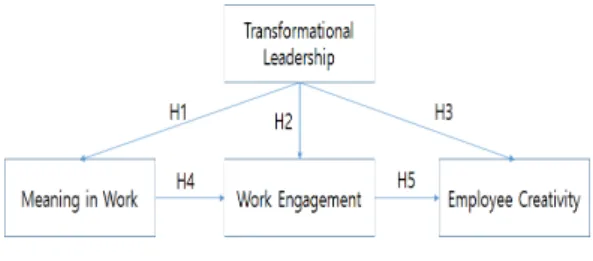
meaning in work, work engagement and employee creativity. Research model was showed in Fig. 1.

Fig. 1. Research Model

3.1 Transformational Leadership and Meaning in Work

Meaning in work not only concerns reward an employee to encourage their performance, but also forms the link between purpose and values[23]. Leaders want to develop goals, missions and identities for company that can impact employees’ perceptions to perceive work as meaningful. Through inspirational stimulation, leaders are viewed as having a compelling vision of the future, and communicating optimism about future goals, which in turn increases employees’

personal core values[7, 8]. Consistency between leaders’

vision of the company’s objectives and the core value of their employees are more likely to appear. Thus, employees are likely to perceive the work to be more motivational and creative-all of which are integral components of perceiving meaning in work[24].

Excellent leaders’ transformational leadership behaviors and employees’ perception of meaning in work is likely to improve. Thus we propose a hypothesis as follows:

H1: Transformational leadership has a positive effect on meaning in work.

3.2 Transformational Leadership and Work Engagement

Transformational leadership includes four parts:

inspirational motivation; idealized influence; individual consideration and intellectual stimulation. In other words, the leader is optimistic and enthusiastic about the future. Idealized influence refers to behaviors like

benefits of the group are more important than benefits of the individual, demonstrating high ethical norms, and being a role model for the employees[25]. Inspirational motivation and idealized influence together are also called “charisma". "Charismatic" leaders have a positive influence on their employees and can change the self-focus of the employees to a collective focus[26].

As a result, employees become more involved with the vision of the leader and are willing to make sacrifices for that vision[27]. The third component of transformational leadership, individual consideration, refers to coaching, supporting and stimulating subordinates. The supervisor acknowledges followers’

feelings and emotions and their need to grow and develop themselves. Employees are seen as unique individuals who need specific, individual attention that is congruent with the developmental phase they are in[28]. The last component of transformational leadership is called intellectual stimulation, which means that the supervisor challenges the subordinate to see problems from a different perspective. It has been found that employees’ feelings of involvement, cohesiveness, commitment, potency, and performance are enhanced by the transformational leadership style[29]. If employees receive motivation, assistance quality coaching and stimulation from leaders, they tend to be highly engaged with the work. Thus:

H2: Transformational leadership has a positive effect on the work engagement.

3.3 Transformational Leadership and Employee Creativity

Transformational leadership can positively influence

employees’ creativity, as it promotes employee

motivation to challenge old ways of doing things[30]. In

addition, as firms in the hospitality industry aim to

increase the satisfaction of customers, transformational

supervisors can encourage the desire of creative people

to provide better quality services, and thus help to

develop and maintain competitive advantages[31]. For

example, [32]evaluated the effects of different

(5)

leadership styles in a longitudinal laboratory experiment, and the results indicated that transformational leadership had more positive effects on group effectiveness. [9] proposed that transformational leadership has positively impacts on both the individual creativity of employees and organizational innovation.

Thus, we proposed the following hypothesis:

H3: Transformational leadership has a positive effect on employee creativity.

3.4 Meaning in Work and Work Engagement The body of literature on meaning in work and work engagement indicated the relationship between both terms but with some contradictions. Work engagement has been studied in both directions: either as an antecedent variable to appearance of meaning in work or as a consequence for finding meaning in work. On the one hand, some supported the idea that perceiving meaning in work is an intrinsic motivational factor that predicts characteristics of work engagement[33].

Others found meaning in work as an antecedent to work engagement[34]. Some also have suggested that during times spent in work when the employee is being engaged, employees may come to value the work they do and be more aware about the significant and values of the work values[35]. Therefore:

H4: Employees' perceptions of meaning in work has a positive effect on the employee's work engagement.

3.5 Work Engagement and Employee Creativity Through literature review, we found that some internal and external factors influencing the success of employee engagement in the workplace. [36]used inductive methods to investigate factors affecting engagement in the innovation process. The study showed that three types of demand were interacted and coadjutant to impact engagement which give managers implications to improve followers' creative behaviour.

Some previous scholars on employee engagement have partially mentioned creativity and innovation as an

outcome of engaged employees. [37]pointed out that employees engagement is very difficult to imitate, which means engaged employees are eager to their job tasks and will be highly immersed in their work. The empirical results evidently showed that employees engagement can make a positive influence helping followers to come up with some new ideas at the workplace. Thus:

H5: Work engagement has a positive effect on the employee creativity.

4. Research Design and Research Result

4.1 Operational Definition and Measurement Items

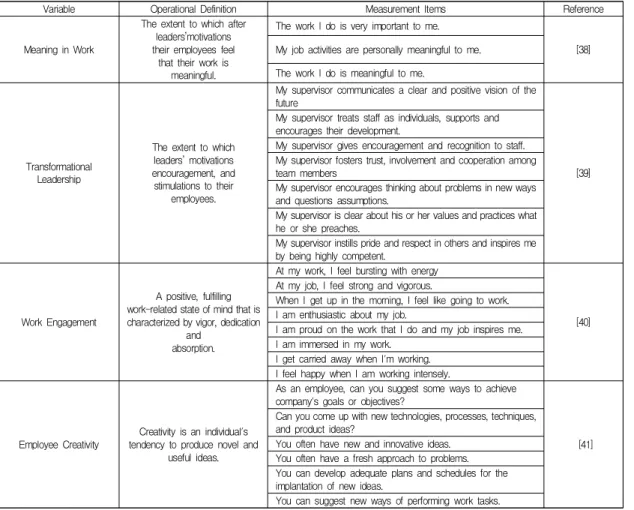
Table 1 showed the operational definition of each concept and measurements for each variable with related previous studies.

4.2 Sampling Design and Data Collection With the science and technology's rapid development, high technology companies like XunLei Networking Technology Corporation in ShenZhen, China, has realized that human resources are critical for high-tech companies' development. The key point for human resource is to motivate them to develop their innovation and creativity. Thus, this study adopted the method of questionnaire survey and focused on the employees working in XunLei Corporation. The survey was conducted from June to September in 2016 by using instant message and e-mail in China.

Questionnaires were translated into Chinese. Each measurement item is rated on 5-point Likert-scale. A total number of 183 employees are collected and among all of the respondents, 140 data are valid to use. Data was analyzed using SPSS 20.0 and Amos 20.0.

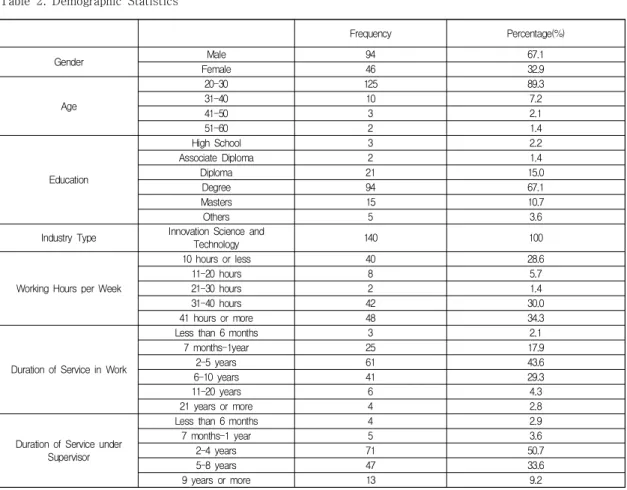
The demographic characteristics of the respondents

was shown in Table 2. From the table we can see that

there 61.7% males and 32.9% female. And in terms of

(6)

the age distribution, 89.3% of the respondents are under 30s and 10.7% of respondents are over 30s. And in terms of the education, 15% of respondents have diploma. 67.1% of respondents have bachelor degree, 10.7% of respondents have master. In terms of working hours per week, 35.7% of respondent is below 30 working hours per week, and meanwhile 64.3% of respondents is over 30 working hours per week. In terms of duration of service in work, 63.6% of respondents are under six years, but 36.4% of respondents are over six years. In terms of duration of service under supervisor, 57.2% of respondents are under 4 years, but 42.8% of respondents are over 4 years.

4.3 Validity, Reliability and Model Fit Test Validity is “an integrated evaluation judgement of the degree to which empirical evidence and theoretical rationale support the adequacy and appropriateness of inferences and actions based on test score". Factor analysis is a common used procedure for interpreting a large number of correlations is factor analysis, which is a group of analytical and statistical techniques.

Table 3 showed the factor loading and Cronbach’s alpha results of the research model. From the table we can see that the lowest accepted level of factor loading is higher than 0.5. And Cronbach’s alpha was used to measure the reliability of each item. From the table we can know that Cronbach's alpha for all of the variable are more than 0.7, which indicating a good reliability of

Variable Operational Definition Measurement Items Reference

Meaning in Work

The extent to which after leaders’motivations their employees feel

that their work is meaningful.

The work I do is very important to me.

[38]

My job activities are personally meaningful to me.

The work I do is meaningful to me.

Transformational Leadership

The extent to which leaders’ motivations encouragement, and stimulations to their

employees.

My supervisor communicates a clear and positive vision of the future

[39]

My supervisor treats staff as individuals, supports and encourages their development.

My supervisor gives encouragement and recognition to staff.

My supervisor fosters trust, involvement and cooperation among team members

My supervisor encourages thinking about problems in new ways and questions assumptions.

My supervisor is clear about his or her values and practices what he or she preaches.

My supervisor instills pride and respect in others and inspires me by being highly competent.

Work Engagement

A positive, fulfilling work-related state of mind that is characterized by vigor, dedication

and absorption.

At my work, I feel bursting with energy

[40]

At my job, I feel strong and vigorous.

When I get up in the morning, I feel like going to work.

I am enthusiastic about my job.

I am proud on the work that I do and my job inspires me.

I am immersed in my work.

I get carried away when I'm working.

I feel happy when I am working intensely.

Employee Creativity

Creativity is an individual's tendency to produce novel and

useful ideas.

As an employee, can you suggest some ways to achieve company's goals or objectives?

[41]

Can you come up with new technologies, processes, techniques, and product ideas?

You often have new and innovative ideas.

You often have a fresh approach to problems.

You can develop adequate plans and schedules for the implantation of new ideas.

You can suggest new ways of performing work tasks.

Table 1. Operational Definition and Measurements

(7)

Frequency Percentage(%)

Gender Male 94 67.1

Female 46 32.9

Age

20-30 125 89.3

31-40 10 7.2

41-50 3 2.1

51-60 2 1.4

Education

High School 3 2.2

Associate Diploma 2 1.4

Diploma 21 15.0

Degree 94 67.1

Masters 15 10.7

Others 5 3.6

Industry Type Innovation Science and

Technology 140 100

Working Hours per Week

10 hours or less 40 28.6

11-20 hours 8 5.7

21-30 hours 2 1.4

31-40 hours 42 30.0

41 hours or more 48 34.3

Duration of Service in Work

Less than 6 months 3 2.1

7 months-1year 25 17.9

2-5 years 61 43.6

6-10 years 41 29.3

11-20 years 6 4.3

21 years or more 4 2.8

Duration of Service under Supervisor

Less than 6 months 4 2.9

7 months-1 year 5 3.6

2-4 years 71 50.7

5-8 years 47 33.6

9 years or more 13 9.2

Table 2. Demographic Statistics

Variable Item Factor Loading Eigen Value Cronbach’s alpha

Transformational Leadership

TL4 0.866

5.201 0.944

TL5 0.826

TL3 0.825

TL1 0.803

TL2 0.794

TL7 0.786

TL6 0.753

Meaning in Work

WE2 0.772

2.678 0.903

WE1 0.766

WE4 0.761

WE8 0.729

WE5 0.590

Work Engagement

EC2 0.818

2.012 0.935

EC5 0.813

EC6 0.803

EC1 0.667

Employee Creativity

MW3 0.756

1.689 0.893

MW2 0.753

MW1 0.691

Table 3. Validity and Reliability Analysis

(8)

the variables. Table 4 showed the results of the convergent validity analysis result. From the table we can see that, the standard estimate(standardized indicator item loading) of each item is above the standard of 0.7, and all the Average Variance Extracted (AVE) are above 0.5, which indicating the convergent validity was confirmed. Table 5 showed the discriminant validity test result. The correlation indicators are all less than the square root of AVE and most of them are significant at the 0.01 level, which showing that the items are valid to use in this study.

For the model fit of the whole dataset. x²/DF is 1.736, less than 3.0. GFI is 0.903 is higher than the recommended value of 0.900. AGFI is 0.801, higher than the recommended value of 0.800. PGFI is 0.652, higher than the standard 0.6. CFI is 0.955 and NFI is 0.901, both larger than the recommended value of 0.9.

RMR is 0.048, less than value 0.050. RMSEA is 0.073,

less than the recommended value 0.080. According to the results, we could confirm the research model possesses a good model fit.

Hypothesis Standardized

Estimate S.E. C.R. P-value Result

H1 TL→MW 0.541 0.077 7.035 *** Accepted

H2 TL→WE 0.125 0.046 2.697 0.007 Accepted

H3 TL→EC 0.115 0.067 8.742 0.069 Rejected

H4 MW→WE 0.589 0.063 1.816 *** Accepted

H5 WE→EC 0.637 0.108 5.909 *** Accepted

Table 6. Hypothesis Test Result

Factors Item Standard Estimate S.E. C.R. AVE

Transformational Leadership

TL7 0.847 --- ---

0.709

TL6 0.705 0.08 9.614

TL5 0.859 0.075 13.136

TL4 0.876 0.072 13.562

TL3 0.868 0.069 13.474

TL2 0.876 0.07 13.629

TL1 0.852 0.072 12.889

Meaning in Work

MW3 0.907 --- ---

0.764

MW2 0.888 0.058 15.786

MW1 0.825 0.066 13.123

Work Engagement

WE8 0.787 --- ---

0.748

WE5 0.878 0.106 11.863

WE4 0.899 0.0903 12.347

WE2 0.878 0.096 11.935

WE1 0.877 0.091 11.989

Employee Creativity

EC1 0.789 --- ---

0.680

EC2 0.841 0.107 10.545

EC5 0.811 0.101 10.243

EC6 0.855 0.098 11.018

Table 4. Convergent Validity Analysis

Mean SD TL MW WE EC

TL 3.60 .73 0.842

MW 3.27 .75 .554*** 0.874

WE 3.33 .86 .600*** .823*** 0.865

EC 3.28 .93 .520*** .638*** .681*** 0.825

***) Correlation is significant at the 0.01 level (2-tailed).

Table 5. Discriminant Validity Analysis

(9)

4.4 Hypothesis Test

Table 6 gave the result of hypothesis test using the whole dataset. All the hypothesis were supported excepted H3. According to the result, work engagement has relatively strong influence on employee creativity (H5: 0.637***) at a high significant level, that is to say, for employees working in high-tech companies, when they want to be engaged in their work, they can extend their creativity. Meaning in work has the second stronger positive influence on work engagement (H4:

0.589***). When employees working in high-tech companies, if they feel that their work is meaningful, they want to be engaged in their work.

Transformational leadership has the third stronger positive influence on meaning in work (H1: 0.541***), that means when supervisors can motivate their subordinates, their subordinates will feel their work is meaningful. Transformational leadership has the forth stronger positive influence on work engagement (H2:

0.125***). That means, employees can be engaged in their job after top leaders’ motivation. But there is no direct relationship between transformational leadership and employee creativity (H3: 0.069). Thus, in Chinese IT company, leader's motivation may not extend employees' creativity directly.

5. Implications and Discussion

According to the results of our data analysis, we know that transformational leadership were proved positively influence on meaning in work (H1), and work engagement (H2), but transformational leadership has no direct effect on employee creativity (H3). In addition, meaning in work has a positive and significant influence on work engagement (H4), and work engagement has a positive and significant effect on employee creativity (H5).

5.1 Academic Implications

The result of H1 is accordance with the prior studies

of [7]. The study proved that leaders who developed goals, missions, and identities for company can impact employees' perceptions to perceived work as meaningful. The result of H2 is accordance with the prior studies of [8]. They showed that employees' feeling of involvement, commitment, potency and performance were enhanced by the transformational leadership style. The result of H3 indicated that there is no significant relationship between transformational leadership and employee creativity. This result is out of our expectation and may because the country discrepancy. The result of H4 is accordance with the prior studies of [33]. And the results of H5 is in accordance with [10].

5.2 Practical Implications

For high-level management working in XunLei Corporation, the main responsibilities for management is how to motivate their subordinates to work more efficiently and meaningfully. For employees, when high-level management do not realize motivation is an important things, employees tend to have no any directions to finish their work, they do not know how to utilize their time to achieve company’s objectives.

But if high-level management realize that stimulation can help subordinates to finish their work efficiently, using different motivation methods, the organizational climate can be changed, and the employees will know their value and would like to engage in their work.

H5 indicated that work engagement has the

strongest relationship with employee creativity,

comparing with the other hypothesis. That means, if

employees want to be engage in their work, they can

be more creative. Meaning in work has the second

strongest relationship with work engagement, which

indicated that if employees feel that their work is very

meaningful and not so boring, they tend to be engaged

in their work. Transformational leadership has the third

strongest relationship with meaning in work. Through

leaders' motivations, leaders can change employees'

ideas, make the work become more meaningful.

(10)

Sometimes, not all the employees want to be engaged in their work, sometimes they are very tired and lazy, sometimes, they will sleep when they are working. If leaders arrange some missions which can be figure out easily, they will have more motivations to engage in work.

5.3 Limitations

The study has some limitations. First of all, most of the respondents of this paper are under 30 years old, this may lead to bias among other people. Second, all the respondents are from innovation science and technology industry, different industry type may has different result, and we only choose one Chinese IT company, thus the limitation of industry type may influence the result. And all the respondents are from this IT company, maybe respondents in different companies will have different perspectives and this will influence the result. Third, we only focused on employees' perspectives and ignore measuring high-level managements' perspectives. As a matter of fact, high-level management is a main element for transformational leadership. Thus, it is suggested that future studies should focus on various industries and examine different kinds of leadership style.

REFERENCES

[1] T. A. Judge & R. F. Piccolo. (2004). Transformational and Transactional Leadership: A Meta-analytic Test of their Relative Validity. Journal of Applied Psychology, 89(5), 755-768.

[2] J. Kim. (2018). Effects of Team Leadership Behavior of SME Organization on Teamwork and Job Satisfaction.

Journal of the Korea Convergence Society, 8(2), 105-112.

[3] J. B. Kim. (2017). Influence of College Student’

Leadership Behavior Characteristics on Organizational Citizenship Behavior: Moderating Effect of Self-Efficacy.

Journal of the Korea Convergence Society, 8(12), 351-357.

[4] K. Nielsen & F. Munir. (2009). How do Transformational

Leaders Influence their Followers' Affective Well-being?

Exploring the Mediating Role of Self-efficacy, Work &

Stress, 23(4), 313-329.

[5] J. M. Burns. (1978). Leadership, New York.

[6] B. J. Avolio, S. Hannah, R. Reichard, A. Chan & F.

Walumbwa. (2009). A Meta-analytic Review of Leadership Impact Research: Experimental and Quasi-experimental Studies. The Leadership Quarterly, 20(5), 764-784.

[7] K. Nielsen, J. Yarker, S. O. Brenner & R. Randall. (2008).

The Importance of Transformational Leadership for the Well-Being of Employees Working with Older People.

Journal of Advanced Nursing, 63(5), 465-475.

[8] B. Shamir, R. J. House & M. B. Arthur. (1993).

Motivational Effects of Transformational Leadership: A Self-Concept Based Theory. Organization Science, 4(4), 577-594.

[9] L. Gumusluoglu & A. Llsev. (2009). Transformational Leadership, Creativity and Organizational Innovation.

Journal of Business Research, 62(4), 461-473.

[10] A. B. Bakker & W. B. Schaufeli. (2008). Positive Organizational Behavior: Engaged Employees in Flourishing Organizations. Journal of Organization Behavior, 29(2), 147-154.

[11] B. M. Bass. (1985). Leadership and Performance Beyond Expectations. Collier Macmillan.

[12] M. M. Chemers. (2000). Leadership Research and Theory: A Functional Integration. Group Dynamics:

Theory, Research and Practice, 4(1), 27-43.

[13] B. D. Rosso, K. H. Dekas & A. Wrzesniewski. (2010). On the Meaning of Work: A Theoretical Integration and Review. Research in Organizational Behavior, 30, 91-127.

[14] G. M. Spreitzer. (1997). Toward Common Ground in Defining Empowerment. Academy of Management Meetings, Vancouver, BC, Canada; An Earlier Version was Presented at the Aforementioned Conference.

Elsevier Science/JAI Press.

[15] J. R. Hackman & G. R. Oldham. (1976). Motivation through the Design of Work: Test of A Theory.

Organizational Behavior and Human Performance, 16(2), 250-279.

[16] B. Shamir. (1991). Self and Motivation in Organization.

Organization Studies, 12(3), 405-424.

[17] W. A. Kahn. (1990). Psychological Conditions of Personal Engagement and Disengagement at Work.

Academy of Management Journal, 33(4), 692-724.

[18] C. Maslach, S. E. Jackson & M. Lerter. (1997). The

(11)

Truth about Burnout: How Organizations Cause Personal Stress and What to do about It. Wiley.

[19] A. B. Bakker & E. Demerouti. (2007). Using the Job Demands-Resources Model to Predict Burnout and Performance. Human Resource Management, 43(1), 83-104.

[20] W. B. Schaufeli, I. M. Martinez & A. M. Pinto. (2002).

Burnout and Engagement in University Students: A Cross-National Study. Journal of Cross-Cultural Psychology, 33(5), 464-481.

[21] C. E. Shalley & L. L. Gilson. (2004). What Leaders Need to Know: A Review of Social and Contextual Factors that Can Foster or Hinder Creativity. The Leadership Quarterly, 15(1), 33-53.

[22] T. M. Amabile. (1998). How to Kill Creativity. Boston, MA: Havard Business School Publishing.

[23] N. Chalofsky. (2008). Work-Life Programs and Organizational Culture: The Essence of Workplace Community. Organization Development Journal, 26(1), 1095-1101.

[24] N. Chalofsky. (2003). An Emerging Construct for Meaningful Work. Human Resource Development International, 6(1), 69-83.

[25] J. E. Bono & T. A. Judge. (2004). Personality and Transformational and Transactional Leadership: A Meta-Analysis. Journal of Applied Psychology, 89(5), 901-910.

[26] S. L. Yorges, H. M. Weiss & O. J. Strickland. (1999).

The Effect of Leader Outcomes on Influence, Attributions, and Perceptions of Charisma. Journal of Applied Psychology, 84(3), 428-436.

[27] R. J. House & J. M. Howell. (1992). Personality and Charismatic Leadership. The Leadership Quarterly, 3(2), 81-108.

[28] B. J. Avolio & B. M. Bass. (1995). Individual Consideration Viewed at Multiple Levels of Analysis: A Multi-level Framework for Examining the Diffusion of Transformational Leadership. The Leadership Quarterly, 6(2), 199-218.

[29] B. Shamir, R. J. House & M. B. Arthur. (1993).

Motivational Effects of Transformational Leadership: A Self-Concept Based Theory. Organization Science, 4(4), 577-594.

[30] Y. Gong, J. Huang & J. Farh. (2009). Employee Learning Orientation, Transformational Leadership, and Employee Creativity: The Mediating Role of Employee Creative Self-Efficacy. Academy of Management Journal, 52(4), 765-778.

[31] A. Mohsin & T. Lockyer. (2010). Customer Perceptions of Service Quality in Luxury Hotels in New Delhi, India:

An Exploratory Study. International Journal of Contemporary Hospitality Management, 22(2), 160-173.

[32] J. J. Sosik. (1997). Effects of Transformational Leadership and Anonymity on Idea Generation in Computer-Mediated Groups. Group & Organization Management, 22(4), 460-487.

[33] D. R. May, R. L. Gilson & L. M. Harter. (2004). The Psychological Conditions of Meaningfulness, Safety, and Availability and the Engagement of the Human Spirit at Work. Journal of Occupational Psychology, 77(1), 11-37.

[34] F. Mendes & M. W. Stander. (2011). Positive Organization: The Role of Leader Behavior in Work Engagement and Retention. South African Journal of Industrial Psychology, 37(1), 1-13.

[35] A. B. Bakker & M. P. Leiter. (2010). Work Engagement:

A Handbook of Essential Theory and Research.

Psychology Press.

[36] K. L. Unsworth. (2003). Engagement in Employee Innovation: A Grounded Theory Investigation.

[37] B. K. Sundaray. (2011). Employee Engagement: A Driver of Organizational Effectiveness. European Journal of Business and Management, 3(8), 53-59.

[38] D. R. May, R. L. Gilson & L. M. Harter. (2004). The Psychological Conditions of Meaningfulness, Safety, and Availability and the Engagement of the Human Spirit at Work. Journal of Occupational Psychology, 77(1), 11-37.

[39] S. A. Carless, A. J. Wearing & L. Mann. (2000). A Short Measure of Transformational Leadership. Journal of Business and Psychology, 14(3), 389-405.

[40] E. Demerouti & A. B. Bakker. (2006). Employee Well-being and Job Performance: Where We Stand and Where We Should. Occupational Health Psychology:

European Perspectives on Research, Education and Practice, 1, 83-111.

[41] X. Zhang & K. M. Bartol. (2010). The Influence of

Creative Process Engagement on Employee Creative

Performance and Overall Job Performance: A Curvilineal

Assessment. Journal of Applied Psychology, 95(5),

862-873.

(12)

무홍레이(Mu Hong Lei) [정회원]

▪2017년 2월 : 동국대학교 글로벌비 즈니스(석사)

▪2017년 3월 ~ 현재 : 동국대학교 글로벌비즈니스(박사과정 재학)

▪관심분야 : 핀테크, 전자상거래, 모 바일 쇼핑

▪E-Mail : [email protected]

이 영 찬(Lee, Young Chan) [정회원]

▪1993년 2월 : 서강대학교 (경영학 사)

▪1995년 2월 : 서강대학교(경영학 석사)

▪2003년 2월 : 서강대학교(경영학 박사)

▪2004년 9월 ~ 현재 : 동국대학교 경주캠퍼스 경영학부 교수

▪관심분야 : 기업성과측정, 데이터마이닝, 복잡계 이론, 다기준의사결정

▪E-Mail : [email protected]

단 상 청(Changqing Duan) [정회원]

▪2016년 8월 : 동국대학교 석사

▪관심분야 : 기업가정신, 리더십

▪E-Mail :

[email protected]

수치

Fig.  1.  Research  Model
Table 3 showed the factor loading and Cronbach’s alpha results of the research model. From the table we can see that the lowest accepted level of factor loading is higher than 0.5
Table  2.  Demographic  Statistics
Table  5.  Discriminant  Validity  Analysis

참조

관련 문서