• 검색 결과가 없습니다.

Mediating Effects of Anger Level on the Relationship between Smartphone Addiction and School Adjustment of Middle School Students

N/A
N/A
Protected

Academic year: 2021

Share "Mediating Effects of Anger Level on the Relationship between Smartphone Addiction and School Adjustment of Middle School Students"

Copied!
8
0
0

로드 중.... (전체 텍스트 보기)

전체 글

(1)

Mediating Effects of Anger Level on the Relationship between Smartphone Addiction and School Adjustment of Middle School Students

1)

Pyeong-su Yu*, Hey-yeon Hwang**

Abstract

The purpose of this study is to analyze the mediating effects of anger level on the effects of middle school students' school adjustment on smartphone addiction. In order to accomplish the purpose of this study, the following research problems were set up.

First, what is the relationship between Chinese smartphone addiction, anger level, and school adjustment of Chinese middle school students? Second, what is the effect of smartphone addiction on middle school students' anger level and school adjustment? Third, what is the mediating effect of the level of anger in the process of affecting the school adjustment to smartphone addiction by Chinese middle school students?

The subjects of this study were five city schools and seven municipal schools in J-do, among which 450 students were enrolled from April 23 to May 18, 2018. A total of 439 copies were used for the analysis, except for 11 unexplained questionnaires or unfairly responded to the collected questionnaires.

The conclusions based on the results of this study are as follows.

First, there are negative correlations between the sub-factors of smartphone addiction and the sub-factors of school adjustment. Among them, tolerance is only positively correlated with the peer relationship. The sub-factors of smartphone addiction have negatively correlated with anger expression, anger control, and anger suppression. Second, the effect of sub-factors of smartphone addiction on the level of anger was 3.6%, and the effect on school adjustment was 4.2%. Third, The anger level of the middle school students affected the school adjustment by the smartphone addiction has a partial mediating effect of 0.8%.

▸KeyWord: smartphone addiction, anger level, school adjustment, mediating effects, middle school students

I. Introduction

휴대폰이 대중에게 확산되기 시작한 시점은 1990년대 말이 다. 그 때에는 이동 중에 통화하는 것이 주목적이었으며, 데이터 통신은 문자 메시지를 주고받는 정도가 대부분이었다. 그러나 휴대폰이 진화를 거듭하면서 데이터 통신 기술도 비약적으로 발 전하였으며, 오늘에 이르러서는 이동통신망 외에도 Wi-Fi, DMB, GPS, 블루투스 등 다양한 방식으로 데이터 통신을 이용할

수 있게 되었다. 특히 최근 보급이 확대되고 있는 스마트폰에서 는 이상의 통신 방식들을 거의 모두 이용할 수 있다.

미국의 여론조사기관인 '퓨 리서치'에 따르면, 2019년 우리 나라의 스마트폰 보유율은 95%로 조사대상 27개국 가운데 가장 높았다. 이런 높은 보유율에 따라 우리나라 청소년들의 스마트폰 보유는 거의 100%에 가깝다고 할 수 있다. 청소년

∙First Author: Pyeong-su Yu, Corresponding Author: Hey-yeon Hwang

*Pyeong-su Yu ([email protected]), Dept. of Education, Jeonju University

**Hey-yeon Hwang ([email protected]), The Education Innovation Division, Jeonju University

∙Received: 2019. 05. 31, Revised: 2019. 06. 17, Accepted: 2019. 06. 21.

(2)

들의 스마트폰 사용의 공과는 연구에 따라 다양하여 긍정적인 면과 부정적인 면을 동시에 가지고 있다고 할 수 있다. 스마트 폰 사용의 긍정적 영향을 다룬 연구결과를 보면, 스마트폰 상 에서 SNS 등의 활용은 관계적인 면에서 안정감, 소속감을 채 워주며[1], 다양한 애플리케이션의 활용은 신체적으로는 건강 관리 및 증진 효과[2]를, 인지적으로는 청소년의 시공간 지능 강화 등의 고등적 사고활동 촉진 효과[3]를, 정신건강 면에서 는 여가활동과 놀이기회를 제공하여 스트레스를 해소하는 역 할[4]을 하는 등 스마트폰 사용이 관계, 신체, 인지, 정신 등 다양한 영역에 긍정적 영향을 미치는 결과들을 제시하고 있 다.

그러나 스마트폰 사용의 부정적 영향을 다룬 연구결과들도 있어, 관계적 측면에서는 스마트폰 사용 빈도수와 면대면 대 화 간에 부적 관계가 보고되었고[5], 신체 건강 면에서는 다 른 미디어기기와 마찬가지로 손목터널증후군과 같은 근골격계 의 문제[6], 시력 저하 혹은 근시 증가[7]가 나타나며, 스마트 폰의 다중처리방식의 사용은 추상적·비판적 사고와 같은 고차 원적 인지 능력의 저하[8], 우울, 사회적 불안과도 깊은 관련 이 있다[9]는 등 과도한 스마트폰 사용은 청소년에게 여러 가 지 부정적 영향을 미치는 것으로 나타나고 있다.

스마트폰 사용의 긍정적인 효과에도 불구하고 청소년들의 스마트폰 중독 문제가 심각해지면서 스마트폰 사용의 부작용 과 관련된 연구들이 활발히 이루어지고 있으며, 사회적 대안 마련의 필요성이 제기 되고 있다.

지금까지의 휴대폰이나 스마트폰에 관한 연구는 주로 매체 의 속성과 이용 동기와 이용 실태 조사[10][11], 휴대전화의 효과와 의존 및 중독적 이용[12][13], 휴대폰 이용에 관한 사 례 연구와 이론적 논의[14], 스마트폰 중독과 분노나 공격성 에 대한 연구[15][16], 스마트폰 중독과 관련요인 분석 연구 [17][18][19][20] 등이 있다.

청소년은 하루 중 상당 시간을 학교 내에서 보내고 있다.

학교는 청소년의 교육기능을 전담하는 곳으로, 학문적인 지식 뿐만 아니라 인격 형성 및 대인관계 등 비인지적 능력에 대해 서도 교육하며, 올바른 사회 구성원으로 성장하도록 발판을 마련하는 중요한 학습의 장이다[21][22]. 특히, 중학생의 학 교생활적응이 그들의 학습과 성장에 지대한 영향을 미칠 것으 로 여기고 본 연구에서는 스마트폰 중독 관련요인 분석 중에 서 학교생활적응에 미치는 영향을 알아보고자 시도되었다.

학교생활적응과 스마트폰 중독에 대한 연구에서 올바른 학 교생활적응은 청소년의 성장에 좋은 밑거름이 되지만, 반대로 학교생활에 제대로 적응하지 못할 경우 일탈, 비행 등 문제 행 동을 일삼을 수 있으며, 이는 한 개인과 가정의 문제 일 뿐만 아니라 국가적인 차원에서 미래 인적 자원의 손실이 될 수 있 는 매우 중요한 문제이다[23]. 그렇기 때문에 학교생활적응에 영향을 주는 변수들에 대해 연구하고, 올바른 교육을 통해 청 소년이 학교생활에 잘 적응하여 건강하게 성장할 수 있도록 지원해야 한다. 중학생들이 겪고 있는 중독 현상에 대한 연구

에는 스마트폰중독이나 인터넷게임중독이 대부분을 차지하고 있으며, 일부 SNS 중독과 도박중독에 관한 연구도 있다. 따 라서 청소년의 건강한 발달에 위험요소로 작용할 수 있는 스 마트폰 중독이 학교생활적응에 어떠한 영향을 미치는지 살펴 볼 필요가 있다.

그동안의 선행연구를 고찰해본 결과, 스마트폰 관련변인에 대한 연구는 스마트폰 중독이 학교생활적응에 미치는 영향에 서 자기통제력, 일상적 스트레스의 매개효과와 부모감독의 조 절효과 분석 연구[24], 정신건강의 매개효과 분석[25], 정서 조절능력의 조절효과[26], 자기통제력의 매개효과 분석[27]

등이 있었다. 그러나 본 연구자가 관심을 가지고 있던 분노수 준의 매개효과를 분석한 연구는 선행연구에서 찾아보지 못하 였다.

청소년기는 아동에서 성인으로 성장해가는 복잡한 과정을 겪는 과도기로 신체적, 정신적으로 많은 변화를 경험하며 [28], 이로 인해 정서적으로 취약하고 불안정한 모습을 보인 다[22]. 청소년기 중 가장 많은 스마트폰 중독 위험군을 보이 고 있는 중학생을 대상으로 스마트폰 중독이 학교생활적응에 미치는 영향을 파악하고자 한다. 또한 분노수준의 매개효과가 있는지를 확인함으로써, 실제 교육현장에서 청소년의 올바른 스마트폰 사용과 학교생활적응을 지도하는데 도움이 될 수 있 도록 자료를 제시하고자 한다. 이에 본 연구는 중학생의 스마 트폰 중독이 학교생활적응에 미치는 영향에서 분노수준의 매 개효과가 어느 정도인지를 분석하는데 목적이 있다. 본 연구 의 목적을 달성하기 위해 다음과 같은 연구문제를 설정하였 다.

첫째, 중학생의 스마트폰 중독, 분노수준, 학교생활적응 간 의 관계는 어떠한가? 둘째, 중학생의 스마트폰 중독이 분노수 준과 학교생활적응에 미치는 영향은 어떠한가? 셋째, 중학생 의 스마트폰 중독이 학교생활적응에 영향을 미치는 과정에서 분노수준의 매개효과는 어떠한가?

Ⅱ. Research method

1. Subject of study

본 연구의 대상자는 J도에 소재한 5개 도시학교와 7개 읍

면학교, 총 12개 학교를 모집단으로 하여 비확률적 표집

(nonprobability sampling) 방법의 하나인 목적표집

(purposeful sampling)을 통하여 학생 450명을 대상으로

2018년 4월 23일 ~ 5월 18일까지 실시하였다. 회수한 설문

지에서 불성실하게 응답하거나 미완성 설문지 11부를 제외하

고 최종으로 439부를 분석에 사용하였다. 조사대상자의 인구

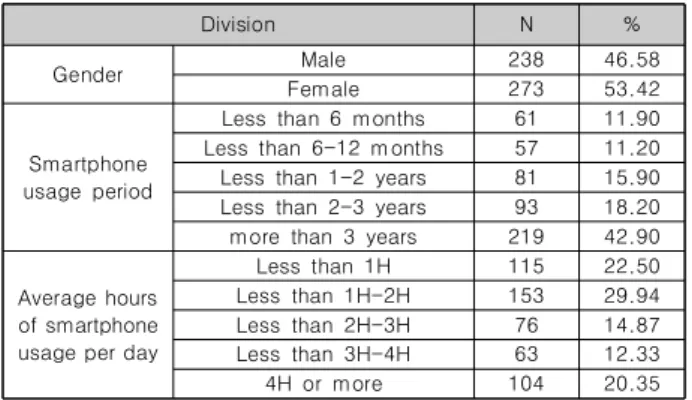
통계학적 특성을 구체적으로 살펴보면 Table 1과 같다.

(3)

Division N %

Gender Male 238 46.58

Female 273 53.42

Smartphone usage period

Less than 6 months 61 11.90 Less than 6-12 months 57 11.20 Less than 1-2 years 81 15.90 Less than 2-3 years 93 18.20 more than 3 years 219 42.90

Average hours of smartphone usage per day

Less than 1H 115 22.50

Less than 1H-2H 153 29.94 Less than 2H-3H 76 14.87 Less than 3H-4H 63 12.33

4H or more 104 20.35

Table 1. Demographic characteristics of study subjects

2. Measuring tools

본 연구에서 스마트폰 중독을 측정하기 위해 한국정보화진 흥원[29]에서 개발한 성인 스마트폰 중독 자가진단 척도 (Smart phone Addiction Proneness Scale for Adult:

Self-report)를 참고하여 교육학과 교수 3인의 수정을 거쳐 내용타당도를 검증하였다.

한국정보화진흥원[29]의 연구에서 전체 신뢰도 Cronbach's α값는 .81로 나타났으며, 본 연구의 신뢰도 Cronbach's α값은 .839이며, 하위요인별 신뢰도는 각각 일상생활장애 .754, 가상 세계지향성 .712, 금단 705, 내성 .765였다.

분노수준의 측정도구는 Spielberger[30]가 개발한 상태- 특성 분노표현척도(State-trait Anger Expression Inventory: STAXI)를 한덕웅, 이장호, 전겸구[31]이 한국판 (STAXI-Korean Version)으로 개발한 것으로 이 척도는 총 44문항으로 특성분노(trait anger) 10문항, 상태분노(state anger) 10문항, 분노표출(anger-out) 8문항, 분노억제 (anger-in) 8문항, 분노조절(anger-control) 8문항으로 구성 되어 있다. 본 연구에서는 연구의 목적에 맞게 분노수준에 해 당하는 분노표출, 분노억제, 분노조절의 24문항을 사용하였다.

분노수준의 측정도구는 총 24문항으로 구성되어 있으며 각 하위영역 문항 수는 8문항으로 구성되었다. 각 문항은 ‘거의 전혀 아니다(1)’에서 ‘거의 언제나 그렇다(4)’까지 4점 Likert 형식의 척도로 평정하도록 되어 있다. 중·고등학생을 대상으로 한 조혜리[32]의 연구에서 내적합치도(Cronbach's α)는 분노 표출 .812, 분노억제 .76, 분노조절 .79로 나타났으며 본 연구 에서는 분노수준이 .764이며, 하위요인별 신뢰는 각각 분노표 출 .806, 분노억제 .724, 분노조절 .761이였다.

본 연구에서는 학교생활적응을 측정하기 위해 김아영 [33]

이‘학교동기 표준 연구’에서 제작한 학교생활적응척도(School Adjustment: SA)를 사용하였다. 학교생활적응 척도는 교사관 계, 교우관계, 학교수업, 학교규칙 등 4개 하위요인 총 20문항 으로 구성되어 있으며, 반응양식은 Likert 5점 척도로 되어 있 다. 본 연구의 학교생활 적응 신뢰도 Cronbach's α값은 .816 이며, 하위요인별 신뢰도는 각각 교사관계 .885, 교우관계 .812, 학교수업 .792, 학교규칙 .855이였다.

3. Data collection and analysis methods

본 연구의 자료 분석과 문제 검증을 위해 통계 프로그램 SPSS 23.0을 사용하였다.

첫째, 구체적인 자료 분석에 앞서 역산문항에 대해 역코딩 을 실시하였으며, 각 변수에 대한 측정도구의 신뢰도 값을 알 아보기 위해 신뢰도 계수를 산출하여 Cronbach's α 값을 확인 하였다.

둘째, 조사대상자의 인구통계학적 특성과 스마트폰 사용실 태를 확인하기 위해 빈도분석을 실시하였다.

셋째, 중학생의 스마트폰 중독, 분노수준, 학교생활적응 간 의 관계를 검증하기 위해 중다회귀분석을 실시하였다.

넷째, 중학생의 스마트폰 중독이 학교생활적응에 영향을 미 치는 과정에서 분노수준의 매개효과를 검중하기 위해 Baron

&과 Kenny[34]의 매개효과 검증 절차를 사용하였다. 입력 (enter)방식을 실시하였다. 회귀분석 실시 전 주요 변수 하위 요인 간의 상관관계 분석을 위해 이변량 상관계수를 실시한 후 회귀분석을 실시하였다.

다섯째, 매개효과 분석은 총 3단계에 걸쳐 검증이 이루어지 며 1단계에서는 독립변수가 매개변수에 미치는 영향을 살펴보 기 위한 분석을 실시한다. 2단계에서는 독립변수가 종속변수 에 미치는 영향을 살펴보며, 마지막 3단계에서는 독립변수와 매개변수를 동시에 투입하여 종속변수에 미치는 영향이 이전 단계와 차이가 있는지 확인한다.

Ⅲ. Research Results and Discussion

1. Relationship between smart phone addiction, anger level, and school adjustment

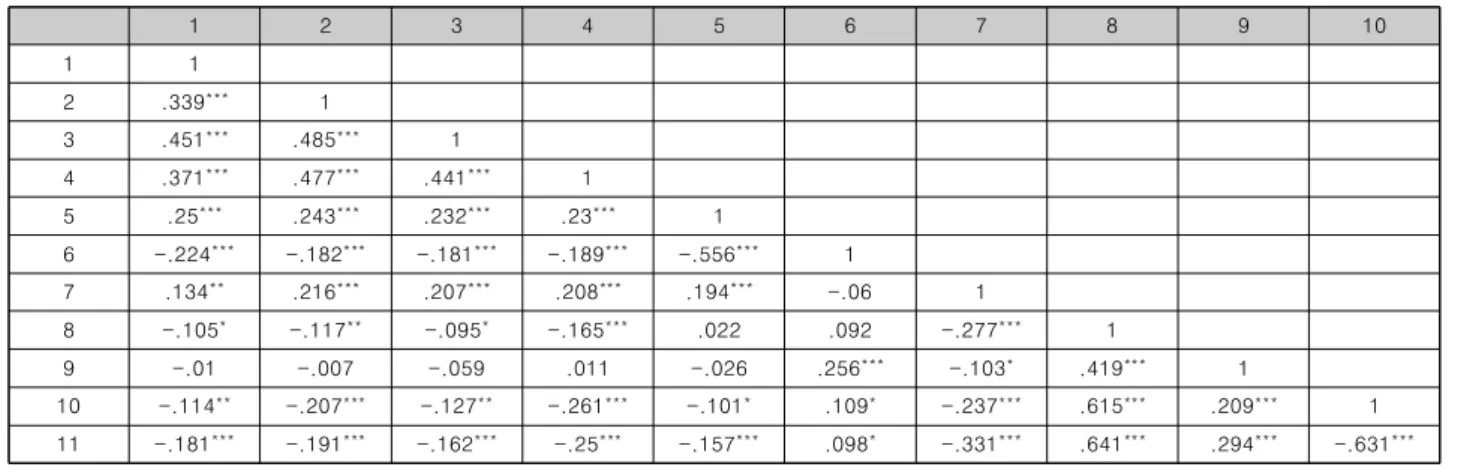
본 연구의 변인인 스마트폰 중독, 분노수존, 학교생활적응 하위요인간의 상관관계를 알아보기 위하여 Pearson 상관계수 를 산출하였으며, 결과는 Table 2와 같다.

모두 하위요인들 간의 상관계수 r 값은 -.007~.641 범위에 있어, 거의 관계없음(.0~.1)에서 부터 강한 양의 관계(.6~.8) 까지 분포되어 있음을 알 수 있다.

스마트폰 중독, 분노수준, 그리고 학교생활적응의 하위요인

간 상관관계에서 가장 높은 상관은 교사관계 요인과 학교규칙

요인으로 r=.641이고, 그 다음으로는 학교수업 요인과 학교규칙

요인이 r=.631, 교사관계 요인과 학교수업 요인으로 r=.615 순

으로 나타나 학교생활적응 하위요인간의 상관은 강한 양의 관계

를 보였다. 분노억제 요인과 스마트폰 중독 하위요인 간에는 부

적 상관이 있었으며, 교사관계와 학교적응 하위요인 간에는 비교

적 강한 양의 상관관계가 있었다. 일상생활장애 요인, 가상세계

지향성 요인, 금단 요인, 내성 요인과 학교적응 하위요인 간에는

약한 음의 상관관계가 있었다(-.01 ~-.261).

(4)

1 2 3 4 5 6 7 8 9 10

1 1

2 .339 *** 1

3 .451 *** .485 *** 1

4 .371 *** .477 *** .441 *** 1

5 .25 *** .243 *** .232 *** .23 *** 1

6 -.224 *** -.182 *** -.181 *** -.189 *** -.556 *** 1

7 .134 ** .216 *** .207 *** .208 *** .194 *** -.06 1

8 -.105 * -.117 ** -.095 * -.165 *** .022 .092 -.277 *** 1

9 -.01 -.007 -.059 .011 -.026 .256 *** -.103 * .419 *** 1

10 -.114 ** -.207 *** -.127 ** -.261 *** -.101 * .109 * -.237 *** .615 *** .209 *** 1 11 -.181 *** -.191 *** -.162 *** -.25 *** -.157 *** .098 * -.331 *** .641 *** .294 *** -.631 ***

*p<.05, **p<.01, ***p<.001

1-Daily living disorder, 2-Virtual world orientation, 3-Forbidden, 4-tolerance, 5-Anger expression, 6-Anger suppression, 7-Anger control, 8-Teacher relationship, 9-Friendship, 10-School lesson, 11-School rules

Table 2. Relationship between smart phone addiction, anger level, school adjustment factors

2. Effects of Smartphone Addiction on Anger Level and school adjustment

스마트폰 중독이 분노수준에 미치는 영향을 검증한 결과는 Table 3과 같다. 여기에서 스마트폰 중독에 대한 예측 변수간 의 상관관계가 .80을 넘지 않고 네 개 하위변수의 VIF값이 10 이하이기 때문에 공선성에는 문제가 없었다. 결정계수인 수정 된 R 2 값이 .031인 것으로 보아, 스마트폰 중독은 분노수준에 대해 3.1%의 설명력을 가지고 있음을 알 수 있다. 스마트폰 중독 하위요인 중, 일상생활장애의 β값이 -.002, 금단의 β값 이 .085, 내성의 β값이 .081로 유의하지 않았으며(p>.05수 준), 가상세계지향성만 β값이 .1로 p<.05수준에서 유의한 것 으로 나타났다.

model

nonstandard coefficient

stan- dard coeffi

-cient t p

Collinearity statistic

B SD β Toler

ance VIF (constant) 2.097 .064 34.436 .000

Daily living disorder

.001 .019 -.002 -.061 .953 .763 1.322

Virtual world- orientation

.031 .018 .1 1.916 .042 .682 1.479

Forbidden .039 .027 .085 1.556 .124 .653 1.546 tolerance .034 .024 .081 1.555 .129 .701 1.439

R 2 =.042, Modified R 2 =.031, F(p)=5.798(.000)

Table 3. Effects of the Sub-factors of Smartphone Addiction on Anger Level

스마트폰 중독이 학교생활적응에 미치는 영향을 검증한 결 과는 Table 4와 같다. 여기에서도 스마트폰 중독에 대한 예측 변수간의 상관관계가 .80을 넘지 않고 네 개 하위변수의 VIF

값이 10이하이기 때문에 공선성에는 문제가 없었다. 결정계수 인 수정된 R 2 값이 .0413로, 스마트폰 중독은 학교생활적응을 4.1% 정도 설명해 주고 있음을 알 수 있다. 스마트폰 중독 하 위요인 중, 일상생활장애의 β값이 -.032, 가상세계지향성의 β 값이-.058, 금단의 β값이-.029, 내성의 β값이-.15로 나타났 으며 이중 내성 하위요인에서만 p<.01수준에서 유의한 값을 보이고 있어 다른 하위요인에 비해 학교생활적응에 미치는 영 향이 매우 크다는 점을 알 수 있다. 또한 이 결과는 F값이 6.428로서 p<.001수준에서 통계적으로 유의하였다. 즉, 입력 별로 스마트폰 중독 하위요인을 투입한 결과, 내성이 가장 중 요한 요인으로 학교생활적응을 가장 잘 설명해주고 있었다.

model

nonstandard coefficient

stan- dard coeffi

-cient t p

Collinear -ity statistic

B SD β Toler

-ance VIF (constant) 3.944 .132 3.068 .000

Daily living disorder

-.021 .036 -.032 -.668 .506 .763 1.322

Virtual world orien- tation

-.035 .034 -.058 -1.127 .263 .682 1.479

Forbidden -.027 .053 -.029 -.561 .577 .653 1.546 tolerance -.129 .046 -.15 -2.9 .007 .701 1.439

R 2 =.047, Modified R 2 =.0413, F(p)=6.424(.000)

Table 4. Effects of sub-factors of smartphone addiction on school adjustment

3. Mediated Effect of Anger Level on the Effect

of Smartphone Addiction on school adjustment

매개효과 분석을 위해 Baron 과 Kenney[34]의 매개효과

검증 절차를 사용하였다. 중다회귀분석을 통해 총 3단계에 걸

쳐 검증이 이루어지며, 1단계에서는 독립변수가 매개변수에

(5)

미치는 영향, 2단계에서는 독립변수가 종속변수에 미치는 영 향, 3단계에서는 독립변수와 매개변수를 동시에 투입하여 종 속변수에 미치는 영향이 이전 단계와 차이가 있는지 확인하였 다. 2단계에서는 독립변수가 종속변수에 유의미한 영향을 미 쳤으나, 3단계에서 매개변수와 동시에 투입한 후 유의미한 영 향을 미치지 않는 경우, 이를 완전매개효과라고 하며, 2단계에 이어 3단계에서도 유의미한 영향을 미칠 경우, 이를 부분매개 효과라고 한다.

Division

Stage 1 Stage 2 Stage 3

smartphone addiction

smartphone addiction

smartphone addiction &

anger level

→ → →

anger level school adjustment

school adjustment smartphone

addiction β .179 *** -.215 *** -.188 ***

anger

level β -.109 *

F값 17.301 *** 22.974 *** 13.856 ***

R 2 (adj. R 2 )

.032 (.029)

.041 (.038)

.051 (.046)

*** p<.001

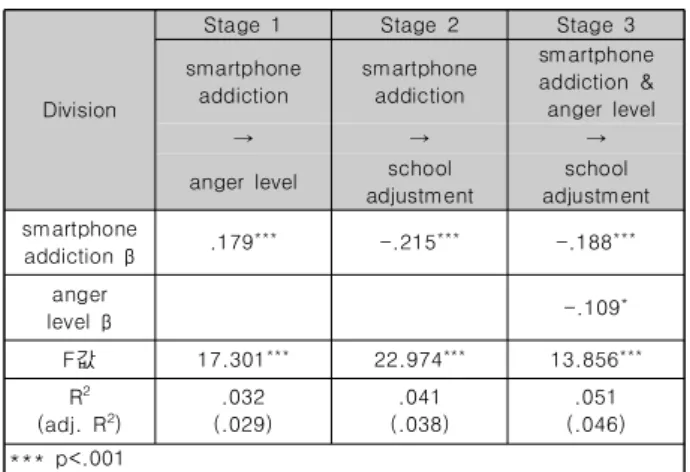
Table 5. Mediating effects of anger level on the process of smartphone addiction affecting school adjustment

스마트폰 중독과 학교생활적응의 관계에서 분노수준의 매 개효과를 확인하기 위해 Baron 과 Kenny[34] 매개효과 검증 절차에 따라 회귀분석을 실시한 결과는 Table 5와 같다.

1단계로 독립변수 스마트폰 중독이 매개변수 분노수준에 미치는 영향(p<.001, β=.179, 수정된 R 2 =.029)은 유의미한 것으로 나타났으며, 2단계로 독립변수인 스마트폰 중독이 종 속변수 학교생활적응에 미치는 영향(p<.001, β=-.215, 수정 된 R2=.038) 역시 유의미한 것으로 나타났다. 이어 독립변수 와 매개변수를 동시에 투입한 3단계에서 독립변수인 스마트폰 중독도 유의미한 영향(p<.001, β=-.188)을, 매개변수인 분노 수준도 유의미한 영향(p<.05, β=-.109)을 미치는 것으로 나 타났다. 따라서 중학생의 스마트폰 중독이 학교생활적응에 영 향을 미치는 과정에서 분노수준은 0.8%의 부분매개효과로 작 용하고 있음을 알 수 있다.

4. Discussion

본 연구에서는 중학생의 스마트폰 중독이 학교생활적응에 미치는 영향에서 분노수준의 매개효과 검중하였다. 연구 목적 을 달성하기 위해 설정한 연구문제와 그 결과를 중심으로 논 의하면 다음과 같다.

첫째, 스마트폰 중독과 학교생활적응의 상관관계 분석에서, 스마트폰 중독과 학교생활적응에서 유의한 부적 상관이 있는 것으로 나타난 결과는 이정화, 장형욱[35]의 연구, 최현석, 이 현경, 하정철[36]의 연구, 그리고 William & Merten[37]의

연구와 동일한 결과를 보여주고 있으며, 이는 스마트폰의 중 독성은 청소년기 학교생활적응 전반에 많은 어려움을 가져다 주고 있음을 시사하고 있다.

스마트폰 중독과 분노수준의 상관관계 분석에서, 스마트폰 중독은 분노수준과 유의한 정적 상관을 있다고 한 결과는 송 재복[38]의 연구에서 스마트폰 중독과 분노표출은 유의미한 상관(r=.28, p<.01)이 있어 분노표출이 높을수록 스마트폰 중 독이 높은 것으로 나타난 것과 일치하였으며, 박성근[16], 진 은영, 서영미[39]의 연구 결과와도 일맥상통한 결과를 보여주 고 있다. 이는 스마트폰 중독이 학교생활뿐만 아니라 일상생 활에서 청소년들의 분노수준을 높이는 데 많은 영향을 주고 있음을 알 수 있다. 따라서 중학생의 분노수준을 낮추고 그들 의 평정심을 찾고 마음의 안정감을 높이기 위한 방안 중의 하 나가 스마트폰 중독에서 벗어나도록 하는 것임을 상기 시켜주 고 있다

분노수준과 학교생활적응의 상관관계 분석에서, 분노수준 은 학교생활적응과 유의한 부적 상관을 보인 결과는 박미향, 김완일[40]의 연구에서 공격성과 학교생활적응은 유의미한 부적 상관(r=-.275, p<0.01)이 있어 공격성이 높을수록 학교 생활적응이 낮은 것으로 나타난 결과와 유사하였다. 이는 억 압된 분노를 자연스럽게 표현할 기회를 제공하고 청소년들의 스트레스 감소 및 자신의 행동을 통제할 수 있는 기회를 적절 하게 제공해줌에 따라 학교생활적응이 향상될 수 있음을 시사 하고 있다. 또한 자신의 억압된 분노의 표출을 통해 교사관계 와 교우관계를 원만하게 형성할 수 있음을 보여주고 있다.

Ⅳ. Conclusion and Suggestions

본 연구의 결과를 토대로 나타난 결론을 제시하면 다음과 같다.

첫째, 스마트폰 중독의 하위요인들과 학교생활적응의 하위 요인들과는 부적 약한 상관을 가지고 있고, 그중 내성과 교우 관계만이 정적 상관관계가 있다. 스마트폰 중독 하위요인들은 분노수준의 하위요인 중 분노표출, 분노조절과 정적인 상관을, 분노억제와는 부적인 상관을 가지고 있다.

둘째, 스마트폰 중독 하위요인이 분노수준에 대한 설명력은 3.1%이고, 학교생활적응에 대한 설명력은 4.1%이다.

셋째, 중학생의 스마트폰 중독이 학교생활적응에 영향을 미 치는 과정에서 분노수준은 0.8%의 부분매개효과가 있다.

본 연구결과를 토대로 몇 가지 제언을 제시하면 다음과 같 다.

첫째, 중학생의 스마트폰 중독이 학교생활적응에 영향을 미

치는 과정에서 분노수준은 부분매개효과가 있는 것으로 나타

난바, 청소년의 올바른 학교생활적응을 위해 분노수준 감소

프로그램 개발과 적용이 요구된다. 둘째, 중학생을 대상으로

(6)

한 스마트폰의 올바른 사용방법과 분노수준을 완화시키는 상 담적 개입 및 예방 프로그램의 적용이 요구되어진다. 중학생 의 다양한 스트레스 해소방안으로 스마트폰 이외의 적절한 해 소방법을 제시하여 정신적 건강을 도울 수 있는 방안을 마련 해야 할 것이다. 셋째, 중학생의 분노수준과 학교생활적응은 가정환경과 밀접한 관계가 있기 때문에 가정과의 연계를 통한 치료프로그램 활용과 적절한 부모교육이 요구된다. 또한 중학 생의 분노수준 감소와 학교생활적응의 향상이 유지되기 위해 서는 교육현장에서 보다 다양한 프로그램의 개발이 이루어질 필요가 있다.

REFERENCES

[1] Song K. J. Special: Evolution of IT-based communication:

social media combined with SNS and smartphone. Korea Local Information Research & Development Institute, 64, pp. 4-9, 2010.

[2] Yoon Soon-Hye. (A)study on the analysis of the influencing factors and operational effects of the physical fitness class using SNS: case of using 'classting' in a middle school. Master’s Degree in Hanyang University Graduate, 2013.

[3] Greenfield, P. M. Technology and information education:

what is taught, what is learned. Science, 323(5910), pp.

69-71, Jan, 2009.

[4] Kim Suk-Woo. The effect of mobile convergence phenomenon on mobile user's Leisure satisfaction:

Focused on smart phone. Master’s Degree in Hansung University, 2012.

[5] Casey, B. M. Linking Psychological Attributes to Smart Phone Addiction, Face-to-Face Communication, Present Absence and Social Capital. Doctoral dissertation, The Chinese University of Hong Kong, 2012.

[6] I. S. Yoo. Prevention of disease in modern people, Turtle neck syndrome (Date neck). Korean Society of Steel Construction, 22(4), p. 80, August, 2010.

[7] Kim. Bong-Hwan,Han. Sun-Hee, Shin. Young Gul,Kim.

Da Yeong, Park. Jin Young, Sin. Won Chul, Yoon. Jeong.

Aided Distance Visual Acuity and Refractive Error Changes by Using Smartphone. The Korean Ophthalmic Optics Society, 17(3), pp. 305-309, September 2012.

[8] Gabler, H., Babner, K, Laap, H. V. D, Wolf, K., & Pelanyter, A. No use for thinking: Down sides of innovation in information science. Bobcatsss 2012 20 th International Conference on Information Science. Amsterdam, Netherlands, 2012.

[9] Becker, M. W., Alzahabi, R., & Hopwood, C. J. Media Multitasking Is Associated with Symptoms of Depression and Social Anxiety. Cyber psychology, Behavior, and Social Networking, 16(2) , pp. 132-135, Feb. 2013.

[10] Cho Min-Je. A Survey of Addiction Level, Use Realities, and Recognition on Cellular Phone in High Grade of Elementary School. Master’s Degree in Kyungnam University Graduate, 2010.

[11] Chio Jin-Oh. ICT device addiction and ADHD characteristics of elementary students. The Journal of Special Children Education, 13(3), pp. 207-226, September, 2011.

[12] Sun-nam Kim, Hyun-wook Jung. A Study on Teenagers’

Mobile Phone Addict. Korean Journal of Broadcasting and Tele communication Studies. 18(4), pp. 88-116, 2004.

[13] Lee Hye-Seon, Kang Cha Yeun. (The) Relationship among the Overuse of Cellular Phones, Attachment and Behavioral Problems in Middle Schoolers. Seoul Woman’s University Student Conseling Center. study of students’ life, 20, pp. 79-95, 2007.

[14] Hwang Joo-Seong, Yoo Ji-Yeon, Lee Dong-Hoo.

Impacts of Mobile Communications on the Space.

Korean Journal of Communication & Information, 34, pp. 306-341, May, 2006.

[15] Cho Mi-Jung. Emotional Problems and Their Solutions for Smartphone Addiction in Elementary School Students. Master’s Degree in Graduate School Education of Chonbuk National University, 2015.

[16] Park Seong-Geun. (The) influence of middle school students’participation in school sportsclub activities on smartphone addiction and aggressiveness. Master’s Degree in Graduate School Education of Kyonggi University, 2016.

[17] Ko Ki-Sook. A Study on the Mediating Effect of Depression between Smartphone Addiction and School Adaptation of University Students . Journal of School Work, 32, pp. 189-216, 2015.

[18] Moon Jong-Mi, Chol Jin-Oh. Smartphone Addiction Tendency of Elementary School Students Influencing School Adjustment and Academic Achievement:

Mediating Effect of ADHD Tendency . The Jourcal of Special Children Education, 17(1), pp. 263-292, March, 2015.

[19] Chang Seok-Jin, Song So-Won, Cho Mi-Na. The Effects of Perceived Positive Parenting Attitude on Mobile Phone Dependency: The Mediating Roles of Self-Esteem and Attachment to Peer. Korean journal of youth studies.

19(5), pp. 161-187, May, 2012.

[20] Jang Sung-Hwa. The Explanatory of Personal, Family,

(7)

School Variables on Cellular Phone Addiction by the Elementary School Students. The Journal of Learner-Centered Curriculum and Instruction, 11(1).

pp. 291-310, March, 2011.

[21] Kim Yoon-Mi. A Study on the Adaptation of the Adolescent to school. Master’s Degree in Graduate School Education of Catholic Kwandong University, 2010.

[22] B. S. Hong, M. A. Nam. Social welfare with youth.

Goyang: Knowledge Community, 2016.

[23] Ah Young-Ah, Jeong Weon-Cheol. The Mediating Effect of Internet Addiction between Academic Stress and School Maladjustment in Adolescence. Korean journal of youth studies, 18(2), pp. 27-50, 2011.

[24] Oh Yoon-Jeong. The effect of smart phone addiction of the middle school students on the school adjustment : mediating effect of self control and daily stress and regulation effect of parental supervision. Master’s Degree in Social Welfare Graduate School of Donga University, 2015.

[25] Kim Tae-Rang. Effects of Junior High School Students' Addiction to Smartphone on School Adjustment : Focusing on Mediating Effect of Mental Health. Master’s Degree in Graduate School Education of Uiduk University, 2015.

[26] Kim Su-Mi. Moderating Effect of Emotional Adjustment on Middle School Students' Parent-Child Communication and Smartphone Addiction. Master’s Degree in Graduate School Education of Jeju National University, 2018.

[27] Kim Yeoung-Mi, Kim Doo-Beom. Mediating Effects of Self-Control on the Relationship between Smartphone Use and School Adjustment in Middle School Students. Korean Journal of Youth Studies, 23(3), pp. 133-162, March, 2016.

[28] Kim Bo-Mi. The Effects of Daily Stress and Self-Esteem on School Adjustment in Adolescents. Master’s Degree in Graduate School Education of Ewha University, 2014.

[29] National Information Society Agency. Development of Smartphone Addiction Diagnosis Scale. Daegu:

National Information Society Agency Media Addiction Correspondence Division, 211.

[30] Spielberger, C. D. Preliminary Manual for the State-Trait Personality Inventory(STPI) Tampa:

University of South Florida, 1979.

[31] Doug-Woong Hahn, Chang Ho Lee, Kyum Koo Chon.

Korean Adaptation of Spielberger’s STAI(K-STAI).

The Korean Journal Of Health Psychology 1(1), pp.1-14, June, 1996.

[32] Cho, Hye Ri. The relationship among Parenting

Behavior, Empathic ability, Anger Expression and Juvenile Delinquency. The Graduate School of Ewha Womans University, 2009.

[33] Kim A-Young. Development of Standardized Student Motivation Scales. Journal of Educational Evaluation, 15(1), 157-184, 2002.

[34] Baron, R. M., & Kenny, D. A. The moderator-mediator variable distinction in social psychological research:

Conceptual, strategic, and statistical considerations.

Journal of Personality and Social Psychology, 51(6), pp. 1173-1182. 1986.

[35] Lee Joung-Hwa, Chang Hyung- Wook. The Effect of Self-control and Smartphone on Adaptability to Tourism High School Life. International Journal of Tourism Management and Sciences, 31(3), pp.

249-275, 2016.

[36] Choi Hyun-Seok, Lee Hyun-Kyung, Ha Jeong Cheol.

The influence of smartphone addiction on mental health, campus life and personal relations -Focusing on K university students. Journal of the Korean Data And Information Science Society, 23(5), pp. 1005-1015, October, 2012.

[37] Williams, A L., & Merten, M. J. A Review of Online Social Networking Profiles by Adolescents:

Implications for Future Research and Intervention.

Adolescence, 43(170), pp. 253-274, 2008.

[38] Song Jae-Bok. The Relationship among Self-Control, Anger-Expression and Smartphone Addiction of the Adolescent. Master’s Degree in Graduate School Education of Konyang University, 2013.

[39] Chin Eun-Young, Seo Young-Mi. The Study on the Relations among Anger, Suicidal ideation and Internet Addiction in Male High School Students. The Korea Contents Society, 12(1), pp. 430-437, December, 2012.

[40] Park Mi-Hyang, Kim Wan-il. Mediating Effects of

Self-Esteem Stability in the Association between

Aggression and Adjustment to School Life among

Adolescents. Korean Journal of youth studies, 21(10),

pp. 475-501, 2017.

(8)

Authors

Pyeong-su Yu received the B.S., M.S. and Ph.D. degrees in Education from Chonbuk National University, Korea, in 1986, 1988 and 1998, respectively. Dr. Yu joined the faculty of the Department of Education at Jeonju University, Korea, in 2002. He is currently a Professor in the Department of Education, Jeonju University. He is interested in school organization, school management, university evaluation, lifelong education, and youth education.

Hey-yeon Hwang received the M.S. and Ph.D. degrees in Education from Chonbuk National University, Korea, in 2002 and 2014, respectively. Dr. Hwang is currently working as a researcher at the Education Innovation Division of Jeonju University.

She is interested in education philosophy, UNESCO school,

teaching method, and college education.

수치

Table  1.  Demographic  characteristics  of  study  subjects
Table  2.  Relationship  between  smart  phone  addiction,  anger  level,  school  adjustment  factors
Table  5.  Mediating  effects  of  anger  level  on  the  process  of  smartphone  addiction  affecting  school  adjustment

참조

관련 문서

The effect of sportsmanship of middle school students on personality development through net type competitive sport activities was positively

The purpose of this study is to clarify the effect of identification affirmation according to K-Pop star image on the desire of middle school students to participate

The students of Gwangju Secondary School had to compete with the students of Gwangju Intermediate School, who were Japanese nationals for access to a

especially to people who teach the biology in middle school at the moment and freshman of high school students, how do they recognition about

The purpose of this study is to analyze the interest and self-confidence of middle school students in learning English grammar and to examine the

The results of analysis on the difference of psychological happiness according to frequency of participation of external physical activity of female middle school

The purpose of this study is to investigate the effect of peer-mentoring on the achievement and learning attitudes of middle school students toward

In this study, a family of middle school students the health, self-resilience, recreation and leisure satisfaction and satisfaction with school life were