• 검색 결과가 없습니다.

Knowledge Sharing and Utilization Effects on Corporate Performance for Project Groups-Focus on ICT companies in Korea

N/A
N/A
Protected

Academic year: 2021

Share "Knowledge Sharing and Utilization Effects on Corporate Performance for Project Groups-Focus on ICT companies in Korea"

Copied!
6
0
0

로드 중.... (전체 텍스트 보기)

전체 글

(1)

Knowledge Sharing and Utilization Effects on Corporate Performance for Project Groups-Focus on ICT companies in Korea

1)

Won-Hee Lee*, Jae-Young Moon**

Abstract

Knowledge sharing is safe to say that we have already embarked on knowledge-based global economy where knowledge is a decisive factor in global competition for corporations. So in the age of knowledge-based management, it is how we use knowledge that decides success or failure for corporations and the competitiveness of their countries at large as well. We did this research with the help of those who were working in ICT industry including manufacturing, tourism, and others. In this research, we looked into how project participants, organizational characteristic, and relational characteristic affect knowledge sharing and utilization, and what are the factors that have positive effects on corporate success. And all the factors presented in the research are found to have positive effects on the knowledge sharing and utilization. The factors appeared to have positive effects starting with project at first and then on corporate success at large.

▸Keyword: Knowledge-based Management, Knowledge Acquisition, Knowledge Transfer, Knowledge Sharing and Utilization

I. Introduction

Environmental changes happen pretty fast in our global economy today. Faced with such dynamic and complex managerial environment, corporations are tasked with continuous acquisition of new knowledge and knowledge utilization, based on their unique situation[1][2].

Moreover, in knowledge-based economy today, knowledge is considered an important factor that can virtually decides corporate success or failure[3-7].

There are many researches mentioned that today is an era of knowledge business. So rightly in today’s knowledge-based management, those who can make optimal use of their knowledge can survive in this competitive environment today, therefore knowledge is considered a key asset that enables corporations to possess competitive and sustainable advantage[8].

Recently, one of the most important reasons why academicians and practitioners alike pay such attention to knowledge-based management has been because corporate competition is more and more knowledge-based. Today corporations are considered a body of collective knowledge as pointed out in many existing researches in international business management, they; therefore, consider that it is knowledge asset among others that is a source of sustainable differentiation and competitive advantage[5]. In this regard, research in knowledge-based management focus on the identification and verification of such factors as knowledge creation and accumulation, knowledge transfer and sharing, and knowledge acquisition and learning that can contribute to the maximization of organizational potential[9]. It is

∙First Author: Won-Hee Lee, Corresponding Author: Jae-Young Moon

*Won-Hee Lee ([email protected]), Subdivision of Business Administration, Kyungnam College of Information &

Technology

**Jae-Young Moon ([email protected]), Division of Global Business Administration, Dongseo University

∙Received: 2019. 05. 20, Revised: 2019. 06. 07, Accepted: 2019. 06. 07.

(2)

because acquiring and learning new knowledge can contribute to corporate management success a lot[10][11]. Corporations, therefore, are striving to learn and develop new knowledge faster than do their competitors.

Corporations are basically knowledge seeking, creating organizations and they consider acquiring new knowledge through learning their key strategic task. As such, interest in knowledge-based management dealing with how effectively acquire and utilize new knowledge is increasing more and more[12][13]. Knowledge learning, knowledge transfer and sharing, and knowledge creation, particular focus has been on the transfer and sharing of knowledge asset the goal of which is to enhance key potential through knowledge transfer and diffusion[8].

Knowledge transfer and sharing is considered to be a prerequisite for the success in knowledge-based management because knowledge transfer and sharing lay a foundation on which to build new value by acquiring, accumulating, and learning knowledge-related assets necessary for the creation of competitive advantage[9].

Thus far, investigations in knowledge transfer, domestic and abroad alike, have focused mainly on knowledge transfer between multinational corporations and their partners overseas for their expansion abroad, and on knowledge transfer in manufacturing industry.

In this paper, we suggested what influeces the factors of project participants, organization characteristic, and relational characteristic can have on knowledge sharing and utilization in the context of ICT industry in Korea.

However, when it comes to ICT industry, it requires different approach from that of more traditional industries in terms of facilitating capacity, learning capacity, communication between the headquarters and project participants including manufacture, hotel, tourism, and other service area, due to cultural differences from opportunistic conducts of the beneficiary of the knowledge transfer and their different working environments because the transferor and its beneficiary are the participants in the ICT project unlike in more traditional industry where knowledge transfer and sharing take place within the company itself.

Therefore, more empirical studies are necessity to clarify what knowledge and how much to transfer between the headquarters and project participants and to find factors that affect knowledge transfer and sharing, and the knowledge utilization.

II. Research Background

Today, we have many kind of definitions of knowledge depending on an academician. In general, however, it means individual insight, decision and innovation derived from knowledge, experience, discovery method, arrangement, and neurological combinations.

The overall knowledge management process of a company begins with knowledge acquisition. This consists of processes to attain new knowledge not previously owned by the company. Such knowledge is newly created through (1) the research, experimentation and experiences of its members, or (2) obtained through search and exploration from external sources.

Knowledge transfer in an organization is defined as individuals, teams, and departments that are influenced through new experiences[14]. Once new knowledge is obtained, such knowledge needs to be transferred to other parts (for example, individual, group, departments or sectors) of the organization that need such knowledge or can benefit through such knowledge. When such transfer does not occur, such absorbed knowledge cannot have much impact on the organization. Capability to disseminate knowledge beyond time and space, therefore, is an important factor in a large collection of knowledge by a company.

In fact, difficulty can arise in the process of knowledge transfer or absorption, and this makes knowledge transfer the most difficult aspect in knowledge management procedures. It is because knowledge has more

“stickiness”, the more knowledge is internalized in the individual, environment and locality. Some stickiness slows knowledge transfer among people, increases costs and uncertainty[15].

Previous studies, however, tend to assert that knowledge transfer is essentially free, instantaneous and having no need to make a separate effort, thereby ignoring such issues. In fact, the experienced difficulties are considered as unusual rather than as the characteristic of knowledge transfer. As a result, such issues related to knowledge transfer process do not tend to get attention, compared to the step of knowledge acquisition.

Szulanski[16] verified that factors that influence

knowledge transfer, such as knowledge characteristics,

knowledge provider characteristics, knowledge

beneficiary factors and background characteristics, hinder

or impact knowledge transfer.

(3)

Knowledge-based management can be seen from separate perspectives, knowledge management and knowledge control. Knowledge management is an overall management paradigm, meaning working principle of all the components that make up a corporation, such as an organization, its member, the culture, and the infrastructure. According to Brooking[17], knowledge is defined “information to apply the knowledge according to the context of the understanding”. It also emphasizes that there are several forms of knowledge such as tacit, implicit, explicit, and systematic in terms of individuals, groups and organizations from various perspectives[9][18][19][20].

Blacker[21] suggested that the process of knowing, making knowledge understandable, and knowledge transferring are important, with emphasis on the process of knowing. Nonaka[10] also emphasized that knowledge is a social product, a result of participation and socialization of the members, in which individual knowledge becomes group knowledge through meaningful mutual conversation, and group knowledge becomes organization knowledge through interaction between individual and group, and between groups, and between group and organization, along the process of knowledge creation.

For successful exploitation of external knowledge and skill transfer potential, it is a prerequisite to develop internal capability to absorb such potential and a source of performance differences among corporations will be decided by the very nature of knowledge information itself and a capacity to combine and utilize knowledge available[4][22][23].

Therefore, this research is to investigate the characteristics of knowledge transfer and sharing in the context of ICT industry in Korea, building on existing definition of knowledge and knowledge transfer, and existing studies on the utilization of knowledge.

III. Research Hypotheses

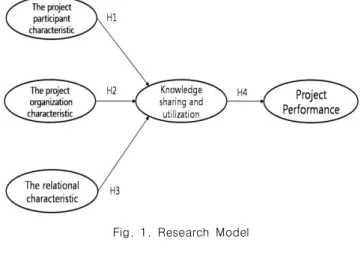
The main purpose of the research is to investigate the effect on knowledge transfer of the factors of project participants, project organization, interaction, and local environment within the context of project organization in ICT industry in Korea. To this end, based on the study of

existing investigation, the first factor, project participant characteristic, in the research is divided into the motive and willingness of the transferor, motive and willingness of the beneficiary, and contract compliance between the participants, and the absorbing capacity of the participants.

The second factor, project organizational characteristic, is divided into managerial autonomy and organizational cultural similarity. And the third factor, relational characteristic, is divided into communication efficiency, trust, management interest and support, and compensation level.

The hypotheses in the research are as follows:

H1: The project participant characteristic factor will have positive influences on knowledge sharing and utilization.

H2: The project organization characteristic factor will have positive influences on knowledge sharing and utilization.

H3: The relational characteristic factor will have influences on knowledge sharing and utilization.

H4: Knowledge sharing and utilization will have positive influences on the project performance.

Fig. 1. Research Model

IV. Results

4.1 Result of exploratory factor analysis

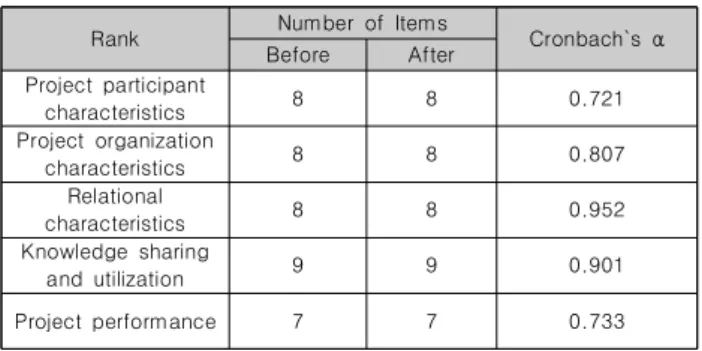
As a result, all the proposed items exceed generally

required Factor Loading FL>0.6, the values of Cronbach`s

α (>0.7) is within the range of 0.721and 0.952, so that

convergent validity and the discriminant validity were

both met.

(4)

Rank Number of Items

Cronbach`s α

Before After

Project participant

characteristics 8 8 0.721

Project organization

characteristics 8 8 0.807

Relational

characteristics 8 8 0.952

Knowledge sharing

and utilization 9 9 0.901

Project performance 7 7 0.733

Table 1. Results of Exploratory Analysis

4.2 Result of Statistical for Research Model AMOS 18.0 is used to investigate causal relationships between all the factors, and the results of Structural Equation Modeling (SEM) are x2=77.122 (d.f=6), p=0.000, x2/d.f=12.8537, GFI=0.832, RMR=0.054, NFI=0.900, AGFI=0.851, CFI=8.571, all of which meet general model’s goodness of fit.

Hypoth

esis Path T-

value P- value

Hypothesis Support H1 Project participants→ knowledge

sharing and utilization 3.447 0.000 **

H2

Projects organization characteristics → knowledge

sharing and utilization

4.542 0.000 **

H3 Relational characteristics →

knowledge sharing and utilization 0.749 0.042 * H4 Knowledge sharing and utilization

→project performance 1.115 0.044 *

*: P<0.05, **: P<0.01 Table 2. Statistical tests for Research model

All the hypotheses are accepted.

4.3 Characteristics of the Sample

Frequency analysis for demography rendered that male responses were 224 (88.1%), which was 194 more than the female responses, 30 (11.9%). The most in an age bracket was 116 of 30s (45.6%), 35 of 40s (13.7%) and 28 for 50 or more (11.2%).

As for their marital status, the number of married was 177 (69.7%) with the number of single at 77 (30.3%).

Regarding their educational backgrounds, high school graduates were 52 (20.5%); 2-year college graduates were 51 (21.0%); 4-year college graduates were 177 (69.7%); and graduate students or more were 25 (9.8%).

So in total, 79% of the respondents had at least a 4-year college degree.

Looking at their title, the highest number were assistant manager/manager, 108 (42.5%); assistant manager/chief

55 (21.7%); deputy general manager/general manager 46 (18.1%); and director (board member) 45 (17.7%), so their overall distribution was about even.

For the number of years they had been working for their company, 6~7 years was 103 (40.6%); 2~3 years 73 (28.7%); 4~5 years was 52 (20.5%); and 1 or less was 26 (10.2%).

V. Conclusions

This research is empirical study on the characteristics of knowledge sharing and utilization between the headquarters and the company and the effect of knowledge sharing and utilization on the performance of the project in the context ICT industry in Korea.

And all the hypotheses in the research model are found to have positive effects.

For the project participants and project organization, in particular, are found to have positive effect on the knowledge sharing and utilization. In the case of relationship between knowledge sharing & utilization and relational characteristic, it is found to be positive even though the effect was not as big as in the H1 and H2.

According to the finding of the research, most competitive tool is knowledge that corporations can make use of, rather than visible physical entity, as proposed in many existing studies. And today, we live through an era of knowledge-based management[11].

For ICT-related corporations, in particular, knowledge-based management can have a most powerful competitiveness with a lot of potential to grow.

As shown in the research, corporations today can obtain information through various techniques, both from existing data and Big data, and they are active at sharing it, thanks to the internet development.

ICT industry, has good internet infrastructure so that it can be said that knowledge sharing is more successful in ICT industry than in any other industry.

In addition, corporations can obtain competitiveness by being able to achieve good performance at various projects they take on.

However, the research has its limitation too although ICT

companies don’t seem to have particular problem at sharing

and utilization their knowledge due to good ICT

infrastructures and their good pool of various experts as

(5)

mentioned before, so that further researches with a boarder range of data from various industries seem necessary to make the finding of the research more general.

REFERENCES

[1] P. Senge, “The Fifth Discipline: The Art and Practice of the Learning Organization,” New York: Double day Currency, 1990.

[2] J. March, “Exploration and exploitation in organizational learning,” Organizational Science, Vol. 2, No. 1,pp. 71-87, 1991.

[3] G. Huber, “Organizational Learning: The Contributing Processes and the Literature,” Organization Science, Vol.

2, No. 1, pp.88-115, 1991.

[4] K. Conner, and C. K. Prahalad, “The Resource-based Theory of the Firm : knowledge vs. Opportunism”, Organization Science, Vol. 7, pp.477-501. 1996.

[5] R. M. Grant, "Toward a Knowledge-Based Theory of the Firm", Strategic Management Journal, Vol. 17, Winter, pp.109-122. 1996.

[6] J. C. Spender, "Competitive Advantage form Tacit Knowledge? Unpacking the Concept and its Strategic Implications In Moingeon." B. Edmondson, A. (eds),

"Organizational Learning and Competitive Advantage", Sage, London, pp.56-71. 1996.

[7] R. Mitchell and S. Nicholas, "Knowledge Creation Group:

The Value of Cognitive Diversity, Trans active Memory, and open-minded ness Norms," The Electronic Journal of Knowledge Management, Vol. 4, No. 1, pp.67-74. 2006.

[8] A. Hilmi, S. Iman,, Kadarsh, and G. Rajesri, "Knowledge Sharing Behavior, Antecedent and Their Impact on the Individual Innovation Capability", Journal of applied Sciences Research. Vol. 5, pp.2238-2246. 2009.

[9] I. Nonaka and H. Takeuchi, "Knowledge and Management:

Chapter 2 of Ilujiro Nonaka and Hirotaka Takeuchi, The Knowledge Creating Company: How Japanese Companies Create the Dynamics of Innovation", New York: Oxford University Press, pp.21-55. 1995.

[10] I. Nonaka, "A Dynamic Theory of Organizational Knowledge Creation", Organization Science, Vol. 5, No.

1, pp.14-37. 1994.

[11] W. Sharon and H. Kelly, "A multi-Theoretical Model of Knowledge Transfer in Organizations, Determinants of Knowledge Contribution and Knowledge Reuse", Journal of Management Studies, Vol. 43, No. 2, pp.141-173. 2006.

[12] G. Hedlund, "A model of knowledge management and the N-form corporation", Strategic Management Journal, Vol. 15, No. 2, pp.73-90. 1994.

[13] A. C. Inkpen, and A. Diur, "Knowledge Management Processes and International Joint Ventures", Organization Science, Vol. 9, No. 4, pp.454-465. 1998.

[14] L. Argote and P. Ingram, "Knowledge Transfer : A Base for Competitive Advantage in Firms", Organizational Behavior and Human Decision Processes, Vol. 82, No.

1, pp. 150-169. 2000.

[15] B. Kogut and U. Zander, "Knowledge of the Firm, Combinative Capabilities, and the Replication of Technology", Organization Science, Vol. 3, No. 3, pp.383-397. 1992.

[16] G. Szulanski, "Exploring Internal Stickiness : Impediments to the Transfer of Best Practice within the Firm", Strategic Management Journal, Vol. 17, No.

2, pp27-43. 1996.

[17] A. Brooking, "Corporate Memories, Strategies for Knowledge Management", Thompson Business press, London. 1999.

[18] T. Davenport and L. Prusak, "Working Knowledge", Havard Business School Press. 2000.

[19] N. Dixon, "Common Knowledge: How Companies Thrive by Sharing What They Know", Boston: Harvard Business press. 2002.

[20] M. Polanyi, "Personal Knowledge", Chicago University Press. 1958.

[21] F. Blacker, "Knowledge, knowledge work and organizations an overview and interpretation", Organization Studies, Vol. 16, No. 1, pp.1021-1046.

1995.

[22] D.Y. Lee, S.D. Shim, and H.J. Kim, M. Polanyi, "The effect of knowledge self-efficacy on employee’s knowledge sharing intention: Analysis of mediating effects of personal outcome expectation and performance-related outcome expectation", Korean Knowledge Management Society, Vol. 19, No. 3, pp.31-46, 2018.

[23] E.J. Ko, S.J. Lee, and S.S. Kim, "Effects of Job Autonomy

and Self-Efficacy on Creative Behavior: Focusing on

the Mediation Effect of Knowledge Sharing in Smart Work

Environment", Korean Knowledge Management Society,

Vol. 19, No. 2, pp.163-185, 2018.

(6)

Authors

Won-Hee Lee received the M.B.A. and Ph.D.

degrees in International Commerce &

Logistics from Pukyong National University, Korea, in 2005 and 2017, respectively Dr. Lee joined the faculty of the Subdivision of Business Administration at Kyungnam College of Information & Technology, Busan, Korea, in 2016. He is currently a Professor in the Subdivision of Business Administration, Kyungnam College of Information & Technology. He is interested in International Management, Business Statistics and International Business Environments, and International Enterprise.

Jae-Young Moon received the M.S. and Ph.D. degrees in Department of Business Administration from Kyung Hee University, Korea, in 2007. Dr. Moon is currently a Associate professor at Division of Business, Dongseo University since 2007.

He is interested in Quality Management, Internet of Things,

Big Data.

수치

Fig.  1.  Research  Model
Table  1.  Results  of  Exploratory  Analysis

참조

관련 문서

This study aims to explore the effects of parenting beliefs and parenting knowledge on parenting behaviors among marriage-immigrant mothers and native-born mothers and

The Effect of Shared Leadership on Voice and Knowledge Sharing Behavior: Creative Self-Efficacy and Change.. Self-Efficacy

Purpose: The aim of this study is to identify the relationship between knowledge and awareness of radiation department students and their intent in

41 Developing Web Intelligence System of Construction Tacit Knowledge Based on Text

Mapping the Knowledge on Socio-nuclear Studies in Korea through Keyword Network Analysis.. Youngjune

– A Guide to the Project Management Body of Knowledge (PMBOK Guide, Fourth Edition), PMI (Project Management Institute)...

Mobilization, Knowledge Creation and Development. The innovation indicators used to analyse the structure system functions are based on primary and secondary

To improve nursing students' CPR knowledge, self-efficacy, and performance in the future, simulation-based CPR training that provides experience which is similar