1)
INTRODUCTION
Deficiency of von Willebrand factor-cleaving protease, a disintegrin-like and metalloprotease with thrombospon- din type 1 motif 13 (ADAMTS13) is thought to be res- ponsible for platelet aggregation and microthrombi forma- tion, which in turn cause the development of typical
Submitted : 16 October 2008, Accepted : 9 March 2009 Correspondence : Jongwook Lee, M.D.
Department of Laboratory Medicine, Hanaro Medical Foundation, 194-4 Insa-dong, Jongno-gu, Seoul, 100-290, Korea
Tel : +82-2-732-3030, Fax : +82-2-720-8922 E-mail : [email protected]
thrombotic microangiopathies (1). This deficiency is found in patients with thrombocytopenia-associated multiple organ failure such as thrombocytopenic purpura, hemolytic uremic syndrome, or sepsis (2-6). Disseminated intravas- cular coagulation (DIC) is a microangiopathic phenotype characterized by increased tissue factor (TF) and plasmino- gen activator inhibitor type I (PAI-1), unopposed by the anticoagulant proteins tissue factor pathway inhibitor (TFPI), protein C, antithrombin III, and prostacyclin (6, 7).
The severest forms also have an ADAMTS 13 deficiency (8). We evaluated the clinical significance of ADAMTS13 deficiency in patients with sepsis-induced DIC.
DOI : 10.3947/ic.2009.41.2.78 ORIGINAL ARTICLE
Clinical Significance of von Willebrand Factor-Cleaving Protease (ADAMTS13)
Deficiency in Patients with Sepsis-Induced Disseminated Intravascular Coagulation
Young Keun Kim, M.D.1, Jongwook Lee, M.D.2, Kyung-A Lee, M.D.3and Hee Uk Kwon, M.D.4 Department of Internal Medicine1, Yonsei University Wonju College of Medicine, Wonju,
Department of Laboratory, Medicine2, Hanaro Medical Foundation, Seoul,
Department of Laboratory Medicine3, Yonsei University College of Medicine, Seoul,
Department of Anesthesiology and Pain Medicine4, Konyang University College of Medicine, Daejeon, Korea
Background : Deficiency of von Willebrand factor-cleaving protease, a disintegrin-like and metallo- protease with thrombospondin type 1 motif 13 (ADAMTS13), is thought to be responsible for platelet aggregation and microthrombi formation, which in turn cause typical thrombotic microangiopathies.
This deficiency is found in patients with thrombocytopenia-associated multiple organ failure such as thrombocytopenic purpura and disseminated intravascular coagulation (DIC). We evaluated the clinical significance of ADAMTS13 deficiency in patients with sepsis-induced DIC.
Materials and Methods : Nineteen patients with sepsis-induced DIC were enrolled. ADAMTS13 anti- gen levels were determined by Enzyme-Linked Immunosorbent Assay (ELISA) and activity levels were measured by fluorescence resonance energy transfer assay. Patients were categorized into two groups according to ADAMTS13 antigen level: less than 350 ng/mL or above. Clinical charac- teristics and survival were compared between the two groups.
Results : ADAMTS13 antigen level was less than 350 ng/mL in 7 patients and was above 350 ng/mL in 12 patients. There were no significant differences between the groups for age, sex, severity of illness, and other clinical characteristics. In patients with ADAMTS13 antigen level less than 350 ng/mL, in-hospital mortality was much higher (100% versus 25%,P=0.003) and 7-day survival was much shorter (P=0.023).
Conclusion : Deficiency of ADAMTS13 could be thought to be associated with unfavorable outcome in patients with sepsis-induced DIC.
Key Words : ADAMTS13, Disseminated intravascular coagulation, Sepsis, Prognosis
78Infection and Chemotherapy : Vol.41, No.2, 2009
MATERIALS AND METHODS
1, Study population
From September 2005 to December 2005, 19 patients with sepsis-induced DIC were enrolled at Konyang Uni- versity Hospital, 813-bed teaching hospital located in Dajeon, Korea. Since the normal value of ADAMTS13 antigen level defined by manufacturer's instruction was less than 350 ng/mL, patients were categorized into two groups accordingly: the ADAMTS13 antigen level less than 350 ng/ml or above. Clinical characteristics and sur- vival were compared between the two groups.
2. Diagnosis of sepsis and DIC
The diagnosis of sepsis was made according to the definition of the American College of the Chest Physicians/
Society of Critical Care Medicine Consensus Conference Committee (9). The diagnosis of DIC was made according to the criteria established by the Japanese Ministry of Health and Welfare (1988), which are described elsewhere (10). Briefly, the presence of underlying diseases (infection or malignancies), specific clinical conditions (bleeding or organ dysfunction), and results of laboratory examinations (platelet counts, prothrombin time, fibrinogen, and/or fibrin degradation products) were quantified based on the score.
If the score was 7 or more, the diagnosis of DIC was made.
The severity of illness of the patients was evaluated according to the Acute Physiology and Chronic Health Evaluation II (APACHE II) (11).
3. Measurement of ADAMTS13
ADAMTS13 antigen levels were determined by IMUBINDⓇADAMTS13 ELISA kit (America Diagnostica Inc, Stamford, CT, USA). ADAMTS13 activity levels were measured by fluorescence resonance energy transfer assay described previously (12).
4. Statistical analysis
The clinical characteristics were compared using the Mann-Whitney U test and Fisher's exact test depending on the scales of measurement. Survival was evaluated
using Kaplan-Meier method. All P values were two- tailed, and P<0.05 was considered to be statistically sig- nificant. All analyses were performed using Statistical Package for the Social Sciences (SPSS) 11.0 (SPSS Inc., Chicago, IL, USA).
RESULTS
1. Demographic characteristics of patients
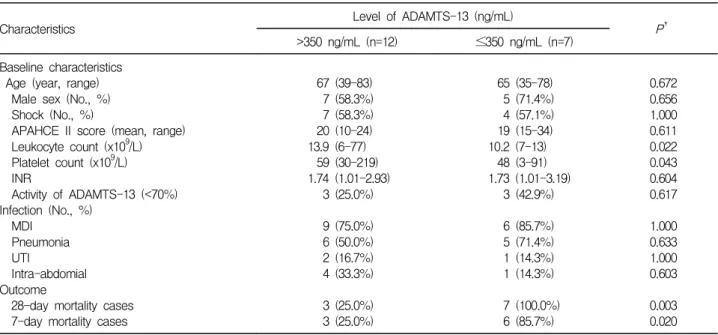
Among enrolled 19 patients, the level of ADAMTS-13 was below 350 ng/mL in 7 patients and above 350 ng/mL in 12 patients. Age, sex, and severity index of illness such as the presentation of septic shock and APACHE II score between the two groups did not show statistically signifi- cant differences (Table 1). The number of cases of micro- biologically defined infections was 15 patients (79%). The causes of infections were pneumonia, intra-abdominal in- fections, and urinary tract infection in decreasing order of frequency; there were no differences in the cause of infec- tion between the two groups (Table 1). The activity of ADAMTS-13 was below 70% in 6 patients; 3 patients (25
%) were from the group whose level of ADMAMTS-13 was
>350 ng/mL and 3 (42.9%) patients were from the group whose level of ADMAMTS-13 was ≤350 ng/ml. There were no differences between the two groups (Table 1).
2. Mortality according to the level of ADAMTS-13 Nine patients died of sepsis within 7 days after admis- sion. Seven-day mortality rate was 25.0 % (3 of 12) in the group with the levels of ADMAMTS-13 >350 ng/ml, and 85.7% (6 of 7) in the group with the levels of ADMAMTS- 13 ≤350 ng/mL (Table 1). Log rank test using Kaplan- Meyer methods revealed that 7-day survival was much shorter in patients with ADAMTS13 antigen levels less than 350 ng/ml (P=0.023) (Fig. 1).
DISCUSSION
ADAMTS-13 activity is decreased in thrombotic throm- bocytopenic purpura, sepsis, idiopathic thrombocytopenic purpura, heparin induced thrombocytopenia, liver cirrhosis, leukemia, and systemic lupus erythematosus (4, 13-15). In patients with sepsis, severe deficiency of ADAMTS-13
ADAMTS13 in Sepsis Induce DIC Vol.41, No.2, 2009 79
was associated with renal failure (8) and/or sepsis-in- duced thrombocytopenia and organ failure (15).
In this study, among patients with sepsis-induced DIC in intensive care unit, all patients whose level of ADAMTS13 was below 350 ng/mL died within 28 days, but only 3 patients (25%) from 12 patients whose levels of ADAMTS13 was above 350 ng/mL died. If cutoff value had been 500 ng/mL, the 28-day mortality rate of the patients with ADAMTS13 deficiency would be 75.0% (9/12) and the
mortality rate of the patients without ADAMTS13 de- ficiency would be 14.3% (1/7). Therefore, the further study is needed to define the cutoff value of ADAMTS13 as a risk factor of mortality in patients with sepsis with DIC.
Ono and colleague reported that severe secondary de- ficiency of ADAMTS13 in patients with sepsis-induced DIC was correlated with development of renal failure (8). Also, this study revealed that severe secondary deficiency of ADAMTS13 in patients with sepsis-induced DIC was associated with mortality. The underlying mechanism of sepsis-induced thrombocytopenia and organ failure is not well known, but it could be hypothesized that sepsis-as- sociated thrombocytopenia results from widespread platelet aggregation and thrombotic microangiopathy caused, in part, by deficient proteolysis of ultra-large von Willebrand factor (ULVWF) (15). ULVWF is cleaved by ADAMTS13 (16). Therefore, ADAMTS13 deficiency may play a role in the sepsis-induced thrombocytopenia, organ failure, and subsequent mortality. The restoration from the deficient proteolysis of ULVWF could be achieved by plasma exchange (17) and it could attribute to clinical improvement in patients with severe sepsis if more studied are needed.
There are some prognostic indexes such as APACHE Figure 1. Cumulative survival in patients with sepsis-induced DIC
according to the level of ADAMTS13.
Table 1. Comparison of Characteristics according to the Level of ADAMTS-13 in Patients with Sepsis-induced Disseminated Intravascular Coagulation*
Characteristics Level of ADAMTS-13 (ng/mL)
P†
>350 ng/mL (n=12) ≤350 ng/mL (n=7) Baseline characteristics
Age (year, range) Male sex (No., %) Shock (No., %)
APAHCE II score (mean, range) Leukocyte count (x109/L) Platelet count (x109/L) INR
Activity of ADAMTS-13 (<70%) Infection (No., %)
MDI Pneumonia UTI
Intra-abdomial Outcome
28-day mortality cases 7-day mortality cases
67 (39-83) 7 (58.3%) 7 (58.3%) 20 (10-24) 13.9 (6-77)
59 (30-219) 1.74 (1.01-2.93)
3 (25.0%)
9 (75.0%) 6 (50.0%) 2 (16.7%) 4 (33.3%)
3 (25.0%) 3 (25.0%)
65 (35-78) 5 (71.4%) 4 (57.1%) 19 (15-34) 10.2 (7-13)
48 (3-91) 1.73 (1.01-3.19)
3 (42.9%)
6 (85.7%) 5 (71.4%) 1 (14.3%) 1 (14.3%)
7 (100.0%) 6 (85.7%)
0.672 0.656 1.000 0.611 0.022 0.043 0.604 0.617
1.000 0.633 1.000 0.603
0.003 0.020 Abbreviations : ICU, intensive care unit; APACHE II, acute physiologic and chronic health evaluation II; INR, international normalized ratio; MDI, microbiologic defined infection; UTI, urinary tract infection.
*Data are expressed as number (percentage) or median (range).
†Mann-Whitney U test for continuous variables and Fischer's exact test for categorical values.
80Infection and Chemotherapy : Vol.41, No.2, 2009
II score and Sequential Organ Failure Assessment (SOFA) score for severe sepsis. The difference in severity index of illness such as the presentation of shock and APACHE II score between the two groups was not observed.
Therefore, the level of ADAMTS13 could be a significant prognostic factor in patients with sepsis-induced DIC.
This study has some limitations such as small number of subjects. However, this study revealed that secondary deficiency of ADMATS13 in patients with sepsis-induced DIC may be associated with unfavorable outcome. More studies are needed if the restoration from the status of de- ficient proteolysis of ULVWF could improve the survival rate of patients with sepsis.
ACKNOWLEDGEMENT
This work was supported in part by Konyang Uni- versity Myung Gok Research Fund of 2006.
REFERENCES
1) Moake JL. Thrombotic microangiopathies. N Engl J Med 347:589-600, 2002
2) Furlan M, Robles R, Solenthaler M, Lämmle B. Ac- quired deficiency of von Willebrand factor-cleaving protease in a patient with thrombotic thrombocytopenic purpura. Blood 91:2839-46, 1998
3) Mannucci PM, Canciani MT, Forza I, Lussana F, Lattuada A, Rossi E. Changes in health and disease of the metalloprotease that cleaves von Willebrand factor.
Blood 98:2730-5, 2001
4) Loof AH, van Vliet HH, Kappers-Klunne MC. Low activity of von Willebrand factor-cleaving protease is not restricted to patients suffering from thrombotic thrombocytopenic purpura. Br J Haematol 112:1087- 8, 2001
5) Moore JC, Hayward CP, Warkentin TE, Kelton JG.
Decreased von Willebrand factor protease activity associated with thrombocytopenic disorders. Blood 98:
1842-6, 2001
6) Nguyen TC, Carcillo JA. Bench-to-bedside review:
thrombocytopenia-associated multiple organ failure-a newly appreciated syndrome in the critically ill. Crit Care 10:235, 2006
7) Green J, Doughty L, Kaplan SS, Sasser H, Carcillo JA.
The tissue factor and plasminogen activator inhibitor type-1 response in pediatric sepsis-induced multiple organ failure. Thromb Haemostasis 87:218- 23, 2002 8) Ono T, Mimuro J, Madoiwa S, Soejima K, Kashiwakura
Y, Ishiwata A, Takano K, Ohmori T, Sakata Y. Severe secondary deficiency of von Willebrand factor-cleaving protease (ADAMTS13) in patients with sepsis-induced disseminated intravascular coagulation: its correlation with development of renal failure. Blood 107:528-34, 2006
9) American College of Chest Physicians/Society of Critical Care Medicine Consensus Conference: definitions for sepsis and organ failure and guidelines for the use of innovative therapies in sepsis. Crit Care Med 20:864-74, 1992
10) Gando S, Kameue T, Morimoto Y, Matsuda N, Hayakawa M, Kemmotsu O. Tissue factor production not balanced by tissue factor pathway inhibitor in sepsis promotes poor prognosis. Crit Care Med 30:1729-34, 2002
11) Knaus WA, Draper EA, Wagner DP, Zimmerman JE.
APACHE II: a severity of disease classification sys- tem. Crit Care Med 13:818-29, 1985
12) Kokame K, Nobe Y, Kokubo Y, Okayama A, Miyata T.
FRETS-VWF73, a first fluorogenic substrate for ADAMTS13 assay. Br J Haematol 129:93-100, 2005 13) Bianchi V, Robles R, Alberio L, Furlan M, Lämmle B.
Von Willebrand factor-cleaving protease (ADAMTS13) in thrombocytopenic disorders: a severely deficient activity is specific for thrombotic thrombocytopenic purpura. Blood 100:710-3, 2002
14) Mannucci PM, Vanoli M, Forza I, Canciani MT, Scorza R. Von Willebrand factor cleaving protease (ADAMTS- 13) in 123 patients with connective tissue diseases (systemic lupus erythematosus and systemic sclerosis).
Haematologica 88:914-8, 2003
15) Nguyen TC, Liu A, Liu L, Ball C, Choi H, May WS, Aboulfatova K, Bergeron AL, Dong JF. Acquired ADAMTS-13 deficiency in pediatric patients with severe sepsis. Haematologica 92:121-4, 2007
16) Furlan M, Robles R, Lämie B. Partial purification and characterization of a protease from human plasma cleaving von Willebrand factor to fragments produced by in vivo proteolysis. Blood 87:4223-34, 1996 17) Nguyen TC, Stegmayr B, Busund R, Bunchman TE,
Carcillo JA. Plasma therapies in thrombotic syndromes.
Int J Artif Organs 28:459-65, 2005
ADAMTS13 in Sepsis Induce DIC Vol.41, No.2, 2009 81