Chemotherapy
Infect Chemother 2015;47(4):225-230
ISSN 2093-2340 (Print) · ISSN 2092-6448 (Online)
Received: May 16, 2015 Revised: June 25, 2015 Accepted: June 25, 2015 Corresponding Author : Alireza Fahimzad, MD
Department of Pediatrics, Shahid Beheshti University of Medical Sciences, Mofid Children Hospital, Shariati Street, Tehran 1546815514, Iran
Tel: +98 -21-22226941, Fax: +98-21-22227033, E-mail: [email protected]
* Ethical approval: Approved by Ethical committee of Pediatric Infectious Research Center
This is an Open Access article distributed under the terms of the Creative Commons Attribution Non-Commercial License (http://creativecommons.org/licenses/by-nc/3.0) which permits unrestricted non-commercial use, distribution, and repro- duction in any medium, provided the original work is properly cited.
Copyrights © 2015 by The Korean Society of Infectious Diseases | Korean Society for Chemotherapy
www.icjournal.org
Antibiotic Susceptibility Evaluation of Group A Streptococcus Isolated from Children with
Pharyngitis: A Study from Iran
Shirin Sayyahfar
1, Alireza Fahimzad
2, Amir Naddaf
3, and Sara Tavassoli
41Division of Pediatric Infectious Diseases, Departement of Pediatrics, Ali Asghar Children Hospital, Iran University of Medical Sciences;
2Division of Pediatric Infectious Diseases, Departement of Pediatrics, Pediatric Infectious Research Center, Mofid Children Hospital, Shahid Beheshti University of Medical Sciences, Tehran; 3Department of Pediatrics, Fasa University of Medical sciences, Fasa;
4Traditional Medicine, Tehran University of Medical Sciences, Tehran, Iran
Background: The aim of this study was to evaluate the antibiotic susceptibility of Group A streptococcus (GAS) to antibiotics usually used in Iran for treatment of GAS pharyngitis in children.
Materials and Methods: From 2011 to 2013, children 3-15 years of age with acute tonsillopharyngitis who attended Mofid Children’s Hospital clinics and emergency ward and did not meet the exclusion criteria were enrolled in a prospective study in a sequential manner. The isolates strains from throat culture were identified as GAS by colony morphology, gram staining, beta hemolysis on blood agar, sensitivity to bacitracin, a positive pyrrolidonyl aminopeptidase (PYR) test result, and the presence of Lancefield A antigen determined by agglutination test. Antimicrobial susceptibility was identified by both disk diffusion and broth dilution methods.
Results: From 200 children enrolled in this study, 59 (30%) cases were culture positive for GAS. All isolates were sensitive to penicil- lin G. The prevalence of erythromycin, azithromycin, and clarithromycin resistance by broth dilution method was 33.9%, 57.6%, and 33.9%, respectively. Surprisingly, 8.4% of GAS strains were resistant to rifampin. In this study, 13.5% and 32.2% of the strains were resistant to clindamycin and ofloxacin, respectively.
Conclusion: The high rate of resistance of GAS to some antibiotics in this study should warn physicians, especially in Iran, to use antibiotics restrictedly and logically to prevent the rising of resistance rates in future. It also seems that continuous local sur- veillance is necessary to achieve the best therapeutic option for GAS treatment.
Key Words: Antibiotic resistance; Group A streptococci; Pharyngitis; Streptococcus pyogenes; Tonsillitis
Introduction
Group A streptococcus (GAS), or Streptococcus pyogenes, is a facultative, Gram-positive coccus which causes a wide range of diseases in humans, from mild to life-threatening ones, such as pharyngitis, scarlet fever, tonsillitis, cellulitis, impetigo, erysipelas, proctitis, vulvovaginitis, pneumonia, endocarditis, meningitis, sepsis, necrotizing fasciitis, and myonecrosis [1-6].
GAS is the most common cause of bacterial pharyngitis in children [7]. Antibiotic resistance to this organism has been changing in recent years, mostly due to inappropriate usage of wide spectrum antibiotics [8]. The frequency of resistance of this organism to antibiotics and the number of drugs to which they are resistant have been increasing worldwide [9]. Cur- rently, penicillin is the drug of choice for GAS pharyngitis treatment, and penicillin resistance to GAS has not been re- ported yet [5, 8]. However, the prevalence of resistance to oth- er antibacterial agents such as macrolides has been increasing [3, 4, 7, 10]. The antibiotic resistance rate to GAS is related to geographic and epidemiologic factors and the time of investi- gation.
Continuous local surveillance is recommended to observe changes in the antimicrobial susceptibility profile of GAS in order to guide physicians to choose appropriate antibiotics.
There are scanty data on epidemiology and antibiotic resis- tance of GAS in Iranian children. The current resistance pat- tern of GAS in Iran is unknown; therefore, this study was con- ducted to evaluate the antibiotic susceptibility of GAS to the antibiotics usually used in Iran for treatment of GAS pharyn- gitis in children.
Materials and Methods
1. Study population
In this prospective study, children 3-15 years of age with acute tonsillopharyngitis who attended.
Mofid Children’s Hospital emergency ward in Tehran, Iran were enrolled in a sequential manner from 2010-2013. The study was approved by the ethics review committee for clini- cal research, Pediatric Infectious Research Center (PIRC). In- formed consent was received from children’s guardians before enrollment.
Exclusion criteria were pharyngitis with at least one of the following signs and symptoms: conjunctivitis, coryza, promi- nent cough, vesicular or ulcerative stomatitis, and hoarseness or aphonia. Throat culture was carried out in 200 children.
2. Sample collection, transport, and culture
A throat sample was obtained with a Dacron swab from the patients by a physician and was transported to the Pediatric Infectious Research Center in the thioglycolate transport me- dia within 2 hours. Each sample was cultured on trypticase soy blood agar with 5% sheep blood, incubated overnight at C under 5% CO2 effect, and tested for the pressure of GAS by the formation of distinct zones of beta hemolysis around colonies.
The isolated strains were identified as GAS by colony mor- phology, gram staining, beta hemolysis on blood agar, sensi- tivity to bacitracin (inhibition screening test using 0.04-Ubaci- tracin disk), a positive pyrrolidonyl arylamidase (PYR) test result, and the presence of Lancefield A antigen determined by agglutination test.
3. Antibiotic susceptibility testing
Antimicrobial susceptibility was first identified by disk diffu- sion method on Muller-Hinton agar supplemented with 5%
defibrinated sheep blood using the disk of commonly used antibiotics in Iran and in accordance with Clinical and Labo- ratory Standards Institute (CLSI 2012) guideline [11].
The antibiotics used were erythromycin (15 μg), penicil- lin (1 μg), azithromycin (15 μg), clarithromycin (15 μg), ofloxacin (5 μg), clindamycin (2 μg), rifampin (5 μg), ceftriax- one, and cefixime.
Cefixime is one of the most commonly used antibiotics for upper respiratory tract infection treatment in Iran, but in vitro susceptibility of Streptococcus pyogenes to this antibiotic is not included in the CSLI 2012 guideline; therefore, another refer- ence for determining the rate of susceptibility was used [11, 12].
Susceptibility of the GAS strains to the described antibiotics was also checked by the broth dilution method according to the CLSI, 2012 guideline recommendation. Briefly susceptibil- ity testing was performed by broth microdilution procedure using dried plates reconstituted with Mueller–Hinton broth with 5% lysed horse blood. The inocula were 5 × 10⁵ CFU/mL.
The microdilution trays were incubated in ambient air at 35°C for 24 hours. Minimum inhibitory concentration (MIC) was determined after 24 hours of incubation and was defined as the lowest concentration that yielded no visible growth. Strep- tococcus pneumoniae ATCC 49619 was included as a control strain.
4. Statistical analysis
Frequency of categorical variables including susceptible and resistant strains, age groups, and sign and symptoms were reported as numbers and percentages.
Results
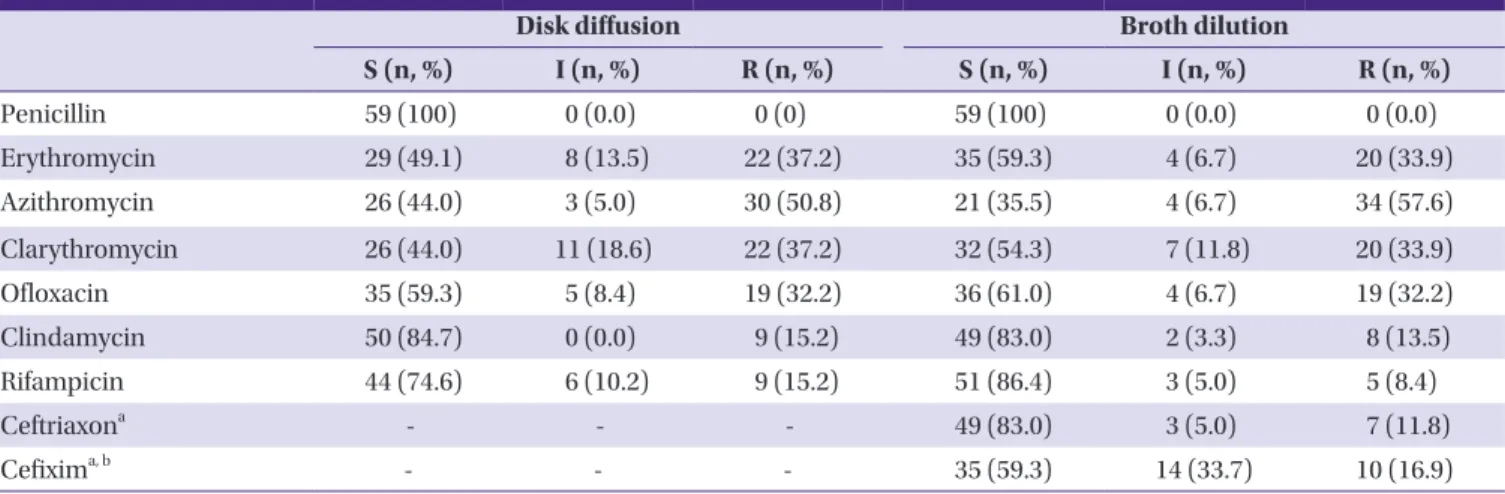
From 200 children 3-15 years of age with acute tonsillophar- yngitis enrolled in this study, 59 (30%) cases were culture pos- itive for GAS, 33 (55.9%) of which were male. The age distribu- tion of the patients is shown in Table 1. The incidence of GAS pharyngitis was most prevalent in the 3-5 years age group. The comparison of antibiotic susceptibility tests results performed by disc diffusion and broth dilution methods is shown in Ta- ble 2. All of the isolates were sensitive to penicillin. The preva- lence of erythromycin, azithromycin, and clarithromycin re- sistance by broth dilution method was 33.9%, 57.6%, and 33.9%, respectively. Surprisingly, 8.4% of GAS strains were re- sistant to rifampin. The prevalence of signs and symptoms are shown in Table 3.
All of the cases had fever. The most prevalent symptom after fever was sore throat. The most prevalent sign of streptococcal pharyngitis was Pharyngeal erythema.
Discussion
Although there are several therapeutic options for GAS pharyngitis, the most acceptable recommendation is single dose intramuscular benzathine penicillin in Iran because penicillin is the drug of choice for the treatment of GAS phar- yngitis, and no GAS resistance to this antibiotic has been re- ported yet throughout the world [5]. In addition, the compli- ance of Iranian parents for ten days oral therapy is usually low.
On the other hand, there are some families that do not ac- cept injection, or patients with immediate- type hypersensi- tivity to penicillin that compel pediatricians to use other ther- apeutic options such as macrolides, oral beta lactams, clindamycin, or oral cephalosporins [5,13]. So it is very im- portant for all the physicians to be aware of local antimicrobi- al susceptibility patterns to select appropriate alternative treatment options.
In our study, all the GAS strains were susceptible to penicil- lin, so this antibiotic remains the drug of choice for GAS phar- yngitis.
Surprisingly, 8.4% of GAS strains were resistant to rifampin by broth dilution method, and 5% of the strains had interme- diate sensitivity to this antibiotic. In other studies from Roma- nia in 2011, the USA in 2003, and Greece in 2009, all of the GAS strains were susceptible to rifampin [14, 15]. Epidemio- logically, most of the provinces of Iran are endemic for tuber- culosis, so it seems that rifampin usage as one the main agents of tuberculosis treatment might be a cause of increasing resis- tance to rifampin, and this is an alarm for physicians in areas endemic for tuberculosis to be aware and use the anti-tuber- culosis antibiotics cautiously. In addition, rifampin might be
Table 2. Antimicrobial resistance pattern for GAS isolated from the pharynx of the patients by disk diffusion and broth dilution method (n = 59)
Disk diffusion Broth dilution
S (n, %) I (n, %) R (n, %) S (n, %) I (n, %) R (n, %)
Penicillin 59 (100) 0 (0.0) 0 (0) 59 (100) 0 (0.0) 0 (0.0)
Erythromycin 29 (49.1) 8 (13.5) 22 (37.2) 35 (59.3) 4 (6.7) 20 (33.9)
Azithromycin 26 (44.0) 3 (5.0) 30 (50.8) 21 (35.5) 4 (6.7) 34 (57.6)
Clarythromycin 26 (44.0) 11 (18.6) 22 (37.2) 32 (54.3) 7 (11.8) 20 (33.9)
Ofloxacin 35 (59.3) 5 (8.4) 19 (32.2) 36 (61.0) 4 (6.7) 19 (32.2)
Clindamycin 50 (84.7) 0 (0.0) 9 (15.2) 49 (83.0) 2 (3.3) 8 (13.5)
Rifampicin 44 (74.6) 6 (10.2) 9 (15.2) 51 (86.4) 3 (5.0) 5 (8.4)
Ceftriaxona - - - 49 (83.0) 3 (5.0) 7 (11.8)
Cefixima, b - - - 35 (59.3) 14 (33.7) 10 (16.9)
GAS, group A streptococcus; S, sensitive; I, intermediate; R, resistant.
aAntibiotic susceptibility of GAS is not defined by CLSI for disk diffusion method.
bAntibiotic susceptibility of GAS is not defined by CLSI for both disk diffusion and broth dilution method.
Table 1. Prevalence of streptococcal pharyngitis according to age groups (n = 200)
Age group (in year)
Cases enrolled
Positive for GAS pharyngitis
3-5 108 (54%) 36 (33.3%)
6-8 57 (28.5%) 16 (28%)
9-11 30 (15%) 5 (16.6%)
12-15 5 (2.5%) 2 (40%)
Total 200 (100%) 59 (29.5%)
GAS, Group A streptococcus.
used in the treatment regimen of some infections caused by multi-resistant microorganisms, such as acinetobacter spp.
and MRSA. The increasing rate of these multi drug- resistant microorganisms in recent years might be another cause of in- creasing consumption and resistance to rifampin.
Macrolides have been widely used for the treatment of GAS pharyngitis, and it seems that high resistance to the macro- lides in recent years is related to this over usage.
In our study, 33.9%, 57.6%, and 33.9% of the GAS strains were resistant to erythromycin, azithromycin, and clarithro- mycin, respectively.
Other studies confirm the increasing rate of resistance to macrolides in most parts of the world [4, 16]. An increasing trend toward erythromycin resistance was reported from Tai- wan, and then decreased once the use of this antibiotic was reduced [17]. The resistance rate to erythromycin decreased from 53.1% in 1998 and 2000 to 14.6% in 2002 and 2004, and finally to 10.7% in 2006-2010 [17].
Currently, treatment of GAS pharyngitis with macrolides is absolutely discouraged in Iran. The results of a surveillance study in Iran from 1995-1997 showed 0.2% resistance to eryth- romycin [18]. After nearly 15 years, the resistance rate has reached 33.9% and 57.6% resistance to erythromycin and azi- thromycin, respectively. These findings might be the result of inappropriate use of these antibiotics in recent years in Iran.
Surprisingly the resistance to azithromycin was more than the two other macrolides. Azithromycin is one of the antibiot- ics in which general practitioners and pediatricians are very interested in Iran. Its low cost, availability and short course of therapy have made it a first choice for many related pediatric infections. Clarithromycin is more expensive and less popular for usage among general practitioners in Iran. Longer course of therapy (10 vs. 5 days) and more side effects have made
Erythromycin loss its priority after introduction of the azithro- mycin. So it seems that the increased resistance of azithromy- cin in comparison of the two other macrolides is related to its more consumption in Iran.
In this study, 13.5% of strains were resistant to clindamycin, which is similar to the result of a study from Romania in 2011 in which 15% of the strains were resistant to clindamycin [15].
This rate of resistance should warn physicians to use this anti- biotic restrictedly and logically to prevent the rising resistance rate in the future. A study from Korea showed 32.5% resistance of GAS to clindamycin [2]. Nevertheless there are some re- ports showing very low resistance to clindamycin from other countries [14, 19]. This might be related to difference in the rate of resistance genotypes and phenotypes (e.g. cMLSB and iMLSB) or policies of antibiotic consumption among different parts of the world.
The resistance rate of our GAS strains to ofloxacin, the only fluoroquinolone that was evaluated in our study, was 32.5%.
In general, older fluoroquinolones (e.g., ciprofloxacin) have limited activity against GAS pharyngitis and should not be used to treat GAS pharyngitis [20]. Newer fluoroquinolones (e.g., levofloxacin and moxifloxacin) are active in vitro against GAS, but they are expensive, have an unnecessarily broad spectrum of activity, and therefore not recommended for rou- tine treatment of GAS pharyngitis [20].
In 2003, a study from the USA showed 0.05% resistance of GAS to levofloxacin [19]. On the other hand, a study from Bel- gium identified an increase in fluoroquinolones non-suscepti- bility from 4.3% (2008) to 10.9% (2009) to 21.6% in 2010 [21].
Although fluoroquinolones are used restrictedly in the pedi- atric age group, it seems that inappropriate use of this catego- ry of antibiotics in domestic animals, veterinary medicine, in- dustries, and also in adults has raised the GAS resistance to these agents in recent years in our region.
Although some studies from 2002 to 2012 with no GAS resis- tance to cefteriaxon exist, 11.8% of the GAS stains in the cur- rent study were resistant to this antibiotic, which might again be the result of its over-usage in our country [14]. The relation- ship between antibiotic usage and resistance is strongly sup- ported by data from this study. It seems that countries with the highest per capita antibiotic consumption have the high- est resistance [9].
The signs and symptoms of GAS pharyngitis overlap exten- sively with other infectious causes, particularly viral agents, making a diagnosis based solely on clinical findings difficult [5, 13].
Although there are several scoring systems to raise the prob- Table 3. Prevalence of signs and symptoms in the patients with tonsillo-
pharyngitis in this study
GAS positive (n=59)
Fever 59 (100%)
Pharyngeal erythema 56 (94.9%)
Sore throat 55 (93.2%)
Pharyngeal exudates 46 (77.9%)
Headache 14 (23.7%)
Abdominal pain 10 (16.9%)
Cervical lymphadenopathy 12 (20.3%)
Vomiting 7 (11.8%)
Values are presented as n (%).
GAS, group A streptococcus.
ability of streptococcal pharyngitis in children, none of them could definitely differentiate streptococcal from non-strepto- coccal ones.
In this study, despite usage of the exclusion criteria, only one-third of the enrolled cases were culture positive. One of the most important reasons for this problem is the liberal use of antibiotics in Iran, which affects the rate of positive cultures.
In addition, our study was based on culture result, and rapid antigen test or serologic study for detecting GAS infection was not performed; therefore, the GAS positive-culture negative cases could not be determined.
According to 2012 Infectious Diseases Society of America guideline for the diagnosis and management of group A strep- tococcal pharyngitis, diagnostic studies for GAS pharyngitis are not indicated for children <3 years. Therefore, we conduct- ed our study for children 3-15 years old particularly because streptococcal pharyngitis is most prevalent in 5-15 years old cases [20].
The most prevalent symptoms of streptococcal pharyngitis are the sudden onset of fever greater than 38°C and sore throat [5, 13]. Cervical lymphadenopathy, pharyngeal and/or tonsil- lar inflammation, or exudates are common signs [5, 13]. Pala- tal petechiae and scarlatiniform rash are highly specific, but uncommon [13]. Some nonspecific symptoms such as head- ache, vomiting, and abdominal pain may also be noted [13].
In our study, the most prevalent symptoms and signs were fe- ver, sore throat, and pharyngeal erythema and exudate, re- spectively. In our and most other studies, fever is the most constant symptom of streptococcal pharyngitis, so it seems that absence of fever could generally help to rule out GAS pharyngitis.
In conclusion, it seems that the high rate of GAS resistance to some antibiotics in this study should warn physicians to use the antibiotics restrictedly and logically to prevent the ris- ing of resistance rates in the future. Continuous local surveil- lance is also necessary to achieve the best therapeutic option for GAS treatment.
Although the number of isolates in this study was not suffi- cient to make any epidemiological conclusions, the high resis- tance to some antibiotics could render these data useful for future decisions to develop a therapeutic streptococcal guide- line in Iran.
Conflicts of Interest
No conflicts of interest.
ORCID
Shirin Sayyahfar http://orcid.org/0000-0002-7772-8353 Alireza Fahimzad http://orcid.org/0000-0001-6054-0656 Amir Naddaf http://orcid.org/0000-0002-2345-1598 Sara Tavassoli http://orcid.org/0000-0001-5050-7107
References
1. Facklam R, Beall B, Efstratiou A, Fischetti V, Johnson D, Kaplan E, Kriz P, Lovgren M, Martin D, Schwartz B, Toto- lian A, Bessen D, Hollingshead S, Rubin F, Scott J, Tyrrell G.
emm typing and validation of provisional M types for group A streptococci. Emerg Infect Dis 1999;5:247-53.
2. Kim HY, Uh Y. Macrolide resistance in beta-hemolytic streptococci: changes after the implementation of the sep- aration of prescribing and dispensing of medications poli- cy in Korea. Yonsei Med J 2004 31;45:591-7.
3. Rijal KR, Dhakal N, Shah RC, Timilsina S, Mahato P, Thapa S, Ghimire P. Antibiotic susceptibility of Group A Strepto- coccus isolated from throat swab culture of school chil- dren in Pokhara, Nepal. Nepal Med Coll J 2009;11:238-40.
4. Bingen E, Bidet P, Mihaila-Amrouche L, Doit C, Forcet S, Brahimi N, Bouvet A, Cohen R. Emergence of macro- lide-resistant Streptococcus pyogenes strains in French children. Antimicrob Agents Chemother 2004;48:3559-62.
5. Martin JM, Green M. Group A streptococcus. Semin Pedi- atr Infect Dis 2006;17:140-8.
6. Fazeli MR, Ghaemi E, Tabarraei A, Kaplan EL, Johnson DR, Vakili MA, Khodabakhshi B. Group a streptococcal serotypes isolated from healthy school children in Iran.
Eur J Clin Microbiol Infect Dis 2003;22:475-8.
7. Kim S, Lee NY. Epidemiology and antibiotic resistance of group A streptococci isolated from healthy schoolchildren in Korea. J Antimicrob Chemother 2004;54:447-50.
8. Jain A, Shukla VK, Tiwari V, Kumar R. Antibiotic resistance pattern of group-a betahemolytic streptococci isolated from north Indian children. Indian J Med Sci 2008;62:392-6.
9. Cizman M. The use and resistance to antibiotics in the community. Int J Antimicrob Agents 2003;21:297-307.
10. Ikebe T, Hirasawa K, Suzuki R, Isobe J, Tanaka D, Katsuka- wa C, Kawahara R, Tomita M, Ogata K, Endoh M, Okuno R, Watanabe H. Antimicrobial susceptibility survey of Strep- tococcus pyogenes isolated in Japan from patients with se- vere invasive group A streptococcal infections. Antimicrob Agents Chemother 2005;49:788-90.
11. Clinical and Labo ratory Standards Institute (CLSI). Per- formance standards for antimicrobial suscepti bility test- ing; Twenty second informational supplement. CLSI doc- ument M100-S22. Wayne, PA: CLSI; 2012
12. Stevens DL. Streptococcus pyogenes: group A β-hemolytic Streptococcus. Available at: http://www.antimicrobe.org/
b239.asp. Accessed 20 October 2014.
13. Choby BA. Diagnosis and treatment of streptococcal pharyngitis. Am Fam Physician 2009;79:383-90.
14. Michos AG, Bakoula CG, Braoudaki M, Koutouzi FI, Roma ES, Pangalis A, Nikolopoulou G, Kirikou E, Syriopoulou VP. Macrolide resistance in Streptococcus pyogenes: preva- lence, resistance determinants, and emm types. Diagn Mi- crobiol Infect Dis 2009;64:295-9.
15. Gavriliu LC, Popescu GA, Popescu C, Streinu-Cercel A.
Antimicrobial treatment for infections due to beta-hemo- lytic group a streptococci. Therapeutics, Pharmacology and Clinical Toxicology. 2011;15:221-4.
16. Gracia M, Díaz C, Coronel P, Gimeno M, García-Rodas R, Rodríguez-Cerrato V, del Prado G, Huelves L, Ruiz V, Naves PF, Ponte MC, Granizo JJ, Soriano F. Antimicrobial suscep- tibility of Streptococcus pyogenes in Central, Eastern, and Baltic European Countries, 2005 to 2006: the cefditoren surveillance program. Diagn Microbiol Infect Dis 2009;64:
52-6.
17. Huang CY, Lai JF, Huang IW, Chen PC, Wang HY, Shiau YR, Cheng YW, Hsieh LY, Chang SC, Lauderdale TL. Epi- demiology and molecular characterization of macro- lide-resistant Streptococcus pyogenes in Taiwan. J Clin Mi- crobiol 2014;52:508-16.
18. Jasir A, Tanna A, Noorani A, Mirsalehian A, EfstratiouA , Schalen C. High rate of tetracycline resistance in Strepto- coccus pyogenes in Iran: an epidemiological study . J Clin Microbiol 2000;38:2103-7.
19. Richter SS, Heilmann KP, Beekmann SE, Miller NJ, Miller AL, Rice CL, Doern CD, Reid SD, Doern GV. Macrolide-re- sistant Streptococcus pyogenes in the United States, 2002- 2003. Clin Infect Dis 2005;41:599-608.
20. Shulman ST, Bisno AL, Clegg HW, Gerber MA, Kaplan EL, Lee G, Martin JM, Van Beneden C. Clinical practice guide- line for the diagnosis and management of group A strep- tococcal pharyngitis: 2012 update by the Infectious Dis- eases Society of America. Clin Infect Dis 2012;55:e86-102.
21. Van Heirstraeten L, Leten G, Lammens C, Goossens H, Malhotra-Kumar S. Increase in fluoroquinolone non-sus- ceptibility among clinical Streptococcus pyogenes in Bel- gium during 2007-10. J Antimicrob Chemother 2012;67:
2602-5.