Enzalutamide in chemotherapy-naive patients with metastatic castration-resistant prostate
cancer: A retrospective Korean multicenter study in a real-world setting
Seung Il Jung1 , Myung Soo Kim1 , Chang Wook Jeong2 , Cheol Kwak2 , Sung Kyu Hong3 , Seok Ho Kang4 , Jae Young Joung5 , Seung Hwan Lee6 , Seok Joong Yun7 , Tae-Hwan Kim8 , Sung Woo Park9 ,
Seong Soo Jeon10 , Minyong Kang10 , Ji Youl Lee11 , Byung Ha Chung12 , Jun Hyuk Hong13 , Hanjong Ahn13 , Choung-Soo Kim13 , Dong Deuk Kwon1
1Department of Urology, Chonnam National University Medical School, Gwangju, 2Department of Urology, Seoul National University Hospital, Seoul National University College of Medicine, Seoul, 3Department of Urology, Seoul National University Bundang Hospital, Seoul National University College of Medicine, Seongnam, 4Department of Urology, Korea University College of Medicine, Seoul, 5Department of Urology, Center for Prostate Cancer, Korea National Cancer Center, Goyang, 6Department of Urology, Severance Hospital, Yonsei University Health System, Seoul, 7Department of Urology, Chungbuk National University Hospital, Chungbuk National University College of Medicine, Cheongju, 8Department of Urology, Kyungpook National University School of Medicine, Daegu, 9Department of Urology, Pusan National University Yangsan Hospital, Yangsan, 10Department of Urology, Samsung Medical Center, Sungkyunkwan University School of Medicine, Seoul, 11Department of Urology, The Catholic University of Korea, Seoul St. Mary Hospital’s, College of Medicine, The Catholic University of Korea, Seoul, 12Department of Urology, Gangnam Severance Hospital, Yonsei University College of Medicine, Seoul, 13Department of Urology, Asan Medical Center, University of Ulsan College of Medicine, Seoul, Korea
Purpose: This study aimed to evaluate the clinical efficacy of enzalutamide in chemotherapy-naïve metastatic castration-resistant prostate cancer (mCRPC) patients using real-world data from Korean patients.
Materials and Methods: We retrospectively reviewed the medical records of 199 chemotherapy-naïve patients with mCRPC at 13 tertiary centers in Korea between 2014 and 2017. All patients received enzalutamide daily and 89 patients received concurrent an- drogen deprivation therapy (ADT).
Results: The median age of the patients was 74 years. Initial results showed that 81.5% of the patients had Gleason score ≥8 and 33.3% of the patients had European Cooperative Oncology Group Performance Status 0. The overall mortality rate was 12%. The median OS was not archieved and 76.7% of patients were alive at 30 months. Median time until PSA progression was 6 months. The overall survival rate at 2 years was significantly higher (84.6% vs. 71.7%, p=0.015) and the duration of PSA progression-free survival was significantly longer (8.0 vs. 4.6 months, p=0.008) in patients receiving concurrent ADT than in those receiving enzalutamide alone. The incidence of adverse events of grade 3 or higher was 1.7%. Multivariate Cox proportional hazard analysis indicated that ADT administered concurrently with enzalutamide significantly improved the overall survival (hazard ratio, 0.346; 95% confidence interval, 0.125–0.958).
Conclusions: Enzalutamide is effective and safe for chemotherapy-naïve patients with mCRPC. Furthermore, the overall survival was significantly higher in patients receiving enzalutamide and concurrent ADT than in patients receiving enzalutamide alone.
Keywords: Androgen antagonists; Neoplasm metastasis; Prostate neoplasms; Treatment outcome
This is an Open Access article distributed under the terms of the Creative Commons Attribution Non-Commercial License (http://creativecommons.org/licenses/by-nc/4.0) which permits unrestricted non-commercial use, distribution, and reproduction in any medium, provided the original work is properly cited.
Received: 10 December, 2018 • Accepted: 25 August, 2019
Corresponding Author: Dong Deuk Kwon https://orcid.org/0000-0002-4544-5420
Department of Urology, Chonnam National University Hospital, Chonnam National University Medical School, 42 Jebong-ro, Dong-gu, Gwangju 61469, Korea
TEL: +82-62-220-6700, FAX: +82-62-227-1643, E-mail: [email protected]
ⓒ The Korean Urological Association
www.icurology.org
Investig Clin Urol 2020;61:19-27.
https://doi.org/10.4111/icu.2020.61.1.19 pISSN 2466-0493 • eISSN 2466-054X
INTRODUCTION
In 2012, prostate cancer was the fifth most commonly diagnosed malignancy in Korean men [1]. The incidence of prostate cancer is lower in Korea than in western countries [2]. However, a steady increase has been observed in the prevalence of prostate cancer in Korea during the last de- cade [3]. Progression of prostate cancer leads to metastasis, and most patients respond to androgen deprivation therapy (ADT). However, patients develop resistance to ADT, and this condition is known as metastatic castration-resistant prostate cancer (mCRPC). Metastatic CRPC is defined by progression of cancer despite the effective lowering of serum testosterone levels to castrate levels [4]. Docetaxel plus pred- nisone is the current standard of care for mCRPC in Korea, but this therapy has toxic effects and leads to the develop- ment of drug resistance [5]. Recent findings have shown that androgen receptor signaling plays an important role in CRPC, which suggests that inhibition of this pathway using non-cytotoxic therapies may confer a survival benefit. The results of the international, randomized, double-blind, phase 3, PREVAIL trial in chemotherapy-naïve men showed that enzalutamide improves overall survival (OS) [6].
Results of the PREVAIL showed that treatment with enzalutamide showed positive outcomes on all secondary endpoints, including the time until the first skeletal-related event (SRE), soft-tissue response rate, time until prostate- specific antigen (PSA) progression, and PSA response rate (≥50% decline), as well as patient-reported outcomes [6-9].
Enzalutamide was approved in Korea in June 2013 for use in men with CRPC post-chemotherapy based on the results of the AFFIRM trial. In May 2015, the indication was ex- panded to include men with CRPC regardless of previous exposure to chemotherapy based on results of the PREVAIL trial [10]. This study aimed to evaluate the clinical results of enzalutamide in chemotherapy-naïve mCRPC patients using Korean, multicenter, real-world data and to compare them with the results of the PREVAIL study. In Korea, continuous ADT for mCRPC patients was prohibited until January 2017; subsequently, concurrent ADT was allowed.
Thus, we were able to analyze the efficacy of enzalutamide and concurrent ADT in the treatment of patients with che- motherapy-naïve mCRPC. This study will support evidence to the current recommendations for continuing luteinizing hormone-releasing hormone (LHRH) therapy, which can improve the benefits of enzalutamide treatment in patients with chemotherapy-naïve mCRPC.
MATERIALS AND METHODS
1. Study design and patients
We retrospectively reviewed the medical records of 199 chemotherapy-naïve patients with mCRPC at 13 ter- tiary centers in Korea between 2014 and 2017. The exclu- sion criteria were previous docetaxel chemotherapy, brain metastasis, or epidural disease. Patients who had already received enzalutamide treatment included in a clinical trial were excluded. Enzalutamide was administered daily at an initial dose of 160 mg, and ADT was administered in a con- ventional manner. Unlike the PREVAIL trial, our trial did not have stringent eligibility criteria to reflect a real clini- cal environment. The endpoint of this trial was OS, which was defined as the time from the start of treatment to any cause of death. We followed the protocol mentioned in the PREVAIL trial for the definition of response criteria and endpoints in Prostate Cancer Clinical Trial Working Group 2, Solid Tumor Version 1.1 (RECIST 1.1). For patients with a de- creased PSA levels at week 13, the time to PSA progression was defined as the day on which PSA levels increased by more than 25% and the day on which PSA levels increased by at least 2 ng/mL over a minimum of two consecutive days. For patients without a decreased PSA levels at week 13, the day on which PSA levels increased by more than 25% and the day on which a 2 ng/mL increase over baseline levels was recorded was identified as the second consecutive value. Radiographic progression-free survival (rPFS) was defined as the time of initial objective evidence of radiologi- cal progression or death. Radiographic progression is defined as the appearance of two or more new lesions according to RECIST 1.1 or on the bone scan for soft tissue disease. SREs are defined as the events that necessitate changes in chemo- therapy, such as radiation therapy or bone surgery for the treatment of pathological fractures, spinal cord compression, or bone pain. Advent events (AEs) were evaluated according to National Cancer Institute Common Terminology Criteria for Adverse Events, version 4.0.3.
2. Data collection and statistical analysis
The research data were collected using the Research Electronic Data Capture (REDCap) program designed to sup- port data capture. We performed the chi-square or Mann–
Whitney U tests to compare the categorical and continuous variables, respectively, between the two groups. PFS and OS were analyzed using Kaplan–Meier methods and log-rank tests. Univariate and multivariate Cox proportional hazards regression analyses were performed to assess the association between baseline parameters and OS. All p-values correspond
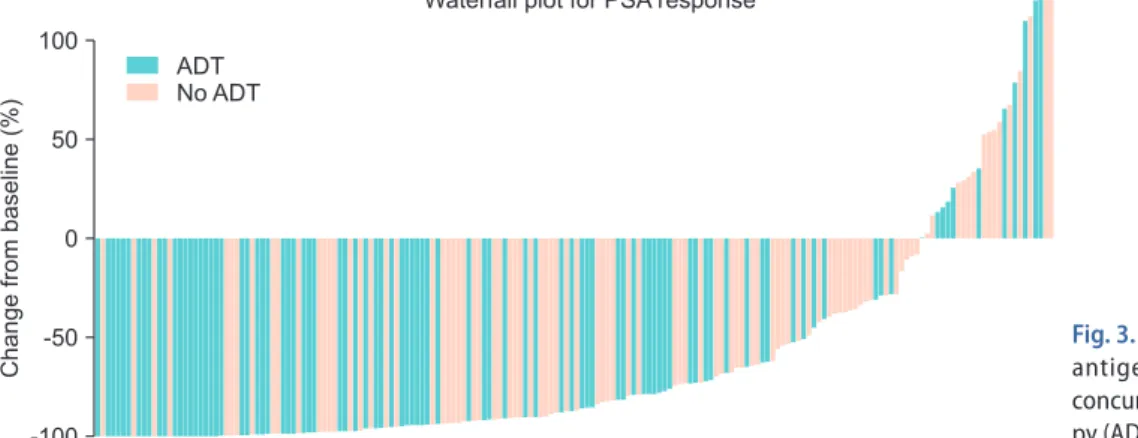
to two-sided tests, with p-values <0.05 considered statistically significant. PSA response summaries were presented as per- centages of patients who showed a decrease in PSA levels by more than 50% or 90%, respectively, from baseline to lowest point, and were visualized using waterfall plots. AEs were described as the rate of all grade or grade ≥3 events.
3. Ethical statement
This study was approved by the Institutional Review Boards at each participating center (representative IRB:
Seoul National University Hospital IRB no. H-1604-099-755).
Subjects provided written informed consent, and the study was performed according to the Declaration of Helsinki.
RESULTS
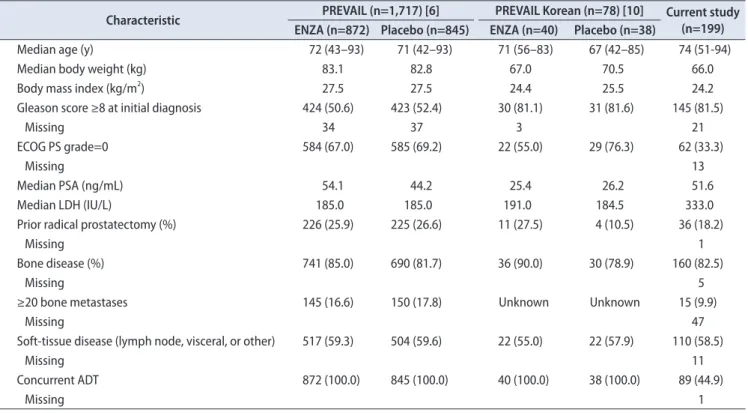
Demographic features and disease characteristics of pa- tients are shown in Table 1 [6,10]. Initial results showed that 81.5% of the patients had Gleason score (GS) ≥8 and 33.3% of the patients had European Cooperative Oncology Group Per- formance Status (ECOG PS) 0. Eighty-nine patients (44.9%) received concurrent ADT. Median follow-up is 9.4 months (interquartile range, 3.9–13.5 months). The overall mortality rate was 12%. The Kaplan–Meier curves for OS and rPFS
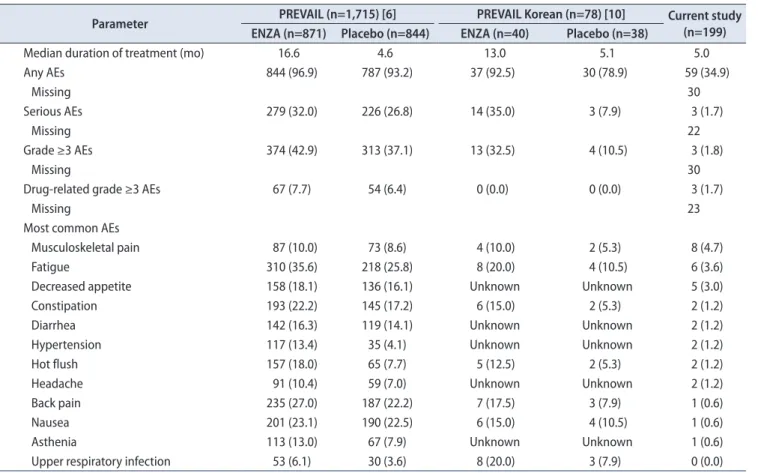
are shown in Fig. 1 [6,10]. Median OS, median rPFS, median time until chemotherapy, median time until first SRE was not reached until our analysis (Fig. 1, Table 2) [6,10]. Median time until PSA progression was 6 months (Table 2) [6,10]. Af- ter enzalutamide treatment, 35.2% of patients received more than one systemic chemotherapy (Table 3) [6,10]. The median OS was not achieved and 76.7% of patients were alive at 30 months. In a Kaplan–Meier curve with 95% confidence interval (CI), OS was 0.84 (95% CI, 0.76–0.91) at 12 months and 0.77 (95% CI, 0.67–0.87) at 24 months (Supplementary Fig. 1). The results of the univariate Cox proportional haz- ard analysis for OS showed that concurrent ADT, ECOG PS, and baseline PSA levels were significant predictors of OS (Table 4). Results of multivariate analysis showed that enzalutamide and concurrent ADT significantly improved the OS (hazard ratio, 0.346; 95% CI, 0.125–0.958). The median duration of enzalutamide treatment was 5 months, and the incidence of AEs of grade 3 or higher was 1.7% (Table 5) [6,10].
The Kaplan–Meier curves for OS, PSA PFS, and rPFS af- ter concurrent ADT are shown in Fig. 2. The OS by 2 years was significantly improved with concurrent ADT (84.6%
vs. 71.7%, p=0.015). In addition, patients receiving concurrent ADT showed a significant improvement in PSA PFS (8.0 vs.
4.6 months, p=0.008). However, rPFS at 2 years was not dif-
Table 1. Baseline patient and disease characteristics
Characteristic PREVAIL (n=1,717) [6] PREVAIL Korean (n=78) [10] Current study (n=199) ENZA (n=872) Placebo (n=845) ENZA (n=40) Placebo (n=38)
Median age (y) 72 (43–93) 71 (42–93) 71 (56–83) 67 (42–85) 74 (51-94)
Median body weight (kg) 83.1 82.8 67.0 70.5 66.0
Body mass index (kg/m2) 27.5 27.5 24.4 25.5 24.2
Gleason score ≥8 at initial diagnosis 424 (50.6) 423 (52.4) 30 (81.1) 31 (81.6) 145 (81.5)
Missing 34 37 3 21
ECOG PS grade=0 584 (67.0) 585 (69.2) 22 (55.0) 29 (76.3) 62 (33.3)
Missing 13
Median PSA (ng/mL) 54.1 44.2 25.4 26.2 51.6
Median LDH (IU/L) 185.0 185.0 191.0 184.5 333.0
Prior radical prostatectomy (%) 226 (25.9) 225 (26.6) 11 (27.5) 4 (10.5) 36 (18.2)
Missing 1
Bone disease (%) 741 (85.0) 690 (81.7) 36 (90.0) 30 (78.9) 160 (82.5)
Missing 5
≥20 bone metastases 145 (16.6) 150 (17.8) Unknown Unknown 15 (9.9)
Missing 47
Soft-tissue disease (lymph node, visceral, or other) 517 (59.3) 504 (59.6) 22 (55.0) 22 (57.9) 110 (58.5)
Missing 11
Concurrent ADT 872 (100.0) 845 (100.0) 40 (100.0) 38 (100.0) 89 (44.9)
Missing 1
Values are presented as median (range), number only, or number (%).
ENZA, enzalutamide; ECOG PS, European Cooperative Oncology Group Performance Status; PSA, prostate-specific antigen; LDH, lactate dehydro- genase; ADT, androgen deprivation therapy.
ferent in patients receiving concurrent ADT (71.8% vs. 68.4%, p=0.154). The waterfall plot of the change in PSA levels in patients receiving concurrent ADT is shown in Fig. 3. To compare Korean real-world data with the result of the PRE-
VAIL study, we described data of PREVAIL study in Table 1, Table 2, Table 3, Table 5 and Fig. 1 [6,10].
A
0 3 6 9 12 15 18 21 24 27 30 33 36 39 42 100
90 80 70 60 50 40 30 20 10
45
Overallsurvival(%)
Months 0
PREVAIL [6]
Enzalutamide Placebo PREVAIL Korean [10]
Enzalutamide Placebo Current study
Enzalutamide
B
0 3 6 9 12 15 18 21
100 90 80 70 60 50 40 30 20 10 Radiographicprogression- freesurvival(%)
Months 0
PREVAIL Korean [10]
Enzalutamide Placebo Current study
Enzalutamide
Fig. 1. Kaplan–Meier survival curves for (A) overall survival and (B) radiographic progression-free survival in PREVAIL study [6], in PREVAIL Korean post hoc analysis [10], and in this study.
Table 3. Subsequent anti-neoplastic and endocrine therapies
Type of treatment PREVAIL (n=1,717) [6] PREVAIL Korean (n=78) [10] Current study (n=199) ENZA (n=872) Placebo (n=845) ENZA (n=40) Placebo (n=38)
Any systemic treatment 382 (43.8) 642 (76.0) 7 (17.5) 25 (65.8) 70 (35.2)
Missing 23
Antineoplastic agent 308 (35.3) 515 (60.9) 6 (15.0) 22 (57.9) 40 (22.7)
Docetaxel 286 (32.8) 479 (56.7) 5 (12.5) 22 (57.9) 34 (19.3)
Abiraterone acetate 179 (20.5) 385 (45.6) 1 (2.5) 4 (10.5) 9 (5.1)
Cabazitaxel 51 (5.8) 110 (13.0) 0 (0.0) 3 (7.9) 2 (1.1)
Mitoxantrone 5 (0.6) 9 (1.1) 0 (0.0) 1 (2.6) 0 (0.0)
Duplicated count was allowed.
ENZA, enzalutamide.
Table 2. Summary of oncologic outcomes
Variable PREVAIL (n=1,717) [6] PREVAIL Korean (n=78) [10] Current study (n=199) ENZA (n=872) Placebo (n=845) ENZA (n=40) Placebo (n=38)
Median time until chemotherapy (mo) 28.0 10.8 NYR 11.2 NYR
HR (95% CI) 0.35 (0.30–0.40) 0.21 (0.08–0.51)
Median time until PSA progression (mo) 11.2 2.8 11.1 2.9 6.0
HR (95% CI) 0.17 (0.15–0.20) 0.31 (0.17–0.56)
Median time until first SRE (mo) 31.1 31.3 NYR 20.1 NYR
HR (95% CI) 0.72 (0.61–0.84) 1.40 (0.46–4.33)
PSA decline of
≥50% from baseline (n/total n; %) 666/854 (78.0) 27/777 (3.5) 28/40 (70.0) 4/38 (10.5) 139/187 (74.3) ≥90% from baseline (n/total n; %) 400/854 (46.8) 9/777 (1.2) Unknown Unknown 88/187 (47.1) ENZA, enzalutamide; HR, hazard ratio; CI, confidence interval; PSA, prostate-specific antigen; SRE, skeletal-related event; NYR, not yet reached.
DISCUSSION
The effects of enzalutamide observed in our study with asymptomatic or mildly symptomatic Korean chemotherapy- naïve patients with mCRPC were consistent with those ob- served in the study population of the PREVAIL trial [6,10].
However, the baseline disease characteristics of the sub- jects in our study were different from those of the subjects in the PREVAIL trial, which may be because of the differ- ences in real clinical practice. A high percentage of Korean patients had a GS of at least 8, which indicates a high dis- ease burden. Our finding was consistent with that observed in the PREVAIL trial in that 50.6% and 81.1% patients receiving enzalutamide among the overall population and in Korean subgroup, respectively, has a GS ≥8 [10]. Some dif-
ferences were observed in the characteristics of the disease between the real-world Korean patients and the subjects in the PREVAIL trial; these differences may be related to dif- ferences in ethnicity. Compared to the overall study popula- tion of the PREVAIL trial, a larger proportion of Korean patients had poor PS. A lower proportion of patients in our study had ECOG PS=0 (33.3% vs. 67.0% in the PREVAIL study). In clinical practice, the physicians, patients, and rela- tives of chemotherapy-naïve patients with mCRPC with poor PS are reluctant to undergo chemotherapy. Therefore, they prefer treatment with enzalutamide despite its high cost before commencing chemotherapy. Thus, this finding may explain why our data showed that a high proportion of Korean patients had poor performance status. Korean patients receiving enzalutamide had a short median time Table 4. Cox regression analysis for overall survival
Variable Univariate Multivariate
HR 95% CI p-value HR 95% CI p-value
Age (y)
<65 Reference
≥65 0.808 0.302–2.162 0.672
ECOG PS
0–1 Reference
≥2 2.993 1.160–7.723 0.023
No. of HT
≤2 Reference
>2 1.048 0.247–4.453 0.949
Type of progression at study entry
PSA only Reference
Radiographic progression +/- PSA progression 0.699 0.350–2.020 0.699 No. of bone lesions
<20 Reference
≥20 1.090 0.141–8.435 0.934
Lymph node involvement
No Reference
Yes 0.943 0.415–2.139 0.888
Visceral metastasis
No Reference
Yes 1.170 0.342–4.006 0.802
Gleason score
≤7 Reference
≥8 6.059 0.818–44.86 0.078
Baseline PSA
≤Median Reference Reference
>Median 2.517 1.084–5.840 0.032 2.507 0.958–6.563 0.061
Concurrent ADT
No Reference Reference
Yes 0.335 0.133–0.845 0.020 0.346 0.125–0.958 0.041
HR, hazard ratio; CI, confidence interval; ECOG PS, European Cooperative Oncology Group Performance Status; HT, hormonal treatment; PSA, prostate-specific antigen; ADT, androgen deprivation therapy.
until PSA progression, and poor baseline characteristics and PS may be attributed to this result. In addition to baseline characteristics, concurrent ADT affects the OS. Unlike the patients in the PREVAIL trial, a larger proportion of Ko- rean patients (55%) had did not receive concurrent ADT with enzalutamide in the clinical setting because the Korean medical insurance system prohibited continuous ADT for mCRPC until January 2017. Our results showed that ADT administered concurrently with enzalutamide improved the
oncologic outcomes of chemotherapy-naïve patients with mCRPC.
To date, no study has established evidence supporting continuation of LHRH therapy for CRPC [11]. Few studies have investigated the effects of termination of LHRH ther- apy in patients with CRPC and, therefore, the current Euro- pean guidelines recommend medical castration [12]. The Ko- rean medical insurance system prohibited continuous ADT for mCRPC because of lack of evidence until January 2017.
0 10 20 30 40
100
80
60
40
survivalOverall(%) 20
Months 0
A
ADT ADT No p=0.015
0 25
100
80
60
40
20 PSAprogression- freesurvival(%)
Months 0
B
ADT ADT No p=0.008
0 25
100
80
60
40
20 Radiographicprogression- freesurvival(%)
Months 0
C
ADT ADT No p=0.154
5 10 15 20 5 10 15 20
Fig. 2. According to concurrent androgen deprivation therapy (ADT), Kaplan–Meier survival estimates for (A) overall survival and (B) time to prostate- specific antigen (PSA) progression-free survival, and (C) radiographic progression-free survival.
Table 5. Summary of adverse events
Parameter PREVAIL (n=1,715) [6] PREVAIL Korean (n=78) [10] Current study (n=199) ENZA (n=871) Placebo (n=844) ENZA (n=40) Placebo (n=38)
Median duration of treatment (mo) 16.6 4.6 13.0 5.1 5.0
Any AEs 844 (96.9) 787 (93.2) 37 (92.5) 30 (78.9) 59 (34.9)
Missing 30
Serious AEs 279 (32.0) 226 (26.8) 14 (35.0) 3 (7.9) 3 (1.7)
Missing 22
Grade ≥3 AEs 374 (42.9) 313 (37.1) 13 (32.5) 4 (10.5) 3 (1.8)
Missing 30
Drug-related grade ≥3 AEs 67 (7.7) 54 (6.4) 0 (0.0) 0 (0.0) 3 (1.7)
Missing 23
Most common AEs
Musculoskeletal pain 87 (10.0) 73 (8.6) 4 (10.0) 2 (5.3) 8 (4.7)
Fatigue 310 (35.6) 218 (25.8) 8 (20.0) 4 (10.5) 6 (3.6)
Decreased appetite 158 (18.1) 136 (16.1) Unknown Unknown 5 (3.0)
Constipation 193 (22.2) 145 (17.2) 6 (15.0) 2 (5.3) 2 (1.2)
Diarrhea 142 (16.3) 119 (14.1) Unknown Unknown 2 (1.2)
Hypertension 117 (13.4) 35 (4.1) Unknown Unknown 2 (1.2)
Hot flush 157 (18.0) 65 (7.7) 5 (12.5) 2 (5.3) 2 (1.2)
Headache 91 (10.4) 59 (7.0) Unknown Unknown 2 (1.2)
Back pain 235 (27.0) 187 (22.2) 7 (17.5) 3 (7.9) 1 (0.6)
Nausea 201 (23.1) 190 (22.5) 6 (15.0) 4 (10.5) 1 (0.6)
Asthenia 113 (13.0) 67 (7.9) Unknown Unknown 1 (0.6)
Upper respiratory infection 53 (6.1) 30 (3.6) 8 (20.0) 3 (7.9) 0 (0.0)
Values are presented as number only or number (%).
ENZA, enzalutamide; AE, adverse event.
Continuation of LHRH therapy may cause considerable side effects and unnecessary expenses [13]. Results from previous clinical trials indicate that castration offers only a marginal survival benefit [14,15]. Taylor et al. [14] reported the results of a retrospective study, which showed a significant mar- ginal survival benefit for patients continuing an LHRH agonist along with anthracycline, platinum, or ketoconazole treatment for mCRPC. However, a consensus remains to be achieved about the continuation of LHRH treatment. Anal- ysis of 5 Southwest Oncology Group phase II chemotherapy trials conducted in the 1990s failed to show an obvious ad- vantage of continuous ADT in terms of response to cytotoxic chemotherapy or OS in patients with CRPC [15]. The results of another retrospective study of 78 patients failed to show a survival benefit of docetaxel and concurrent ADT in pa- tients with CRPC [16]. However, it could be an underpow- ered study because of the small number of patients. Lee et al. [16] found that serum testosterone levels did not recover to those observed in noncastrated individuals in most pa- tients after withdrawal of ADT for the entire duration of chemotherapy. A similar phenomenon was observed in men with hormone-sensitive prostate cancer, in which approxi- mately half of the patients who received ADT for a long- term remained castrated at 2.5 years after ADT cessation [17].
Results of previous studies indicate that serum testosterone levels remain low after long-term treatment with LHRH agonists [18-20]. Therefore, cessation of LHRH therapy may have only little clinical relevance since serum testosterone levels remain low and may not affect proliferation of cancer cells. However, unlike serum testosterone levels, serum LH levels recover after several weeks to months after cessation of LHRH therapy [18-20]. Cessation of LHRH therapy leads to rapid recovery of LH levels after a median of 58 days to 4.5 months, even after long-term medical castration [18,19].
Apart from its action on the testes and adrenal glands, LH acts directly on prostate cancer cells via LH-specific receptors
and increases the expression of several key steroidogenic en- zymes [21]. Administration of abiraterone alone increases the LH [22]. To date, the SPARE trial (NCT02077634) is the only trial that provides further insights into the complex hor- monal changes that occur after treatment with abiraterone with or without concurrent LHRH therapy [23]. The SPARE trial is investigating the role of continuation of LHRH ther- apy when starting treatment with abiraterone in patients with asymptomatic or mild symptomatic chemotherapy- naïve CPRC. To date, no study has investigated the efficacy of enzalutamide and concurrent ADT in the treatment of chemotherapy-naïve mCPRC. Therefore, the results of our trial provide important evidence based on unique data.
This study is subject to the usual limitations inherent with retrospective design and data collection. The follow- up period of this study was relatively short. Further, some missing values are another weakness of the data. The rate of AEs in our study was lower than those in the PREVAIL trial, which may be because of the retrospective study de- sign. The advantages of our study are that we analyzed real- world data from multiple institutions. Furthermore, the pri- mary endpoint was OS, which is relatively objective and less confounded even in a retrospective study. Thus, our results provide novel data about the efficacy of enzalutamide and concurrent ADT for the treatment of men with chemother- apy-naïve mCRPC due to the previous medical environment in Korea, in which continuous ADT therapy for mCRPC patients was prohibited.
CONCLUSIONS
A higher proportion of patients in our cohort study showed a GS ≥8 and poor ECOG performance status than those in the PREVAIL study, but the efficacy results in our study were similar to those in the PREVAIL study.
Despite the limitations of retrospective studies, the safety
100
50
0
-50
-100
Changefrombaseline(%)
Waterfall plot for PSA response
ADT ADT No
Fig. 3. Waterfall plot for prostate-specific antigen (PSA) response according to concurrent androgen deprivation thera- py (ADT).
was also acceptable. Enzalutamide is effective and safe for chemotherapy-naïve patients with mCRPC in the real-world setting. Further, compared to enzalutamide alone, concur- rent administration of ADT with enzalutamide significantly prolonged the survival. Thus, we recommend concurrent administration of ADT with enzalutamide for the treatment of chemotherapy-naïve patients with mCRPC.
CONFLICTS OF INTEREST
The authors have nothing to disclose.
AUTHORS’ CONTRIBUTIONS
Research conception and design: Chang Wook Jeong, Seung Il Jung, Cheol Kwak, and Dong Deuk Kwon. Data acquisition: all authors. Data analysis and interpretation:
Myung Soo Kim, Chang Wook Jeong, and Seung Il Jung.
Drafting of the manuscript: Myung Soo Kim and Seung Il Jung. Approval of final manuscript: all authors.
SUPPLEMENTARY MATERIAL
Scan this QR code to see the supplementary material, or visit https://www.icurology.org/src/sm/icurology-61-19-s001.pdf.
REFERENCES
1. Jung KW, Won YJ, Kong HJ, Oh CM, Cho H, Lee DH, et al.
Cancer statistics in Korea: incidence, mortality, survival, and prevalence in 2012. Cancer Res Treat 2015;47:127-41.
2. Ferlay J, Soerjomataram I, Dikshit R, Eser S, Mathers C, Rebelo M, et al. Cancer incidence and mortality worldwide: sources, methods and major patterns in GLOBOCAN 2012. Int J Can- cer 2015;136:E359-86.
3. Lee DH, Jung HB, Chung MS, Lee SH, Chung BH. The change of prostate cancer treatment in Korea: 5 year analysis of a single institution. Yonsei Med J 2013;54:87-91.
4. Scher HI, Halabi S, Tannock I, Morris M, Sternberg CN, Carducci MA, et al.; Prostate Cancer Clinical Trials Working Group. Design and end points of clinical trials for patients with progressive prostate cancer and castrate levels of testosterone:
recommendations of the Prostate Cancer Clinical Trials Work- ing Group. J Clin Oncol 2008;26:1148-59.
5. Tannock IF, de Wit R, Berry WR, Horti J, Pluzanska A, Chi KN, et al. Docetaxel plus prednisone or mitoxantrone plus prednisone for advanced prostate cancer. N Engl J Med 2004;351:1502-12.
6. Beer TM, Armstrong AJ, Rathkopf DE, Loriot Y, Sternberg CN, Higano CS, et al. Enzalutamide in metastatic prostate cancer before chemotherapy. N Engl J Med 2014;371:424-33.
7. Scher HI, Fizazi K, Saad F, Taplin ME, Sternberg CN, Miller K, et al.; AFFIRM Investigators. Increased survival with enzalu- tamide in prostate cancer after chemotherapy. N Engl J Med 2012;367:1187-97.
8. Saad F, de Bono J, Shore N, Fizazi K, Loriot Y, Hirmand M, et al. Efficacy outcomes by baseline prostate-specific antigen quartile in the AFFIRM trial. Eur Urol 2015;67:223-30.
9. Loriot Y, Miller K, Sternberg CN, Fizazi K, De Bono JS, Chow- dhury S, et al. Effect of enzalutamide on health-related qual- ity of life, pain, and skeletal-related events in asymptomatic and minimally symptomatic, chemotherapy-naive patients with metastatic castration-resistant prostate cancer (PRE- VAIL): results from a randomised, phase 3 trial. Lancet Oncol 2015;16:509-21.
10. Kim CS, Theeuwes A, Kwon DD, Choi YD, Chung BH, Lee HM, et al. The PREVAIL trial of enzalutamide in men with chemotherapy-naïve, metastatic castration-resistant prostate cancer: post hoc analysis of Korean patients. Investig Clin Urol 2016;57:174-83.
11. Merseburger AS, Hammerer P, Rozet F, Roumeguère T, Caffo O, da Silva FC, et al. Androgen deprivation therapy in castrate- resistant prostate cancer: how important is GnRH agonist backbone therapy? World J Urol 2015;33:1079-85.
12. Heidenreich A, Bastian PJ, Bellmunt J, Bolla M, Joniau S, van der Kwast T, et al.; European Association of Urology. EAU guidelines on prostate cancer. Part II: Treatment of advanced, relapsing, and castration-resistant prostate cancer. Eur Urol 2014;65:467-79.
13. Merseburger AS, Björk T, Whitehouse J, Meani D. Treatment costs for advanced prostate cancer using luteinizing hormone- releasing hormone agonists: a solid biodegradable leuprorelin implant versus other formulations. J Comp Eff Res 2015;4:447- 53.
14. Taylor CD, Elson P, Trump DL. Importance of continued tes- ticular suppression in hormone-refractory prostate cancer. J Clin Oncol 1993;11:2167-72.
15. Hussain M, Wolf M, Marshall E, Crawford ED, Eisenberger M. Effects of continued androgen-deprivation therapy and other prognostic factors on response and survival in phase II chemotherapy trials for hormone-refractory prostate cancer: a Southwest Oncology Group report. J Clin Oncol 1994;12:1868- 75.
16. Lee JL, Eun Kim J, Ahn JH, Lee DH, Lee J, Kim CS, et al. Role of androgen deprivation treatment in patients with castration- resistant prostate cancer, receiving docetaxel-based chemo- therapy. Am J Clin Oncol 2011;34:140-4.
17. Bong GW, Clarke HS Jr, Hancock WC, Keane TE. Serum testosterone recovery after cessation of long-term luteinizing hormone-releasing hormone agonist in patients with prostate cancer. Urology 2008;71:1177-80.
18. Kobayashi T, Nishizawa K, Mitsumori K. Individual variation of hormonal recovery after cessation of luteinizing hormone- releasing hormone agonist therapy in men receiving long-term medical castration therapy for prostate cancer. Scand J Urol Nephrol 2006;40:198-203.
19. Kaku H, Saika T, Tsushima T, Ebara S, Senoh T, Yamato T, et al. Time course of serum testosterone and luteinizing hor- mone levels after cessation of long-term luteinizing hormone- releasing hormone agonist treatment in patients with prostate cancer. Prostate 2006;66:439-44.
20. Hall MC, Fritzsch RJ, Sagalowsky AI, Ahrens A, Petty B, Roehrborn CG. Prospective determination of the hormonal response after cessation of luteinizing hormone-releasing hor- mone agonist treatment in patients with prostate cancer. Urol- ogy 1999;53:898-902; discussion 902-3.
21. Pinski J, Xiong S, Wang Q, Stanczyk F, Hawes D, Liu SV. Effect of luteinizing hormone on the steroidogenic pathway in pros- tate cancer. Prostate 2011;71:892-8.
22. O'Donnell A, Judson I, Dowsett M, Raynaud F, Dearnaley D, Mason M, et al. Hormonal impact of the 17alpha-hydroxylase/
C(17,20)-lyase inhibitor abiraterone acetate (CB7630) in pa- tients with prostate cancer. Br J Cancer 2004;90:2317-25.
23. Ohlmann CH, Jäschke M, Jaehnig P, Krege S, Gschwend J, Rexer H, et al. Abiraterone acetate plus LHRH therapy versus abiraterone acetate while sparing LHRH therapy in patients with progressive, metastatic and chemotherapy-naïve, castra- tion-resistant prostate cancer (SPARE): study protocol for a randomized controlled trial. Trials 2017;18:457.
![Fig. 1. Kaplan–Meier survival curves for (A) overall survival and (B) radiographic progression-free survival in PREVAIL study [6], in PREVAIL Korean post hoc analysis [10], and in this study.](https://thumb-ap.123doks.com/thumbv2/123dokinfo/5240032.130181/4.892.77.819.87.407/survival-survival-radiographic-progression-survival-prevail-prevail-analysis.webp)