• 검색 결과가 없습니다.

The Effect of Aquatic Task Training on Gait and Balance Ability in Stroke Patients

N/A
N/A
Protected

Academic year: 2021

Share "The Effect of Aquatic Task Training on Gait and Balance Ability in Stroke Patients"

Copied!
7
0
0

로드 중.... (전체 텍스트 보기)

전체 글

(1)

Ji-Yeun Lee, PT, MS; Jung-Seo Park, PT, MS

1

; Kyoung Kim, PT, PhD

2

Department of Physical Therapy, Andong Science College;

1

Department of Physical Therapy, Youngdong University;

2

Department of Physical Therapy, College of Rehabilitation Science, Daegu University

Purpose:

The purpose of study was to measure stroke patients’ ability to balance and their degrees of clinical function and  to examine the effect of the aquatic exercise method using tasks related to these features.

Methods:

Twenty stroke patients were randomly assigned to an aquatic task exercise group and a land task exercise group. 

Both groups used the same exercise method for 60 minutes each session, three times a week for 12 weeks at the same time  point and with the same amount of exercise.

Results:  Before  and  after  the  exercise,  static  balance  was  measured  using  balance  measuring  instruments  locomotive 

faculties, muscular strength, and dynamic balancewere assessed through the Berg balance and 10 m gait tests. Finally, gait  abilities were measured, and the data obtained were analyzed to generate the results.

Conclusion:  Both  groups  showed  significant  improvement,  but  the  aquatic  exercise  group  showed  slightly  more 

significant results in static balance, Berg balance, and upright walking tests. It is thought that the improvement of stroke  patients’ balance and gait ability can be triggered through the application of aquatic exercise programs in the future.

Keywords: Chronic stroke, Balance, Aqua exercise, Gait 

Received: April 28, 2011

Revised: May 09, 2011 Accepted: May 30, 2011

Corresponding author: Jung-Seo Park, [email protected]

in Stroke Patients

The Journal of Korean Society of Physical Therapy

I. Introduction

The central nervous system, which plays an important role in the maintenance of physical activity, can be damaged by diverse causes stroke is one of the diseases resulting from such damage.

Stroke is defined as damage to the brain caused by cerebro- vascular bursting or occlusion that causes sudden neurological deficits to corresponding brain areas, triggering hemiplegia, sensory disturbance, dystaxia and balance disorders, cognitive functional disorder, language disorder, etc., thereby restricting daily life activities.

1

Thus, stroke is a general medical condition causing a long-term disorder that needs to be continuously managed.

2

In terms of hemiplegia patients’ neurological deficits resulting from stroke, a combination of problems in the sensory, motor, and cognitive abilities and emotional disturbance appear, along with balance deficits and amyotrophy.

3

Therefore, hemiplegic patients should actively participate in exercise

programs aimed at maintaining and improving their ability to engage in physical activities.

4

Among such programs, task- oriented approaches represent an efficient treatment method, as they are composed of tasks that can effectively present diverse functional activities to stroke patients and help them to improve their ability to perform their actual daily life activities.

5

It has been said that in the case of oriented movements toward certain targets, kinetic subcomponents related tothe complexity of movements such as the sizes and distances of targets and the speed of movements are greatly involved in the execution and programming of motion.

6

Furthermore, changes in the speed and accuracy of movements involve the integration of neurological circuits that become the basis of movements in the planning process.

7

Although exercise programs for improving such functions

among hemiplegia patients have been discussed in many studies,

recently, aquatic rehabilitation exercises that enable both

(2)

physical therapy and kinesitherapy to be conducted have been applied to diverse diseases, including stroke.

8

In particular, aquatic exercise programs provide patients who cannot bear weight loads on land with an environment in which they can begin to exercise at an earlier time after stroke.

9

The dynamic properties of water serve the role of supporting the body and reducing the fear of falling, as well as reducing the possibility of acute damage during exercise, creating a low-risk exercise environment. Therefore, the aquatic environment is safest for exercise.

10

In a study by Jung et al.,

11

it was reported that when compared with exercises on land, exercises on aquatic treadmills reduced patients’ overall tension and fears due to the dynamic characteristics of water, thereby affecting postural stability and showing significant effects on stance phase stability. Further- more, in a study by Driver et al.,

12

it was reported that when aquatic exercises were applied to brain-damaged patients, positive changes in the patients’ physical strength were observed due to the effects of buoyancy and hydrostatic pressure.

Hurkmans et al.

13

reported that aquatic exercise programs showed positive results in terms of functional abilities, the aerobic capacity of the body, and muscular strength. Moreover, Takeshinma et al.

14

claimed that aquatic exercises for eight weeks or longer increased cardiovascular movements not only in brain-damaged patients, but also in the elderly and patients with rheumatoid arthritis.

As such, according to recent studies, aquatic exercise pro- grams positively affect physiological changes and gaits, although studies of the diversity and effects of aquatic exercise programs have been insufficient. Furthermore, although there are many studies comparing the use of gaits and treadmills in aquatic exercises with those in land exercises too few studies using normalized programs have been conducted. Thus, the purpose of this study was to design normalized programs in which tasks are given, examine the effects of these programs on hemiplegia patients’ clinical functional abilities and balance, and assess the effects of the programs for land and aquatic tasks.

II. Methods

1. Subjects

A group of 20 subjects was recruited from D hospital. To be eligible to participate, subjects had to meet the following

inclusion criteria: (1) discharged from all rehabilitation services and living at home; (2) able to walk 10 meters independently with or without an assistive device; (3) capable of understanding and following directions given by a researcher during the program; (4) completion of at least three months diagnosis post-stroke; and (5) score more than 24 on the Mini-Mental State Examination Korea (MMSE-K). Subjects were excluded if they had any medical condition that would prevent participation in a training program. The subjects were divided into two groups: an aquatic exercise group (experimental group) and a land exercise group (control group).

2. Intervention methods

This study was conducted for 12 weeks in a rehabilitation hospital with an aquatic care unit. Exercise intensity based on targeted heart rates could not be used due to the nature of the subjects thus, the rating of perceived exertion (RPE) was used.

The exercises were performed for 12 weeks with an exercise intensity of level 13 on the RPE (moderately difficult) for 60 minutes per session, three times a week water temperatures were maintained at 30.80±0.42°C.

15

1) Aquatic intervention

The aquatic exercise program applied was a modification of three aquatic exercise methods from Colado et al.,

16

Burns and Lauder,

17

and Dean et al.

18

The program comprised three stages.

Stage 1 was composed of exercises to relax or extend the body stage 2 was composed of exercises to have the body naturally react and stage 3 was composed of cooling-down exercises. The exercises were performed three times a week for 60 minutes for a total of 12 weeks. Incremental exercise loads were applied based on the subjects’ development of exercise abilities to move from one stage to another. The aquatic exercise program is as shown in Table 1.

2) Land intervention

The land exercise program was implemented using the same method as the aquatic exercise program, applying the exercises for the same time and with the same intensity Table 1.

3. Measurements 1) Static balance

To assess the subjects’ static balance while standing, their lateral

(3)

Aquatic intervention exercise program

Stage Time Contents Program

Warming-up exercise 10 min Flexibility whole body exercise Upperㆍlower extremity stretching and joint moving exercise

Main exercise 40 min Task-oriented exercise

① Jumping

② Lifting and lowering the heel repeatedly

③ Stopping while walking on oral command

④ Walking laterally

⑤ Repeating walking and stopping in accordance with oral commands while holding a heavy ball for sensory treatment

⑥ Repeatedly going up and down water Steps

⑦ Walking 6 m back and forth Cooling-down exercise 10 min Flexibility, whole-body exercise Upperㆍlower extremity stretching

Land intervention exercise program

Stage Time Contents Program

Warming-up exercise 10 min Flexibility, whole-body exercise Upperㆍlower extremity stretching and joint moving exercise

Main exercise 40 min Task-oriented exercise

① Jumping

② Lifting and lowering the heel repeatedly

③ Stopping while walking on oral command

④ Walking laterally

⑤ Repeating walking and stopping in accordance with oral commands while holding a heavy ball for sensory treatment

⑥ Repeatedly going up and down steppers

⑦ Walking 6 m back and forth Cooling-down exercise 10 min Flexibility, whole-body exercise Upperㆍlower extremity stretching Table 1. Program of the Aquatic and Land Groups

and anteroposterior postural perturbation speeds were measured using a Good Balance System (Metitur Ltd, Jyvӓkylӓ Finland) composed of triangle force platforms. This equipment is widely used to measure and train the balance of the elderly and patients with neurological damage.

19

The subjects were instructed to stand on the force platforms wearing the shoes they normally wear, with their eyes open and their legs apart to the width of their shoulders, and keep their eyes on the numerals appearing on the monitor in front of them for 30 seconds. The perturbation speeds were measured three times, and the mean values were indicated in mm/s.

2) Berg’s Balance Scale (BBS)

The balance assessment consisted of 14 subtests performed in a standard order. Each task was scored on a five-point scale (0-4) according to the quality of the performance or the time taken to complete the task, as ranked by the test developers. The maximum possible score for this assessment was 56.

20

The BBS

is a psychometrically sound measure of balance impairment for use in post-stroke assessment.

21

3) 10 m walking test (10mWT)

The 10 m walking test (10mWT) is a test that can evaluate the ability to move, muscular strength, and dynamic balancing abilities simultaneously. This test is generally used in evaluating the gait abilities of patients with neurological damage, and its intertester reliability is 0.97.

22

In this study, the subjects were made to walk a linear, flat distance of 14 m two times, the first and last 2 m were excluded from the measurement. The time taken for 10 m walking was measured, and the mean time was obtained down to the unit of 0.01 sec using a stopwatch.

4) Time Up & Go Test (TUG)

From a starting position of sitting on a chair with arms, the subjects were asked to turn around 3 m and then sit on a chair.

Physiotherapists recorded the time to complete the task, using a

(4)

Variables Pre-training Post-training p X-speed*

(mm/s)

Aqua Group 28.83±4.25 17.24±2.57 0.01§ Land Group 17.25±2.57 16.27±5.22 0.04§ Y-speed

(mm/s)

Aqua Group 18.52±3.56 10.16±2.29 0.02§ Land Group 20.77±5.45 18.67±2.89 0.04§

BBS (score)II

Aqua Group 36.88±3.65§ 42.65±6.15 0.01II Land Group 37.64±4.48 40.78±3.21 0.02II

* X-speed: mediolateral velocity

Y-speed: anteroposterior velocity

II BBS: Berg’s balance scale

Mean±SD

§ p<0.05

Table 3. Comparison of balance between group (n=20)

Variable Aqua group

(n=10)

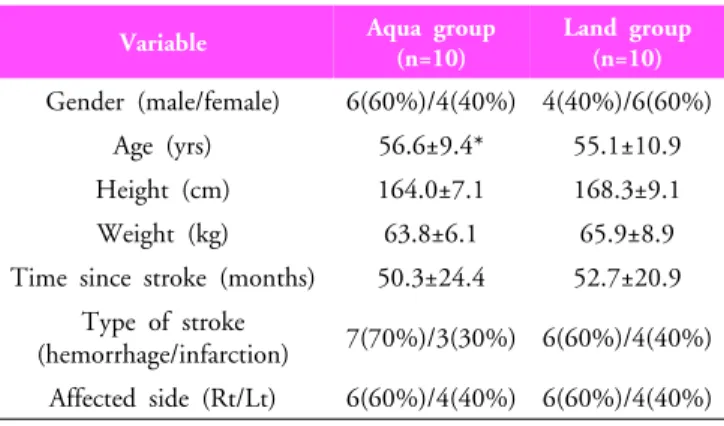
Land group (n=10) Gender (male/female) 6(60%)/4(40%) 4(40%)/6(60%)

Age (yrs) 56.6±9.4* 55.1±10.9

Height (cm) 164.0±7.1 168.3±9.1

Weight (kg) 63.8±6.1 65.9±8.9

Time since stroke (months) 50.3±24.4 52.7±20.9 Type of stroke

(hemorrhage/infarction) 7(70%)/3(30%) 6(60%)/4(40%) Affected side (Rt/Lt) 6(60%)/4(40%) 6(60%)/4(40%)

* Mean±SD

Table 2. General characteristics of subjects

Variables Pre-training Post-training p TUG

(sec)

Aqua Group 12.49±5.56§ 10.70±6.70 0.03II Land Group 14.06±4.56 10.01±5.70 0.02II 10mWT

(sec)

Aqua Group 25.49±5.56§ 22.70±6.70 0.04II Land Group 28.02±4.56 25.02±6.45 0.04II

TUG: Time up and go test

10mWT: 10 m walking test

§ Mean±SD

II p<0.05

Table 4. Comparison of the physical function test between
the groups

stop watch. The subjects practiced the task once, and then were timed three times. The mean of the three values was used in the analyses.

23

4. Data Analysis

The results of this study were statistically processed using the SPSS 12.0 for Windows, and Mann-Whitney U tests were conducted to compare the homogeneity of the subjects between the groups. Wilcoxon matched-pairs signed-ranks tests, which are nonparametric tests, were used to test the differences between before and after the individual exercises and to test statistical significance. Significance level p was set to 0.05.

III. Results

1. Clinical characteristics of subjects

A total of 20 subjects participated in this study. They were divided into two groups: an aquatic exercise group and a land exercise group. The subjects’ clinical characteristics are as follows (Table 2).

2. Comparison of the aquatic exercise group and the land exercise group before and after the exercise

1) Comparison of static balance between the groups

The results of static balance measured in the aquatic exercise group showed statistically significant decreases in X-speed values from 28.83±4.25 before the exercise to 17.24±2.57 after the exercise, and Y-speed values from 18.52±3.56 before the exercise to 10.16±2.29 after the exercise (p<0.05). The land exercise

group’s X-speed values significantly decreased from 17.25±2.57 before the exercise to 16.27±5.22 after the exercise, and the Y-speed values decreased from 20.77±5.45 before the exercise to 18.67±2.89 after the exercise (p<0.05)(Table 3).

2) Comparison of the physical function test between the groups In the results of the Berg balance and upright walking tests, which were conducted to test dynamic balancing abilities, both the aquatic exercise group and the land exercise group showed significant differences after the exercisecompared to before the exercise (p<0.05). In the 10mWTs conducted to assess gait abilities, the time was significantly shortened (p<0.05)(Table 4).

IV. Discussion

Patients with hemiplegia resulting from stroke exhibit forms of

dystaxiasuch as motor abnormality, spasticity due to paralysis,

and akinesia; consequently, brain damage adversely affects

physical functions.

12

Among the diverse treatment methods for

(5)

hemiplegia patients, aquatic exercises have been used as a method to maintain and improve health-related physical elements and have recently begun to attract increased attention.

In a study by Duffield,

24

it was reported that aquatic exercises using aquatic rotating effects could increase postural stability by reducing the instability of the body and promoting dynamic of joint reactions thus, aquatic exercises were much more advantageous than land exercises. As such, studies of the effect of aquatic exercises are being actively conducted. However, studies of aquatic task training and clinical functions are insufficient. In this study, patients with hemiplegia resulting from stroke were divided into an aquatic exercise group and a land exercise group, and static balance tests, Berg balance tests, 10 m gait tests, and upright walking tests were employed over 12 weeks in to examine changes in the patients’ balance ability and various clinical functions. Based on the results, both the aquatic exercise group and the land exercise group showed significant improve- ment after the exercise in all the tests the aquatic exercise group showed significantly more improvement compared to the land exercise group in the static balance tests and Berg balance tests.

Although the exercise programs and subjects are different, the results of this research are consistent with those of many previous studies, indicating that aquatic exercises have positive effects.

Chu et al.

25

advised that after aquaticlower extremity muscular strength exercises, hemiplegia patients’ gait speed increased, and that when the patients moved in the water, its viscosity caused resistance, which followed the patients as they moved. The resistance varied with speed because, when the speed increased, the viscosity also increased to augment the resistance. Consequently, the patients’ balance and gait improved. In this study, the task training experiments of the aquatic exercise group and the land exercise group also showed increases in static balance abilities, exhibiting significant improvement in balance measurement. In particular, given that the balance ability of the aquatic exercise group was improved further than the land exercise group, these results can be said to support the results indicating that aquatic exercises are more efficient than land exercises. However, Willen et al.

26

reported on 50-year-old poliomyelitis patients who performed aquatic exercises using 12 different tasks two times a week for 45 minutes each time over 20 weeks in their study, the subjects’

muscular strength, gait, and balance only showed a tendency

toward improvement compared to before the experiment. In relation to a control group that received only physical therapy, there were only differences in the degrees of pain, while there were no differences in the other items. Thus, Willen et al.’s research results conflict with the results of this study. However, other factors of the patients’ disease may have been important, and classical physical therapy was as effective as aquatic exercises in treating these patients.

Geiger et al.

27

advised that after joint movements using classical physical therapy and weight-bearing training where the center of gravity was moved without the subjects’ taking their feet off the ground, the weight bearing of the non-paralytic side increased by between 61% and 80% thus, these methods were effective in improving balance. Given these results, although classical physical therapy also helps in the improvement of balance ability and muscle power, if different types of aquatic exercises are included in the process of rehabilitation, better outcomes may be obtained in chronic stroke patients’ balance, muscular strength, and so on.

In this study, 10mWTs were conducted in order to assess gait abilities based on the results, the walking time was shortened after the exercise compared to before the exercise. Thus, the walking speeds were significantly improved.

Since stroke patients’ gait improvement is reported to be an important element of patients’ personal satisfaction with life and physical activities, many previous studies have applied aquatic rehabilitation exercises and assessed gait abilities to analyze their effects. In a study where the gait of stroke-disabled persons who switched to land exercises after aquatic rehabilitation exercises for 12 weeks was compared with the gait of stroke patients who continued with aquatic rehabilitation exercises, the patient group that continued with aquatic rehabilitation exercises had increased numbers of gaits per minute and walking speeds.

28

Furthermore, in a study by Lee and Kim

29

, aquatic rehabilitation exercises were applied to stroke patientsas a result, walking speeds and walking endurance significantly increased in 10mWTs and 12 minute walking tests. In this study, the improvements in gait abilities after applying aquatic rehabil- itation exercises were similar to the results of previous studies.

This improvement is interpreted to be the result of the reduction

of gravity through water buoyancy, which reduced burdens on

the muscles and joints that had been restricted in use to enable

movements even with a small amount of force. Those move-

(6)

ments would have stimulated the contracted muscles to further activate the muscles used in walking, thereby showing significant increases in walking speeds.

29

It also seems thatthe resistance of water increased the muscular strength of the lower extremities related to gait, thus affecting walking speeds.

25

In this study, physical functions and gait speeds significantly improved in the upright walking tests and Berg balance tests that were conducted to assess functional movements and balancing abilities. These results are similar to a study by Lee and Kim,

29

in which upright walking tests were conducted after aquatic rehabilitation exercises were applied to stroke disabled persons for 12 weeks, and significant improvement of balancing abilities was reported based on the results. Since upright walking tests and Berg balance tests require increased lower extremity muscular strength, the ability to quickly switch directions, etc., many kinds of motions should be implemented, it is assumed that these abilities were improved through aquatic rehabilitation exercises.

30

In this study, the benefits given by the special aquatic envir- onment and the function-reinforcing training implemented by introducing given tasks helped in hemiplegia patients’ recovery of functions.

18

One caveat to our results is that although they showed more positive changes in the group that performed aquatic exercise, it is difficult to generalize the changes for all hemiplegia patients in terms of interpretation since this study was conducted using only patients who satisfied the selection criteria, Additionally, due to ethical issues, environments could not be controlled during times other than the treatments time.

Furthermore, the subjects included patients with different kinds and sites of brain lesions. As it is evident from this study that patients’ balance ability and clinical functionscan be improved through repeated aquatic task implementation, diverse aquatic task programs should be developed and diverse effects should be studied.

V. Conclusion

To examine the effects of aquatic task training on stroke patients’

balance and gait ability, 20 stroke patients performed aquatic rehabilitation exercises and land exercises three times a week for 60 minutes each time for 12 weeks. The significant improve- ment of balance and gait ability was observed in both groups,

but the aquatic exercise group showed better results. Given these results, we believe that aquatic task training can help stroke patients to recover their functions and live independent lives. It is also expected that, by providing patients with rehabilitation and motivations through safe and effective aquatic exercises at an early time, more diverse approaches to stroke patients’ therapy will be implemented.

Author Contributions Research design: Lee JY, Park JS Acquisition of data: Park JS, Lee JY Analysis and interpretation of data: Kim K Drafting of the manuscript: Park JS, Lee JY

Administrative, technical, and material support: Lee JY , Park JS Research supervision: Lee JY , Park JS

References

1. Song JM, Kim SM. The Effect of Aquatic Exercise on the Improvement of Physical and Pulmonary Function After Stroke. J Kor Soc Phys Ther. 2009;21(2):15-22.

2. Grysiewicz RA, Thomas K, Pandey DK. Epidemiology of ischemic and hemorrhagic stroke: incidence, prevalence, mortality, and risk factors. Neurol Clin. 2008;26(4):871-95.

3. Eng JJ, Chu KS. Reliability and comparison of weight-bearing ability during standing tasks for individuals with chronic stroke.

Arch Phys Med Rehabil. 2002;83(8):1138-44.

4. Holt RR, Simpson D, Jenner JR et al. Ground reaction force after a sideways push as a measure of balance in recovery from stroke. Clin Rehabil. 2000;14(1):88-95.

5. Glen G, Ann B. stroke rehabilitation: a function-based approach. 2th ed. Mosby, 2004:116-7.

6. Rand MK, Stelmach GE, Bloedel JR. Movement accuracy constraints in parkinson's disease patients. Neuropsychologia.

2000;38(2):203-12.

7. Rand MK, Alberts JL, Stelmach GE et al. The inflence of movement segment difficulty on movement with two-stroke sequence. Exp brain Res. 1997;115(1):137-46

8. Campion M. Hydrotherapy principles and practice. 2nd ed.

Oxford, Butterworth heinemana, 1997:32-35.

9. Houglum PA. Therapeutic Exercise for athletic Injuries.

Champaign, Human Kinetics Publishers, 2001:66-71.

10. Hauer K, Specht N, Schuler M et al. Intensive physical training

in geriatric patients after severe falls and hip surgery. Age and

(7)

ageing. 2002;31(1):49-57.

11. Jung T, Lee D, Charalambous et al. The influence of applying additional weight to the affected leg on gait patterns during aquatic treadmill walking in people poststroke. Arch Phys Med Rehabil. 2010;91(1):129-36.

12. Driver S, O'connor J, Lox C et al. Evaluation of an aquatics programme on fitness parameters of individuals with a brain injury. Brain Inj. 2004;18(9):847-59.

13. Hurkmans E, van der Giesen FJ, Schoones J et al. Dynamic exercise programs (aerobic capacity and/or muscle strength training) in patients with rheumatoid arthritis. Cochrane Database Syst Rev. 2009;7(4):CD006853.

14. Takeshima N, Rogers ME, Watanabe E et al. Water-based exercise improves health-related aspects of fitness in older women. Med Sci Sports Exerc. 2002;34(3):544-51.

15. Alberton CL, Antunes AH, Pinto SS et al. Correlation between rating of perceived exertion and physiological variables during the execution of stationary running in water at different cadences. J Strength Cond Res. 2011;25(1):155-62.

16. Colado JC, Garcia-Masso X, Gonzalez LM et al. Two-leg squat jumps in water: an effective alternative to dry land jumps. Int J Sports Med. 2010;31(2):118-22.

17. Burns AS, Lauder TD. Deep water running: an effective non-weight bearing exercise for the maintenance of land-based running performance. Mil Med. 2001;166(3):253-8.

18. Dean CM, Richards CL, Malouin F. Task-related circuit training improves performance of locomotor tasks in chronic stroke: a randomized, controlled pilot trial. Arch Phys Med Rehabil. 2000;81(4):409-17.

19. Pajala S, Era P, Koskenvuo M et al. Genetic and evnironmental contribution to postural balance of older women in single and dual task situations. Neurobiol Aging. 2007;28(6):947-54.

20. Blum L, Korner-Bitensky N. Usefulness of the berg balance scale in stroke rehabilitation: a systematic review. Phys Ther.

2008;88(5):559-66.

21. Lee HS, Kim MCl. The Effect of balance task-related circuit training on chronic stroke patients. J Kor Soc Phys Ther.

2009;21(4):23-30.

22. Duncan P, Studenski S, Richards L et al. Randomized clinical trial of therapeutic exercise in subacute stroke. Stroke.

2003;34(9):2173-80.

23. Park RJ, Son HH. Cho JS et al. Correlations between SPPB, FRT, and TUG in hospitalized frail people. J Kor Soc Phys Ther.

2011;23(2):17-21.

24. Duffield MH. Exercise in water. Philadelphia, Bailliere Tindall.

1976;3:4-46.

25. Chu KS, Eng JJ, Dawson AS et al. Water-based exercise for cardiovascular fitness in people with chronic stroke: a randomized controlled trial. Arch Phys Med Rehabil.

2004;85(6):870-4.

26. Willen C, Sunnerhagen KS, Grimby G. Dynamic water exercise in individual with late poliomyelitis. Arch Phys Med Rehabil.

2001;82(1):66-72.

27. Geiger RA, Allen JB. O'Keefe J et al. Balance and mobility following stroke: effects of physical Therapy interventions with and without biofeedback/forceplate training. Phy Ther.

2001;81(4):995-1005.

28. Kim HM, Woo SY, Kim KW. Gate comparison of the stroke patient’s ground & aqua‐rehabilitation program for one year after 12 weeks aqua‐rehabilitation program. Journal of Adapted Physical Activity & Exercise. 2007;15(4):245‐59.

29. Lee YH, Kim JH. The effects of aquatic rehabilitation exercise on relation factors of gait in hemiplegic male disabled after CVA. Journal of Adapted Physical Activity & Exercise.

2008;16(4):39‐54.

30. Yoo KT, Lee MG, Sung SC. Effects of combined and aerobic

exercise training on functional fitness, gait, and stability in

hemiplegic stroke patients. Journal of Korea institute of sports

science. 2008;19(2):37‐50.

수치

Table 2. General characteristics of subjects

참조

관련 문서

Third, for the change in balance ability according to core training and plyometric training, the core group showed a significant difference in travel area

Results: In this research, in the group with fibromyalgia patients group, systemic lupus erythematosus patients group and without systemic autoimmune

The change in active oxygen was decreased after exercise in the exercise group than in the control group, and there was a statistically significant

straight cylinder (no problems with toroidal force balance) - The 1-D radial pressure balance relation is valid for.. tokamaks, stellarators, RFP’s,

In the lower extremity balance, the change in left unilateral clerk showed a statistically significant difference as the exercise group increased post-test

Second, the total cholesterol, low density lipoprotein cholesterol, and triglyceride of the exercise group significantly decreased after 8 weeks of Ju-do

The aim of this study was to develop a training program for swallowing and to test its effect on swallowing capacity and nutritional status in stroke

The water balance analysis is performed with the runoff curve numbers(CN) derived from the soil classification and land use characteristics and with the