• 검색 결과가 없습니다.

The Impact of an Attending Intensivist on the Clinical Outcomes of Patients Admitted to the Cardiac Surgical Intensive Care Unit after Coronary Artery Bypass Grafting

N/A
N/A
Protected

Academic year: 2021

Share "The Impact of an Attending Intensivist on the Clinical Outcomes of Patients Admitted to the Cardiac Surgical Intensive Care Unit after Coronary Artery Bypass Grafting"

Copied!
8
0
0

로드 중.... (전체 텍스트 보기)

전체 글

(1)

KJTCVS

The Korean Journal of Thoracic and Cardiovascular Surgery

Clinical Research

https://doi.org/10.5090/kjtcs.2020.53.1.8 pISSN: 2233-601X eISSN: 2093-6516

Korean J Thorac Cardiovasc Surg. 2020;53(1):8-15

The Impact of an Attending Intensivist on the Clinical Outcomes of Patients Admitted to the Cardiac Surgical Intensive Care Unit after Coronary Artery Bypass Grafting

Dong Jung Kim, M.D., Bongyeon Sohn, M.D., Hakju Kim, M.D., Hyoung Woo Chang, M.D., Jae Hang Lee, M.D., Jun Sung Kim, M.D., Cheong Lim, M.D., Kay-Hyun Park, M.D.

Department of Thoracic and Cardiovascular Surgery, Seoul National University Bundang Hospital, Seoul National University College of Medicine, Seongnam, Korea

ARTICLE INFO

Received October 18, 2019 Revised October 23, 2019 Accepted October 28, 2019 Corresponding author Dong Jung Kim Tel 82-31-787-7411 Fax 82-31-787-4050

E-mail [email protected] ORCID

https://orcid.org/0000-0003-0332-3430

Background: We aimed to investigate the associations of critical care provided in a car- diac surgical intensive care unit (CSICU) staffed by an attending intensivist with improve- ments in intensive care unit (ICU) quality and reductions in postoperative complications.

Methods: Patients who underwent elective isolated coronary artery bypass grafting (CABG) between January 2007 and December 2012 (the control group) were propensi- ty-matched (1:1) to CABG patients between January 2013 and June 2018 (the intensivist group).

Results: Using propensity score matching, 302 patients were extracted from each group.

The proportion of patients with at least 1 postoperative complication was significantly lower in the intensivist group than in the control group (17.2% vs. 28.5%, p=0.001). In the intensivist group, the duration of mechanical ventilation (6.4±13.7 hours vs. 13.7±49.3 hours, p=0.013) and length of ICU stay (28.7±33.9 hours vs. 41.7±90.4 hours, p=0.018) were significantly shorter than in the control group. The proportions of patients with pro- longed mechanical ventilation (2.3% vs. 7.6%, p=0.006), delirium (1.3% vs. 6.3%, p=0.003) and acute kidney injury (1.3% vs. 5.3%, p=0.012) were significantly lower in the intensivist group than in the control group.

Conclusion: A transition from an open ICU model with trainee coverage to a closed ICU model with attending intensivist coverage can be expected to yield improvements in CSI- CU quality and reductions in postoperative complications.

Keywords: Intensivist, Critical care, Intensive care unit staffing, Coronary artery bypass grafting, Postoperative complications

Copyright © The Korean Society for Thoracic and Cardiovascular Surgery. 2020. All right reserved.

This is an Open Access article distributed under the terms of the Creative Commons Attribution Non-Commercial License (http://creativecommons.org/licenses/

Introduction

Cardiac surgical intensive care units (CSICUs) have commonly been established with an open intensive care unit (ICU) model. In this model, the most responsible phy- sicians are cardiac surgeons who are not always available to immediately manage postoperative patients in the ICU. In the closed model, in contrast, intensivists are responsible for the care of patients and almost always remain in the ICU during working hours to manage patients in a prompt manner. Although several studies have demonstrated that the closed ICU model could improve clinical outcomes rel-

ative to the open ICU model [1-5], fewer reports have eval- uated the effectiveness of the closed model in CSICUs [6-8].

At Seoul National University Bundang Hospital, in 2013, a

transition took place from an open ICU model with trainee

coverage to a closed ICU model with attending intensivist

coverage. An intensivist who was board-certified in car-

diothoracic surgery and critical care remained in the CSI-

CU during daytime hours and promptly made independent

decisions on most medical issues, but communicated with

cardiac surgeons about critical surgical decisions, such as

re-exploration. The hypothesis of our study was that criti-

cal care provided by an attending intensivist who was

(2)

Dong Jung Kim, et al. Intensivist in Cardiac Surgical Intensive Care Unit KJTCVS

board-certified in cardiothoracic surgery would be associ- ated with improvements in CSICU quality and reductions in postoperative complications.

Methods

Study population and outcomes measured

We retrospectively reviewed the electronic medical re- cords of all patients who were admitted to the CSICU after undergoing coronary artery bypass grafting (CABG) be- tween January 2007 and June 2018 (n=1,521). Although there were several changes of staffing in the Department of Thoracic and Cardiovascular Surgery during that period, we included only patients who underwent surgery per- formed by 2 cardiac surgeons (surgeons A and B), who worked at our institution throughout the entire study peri- od (n=1,284). These 2 cardiac surgeons already had more than 10 years of surgical experience in 2007. We excluded cases of CABG with any type of concomitant cardiovascu- lar surgery, such as valvular, aortic, and peripheral vascu- lar surgery (n=238). We also excluded urgent or emergent cases of isolated CABG (n=249). The remaining 797 pa- tients who underwent elective isolated CABG were includ- ed in the final analysis. These patients were divided into 2 groups according to the presence of an attending intensiv- ist. At our institution in 2013, a transition took place from an open ICU model with trainee coverage to a closed ICU model with attending intensivist coverage. From January 2007 to December 2012, management of CSICU patients undergoing open cardiac surgery was provided by a resi- dent or fellow with back-up from the cardiac surgeon who had operated on each patient (control group, n=369). From January 2013 to June 2018, patients who were admitted to the CSICU after undergoing open cardiac surgery were managed by a single intensivist who was board-certified in cardiothoracic surgery and critical care (intensivist group, n=428). Starting in January 2013, the intensivist provided critical care for CSICU patients during daytime hours (08:00–18:00, Monday to Friday, except for holidays). Over- night coverage (18:00-08:00) was provided by an on-duty resident or fellow with back-up from the intensivist provid- ing home-call consultation. The intensivist remained in the CSICU during the daytime hours and served as the primary decision-maker for all aspects of patient care. The intensivist made independent decisions on most medical issues, but communicated with cardiac surgeons about critical surgical decisions, such as re-exploration. We in- vestigated whether the ICU quality improved and the inci-

dence of common postoperative complications decreased due to the presence of an attending intensivist in the CSI- CU. The primary outcome was a composite of postopera- tive complications, including indicators reflecting the quality of ICU care. These included prolonged mechanical ventilation for more than 24 hours, re-intubation within 48 hours after extubation, a prolonged ICU stay for more than 72 hours, ICU re-admission within 48 hours after dis- charge, re-exploration for postoperative bleeding, cardiac arrest, deep sternal wound infection, ventilator-associated pneumonia (VAP), delirium, stroke, acute kidney injury (AKI), the use of intermittent dialysis or continuous renal replacement therapy (RRT), a prolonged hospital stay for more than 14 days, and 30-day mortality. The secondary outcomes were the duration of mechanical ventilation, the length of ICU and hospital stay, the rate of early extubation within 6 hours, and the percentage of patients with 2 or more complications. This study was approved by the Insti- tutional Review Board of Seoul National University Bun- dang Hospital (IRB approval no., B-1910-568-106).

Statistical analysis

Continuous variables were expressed as mean±standard

deviation. Categorical variables were expressed as number

(%). Statistical comparisons between the 2 unmatched

groups were made via the Student t-test for continuous vari-

ables and the chi-square test for categorical variables. To

overcome the differences in baseline characteristics between

the 2 groups, a propensity score for group assignment was

calculated. One-to-one propensity score matching was per-

formed. The following underlying characteristics were used

to calculate the propensity score: age, sex, height, body

weight, body mass index, European System for Cardiac Op-

erative Risk Evaluation (EuroSCORE) II, EuroSCORE II ≥5,

diabetes mellitus, hypertension, dyslipidemia, history of

stroke, chronic renal failure, peripheral vascular disease,

chronic obstructive pulmonary disease, left ventricular dys-

function (left ventricular ejection fraction <40%), the oper-

ating surgeon, off-pump CABG (OPCAB), use of a saphe-

nous vein graft, number of anastomoses, and operating

time. The p-value of the Hosmer-Lemeshow test and the

c-statistic of the propensity score model, which reflected its

calibration and discriminatory power, were 0.56 and 0.69,

respectively. Differences in the baseline characteristics be-

tween the 2 groups were calculated before and after propen-

sity score matching to evaluate the balance among covari-

ates. Covariates with a standardized mean difference (SMD)

less than 0.15 were considered acceptable. The SMDs of all

(3)

https://doi.org/10.5090/kjtcs.2020.53.1.8

KJTCVS

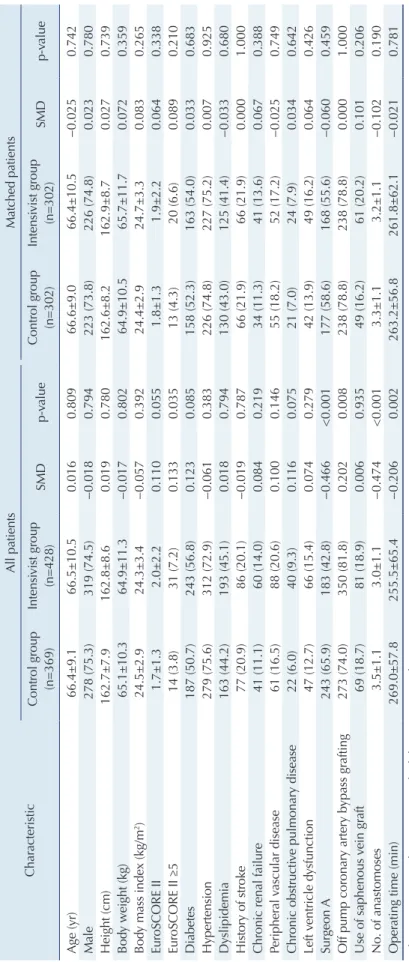
Table 1. D emog raphic and clinical char ac ter istics of pa tien ts bef or e and af ter pr opensit y sc or e ma tching Char acteristic All patients Matc hed patients Control group (n=369) Intensi vist group (n=428) SMD p-v alue Control group (n=302) Intensi vist group (n=302) SMD p-v alue Age (yr) 66.4±9.1 66.5±10.5 0.016 0.809 66.6±9.0 66.4±10.5 −0.025 0.742 Male 278 (75.3) 319 (74.5) −0.018 0.794 223 (73.8) 226 (74.8) 0.023 0.780 Height (cm) 162.7±7.9 162.8±8.6 0.019 0.780 162.6±8.2 162.9±8.7 0.027 0.739 Bod y weight (kg) 65.1±10.3 64.9±11.3 −0.017 0.802 64.9±10.5 65.7±11.7 0.072 0.359 Bod y mass index (kg/m

2

) 24.5±2.9 24.3±3.4 −0.057 0.392 24.4±2.9 24.7±3.3 0.083 0.265 EuroSCORE II 1.7±1.3 2.0±2.2 0.110 0.055 1.8±1.3 1.9±2.2 0.064 0.338 EuroSCORE II ≥5 14 (3.8) 31 (7.2) 0.133 0.035 13 (4.3) 20 (6.6) 0.089 0.210 Diabetes 187 (50.7) 243 (56.8) 0.123 0.085 158 (52.3) 163 (54.0) 0.033 0.683 Hypertension 279 (75.6) 312 (72.9) −0.061 0.383 226 (74.8) 227 (75.2) 0.007 0.925 Dyslipidemia 163 (44.2) 193 (45.1) 0.018 0.794 130 (43.0) 125 (41.4) −0.033 0.680 History of stroke 77 (20.9) 86 (20.1) −0.019 0.787 66 (21.9) 66 (21.9) 0.000 1.000 Chronic renal failure 41 (11.1) 60 (14.0) 0.084 0.219 34 (11.3) 41 (13.6) 0.067 0.388 Peripher al v ascular disease 61 (16.5) 88 (20.6) 0.100 0.146 55 (18.2) 52 (17.2) −0.025 0.749 Chronic obstructi ve pulmonary disease 22 (6.0) 40 (9.3) 0.116 0.075 21 (7.0) 24 (7.9) 0.034 0.642 Left v entricle d ysfunction 47 (12.7) 66 (15.4) 0.074 0.279 42 (13.9) 49 (16.2) 0.064 0.426 Surgeon A 243 (65.9) 183 (42.8) −0.466 <0.001 177 (58.6) 168 (55.6) −0.060 0.459 Off pump coronary artery b ypass gr afting 273 (74.0) 350 (81.8) 0.202 0.008 238 (78.8) 238 (78.8) 0.000 1.000 Use of saphenous v ein gr aft 69 (18.7) 81 (18.9) 0.006 0.935 49 (16.2) 61 (20.2) 0.101 0.206 No. of anastomoses 3.5±1.1 3.0±1.1 −0.474 <0.001 3.3±1.1 3.2±1.1 −0.102 0.190 Oper ating time (min) 269.0±57.8 255.5±65.4 −0.206 0.002 263.2±56.8 261.8±62.1 −0.021 0.781 V alues are presented as mean±standard deviation or number (%). EuroSCORE; European System for Cardiac Oper ati ve Risk Ev aluation; SMD , standardized mean difference.

(4)

Dong Jung Kim, et al. Intensivist in Cardiac Surgical Intensive Care Unit KJTCVS

covariates are shown in Table 1. To compare categorical and continuous variables between the 2 matched groups, the McNemar test and the Wilcoxon signed-rank test were used. Associations between the presence of an intensivist and clinical outcomes were presented as odds ratios (ORs) and 95% confidence intervals (CIs). IBM SPSS ver. 25.0 (IBM Corp., Armonk, NY, USA) was used for the statistical analysis, and p-values <0.05 were considered to indicate sta- tistical significance.

Results

The propensity score matching analysis extracted 302 patients from each group. Because the SMDs of all covari- ates after matching were less than 0.15, we considered them to be acceptable. Before propensity score matching, some significant differences were observed in clinical character- istics between the 2 groups. The proportion of high-risk patients with a EuroSCORE II ≥5 in the intensivist group was higher than that in the control group (7.2% versus 3.8%, p=0.035). In the control group, more patients under- went surgery performed by surgeon A than in the intensiv- ist group (65.9% versus 42.8%, p<0.001). The intensivist group showed a higher percentage of OPCAB (81.8% versus 74.0%, p=0.008), fewer anastomoses (3.0±1.1 versus 3.5±1.1, p<0.001), and a shorter operating time (255.5±65.4 minutes versus 269.0±57.8 minutes, p=0.002) than the control group. After propensity score-matching, the demographic and clinical characteristics of the patients were evenly dis- tributed between the 2 matched groups (Table 1).

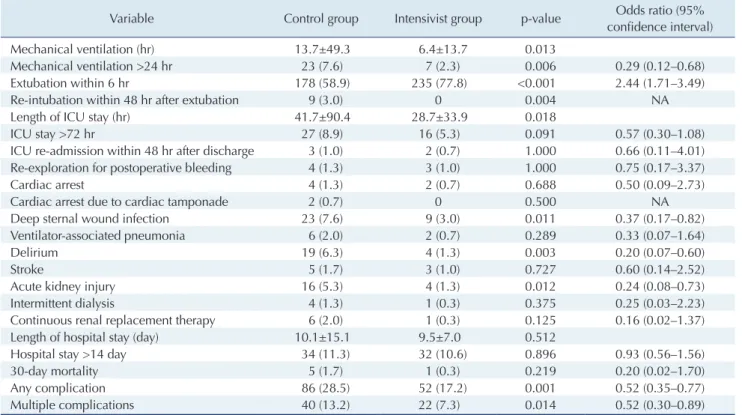
The primary outcome was a composite of postoperative complications. The proportion of patients with at least 1 postoperative complication was significantly lower in the intensivist group than in the control group (17.2% versus 28.5%; OR, 0.52; 95% CI, 0.30–0.77; p=0.001). The percent- age of patients who had 2 or more complications was also significantly lower in the intensivist group than in the con- trol group (7.3% versus 13.2%; OR, 0.52; 95% CI, 0.30–0.89;

p=0.014). The average duration of mechanical ventilation was significantly shorter in the intensivist group than in the control group (6.4±13.7 hours versus 13.7±49.3 hours, p=

0.013). The proportion of patients who underwent mechani- cal ventilation for more than 24 hours was significantly low- er in the intensivist group than in the control group (2.3%

versus7.6%; OR, 0.29; 95% CI, 0.12–0.68, p=0.006). In the intensivist group, significantly more patients were extubat- ed within 6 hours (77.8% versus 58.9%; OR, 2.44; 95% CI, 1.71–3.49; p<0.001), while the percentage of patients requir- ing re-intubation within 48 hours was significantly lower

than in the control group (0% versus 3.0%, p=0.004). The average length of ICU stay was significantly shorter in the intensivist group than in the control group (28.7±33.9 hours versus 41.7±90.4 hours, p=0.018). The proportion of patients who stayed in the ICU for more than 72 hours was higher in the control group than in the intensivist group (8.9% ver- sus 5.3%), but this difference was not statistically significant.

Although the rate of ICU re-admission within 48 hours af- ter discharge was slightly lower in the intensivist group (0.7% versus 1.0%), this difference did not show statistical significance. There were no significant differences in the rate of re-exploration for postoperative bleeding and cardi- ac arrest requiring cardiopulmonary resuscitation (CPR) between the 2 matched groups. Although no patient experi- enced cardiac arrest due to cardiac tamponade in the inten- sivist group, this difference was not statistically significant when compared to the control group (0% versus 0.7%). The intensivist group had a significantly lower rate of deep ster- nal wound infections (3.0% versus 7.6%; OR, 0.37; 95% CI, 0.17–0.82; p=0.011) and delirium (1.3% versus 6.3%; OR, 0.20; 95% CI, 0.07–0.60; p=0.003) than the control group.

Although the incidence of VAP was also lower in the inten- sivist group (0.7% versus 2.0%), this difference did not reach statistical significance. The incidence of stroke was also similar in both groups. Although the rate of AKI was sig- nificantly lower in the intensivist group (1.3% versus 5.3%;

OR, 0.24; 95% CI, 0.08–0.73; p=0.012), no statistically sig- nificant difference was found in the proportion of patients who required RRT, such as intermittent dialysis or continu- ous RRT. There were no significant differences in the length of hospital stay and the rate of prolonged hospital stay for more than 14 days between the 2 matched groups. The 30- day mortality rate in the intensivist group was lower than that in the control group (0.3% versus 1.7%), but the differ- ence was not statistically significant (Table 2, Fig. 1).

Discussion

The average age of patients undergoing cardiac surgery

and the burden of their accompanying diseases have in-

creased over the past 20 years [9]. With the increased preop-

erative risk of patients undergoing cardiac surgery, more pa-

tients experience postoperative complications, leading to

prolonged ICU stays and mortality [10]. Great efforts have

been made to reduce the complication rates of cardiac sur-

gery and to improve ICU quality, and many ICUs are mov-

ing from open systems to closed systems based on the results

of previous studies and critical care guidelines. Previous

studies comparing the open and closed models showed that

(5)

https://doi.org/10.5090/kjtcs.2020.53.1.8

KJTCVS

the outcomes of the closed ICU model were better than those of the open model [1-5]. The Society of Critical Care Medicine recommended the closed ICU model because it was associated with a shorter length of ICU stay, lower mor- tality, and improved patient safety [11]. Although the afore- mentioned studies did not specifically investigate CSICUs,

some studies have demonstrated that attending intensivist coverage was associated with a reduction in major postoper- ative complications in patients who underwent cardiac sur- gery [6-8]. Although these results are very meaningful, it is also necessary to consider some factors that could potential- ly confound the association between the presence of an in- tensivist and improved clinical outcomes. The most import- ant confounding factor may be the considerable heterogeneity of the patient populations analyzed in previous studies.

Postoperative outcomes can vary greatly depending on the type of surgery, the urgency of the operation, and who the surgeon was. Although previous studies applied propensity score matching to overcome such heterogeneity, even with positive results, it may be difficult to fully distinguish whether these results were due to the presence of an inten- sivist because of the possibility of unidentified confounding factors. Therefore, we only included patients who underwent elective isolated CABG to minimize patients’ heterogeneity.

The preoperative status of patients electively undergoing iso- lated CABG is generally expected to be similar. In this study, although the intensivist group contained a larger proportion of high-risk patients with a EuroSCORE II ≥5, we could not find any other significant differences in the preoperative de- Table 2. Comparison of clinical outcomes between control group and intensivist group after propensity score matching

Variable Control group Intensivist group p-value Odds ratio (95%

confidence interval)

Mechanical ventilation (hr) 13.7±49.3 6.4±13.7 0.013

Mechanical ventilation >24 hr 23 (7.6) 7 (2.3) 0.006 0.29 (0.12–0.68)

Extubation within 6 hr 178 (58.9) 235 (77.8) <0.001 2.44 (1.71–3.49)

Re-intubation within 48 hr after extubation 9 (3.0) 0 0.004 NA

Length of ICU stay (hr) 41.7±90.4 28.7±33.9 0.018

ICU stay >72 hr 27 (8.9) 16 (5.3) 0.091 0.57 (0.30–1.08)

ICU re-admission within 48 hr after discharge 3 (1.0) 2 (0.7) 1.000 0.66 (0.11–4.01)

Re-exploration for postoperative bleeding 4 (1.3) 3 (1.0) 1.000 0.75 (0.17–3.37)

Cardiac arrest 4 (1.3) 2 (0.7) 0.688 0.50 (0.09–2.73)

Cardiac arrest due to cardiac tamponade 2 (0.7) 0 0.500 NA

Deep sternal wound infection 23 (7.6) 9 (3.0) 0.011 0.37 (0.17–0.82)

Ventilator-associated pneumonia 6 (2.0) 2 (0.7) 0.289 0.33 (0.07–1.64)

Delirium 19 (6.3) 4 (1.3) 0.003 0.20 (0.07–0.60)

Stroke 5 (1.7) 3 (1.0) 0.727 0.60 (0.14–2.52)

Acute kidney injury 16 (5.3) 4 (1.3) 0.012 0.24 (0.08–0.73)

Intermittent dialysis 4 (1.3) 1 (0.3) 0.375 0.25 (0.03–2.23)

Continuous renal replacement therapy 6 (2.0) 1 (0.3) 0.125 0.16 (0.02–1.37)

Length of hospital stay (day) 10.1±15.1 9.5±7.0 0.512

Hospital stay >14 day 34 (11.3) 32 (10.6) 0.896 0.93 (0.56–1.56)

30-day mortality 5 (1.7) 1 (0.3) 0.219 0.20 (0.02–1.70)

Any complication 86 (28.5) 52 (17.2) 0.001 0.52 (0.35–0.77)

Multiple complications 40 (13.2) 22 (7.3) 0.014 0.52 (0.30–0.89)

Values are presented as mean±standard deviation or number (%).

NA, not applicable; ICU, intensive care unit.

Fig. 1. Odds ratio plot of clinical outcomes according to trainee coverage versus attending intensivist coverage.

Mechanical ventilation >24 hr Intensive care unit stay >72 hr Deep sternal wound infection Delirium Acute kidney injury 30-day mortality Any complication Multiple complications

Favors attending intensivist coverage

0.0 0.5 1.0 1.5 2.0 2.5 Favors trainee

coverage

Odds ratio (95% confidence interval)

(6)

Dong Jung Kim, et al. Intensivist in Cardiac Surgical Intensive Care Unit KJTCVS

mographic and clinical characteristics between the 2 un- matched groups. Moreover, we only included patients who underwent surgery performed by 2 cardiac surgeons (sur- geons A and B), who worked at our institution throughout the entire study period and already had more than 10 years of surgical experience in 2007. Given that the surgical and anesthetic policies for performing CABG remained constant throughout the study period, we expected that there would be no significant difference in the operative details between the 2 unmatched groups. However, we found some signifi- cant differences in the percentage of OPCAB procedures, the number of anastomoses, and the operating time. In ad- dition, the proportion of CABG procedures performed by surgeon A decreased over time compared to surgeon B. To overcome these differences, propensity score matching of the included patients was conducted. As a result of these processes, we expected that the differences between the 2 groups—except for the presence of an attending intensiv- ist—would be minimized in this study compared to previous studies.

The primary outcome was a composite of postoperative complications, including indicators reflecting the quality of ICU care. With reference to the indicators identified by the European Society of Intensive Care Medicine for im- proving safety and quality in the ICU [12], we investigated the rate of re-intubation within 48 hours, the incidence of VAP, and the rate of ICU re-admission within 48 hours af- ter discharge. We examined the rate of the 5 major postop- erative complications defined by the Society of Thoracic Surgeons (stroke, AKI, prolonged intubation more than 24 hours, unplanned reoperation, and deep sternal wound in- fection). In addition, we investigated the rate of prolonged ICU and hospital stays, cardiac arrest, delirium, the use of intermittent dialysis or continuous RRT, and 30-day mor- tality. We compared the proportions of patients with any of the complications described above between the 2 groups.

The percentage of patients with 2 or more complications was also investigated. We also investigated the rate of early extubation within 6 hours, which is used as a quality mark- er by the Society of Thoracic Surgeons.

Since an attending intensivist started providing critical care in the CSICU, the duration of mechanical ventilation significantly decreased by an average of more than 6 hours, and the frequency of prolonged mechanical ventilation also significantly declined. A possible explanation for this is that patients in the intensivist group were extubated earlier than those in the control group. In fact, we found that the proportion of patients who were extubated within 6 hours was significantly higher in the intensivist group. The crite-

rion of extubation within 6 hours has been considered as

an indicator of a successful fast-track ventilator weaning

protocol [13]. Another significant finding was that the

number of patients who required re-intubation within 48

hours after extubation was significantly lower in the inten-

sivist group, even though the rate of early extubation was

higher. This may indicate that the decision to extubate was

more appropriate in the intensivist group. As the rate of

early extubation increased and the duration of mechanical

ventilation was shortened, we expected the incidence of

VAP and delirium to decrease because both are associated

with a longer mechanical ventilation time [14,15]. Although

the incidence of VAP was lower in the intensivist group, as

we expected, this difference did not reach statistical signif-

icance. However, we noted that the incidence of VAP was

similar between the 2 unmatched groups (1.6% versus

1.4%), even though more patients at high risk (EuroSCORE

II ≥5) were included in the intensivist group before pro-

pensity score matching. This means that significant differ-

ences could have been found if high-risk cases such as

emergent operations, which are expected to have a high in-

cidence of VAP, were included. The incidence of delirium

in the intensivist group was significantly lower, as expect-

ed. A prolonged ICU stay, especially longer than 72 hours,

in patients undergoing cardiac operations is known to be

associated with higher hospital mortality and poorer long-

term survival [16]. In this study, the length of ICU stay in

the intensivist group was significantly lower than in the

control group, by an average of more than 12 hours. Al-

though the number of patients with an ICU stay over 72

hours was also lower, this difference did not reach statisti-

cal significance. We found that the incidence of delirium

and AKI in the intensivist group was significantly lower

than in the control group, as mentioned previously. These

findings may be associated with the shorter duration of

mechanical ventilation and length of ICU stay as a result of

early extubation. These results may also have been due to

immediate interventions made by the attending intensivist

in response to changes in patients’ condition, which helped

to achieve hemodynamic stability [17]. The attending in-

tensivist remained in the CSICU during daytime hours

and promptly made independent decisions on most medi-

cal issues as the primary decision-maker. These results

could be attributed to the rapid correction of electrolyte

and metabolic disturbances with appropriate fluid replace-

ment provided by the attending intensivist [18], although

further research is needed to support this hypothesis. The

incidence of deep sternal wound infections was also sig-

nificantly reduced, and regular rounding, active use of an-

(7)

https://doi.org/10.5090/kjtcs.2020.53.1.8

KJTCVS

tibiotics, and immediate action in communication with cardiac surgeons may have contributed to this. No statisti- cally significant difference was found in the rate of cardiac arrest. The main causes of cardiac arrest were arrhythmia and postoperative bleeding. In the control group, 2 patients had cardiac tamponade due to postoperative bleeding and they required CPR before re-exploration. However, there were no cases of cardiac arrest due to cardiac tamponade in the intensivist group. This may have been due to the early diagnosis of postoperative bleeding, before the occur- rence of cardiac arrest due to cardiac tamponade. Because the attending intensivist was credentialed as an echocardi- ography specialist, he regularly performed echocardio- graphic examinations and communicated with cardiac surgeons about the results of those examinations. The at- tending intensivist frequently performed echocardiograph- ic examinations of patients who were likely to develop car- diac tamponade due to postoperative bleeding. Based on the results of those examinations and subsequent commu- nication with cardiac surgeons, if deemed necessary, im- mediate re-exploration was performed. We believe that the decreased number of cases of cardiac arrest due to cardiac tamponade may have been associated with regular echo- cardiographic examinations by the attending intensivist.

These results might also have been due to the attending in- tensivist’s thorough understanding of cardiac surgery and ability to communicate clearly with the cardiac surgeons, as the attending intensivist was board-certified in cardio- thoracic surgery. The length of hospital stay was decreased by an average of 0.6 days (=14 hours), in line with the de- crease in the length of ICU stay, but there was no signifi- cant difference in the overall length of hospital stay or the proportion of patients with a prolonged hospital stay of more than 14 days. The 30-day mortality rate was lower in the intensivist group, but no statistically significant differ- ence was found between the 2 matched groups, which may have been due to the fact that elective isolated CABG has a much lower mortality rate than other types of cardiac sur- gery. Although further investigations are needed, a greater improvement in the mortality rate in the intensivist group would be expected if patients undergoing valvular or aortic surgery, which pose a higher risk for mortality, are includ- ed. The proportion of patients with any of the abovemen- tioned complications was significantly lower in the inten- sivist group. The percentage of patients with 2 or more complications was also significantly lower in the intensivist group.

There are several limitations of our study. The first lim- itation is that only patients who underwent elective isolated

CABG were included. Given that the intensivist in this study managed every postoperative patient regardless of the type of surgery, in principle, all types of open cardiac surgery—including aortic and valvular surgery—could have been included. If we did so, the results could have been different, but as mentioned previously, the heteroge- neity of the population might have led to difficulties in in- terpreting the results. In a future study, the same method could be used to determine whether the presence of an at- tending intensivist had a positive effect on clinical out- comes in patients undergoing aortic or valvular surgery.

The second limitation is that there was only 1 intensivist in this study. The presence of a homogeneous group of inten- sivists in this study would have yielded more meaningful results. However, due to the lack of intensivists, previous studies have assessed the impact of a heterogeneous group of intensivists with various specialties. It would be very in- teresting if a future study investigated whether intensivists with different specialties have different impacts on clinical outcomes. Finally, even though several studies have proven that the presence of an attending intensivist is associated with improved clinical outcomes, the cost of introducing the closed ICU system should be considered. Therefore, the cost-effectiveness of the closed CSICU model with attend- ing intensivist coverage should be analyzed in future stud- ies. In conclusion, we found that a transition from an open ICU model with trainee coverage to a closed ICU model with attending intensivist coverage was associated with better clinical outcomes. Our findings indicate that the presence of an attending intensivist who was board-certi- fied in cardiothoracic surgery and critical care was associ- ated with improvements in CSICU quality and reductions in postoperative complications.

Conflict of interest

No potential conflict of interest relevant to this article was reported.

ORCID

Dong Jung Kim: https://orcid.org/0000-0003-0332-3430 Bongyeon Sohn: https://orcid.org/0000-0003-0613-8273 Hakju Kim: https://orcid.org/0000-0003-0613-8273

Hyoung Woo Chang: https://orcid.org/0000-0001-5516-0333

Jae Hang Lee: https://orcid.org/0000-0003-4769-5340

Jun Sung Kim: https://orcid.org/0000-0003-4285-8200

Cheong Lim: https://orcid.org/0000-0003-0913-7014

(8)

Dong Jung Kim, et al. Intensivist in Cardiac Surgical Intensive Care Unit KJTCVS

Kay-Hyun Park: https://orcid.org/0000-0002-1111-9627

References

1. Dimick JB, Pronovost PJ, Heitmiller RF, Lipsett PA. Intensive care unit physician staffing is associated with decreased length of stay, hospital cost, and complications after esophageal resection. Crit Care Med 2001;29:753-8.

2. Treggiari MM, Martin DP, Yanez ND, Caldwell E, Hudson LD, Rubenfeld GD. Effect of intensive care unit organizational model and structure on outcomes in patients with acute lung injury. Am J Respir Crit Care Med 2007;176:685-90.

3. Pronovost PJ, Jenckes MW, Dorman T, et al. Organizational charac- teristics of intensive care units related to outcomes of abdominal aor- tic surgery. JAMA 1999;281:1310-7.

4. Carson SS, Stocking C, Podsadecki T, et al. Effects of organizational change in the medical intensive care unit of a teaching hospital: a comparison of ‘open’ and ‘closed’ formats. JAMA 1996;276:322-8.

5. Multz AS, Chalfin DB, Samson IM, et al. A “closed” medical inten- sive care unit (MICU) improves resource utilization when compared with an “open” MICU. Am J Respir Crit Care Med 1998;157(5 Pt 1):

1468-73.

6. Kumar K, Zarychanski R, Bell DD, et al. Impact of 24-hour in-house intensivists on a dedicated cardiac surgery intensive care unit. Ann Thorac Surg 2009;88:1153-61.

7. Benoit MA, Bagshaw SM, Norris CM, et al. Postoperative complica- tions and outcomes associated with a transition to 24/7 intensivist management of cardiac surgery patients. Crit Care Med 2017;45:

993-1000.

8. Huard P, Kalavrouziotis D, Lipes J, et al. Does the full-time presence of an intensivist lead to better outcomes in the cardiac surgical inten- sive care unit? J Thorac Cardiovasc Surg 2019:S0022-5223(19) 30976-6.

9. Ferguson TB Jr, Hammill BG, Peterson ED, DeLong ER, Grover FL;

STS National Database Committee. A decade of change: risk profiles

and outcomes for isolated coronary artery bypass grafting proce- dures, 1990-1999: a report from the STS National Database Commit- tee and the Duke Clinical Research Institute. Society of Thoracic Surgeons. Ann Thorac Surg 2002;73:480-9.

10. Rahmanian PB, Kroner A, Langebartels G, Ozel O, Wippermann J, Wahlers T. Impact of major non-cardiac complications on outcome following cardiac surgery procedures: logistic regression analysis in a very recent patient cohort. Interact Cardiovasc Thorac Surg 2013;

17:319-26.

11. Haupt MT, Bekes CE, Brilli RJ, et al. Guidelines on critical care ser- vices and personnel: recommendations based on a system of catego- rization of three levels of care. Crit Care Med 2003;31:2677-83.

12. Rhodes A, Moreno RP, Azoulay E, et al. Prospectively defined indi- cators to improve the safety and quality of care for critically ill pa- tients: a report from the Task Force on Safety and Quality of the Eu- ropean Society of Intensive Care Medicine (ESICM). Intensive Care Med 2012;38:598-605.

13. Probst S, Cech C, Haentschel D, Scholz M, Ender J. A specialized post anaesthetic care unit improves fast-track management in cardiac surgery: a prospective randomized trial. Crit Care 2014;18:468.

14. Wu D, Wu C, Zhang S, Zhong Y. Risk factors of ventilator-associat- ed pneumonia in critically III patients. Front Pharmacol 2019;10:482.

15. Park SY, Lee HB. Prevention and management of delirium in criti- cally ill adult patients in the intensive care unit: a review based on the 2018 PADIS guidelines. Acute Crit Care 2019;34:117-25.

16. Mahesh B, Choong CK, Goldsmith K, Gerrard C, Nashef SA, Vuyl- steke A. Prolonged stay in intensive care unit is a powerful predictor of adverse outcomes after cardiac operations. Ann Thorac Surg 2012;

94:109-16.

17. Siepe M, Pfeiffer T, Gieringer A, et al. Increased systemic perfusion pressure during cardiopulmonary bypass is associated with less early postoperative cognitive dysfunction and delirium. Eur J Cardiothorac Surg 2011;40:200-7.

18. Brown CH. Delirium in the cardiac surgical ICU. Curr Opin Anaes-

thesiol 2014;27:117-22.

수치

Table 1. Demographic and clinical characteristics of patients before and after propensity score matching CharacteristicAll patientsMatched patients Control group (n=369)Intensivist group(n=428)SMDp-valueControl group(n=302)Intensivist group(n=302)SMDp-valu
Fig. 1. Odds ratio plot of clinical outcomes according to trainee  coverage versus attending intensivist coverage.

참조

관련 문서