Impact of Neurointensivist Co-management on the Clinical Outcomes of Patients Admitted to a Neurosurgical Intensive Care Unit
Limited data are available on improved outcomes after initiation of neurointensivist co- management in neurosurgical intensive care units (NSICUs) in Korea. We evaluated the impact of a newly appointed neurointensivist on the outcomes of neurosurgical patients admitted to an intensive care unit (ICU). This retrospective observational study involved neurosurgical patients admitted to the NSICU at Samsung Medical Center between March 2013 and May 2016. Neurointensivist co-management was initiated in October 1 2014.
We compared the outcomes of neurosurgical patients before and after neurointensivist co- management. The primary outcome was ICU mortality. A total of 571 patients were admitted to the NSICU during the study period, 291 prior to the initiation of
neurointensivist co-management and 280 thereafter. Intracranial hemorrhage (29.6%) and traumatic brain injury (TBI) (26.6%) were the most frequent reasons for ICU admission.
TBI was the most common cause of death (39.0%). There were no significant differences in mortality rates and length of ICU stay before and after co-management. However, the rates of ICU and 30-day mortality among the TBI patients were significantly lower after compared to before initiation of neurointensivist co-management (8.5% vs. 22.9%;
P = 0.014 and 11.0% vs. 27.1%; P = 0.010, respectively). Although overall outcomes were not different after neurointensivist co-management, initiation of a strategy of routine involvement of a neurointensivist significantly reduced the ICU and 30-day mortality rates of TBI patients.
Keywords: Neurosurgery; Intensive Care Unit; Critical Care Outcomes Jeong-Am Ryu,1 Jeong Hoon Yang,1,2
Chi Ryang Chung,1 Gee Young Suh,1,3 and Seung-Chyul Hong4
1Department of Critical Care Medicine, Samsung Medical Center, Sungkyunkwan University School of Medicine, Seoul, Korea; 2Division of Cardiology, Department of Medicine, Samsung Medical Center, Sungkyunkwan University School of Medicine, Seoul, Korea; 3Division of Pulmonary and Critical Care Medicine, Department of Medicine, Samsung Medical Center, Sungkyunkwan University School of Medicine, Seoul, Korea; 4Department of
Neurosurgery, Samsung Medical Center, Sungkyunkwan University School of Medicine, Seoul, Korea
Received: 14 November 2016 Accepted: 10 March 2017 Address for Correspondence:
Seung-Chyul Hong, MD, PhD
Department of Neurosurgery, Samsung Medical Center, Sungkyunkwan University School of Medicine, 81 Irwon-ro, Gangnam-gu, Seoul 06351, Korea
E-mail: [email protected]
https://doi.org/10.3346/jkms.2017.32.6.1024 • J Korean Med Sci 2017; 32: 1024-1030
INTRODUCTION
Intensivists are physicians who specialize in the care of critically ill patients and are trained to manage all aspects of the inten- sive care unit (ICU) stay (1,2). Intensivists improve the clinical outcomes of critically ill patients (3-5). Neurointensivists are specialists focused on the management of patients with acute neurologic conditions including traumatic brain injury (TBI), stroke, status epilepticus, and neuromuscular respiratory fail- ure (6-8). Despite several studies of outcome prediction in gen- eral and surgical ICUs, high-intensity ICUs managed by neuro- intensivists are not common in many hospitals (7-9). Limited data are available regarding prediction of outcomes in neuro- science ICUs (4,7,10). Several studies reported improved out- comes by neurointensivists, including decreased mortality rates, shortened lengths of ICU and hospital stay in patients with TBI, intracranial hemorrhage, and subarachnoid hemorrhage (2,3,9, 11,12). However, the impact of neurointensivists and improved outcome in neuroscience ICUs in Korea has not been evaluat- ed. This is the first report of the role of neurointensivists and clin-
ical outcomes after initiation of neurointensivist co-management in neurosurgical intensive care units (NSICUs) in Korea. In this study, we evaluated the impact of neurointensivist co-manage- ment on outcomes in patients admitted to a NSICU.
MATERIALS AND METHODS Study population
This was a retrospective, single-center, observational study of neurocritically ill patients and neurosurgical patients who were admitted to the NSICU at the Samsung Medical Center between March 2013 and May 2016. The patients admitted to the NSICU were considered for this study. Patients were excluded if they were admitted to departments other that neurosurgery or had not neurological problems. We also excluded the patients who were transferred to departments other that neurosurgery dur- ing ICU hospitalization because factors other than neurosurgi- cal team and neurointensivist might have influenced the result of this study. In addition, we excluded in this analysis the pati- ents with elective surgery such as brain tumor surgery, elective ORIGINAL ARTICLE
Emergency & Critical Care Medicine
2017-03-16 https://crossmark-cdn.crossref.org/widget/v2.0/logos/CROSSMARK_Color_square.svg
vascular surgery, microvascular decompression, epileptic sur- gery, elective spinal surgery, or surgery of congenital anomaly.
Definitions and outcomes
The NSICU was independently operated and separated from the neurology and general surgery ICUs in this study. Neuroin- tensivist co-management was initiated on October 1 2014. Dur- ing the neurointensivist co-management period, the neuroin- tensivist worked 6 days per week during the daytime. The neur- ocritical care team consisted of an attending neurointensivist, neurosurgical resident, and consultant pharmacist. The consul- tant pharmacist advised the neurocritical care team on phar- maceutic issues by phone after morning rounds. Neurointen- sivist was involved in general critical managements, including hemodynamic monitoring, nutritional support, and use of me- chanical ventilation, renal replacement therapy, etc. Neurosur- geon was responsible for surgical management. However, neu- rosurgeon discussed important decisions with neurointensivist in neurocritical management such as control strategy of increa- sed intracranial pressure and neuromonitoring methods. Al- though the neurosurgical team discussed the treatment plans of all ICU patients with the neurointensivist, the leader of the neurosurgical team was responsible for the patients and deter- mined their transfer from the ICU to the neurosurgical ward in this study. The neurointensivist managed all aspects of these neurosurgical patients during their ICU hospitalization. In ad- dition, the neurointensivist evaluated and managed neurosur- gical patients by lung sonography, echocardiography and bron- choscopy, together with neurocritical management. The neu- rointensivist also implemented central venous catheterization and peripherally inserted central catheterization, endotracheal intubation, percutaneous dilatational tracheostomy, etc. The neurointensivist had educated neurosurgical residents and mon- itored procedures performed by the residents in the ICU. Fur- thermore, the neurointensivist consulted for patients in the neu- rosurgical ward who had hemodynamic instability or respirato- ry problem.
The initial Glasgow Coma Scale (GCS) was defined as the best GCS within 24 hours of ICU admission. Severity of illness was assessed by the Acute Physiology and Chronic Health Evalua- tion II (APACHE II) score (13).
We compared the outcomes of neurosurgical patients admit- ted before and after initiation of mandatory neurointensivist co- management in the NSICU. Subgroup analysis was performed as causes of ICU admission such as TBI, intracranial hemorrhage, subarachnoid hemorrhage, and cerebral infarction. We analyzed TBI patients on ICU admission or preoperative state. TBI patients were assessed by using International Mission for Prognosis and Analysis of Clinical Trials (IMPACT) prognostic model and APA- CHE II score (14,15). Brain computed tomography (CT) finding was accessed according to the Marshall CT scan classification
system in TBI patients (16).
The primary endpoint was ICU mortality. Secondary endpoints were 30-day mortality and length of stay (LOS) in the ICU.
Statistical analysis
All data are presented as means ± standard deviations (SD) for continuous variables and as numbers (percentages) for cate- gorical variables. Data were compared using Student’s t-test for continuous variables and the χ2 test or Fisher’s exact test for cat- egorical variables. The Kaplan-Meier method was used to gen- erate survival curves, which were compared using log-rank test.
Multiple logistic regression analysis was used to identify inde- pendent predictors of survival in neurocritically ill patients, as measured by the estimated odds ratio (OR) with 95% confidence intervals (CIs). Variables with a P value less than 0.2 on univari- ate analyses, as well as a priori variables that were clinically rel- evant, were entered into the multiple logistic regression model.
All tests were 2-sided, and P values < 0.05 were considered to indicate statistical significance. Data were analyzed using SPSS statistics version 20 (IBM, Armonk, NY, USA).
Ethics statement
This was a retrospective, single-center, observational study of neurocritically ill patients and neurosurgical patients who were admitted to the NSICU at the Samsung Medical Center between March 2013 and May 2016. The study was approved by the In- stitutional Review Board of Samsung Medical Center (IRB No.
SMC 2016-08-126-001) to review and publish information from patients’ records. The requirement for informed consent was waived because of the retrospective nature of the study.
RESULTS
Baseline characteristics
A total of 3,683 patients was admitted to the NSICU during the study period. The patients with elective surgery and were trans- ferred to departments other that neurosurgery during ICU hos- pitalization were excluded. Finally, 571 patients were analyzed in this study; 291 prior to initiation of neurointensivist co-man- agement and 280 thereafter. The mean age was 58.2 ± 19.0 years, and 306 patients (53.6%) were men. Intracranial hemorrhage (29.6%) and TBI (26.6%) were the most common reasons for ICU admission. There were no significant differences in gender, comorbidities, causes of ICU admission, and GCS and APACHE II score on ICU admission between before and after neuroin- tensivist co-management (Table 1).
Clinical outcomes
There were no significant differences in ICU mortality rate (11.0%
vs. 9.6%; P = 0.595), hospital mortality rate (14.4% vs. 12.9%, P = 0.584), and LOS in the ICU (6.1 ± 7.7 days vs. 7.1 ± 7.9 days; P =
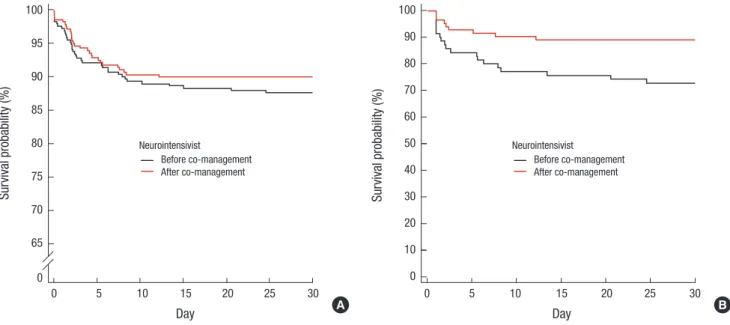
Fig. 1. Kaplan-Meier 30-day survival analyses before and after neurointensivist co-management in all ICU patients (A) and TBI patients (B). Black solid line, before neurointen- sivist co-management; red solid line, after neurointensivist co-management; P = 0.373 and P = 0.011, respectively, based on log-rank tests.
ICU = intensive care unit, TBI = traumatic brain injury.
Survival probability (%)
Day
0 5 10 15 20 25 30 100
95
90
85
80
75
70
65
0
Before co-management After co-management Neurointensivist
A
Survival probability (%)
Day
0 5 10 15 20 25 30
100 90 80 70 60 50 40 30 20 10 0
Before co-management After co-management Neurointensivist
B Table 1. Baseline characteristics on ICU admission before and after neurointensivist
co-management
Parameters Before (n = 291) After (n = 280) P value
Age, yr 56.8 ± 20.2 59.6 ± 17.6 0.077
Gender, man 159 (54.6) 147 (52.5) 0.608
Comorbidities
Diabetes mellitus 36 (12.4) 46 (16.4) 0.167
Hypertension 109 (37.5) 123 (43.9) 0.115
Malignancy 71 (24.4) 81 (28.9) 0.221
Dyslipidemia 73 (25.1) 75 (26.8) 0.643
Chronic kidney disease 11 (3.8) 19 (6.8) 0.108
Chronic liver disease 9 (3.1) 9 (3.2) 0.934
Previous TIA or stroke 26 (8.9) 24 (8.6) 0.878
Cause of ICU admission 0.545
Intracranial hemorrhage 89 (30.6) 80 (28.6)
TBI 70 (24.1) 82 (29.3)
Subarachnoid hemorrhage 71 (24.4) 71 (25.4) Cerebral infarction 33 (11.3) 22 (7.9)
CNS infection 16 (5.5) 12 (4.3)
Other 12 (4.1) 13 (4.6)
GCS on ICU admission 11.5 ± 3.9 11.7 ± 3.7 0.491
APACHE II score on ICU admission 13.0 ± 6.5 13.0 ± 7.0 0.990 Values are presented as number of patients (%) or mean ± SD.
ICU = intensive care unit, TIA = transient ischemic attack, TBI = traumatic brain inju- ry, CNS = central nervous system, GCS = Glasgow Coma Scale, APACHE = Acute Physiology and Chronic Health Evaluation, SD = standard deviation.
0.454) before and after neurointensivist co-management. The duration of mechanical ventilator use were increased after com- pared to before initiation of neurointensivist co-management (8.7 ± 11.7 days vs. 5.7 ± 4.8 days; P = 0.007). Thirty-day mortal- ity rate showed a reducing tendency after compared to before initiation of neurointensivist co-management, but there was no significant difference (10.0% vs. 12.4%, log-rank test; P = 0.373;
Fig. 1A). Clinical outcomes are shown in Table 2.
TBI was the most common cause of death in the ICU (39.0%).
Twenty-three patients died of TBI during treatment in ICU. Of these patients, 16 patients were dead before neurointensivist co-management. Ten patients died of severe brain damage, while 6 patients died of medical and other problems (3 septic shock, 2 multiorgan failure, and 1 tension pneumothorax). Among 7 TBI patients who were dead after neurointensivist co-manage- ment, 6 patients died of severe brain damage and only 1 patient died of multiorgan failure. There were no significant differences in IMPACT prognostic models and APACHE II score before and after neurointensivist co-management (Table 3). However, there were significant differences in the ICU mortality rate (22.9% vs.
8.5%; P = 0.014) and hospital mortality rate (28.6% vs. 14.6%;
P = 0.036) in TBI patients before and after co-management (Ta- ble 3). The 30-day mortality rate was significantly lower after compared to before initiation of neurointensivist co-manage- ment (11.0% vs. 27.1%, log-rank test; P = 0.011; Fig. 1B). In ad- dition, there was significantly lower in ICU mortality among the TBI patients with GCS below 12 after compared to before initia- tion of neurointensivist co-management (17.1% vs. 38.5%; P = 0.031). Neurointensivist co-management was an independent predictor of an improved ICU mortality rate in TBI patients (ad- justed OR, 0.160; 95% CI, 0.028–0.905).
The clinical outcomes were similar after compared to before initiation of neurointensivist co-management in patients with intracranial hemorrhage, subarachnoid hemorrhage, and cere- bral infarction. There were no significant differences in ICU mor- talities, 30-day mortality, and LOS in the ICU in these patients before and after neurointensivist co-management.
Table 2. Clinical outcomes before and after neurointensivist co-management
Clinical outcomes Before (n = 291) After (n = 280) P value
Need for mechanical ventilator 129 (44.3) 130 (46.4) 0.615
Need for renal replacement therapy 9 (3.1) 17 (6.1) 0.088
Need for invasive ICP monitoring 61 (21.0) 66 (23.6) 0.454
Duration of mechanical ventilator, day 5.7 ± 4.8 8.7 ± 11.7 0.007
Duration of renal replacement therapy, day 5.8 ± 3.1 6.5 ± 4.1 0.638
Duration of invasive ICP monitoring, day 7.6 ± 9.2 7.5 ± 5.3 0.907
ICU mortality according to causes of ICU admission 0.451
TBI 16 (50.0) 7 (25.9)
Intracranial hemorrhage 8 (25.0) 10 (37.0)
Subarachnoid hemorrhage 5 (15.6) 7 (25.9)
Cerebral infarction 2 (6.2) 2 (7.4)
Other 1 (3.1) 1 (3.7)
Outcomes
ICU mortality 32 (11.0) 27 (9.6) 0.595
30-day mortality 36 (12.4) 28 (10.0) 0.369
Hospital mortality 42 (14.4) 36 (12.9) 0.584
LOS in ICU, day 6.1 ± 7.7 7.1 ± 7.9 0.454
LOS in hospital, day 65.4 ± 269.8 51.1 ± 123.5 0.417
Values are presented as number of patients (%) or mean ± SD.
ICP = intracranial pressure, TBI = traumatic brain injury, LOS = length of stay, ICU = intensive care unit, SD = standard deviation.
Table 3. Baseline characteristics and clinical outcomes of TBI patients before and after neurointensivist co-management
Parameters Before (n = 70) After (n = 82) P value
Age, yr 57.0 ± 25.8 64.2 ± 15.2 0.045
Gender, man 48 (68.6) 53 (68.3) 0.971
Comorbidities
Diabetes mellitus 12 (17.1) 23 (28.0) 0.111
Hypertension 21 (30.0) 37 (45.1) 0.056
Malignancy 13 (18.6) 18 (22.0) 0.606
Dyslipidemia 12 (17.1) 29 (35.4) 0.012
Chronic kidney disease 2 (2.9) 8 (9.8) 0.109
Chronic liver disease 2 (2.9) 6 (7.3) 0.289
Previous TIA or stroke 6 (8.6) 2 (2.4) 0.144
IMPACT
Core model 5.9 ± 4.3 5.6 ± 3.5 0.669
Extended model* 8.1 ± 6.3 8.3 ± 4.7 0.807
Lab model† 11.6 ± 7.2 11.8 ± 5.2 0.836
Marshall CT grade 3.7 ± 1.7 4.1 ± 1.5 0.137
APACHE II score on ICU admission 14.9 ± 7.7 14.5 ± 6.2 0.635
GCS on ICU admission 10.2 ± 4.3 11.1 ± 3.8 0.162
Need for mechanical ventilator 40 (57.1) 42 (51.2) 0.465
Need for renal replacement therapy 1 (1.4) 8 (9.8) 0.030
Need for invasive ICP monitoring 6 (8.6) 12 (14.6) 0.249
Need for vasopressor 12 (17.1) 18 (22.0) 0.458
Mean blood pressure on ICU admission, mmHg 77.5 ± 10.3 76.7 ± 9.7 0.634
Duration of mechanical ventilator, day 4.9 ± 4.2 13.2 ± 14.7 0.001
Duration of renal replacement therapy, day 2.0 9.4 ± 3.9 -
Duration of invasive ICP monitoring, day 7.3 ± 4.0 5.3 ± 4.8 0.394
Outcomes
ICU mortality 16 (22.9) 7 (8.5) 0.014
30-day mortality 19 (27.1) 9 (11.0) 0.010
Hospital mortality 20 (28.6) 12 (14.6) 0.036
LOS in ICU, day 5.2 ± 7.4 7.1 ± 10.4 0.197
LOS in hospital, day 27.4 ± 26.3 60.3 ± 91.4 0.002
Values are presented as number of patients (%) or mean ± SD.
TBI = traumatic brain injury, TIA = transient ischemic attack, IMPACT = International Mission for Prognosis and Analysis of Clinical Trials, CT = computed tomography, APACHE = Acute Physiology and Chronic Health Evaluation, GCS = Glasgow Coma Scale, LOS = length of stay, ICU = intensive care unit, ICP = intracranial pressure, SD = standard devi- ation.
*Core plus hypoxia, hypotension, and CT characteristics; †Extended plus glucose and hemoglobin.
DISCUSSION
This study is the first report of the role of neurointensivists and clinical outcomes after initiation of neurointensivist co-man- agement in NSICUs in Korea. Intracranial hemorrhage and TBI were the most frequent reasons for ICU admission. Approximate- ly half of the ICU patients suffered from these diseases. TBI was the most common cause of death in the ICU. There were no sig- nificant differences in mortality rates and LOS in the ICU before and after initiation of neurointensivist co-management in this study. However, the ICU and 30-day mortality rates were signif- icantly lower among the TBI patients after compared to before initiation of neurointensivist co-management.
Neurointensivists are critical care physicians specifically fo- cused on the management of neurocritically ill patients (6-8).
The birth of neurocritical care stemmed from the appreciation that an already affected brain (primary injury) is greatly influ- enced by systemic alterations that may adversely affect its func- tion (secondary injury). Neurointensivist are specially trained to recognize and treat such injuries (6,7). Because of this incre- asing complexity of acute care of the neurocritically ill patient, a multidisciplinary approach to the neurocritical care is neces- sary. Neurointensivists have to work in collaboration with neu- rosurgeons and other physicians in coordinating acute care pro- tocols, decisions about advanced neuromonitoring, and other aspects of care (6).
Neurointensivists have emerged in the last decades as spe- cialists trained to manage all aspects of the ICU stay of neuro- critically ill patients in the USA (2). The institution of a neuroin- tensivist-led team model has been reported to improve outcomes, including decreased mortality rates, shortened length of ICU and hospital stay in neurocritically ill patients with TBI, intra- cranial hemorrhage, and subarachnoid hemorrhage (2,3,11).
However, there are only a few neurointensivists in Korea. In ad- dition, neuroscience ICUs, which are operated jointly by neu- rology and neurosurgery, are uncommon (17). NSICUs operate independently in most tertiary hospitals in Korea (17). Further- more, it is very rare to treat neurocritically ill patients in cooper- ation between neurosurgical teams and neurointensivists in NSICUs. The concept of neurocritical care emerged in Korea only recently. Intensivists in general medical and surgical ICUs also emerged recently, and so the current status of critical care in Korea is not comparable to that of advanced countries (18).
A nationwide survey of ICUs was performed in 2014, and only 17.3% of ICUs had intensive care specialists with a 5-day work week (18,19).
In general, adequate staffing showed favorable effects on ICU stay and decreased use of resources (18). However, there was no significant difference in length of ICU stay before and after initiation of neurointensivist co-management in this study.
Furthermore, duration of mechanical ventilator showed an in-
creasing trend after neurointensivist co-management. Neuro- surgeons usually determined whether to transfer patients from the NSICU to general wards in this study, usually after confirm- ing that the patients had fully recovered. Some patients stayed in ICU over a weekend, during which time the neurosurgeon wanted to monitor them closely. The indications for which the neurosurgical patients were transferred from the ICU to general wards differed among the neurosurgeons. If the patients exhib- ited medical problems such as sepsis, pneumonia, acute respi- ratory distress syndrome, and hemodynamic instability, they were transferred to internal medicine and treated in the medi- cal ICU before neurointensivist co-management. However, af- ter initiation of co-management many of the patients with med- ical problems were treated by a neurointensivist in the NSICU.
Neurointensivist were sometimes consulted for patients with respiratory and hemodynamic instability in the neurosurgery general ward. Therefore, these special situations might be asso- ciated with the length of ICU stay and prolonged duration of mechanical ventilator use.
The overall mortality rate of TBI patients improved after neu- rointensivist co-management. Mortality according to medical problems was decreased after neurointensivist co-management in TBI patients. This change was associated with effort of neu- rointensivist. Furthermore, brain death according to severe brain damage was also decreased after neurointensivist co-manage- ment. The clinical outcomes of TBI patients depend on both primary and secondary brain insults (20). Aggressive manage- ment of secondary brain injury is associated with a good neu- rological outcome (20). Furthermore, TBI may be accompanied by hemodynamic instability for various reasons (21,22). Hemo- dynamic stability is important to maintain the capacity for vas- cular autoregulation, either globally or locally, in severe TBI pa- tients (21,22). Therefore, collaboration between neurointensiv- ists and neurosurgeons is necessary. Indeed, co-management with a neurointensivist improved the clinical outcomes of TBI (3,20,21). Interestingly, emergency operations on TBI patients are usually performed by young neurosurgeons in Korea. Young neurosurgeons may not have sufficient time to treat neurocriti- cally ill patients. Therefore, young neurosurgeons need to col- laborate with neurointensivists. Indeed, young neurosurgeons discussed their patients with the neurointensivist more actively than did senior members of the faculty in our hospital.
Several neuroscience ICU models such as “open” vs. “semi- closed” and “closed” ICU practice models are available (11). Ko- rea contains all of these types; our NSICU is similar to an open ICU model. It is important to collaborate with each physician in an open ICU model. Because of the increased complexity of neurological diseases, a multidisciplinary approach to neuro- critical care is required (8). Neurointensivists have to collabo- rate with neurosurgeons, neurologists and other physicians for decisions regarding acute care protocols in neuroscience ICU
(8). However, it is not easy to cooperate with all neurosurgeons.
While some neurosurgeons were cooperative, others were not.
A neurointensivist alone cannot treat all patients and neurosur- geons cannot stay in the ICU all day. Thus sharing of opinions and collaboration between neurosurgeons and neurointensiv- ists are required in treatment of neurocritically ill patients. Neu- rointensivists can manage not only neurological diseases but also all aspects of the critical care. They can rapidly respond to emerging problems in neuroscience ICUs. In the near future, full-time employment of neurointensivists can improve clinical outcome in neuroscience ICUs in Korea.
This study had several limitations. It was a retrospective re- view of medical records. Our study may not be broadly applica- ble to other centers at which no neurointensivists are available because our study was conducted at a single tertiary institution with a specialized NSICU for neurosurgical and neurocritically ill patients. The neurointensivist in our hospital is a neurologist and trained to manage all aspects of critically ill patients in med- ical and surgical ICUs. The treatment tendency of this neuroin- tensivist might have influenced the clinical outcomes in neuro- critically ill patients. The neurosurgical team discussed the treat- ment plans of all ICU patients with the neurointensivist, but it was sometimes difficult to cooperate with the neurosurgeon and the neurointensivist because collaborative work was just begun. Because of these situations, the role of neurointensivist might be limited. These special situations were different from other NSICUs in Korea. Therefore, selection bias and other con- founding factors might have been influenced. Prospective large- scale studies are needed to evaluate the impact of neurointen- sivists in the management of neurocritically ill patients in Korea.
In conclusion, although overall outcomes were not significant- ly different after neurointensivist co-management, the ICU and 30-day mortality rates of TBI patients were significantly reduced.
A multidisciplinary approach is important in treatment of neu- rocritically ill patients because of the increasing complexity of neurological problems. Therefore, collaboration between neu- rosurgeons and neurointensivists is necessary. In the near fu- ture, this multidisciplinary team-based approach involving neu- rointensivists and neurosurgeons working together will improve the outcome of neurocritically ill patients in Korea.
ACKNOWLEDGMENT
We would like to thank the nursing director of the NSICU, Hye Ok Choi, who gave excellent advice and fruitful discussions. We would also like to thank all nurses of the NSICU at Samsung Med- ical Center.
DISCLOSURE
The authors have no potential conflicts of interest to disclose.
AUTHOR CONTRIBUTION
Conceptualization: Ryu JA, Suh GY, Hong SC. Investigation: Ryu JA, Chung CR. Writing - original draft: Ryu JA, Hong SC.
ORCID
Jeong-Am Ryu http://orcid.org/0000-0003-1705-848X Jeong Hoon Yang http://orcid.org/0000-0001-8138-1367 Chi Ryang Chung http://orcid.org/0000-0003-1830-307X Gee Young Suh http://orcid.org/0000-0001-5473-1712 Seung-Chyul Hong http://orcid.org/0000-0002-9064-5050
REFERENCES
1. Park CM, Chun HK, Lee DS, Jeon K, Suh GY, Jeong JC. Impact of a surgi- cal intensivist on the clinical outcomes of patients admitted to a surgical intensive care unit. Ann Surg Treat Res 2014; 86: 319-24.
2. Josephson SA, Douglas VC, Lawton MT, English JD, Smith WS, Ko NU.
Improvement in intensive care unit outcomes in patients with subarach- noid hemorrhage after initiation of neurointensivist co-management. J Neurosurg 2010; 112: 626-30.
3. Varelas PN, Eastwood D, Yun HJ, Spanaki MV, Hacein Bey L, Kessaris C, Gennarelli TA. Impact of a neurointensivist on outcomes in patients with head trauma treated in a neurosciences intensive care unit. J Neurosurg 2006; 104: 713-9.
4. Suarez JI, Zaidat OO, Suri MF, Feen ES, Lynch G, Hickman J, Georgiadis A, Selman WR. Length of stay and mortality in neurocritically ill patients:
impact of a specialized neurocritical care team. Crit Care Med 2004; 32:
2311-7.
5. Morrow DA, Fang JC, Fintel DJ, Granger CB, Katz JN, Kushner FG, Kuvin JT, Lopez-Sendon J, McAreavey D, Nallamothu B, et al. Evolution of criti- cal care cardiology: transformation of the cardiovascular intensive care unit and the emerging need for new medical staffing and training mod- els: a scientific statement from the American Heart Association. Circula- tion 2012; 126: 1408-28.
6. Jarquin-Valdivia AA, Bonovich DC, Hemphill JC III. The role of the neuro- intensivist. Semin Neurosurg 2003; 14: 131-8.
7. Suarez JI. Outcome in neurocritical care: advances in monitoring and treat- ment and effect of a specialized neurocritical care team. Crit Care Med 2006; 34: S232-8.
8. Bithal PK. Neurointensive care unit and neurointensivist: do we need them?
J Neuroanaesth Crit Care 2016; 3: 1-2.
9. Knopf L, Staff I, Gomes J, McCullough L. Impact of a neurointensivist on outcomes in critically ill stroke patients. Neurocrit Care 2012; 16: 63-71.
10. Varelas PN, Conti MM, Spanaki MV, Potts E, Bradford D, Sunstrom C, Fed- der W, Hacein Bey L, Jaradeh S, Gennarelli TA. The impact of a neuroin- tensivist-led team on a semiclosed neurosciences intensive care unit. Crit Care Med 2004; 32: 2191-8.
11. Mirski MA, Chang CW, Cowan R. Impact of a neuroscience intensive care unit on neurosurgical patient outcomes and cost of care: evidence-based support for an intensivist-directed specialty ICU model of care. J Neuro- surg Anesthesiol 2001; 13: 83-92.
12. Bershad EM, Feen ES, Hernandez OH, Suri MF, Suarez JI. Impact of a spe-
cialized neurointensive care team on outcomes of critically ill acute isch- emic stroke patients. Neurocrit Care 2008; 9: 287-92.
13. Kümpers P, Hafer C, Lukasz A, Lichtinghagen R, Brand K, Fliser D, Faul- haber-Walter R, Kielstein JT. Serum neutrophil gelatinase-associated li- pocalin at inception of renal replacement therapy predicts survival in criti- cally ill patients with acute kidney injury. Crit Care 2010; 14: R9.
14. Steyerberg EW, Mushkudiani N, Perel P, Butcher I, Lu J, McHugh GS, Mur- ray GD, Marmarou A, Roberts I, Habbema JD, et al. Predicting outcome after traumatic brain injury: development and international validation of prognostic scores based on admission characteristics. PLoS Med 2008; 5:
e165.
15. Raj R, Siironen J, Kivisaari R, Hernesniemi J, Skrifvars MB. Predicting out- come after traumatic brain injury: development of prognostic scores based on the IMPACT and the APACHE II. J Neurotrauma 2014; 31: 1721-32.
16. Deepika A, Prabhuraj AR, Saikia A, Shukla D. Comparison of predictabili- ty of Marshall and Rotterdam CT scan scoring system in determining ear- ly mortality after traumatic brain injury. Acta Neurochir (Wien) 2015; 157:
2033-8.
17. Song HK, Lee BI, Lee JH, Lee KS, Whang SH. Status of neurocritical care in Korea: a nationwide questionnaire survey. J Neurocrit Care 2013; 6:
82-6.
18. Lim CM, Kwak SH, Suh GY, Koh Y. Critical care in Korea: present and fu- ture. J Korean Med Sci 2015; 30: 1540-4.
19. Kwak SH, Jeong CW, Lee SH, Lee HJ, Koh Y. Current status of intensive care units registered as critical care subspecialty training hospitals in Ko- rea. J Korean Med Sci 2014; 29: 431-7.
20. Wijayatilake DS, Shepherd SJ, Sherren PB. Updates in the management of intracranial pressure in traumatic brain injury. Curr Opin Anaesthesiol 2012; 25: 540-7.
21. Helmy A, Vizcaychipi M, Gupta AK. Traumatic brain injury: intensive care management. Br J Anaesth 2007; 99: 32-42.
22. Haddad SH, Arabi YM. Critical care management of severe traumatic brain injury in adults. Scand J Trauma Resusc Emerg Med 2012; 20: 12.